Chapter XIV · Measure of the Fighting
Reading edition
By the latter part of November, the fighting on the island had entered a crucial stage. The additional troops received from General MacArthur had enabled General Krueger to put into effect his squeeze play against the Japanese. While the X Corps continued to apply unremitting pressure on the 1st and 102d Divisions in the northern mountains of Ormoc Valley near Limon, elements of the XXIV Corps would drive north against the 26th Division along the shores of Ormoc Bay toward Ormoc.
General MacArthur had full confidence in the ability of General Krueger to carry out this plan and thus bring the Leyte Campaign to a successful conclusion. Once having given the Sixth Army commander the assignment for the operation, General MacArthur did not interfere with General Krueger’s prosecution of the battle. But from his headquarters on Leyte, he closely followed the progress of the campaign, frequently visited the command posts of the Sixth Army units, and made available to General Krueger additional troops upon request.
The Americans had had time to test their experience on Leyte against past operations, as well as to determine the good and bad features of their training and tactics and the performance of their weapons and to contrast them with those employed by the Japanese. An evaluation of American methods at this point serves to explain in concrete terms the nature of the fighting that had occurred and of that which would occur in the critical days ahead.
The American Ground Forces
Tactics
Following the customary procedure, the divisions went ashore with two regiments abreast. Within the regiments there were variations, some going ashore with the battalions abreast and others with the battalions in column. The size of the landing beach and the nature of the expected opposition determined the type of landing formation that was employed. Once ashore, the nature of the tactical situation resulted in numerous independent actions by subordinate units. The formation most frequently used was the normal one of two units in the assault and one in reserve.
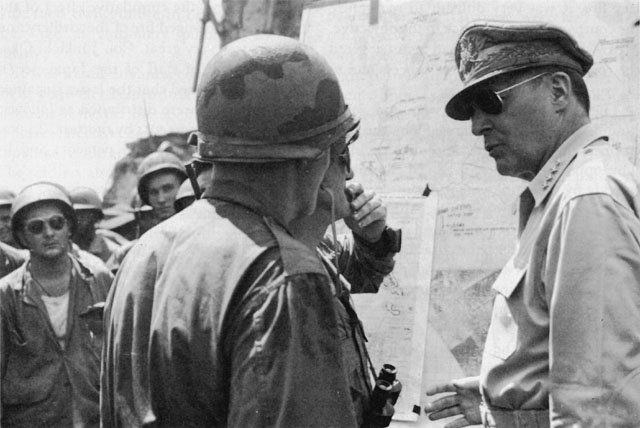
GENERAL MacARTHUR AND MAJ. GEN. ARCHIBALD V. ARNOLD at Headquarters, 7th Division.
Frontal assaults were usually employed against enemy positions, and not enough use was made of envelopments. When envelopments were tried they were nearly always successful. It was sometimes advantageous to bypass isolated enemy strong points, leaving them to be mopped up by the follow-up units.
Although the primary mission of the infantry is to close with the enemy and destroy or capture him, the natural reluctance of American infantrymen to engage the enemy in close quarters had to be overcome. There were several instances in which the American attacking force felt out the Japanese position and then sat back to wait it out. In one area no progress was made for four days. On several occasions strong combat patrols of platoon or company strength were sent to feel out enemy positions, but as soon as they made contact with the Japanese the patrols withdrew. They accomplished nothing except to determine the presence of an unknown number of enemy soldiers.
If more than minor resistance was encountered, the troops frequently fell back and called for fire from supporting weapons. On one occasion a company called for artillery fire upon a roadblock and then withdrew 350 yards while the concentration was delivered. After the lifting of the artillery fire, it was very difficult to reorganize the company and get it back to the objective. Meanwhile the Japanese had again covered the roadblock and the whole process had to be repeated.
The American soldiers were too road-bound. Sometimes resistance along the road stopped the advance of an entire division. This opposition could have been eliminated quickly by the employment of simple envelopments and flanking attacks. Although the presence of swamps, jungle, and rice paddies tended to channelize the attack, the Japanese had displayed superior adeptness, and willingness to go into the swamps and stay there until rooted out.
The standard employment of artillery in close support of the infantry again proved to be very effective and was used extensively. However, since the artillery fire enabled the infantry to secure many heavily fortified positions with few casualties, the infantrymen tended to become too dependent upon the artillerymen and expected them to do the work of the infantry. General Krueger insisted that the infantry must be prepared to close in immediately after the cessation of the artillery fire.
The Americans had developed a strong tendency to telegraph their punches. In the morning, before an assault by the infantry, the artillery pounded the Japanese positions, after which the mortars opened up. The mortar fire nearly always lasted for a half hour, and then the infantry moved out. Upon occasion, the infantry did not attack immediately after the preparation by the supporting weapons. This delay gave the Japanese time and opportunity to regroup and consolidate their forces, and thus nullified the effects of the preparatory fires.
The employment of tanks singly, or in small groups, materially aided the infantrymen, since the tanks could be used effectively to reduce enemy pillboxes and to flush out bamboo thickets. Although light tanks were more mobile it was found that the mediums were more efficient in reducing pillboxes. For successful employment, it was necessary that the tanks have close infantry and engineer support. In some instances the tanks secured objectives when no infantrymen were present to consolidate and hold the positions. For example, a regiment supported by a tank battalion received orders to attack and secure an objective. The tanks quickly moved out and secured the objective with little resistance. Since the infantrymen did not arrive during the day, the tanks withdrew at nightfall. During the night the Japanese mined the area and four of the tanks were lost when they returned next morning.
Likewise, tanks were often disabled because the engineers had failed to remove mines and give support in the crossing of streams. In one case, the engineers failed to repair a bridge, which collapsed after three tanks had crossed over it. The Japanese completely destroyed one of the tanks and disabled the other two. It was necessary for the Americans to destroy the disabled tanks with their own gunfire in order to prevent their use as stationary pillboxes by the enemy.
Although there were three war-dog platoons available for the Leyte operation, their combat value was practically nil. The unit commanders to whom they were attached knew little of their capabilities or limitations. Some expected the dogs to spot a Japanese position exactly at a distance of 200 or more yards. One unit took the dogs on a four-day patrol without sufficient dog rations. Another unit attempted to use dogs in a populated area; the presence of so many civilians thoroughly confused the dogs.
Welfare of the Men
At the same time, in order to obtain the best results from the troops, the unit commanders must concern themselves with the well-being and comfort of their men. Many commanders were indifferent to such matters. One corps, for example, had sufficient rations of all types available, but the meals served the men were poorly prepared and monotonous. Another corps, at the time it landed, was prepared to live indefinitely on field rations. As late as ten days after the landing, no unit—not even any of the fixed installations, including higher headquarters—operated a mess or served hot meals. Some units did serve hot coffee after the first few days.
Weapons and Vehicles
The basic weapons—the U.S. .30-caliber rifle Model 1903, the U.S. .30-caliber rifle M1, the BAR, bayonets, and grenades—with which the rifle squads and the individual soldiers of the heavy weapons company were equipped were generally satisfactory and notably superior to comparable weapons of the Japanese.
The Browning automatic rifle was very popular, the best results being obtained when two were allotted to a squad. The increased fire power thus obtained was very effective in night defense.
The 81-mm. mortar continued to be highly esteemed as a close support infantry weapon. The 4.2-inch chemical mortars of the attached chemical mortar battalions were extensively employed, affording excellent results when emplaced on firm ground. On marshy or swampy ground, however, their base plates would sink and cause inaccurate firing or put the weapons out of commission. The most popular mortar was the 60-mm., which was very mobile and especially suitable for use in close terrain. This mortar fired an illuminating shell which was used constantly for night defense, but its base plate also tended to sink into the ground.
The 7th Division found the 75-mm. self-propelled howitzer, because of its superior mobility, to be the most effective infantry weapon for reduction of Japanese pillboxes. The 105-mm. howitzers of the field artillery battalions again proved their worth by the speed, accuracy, and effectiveness of their fire. The greater striking range of the 155-mm. howitzer had special value for general support missions.
The 37-mm. gun was an antitank weapon only occasionally employed by the 7th Division because there were few Japanese armored vehicles against which to use it. The excessive difficulty of manhandling it into a position from which fire could be delivered against Japanese pillboxes and machine guns rendered it ineffective for that purpose. The 90-mm. guns of the antiaircraft artillery had a considerable number of erratic bursts because of corroded fuzes and worn fuze setting lugs.
The cargo carrier M29 (weasel) proved to be a most useful supply vehicle. The commanders used it for reconnaissance and visits to units in isolated areas and over roads that were impassable to wheeled vehicles. It also was employed to carry supplies and to evacuate the wounded from inaccessible areas. The weasel was much less destructive of roads than any of the other tracked vehicles, but the tendency to use it on dry roads resulted in worn-out tracks and excessive maintenance requirements.
Intelligence
General Krueger pointed out that prompt, aggressive reconnaissance should have been instituted immediately upon the landing of the troops. The fact that knowledge of the terrain was very limited before the assault—inaccuracies in the distances on existing maps were as high as 50 percent—gave urgency to the need for immediate reconnaissance.
The sources of information on the Japanese were as follows: ground and aerial reconnaissance, Filipino civilians, guerrillas, captured documents, and prisoners. Air observation was of limited value because of the Japanese ability at camouflage and because the inclement weather prevented aerial observation of many areas. The tendency of the Filipinos to say “yes” to everything was also a handicap. In general, the guerrilla reports were more accurate than those of civilians. Considerable information was obtained from patrols, which were especially valuable for on-the-spot intelligence.
In interrogating prisoners the best results were obtained by employing Nisei, who obtained more information from prisoners when the latter were not subjected to questioning by an officer through an interpreter. Since most of the prisoners had been separated from their units for a considerable time and were seriously wounded, their information was sparse and generally out of date.
Captured documents were the most fruitful source of intelligence. Although the Japanese made a few attempts to destroy dog tags and other means of identification before going into battle, they were not too successful. The fact that General Krueger obtained information on the proposed ground offensive of the Japanese for the middle of November from papers found on the body of a Japanese officer was not an isolated incident. Many officers carried on their persons sets of orders and maps.
The Japanese received much of their information on the American order of battle from broadcasts emanating from San Francisco. At first, the Japanese on the island were unable to find out the American order of battle for Leyte but within a few days the Americans gratuitously furnished them the information. Said General Tomochika:
Japanese Warfare
The Japanese employed reverse slope defense tactics with much skill and were successful in utilizing terrain for their defensive positions. Caves and other natural formations were exploited to the limit and positions were dug in deeply and expertly camouflaged. The Japanese frequently sacrificed fields of fire for cover and concealment, a fact which made it very difficult for the Americans to locate hostile positions.
Captured documents indicated that the Japanese attacks were generally well conceived but that there were not enough troops at the time of the assault. The documents also gave repeated indications that units either did not receive their orders or did not reach the appointed place on time. The Japanese employed two main types of attack. The first, which was similar to that employed by the Americans, utilized a base of fire from supporting weapons, followed by infantry fire and movement. This type of attack was not usually accompanied by artillery or mortar support. The other method consisted of a localized charge in which the Japanese by sheer force of numbers tried to crack the American lines. The heavy weapons fire of the Americans was nearly always able to break up both types of attack. Enemy forces, generally in small numbers, tried repeatedly to infiltrate through the American lines. The objectives were artillery pieces, supply dumps, and key installations. Rarely did they accomplish even minor damage.
Artillery weapons were seldom used by the Japanese to maximum effect. The gunnery techniques were “remarkably undeveloped” and inefficient, the pieces being used singly or in pairs and only rarely as batteries. Their fire was never massed. The gun positions generally were well constructed but they were frequently selected with such high regard for concealment that the fields of fire were limited. The use of mines and demolition charges was poor, the mine fields being hastily and obviously laid.