Chapter XX · Seizure of Ormoc Valley
Reading edition
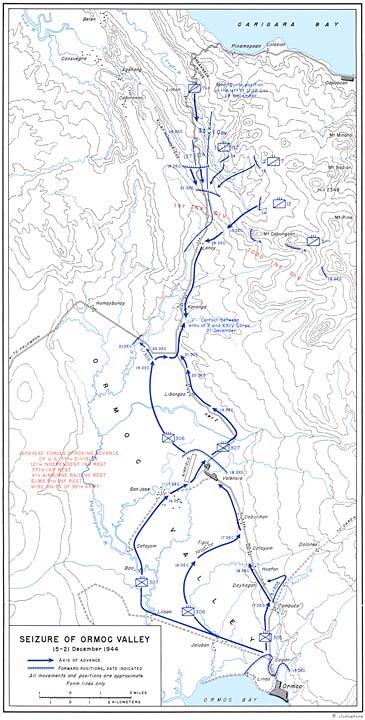
MAP 23 R. Johnstone
SEIZURE OF ORMOC VALLEY
15–21 December 1944
Drive From the South to the Libongao Area
Seizure of the Road Junction
According to its plan of attack for 16 December the 305th Infantry, from the vicinity of Cogon, was to continue its assault north on Highway 2, liquidate the remaining enemy forces in Cogon, and finally secure a large defensive position centered around the road junction north of Cogon. All three battalions of the regiment were to consolidate around the point while the 306th and 307th Infantry Regiments were to drive toward Valencia.
The Cannon and Antitank Companies and the heavy weapons units of the other two regiments were attached to the 305th Infantry for movement only and were to be used solely in case of emergency. These units were to be sent to the 306th and 307th Infantry Regiments upon call by those regiments.
At 0930 on 16 December the assault units of the 305th Infantry moved out. The 1st Battalion, on the left of Highway 2, was to attack north, and the 3d Battalion, on the right of Highway 2, was to attack north and then northeast to effect a juncture with the 1st and 2d Battalions at the road junction north of Cogon. The 2d Battalion was to attack east to flank the enemy positions along the highway. The operation was to be assisted by artillery.
Envelopment of Valencia
The 14th Area Army had planned to reinforce the 35th Army by dispatching the Takahashi Detachment, which consisted of the 5th Infantry Regiment, one artillery battalion, and one engineer company and one transport company each from the 8th Division, together with the Ito Naval Landing Force of 400 troops from Luzon.
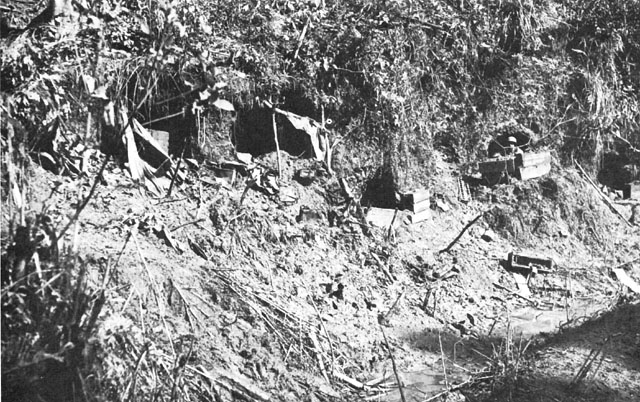
JAPANESE DUG-IN POSITIONS ALONG HIGHWAY BANKS delayed the advance of the 77th Division north of Ormoc.
The 305th Infantry was to drive rapidly north on Highway 2 and clear out the Japanese for a distance of 200 to 300 yards on each side of the road, even though it might mean bypassing groups of the enemy on the flanks. A patrol from the regiment was to operate east of its sector to locate enemy forces. The 306th Infantry was to drive rapidly east toward Highway 2 and then advance north up the highway, clearing a lane 200 to 300 yards wide. At a point 500 to 600 yards north of Cabulihan, it was to await further orders. The regiment was to be prepared to send a battalion south to assist the 305th Infantry in its advance.
General Bruce organized an armored column to carry rations and ammunition to the 306th and 307th Infantry Regiments. This column, which was to move north on Highway 2, consisted of five light tanks from the 7th Division, the Cannon and Tank Destroyer Companies of the 306th and 307th Infantry Regiments, part of Company C, 302d Engineer Battalion, a platoon from the 305th Infantry, and sufficient LVT’s to carry men and supplies. An artillery observer accompanied the column.
General Bruce had ordered the 307th Infantry to remain in San Jose until further notice. Since the guerrilla forces had reported a large number of Japanese in the area, General Bruce had made arrangements to soften the sector with an aerial bombardment and artillery fire before the infantry attack. In response to Bruce’s request, fifteen P-40’s from the V Fighter Command had been made available by General Whitehead for an air strike against the Valencia area.
On the morning of 18 December, since supplies and ammunition for the 306th and 307th Infantry Regiments were becoming dangerously low, General Bruce pushed the armored column vigorously forward through the 305th Infantry. The column swept past enemy strong points and succeeded in bringing supplies to both regiments.
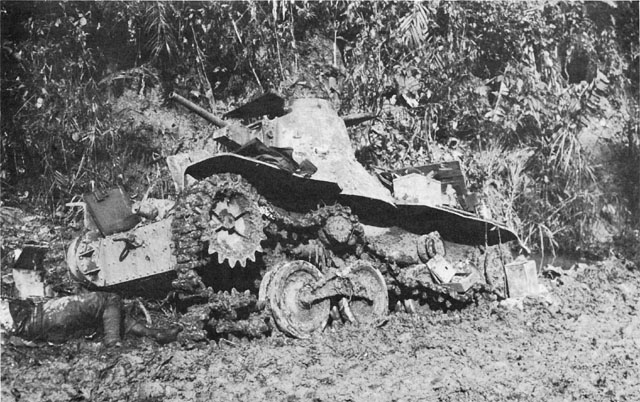
JAPANESE LIGHT TANK destroyed during the fighting along Highway 2. Note dugouts in the sides of banks behind the tank.
At 0830 on 18 December the 306th Infantry renewed its attack. At first the 2d Battalion moved south astride Highway 2 in order to make contact with the 305th Infantry, which was pushing north along the highway, but since there was little resistance the battalion withdrew and rejoined the regiment. As the rest of the regiment continued north it met moderate opposition but pushed ahead steadily. The troops encountered many strong points along the road but no organized main line of resistance.
In three days of relatively fast fighting and maneuvering the 77th Division had shaken the Japanese forces badly and disrupted the plans of General Suzuki. The 307th Infantry, by making a wide envelopment of the west flank, had captured Valencia and its airfield, and the 306th Infantry, making a smaller envelopment, had bisected Highway 2 at Cabulihan while the 305th Infantry moved up the highway from Cogon. All of southern Ormoc Valley from Ormoc to Valencia, a distance of about six and a half miles as the crow flies, was securely in American hands. All units were in contact and ready for the next phase of their mission.
Drive to Palompon Road Junction
The 1st Battalion pushed steadily forward and reached the eastern banks of the Togbong River at the bridge crossing, the bridge itself having been destroyed by the enemy. From a commanding ridge upon the western banks of the river, just north of the bridge site, a Japanese force estimated to be a battalion in strength opposed any further advance. The company on the left forced a passage across the river south of the bridge site, but the company on the right, despite repeated attempts, was unable to cross the river. At 1630 the 1st Battalion received orders to take up a night defensive position on the eastern banks of the river. During the night the enemy unsuccessfully launched three counterattacks against the 1st Battalion. In the morning the battalion counted more than 400 Japanese dead around its position.
The 3d Battalion, 306th Infantry, upon reaching the Palompon road turned east and encountered steadily increasing enemy opposition. By 1500, however, Company K reached the road junction. At the same time the 3d Battalion received orders to withdraw west 300 yards so that the 307th Infantry could register unrestricted fire to its front. This withdrawal was carried out and the 3d and 2d Battalions of the 306th Infantry established night positions 300 yards west of the road junction.
During the night of 20–21 December the 77th Division artillery expended half a unit of fire, intermittently bombarding enemy positions west of the 77th Division and to the east of Highway 2. The bombardment was the most intensive made by the 77th Division during the campaign. Just before renewal of the attack on 21 December, the artillery delivered a concentrated thirty-minute preparation. General Bruce ordered the 306th Infantry to move out at 0630. Since the 1st Battalion was short of ammunition, it was to await the arrival of Company E, which had been attached to the battalion, with additional ammunition. At 1250, having received the ammunition, the battalion moved out and at 1330 secured the ridge (overlooking the bridge site), which had blocked its advance the previous day.
The 77th Division had reached the Palompon road. In its drive north the division had destroyed the major elements of the 5th and 77th Infantry Regiments and the 4th Airborne Regiment.
The 32d Division Resumes the Offensive
For the next few days the regiments of the 32d Division fought valiantly against a foe that limited the division’s advance to a few score yards a day. Of the many acts of individual bravery, those of Pfc. Dick J. Vlug and Sgt. Leroy Johnson were outstanding. Private Vlug single-handedly destroyed five enemy tanks that were moving north along the highway. Sergeant Johnson threw himself upon an enemy grenade that killed him but did not hurt those comrades near him. Both men were awarded the Medal of Honor.
On the morning of 17 December advance elements of the 126th Infantry were about 4,000 yards south of Limon. After a preparation of heavy mortar fire the 1st Battalion moved out at 0730, encountering about a platoon of the enemy on a knoll 300 yards east of the road. A bitter fire fight broke out and continued throughout the day. The battalion was unable to advance farther and set up a night perimeter. During the fight the 1st Battalion captured four enemy machine guns.
In the zone of the 2d Battalion, east of the highway, all the battalion’s mortars, machine guns, and 37-mm. guns, together with four medium tanks, massed their combined fires on the enemy positions to the front. These positions consisted of numerous foxholes, pillboxes of coconut logs, and L-shaped fortifications dug into the mountain sides. A rain of steel descended upon the Japanese on the high ground directly east of the battalion. This preparatory fire had excellent results and the 2d Battalion, after moving out at 1100, quickly secured the ridge and consolidated its position. It captured three 47-mm. antitank guns, three 75-mm. mountain guns, and two 70-mm. battalion guns. About 150 of the enemy were killed by the preparatory fire and the battalion attack.
By the following morning, 18 December, the 126th Infantry was on a line that extended east of Highway 2. To the front of the regiment, elements of the 1st Division occupied three positions on an east-west line approximately 800 yards in length and extending across Highway 2. There were actually three ridges along this line. The first ran north and south beside the road, and on it was located the western position of the enemy. From this site the Japanese were able to roll hand grenades down on the road. About 200 yards to the east was another strongly fortified north-south ridge, east of which was a small valley with a banana grove. Still farther east was a small knoll upon which was located a strong enemy defensive position. An estimated two reinforced enemy companies, well supported by automatic weapons and well dug in, occupied this position. The whole area was covered with a dense rain forest, and it was impossible to spot any Japanese fortified position more than thirty yards away.
On the morning of 19 December the 126th Infantry followed the same procedure that had been used the previous day. A heavy machine gun and mortar concentration was placed upon the Japanese positions on the crest of a ridge fifty yards to the front. At 1100 the 126th Infantry moved out with battalions abreast, the 1st Battalion on the right and the 2d on the left. Six heavy machine guns immediately fired on the left flank of the 1st Battalion. The battalion withdrew and placed a concentration of more than 200 rounds of mortar fire on the position while its machine guns raked the Japanese force “fore and aft.” The troops then renewed the assault but the Japanese continued to resist. Elements of the 1st Division had dug in on the top and both sides of a ridge and had utilized caves to construct a defensive position in which there were more than 100 foxholes with communicating trenches. Heavy fighting continued throughout the day. The 1st Battalion used mortars, flame throwers, white phosphorus grenades, hand grenades, rifles, and supporting flanking fire from its heavy and light machine guns, but was able to advance only seventy-five yards. Although the battalion overran many emplacements, a determined Japanese force remained to be overcome when the battalion established its night perimeter on the eastern slope of the ridge.
The 2d Battalion, 126th Infantry, encountered only scattered rifle fire that came principally from the enemy position on its right flank. During its advance the battalion delivered flanking machine gun and rifle fire in support of the 1st Battalion on its right. By 1200 the 2d Battalion had advanced 200 yards and secured the area in its zone of action. At 1530 the 1st Squadron, 112th Cavalry, which had been protecting the eastern flank of the 32d Division, relieved the 2d Battalion, which withdrew to an assembly area in the rear.
During the night of 19–20 December, the commanding officer of Company B, 126th Infantry, which had borne the brunt of the enemy resistance, placed one platoon of the company along the eastern side of the ridge and another platoon on the western side. At the same time he continued the pressure from the south. Throughout the night the company kept firing at known enemy positions and the sector in general. The company commander also required each of his men to throw hand grenades periodically. At first light and without any breakfast the troops rushed the enemy position. The Japanese had lost the power to resist and by 1000 the company had taken the last of the three enemy positions. Two hundred Japanese dead were counted in the area.
Debouchment From the Mountains
The 112th Cavalry Regimental Combat Team had moved south on the eastern flank of the 32d Division. The 1st Squadron of the 112th Cavalry had been able to keep pace with the 32d Division, but the 2d Squadron had encountered a very strong enemy force on a ridge overlooking the Leyte River south of Limon. The Japanese resisted all the squadron’s efforts to dislodge them. The 2d Squadron, 7th Cavalry, relieved the 2d Squadron, 112th Cavalry, and on 14 December it had succeeded in overcoming the Japanese and had seized the ridge.
Spearhead of the Assault
Lonoy
At 2235, on 18 December, the 12th Cavalry received orders to move out the following morning, seize Lonoy, and be prepared to seize Kananga. The commanding officer of the regiment decided to have the 1st and 2d Squadrons move out abreast with the 2d Squadron on the left. During the entire night the artillery was to deliver harassing fire on the highway north of Lonoy and on the area between the routes of approach of the two squadrons.
After a preparation on 19 December, the 1st and 2d Squadrons moved out at 0800. The 1st Squadron met only light, sporadic resistance. The troops observed many Japanese proceeding north along the highway and had mortar and artillery fires placed upon them. At 1200, the 1st Squadron seized Lonoy, captured much enemy equipment, and destroyed many supply dumps. The 1st Squadron moved to assist the 2d Squadron in the capture of a knoll southeast of the barrio. The 1st Squadron closed on the knoll about 1400, and aided the assault of the 2d Squadron by fire and by sending a troop east to assist it.
The 2d Squadron jumped off on schedule but at 0930, when it was 800 yards short of its objective, the squadron came under heavy rifle and machine gun fire from the thick woods. The 271st Field Artillery Battalion placed fire on the area and a great many of the enemy were killed, the remainder fleeing south. The squadron received additional machine gun fire from the north but a patrol quickly silenced it. In the meantime the mortar platoon from Troop D, in support of the 1st Squadron, fired upon Lonoy. The Japanese immediately responded with fire from a 105-mm. gun, which they had cleverly concealed in the gap between the two squadrons and about 600 yards from the regimental observation post at which the gun directed its fire. The enemy gun killed one man and wounded fifteen others of the command-post group. The heavy machine guns from the Weapons troop and the artillery from the 271st Field Artillery Battalion began concentrating their fires upon the enemy gun. The Antitank Platoon was sent out to destroy the gun and its crew. Following the machine gun and artillery fire, the enemy gun was silent for about half an hour. It then suddenly opened up against the 2d Squadron at a range of about 300 yards. The enemy fire resulted in tree bursts which killed five men and wounded fifteen others. Troop G, which suffered the most casualties, and the Antitank Platoon immediately turned and attacked to the north to destroy the gun. The 2d Squadron, less Troop G, renewed the attack towards Lonoy, receiving scattered rifle fire. At 1730 it reached Lonoy and was in contact with the 1st Squadron.
Late that night the regimental commander ordered the 2d and 1st Squadrons of the 12th Cavalry to move south on the morning of 20 December along Highway 2 in a column of squadrons, with the 2d Squadron in the lead. During the night, in preparation for this advance, the 271st Field Artillery Battalion fired 1,096 rounds on Kananga, on the road north of Lonoy, and on sectors occupied by the enemy artillery. This fire destroyed the enemy 105-mm. gun.
At 0715 on the morning of 20 December the 2d Squadron, less Troop G, moved out and immediately came under heavy fire from enemy forces that had dug in underneath houses and behind small pieces of cover along the road. The squadron eliminated these pockets of resistance by direct fire and by flanking movements on both sides of the highway. At 1200 the 2d Squadron forced the Japanese off a ridge which was just east of the highway and about 500 yards north of Kananga. The squadron then encountered heavy rifle and machine gun fire that came from a coconut grove and some houses about 200 yards south of the ridge.
In the meantime, the 1st Squadron, at 0830, moved south to support the attack of the 2d Squadron. At about 1230, the 1st Squadron arrived behind the ridge occupied by the 2d Squadron and then continued south, at 1500, seizing and completely dominating a ridge about fifty yards east of Kananga. The 2d Squadron and a platoon from the 1st Squadron attacked north, parallel to the highway, and by nightfall cleaned out the coconut grove and set up a night perimeter.
General Mudge, commanding general of the 1st Cavalry Division, said of the 12th Cavalry:
During the night General Mudge ordered the 12th Cavalry to move out at 0800 21 December, seize Kananga, and then make physical contact with the 77th Division, which was pushing north from Libongao. He attached the 1st Squadron, 5th Cavalry, to the 12th Cavalry.
Juncture of Forces
On the morning of 21 December the 1st and 2d Squadrons of the 12th Cavalry, supported by the 271st Field Artillery Battalion, moved out in a co-ordinated assault against Kananga. The 1st Squadron attacked from the north while the 2d Squadron drove in from the ridge on the east. The first elements of the regiment reached Kananga at 1157 and by 1425 the 12th Cavalry was in the town. The regiment methodically cleared out every hut, ferreted out each Japanese, and destroyed every installation. While the mopping up was going on, patrols from the 12th Cavalry pushed to the south to make contact with the 77th Division.
The regimental commander ordered the commander of the 3d Battalion, 306th Infantry, to push east at 0730 on 21 December along the Palompon road to the juncture of the road with Highway 2 and then turn north for 1,000 yards and attempt to establish contact with the 1st Cavalry Division. The 3d Battalion moved out on time, and within fifteen minutes reached the road junction and turned north. The battalion had gone only 200 yards north when its left-flank company came under intense fire from a ridge overlooking the road. The 2d Battalion complied with orders from the regimental commander to “put out something” on the 3d Battalion’s left flank and sent out one rifle company to envelop the enemy position. This move relieved the pressure to some extent but the advance was still slow and costly.
In the meantime, the 307th Infantry reached the road junction at 0800, having advanced without incident. With the slowing up of the 306th Infantry, General Bruce ordered the commander of the 307th Infantry Regiment to send forward additional troops. The 2d Battalion, 307th Infantry, and the Cannon and Antitank Companies of the regiment were sent to the front to reinforce the 306th Infantry. This maneuver was successful and the attacking forces pushed forward.
The Ormoc Valley, in which the Japanese had so tenaciously resisted the American advance, was now securely in the hands of the Sixth Army. The northern and southern prongs of the trap had closed. There remained only Palompon as an exit for the Japanese forces. To the securing of that port, the X and XXIV Corps, acting in concert, could concentrate their main efforts. Plans had been readied. The Sixth Army was poised in a position from which it could drive westward to the sea and bring the Leyte campaign to a successful conclusion.