Chapter X · Northern Leyte Valley: Part Two
Reading edition
Drive up Leyte Valley
The 34th Infantry Advances Into the Valley
Highway 2 was a one-lane all-weather road, twelve feet wide with four-foot shoulders. It had a crushed rock and gravel surface. In general it ran through level ground, with occasional groves of light timber, bamboo, and abaca. Much of the area was under cultivation. At Santa Fe a one-lane all-weather branch road ran four miles south to Pastrana, at which point a seasonal one-lane road ran southward for about five miles to Dagami and another northwest for about eight and a half miles to Jaro.
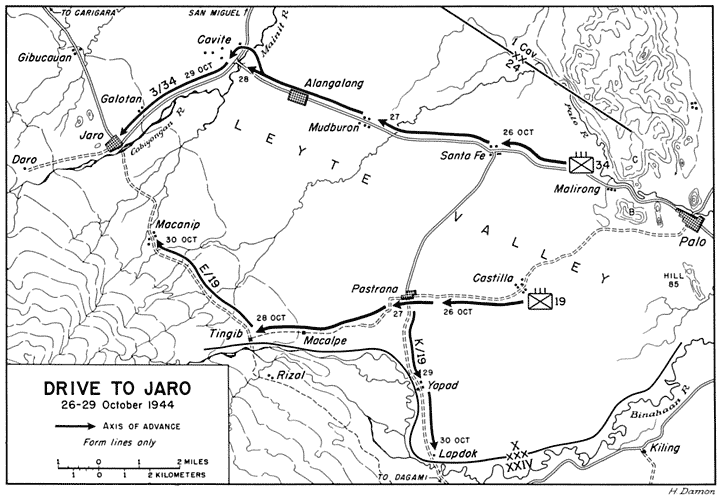
MAP 11 H. Damon
DRIVE TO JARO
26–29 October 1944
Mainit River Bridge
The 1st Battalion moved to the water’s edge, where it was pinned down by enemy fire. Companies E and F of the 2d Battalion, however, were able to push north 500 yards through the heavy brush, and amid a driving rain they managed to ford the river unobserved. Once on the other side they charged the entrenchments of the 41st Infantry Regiment on the river, with Company F in the lead. As Company F neared the bridge it overran three mortar positions without stopping but was finally halted by heavy machine gun fire. After the company’s 60-mm. mortar had knocked out the machine gun, the unit continued to advance and passed the bridgehead before it ran out of ammunition. Company E then relieved Company F, while the latter set up heavy machine guns to silence enemy machine guns in the woods to the west. By 1500 the bridge was in American hands. The Japanese had placed a demolition charge on the bridge, but the American advance had been so swift that the enemy never had an opportunity to set off the charge.
The 3d Battalion had meanwhile moved up to the rear of the other two battalions and established contact south of Santa Fe with the 19th Infantry, which was protecting the southern flank of the division.
Seizure of Pastrana
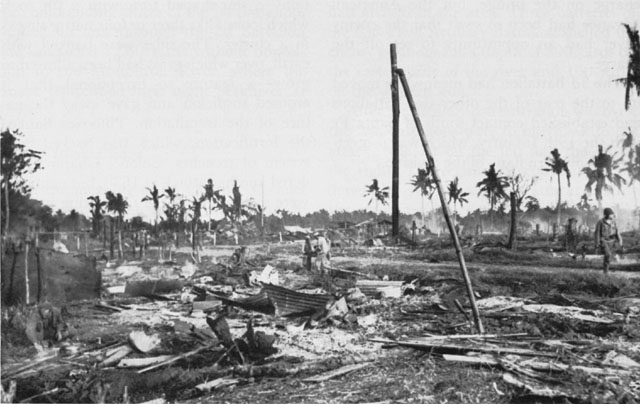
PASTRANA was left a mass of smoldering ruins after the shelling of 26–27 October.
Fall of Jaro
At the crossing of the Mainit River, a one-lane all-weather branch road runs southwest for about three and a half miles to Jaro, and then northwest along the western edge of Leyte Valley for about ten and a half miles to Carigara on the north coast. At Jaro many dirt roads and trails branch out in all directions.
The drive of the 24th Division toward Carigara was continued as the 34th Infantry, protected by the 19th Infantry on its flank, moved toward Jaro. After the seizure of the Mainit River bridge, two tanks of the 1st Platoon, 603d Tank Company, attached to the 34th Infantry, scouted north and made contact with forward elements of the 2d Squadron of the 8th Cavalry, which had arrived in the San Miguel area.
By this time the 19th Infantry had gained control of the area south and east of Jaro. Junction between the 34th Infantry and 19th Infantry was accomplished on 31 October when the 1st Battalion, 19th Infantry, moved into Jaro. Other elements of the 19th Infantry were engaged in mopping up in the Pastrana sector. The 19th and 34th Infantry Regiments had been able to advance rapidly in their drives through Leyte Valley, had maintained contact with the 1st Cavalry Division, and had arrived within ten miles of Carigara Bay.
The American advance had been so rapid that General Suzuki did not have sufficient time to put into effect his plan for making Jaro the assembly ground for the 35th Army. He was forced to use the Carigara area as the new point of rendezvous for his troops. On the evening of 28 October Colonel Newman planned his attack for the remaining distance to Carigara. He hoped that the troops would make a swift passage, but later events proved that the Japanese intended to contest the advance bitterly.
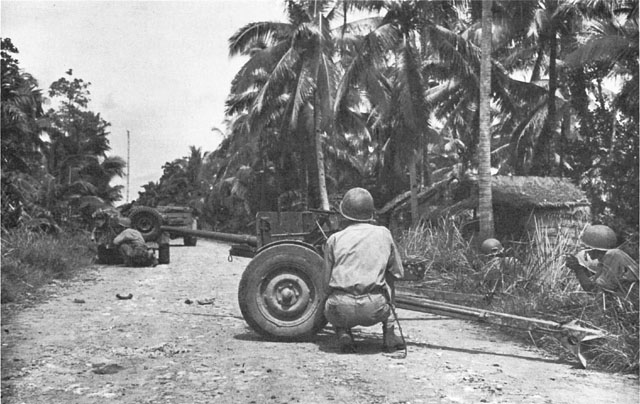
U.S. ANTITANK PLATOON under enemy fire at Jaro. Soldier in foreground is taking cover behind a 37-mm. antitank gun M3.
Drive From the North
Drive to Tunga
On 29 October the Japanese had prepared new plans for the defense of Leyte. (See Map 2) In order to simplify planning, the 35th Army headquarters was relieved of command responsibility for Samar by the 14th Area Army. Almost simultaneously, the 35th Army received the erroneous report that the Japanese naval forces had destroyed a large part of the U. S. Navy on 24 and 25 October in engagements off Leyte and that the losses would prevent the Americans from continuing the operation. On the contrary, the American naval forces had secured a decisive victory. The Japanese reverse seriously affected General Suzuki’s attempt to put his new plans for the 35th Army into effect.
On the night of 29 October the 34th Infantry had captured Jaro and was about ten miles from Carigara along the Jaro-Carigara highway. (Map 12) At 0800 on 30 October Colonel Newman ordered the 3d Battalion of the 34th Infantry to start for Carigara down the highway. As the battalion left the outskirts of Jaro, with Company L in the lead, it came under fire from Japanese who were dug in under shacks along the road. Upon a call from the commanding officer of Company L, the tanks came up in a column, fired under the shacks, and then retired. The leading platoon was drawn back so that artillery fire might be placed on the Japanese, but the enemy could not be located precisely enough to use the artillery. Colonel Newman then ordered a cautious movement forward without artillery support, a squad placed on each side of the road and two tanks in the center. The squads had advanced only fifty yards when Japanese fire again pinned them down.
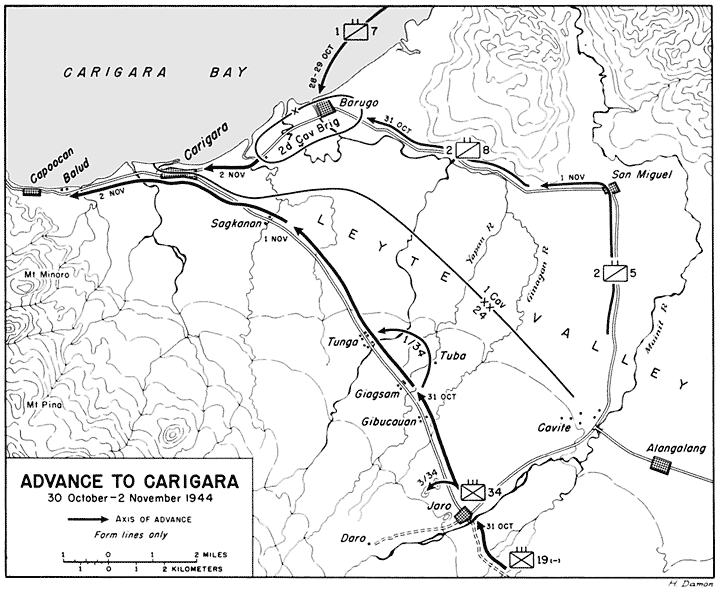
MAP 12 H. Damon
ADVANCE TO CARIGARA
30 October–2 November 1944
The artillery concentrated its fire on the area to the front, and at 1230 the 3d Battalion renewed the attack with Company K on the left of the road and Company I on the right. After the troops had proceeded about 200 yards, heavy artillery, machine gun, mortar, and rifle fire pinned them down. Company L in the rear thereupon attempted a flanking movement to the left across an open field but came under heavy fire from a ridge that commanded the road. All the companies were forced to pull back. At the end of the day’s action, the forward elements were still on the outskirts of Jaro.
At 0820 the 3d Battalion, 34th Infantry, supported by the 2d Battalion, attacked along the Jaro-Carigara highway. Company L went down the highway and then to the rear of the hill from which it had been repulsed the previous day; Company I moved forward astride the road; and Company K was in reserve. As advanced elements of Company I reached a stream, they came under intense fire but moved to a position from which they could attack the reverse slope of the hill. Other elements of the company moved off the road to the top of the hill. When they pushed westward along the crest they discovered another hill behind it.
In the meantime the troops that had attacked the reverse slope came under intense fire from the second hill. Concentrated fire was laid on the second hill and a heavy machine gun was sent to the top of the first. Company I, protected by the fire, was thus able to assault and take the first hill. Company K, the reserve company, thereupon occupied the hill. These assaults drove the enemy into Company L, which was at the foot of the hill. A determined three-hour fight followed, and, although at one time elements of the company were driven across the highway, the company retaliated and eventually cleared the area of Japanese.
While this fight was going on the 2d Battalion, with Company E as the point, moved along the highway toward Tunga. At 1130 the Japanese opened fire on Company E at the Ginagan River. Tanks, which had been brought up, fired with machine guns at the enemy positions on the left of the road. The Japanese retaliated with mortar and artillery fire, pinning down an antitank gun crew and Company E’s mortar section. The artillery fired a concentration on the Japanese positions and the advance was able to continue.
At 1430 the enemy reopened fire on the 2d Battalion at the Yapan River. Company G was in the lead, with the 2d Platoon on the left of the road and the 3d Platoon on the right. Company E was on Company G’s left flank. With all the troops in a skirmish line, the 2d Battalion, with tanks, moved down the road to attack. When Company G came under fire the tanks went to its assistance, and the Japanese then concentrated their fire on the armor.
Meanwhile Company E pushed down the left side of the road but was halted by fire from an enemy pillbox on a knoll. A self-propelled 105-mm. howitzer was brought up, and fire from this weapon completely disorganized the Japanese and forced them to desert their position. When the howitzer had exhausted its ammunition, another was brought up to replace it. By this time, however, the enemy’s artillery was registering on the spot and the second was disabled before it could fire a shot.
Elements of the 41st Infantry Regiment, protected by artillery, gathered in front of Company E and emplaced machine guns in a position from which they could enfilade the company. Thereupon Company E committed its reserve platoon to its left flank but shortly afterward received orders to protect the disabled howitzer and dig in for the night. A tank was sent up to cover the establishment of the night perimeter. Company G received orders to fall back and dig in for the night, and upon its withdrawal the Japanese concentrated their fire on Company E. Although badly shaken, Company E held on and protected the howitzer. A tank was sent forward to tow the weapon, but since it was untowable because of broken treads the crew sent a shell through it to prevent its use by the enemy. Company E then disengaged and fell back through Company F, as Company G had done.
Under the protective cover of night, the 41st Infantry Regiment retreated.
In accordance with this order, Companies A and B, 34th Infantry, were sent at 0820 to make a wide flanking movement eastward to Tuba and then strike at Tunga from the northeast. At 0900, after patrols had reported no enemy contact, the 2d Battalion moved on down the Jaro-Carigara highway.
On the previous day the regimental headquarters had moved into Jaro. It had been a bloody road to Carigara, but the 24th Division was knocking at the back door for admittance as the 1st Cavalry Division on the north was demanding entrance at the front door.
Capture of Carigara
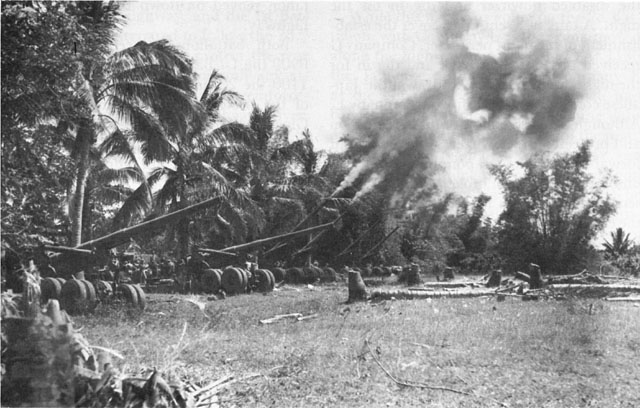
155-MM. GUNS FIRING ON CARIGARA
Plans of X Corps
Seizure of Carigara
By 0900 the 1st Battalion, 34th Infantry, reached a small bridge at the outskirts of Carigara and awaited word from the 1st Cavalry Division. After a wait of one and a half hours, patrols were sent into the western portion of Carigara, but they reported no enemy contact. All was quiet and the town deserted. The battalion then skirted Carigara and proceeded along the coast toward Capoocan. It encountered difficulty in crossing the Carigara River, since the bridge had been destroyed, but was able to get as far as Balud, where it set up a night perimeter after being halted by enemy fire. The 2d Battalion moved to the Carigara River, where it dug in for the night and was rejoined there by G Company. The 3d Battalion set up its perimeter just behind the 2d, and the regimental headquarters of the 34th Infantry was set up in Carigara.
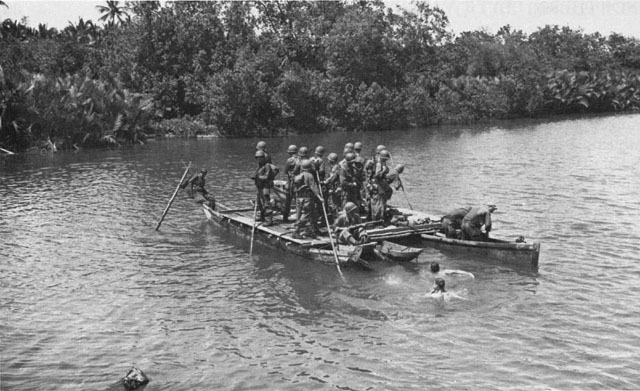
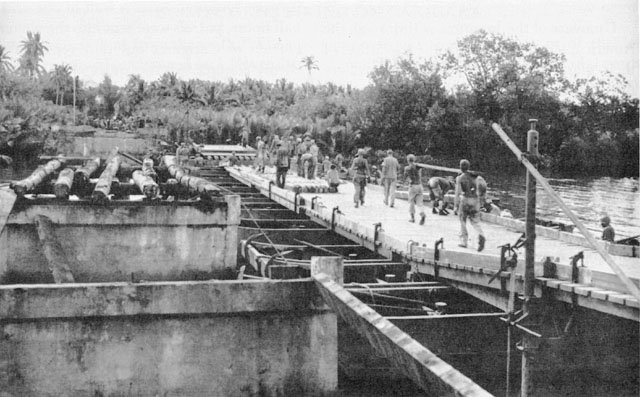
U.S. PATROL CROSSING THE CANOMONTAG RIVER (above). Engineer troops replacing a Capoocan River bridge blown up by retreating Japanese.
In the advance through northern Leyte Valley the 24th Division had lost 210 killed, 859 wounded, and 6 missing in action, but it had killed an estimated 2,970 Japanese and taken 13 prisoners.
With the capture of Carigara, the second phase of General Krueger’s plan for the liberation of Leyte was completed. Panaon and San Juanico Straits, respectively south and north of the island, had been seized. Elements of the Sixth Army were on the west coast in the vicinity of Baybay on the shores of Ormoc Bay, and others were at Carigara near the northern entrance to Ormoc Valley. The two forces were poised for a co-ordinated drive toward Ormoc Valley—the last important Japanese stronghold on the island. Nearly all the tactically significant airfields and ports, together with Leyte Valley, were in the hands of the Sixth Army. Victory appeared to be in sight—but continued reinforcement of the island by the Japanese and delay in the construction program for building Leyte Valley into a major air and supply base were matters of grave concern.