Chapter VI · The Japanese Reaction
Reading edition
The Japanese undertook the defense of Leyte with serene assurance. Their pilots had erroneously reported the naval battle off Formosa as a great victory and declared that only remnants of the once strong American Navy remained. The defeatist attitude of the summer of 1944 vanished.
Confident that the U. S. fleet had suffered grievously in the battle off Formosa, the Japanese closed ranks and all the commands agreed that the time was most opportune to deliver the coup de grâce. The foolhardy Americans would take a severe drubbing, and Japan, after a long series of humiliating and costly defeats, would regain the initiative. It was therefore a jubilant Imperial General Headquarters that ordered its armed forces to do battle with the Americans.
The Air Forces
On the evening of 17 October the 4th Air Army, upon receiving word that the U. S. forces were in the vicinity of Suluan Island, ordered the entire 2d Air Division to attack the Americans. The main strength of the fighter units was to be concentrated in the central and southern Philippines areas. Although bad weather prevented a reconnaissance, the increase in American air raids on the central and southern Philippines made it imperative for the Japanese to attack with their main air force. The 2d Air Division was ordered to move from Clark Field on Luzon to Bacolod on Negros Island. It was unable to do this because of the bad weather, and it was therefore unable to forestall the American landings. The commander of the 4th Air Army decided on 21 October, as a result of the American landings, to use the entire air force under his command, employing the 7th Air Division and the 30th Fighter Group, in addition to the 2d Air Division. The 12th Air Brigade of the 30th Fighter Group had just arrived in the Philippines from Japan, via Shanghai, and it was necessary to employ this brigade immediately because of the impending battle in Leyte Gulf.
The Americans anticipated increased aerial activity over Leyte, and therefore the number of fighters was increased on 24 October to 36, on call from 0545 till dark, with an additional 16 fighters ready for immediate action upon request. Twenty-eight of the 36 were assigned to the attack force commanders and 8, retained by General Krueger, patrolled the beachhead area and provided additional fighters when and where they were needed.
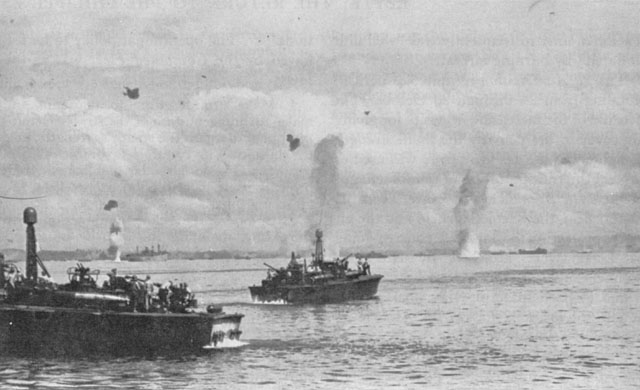
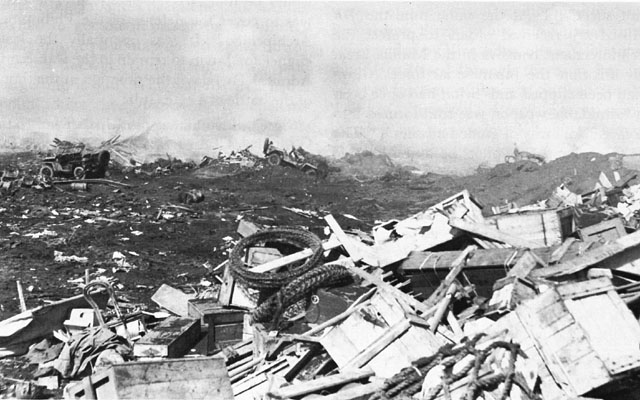
JAPANESE AIR ATTACKS on shipping (above) and supply dumps (below) were a constant threat during the early days of the invasion.
The Battle of Leyte Gulf
Japanese Naval Plans
1. Make utmost effort to maintain and make advantageous use of the strategic status quo; plan to smash the enemy’s strength; take the initiative in creating favorable tactical opportunities, or seize the opportunity as it presents itself to crush the enemy fleet and attacking forces.
2. Co-operate in close conjunction with the Army, maintain the security of sectors vital to national defense, and prepare for future eventualities.
The strongest Japanese naval force—the 1st Diversion Attack Force—moved from the south, reached Brunei Bay in northwest Borneo on 20 October, and after refueling split into two parts and proceeded on its way two days later. The main strength of the 1st Diversion Attack Force, under Admiral Kurita, sailed northeast up the west coast of Palawan (one of the Visayan Islands), and then turned eastward through the waters of the central Philippines to San Bernardino Strait, while the smaller unit commanded by Vice Adm. Shoji Nishimura moved eastward through the Sulu Sea in order to force an entrance at Surigao Strait. The 2d Diversion Attack Force, commanded by Vice Adm. Kiyohide Shima, after leaving the Pescadores on 21 October, sailed south, past western Luzon, and after refueling in the Calamian Islands, just south of Mindoro, proceeded to follow and support the southern part of the 1st Diversion Attack Force in forcing Surigao Strait.
There were two American fleets in Philippine waters—the Seventh Fleet under Admiral Kinkaid, whose superior was General MacArthur, and the Third Fleet under Admiral Halsey, whose superior was Admiral Nimitz. The Seventh Fleet, which consisted of 6 old battleships, 16 escort carriers, 4 heavy cruisers, 4 light cruisers, 30 destroyers, and 10 destroyer escorts, had escorted the convoy to Leyte and now stood by to protect it as it unloaded. The Third Fleet was composed of Task Force 38 under Admiral Mitscher. It consisted of four task groups which averaged 23 ships each, divided about as follows: 2 large carriers, 2 light carriers, 2 new battleships, 3 cruisers, and 14 destroyers. The task force was to secure air supremacy over the Philippines, protect the landings, and apply unremitting pressure on Japan. If the opportunity to destroy the major portion of the Japanese fleet should arise or could be created, that destruction was to be its primary task.
On 23 October two American submarines, the Dace and the Darter, encountered the 1st Diversion Attack Force and sank two heavy cruisers, the Atago and Maya, off the western coast of Palawan. The former was Kurita’s flagship; its sinking forced the Japanese admiral to transfer hurriedly to another vessel. The submarines also seriously damaged another heavy cruiser.
The aircraft from the Japanese 2d Air Fleet attempted to aid the naval forces which were moving eastward through the Philippines. In co-operation with some aircraft from the Main Body, which was now about 100 miles east of Luzon, they attacked the northernmost unit of the American carriers. Halsey’s airmen sighted and reported the sacrificial Japanese Main Body in the afternoon. Not knowing that this force consisted mainly of empty carriers and believing that the 1st Diversion Attack Force had been severely damaged, Admiral Halsey withdrew the battleships and carriers of his Third Fleet and steamed north to meet the new threat, leaving San Bernardino Strait wide open. At midnight Kurita’s 1st Diversion Attack Force moved unmolested through San Bernardino Strait and turned south toward Leyte Gulf. The Japanese strategy had worked.
As the Japanese retreated throughout the 25th and 26th of October, carrier- and land-based aircraft struck at the enemy vessels and inflicted fresh injuries upon them.
The Sixth Army summarized its view of the probable consequences if the battle had gone against the U. S. Navy as follows:
The Sixth Army, however, was depicting the worst of all possible contingencies. Admiral Halsey’s conclusion is quite different:
The Japanese Reinforce the Leyte Garrison
The Japanese felt that the honors of the battle were evenly divided and consequently continued with their program of making Leyte the decisive battle of the Philippines. Although the American fleet had soundly whipped the Japanese Navy, the Japanese were still able to send reinforcements in great numbers to their Leyte garrison. Because of the lack of sufficient aerial strength, the Americans were unable to check the steady flow of troops into the port of Ormoc.
American Aerial Retaliation
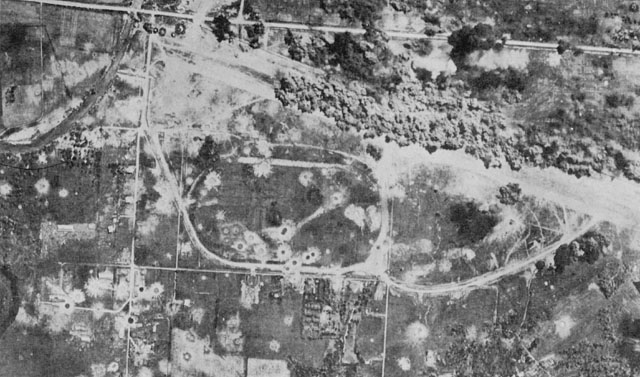
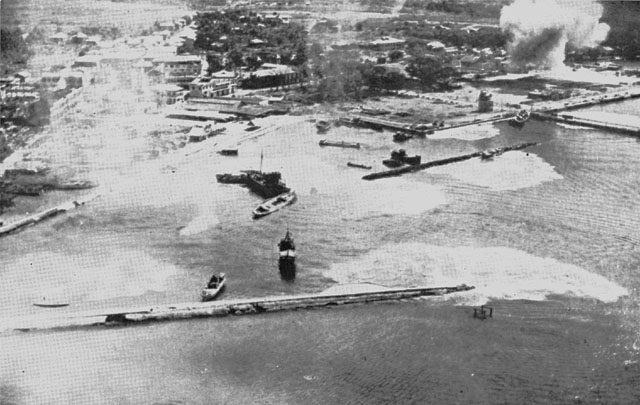
AIR STRIKES AGAINST JAPANESE INSTALLATIONS included on Bacolod Airfield, Negros Island (above), and on shipping in Zamboanga harbor, Mindanao (below).
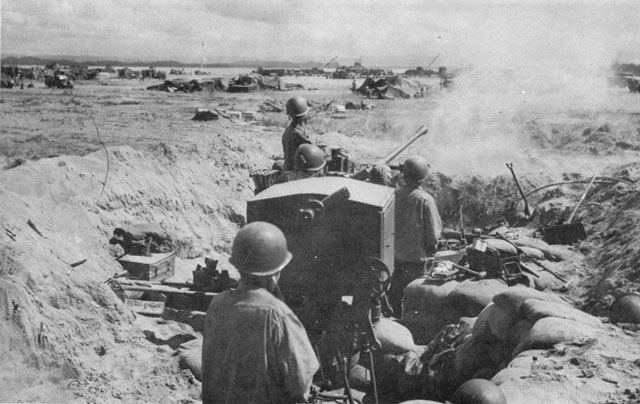
ANTIAIRCRAFT GUN in action at Tacloban airstrip, 27 October 1944.
The 29th of October, however, was a day of heavy action for the Army flyers, as described in a report of the 7th Fighter Squadron:
The 29th was a day that will be long remembered.... Two more Nips were added to the unit’s score;... the 49th Group’s 500th victory. But more important at that time was the fact ... [that] the ... road between the strip and the camp collapsed under army traffic.... The already long hours were lengthened still more as pilots and men were forced to arise between three and four o’clock in the morning, make their way to the barge at Tacloban, cross to the strip by water and then sweat out the pre-dawn raids. At night, the planes landing at dusk had hardly hit the runway before ... BOFORS [40-mm. antiaircraft guns] went off and the lights went out. Then down to the end of the strip near the gas dumps, and another session of sweating beneath A/A [antiaircraft] awaiting the barge for the trip back to Tacloban and then to camp. Supper was served as late as 10 o’clock ... a few brave individuals tried an alternate road to the south, swinging out east to White Beach above Dulag and then north along the beach to Tacloban Strip. Japanese snipers soon put a stop to this travel during the hours of darkness.
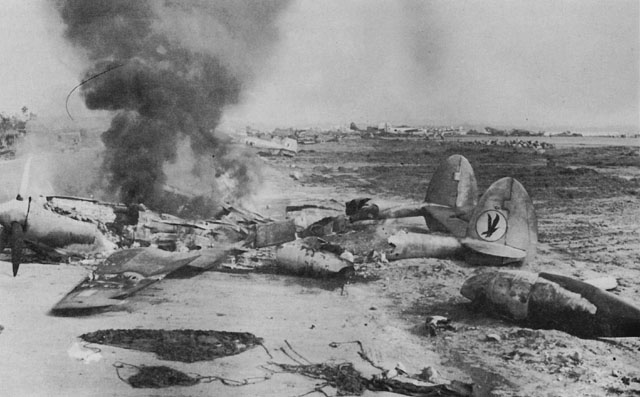
LOCKHEED P-38 after Japanese raid on Tacloban airstrip.
The TA Operation
The first Japanese convoy had three echelons. The first consisted of a landing barge and an auxiliary sailing vessel carrying about 300 troops of the 102d Division. The second echelon, whose composition was identical with the first, carried about 150 troops of the same division. Both safely discharged their troops on 23 and 25 October, respectively. The third echelon was made up of 2 destroyers, together with 4 transports carrying about 2,000 men of the 30th Division. The transports safely unloaded their passengers on 26 October, but American airmen later sank the destroyers and all but one of the transports. The remaining vessel was damaged.
The second convoy consisted of three echelons, composed of 3, 1, and 4 transports respectively. The escorting vessels of the third echelon, the only one that had an escort, consisted of 6 destroyers and 4 coast defense vessels. The escort vessels carried the troops of the 1st Division: the first wave about 1,000 men, the second about 100 headquarters men, and the third approximately 10,000 troops and about 9,000 ship tons of provisions and ammunition. All vessels safely debarked their troops on 1 and 2 November.
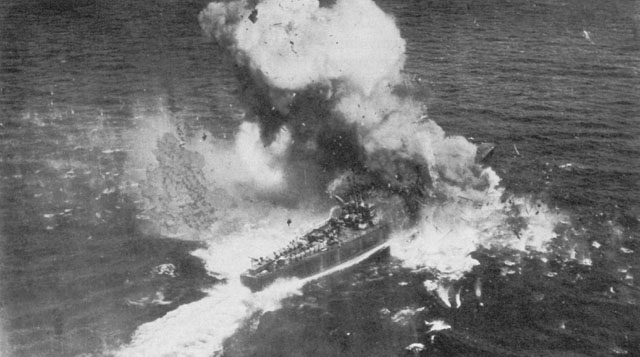
JAPANESE CONVOY UNDER ATTACK in Ormoc Bay. A destroyer escort is blown apart by a direct hit (above), and a large transport is straddled by bomb bursts (below).
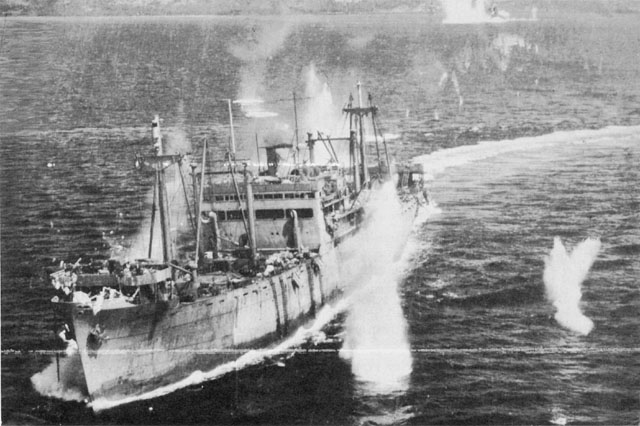
The 5 transports of the third convoy carried about 2,000 troops of the 26th Division and approximately 6,600 tons of supplies. The convoy sailed from Manila on 9 November and was escorted by 1 submarine chaser, 1 torpedo boat squadron, and 4 destroyers. On 10 November, when the convoy reached the mouth of Ormoc Bay, American airmen destroyed all of the escort vessels and transports before they could unload their troops and cargo.
Each of the two echelons of the fourth convoy had 3 transports, but only the first one had an escort—6 destroyers and 4 coast defense vessels. The first echelon carried approximately 10,000 troops of the 26th Division and about 3,500 tons of supplies, including provisions, ammunition, and four long-range guns. The second echelon carried about 1,000 men of the 1st Division. Both discharged their troops safely on 9 November, a day earlier than the anticipated arrival of the third convoy, but because of American air action, they were able to get only a limited part of the supplies ashore.
The fifth convoy was organized on the same pattern as its predecessor, but the first wave had a submarine chaser as an escort while the second had a destroyer. This convoy, which left Manila between 11 and 25 November with an unknown number of troops and quantity of supplies, was completely destroyed en route to Leyte.
The sixth convoy, composed of 2 transports, 2 submarine chasers, and 1 patrol boat, carried approximately 2,500 tons of provisions and ammunition. It entered Ormoc harbor on 28 November and had completed most of its unloading when the vessels were either sunk or set afire by U.S. aircraft and motor torpedo boats.
There were four echelons in the seventh convoy. The composition of the first two is unknown, but it is known that the first echelon completed unloading at Ipil just south of Ormoc on 30 November. The third and fourth echelons, consisting altogether of 3 transports and 2 destroyers, also carried an unknown number of troops and quantity of supplies. As they were unloading at Ormoc on 2 December, the vessels were attacked by American airmen who sank one of the destroyers and damaged the other. The transports and the damaged destroyer returned to Manila.
The 4 transports of the eighth convoy, escorted by 3 destroyers and 2 submarine chasers, carried about 4,000 troops—the main body of the 68th Independent Brigade—and an unknown quantity of provisions and ammunition. It unloaded some of its troops and a part of the cargo at San Isidro on the west coast of Leyte on 7 December; but immediately thereafter, American aircraft sank the transports and heavily damaged the destroyers.
Even though the Japanese had not succeeded completely in their reinforcement program, General Krueger was faced with a far stronger foe than had been anticipated. The Leyte Campaign was to be long and costly and was to upset the timetable for the impending Luzon operation. At the end of A Day the American assault forces had firmly established themselves on the shores of Leyte, but the battle for the island was yet to come.