Chapter XV · Battle of the Ridges
Reading edition
American Plans and Preparations
With the securing of the beachhead areas in the last week of October and the first days of November, General Krueger was ready to launch that part of his plan that concerned a drive north along the west coast of Leyte. Since a preliminary reconnaissance indicated that there were not a great many Japanese troops in the southern half of the island, elements of the 32d Infantry had already started to push west through the mountains to the west coast along the road from Abuyog to Baybay. After the attention of the Japanese had been diverted to the struggle in the northern mountains, the X Corps could launch a drive against Ormoc, proceeding north from Baybay on Highway 2 along the shores of the Camotes Sea and of Ormoc Bay. At the same time elements of the X Corps—the 24th Division and later the 32d Division—could drive down the Ormoc corridor to Ormoc. The enemy forces would then be caught between the jaws of a trap, with their freedom of maneuver limited and most of their strength employed in defensive action. But the need for blocking the exits from the central mountain range and the scarcity of combat troops made it necessary for General Krueger to postpone sending a strong force to the shores of the Camotes Sea until additional reinforcements arrived on Leyte in the middle of November. General Hodge was to be prepared, however, to send strong elements of the XXIV Corps over the mountains.
American Plans
On 9 November the 26th Division landed at Ormoc after a rough voyage from Manila. The transport vessels had been repeatedly attacked by Allied aircraft, which damaged many of the landing barges and ship hatches. These damaging attacks hindered the unloading of equipment, which did not proceed as planned. Many of the landing barges were run aground and destroyed by Allied aircraft, and the transports were forced to sail away before being completely emptied. They carried most of the ordnance, provisions, and munitions of the division with them. On their return trip, all the vessels were sunk by aircraft. The division consequently came ashore underequipped. The strength of the 26th Division consisted of Division Headquarters, one battalion of the 11th Independent Infantry Regiment, three battalions of the 13th Independent Infantry Regiment, and the 2d Battalion of the 12th Infantry Regiment. These units had only light, portable weapons, and none was equipped with machine guns except a battalion of the 13th Independent Infantry Regiment.
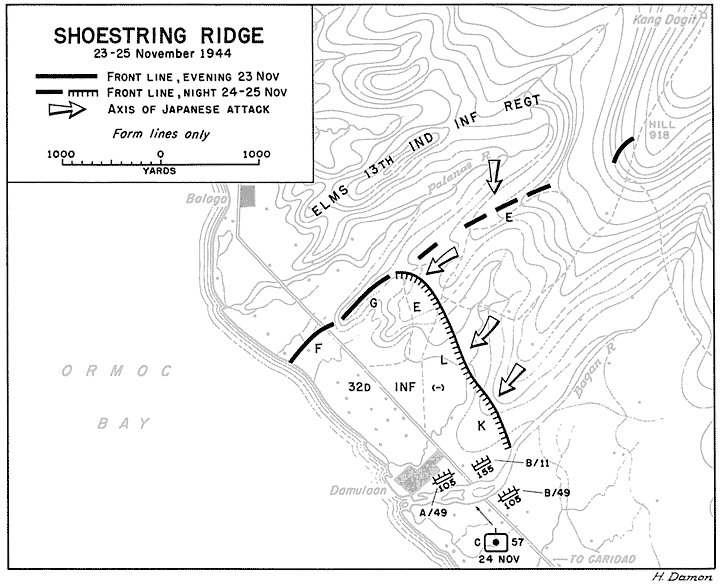
MAP 15 H. Damon
SHOESTRING RIDGE
23–25 November 1944
The Palanas River runs in a southwesterly direction between two ridges that end abruptly on reaching the road. The ridges slope sharply toward the river and are separated by a narrow valley. Colonel Finn chose to stand on Shoestring Ridge, the southernmost of the two, which rises steeply from the fields. Its northerly face drops precipitately for more than 125 feet to the valley, where dense bamboo thickets cover the river banks. The main body of the ridge is covered with cogon grass, interspersed with palms and bamboo, growth being especially heavy in the gullies. Between the western tip of the ridge and the sea are rice paddies and clusters of palm trees, while at a point 3,000 yards northeast of the road the ridge falls into a saddle and then rises to join Hill 918.
Offensive Preparations
While the 26th Division was building up positions on the opposite bank of the Palanas River, Colonel Finn had to solve problems that existed to the rear. Since enemy barges still operated freely a few thousand yards offshore and two Japanese destroyers had cruised by, General Arnold thought that the enemy might try to land forces and seize Baybay in order to separate the American units and sever their line of communications. There were only three infantry battalions on the west coast. The mud and floods on the narrow route that connected this force with the source of supplies at Dulag, on the east coast, made the road so undependable that the 7th Division could not rely on a quick transfer of reinforcements to the west.
Battle of Shoestring Ridge
The Battle Begins
At 2100 the Japanese infantry launched a well-planned attack, supported by artillery, mortars, and machine guns, against the lines of Company E. Although the company retaliated with all weapons at its command, the Japanese continued to come on, despite heavy casualties, through the covered draws, high cogon grass, and bamboo thickets. The guerrilla outpost between Companies G and E withdrew when the Japanese attacked Company E. The enemy force, which consisted of two reinforced rifle companies from the 13th Independent Infantry Regiment, seized portions of the ridge and dug in.
At dawn on 24 November Colonel Nelson re-formed the 2d Battalion. A patrol from Company F went to the Palanas River and found no enemy troops. At 0800 three companies moved to the east toward Hill 918. The troops succeeded in pushing back a Japanese force that had penetrated south of the Palanas River and east of Hill 918. Colonel Finn ordered Company K to move up from Caridad, and he attached it to the 2d Battalion.
During the day, as far as their limited ammunition would allow, the artillery units fired at enemy troop concentrations and possible observation posts. The service troops worked feverishly to move badly needed ammunition to the front lines. The two most critical items were 105-mm. and 81-mm. ammunition, and by nightfall the front lines had received 1,400 rounds of the first item and 1,600 rounds of the second. General Arnold attached the 1st Battalion, 184th Infantry, to the 32d Infantry but Colonel Finn was forbidden to commit it to action without permission from the 7th Division.
Japanese Counterattack
After this thirty-minute artillery and mortar preparation, the Japanese 13th Independent Infantry Regiment attacked the front lines of the Americans, concentrating the assault against three main positions: the right flank of Company G, the draw between Companies L and K, and the center of Company K. At the same time, combat patrols moved from the north against Companies F and G. The companies easily threw back these patrols.
Colonel Nelson ordered all supporting weapons of the 2d Battalion to fire. All three artillery batteries fired at the maximum rate for seven minutes, while the mortars placed their fire directly on the assault force in order to chop it up or drive it back into the artillery fire. Colonel Nelson then put the Ammunition and Pioneer Platoon of the 2d Battalion and a squad from Company B, 13th Engineer Battalion, in previously prepared positions between Companies G and E. Company G was thus able to strengthen its lines at the heaviest point of pressure and repel the frequently repeated assaults.
At about 1900 a strong force of the enemy gathered on the ridge in front of the right flank of Company L. The American mortars fired on the ridge but the American machine guns kept silent in order to conceal their locations. A group of about fifty Japanese came to within thirty yards of the right platoon of Company L and showered it with grenades. Mortar fire also fell on this platoon, and at the same time the platoon of Company K in the draw came under heavy fire. At least twelve emplaced machine guns, in addition to those carried up by the assaulting troops, raked the positions of Companies K and L with intense fire. Company L employed all weapons and threw back the assault with heavy casualties to the Japanese.
The Japanese then attempted to break through the center of Company K’s line, but were driven off by the use of artillery, together with the mortars, machine guns, grenades, and rifles of the company. For the rest of the night the Japanese kept probing the left flank of the company and placing machine gun and mortar fire along the entire line. At one time about twenty-five of the enemy pushed past the outer perimeter to within fifty yards of the perimeter of the command post and set up two machine guns. Headquarters personnel, medical men, and engineers who were manning the perimeter drove the group off.
Meanwhile, the Japanese forces in front of Company L withdrew and were regrouping, preparatory to launching a new attack. Since there was no artillery observer with the company, 1st Lt. William C. Bentley, of the Cannon Company, with two men went to a vantage point from which they could observe the draw and the ridge where the enemy force was assembling. Lieutenant Bentley directed an artillery concentration on the draw. Three times the Japanese tried to pierce the right flank of Company L and three times the artillery drove them back with heavy casualties. The enemy then tried unsuccessfully to get through the left flank of the company. The front line of Company L had comparative quiet for the rest of the night, except for a few infiltrators.
Having failed to pierce the front lines, the 26th Division troops tried desperately to knock out the artillery supporting the 32d Infantry—Batteries A and B of the 49th Field Artillery Battalion receiving the heaviest blows. Battery B had all four of its guns knocked out, but by “cannibalizing” the damaged guns the battery had one of them back in operation by dawn. The enemy shelling gradually slackened in intensity, and by 0400, except for occasional outbursts of fire, all was quiet.
At dawn of 25 November each company sent scouting patrols 2,000 yards to its front in order to forestall any Japanese attempts to move in. The patrols remained out all day. The front lines were reinforced by Company I, which moved into the draw between Companies K and L. The troops prepared positions but occupied them only at night, since they were located in a swampy rice paddy. Headquarters and B Battery of the 57th Field Artillery Battalion moved into the Damulaan area to provide additional artillery support. Four 105-mm. howitzer batteries and one 155-mm. gun battery were then available. The troops of the 3d Battalion reverted to the control of the 3d Battalion commander, Colonel Whitcomb. Because of the intense firing during the night, the ammunition in the front lines had been nearly exhausted, but a sufficient supply was brought forward to the guns by the next evening.
At 2200 the enemy, using the same tactics as on the previous night, again assaulted the eastern positions of the 32d Infantry with approximately one battalion, after an artillery preparation. Although apparently well led and well organized, they were in less strength than before and were driven back, but not without a grenade battle and some hand-to-hand fighting.
While the infantry troops were thus engaged, eight Japanese led by an officer moved unnoticed along the Bucan River about one and a half miles south of the Palanas River. Coming up on the right of B Battery, 49th Field Artillery Battalion, these enemy troops threw a shower of grenades at the gun crews and tried to clamber over the river bank and get at the guns. One man made it, and by placing a satchel charge behind the breechblock of a howitzer he put it permanently out of commission. All of the Japanese were killed.
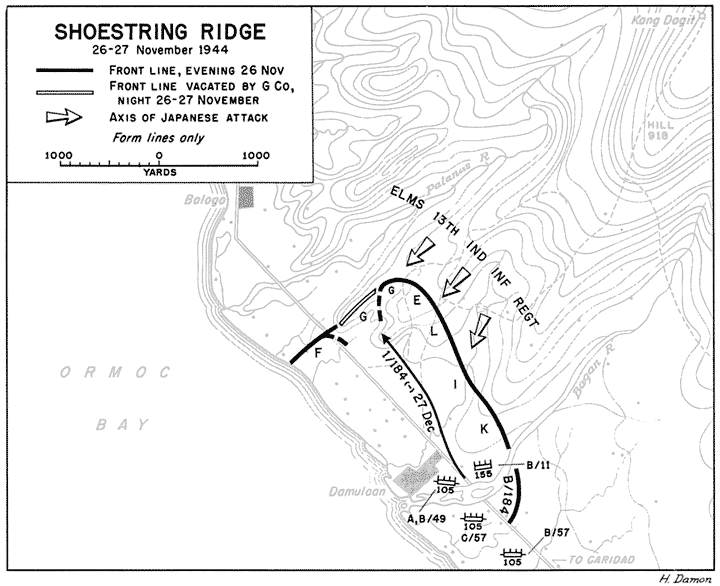
MAP 16 H. Damon
SHOESTRING RIDGE
26–27 November 1944
Bloody Bamboo Thicket
Colonel Finn made plans for the recapture of the ground lost by G Company, and General Arnold made available to him part of the 1st Battalion, 184th Infantry, which was at Caridad. The 1st Battalion, less B Company and two platoons from C Company, left Caridad at 0415 on 27 November, and by 0515 it was in Damulaan in readiness for the assault. Company G, 2d Battalion, 32d Infantry, was also available.
The defensive perimeters of the 32d Infantry were set up. With the addition of the 1st Battalion, 184th Infantry, the lines were much stronger. During the night of 27 November elements of the 13th Independent Infantry Regiment made minor attempts to infiltrate through the lines but were easily repulsed.
The troops of Colonel Finn’s 32d Infantry were weary. They had prevented the Japanese 26th Division from going south along the eastern shore of the Camotes Sea and had held back the best the enemy had to offer. General Arnold desired that the 7th Division push through the enemy lines with two regiments abreast toward Ormoc. The tired 32d Infantry was to be drawn back and replaced by the 184th and 17th Infantry Regiments.
Battles of the Hills
The attempts of the 26th Division to drive the Americans back had been checked, but the front lines remained practically the same as they had been at the outset of the battle for Shoestring Ridge. It had become apparent that the most one regiment could do was to conduct a holding action and that if the 7th Division was to continue the advance it would be necessary to commit a stronger force against the Japanese. Elements of the 26th Division were by now firmly ensconced in the hills that overlooked Highway 2 and were in a position to contest bitterly any forward movement of the 7th Division.
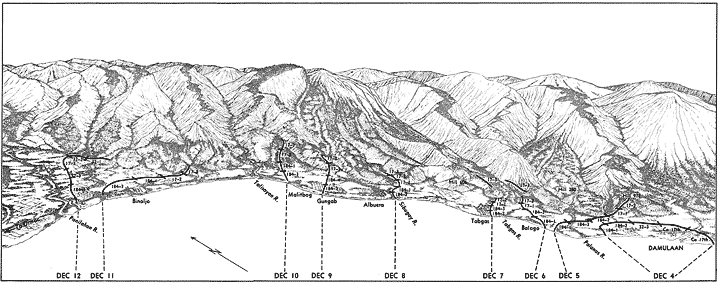
MAP 17
BATTLE OF THE RIDGES
5–12 December 1944
Hill 918
On 4 December General Arnold ordered Lt. Col. O’Neill K. Kane to move the tanks of the 776th Amphibian Tank Battalion by water under cover of darkness to a position 1,000 yards at sea to the west of Balogo, the next coastal town, about a mile to the north of the front lines. The tanks at dawn on the 5th were to assault the beaches in that vicinity and fire on the town and on the north slopes of hills and ravines in the area. These movements of the tank battalion were to be closely co-ordinated with the 184th and 17th Infantry Regiments, into whose areas the attack was to be made.
At 0635 on the 5th, the tank battalion in a column formation started to move north over water. The tanks advanced toward Balogo until they were at a point offshore about 200 yards from the town. They then continued north in a column formation and fired into the town of Tabgas. At the mouth of the Tabgas River, just short of Tabgas, the tanks attacked in line formation. Moving ashore at 0700, they sent approximately 2,550 rounds of 75-mm. ammunition in direct fire against the northern slopes of the hills that confronted the 7th Division.
On the right of the 184th the 17th Infantry had had a busy day in working toward its objective, Hill 918. At 0800 on 5 December the 1st and 2d Battalions of the 17th Infantry, with the 1st Battalion on the left, had moved through the 32d Infantry. At 0906 the advance elements of the 1st Battalion secured a ridge south of the main ridge leading from Hill 918, and at 1000 the entire battalion closed on this ridge. In the face of sporadic rifle and machine gun fire, the leading platoons pushed forward to secure a ridge that led west from Hill 918. As the advance platoons neared the crest of this ridge, they received intense rifle, machine gun, and mortar fire to the front and on both flanks from the 2d Battalion, 12th Independent Infantry Regiment. At the same time the rest of the battalion, in attempting to reach a forward ridge and support the leading platoons, also encountered cross fire that came down the intervening draw. As enemy gunfire pinned down the troops, the 1st Battalion lost contact with Company G, 2d Battalion, and a gap developed between the 1st and 2d Battalions.
Earlier that day the 2d Battalion had driven forward with Company E on the right and Company G on the left. Company E went east along the Bucan River for approximately 1,000 yards and then turned northeast to ascend Hill 918. At first, however, the company had to secure a small ridge southwest of Hill 918 on which was a small but dense banana grove. Company E encountered and destroyed a small enemy force on this ridge, after which the company reorganized and at approximately 1300 began to ascend Hill 918 itself. When Company E reached the military crest of the hill, the Japanese began heavy firing with grenade launchers and at least three machine guns. The enemy fire swept the crest of the hill and prevented any movement over the lip of the ridge.
Meanwhile, Company G went to the left of Company E and secured a small ridge about 1,200 yards from the line of departure and west of Hill 918. The advance platoon of Company G then received fire from automatic weapons that were emplaced in a draw to the left front of the platoon. The rest of the company attempted to move around to the right of the ridge but also encountered automatic weapons fire coming from another draw. Since high cogon grass covered the area, observation was limited to a matter of inches. At about 1300, elements of the 13th Independent Infantry Regiment counterattacked through a gap between Company G and Company A of the 1st Battalion. A machine gun platoon, which was thrown in to plug the gap, succeeded in stopping the attempted Japanese advance.
Company G, however, continued to be pinned down by the enemy fire directed at its front. Company F, the reserve company, was then committed to take a position between G and E Companies. Its mission was to come abreast of Company E, take Hill 918, and then turn west and wipe out the resistance in front of Company G. At 1415 Company F moved up Hill 918 and reached Company E without opposition.
Three spurs led down from Hill 918. The one occupied by Company E ran southwest, that occupied by Company F ran west, and the third ran northwest. As the two commanders started to launch a co-ordinated assault from their respective spurs, their companies received a concentration of about fifty rounds of mortar fire but pushed through this fire and secured the crests of both spurs. They immediately came under automatic weapons and rifle fire from the northwest ridge.
At the end of 5 December the 17th Infantry had secured the ridge west of Hill 918 and the 184th Infantry had secured a line extending from the beach 300 yards south of Balogo east to the high ground southeast of the Palanas River. Company K, 32d Infantry, had filled a gap that had existed between the 17th and 184th Infantry Regiments, while the 3d Battalion, 184th Infantry, had crossed the Palanas River and, advancing up the southwest slope of Hill 380, reached the top of the first ridge. There were no enemy attacks during the night.
Hill 380
At the end of the day the 7th Division had secured the barrio of Balogo, had overrun Hill 918 and occupied Kang Dagit, and had established elements of the division on the banks of the Palanas River and on part of Hill 380.
At dawn the 17th Infantry sent out patrols. The one from the 1st Battalion located an enemy heavy machine gun, two light machine guns, and a mortar, emplaced 150 yards from the battalion’s lines. When the patrol returned, mortar fire was placed on the position and it was wiped out. The 1st Battalion moved out at approximately 0900. Though long-range fire fell on the troops and small arms fire hit the left flank of Company C, the men continued to push forward. The battalion found several ridges leading up Hill 380—a knifelike ridge in front of Company C and a double ridge in the form of a horseshoe, with its closed end toward the hill, in front of Company B.
After its dawn patrols had reported on 7 December, the 2d Battalion, 17th Infantry, jumped off to the attack. Company E secured the first of the three spurs leading from Hill 380, and continued forward to the middle spur in the face of light fire that came from in front of the company in the area the 17th Infantry wished to secure. Presently the fire grew to considerable intensity and the company’s section of light machine guns and two platoons of heavy machine guns moved onto the middle spur, where they neutralized the enemy position.
Apparently realizing that Hill 380 was the key to defense of the Tabgas River valley and Hill 606, troops of the 26th Division poured long-range machine gun fire from Hill 606 into Company G and at the same time halted the company with small arms fire from the immediate left along the ridge. At 1355, after a heavy mortar barrage, about fifty men from the 26th Division counterattacked the positions of Company G, but the company held firm and mowed down the attackers with fire from its rifles and automatic weapons. The position on the hill was maintained.
At the end of the day the 184th Infantry was on the banks of the Tabgas River and the 17th Infantry had secured Hill 380, which commanded the Tabgas River valley.
Although several days of hard going still lay ahead before the 7th Division was to reach its objective, the Talisayan River, the backbone of the Japanese resistance had been broken and the Battle of the Ridges was virtually won. The division had achieved what the Japanese had considered impossible. It had pushed through Leyte over the tortuous mountain road between Abuyog and Baybay, it had held the enemy back at Shoestring Ridge, and it had then pushed north along the shores of Ormoc Bay toward Ormoc, decimating the right flank detachment of the 26th Division in the process. General Suzuki had been forced to send south much of his tactical strength, which was to have been used for the defense of Ormoc. The 7th Division had assisted in no small way in tightening the ever-shortening noose about the Japanese who remained on the island.
On this day, 7 December, the 77th Division landed at Deposito just below Ormoc. The 26th Division was caught between two strong American divisions. It was doomed. At this point the action of the 7th Division merged with that of the 77th Division in the drive of the XXIV Corps against Ormoc.
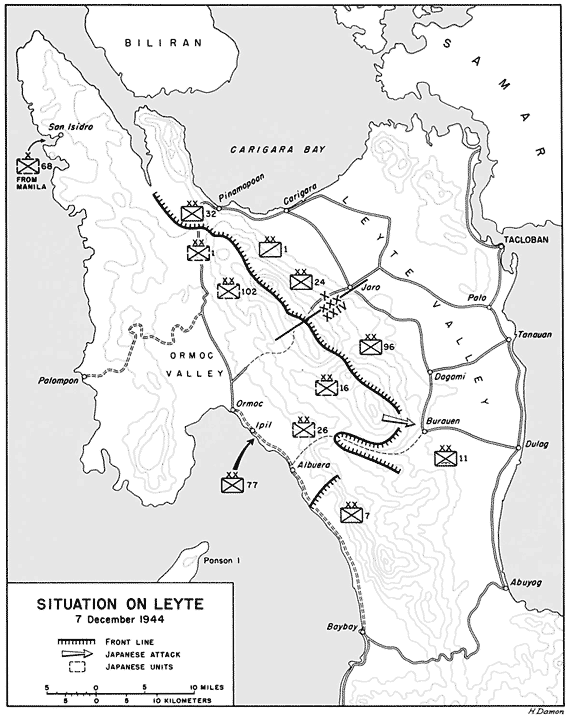
MAP 18 H. Damon
SITUATION ON LEYTE
7 December 1944