Chapter XVI · The Fall of Ormoc
Reading edition
It was a time for decision. By the first of December the two adversaries had taken the measure of each other, but neither felt satisfied with the progress of the campaign.
The tide of battle was slowly turning against the Japanese. They had wagered major stakes that the battle of Leyte should be the decisive one of the Philippines. Someway, somehow, the Japanese felt, they must regain the initiative or Leyte, for which so much had been sacrificed, would be lost to them. The days had dwindled to a precious few.
General Krueger was also making plans. By the middle of November strong elements of the Sixth Army were trying to force their way into the Ormoc Valley and others were on the eastern shore of Ormoc Bay. The plan of General Krueger was simple. He wanted to secure control of the valley and the port of Ormoc and thus force the Japanese into the mountains near the western coast, from which they could escape only by sea.
At this time the XXIV Corps was with difficulty driving west and north from the center of the island. The 96th Division was engaged in mopping up in the mountains overlooking Leyte Valley. Units of the 7th Division, far to the south, were moving westward toward Baybay on the shore of the Camotes Sea. The 1st Cavalry Division and the 24th and 32d Infantry Divisions of the X Corps were making slow progress in driving down the Ormoc corridor from the Limon-Pinamopoan-Carigara area.
Several courses of action were now open to General Krueger. He could concentrate on the drive of the 32d Infantry Division and the 1st Cavalry Division south down the Ormoc corridor, or on the advance of the 7th Division north along the coast of Ormoc Bay from Baybay to Ormoc. A third course also presented itself. An amphibious overwater movement might be attempted by landing troops just below Ormoc in the midst of the enemy force, thus dividing the Japanese strength. After landing, the troops could push north, seize Ormoc, and then drive up the Ormoc corridor and effect a juncture with elements of the X Corps. This move, though highly hazardous, would considerably shorten the Leyte Campaign if successfully carried out.
Plan for Amphibious Movement
At a point about three and a half miles southeast of Ormoc was the barrio of Deposito where the 77th Division was to land. Along the eastern shore of Ormoc Bay, south from Ormoc, there were many areas which offered suitable landing beaches. These were crossed by numerous rivers and streams which discharged into Ormoc Bay. None of these would be a handicap, since all could be forded except during the monsoon season. The beach area selected, though narrow, was suitable for landing, having a surface of hard sand and gravel that could be used as a road by vehicles.
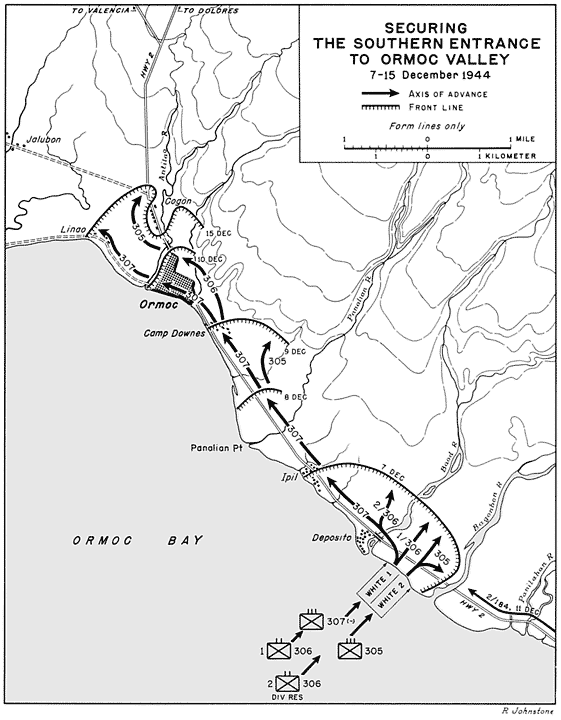
MAP 19 R. Johnstone
SECURING THE SOUTHERN ENTRANCE TO ORMOC VALLEY
7–15 December 1944
Naval Plans
Admiral Struble divided his task group into six units, in addition to the destroyer which was his flagship. These consisted of: a Fast Transport Unit of eight transports; a Light Transport Unit of twenty-seven landing craft and twelve LSM’s (medium landing ships); a Heavy Transport Unit of four LST’s (tank landing ships); an Escort Unit of twelve destroyers; a Mine-Sweeping Unit of nine mine sweepers and a transport; and a Control and Inshore Support Unit made up of four LCI(R)’s (infantry rocket landing craft), two submarine chasers, and one tug. The landing was to be made between the Baod and Bagonbon Rivers but clear of the Bagonbon River delta. The northern half of the beach was called White I and the southern half White II. Six destroyers would bombard the landing beaches.
The line of departure was fixed at 2,000 yards from the beach, but if the shore fire became heavy the line of departure would be moved back 1,000 yards. There would be five assault waves with two LCI(R)’s flanking the first wave to the beach. Each craft would fire so as to cover the sector of the beach in its area to a depth of 600 yards. After completion of the bombardment the LCI(R)’s would reload and remain on the flanks to engage targets of opportunity.
The Fifth Air Force would provide both day and night air cover for the journey of the assault convoy to the target, for the landings, and for the return convoy. It was estimated that on 5 December, for the journey to the target, seventeen night fighter sorties and seventy-two day fighter sorties would be required. Protection would also be furnished by the bombers, and forty-six aircraft would be available on call for strikes against enemy installations and targets of opportunity, as well as for special missions.
On the day of the landings, the tempo would be accelerated. There would be nineteen night fighter sorties and ninety-six day fighter sorties; ten flights of forty bombers to cover the beachhead; six nights of twenty-four bombers to cover the return of the assault convoy; and eleven night fighters to cover the LST and main assault convoys, the beachhead, and the return convoy. There would also be available sixteen bombers for interception or additional cover for the beachhead and convoy; twenty-four P-47’s for interception, ground support, and attacks against enemy shipping or targets of opportunity; sixteen P-40’s for ground strikes; and thirty-four F4U’s for cover or interception.
About 0700 on 6 December the assault shipping rendezvoused off Tarragona and Rizal Beaches, and one hour later the assault troops began to board the vessels. The loading was completed at 1200 and the convoy assembled offshore from Dulag to await the arrival of the twelve escorting destroyers.
The Movement Overwater
The Convoy Sails
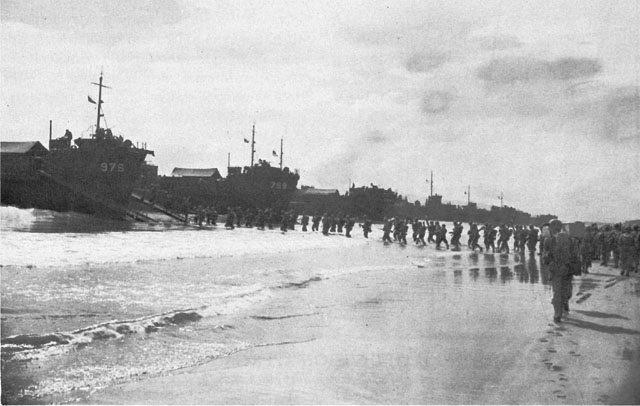
TROOPS OF THE 77TH DIVISION BOARD LCI’S AT TARRAGONA
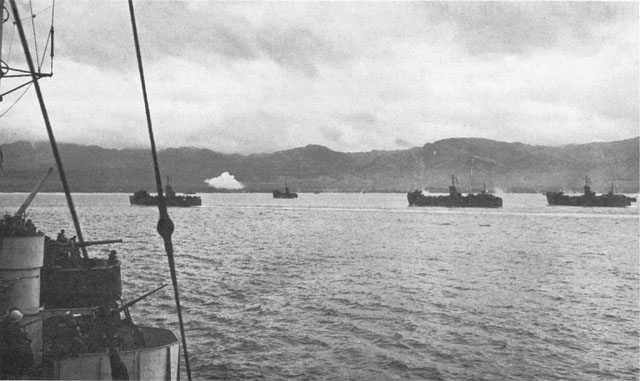
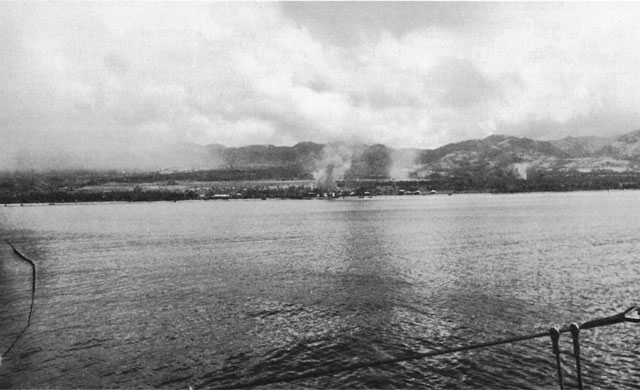
CONVOY CARRYING 77TH DIVISION APPROACHES DEPOSITO (above). Bombardment of enemy positions at Ipil (below), with stack of sugar mill visible. Village is near center of picture.
“Land the Landing Party”
Japanese Plans
The Japanese defenses, however, were not completed at the time of the American landings. Only individual trenches had been dug along the coast, and the field positions in the northern part of Ipil were elementary. Upon being alerted that the Americans had landed, the Shipping Unit of Colonel Mitsui took up its main defensive positions in the Ipil area. At the same time, troops of the Nonaka Battalion of the 30th Division, consisting of an infantry company and a machine gun company, were placed under the command of Colonel Mitsui. The major part of the 30th Division remained on Mindanao. The American strength was estimated to be one regiment.
Drive Toward Ormoc
Ipil
At 1640 General Bruce issued orders for the regiments to consolidate their positions and form night perimeters. The 77th Division had established a two-mile beachhead extending from Ipil in the north to the Bagonbon River on the south and had penetrated inland nearly a mile.
Camp Downes
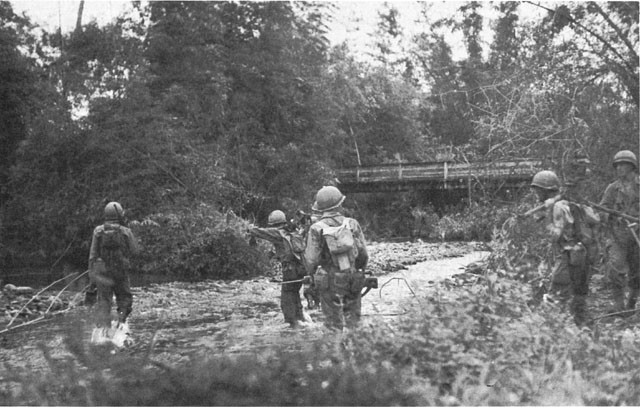
A PATROL OF THE 307TH INFANTRY warily approaches a river crossing near Camp Downes.
Two Sevens are Rolled in Ormoc
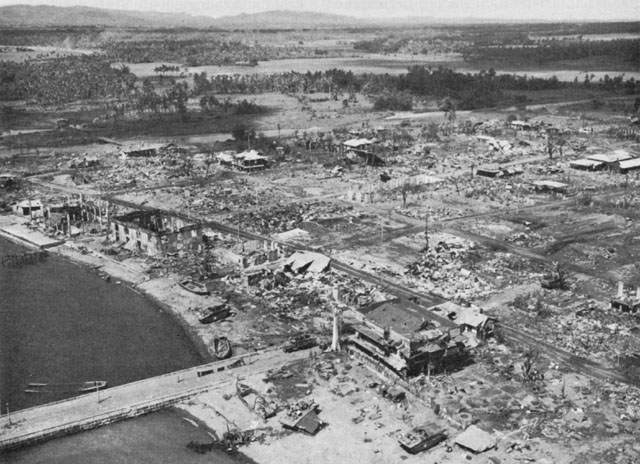
AERIAL VIEW OF ORMOC after the bombardment. In the middle background is the Antilao River, with the mountains of western Ormoc Valley in the distance.
The 306th and 307th Infantry Regiments squeezed the enemy like a tube of toothpaste. The 306th Infantry enveloped the northeast flank, while the drive of the 77th Division up the shore of Ormoc Bay banished any hopes that the Japanese might have entertained of escaping southeast by Highway 2. The Japanese were squeezed through Ormoc to the north.
The 307th Infantry pushed through the town and at 1730 established a night perimeter on the banks of the Antilao River on the western edge of Ormoc where it tied in with the front line of the 306th Infantry. At long last, Ormoc was in American hands.
On 7 December, the 7th Division moved north from its position about seven miles south of Deposito to join the 77th Division, which had landed that day at Deposito. It advanced with two regiments abreast—the 184th Infantry on the left and the 17th Infantry on the right. The regiments made slow progress as they pushed over a series of hills and river valleys. On the night of 9–10 December the Japanese who were caught between the 7th and 77th Divisions withdrew into the mountains. At 1000 on 11 December an advance element, the 2d Battalion, 184th Infantry, reached Ipil and established contact with the 77th Division.