← Table of contents
Leyte

Chapter XVII · Battle of the Airstrips

Reading edition
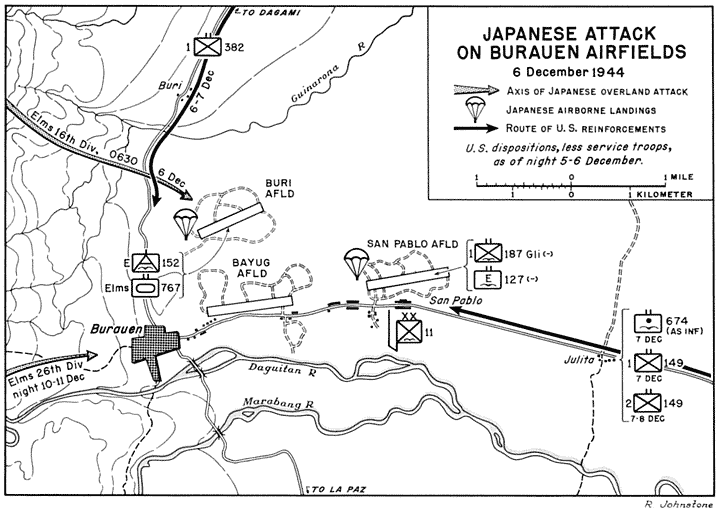
JAPANESE ATTACK ON BURAUEN AIRFIELDS

MAP 20 R. Johnstone

JAPANESE ATTACK ON BURAUEN AIRFIELDS

6 December 1944

Plans were made for the 3d and 4th Airborne Raiding Regiments to descend from Luzon on the Burauen airfields. The 26th Division, together with the 16th Division, which had fought the Americans in Leyte Valley, and the 68th Independent Mixed Brigade of the 35th Army were to infiltrate through the mountains and attack and capture the Burauen airfields. The 16th Division was to move from its position in the mountains west of Dagami toward Buri, the northernmost of the Burauen airfields. Elements of the 26th Division which were engaging the 7th Division on the shores of Ormoc Bay were to break off the fight, move over the mountains, and attack Bayug and San Pablo, the southernmost of the Burauen fields. (Map 20) If all went well they were to proceed east and capture the Dulag airfield, on the shores of Leyte Gulf. The airborne assault was to be made on the night of 5 December. The ground troops were to arrive early on the morning of 6 December and assist in the attack.

Because he felt that he had not made sufficient preparation, General Suzuki requested that the attack be postponed until 7 December. General Yamashita disapproved this request, but since bad weather was forecast for 5 December, he sent a message to General Suzuki changing the date of attack to the night of 6 December. This information was immediately transmitted to the 26th Division. At the same time, efforts were made by General Suzuki’s headquarters to relay the information to the 16th Division, but because of radio difficulties General Makino never received the message.

Unwittingly, the Japanese were flogging a dead horse. General Krueger had stopped all work on these airfields on 25 November.

The American Dispositions

General Swing immediately started to relieve elements of the 7th Division and by 28 November the relief was completed. For several days the 11th Airborne Division sent patrols to the west and maintained small security guards at the Buri and Bayug airfields.

First Japanese Effort

In the meantime the first phase of the Japanese plan to regain the initiative had begun. At 0245 on 27 November, three enemy air transports with lights on flew over Leyte Gulf at an altitude of about fifty feet. Ten minutes later one of these aircraft crash-landed in the water about twenty-five yards offshore in the area of the 728th Amphibian Tractor Battalion, which was about two miles south of Rizal and about three miles north of Tarragona.

Battle of Buri Airstrip

On or about 2 December General Makino, commanding general of the 16th Division, had assembled from the hills southwest of Dagami the remaining elements of the division. The total strength thus massed was only about 500 men. The men rested, and then marched on toward the Buri airstrip. On the way, American artillery and tank fire killed approximately 200 of them. The remaining force moved to a new location—a deep gorge about 6,500 yards southwest of Dagami. On 5 December, this force was to move out of the gorge, join the paratroopers, and launch a combined assault against the Buri airstrip.
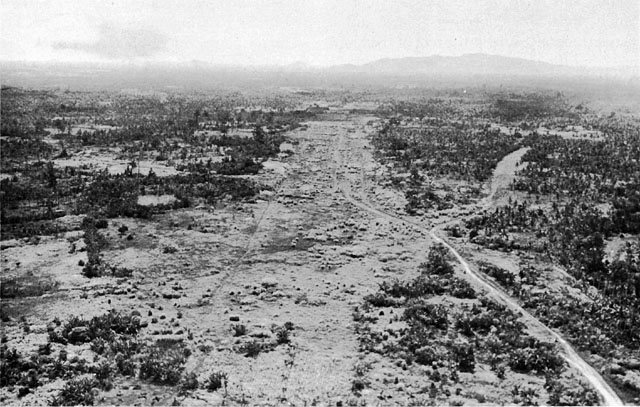
BURI AIRSTRIP as it appeared in 1946.

BURI AIRSTRIP as it appeared in 1946.

The 16th Division was still unaware that the target date for the Burauen operation had been postponed to the night of 6 December, and consequently proceeded with its plans to attack the Buri airstrip on 6 December at 0630—over fourteen hours before the paratroopers were scheduled to land. On the night of 5–6 December, approximately 150 Japanese made their way quietly toward the Buri airstrip.

Attack From the Sky

San Pablo Airstrip
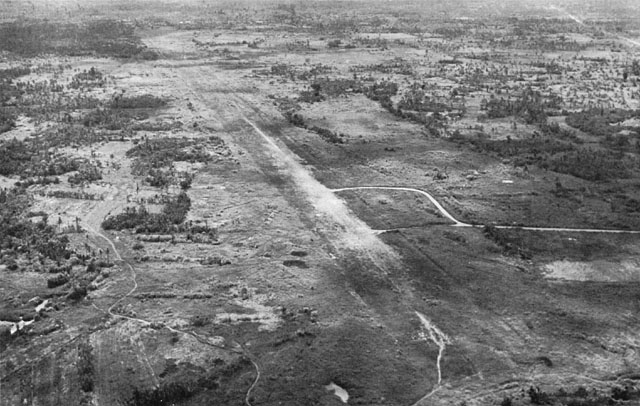
SAN PABLO AIRSTRIP as it appeared in 1946.

SAN PABLO AIRSTRIP as it appeared in 1946.

The Japanese parachutists were well drilled as to their mission. The operation was to be divided into five phases. The first phase was to begin with the jump-off. The men, immediately after landing, were to attack and destroy aircraft on the ground, and one element was to attack the barracks and communications. This phase was to end when the moon rose. In the second phase, ending about 2230, the troops would destroy matériel, ammunition dumps, bridges, and remaining barracks. During the third phase, from 2330 to 0300, the paratroopers were to destroy the remaining aircraft and installations. In the fourth phase, lasting from 0300 to 0600, they were to build defensive positions. In the fifth phase, from 0600 on, preparations were to be made for future operations.

The parachutists, immediately after landing, ran up the north and south sides of the San Pablo strip. They talked in loud tones and allegedly called out in English, “Hello—where are your machine guns?” Most of the enemy forces assembled on the north side of the airstrip. They burned three or four more liaison planes, a jeep, several tents, and another gasoline dump, throwing ammunition on the latter.

At dawn, after most of the paratroopers had assembled on the San Pablo airfield, they moved north and west to the northern edge of the Buri airstrip and joined elements of the 16th Division.

At the San Pablo airstrip, Lt. Col. Douglas C. Davis, the commanding officer of the 127th Airborne Engineer Battalion, organized the miscellaneous service troops into an infantry unit to protect the San Pablo airstrip. The 674th Parachute Field Artillery Battalion, which was at the mouth of the Bito River, north of Abuyog, was to leave its guns at that place and come to the assistance of Colonel Davis’ force. At daylight, the troops of the 127th Airborne Engineer Battalion moved out toward the airstrip and met the 674th Field Artillery Battalion, under Col. Lukas E. Hoska. The artillery battalion swung into line and the two units moved out as a provisional infantry regiment under Colonel Davis—the airborne engineers on the left and the artillery battalion on the right.

Buri Airstrip

On the night of 6–7 December, the Air Corps service personnel had abruptly quitted the Buri airfield, leaving behind carbines, rifles, grenades, small arms ammunition, and machine guns. 2d Lt. Rudolph Mamula of the 767th Tank Battalion had been ordered to take charge of the situation, co-ordinate the action of forces on the airstrip, and recover abandoned armament and ammunition. Apparently he was unsuccessful, because later in the day the Japanese made “the best use” of the same arms and ammunition. By the middle of the morning, on 7 December, the enemy had completely occupied the Buri airstrip.

The commanding officer of the 1st Battalion decided to attack with Companies A and C abreast, Company A on the right, with approximately a 200-yard frontage for each company. A section of heavy machine guns was attached to each unit, and a platoon of 81-mm. mortars from Company D was to support the attack from positions on the San Pablo airstrip.

A staff officer immediately started to investigate the situation. He got Lt. Col. Paul V. Kaessner of the 8th Aviation Signal Battalion on the telephone. The following conversation is reported to have ensued:

“Colonel,” he said sternly, “you’ve got to stop that promiscuous firing down there immediately!”

“Like to, sir,” answered the colonel, “but the Japs....”

“Japs,” shouted the staff officer, “that can’t be Japs. That fire is coming from our fifties.”

“That’s right ... and the Japs are doing the shooting!”

“Where in the hell did the Japs get our machine guns?”

“How in hell should I know, sir?”

“The bullets are coming right through the general’s quarters.”

The air force personnel were pushed back until they reached the hospital, where they halted and held. They then counterattacked and drove the enemy away from the area. The Japanese left thirty of their dead behind them.

The Japanese attempt to take the initiative away from the Americans had failed. The Sixth Army was at the northern and southern entrances to Ormoc Valley. Elements of the X Corps had been battering for a long time at the northern portal. With the capture of Ormoc, the XXIV Corps had sprung the lock on the southern doorway and was in a position to drive north and thus relieve some of the pressure being exerted against the X Corps.

The arrival of the XXIV Corps at the entrance to Ormoc Valley brought the critical logistical situation on the island of Leyte to the fore. The tenuous supply line already had been stretched very thin, and, with the 77th Division extending its lines, a strong possibility existed that it might snap altogether.

Notes in this chapter

Note 1 · USSBS, The War Against Japanese Transportation, 1941–1942 (Washington, 1947), p. 48. ↑Note 2 · Japanese Studies, 11, 35th Army Operations 1944–45, p. 74, OCMH. ↑Note 3 · Tomochika, True Facts of Leyte Opn, p. 23. ↑Note 4 · Japanese Studies in World War II, 7, 14th Area Army Operations on Leyte, p. 11; 10th I&HS, Eighth Army, Stf Study of Japanese 35th Army on LNote 5 · 35th Army Opns, pp. 80–84. ↑Note 6 · Sixth Army Opns Rpt Leyte, p. 62. ↑Note 7 · XXIV Corps FO 28, 22 Nov 44. ↑Note 8 · 149th Para-Glider Inf Opns Rpt Leyte, p. 1. ↑Note 9 · XXIV Corps G-2 Periodic Rpt 39, 27 Nov 44. ↑Note 10 · 11th Airborne Div After Action Rpt, 18 Nov–11 Dec 44. ↑Note 11 · Msg, CG XXIV Corps to CG 7th Div et al., 27 Nov 44, XXIV Corps G-3 Jnl, 27 Nov 44. ↑Note 12 · Msg, G-3 XXIV Corps to CG 11th AB Div, 28 Nov 44, XXIV Corps G-3 Jnl, 28 Nov 44, and Sixth Army G-3 Periodic Rpt 528, 28 Nov 44. ↑Note 13 · 11th Airborne Div FO 3, 29 Nov 44. ↑Note 14 · 728th Amph Tractor Bn Unit Rpt 30, 27 Nov 44, and 20th Armored Gp Unit Rpt 5, in 20th Armored Gp Opns Rpt Leyte. ↑Note 15 · The history of the 11th Airborne Division tells the following story about the landing of the third plane. “An antiaircraft machine gun crew,Note 16 · XXIV Corps G-2 Periodic Rpt 43, 1 Dec 44, XXIV Corps G-3 Jnl, 2 Dec 44; XXIV Corps G-2 Periodic Rpt 45, 3 Dec 44, XXIV Corps G-3 Jnl, 4 Dec Note 17 · XXIV Corps G-2 Periodic Rpt 47, 5 Dec 44. ↑Note 18 · XXIV Corps G-2 Periodic Rpt 50, 8 Dec 44, XXIV Corps G-3 Jnl, 9 Dec 44. ↑Note 19 · Msg, Corps Arty to G-2 XXIV Corps, 0710, 6 Dec 44, XXIV Corps G-3 Jnl, 6 Dec 44. ↑Note 20 · Msg, 96th Div to CG XXIV Corps, 1350, 6 Dec 44, XXIV Corps G-3 Jnl, 6 Dec 44. ↑Note 21 · Msg, 287th FA Obsn Bn to XXIV Corps, 1350, 6 Dec 44, XXIV Corps G-3 Jnl, 6 Dec 44. ↑Note 22 · This man was later caught and turned over to the Filipino guerrillas. ↑Note 23 · Combat History, 5th Bomber Command, 8 June 44-May 45, pp. 5–6, AAF Archives. ↑Note 24 · Msg, 11th Airborne Div to XXIV Corps, 1220, 6 Dec 44, XXIV Corps G-3 Jnl, 6 Dec 44. ↑Note 25 · Msg, CG XXIV Corps to CG 96th Div, 1400, 6 Dec 44, XXIV Corps G-3 Jnl, 6 Dec 44. ↑Note 26 · 96th Div G-3 Periodic Rpt 47, 6 Dec 44. ↑Note 27 · XXIV Corps G-2 Periodic Rpt 48, 6 Dec 44, XXIV Corps G-3 Jnl, 7 Dec 44. ↑Note 28 · Flanagan, The Angels, p. 49. ↑Note 29 · Air Evaluation Board, SWPA, Leyte Campaign, p. 174, AAF Archives. ↑Note 30 · Msg, CG XXIV Corps to CG Sixth Army, 1440, 9 Dec 44, XXIV G-3 Jnl, 9 Dec 44; XXIV Corps G-2 Periodic Rpt 50, Incl 1, 8 Dec 44, XXIV Corps G-Note 31 · Davidson et al., The Deadeyes, pp. 67–68; Flanagan, The Angels, pp. 40–50; 408th Airborne QM Co, Opns Rpt Leyte, pp. 10–11; CG 11th AB Div tNote 32 · Rpt, Capt Charles Bellows to G-3 XXIV Corps, 8 Dec 44, Investigation of Enemy Paratroopers, XXIV Corps G-3 Jnl, 8 Dec 44. ↑Note 33 · 127th AB Engr Bn Opns Rpt Leyte, pp. 1–2; Flanagan, The Angels, p. 51. ↑Note 34 · Sixth Army Opns Rpt Leyte, p. 72. ↑Note 35 · Maj Martin C. Grigg, The Operations of the 1st Battalion, 149th Infantry ... in the Battle for the Buri Airstrip..., pp. 6–7, OCMH. ↑Note 36 · Ibid. ↑Note 37 · Davidson et al., The Deadeyes, p. 67. ↑Note 38 · Rpt, Capt Charles Bellows to G-2 XXIV Corps, 8 Dec 44, Investigation of Enemy Paratroopers, XXIV Corps G-3 Jnl, 8 Dec 44. ↑Note 39 · Private Kelley was posthumously awarded the Medal of Honor. ↑Note 40 · 149th Inf S-3 Periodic Rpt, 9 Dec 44, 149th Inf Opns Rpt Leyte. ↑Note 41 · Davidson et al., The Deadeyes, p. 69. ↑Note 42 · 149th Infantry S-3 Periodic Rpt, 1800, 10 Dec 44, 149th Inf Opns Rpt Leyte. ↑Note 43 · Maj Herbert O. Johansen, “Banzai at Burauen,” Air Force, Vol. 28, No. 3, March 1945, p. 7. ↑Note 44 · Ibid. ↑Note 45 · Japanese Studies, 11, p. 86, OCMH. ↑Note 46 · Air Evaluation Board, SWPA, Leyte Campaign, p. 174, AAF Archives. ↑Note 47 · Ibid. ↑Note 48 · General Makino, after receiving the order for the airborne attack on the night of 5 December to be followed with an attack by his forces on Note 49 · The Sixth Army planners for the Leyte operation had not envisaged the employment of the 11th Airborne Division during the campaign. This divNote 50 · On 22 November, however, General Hodge ordered the relief of the 7th Division, minus the 17th Infantry, by the 11th Airborne Division in ordNote 51 · There were three airstrips—San Pablo, Bayug, and Buri—north of the Dulag-Burauen road in the area between San Pablo and Burauen. Both the BaNote 52 · By 27 November information from captured documents and prisoners interrogated by units of the Sixth Army indicated that the enemy was planniNote 53 · Despite the trail blocks, however, elements of the 16th Division were able to descend upon the Buri airstrip from the mountains southwest ofNote 54 · Although the intelligence officers of the XXIV Corps believed there was no possibility of a co-ordinated ground and aerial assault, General Note 55 · In order to protect the airfields more adequately, a company of the 77th Division was furnished to the 11th Airborne Division to defend the Note 56 · A guard from the battalion, assuming the plane to be friendly, approached it and climbed on the wing to offer assistance. The Japanese emergNote 57 · One of the other two planes crash-landed on the Buri airstrip and all its occupants were killed. The remaining plane crashed on the beach neNote 58 · By 5 December the XXIV Corps was lulled into a sense of false security. The 2d Battalion, 511th Parachute Infantry, which had been in the BuNote 59 · The Americans later learned from interrogated prisoners that the morale of the men of the 16th Division was very low at that time. They wereNote 60 · At 0600, the 287th Field Artillery Observation Battalion, northwest of Burauen, saw elements of the Japanese 16th Division crossing the mainNote 61 · At the Buri strip were about 47 men from the 287th Field Artillery Observation Battalion and 157 miscellaneous troops.21 Small units of engiNote 62 · At 0630, the 16th Division launched its surprise attack. Led by a Filipino,22 the Japanese broke into the American bivouac area while the meNote 63 · Meanwhile, General Hodge ordered that the 1st Battalion, 382d Infantry, be released from the 96th Division and placed under the operational Note 64 · Small patrols of combat troops held the enemy forces in check. At 1030 one patrol killed seventeen Japanese north of the Buri airfield, and Note 65 · The Japanese air transports were scheduled to be over the airfields at 1840 on 6 December, with an escort of fighter aircraft. Fighters wereNote 66 · There were to be three assault waves. The first wave would consist of the headquarters unit with approximately 25 men; the signal unit with Note 67 · Just before dark, thirty-nine Japanese transports with supporting bombers and fighters roared over the Burauen airfields. Several incendiaryNote 68 · The only American troops in the area, a small detachment of the 11th Airborne Division, consisted of elements of the 127th Airborne EngineerNote 69 · They encountered strong resistance to the west of the San Pablo airstrip. After advancing north of the strip, the engineers ran out of ammunNote 70 · In anticipation of the landing of Japanese paratroopers, General Krueger had requested General MacArthur to release elements of the 38th DivNote 71 · The 1st and 2d Battalions of the 149th Infantry, 38th Division, were alerted at 0200 on 7 December for movement to the San Pablo airstrip. TNote 72 · Moving out at 1430, the troops covered the first 400 yards without incident but were stopped by a rain-swollen swamp. Since attempts to bypaNote 73 · By the end of 7 December the 1st Battalion, 149th Infantry, had established a toe hold on the southwestern fringe of the Buri strip. During Note 74 · During the night of 7–8 December, the Japanese brought forward two machine guns and emplaced them directly in front of Company A of the 1st Note 75 · At 1045 on 9 December the 1st Battalion, 149th Infantry, attacked north with Companies A, B, and C on a line. The companies got across the aNote 76 · At twilight the assault companies of the 1st Battalion, 382d Infantry, were sent out in various directions to locate enemy patrols said to bNote 77 · On 10 December, after a half-hour artillery concentration, the 1st Battalion, 149th Infantry, attacked with Companies A and C abreast, and CNote 78 · At 1930 the Japanese launched their final concentrated attack against the airfields. They began to fire at the administration buildings of tNote 79 · “Tell the general to get down on the floor. Incidentally, that yelling you hear is a Banzai raid on our mess hall.”44Note 80 · This action was the last major effort of the Japanese against the Burauen airfields. Only a little more than a battalion of the 26th DivisioNote 81 · The air transports allotted to Tacloban were destroyed by antiaircraft fire, while those destined for Dulag crash-landed, killing all their Note 82 · The Japanese had failed to achieve any major objective. Though they had destroyed minor fuel and supply dumps and a few American aircraft, d
Explore with AITake your curiosity a little further.

Reading settings