Chapter VIII · Southern Leyte Valley: Part Two
Reading edition
The Dulag-Burauen Road
The beachhead quadrangle of the XXIV Corps was bounded, generally, by the Dulag-Burauen-Dagami-Tanauan road. The sections of the road bordering the northern edge of the quadrangle (Dagami to Tanauan) and the eastern edge (Tanauan to Dulag) were, in general, in the 96th Division zone of action. The southern and western sides of the quadrangle were assigned to the 7th Division. The road that ran along the coast between Dulag and Tanauan was a one-way thoroughfare which soon disintegrated under the heavy rainfall and military traffic. (Map 8)
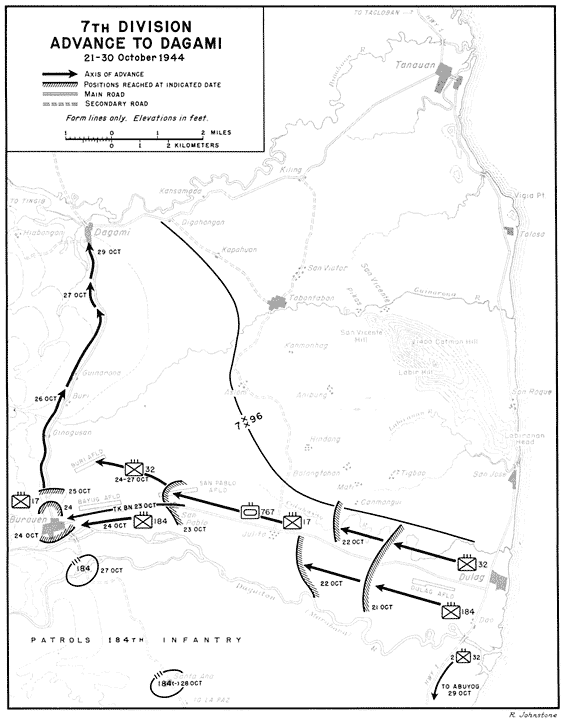
MAP 8 R. Johnstone
7TH DIVISION ADVANCE TO DAGAMI
21–30 October 1944
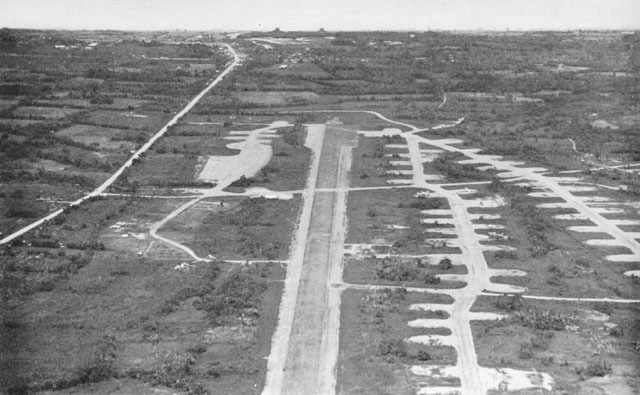
DULAG AND BAYUG AIRSTRIPS as they appeared in 1946. Dulag is above.
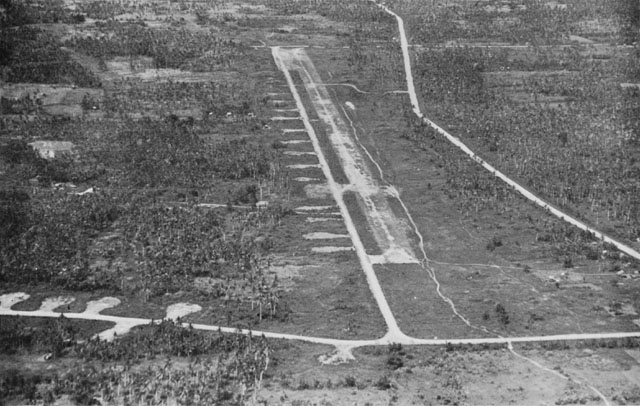
Halfway to Burauen
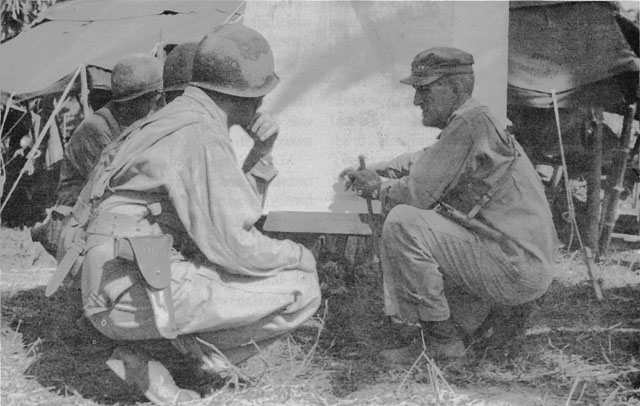
MAJ. GEN. JOHN R. HODGE, XXIV Corps commander, outlines plans to his staff at corps headquarters in Dulag.
The 7th Division had scarcely established itself for the night of 20 October when the Japanese launched two small-scale tank attacks against the perimeter of the division. Since a gap existed between the 184th and 32d Infantry Regiments, Company G of the 184th was committed to fill the space. As the men of the company were digging in for the night, three tanks from the 7th Independent Tank Company came down the road and sprayed the area with machine gun fire, but the fire was high and there were no casualties. Though the company fired rifles, bazookas, and mortars against them, the tanks escaped without injury. An hour later, when one of the tanks returned, it was knocked out and its crew were killed by a rifle grenade. An enemy scout car then dashed down the road, and its occupants killed two men and wounded three others.
As the 2d Battalion, 32d Infantry, moved forward, it encountered Japanese entrenched in positions along the hedgerows. Knocking out these positions from hedgerow to hedgerow greatly retarded the advance. The 3d Battalion on the left faced an impassable swamp. In order to establish contact with the 184th Infantry and cover the area, Company I moved around the left side of the swamp, and Company L went around the right; Company K was to cover the gap between the 2d and 3d Battalions until the 2d Battalion could close it.
There was an enemy strong point between the 2d and 3d Battalions of the 32d Infantry, but since Colonel Logie was anxious to continue the advance of the regiment and straighten the line between the battalions, he ordered the battalions to bypass the strong point, while the 1st Battalion under Maj. Leigh H. Mathias was ordered to move from its assembly area and reduce it. The lines were straightened somewhat, but the swamps and the heavy foliage made contact very difficult.
Both companies were halted. The struggle resolved itself into a battle between the tanks and the Japanese in entrenched positions. The tanks finally silenced the enemy, and the infantrymen moved in with rifles and bazookas and cleared out the foxholes. After the reduction of this strong point, the 1st Battalion tried to overtake the 2d and 3d Battalions. This was not possible, and at 1800 the 1st Battalion formed its own perimeter.
On 21 October an unidentified Japanese soldier wrote in his diary:
Finally the enemy’s gunfire and bombardment has reached our field and road area (except the runway). Gunfire seems to fade to Dulag area during the night. It seems that enemy tanks are approaching San Pablo vicinity. We are preparing for them.... Barracks and fuel dumps are to be burned. I am awaiting the opportune moment....
During the night of 21–22 October all field artillery battalions delivered harassing fires, and just before the assault they fired a fifteen-minute barrage.
In the meantime the 1st Battalion overtook the others and at 1000 moved to the right of the 3d Battalion, bringing the three units into line. Earlier, at 0925, the 3d Battalion was advancing just to the right of the Dulag-Burauen road when it received enemy artillery fire, which came from four 75-mm. field pieces to the rear of a hedgerow 600 to 700 yards ahead. When the companies reached the hedgerow, Company L received heavy fire from four machine guns which had been emplaced to protect the field pieces.
Light machine guns and mortars were brought up, and the 31st Field Artillery Battalion placed a five-minute concentration on the enemy strong point. Three tanks from Company C, 767th Tank Battalion, were poised for an assault. As soon as the artillery lifted its fire, the tanks dashed forward and destroyed one machine gun and one 75-mm. field piece immediately. The tanks then covered the rest of the area with machine gun fire until Company L moved up and destroyed the remaining gun positions with rifles and grenades. The action ended at 1240.
As the 3d Battalion, 32d Infantry, was destroying the artillery position, Company G of the 2d Battalion received heavy enemy machine gun and rifle fire near the banks of the Calbasag River. The 3d Platoon of Company G walked into an ambush of machine guns, which fired from two pillboxes under native shacks. The platoon was pinned down, having suffered ten casualties from the first burst of fire. To keep the advance moving, Company G remained behind to knock out the bunkers while Company F went forward to continue the advance with Company E. Since the swamps prohibited the use of tanks, and the mutually supported pillboxes prevented envelopment, and since the nearness of friendly troops made the use of artillery dangerous, all of Company G was held up. The 3d Platoon hugged the ground until darkness enabled it to withdraw.
Changes in Plans
On the evening of 22 October both General Makino, commander of the 16th Division on Leyte, and General Arnold, commander of the 7th Division, made changes in their plans.
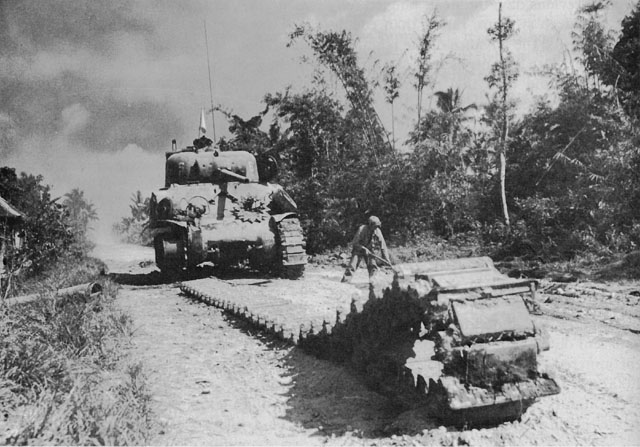
DISABLED M4 TANK on the Dulag-Burauen road.
On to Burauen
The flying wedge was very successful. The tanks of the 767th Tank Battalion moved out at 0730 on the morning of 23 October. Though one of the tanks was knocked out about 3,000 yards west of Julita at 1000, the others reached the western edge of Burauen at 1712 and scattered the enemy forces in that area. At 0800 the assault units of the 17th Infantry jumped off, 400 yards to the rear of the tank battalion. Because of the narrow front the column of troops was elongated, and it was not until shortly after 0900 that the 1st Battalion, 32d Infantry, was able to move forward. Because of the difficult terrain and the blazing heat, the infantrymen experienced difficulty in keeping up with the tanks. The troops encountered sporadic opposition during the day, passed rapidly through the barrios of Julita and San Pablo, and secured San Pablo airfield. At 1115 General Arnold notified Colonel Logie that the 32d Infantry was to be responsible for the right flank of the 7th Division’s zone of action, less the 200-yard front covered by the 17th Infantry.
Securing the XXIV Corps Beachhead Line
Burauen
The 7th Division attacked at 0830 on 24 October, using the same formation employed on the previous day except that the 1st Battalion, 184th Infantry, reverted to regimental reserve. The 1st and 2d Battalions, 17th Infantry, continued along the road to Burauen; the 32d Infantry crossed San Pablo airfield and then went to the right in a north-northwest direction toward the Buri airstrip. The 2d Battalion, 17th Infantry, fought its way through the northeastern part of the town of Burauen and managed to reach the road to Dagami. As the main part of Burauen is south and west of the road, the barrio was in the zone of the 1st Battalion, 17th Infantry, which was advancing along the left side of the road.
As the American tanks moved through the barrio, some of the Japanese jumped out of their spider holes and held explosive charges against the tanks in an attempt to destroy them at the cost of their own lives. The assault forces of the 17th Infantry, despite the difficulty of flushing the enemy from the spider holes under the buildings, made steady progress and by 1400 had mopped up and secured the town. The battalions re-formed and were ready to go north to Dagami.
The Buri Airstrip
At 0800 on 24 October, Colonel Logie was transferred to the headquarters of the 7th Division and Lt. Col. John M. Finn assumed command of the 32d Infantry. Colonel Finn ordered the 1st Battalion, 32d Infantry, to advance to positions across the San Pablo airfield and then continue the attack northwest toward the Buri airstrip. The 2d Battalion remained in division reserve.
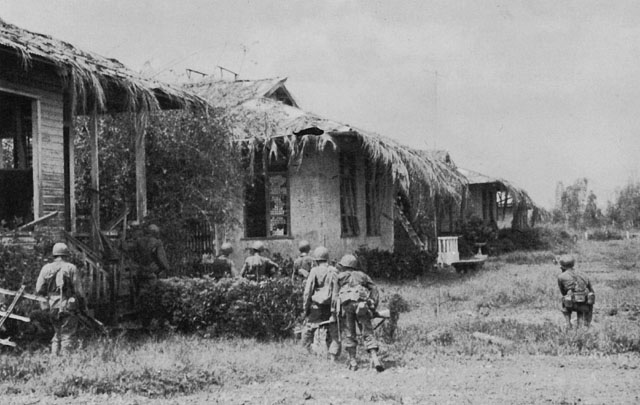
BURAUEN is searched for the enemy by troops of the 17th Infantry.
Although Company C fought valiantly to keep abreast of Company A, the bulk of the enemy strength was in front of it. Heavy machine gun fire on its left flank and in front pinned the company down and kept it from moving forward. This delay created a gap between the two companies which a platoon from Company B was ordered to fill.
When he found that Company C could not move, Major Mathias, commander of the 1st Battalion, started out to locate Company A but was wounded before he could reach it. Maj. Robert C. Foulston, Jr., the battalion’s executive officer, assumed command of the battalion as Major Mathias was evacuated.
Intense enemy rifle and machine gun fire hit both of the flanks and the front of Company C and forced the company to start a confused withdrawal. The 2d Platoon pulled back, but four of its men were cut off from the others and went the wrong way. These men, picking up another who was seriously wounded, proceeded three quarters of a mile behind the Japanese lines before they discovered their mistake. To cover the withdrawal of the rest of the company a holding force, consisting of one platoon from Company C and one platoon from Company B, together with a section of heavy machine guns, was set up about 500 yards to the rear of Company C.
As Company C started its withdrawal, the enemy moved forward. Keeping well concealed, the Japanese edged forward and laid down a heavy volume of rifle, machine gun, and mortar fire on the troops, but the holding force stopped the advance. An intense fire fight broke out in which both sides suffered many casualties. The Americans held on grimly.
At 1530 Colonel Finn ordered the 3d Battalion, 32d Infantry, to move to the left of the 1st Battalion, but the swamps and heavy foliage made progress slow. By 1630 the 3d Battalion was 600 yards to the left rear of the 1st Battalion.
At 0830 the battalions attacked, both advancing 1,500 yards before they encountered any serious obstacle. The 2d Battalion on the right ran into the system of bunkers that protected the Buri airstrip. The 3d Battalion halted and waited for the 2d to overcome the bunkers and move forward. Though an antitank gun was brought up to fire on the bunkers, two futile attacks were launched against them and it became apparent that the 2d Battalion would be considerably delayed. Colonel Finn therefore ordered the 3d Battalion to advance and secure the edge of the Buri airstrip, and, with its reserve company, to close the gap thus created.
Meanwhile the 2d Battalion probed at the bunkers located at the edge of the heavy woods on the northern fringe of the Buri airfield. These defenses consisted of three bunkers connected by an elaborate system of trenches and spider holes. Both flanks of the 2d Battalion received machine gun fire, which became heavier upon any attempt to carry out an enveloping movement. Under cover of fire from American heavy machine guns, the 2d Battalion withdrew its wounded. It then formed a night perimeter and waited for heavier supporting weapons to be brought up.
On the morning of 26 October, the 49th Field Artillery Battalion for ten minutes concentrated its fire for 500 yards on each side of the airstrip. At 0800 the 32d Infantry attacked. The artillery fire had been effective, and the 2d Battalion knocked out the pillboxes that had stopped its advance the previous day. Aided by tanks, the battalion was able to advance 700 yards along the south side of the airstrip by 1700.
Company B bore the brunt of the assault and, fighting tenaciously, had battled through 900 yards of the fortified area by 1700. The 1st and 2d Battalions made contact on the edge of the airstrip and formed their night perimeters; the 3d Battalion protected the rear. During the night the 32d Infantry repulsed several light counterattacks.
On 28 October the 2d Battalion was alerted to move to Abuyog at 0400 on the following day. The 3d Battalion was ordered to move to Guinarona for possible attachment to the 17th Infantry, which had committed all three of its battalions in the fight north along the Burauen-Dagami road.
On to Dagami
About 1530 the right flank of the 17th Infantry came under mortar and machine gun fire which came from a ridge north of Burauen and east of the road to Dagami. The ridge was about 700 yards long, 50 feet high, heavily wooded, and covered with dense undergrowth. Most of the fire seemed to be coming from an eastern spur that overlooked the Bayug and Buri airfields. On the left (west) of the road the terrain was flat and marshy.
At 1630 the 17th Infantry began to form its night perimeter on the southern edge of the ridge. The 1st Battalion protected the left (west) flank and tied in at the road with the regiment’s 2d Battalion. The lines of the 2d Battalion, 17th Infantry, covered the forward line of the ridge that extended to the rear where the 2d Battalion, 184th Infantry, held the entrance to the eastern finger. The perimeter of the 2d Battalion, 184th Infantry, extended south to tie in with the 1st Battalion, 17th Infantry.
Only the 1st Battalion, 17th Infantry, was able to set up its night perimeter without incident. The 2d Battalion, 184th Infantry, ran into determined resistance but was able to establish a firm bivouac for itself, using the vacated enemy positions. The 2d Battalion, 17th Infantry, received scattered rifle fire but did not encounter any of the enemy. During the night the 2d Battalion, 184th Infantry, and the 2d Battalion, 17th Infantry, were harassed by patrols of ten to twenty Japanese each, probing for a break in the lines.
Shortly after nightfall there were two abortive charges against the American lines. As soon as the troops heard the enemy, they called for protective fire, which prevented any of the Japanese from entering the lines. The enemy, however, continually fired into the area throughout the night. Earlier in the day an American tank had bogged down in a swamp to the left of the road, and the crew was forced to abandon it under fire, leaving the guns intact. During the night the Japanese captured the tank and sprayed the areas of the 1st Battalion, 17th Infantry, and the regimental command post with the tank’s 37-mm. and machine guns, and with four of their own machine guns. Fortunately the bullets passed harmlessly over the heads of the troops.
During the night Lt. Col. Francis T. Pachler discussed plans for the following day, 25 October, with his battalion commanders. He was faced with a choice between two courses of action. On the one hand, he could take advantage of the tactical surprise occasioned by his rapid advance, attempt to bypass the Japanese forces on the ridge, and make a dash along the Burauen-Dagami road, disregarding losses that might be inflicted on his flank; or, on the other hand, he could destroy the enemy forces on the ridge before advancing to Dagami. The first alternative must allow for a strong possibility that fire from the 32d Infantry, which was pushing west, might fall upon the 17th Infantry if it continued its advance before the Buri airfield was secured. After prolonged discussion, Pachler decided to destroy the enemy forces on the ridge before proceeding to Dagami.
Colonel Pachler therefore ordered the 1st Battalion, 17th Infantry, to remain in its present position until the 2d Battalion, echeloned to its right rear, could swing up on line facing north. While waiting for the 2d Battalion to move up, the 1st Battalion would send a strong reconnaissance patrol along the road north to the barrio of Buri to determine Japanese strength, and the condition of the road and terrain. The 2d Battalion, 184th Infantry, would attack and destroy the enemy force on the finger of the ridge and then come up, also facing north.
The patrol moved out at 0730 on 25 October. A rifle platoon mounted the tops and sides of five tanks and headed north towards Buri. On its way, the platoon encountered and killed Japanese troops who were emplaced in spider holes and coconut log pillboxes under buildings, but a destroyed bridge at the edge of Buri prevented any further advance. The platoon returned at nightfall with the report that the road to Buri was clear and that it had killed forty-nine of the enemy.
The 2d Battalion, 17th Infantry, made its move without incident. The 2d Battalion, 184th Infantry, advancing from its position on the heavily wooded eastern finger of the ridge, was forced to meet and destroy the enemy force with bayonets and grenades. Its progress was slow until a platoon of the Cannon Company and a platoon of medium tanks made a wide encircling movement through the Bayug airstrip and were able to bring fire to bear on the Japanese. By 1300 the enemy threat was removed and the battalion commenced its swing to the north to join the other two battalions. At dusk the three units were in line; the combat teams had advanced 400 yards and formed their night perimeters.
The 1st Battalion, 17th Infantry, moved out at 0700, Company A on the left (west) and Company C on the right (east). Since the tanks were forced to remain on the road because of swamps on either side, tank support was reduced to a platoon. After having moved about 300 yards beyond the line of departure, Company C ran into a small pocket of enemy resistance which it soon destroyed with hand grenades and small arms fire; twenty-one of the enemy were killed and one was captured. Company A also met and overcame some resistance from enemy in foxholes in its zone, but was not held up. At 1000 the 1st Battalion received machine gun fire to its front and observed a movement in the marsh on its right flank. When the heavy machine guns and 81-mm. mortars were brought to bear upon the marsh, approximately sixty Japanese began to run across the open fields. The 4.2-inch mortars of the 91st Chemical Company also fired on the fleeing enemy.
When the forward elements were about 1,100 yards south of Ginogusan, Company A encountered a rice paddy to its front. One platoon of the company went left to move around the rice field, and the support platoon was committed to close the gap thus created. As the leading elements got past the field, an enemy force, which was entrenched just beyond it, started firing. The rear elements of the 1st Battalion immediately closed in and killed fifteen of the enemy with grenades and small arms fire. In the meantime, Company C encountered about twenty-five Japanese who had dug in under native shacks. Two tanks were called up, and after they had knocked over the shacks the infantrymen closed in and destroyed the enemy.
During this action the 3d Platoon of Company F, 2d Battalion, 17th Infantry, reinforced by one squad of the antitank platoon of the battalion Headquarters Company, established a roadblock on one of the roads that led to the Buri airfield. The troops came under rifle and machine gun fire from their front. Within a few minutes the platoon leader and two other men were killed and another man was wounded. The platoon withdrew about one hundred yards and called for an 81-mm. mortar concentration on the area. The rest of Company F was committed against the Japanese south flank.
In the face of heavy fire Company F pushed through the difficult terrain and forced the enemy to withdraw. However, four Japanese machine guns remained in position and fired into the company. The leader of the antitank squad, though wounded in both legs, ran back to the battalion command post and asked for tanks in support. A cannon platoon which was sent up silenced the enemy guns. While continuing the fight during the enemy withdrawal, the company evacuated its wounded on improvised bamboo litters.
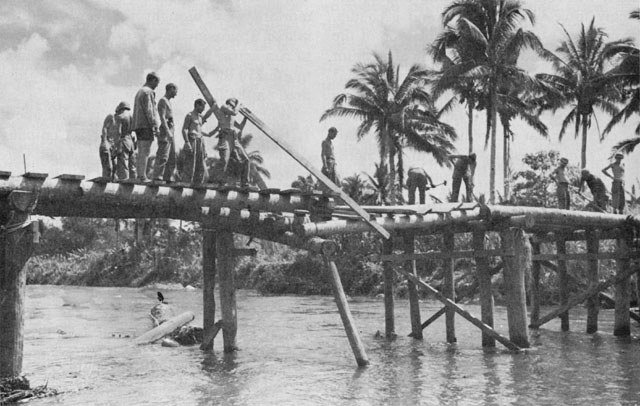
ENGINEER TROOPS of the 13th Engineer Battalion rebuild a bridge near Burauen.
At 0700 the regiment moved out, with the 3d Battalion in the lead, on a 100-yard front on both sides of the highway. The tanks were forced to stay on the road. The 3d Battalion was able to cross a small stream south of Guinarona, although the bridge had been damaged. When it reached the northern bank of the stream the battalion ran into the enemy. Approximately twenty Japanese were dug in around a schoolhouse, with two machine guns mounted in the building. Company K, the lead company, under cover of machine gun and mortar fire, successfully stormed the schoolhouse and killed seventeen of its defenders. The engineer troops from the 13th Engineer Battalion advanced and quickly repaired the bridge, after which the rest of the 17th Infantry moved forward. Since the bridge north of Guinarona was also damaged, the same tactics were used. The infantrymen of the lead company crossed the stream and stood guard while the engineers repaired the bridge. For 2,500 yards the advance continued, unopposed except for small groups of Japanese. The heavy machine guns of the regiment fired from the flanks of the American forces and covered the swamps on both sides of the road. The 17th Infantry went into night perimeter about 2,200 yards south of Dagami and about 200 yards south of a demolished stone bridge. As the regiment started to dig in, enemy rifle and machine gun fire fell on the front of the 3d Battalion but mortars returned the fire and silenced the enemy. Although there was sporadic air and ground activity during the night, no attempt was made to penetrate the lines of the regiment.
Entrance Into Dagami
As the American forces came close to Dagami, the 17th Infantry was moving north along the Burauen-Dagami road, and the 382d Infantry, 96th Division, was approaching the road between Dagami and Tanauan.
At 0730 the 2d Battalion attacked and immediately met very strong opposition. The stone bridge and road were in the middle of a strip of waist-deep swamp 100 yards wide, which funneled out to form a larger swamp. A crescent-shaped coconut grove lay beyond the swamp, one end in front of the road and the other bent to the south about 800 yards west of the road. The road and the curve in the coconut grove divided the swamp into three segments—one on each side of the road, and the third west of and parallel to the road. In the face of intense rifle, machine gun, and mortar fire coming from an unknown number of Japanese, Company F and three tanks managed to cross the creek. The tanks continued north up the road. As Company F waded through the waist-deep swamp, it pushed through direct enemy fire and past a large tank trap and found a line of pillboxes to its front and left flank.
The company commander ordered his unit to hold its position and then returned south of the bridge to bring up more tanks. The 1st Platoon of Company F moved to the left rear to protect that flank, which was receiving considerable enemy fire. As the company commander rushed back to get the tanks, about twenty Japanese attacked the 1st Platoon in an attempt to envelop the left flank of the company. The platoon leader ordered his men to hold their fire until the enemy was only five yards away, and nearly all of the Japanese were killed in the initial volley. The platoon held its ground to prevent any further enveloping attempts by the Japanese. Meanwhile, Company F’s commanding officer found that no tanks were available, since they could not cross the weakened bridge. He returned to Company F and ordered it to retire to the tank trap, reorganize, and evacuate the wounded.
In the meantime, in order to relieve the pressure on Company G (on the right), which had run into somewhat the same situation, Lt. Col. William B. Moore, the battalion commander, committed Company E to the right (east) flank. Company E initially encountered determined opposition but managed to flank the enemy and assist Company G in its sector. At the same time the engineer troops of the 13th Engineer Battalion, working feverishly under heavy fire, tried to repair the damaged bridge. One of the armored bulldozers lost three drivers, successively, to enemy fire.
Under the close supervision of Colonel Moore, who was in the front lines, the 2d Battalion pressed the attack. Two M8 armored cars were brought wide around the right flank in order to avoid the swamp. With their aid, Companies E and G rolled up the east flank of the 20th Infantry Regiment and broke through the pillboxes in their own area.
Company C was committed to the left of Company F in order to aid it. Although this move was partially successful, Company C found itself pinned down by an enemy force entrenched in pillboxes and zigzag trenches. Since the Japanese defense line extended beyond the regiment’s left (west) flank and around it to the south, Company B was committed further left to hit the southern flank of the enemy. Although Company B could not break through the line, it was able to locate the enemy right flank and neutralize the fire on that flank.
One of the three tanks that had gone north in the morning returned at 1400 and was guided into the sector of Company F. With all of its guns blazing, the tank broke through the enemy fortifications, and Companies C and F were then able to move in and mop up the enemy. The other two tanks had gone up the road some 250 yards when they met antitank fire which completely destroyed one and immobilized the other, trapping its crew. As soon as the bridge was made passable, two M8’s, a medium tank, and a squad from Company F were sent to rescue the trapped crew. While the medium tank and the infantry covered the damaged tank, the M8’s drew up to it and allowed its crew to escape into their open turrets. The detail withdrew, having suffered no casualties, and the immobilized tank was then destroyed.
Since the 2d Battalion had borne the brunt of the fighting on 28 October and had suffered numerous casualties, the regimental commander decided to have the battalion drop back into reserve. Although the drive to Dagami was to continue, the north-south line of enemy pillboxes on the left flank of the regiment could not be ignored. At 0800 on 29 October the regimental lines were to be reorganized so that the 3d and 1st Battalions, less Company B, would pass through the 2d Battalion, which would become the regimental reserve. Company B with a platoon of M8’s would attack the flank and rear of the enemy in the left line of pillboxes.
At 0800, under cover of a heavy artillery concentration from the 49th Field Artillery Battalion, the 1st and 3d Battalions, 17th Infantry, passed through the 2d Battalion without incident. Company B, reinforced by the platoon from the Cannon Company, moved out to destroy the enemy force on the regiment’s left flank. The company fought the Japanese from pillbox to pillbox, catching the enemy on his flanks and rear by rifle and machine gun fire, together with time-burst fire from the self-propelled howitzers. This completely demoralized the Japanese, some of whom threw down their arms and tried unsuccessfully to escape. More than 120 enemy dead were counted in the area. The 1st Battalion entered the southern part of Dagami without encountering serious resistance. It then came under artillery fire from the hills west of the town.
The 3d Battalion proceeded east of the road in a column of companies in the order L, K, and I, and met no serious opposition until it reached a cemetery south of Dagami. Overgrown with weeds seven to ten feet high and containing stone crypts built off the ground, the cemetery was divided by a path running east to west. As Company L moved into the burial ground, Company I swung around the right (east) side to come into position for the night. The leading elements of Company L passed through the cemetery and Company I moved into position without incident, but as the 1st Platoon of Company L, the reserve platoon, crossed the path, a headstone tilted back and from the open grave four Japanese opened fire with an American Browning automatic rifle and other small arms. The small arms of the 1st Platoon had no effect and it became necessary to bring forward a flame thrower to burn the enemy out. At the same time the platoon received fire from other open graves, from which the Japanese had removed the bodies. By punching holes through the stone they used the crypts as individual foxholes. The platoon broke into small units and pushed through the cemetery, destroying the enemy forces wherever they could be located.
Company K, which followed Company I, placed two platoons abreast behind Company L. As it came through the weeds past the cemetery path a Japanese officer charged on the right flank with his saber and wounded one man before he could be brought down. Since the platoons were also receiving heavy fire from the tombs, the commander of Company K drew his men back to the path where they reorganized. Preceded by a battery of six flame throwers, the men then marched shoulder to shoulder through the cemetery and burnt out the enemy. About 1900 the regiment completed the action and formed its night perimeter.
By 1040 on 30 October Dagami was securely in American hands, and the 17th Infantry continued to mop up for the rest of the day. The 19th Infantry Regiment of the 24th Division, X Corps, across the Binahaan River north of Dagami, was reached by an airdrop message from the artillery spotter plane, and patrols reached the 382d Infantry of the 96th Division on the east. The mission of the 17th Infantry Regiment—securing the town of Dagami and effecting junction with the X Corps and the 96th Division—was completed. The regiment spent the next two days in mopping up and patrolling the area around Dagami.
The 7th Division had secured the limits of its beachhead line, but the southern approaches to the line had not yet been secured. The road farther south, running across the island from Abuyog on the east coast to Baybay on the west coast, offered a potential route along which the Japanese might pour in reinforcements.
At 0530 on 29 October the 2d Battalion, 32d Infantry, left Burauen for Abuyog via Dao and the coastal road, Highway 1. Its progress was impeded by muddy roads and the previous destruction of the bridge over the Bito River. The battalion, less one company, crossed the river by DUKW’s at 0940 and by 1000 was in Abuyog, having encountered no Japanese. The 7th Cavalry Reconnaissance Troop, acting as an advance guard for the battalion, pushed west from Abuyog inland four miles on the road toward Baybay.
On 30 and 31 October the 2d Battalion, 32d Infantry, remained at Abuyog, but on the latter day it sent Company G, reinforced, toward Baybay on the Abuyog-Baybay road, which corkscrewed through the mountains for about twenty-seven miles between the east and west coasts. The company encountered no Japanese. On 1 November no forward progress was made, but all elements of the 2d Battalion, 32d Infantry, patrolled. On 2 November Company G moved along the road and closed in on Baybay at 2200.
The initial mission of the 7th Infantry Division—to land between the Calbasag and Daguitan Rivers, advance rapidly inland along the axis of the Dulag-Burauen road, seize hostile airstrips in its zone of action, secure the Burauen-Dagami road, and protect the XXIV Corps’ left (south) flank—had been accomplished.
By 2 November, General Hodge’s XXIV Corps had finished its assigned role for the second phase of General Krueger’s plan for the capture of the island of Leyte. It had seized the southern part of Leyte Valley with its important roads, airfields, and potential base sites. An element of the corps had pushed to the west coast of the island, and was preparing for the move toward the important port of Ormoc as part of the third phase of the plan. General Makino had been forced to give up his Dagami headquarters and other positions on the heights overlooking the town. Far to the north, the X Corps was engaged in securing the northern part of Leyte Valley.