Chapter XXI · Westward to the Sea
Reading edition
The northwestern mountains of Leyte west of Ormoc Bay provided a difficult barrier to any movement toward the northwest coast. The area was the last one available to the Japanese either for escaping from Leyte or for staging defensive actions. In general, the terrain was rough, increasing in altitude from broken ground and low hills in the north to steep rocky ridges and high hills in the south. The northern part was either under cultivation or covered with cogon grass. Toward the south, the cultivated fields and grasslands were gradually supplanted by dense forests.
When the 77th Infantry Division and the 1st Cavalry Division joined forces on 21 December just south of Kananga, Highway 2 between Ormoc and Pinamopoan was opened to the Americans. The Sixth Army, anxious to deliver the coup de grâce, arranged its troops for a four-division thrust to the west coast on a long front. In the south the 77th Division was to drive west along the Palompon road. To its right (north) there would be, from left to right, the 1st Cavalry Division and the 32d and 24th Infantry Divisions. The Sixth Army had started the Leyte Campaign with two corps on a four-division front and was ending its part in the campaign with two corps on a four-division front.
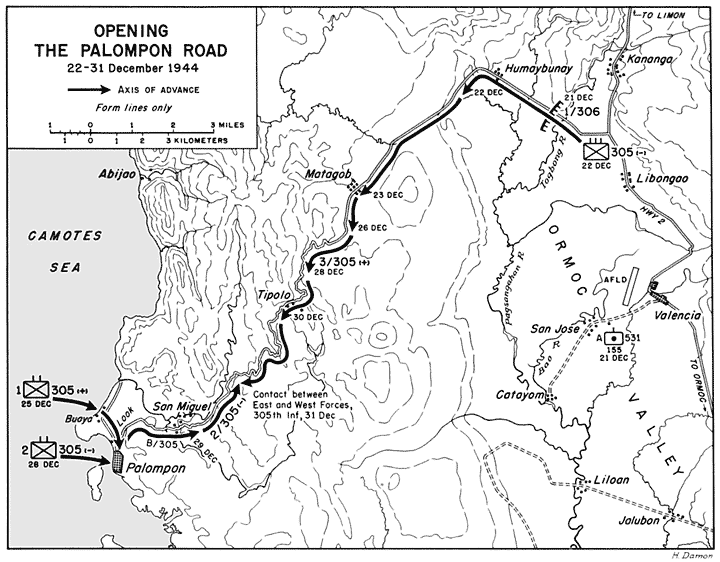
MAP 23 H. Damon
OPENING THE PALOMPON ROAD
22–31 December 1944
The 77th Division Goes West
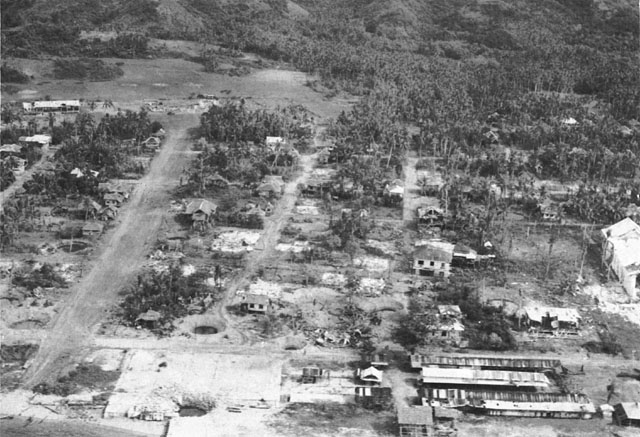
PALOMPON AFTER ALLIED BOMBINGS. Note bomb craters in foreground.
The vessels took position off the landing beaches on the morning of 25 December. After the 155-mm. guns of the 531st Field Artillery Battalion had fired from positions near San Jose, twelve and a half miles east of Palompon, the mortar boats of the 2d Engineer Special Brigade softened up the beaches. The landing waves then started for the shore, the first wave landing at 0720 and the last one at 0755. They received no hostile fire.
The Palompon Road
The Palompon road wound through the mountains and crossed many rivers, over which some forty bridges would have to be built or repaired. It ran northwest two and a half miles from the Togbong River to the barrio of Humaybunay and then cut sharply to the southwest for about four miles to Matagob, at which point it went into the hills almost directly south for about 2,000 yards, and then turned south-southwest for 1,000 yards. At this point it turned and twisted to the southwest for approximately five and a half miles to the vicinity of San Miguel, from where it arched 3,500 yards to Look, on the Camotes Sea.
The Japanese had pockmarked Matagob and the area surrounding it with foxholes and emplacements and had dug spider holes under the houses. South of Matagob, where the road climbed into the hills, the enemy had utilized natural caves, gullies, and ridges on both sides of the road and dug many deep defensive positions. Some of these were eight feet deep, two feet in diameter at the top, and widened to six feet at the bottom. The Japanese had emplaced machine guns in culverts and had constructed several well-camouflaged coconut log pillboxes on the forward slopes of the ridges. An excellent, almost invisible installation, which served as an observation post, was dug in on the forward slope of a ridge about three miles north of San Miguel. It had a concealed entrance on the reverse slope. From this post eight miles of the road to the north and east could be observed.
The Japanese 5th Infantry Regiment was the principal enemy unit in the sector, although remnants of other units retreating west from Highway 2 were in the area. The following Japanese units were identified: 1st, 3d, and 6th Batteries of the 8th Field Artillery Regiment; elements of the 8th Division Signal Unit; the 8th Transport Regiment; and the 8th Engineer Regiment. Although intelligence officers estimated that there were between 2,000 and 3,000 enemy troops in the sector, only a force of about battalion strength opposed the 305th Infantry. The rest had scattered into the hills to the northwest.
At 0700, on 22 December, the 2d Battalion, 305th Infantry, left Valencia followed at 1035 by the 3d Battalion. The 2d Battalion crossed the Togbong River, moved through the 1st Battalion, 306th Infantry, and at 1030 attacked along the Palompon road. The battalion had advanced 1,600 yards northwest by 1230 and secured the Pagsangahan River crossing. The assault continued with the 3d Battalion coming up on the right flank of the 2d. The battalions moved through rice paddies and through Humaybunay and established a night perimeter about one mile southwest of the barrio.
At dawn on 27 December the 3d Battalion moved around the Japanese left flank toward the high ground six hundred yards from the line of departure. Despite enemy artillery and machine gun fire and the difficult terrain, the battalion reached the objective, killing 160 Japanese. The remainder fled to the hills.
At 0800 on 29 December, the 3d Battalion moved out. The battalion had advanced 650 yards at 1000 when it encountered very determined resistance from an enemy force in very well camouflaged, dug-in positions. The troops were pinned down for the rest of the day. The Provisional Mountain Force moved out of Look at 1200 to a position from which it could launch its assault eastward along the road.
X Corps Goes West
The 1st Cavalry Division
With the clearing of Highway 2 and the junction of the X and XXIV Corps at a point just south of Kananga, the 1st Cavalry Division was in readiness to push toward the west coast in conjunction with assaults by the 77th Division on its left and the 32d Division on its right. The troops were on a 2,500-yard front along Highway 2 between Kananga and Lonoy.
On the morning of 23 December the assault units of the 1st Cavalry Division moved out from the highway and started west. None encountered any resistance. The 1st Squadron, 12th Cavalry, established a night perimeter on a ridge about 1,400 yards slightly northwest of Kananga. The 1st Squadron, 5th Cavalry, set up a night perimeter 1,000 yards north of that of the 1st Squadron, 12th Cavalry, while the 1st Squadron, 7th Cavalry, dug in for the night on a line with the other two squadrons.
This first day’s march set the pattern for the next several days. The regiments pushed steadily forward, meeting only scattered resistance. The chief obstacles were waist-deep swamps in the zone of the 12th Cavalry. These were waded on 24 December. The tangled vegetation and sharp, precipitous ridges that were henceforward encountered also made the passage slow and difficult.
On 28 December, the foremost elements of the 5th and 12th Cavalry Regiments broke out of the mountains and reached the barrio of Tibur on the west coast, about 2,800 yards north of Abijao. (See Map 2.) By nightfall on the following day, the 7th Cavalry was also on the west coast but farther north. In its advance it had encountered and destroyed many small, scattered groups of the enemy, most of whom showed little desire to fight. The regiment arrived at Villaba, two and one-half miles north of Tibur, at dusk, and in securing the town killed thirty-five Japanese.
During the early morning hours of 31 December, the Japanese launched four counterattacks against the forces at Villaba. Each started with a bugle call, the first attack beginning at 0230 and the final one at dawn. An estimated 500 of the enemy, armed with mortars, machine guns, and rifles, participated in the assaults, but the American artillery stopped the Japanese and their forces scattered. On 31 December, the 77th Division began to relieve the elements of the 1st Cavalry Division, which moved back to Kananga.
On the morning of the 30th of December, the 7th Cavalry had made physical contact northeast of Villaba with the 127th Infantry, 32d Division, which had been driving to the west coast north of the 1st Cavalry Division.
The 32d Division
Both the 127th and 128th Infantry Regiments sent out patrols on 23 December to reconnoiter the terrain. At 0800 on 24 December the two regiments started for the west coast. Throughout the march to the sea, they encountered only small parties of the enemy, who put up no effective resistance, but heavy rains, dense, almost impassable forests, and steep craggy hills slowed the advance.
The commanding officer of the 127th Infantry said of the hills encountered on 24 December:
The hills were less rugged from then on. On the morning of 25 December, the 1st Battalion, 127th Infantry, encountered and dispersed 300 to 400 Japanese. Throughout the march both regiments received supplies by airdrop, which was not completely satisfactory since none of the drops was made at the requested time and frequently there was a wide scattering of supplies.
The 24th Division, after having been relieved by the 32d Division on Breakneck Ridge, had protected the rear areas on a trail leading from Jaro to Ormoc. Two weeks before the march to the west coast a large Japanese convoy had been attacked by U. S. aircraft and forced into San Isidro Bay on the northern part of the west coast. Although the vessels were destroyed, some of the troops were able to get ashore. On 9 December they headed toward Calubian, on Leyte Bay about six miles northeast of San Isidro. General Woodruff, who had replaced General Irving on 18 November, ordered Colonel Clifford’s 1st Battalion, 34th Infantry, which had been defending Kilay Ridge, to wipe out the part of the enemy force that had landed at San Isidro and fled northeastward to the vicinity of Calubian.
At 2300 on 21 December, Colonel Clifford notified Colonel Dahlen, the commanding officer of the 34th Infantry, that a Japanese force of about 160 men was at Tuktuk, about four miles south of Calubian. He added that at 0800 on the following morning the 1st Battalion would move out and destroy the force.
At 0300 a force consisting of a platoon from Company C and a platoon from Company A moved toward the high ground northwest of Tuktuk in preparation for the assault, but because of very poor trails the force was delayed. In the meantime four LVT’s with a platoon of mortars moved overwater to Tuktuk. At 0830 the attack started, with machine guns mounted on the LVT’s and mortars furnishing supporting fire. The Japanese resistance was sporadic, although some mortar fire was received. As the troops of the 34th Infantry neared the barrio, the enemy defenders broke and fled, and the town was deserted as the soldiers entered. Approximately thirty enemy dead were counted in the barrio and vicinity. The fleeing enemy force was later destroyed by patrols that worked over the sector. The Japanese had obviously been looting because linens, silverware, and women’s clothing were found in their packs. One soldier had a baby’s high chair tied on the top of his pack.
On 23 December, Col William W. Jenna, former commanding officer of the 34th Infantry, returned from sick leave in the States and assumed command of the 34th Infantry. With his arrival plans were expedited to clean up the northwestern end of the Leyte peninsula in conjunction with the assaults of other units of the Sixth Army.
From 23 to 26 December, extensive patrolling was conducted along the west coast of the Leyte peninsula. On 26 December the 34th Infantry issued orders for clearing the part of the Leyte peninsula in its zone. The 1st Battalion was to secure all trails and high ground in the interior, prevent any enemy movement to the north and to the east, and, finally, be prepared to assist the 2d Battalion in the capture of the San Isidro Bay area.
At 2245 on 26 December the LCM’s at Villalon (a barrio on Biliran Strait and about six miles northwest of Calubian) began to load Companies F and G. By 2300 the embarkation was completed and the craft moved to Gigantangan Island, arriving there fifteen minutes after midnight. The troops disembarked and slept. At 0530 they again embarked and proceeded to Taglawigan, arriving there at 0730. After strafing the shore the companies landed, meeting no resistance. At the same time Company F completed its assignment without opposition, pushing east and south and encircling Taglawigan. Before noon, some elements of the 2d Battalion were moving overland to Daha, about two miles to the south, while others had re-embarked and were making an overwater movement toward it. By noon Taglawigan and Daha had fallen to the 2d Battalion.
Company G, reinforced, left Company F at Daha, re-embarked on the landing craft, and headed toward the San Isidro Bay area, 6,000 yards to the south. As the convoy neared San Isidro, it came under machine gun fire from the barrio and the hills to the southwest. A frontal attack on the town was abandoned and the landing craft moved to the southwest of the jetty to make their landing. The LVT’s mired in the mud about 100 to 150 yards offshore. The rest of the force, which was in the LCM’s, waded ashore. Some of the troops from the LVT’s met with great difficulty in trying to get ashore but the LVT’s finally succeeded in retracting and picked them up. Approximately 150 soldiers with supplies for the task force returned to Gigantangan Island. The convoy had only one casualty.
In the meantime, the 1st Battalion had received orders at 1300 to take San Isidro. The battalion moved overland from Calubian and at nightfall it dug in on the high ground overlooking San Isidro.
At 0800 on 28 December, the co-ordinated assault was made against San Isidro, with elements of the 2d Battalion attacking from the north while the 1st Battalion attacked from the east. The troops encountered light resistance, the Japanese defenders being only partially armed. Fifty-five of the enemy were killed and one prisoner was taken. By 1230, the 1st Battalion was out-posting San Isidro.
With the capture of San Isidro, the last main point on the Leyte peninsula was safely in the hands of the 34th Infantry. The troops moved south along the coast and destroyed small, poorly equipped groups of the enemy. One group of Japanese, whose only weapons were bayonets attached to bamboo poles, tried hopelessly to break through the lines.
On 1 January 1945, the 77th Division was ordered to relieve the 32d and 24th Infantry Divisions and the 1st Cavalry Division. The relieved divisions were to move to staging areas and prepare for future operations.
The Japanese Retreat
Condition of Japanese Forces
Withdrawal Plans
1. Supply a. Rations (1) Turkey ration—distribution from Valencia ration dump at 0900, 25 Dec 1944. Ration and mess personnel will exercise great care and speed in handling turkey and keep covered at all times. (2) Organization commanders will serve turkey to every man in this command on 26 Dec 1944. The Division commander has made arrangements for air drop to troops located in areas not accessible by road.