Chapter I · The Strategic Plan
Reading edition
The primary purpose of the Leyte Campaign was to establish an air and logistical base in the Leyte area in order to support operations in the Luzon-Formosa-China coast area and particularly to nullify Japanese strength in Luzon. Leyte is one of the Visayan Islands, which constitute the geographical heart of the Philippines. It was hoped that the fertile Leyte Valley, broad and flat, could be utilized for major airfields and base sites from which large-scale operations could be launched against the rest of the Philippines.
Preliminary Discussion
Leyte occupies a commanding position in the Philippine Islands. Because of its central location, its repossession by the United States would not only divide the Japanese forces in the Philippines but would also provide an excellent anchorage in Leyte Gulf, together with sites for bases and airfields from which land-based aircraft could bomb all parts of the Philippines, the coast of China, and Formosa. To an even greater extent than Mindanao, Leyte could be made into an excellent springboard from which to launch subsequent operations against the Japanese in Formosa or in the rest of the Philippines.
As to the feasibility of bypassing present objectives and choosing new ones, including the Japanese home islands, the two commanders were not in complete agreement. MacArthur pronounced the concept “utterly unsound,” since the available shipping was limited to a seven-division lift and there was insufficient air support. Nimitz thought that no decision should be made until after further developments.
The proposals disturbed General MacArthur, who concluded his message to the Joint Chiefs with the following peroration:
It is my opinion that purely military considerations demand the reoccupation of the Philippines in order to cut the enemy’s communications to the south and to secure a base for our further advance. Even if this were not the case and unless military factors demanded another line of action it would in my opinion be necessary to reoccupy the Philippines.
The Philippines is American Territory where our unsupported forces were destroyed by the enemy. Practically all of the 17,000,000 Filipinos remain loyal to the United States and are undergoing the greatest privation and suffering because we have not been able to support or succor them. We have a great national obligation to discharge.
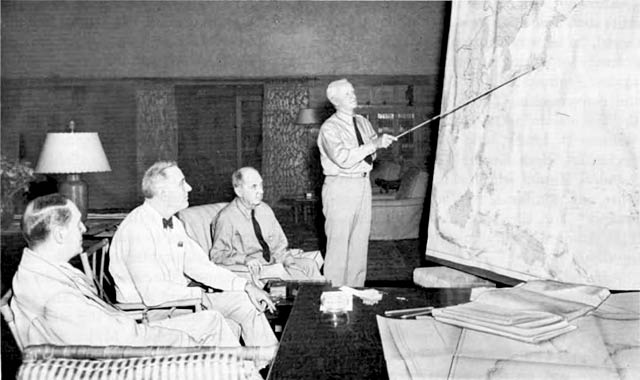
CONFERENCE AT PEARL HARBOR brings together (left to right) General Douglas MacArthur, President Franklin D. Roosevelt, Admiral William D. Leahy and Admiral Chester W. Nimitz.
The Joint Chiefs of Staff concluded that none of the currently selected objectives could be bypassed. They continued, however, to search for means by which the tempo of the war in the Pacific might be accelerated.
Strong efforts were already under way to accelerate operations in the Pacific. A shortage of shipping appeared to be the bottleneck which halted all attempts to speed up the operational target dates. General MacArthur at Brisbane had been directing the whole of his planning toward the reoccupation of the Philippine Islands, and on 10 July had issued a plan for all operations into the archipelago. According to this plan the conquest of the Islands was to be accomplished in four major phases.
Both Washington and Brisbane recognized that the operations in the Leyte-Surigao area were necessary in order to provide air bases, depot areas, and a fleet anchorage for any future advance whether in the Philippines, against Formosa, or by a direct route into the Japanese homeland. Consequently, the planners never seriously entertained any idea of bypassing this area, although they continued to probe for means which would accelerate the target date.
Plans Agreed Upon
Concurrently with the issuance of this directive, momentous events were taking place in the Pacific. Admiral Halsey was in command of scheduled operations against the Palau Islands. On 7 and 8 September aircraft from his carriers struck at Yap and the Palau Islands, against which Admiral Nimitz had scheduled operations, and for the next two days bombed Mindanao. On the 12th and 14th the bombers hit the central Philippines in support of the operations against the Palau Islands and Morotai.