← Table of contents
Leyte

Chapter IV · The Return

Reading edition

For more than two years the high command of the Southwest Pacific had anticipated the promised return to the Philippines. That objective had governed nearly all of the planning and most of the earlier invasions. Now the day had arrived. Plans had been made and troops and cargo were aboard ships. The fleets of the Pacific Ocean Areas and the Southwest Pacific Area were about to join forces in a mighty assault against the Philippines.

The Convoy Forms

That part of the VII Amphibious Force which carried the 24th Infantry Division and the Sixth Army Service Command assembled at the harbor of Hollandia, Netherlands New Guinea. In this force were over 470 ships, ranging in size from small rocket-launching craft to 5,000-man troopships, loaded and now waiting for the message to weigh anchor and head for the Far Shore, as Leyte was designated. They were scheduled to pick up that part of the force which was carrying the 1st Cavalry Division from Manus Island and then rendezvous with the III Amphibious Force.

XXIV Corps Afloat

In the early morning hours of 13 September the headquarters of XXIV Corps at Schofield Barracks, Oahu, Hawaii, was awake and active. Breakfast was served at 0330, and all men who had been informed the day before that they were to embark for an unknown shore shouldered their barracks bags and carried them to waiting trucks. By 0700 the men had been loaded on the trucks, which took them to the narrow-gauge Oahu railroad. In flat cars they traveled some twenty miles to Honolulu Harbor. The usual seeming delays followed, but eventually the hot, tired, and perspiring headquarters men boarded the George F. Clymer and were assigned bunks. The Clymer was but one unit of a large convoy that stretched toward the horizon in every direction. At 1115 on 15 September the convoy got under way for a destination believed to be Yap. As the ships departed, word was received that the Yap operation had been canceled and that Leyte was to be their destination. For the men on board, life fell into the monotonous routine common to all transports. Reading, card and dice games, eating, sleeping, and interminable “bull sessions” helped to pass the time.

Composition of the Convoy

After forming, the convoy proceeded toward the target. At this time a disquieting report was received from the meteorologists on board the ships: a typhoon was headed toward the Leyte Gulf area. Such a disturbance could be fatal to the expedition. A severe storm did in fact lash the gulf area from 14 through 17 October, but it gradually abated and the morning of A Day, 20 October, was clear. This favorable weather augured well for a successful landing.

Softening the Target

Early Strikes

On 4 September the first aerial reconnaissance flights were made over Leyte. During the period 9–14 September, Admiral Mitscher launched a large-scale, carrier-based air assault against the Japanese air defenses in the Philippine Islands in order to protect the Palau and Morotai landings. On 9 September aircraft from the carriers attacked airdromes and installations in the Mindanao area, destroying 60 aircraft on the ground and 8 in the air. On 12 September the attack was directed against the Visayan Islands. Of an estimated air strength of 225 aircraft in the sector, 125 were destroyed on the ground and 75 in the air. During the night of 12 September the Japanese flew in reinforcements from Luzon. A Third Fleet strike on 13 September against the reinforced air strength destroyed an estimated 135 aircraft on the ground and 81 in the air. On the 14th, the Third Fleet planes encountered no enemy air opposition but destroyed from 10 to 15 aircraft on the ground. The air strength which the enemy had conserved for an anticipated American invasion was thus decimated. About 500, or approximately 57 percent of the 884 aircraft believed to be in the Philippines, were rendered nonoperational or destroyed. This successful knocking out of the Japanese air strength in the Philippine Islands was an important factor in the decision to speed up the landing at Leyte by two months.

On 21 September Central Pacific carrier-based aircraft directed their attention to the Luzon area. In spite of their vigorous defense of the Luzon airfields, the Japanese lost an estimated 110 aircraft in the air and 95 on the ground. These included not only combat aircraft but also reconnaissance, transport, and training planes. The remaining air strength in the area was estimated to be 350 aircraft, of which 10 percent were in Mindanao, 20 percent in the Visayan Islands, and 70 percent in Luzon.

Air and Naval Action in the Formosa Area

On the evening of 13 October the American heavy cruiser Canberra was torpedoed eighty-five miles off Formosa. Admiral Halsey kept his forces in the area another day in order to afford protection to the Canberra. Attacks, therefore, continued against enemy aircraft, airfields, and installations. By this time, Japanese reinforcements had arrived. On the evening of 14 October an aerial torpedo hit the heavy cruiser Houston.

Admiral Halsey decided to capitalize on the damage inflicted on the two cruisers. He ordered two task groups, which included the battleships, to retire eastward out of sight; he sent another of the task groups to conduct intermittent air raids against northern Luzon; and he assigned the remaining task group to protect the crippled Canberra and Houston. Halsey instructed this last task group to send out messages in the clear begging piteously for assistance. He hoped that by this ruse, which he called the “Lure of the Streamlined Bait,” the Japanese fleet would be led to believe that this task group was all that remained of the task force and would therefore sweep down for the kill. The two task groups which had retired eastward would then appear and engage the enemy. The Japanese swallowed the bait and dispatched destroyers and cruisers toward the “crippled” American force. Unfortunately, their search planes uncovered the two task forces off Formosa, and the Japanese surface ships hastily withdrew.

Realignment of Air Support

The carrier force of the Seventh Fleet was to bear the brunt of the tactical air support. By the afternoon and night of 17 October the weather had cleared, and flying conditions were perfect as the carriers moved into their operation areas the following morning. The force was divided into three units: one unit operated in the southern part of Leyte Gulf to protect the landings at Panaon Strait; another operated near the entrance to the gulf in order to support the landings of the Southern Attack Force at Dulag; and the last operated southeast of Samar Island to support the landings of the Northern Attack Force at Tacloban.

Japanese Plan of Defense

The air blows on the Philippines served as a warning that the Americans were ready to return to the Islands—an event long expected by the Japanese. By the end of June 1944, the Japanese military situation had considerably worsened. The outer circle of Japan’s perimeter had been pierced and the impetus of the American drive showed no signs of slackening. (Map 4)

The Japanese strategy was simple. Japan wished to remain in the war, and to do so she must at all costs keep open the lines of communication to the sources of her raw materials in the Netherlands Indies.

The Philippine Islands were under the jurisdiction of the Southern Army, whose command organization was extremely complex. (Chart 3) The supreme commander was Field Marshal Count Hisaichi Terauchi. There were four area armies in the Southern Army: the 2d Area Army occupied Netherlands New Guinea, thence west to Timor; the 7th Area Army was at Singapore; the Burma Area Army was at Rangoon; and the 14th Area Army, commanded by Lt. Gen. Shigenori Kuroda, was in the Philippines with its headquarters at Manila. The Southern Army also had two air armies and three garrison armies: the 3d Air Army in Singapore; the 4th Air Army, consisting of two air divisions in the Philippines and one air division in western New Guinea; and a garrison army stationed in Thailand, another in French Indochina, and a third in Borneo. The commander of the 14th Area Army maintained a staff liaison with the 4th Air Army but otherwise had no control over it.
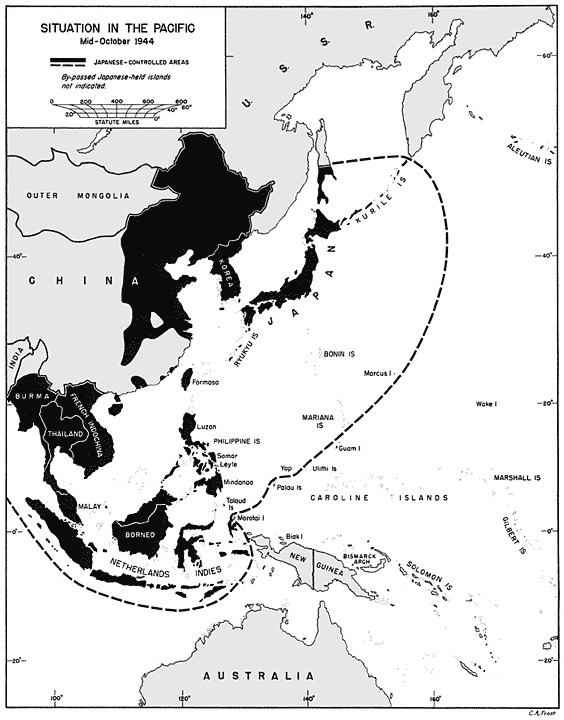
SITUATION IN THE PACIFIC

MAP 4 C. A. Frost

SITUATION IN THE PACIFIC

Mid-October 1944
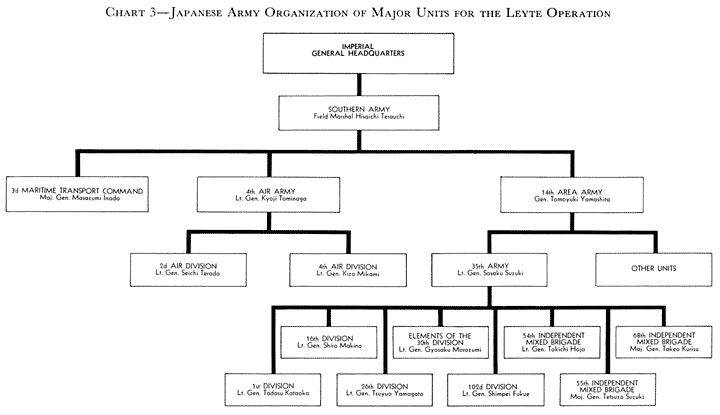
Chart 3—Japanese Army Organization of Major Units for the Leyte Operation

Chart 3—Japanese Army Organization of Major Units for the Leyte Operation

Plans for the 14th Area Army

The Japanese occupation troops of the Philippine Islands had grown soft and had “no particular will to fight.” In the spring of 1944, there were only minor units available to set up an organized defense.

Stories reached the War Ministry that Lt. Gen. Kuroda was devoting more time to his golf, reading and personal matters than to the execution of his official duties. It appeared that his control over staff officers and troops was not sufficiently strong and that there was a good deal of unfavorable criticism of his conduct among the troops. There were also indications that discipline was becoming very lax.
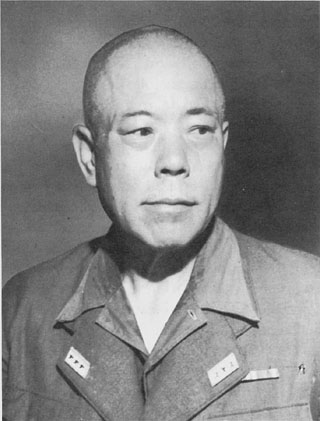
GEN. TOMOYUKI YAMASHITA

GEN. TOMOYUKI YAMASHITA

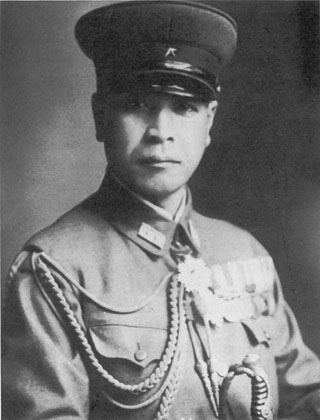
LT. GEN. SOSAKU SUZUKI

LT. GEN. SOSAKU SUZUKI

The Suzu Plan

On 17 August General Suzuki issued the Suzu orders for the defense of the Visayan Islands and Mindanao by the 35th Army. The 100th Division was to protect the Davao area on Mindanao while the 16th Division would defend Leyte. Most of the 30th Division and two infantry battalions were made mobile units which could be rushed to annihilate the American force wherever it landed. However, if the Americans landed simultaneously on Davao and Leyte, the main force of the 30th Division was to be sent to Davao and the other mobile units would go to Leyte.

Lt. Gen. Shiro Makino, commanding the 16th Division, which was the major force on Leyte, had directed his efforts since April 1944 toward the construction of defensive positions on the island. The first line of defense, which was on the east coast in the Dulag area, was practically completed by the middle of October. The third defensive line was in the middle of Leyte Valley in the vicinity of Dagami. The second line of defense was between the two others, while the bulk of supplies was assembled in the central mountain range at Jaro.

In October the 4th Air Army issued a plan for anticipated operations. In co-operation with the Army and the Navy, the 4th Air Army would attempt to destroy the American forces when they struck the Philippines. The Army air force in concert with the naval air units would try to destroy carrier-based planes and air bases. In operations against the American fleet, the Army and Navy air units were to have “a unified and tactful commitment.” If the naval air units could not co-operate the Army air force was to venture a surprise attack with a few planes. Dusk, night, and dawn attacks were to be made against Allied air bases and all means exerted to foil Allied attempts to establish advance bases in the Philippines. The main strength of the fighter units was to move into the central and southern Philippines in order to destroy the principal American landing force. The mission of the Japanese 4th Air Army, operating from Mindanao, Celebes, and northern Borneo, would be restricted to checking the current attempts on the part of the Americans to establish bases on Halmahera and western New Guinea and the destruction of the planes there. For this purpose the Japanese air force would use bases in the southern Philippines.

Japanese Navy Plans

Securing the Channel Approaches

Landings of the 6th Ranger Infantry Battalion

As Company D was moving along the coast of Suluan Island, naval fire blasted away at the extreme northwest coast of Dinagat Island. At 0900 the first assault waves of the 6th Rangers, minus Companies D and B, started for the beach. Although coral reefs approximately one hundred yards offshore grounded the boats so that the men had to wade the remainder of the distance, the companies were all ashore by 1230. No Japanese were on the island and the troops accomplished their mission, the erection of a navigation light at Desolation Point to guide the movement of the main portion of the convoy.
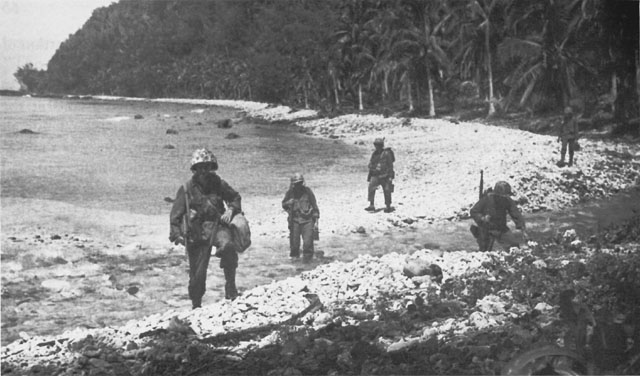
PATROL OF COMPANY F, 6TH RANGERS, at Desolation Point (above), and investigating a native village on Dinagat Island (below).
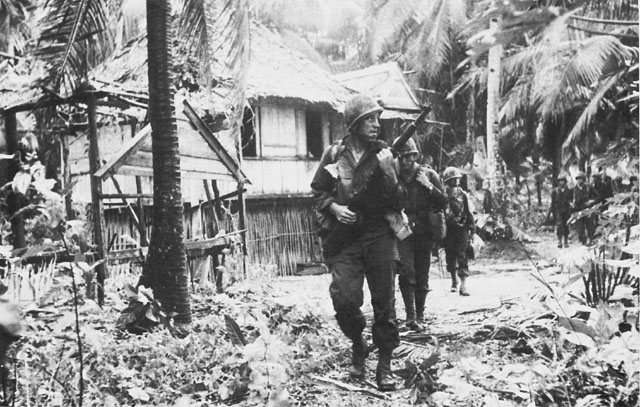

PATROL OF COMPANY F, 6TH RANGERS, at Desolation Point (above), and investigating a native village on Dinagat Island (below).

Illustration from Leyte: The Return to the Philippines

Mine Sweeping

Underwater Demolition Teams

The naval plans for the amphibious phase of the operation contemplated the use of seven underwater demolition teams—three to cover the northern coast beaches and four to cover the southern beaches. The teams, starting A minus 2 (18 October), were to locate underwater obstructions and detonate mines. On 18 and 19 October the underwater demolition teams made a reconnaissance of the landing areas, accompanied by destroyers which bombarded the shores. The two days’ reconnaissance disclosed no underwater obstacles or mines in the vicinity of the proposed landing beaches.

The Convoy Enters Leyte Gulf

Naval plans called for bombardment of the enemy-held shores on A minus 2 (18 October), but because the water areas had not been completely swept for mines by that time, ships could not reach the bombardment area. On A minus 1, bombardment was chiefly for the purpose of providing effective support and coverage for the underwater demolition teams. However, many of the defenses and installations of the enemy on or near the landing beaches, including buildings and supply dumps, were neutralized or destroyed.

Through the night of 19–20 October, destroyers near the shore continued to shell the Japanese forces on land. The American forces were safely within Leyte Gulf—A Day had arrived.

Notes in this chapter

Note 1 · Opns Rpt CTF 78 to COMINCH, Ser 00911, 10 Nov 44. ↑Note 2 · Rpt, Capt Ray Tarbuck, USN, 3 Nov 44, GHQ SWPA G-3 Jnl, 30 Oct 44. (Hereafter cited as Tarbuck Rpt.) ↑Note 3 · Opns Rpt CTF 78 to COMINCH, Ser 00911, 10 Nov 44. ↑Note 4 · 96th Inf Div Opns Rpt Leyte, p. 20. ↑Note 5 · 7th Inf Div Opns Rpt Leyte, p. 2. ↑Note 6 · XXIV Corps Opns Rpt Leyte, p. 4. ↑Note 7 · 96th Div Opns Rpt Leyte, p. 25. ↑Note 8 · XXIV Corps Hist Rpt for 1944, Sec Histories, History of the Adjutant Generals Section from 8 April to 31 December 1944, pp. 10–11. ↑Note 9 · Tarbuck Rpt. ↑Note 10 · Ibid. ↑Note 11 · CTF 77 Opns Rpt, Ser 00302-C, 31 Jan 45. ↑Note 12 · CINCPAC and CINCPOA Rpt Opns in POA in Oct 44, Ser 002397, 31 May 45. ↑Note 13 · USSBS, Employment of Forces Under the Southwest Pacific Command, p. 40. ↑Note 14 · Japanese Studies in World War II, 14, Naval Air Operations in the Philippine Area, 1942–45, p. 18. (Monograph numbers cited in this volume aNote 15 · GHQ SWPA Sum of Enemy Sit 894, GHQ G-3 Jnl, 2 Sep 44. ↑Note 16 · Ibid. ↑Note 17 · GHQ SWPA, Philippine Islands, G-2 Est of Enemy Sit 16, 3–9 Sep 44; 905, 13–14 Sep 44; 914, 22–23 Sep 44; 916, 24–25 Sep 44; and 907, 15–16 SNote 18 · CINCPAC and CINCPOA Rpt on Opns in POA in Oct 44, Ser 002397, 31 May 45. ↑Note 19 · Japanese Studies in WW II, 102, Philippine Area Naval Operations, Oct–Dec 44, Part II, The Battle of Leyte Gulf, pp. 4–11. (Hereafter cited Note 20 · USSBS, Naval Analysis Div, The Campaigns of the Pacific War (Washington, 1946), p. 283. ↑Note 21 · Philippine Naval Opns, pp. 5, 85–86. ↑Note 22 · AAF SWPA Intel Sum, Ser 247, GHQ G-3 Jnl, 29 Oct 44. ↑Note 23 · AAF SWPA Intel Sum, Ser 246, GHQ G-3 Jnl, 22 Oct 44. ↑Note 24 · Rad, Com3rdFlt to CINCPAC-CINCSWPA, 170352 Oct 44, GHQ G-3 Jnl, 17 Oct 44. ↑Note 25 · Rad, Com3rdFlt to CINCPAC and var., H 2692, 0321,15 Oct 44, AAF Hist Archives. ↑Note 26 · Air Evaluation Bd SWPA Rpt, Leyte Campaign—Philippines, 1944, p. 16. ↑Note 27 · Hist of FEAF, pp. 261–63, AAF Hist Archives. ↑Note 28 · Air Evaluation Bd SWPA Rpt, p. 16. ↑Note 29 · Rad, Com3rd Flt to CTG 38.1, 160216, 16 Oct 44, GHQ G-3 Jnl, 17 Oct 44. ↑Note 30 · Tarbuck Rpt. ↑Note 31 · CTG 77.4 Opns Rpt, Ser 00120, 15 Nov 44. ↑Note 32 · Japanese Studies in WW II, 72, Hist of Army Section, Imperial General Headquarters, 1941–45, p. 131. (Hereafter cited as Hist of Army Sec, INote 33 · Ibid., pp. 131–32. ↑Note 34 · Japanese Studies in WW II, 6, 14th Area Army Plans, 1944. (Hereafter cited as 14th Area Army Plans.) ↑Note 35 · The organization of Japanese forces is discussed in detail in Hist of Army Sec, Imperial GHQ. ↑Note 36 · Hist of Army Sec, Imperial GHQ, pp. 140–41. ↑Note 37 · Interv, 2d Lt Stanley L. Falk with General Kuroda, at Sugamo Prison, Tokyo, 13 Jun 47, copy in OCMH. ↑Note 38 · Ibid. ↑Note 39 · Hist of Army Sec, Imperial GHQ, pp. 132–33, 135, 140, and errata sheet to above. ↑Note 40 · Maj Gen Yoshiharu Tomochika, The True Facts of the Leyte Operation, p. 8, typescript of translation in OCMH. ↑Note 41 · Ibid. ↑Note 42 · Ibid., p. 9. ↑Note 43 · Ibid., p. 8. ↑Note 44 · Ibid. ↑Note 45 · Statement of Lt Col Seiichi Yoshie, Circumstances Leading to the Relief of General Kuroda, 1 Oct 51, copy in OCMH. ↑Note 46 · United States vs Tomoyuki Yamashita, Testimony of Yamashita, XXVIII, 3518–19, DRB AGO. ↑Note 47 · Ibid., XXVIII, 3519–20. ↑Note 48 · Ibid., Testimony of Muto, XXII, 2998. ↑Note 49 · A. Frank Reel, The Case of General Yamashita (Chicago, 1949), pp. 18–19. ↑Note 50 · USSBS Interrog 418, Interrog of Maj Gen Toshio Nishimura, 19–22 Nov 45, MS, OCMH. ↑Note 51 · Tomochika, True Facts of Leyte Opn, p. 6. ↑Note 52 · Ibid. ↑Note 53 · Ibid. ↑Note 54 · Japanese Studies in WW II, 11, 35th Army Operations 1944–45, pp. 14–20. (Hereafter cited as 35th Army Opns.) ↑Note 55 · Tomochika, True Facts of Leyte Opn, p. 6. ↑Note 56 · 16th Division Order 821, Tacloban, 17 October 1944, translation in App. C to Annex Y, 7th Div Opns Rpt Leyte, DRB AGO. ↑Note 57 · Japanese Studies in WW II, 7, 14th Area Army Operations on Leyte, p. 4 (Hereafter cited as 14th Area Army Opns Leyte.) ↑Note 58 · USSBS Interrog 506, Interrog of Maj. Gen. Yoshiharu Tomochika, Oct–Dec 44, p. 2, typescript copy in OCMH. ↑Note 59 · Japanese Studies in WW II, 5, 4th Air Army Operations, 1944–45, pp. 1–50. (Hereafter cited as 4th Air Army Opns.) ↑Note 60 · USSBS, Interrogations, I, 160. ↑Note 61 · James A. Field, Jr., The Japanese at Leyte Gulf: The SHO Operation (Princeton, N. J., 1947), p. 8. ↑Note 62 · USSBS, Interrogations, I, 219; II, 500–504. ↑Note 63 · Unless otherwise noted the account of the activities of the 6th Ranger Infantry Battalion is taken from the 6th Ranger Infantry Battalion OpNote 64 · Rad, CTG 77.2 to CTF 78, 17 Oct 44, GHQ G-3 Jnl, 17 Oct 44. ↑Note 65 · Co D, 6th Ranger Inf Bn, Opns Rpt Leyte. ↑Note 66 · Msg, CTG 78.4 to Tancier, 18 Oct 44, Sixth Army G-3 Wasatch Jnl, 18 Oct 44. ↑Note 67 · Rad, GHQ to CofS, 17 Oct 44, GHQ G-3 Jnl, 18 Oct 44. ↑Note 68 · Co B, 6th Ranger Inf Bn, Opns Rpt Leyte, p. 1. ↑Note 69 · Ibid. ↑Note 70 · Rad, CTG 78.5 to CTF 77, 19 Oct 44, Sixth Army G-3 Wasatch Jnl, 19 Oct 44. ↑Note 71 · Rad, Parsons to CTF 77, 78, and 79, 14 Oct 44, Sixth Army G-3 Wasatch Jnl, 14 Oct 44. ↑Note 72 · CTF 77 to COMINCH, Opns Rpt Leyte, Ser 00302-C, 31 Jan 45, p. 8. ↑Note 73 · Sixth Army Opns Rpt Leyte, p. 31. ↑Note 74 · Rad, CTG 77.5 to CTF 77, 19 Oct 44, Sixth Army G-3 Wasatch Jnl, 19 Oct 44. ↑Note 75 · Rpt, COMINCH, Amph Opns—Invasion of the Philippines, COMINCH P-008, pp. 1–3. ↑Note 76 · CTG 77.2 to CTF 77, Sixth Army G-3 Wasatch Jnl, 19 Oct 44. ↑Note 77 · Rpt, CTF 77 to COMINCH, Amph Opn P-008, pp. 1–3. ↑Note 78 · CTG 79.1 Movement Order, A173–44, 9 Oct 44, GHQ G-3 Jnl, 16 Oct 44. ↑Note 79 · Opns Rpt CTG 79.1 to CTF 79, Ser 00454, 26 Oct 44, GHQ G-3 Jnl, 15 Nov 44. ↑Note 80 · Msg, CTF 77 to CINCSWPA, Sixth Army G-3 Wasatch Jnl, 18 Oct 44. ↑Note 81 · Msg, CINCSWPA to CTF 77, Sixth Army G-3 Wasatch Jnl, 18 Oct 44. ↑Note 82 · Tarbuck Rpt. ↑Note 83 · Opns Rpt CTF 79 to Com7thFlt, Ser 00323, 13 Nov 44, p. 71. ↑Note 84 · Japanese Studies 11, 35th Army Opns, p. 24. ↑Note 85 · At 1600 on Friday, the thirteenth of October, the word was given and the great fleet at Hollandia got under way for the target—Leyte—1,300 mNote 86 · On the 25th of the month the Clymer anchored at Eniwetok Island, an anchorage already crowded with hundreds of transports, warships, and carNote 87 · Early in October the convoy crossed the equator. On many of the ships ceremonies were held transforming pollywogs into shellbacks, with the Note 88 · On 11 October the LST transports carrying the assault battalions filed out of the Manus anchorage, and on 14 October the rest of the convoy Note 89 · Thirty-four months had been spent in building and preparing these combatant and amphibious vessels. Practically none of them were in existenNote 90 · Of the vessels assigned to participate in the operation, 157 were combatant ships: 6 old battleships, 5 heavy cruisers, 6 light cruisers, 18Note 91 · The convoy did not include the combatant ships of Admiral Halsey’s Third Fleet. The main striking force of the Third Fleet was Task Force 38Note 92 · Allied aircraft had already visited the Philippine Archipelago. The first aerial strikes since 1942 were made in the early fall of 1944. On Note 93 · At the same time, the carrier-based aircraft made strong strikes against enemy shipping in the central and southern Philippines. It was estiNote 94 · The Third Fleet’s carriers then started to neutralize the approaches to the Philippine Islands. The carrier-based aircraft launched strikes Note 95 · The plans of the Third Fleet called for strong carrier-based strikes against Formosa on 12 and 13 October. The four task groups of Task ForcNote 96 · The enemy pilots made such greatly exaggerated claims of success that Imperial General Headquarters decided to order out the 2d Diversion AtNote 97 · Admiral Halsey’s reaction was to report that “all 3d Fleet Ships reported by radio Tokyo as sunk have now been salvaged and are retiring towNote 98 · The convoy, as it steamed toward Leyte, received the news of the United States success with considerable satisfaction. At this time, howeverNote 99 · On the heels of Admiral Halsey’s announcement that no assistance in connection with the Leyte landings could be expected from the Third FleeNote 100 · Although the missions Admiral Halsey had assigned his carriers apparently prevented any aircraft of the Third Fleet from participating in diNote 101 · During 18 and 19 October, aircraft from the carriers struck at enemy airfields on Cebu, Negros, and Panay Islands. There was very little eneNote 102 · The Allied nations had hit the Japanese from east and west and seriously interfered with their seaborne commerce. Japan was in grave danger Note 103 · In the summer of 1944 Imperial General Headquarters had started to strengthen the Philippines, the Ryukyus, the Kurile Islands, and Japan itNote 104 · In the first part of August 1944, the headquarters of the 14th Area Army, which was to be charged with the defense of the Philippine ArchipeNote 105 · The 1st Air Fleet, under the command of the Southwest Area Fleet, was stationed in the Philippines, with headquarters at Manila. Admiral SoeNote 106 · The Japanese during the summer of 1944 anticipated that the United States forces would return to the Philippine Islands, but when and where Note 107 · To General Kuroda fell the task of making and executing plans for the defense of the Philippines by the 14th Area Army. General Kuroda was eNote 108 · Imperial General Headquarters and the Southern Army thought that because of the many islands in the archipelago emphasis should be placed onNote 109 · That concept is good, but you cannot fight with concept alone. Words alone will not sink American ships and that becomes clear when you compNote 110 · During the month of August, the Japanese devoted their main efforts toward strengthening the air force. After the first of September more emNote 111 · Lt Gen. Sosaku Suzuki, the commander of the 35th Army, thinking that the American Army would land on 1 October, said: “Contrary to what has Note 112 · In the middle of September, Imperial General Headquarters decided to replace General Kuroda with General Tomoyuki Yamashita. Not only did GeNote 113 · On 4 September 1944, I left Tokyo under orders ... to investigate. As a result I obtained many statements substantiating the unfavorable stoNote 114 · General Yamashita, who was in Manchuria, received notification of his appointment on 23 September, and on the 9th of October he assumed commNote 115 · Maj. Gen. Toshio Nishimura, one of three assistants to Yamashita, states that the planning for the Leyte campaign was “very bad.” The supplyNote 116 · There were two tactical concepts of defense of the islands in July and August 1944. One was termed the policy of “annihilation at the beachhNote 117 · The control of the Visayan Islands and Mindanao was vested in the 35th Army, which was the equivalent of an American army corps. General SuzNote 118 · The 16th, 102d, 30th, and the 100th Divisions, which were in Leyte, Panay, and Mindanao, were placed under the 35th Army, whose headquartersNote 119 · In late August, Suzuki received orders to dispose his troops as follows: a reinforced division in the Davao area, three battalions in the SaNote 120 · The distribution of the other troops at the time of the American landings was as follows: one battalion of the 9th Infantry Regiment in the Note 121 · On 17 October General Makino, having heard that American warships had approached Leyte Gulf, alerted the 16th Division for the impending batNote 122 · The principal assignment of the 4th Air Army was to attack American transports and interdict American shipping and, if given the opportunityNote 123 · When the American convoy was sighted moving toward the Philippines, the heavy bombers were to deploy to the central and southern PhilippinesNote 124 · Capt. Toshikazu Ohmae, the chief of staff to the commander in chief of the Japanese Third Fleet, was highly critical of the liaison between Note 125 · On 21 July 1944 Admiral Toyoda received a directive which laid down the basic policies for subsequent “urgent operations.” A great deal of tNote 126 · The success of Admiral Halsey’s carrier strikes against Formosa had considerably weakened the strength of Japanese carrier-based planes, andNote 127 · The forward part of the convoy, which was carrying the 6th Ranger Infantry Battalion, commanded by Lt. Col. Henry A. Mucci, had experienced Note 128 · The USS Crosby, carrying Company D, arrived on schedule off Suluan Island, the outermost of the islands guarding Leyte Gulf. For twenty minuNote 129 · The landing was unopposed. The men immediately filed south 500 yards on a trail along the coast and then headed east toward the lighthouse. Note 130 · In searching the documents found in the lighthouse, the company failed to turn up the hoped-for enemy mine charts.66 It returned to the beacNote 131 · Company B of the 6th Rangers was to have landed on Homonhon Island at the same time landings were made on Suluan and Dinagat. Its mission, tNote 132 · By 18 October, steady white lights were beaming from Dinagat and Homonhon Islands to guide the convoy in to Leyte Island. The one on DinagatNote 133 · The mine-sweeping plans contemplated that the mine-sweeping group would arrive on 17 October simultaneously with the troops that were to stoNote 134 · In the early dawn of 17 October the mine sweepers began their work on the channel approaches to Suluan Island.73 By 0630 they had accomplishNote 135 · As the mine sweepers came close to the land, boats containing Filipinos moved out to welcome the advance party of liberators. The reception Note 136 · By the evening of 19 October the preliminary operations were almost completed. The beaches had been surveyed and found suitable for landing;Note 137 · All ships were to be prepared to attach paravanes (mine-cable cutting devices) on signal at any time after noon on 19 October.78 Since the mNote 138 · The convoy advanced without incident toward the target area. On the 18th Admiral Kinkaid radioed General MacArthur that the operations were Note 139 · As the convoy came ever closer to the target, the atmosphere aboard the vessels became more and more tense. By 1800 on 19 October most of thNote 140 · All vessels arrived on schedule. Because the mine barrier in the entrance had not been completely cleared, the ships entered the gulf somewhNote 141 · By the afternoon of 19 October, when it had become apparent to the Japanese that the Americans had returned to the Philippine Islands, Gener
Explore with AITake your curiosity a little further.

Reading settings