Chapter VII · Southern Leyte Valley: Part One
Reading edition
The SHŌ Operations
On 21 October, after receiving news of the American landings, General Yamashita activated SHŌ ICHI GO (Victory Operation Number One). He made it clear that the Japanese Army, in co-operation with “the total force of the Air Force and Navy,” was to make a major effort on Leyte and destroy the American forces on the island. The 35th Army was to concentrate its forces there. The 1st and 26th Divisions, the 68th Brigade, and an artillery unit from the 14th Area Army would be sent to augment the 35th Army troops. At the same time General Suzuki received information that the Japanese Air Force and Navy would engage in “decisive” battles in support. “The morale of the 35th Army rose as a result.”
The Japanese thought that only two American divisions had landed on Leyte, and that if the 1st, 16th, 30th, and 102d Divisions engaged the Americans, a decisive victory would be theirs. General Suzuki decided to send forward the following reinforcements to Leyte: the main force of the 30th Division, only three battalions of which would remain in Mindanao; three infantry battalions of the 102d Division; and one independent infantry battalion each from the 55th and 57th Independent Mixed Brigades. These forces were in addition to the two battalions previously sent on 23 October.
General Suzuki believed that the Americans would attempt to join and strengthen their beachheads in the vicinity of Tacloban and Dulag before they tried to penetrate inland. At the same time, since Catmon Hill and the high ground west of Tacloban Valley were in Japanese hands, the 16th Division should be able to contain the Americans until reinforcements arrived.
He therefore issued orders based upon these assumptions and also upon the assumption that the Japanese air and naval forces would be victorious. The 35th Army was to concentrate its reinforcements in the Carigara area. The principal elements of the 16th Division were to occupy Burauen and Dagami, and the rest of the division would occupy Catmon Hill and the western plateau of Tacloban. The 16th Division was to protect the concentration of the main force of the 35th Army. The 102d Division was to occupy the Jaro area and give direct protection to the 1st and 26th Divisions and the 68th Brigade. The 30th Division was to land at Ormoc Bay in the Albuera area and then advance to the Burauen area in coordination with the 16th Division and assist the main force of the 35th Army. The 1st Division was to land at Ormoc, the 26th Division and 68th Brigade were to land at Carigara. If the situation were favorable, however, the 68th Brigade was to land in the vicinity of Catmon Hill. After the main elements of the 35th Army had assembled at Carigara and the area southeast of it, they were to move down Leyte Valley and annihilate the American forces in the Tacloban area. All the important airfields, bases, and roads were also in the valley.
The part of Leyte Valley where the Americans hoped air and supply bases could be developed is a broad and level plain inside a quadrangle formed by the main roads linking Tanauan, Dulag, Burauen and Dagami. (Map 7) The region extending ten miles westward from the stretch of coast between Dulag and Tanauan to the foothills of the central range is an alluvial plain, interlaced by many streams, in which swamps and rice paddies predominate. Catmon Hill, about half way between Tanauan and Dulag, was the most prominent terrain feature near the shore line.
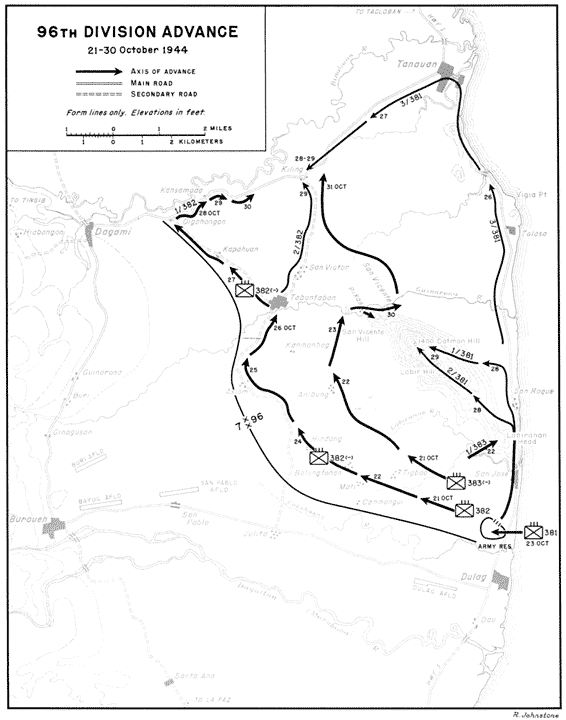
MAP 7 R. Johnstone
96TH DIVISION ADVANCE
21–30 October 1944
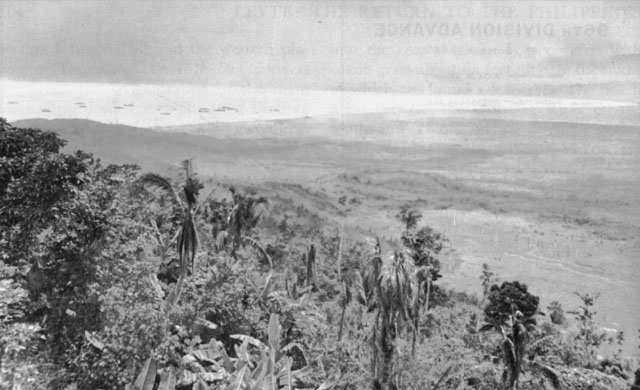
LANDING AREAS AND LEYTE VALLEY as seen from a captured Japanese observation post on Catmon Hill.
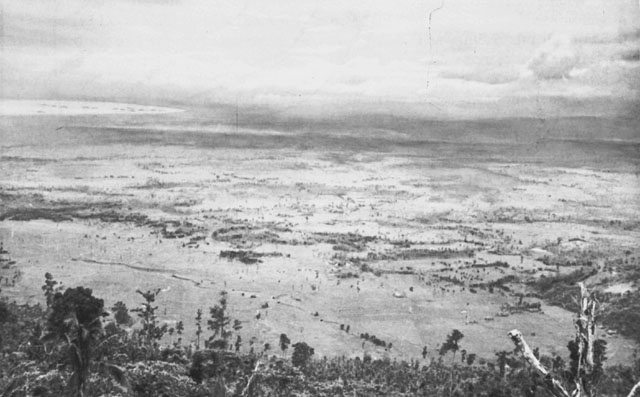
At the end of 20 October the Sixth Army was established on the shores of Leyte Gulf. The X Corps was in the north near Palo and Tacloban, and the XXIV Corps was in the vicinity of Dulag, poised for a drive into southern Leyte Valley. General Krueger planned to push rapidly through Leyte Valley and secure its important roads, airfields, and base sites before General Makino could regroup the 16th Division and offer a firm line of resistance.
Enlarging the 96th Division Beachhead
General Krueger had assigned the mission of seizing southern Leyte Valley to the XXIV Corps. The 96th Division was to seize Catmon Hill and its surrounding area, together with the Dagami-Tanauan road. The 7th Division was to proceed along the Dulag-Burauen road, seize the airfields in that area, and then proceed north to Dagami.
General Bradley’s scheme of maneuver for the 96th Division specified a movement into the interior from the beachhead area in a northwesterly direction with regiments abreast—the 383d Infantry on the right (north) and the 382d Infantry on the left (south). The 1st Battalion, 383d Infantry, was to capture Labiranan Head and secure Highway 1 as far north as San Roque. The rest of the regiment was to proceed inland, bypass Catmon Hill at first, and then, after artillery, naval bombardment, and air strikes had neutralized it, to capture Catmon Hill and the adjacent high ground.
Labiranan Head
The 382d Infantry was to move inland, maintain contact with the 7th Division, and forestall any Japanese attempt to reach the beaches. Concurrently, the 1st Battalion, 383d Infantry, would advance on Catmon Hill from Labiranan Head while the 2d and 3d Battalions of the regiment would swing around the northwest end of Catmon Hill and squeeze the Japanese in a pincers.
At 1130 an assault force commanded by Capt. Hugh D. Young of the 1st Battalion, 383d Infantry, attacked the Japanese position on Labiranan Head. This assault force, a composite company, consisted of a platoon each from A, B, and C Companies, together with the weapons platoon from C Company. The troops moved up the ridge and within ten minutes after starting destroyed one machine gun and drove off the crew of another. Under cover of mortar fire, the Japanese retired to the next ridge.
In co-operation with the advance of Captain Young’s force, the 3d Platoon of Company C, which had established the roadblock at the Highway 1 crossing of Labiranan River on A Day, moved out just below Labiranan Head and hit the Japanese flank. The platoon met a strongly entrenched enemy position which consisted of seven pillboxes guarding ten 75-mm. guns. There were also six coastal guns but only two of these had been even partially assembled. When the men of the platoon got within twenty feet of the enemy position, they received fire from the two flanks and the front. After knocking out a machine gun nest the platoon withdrew.
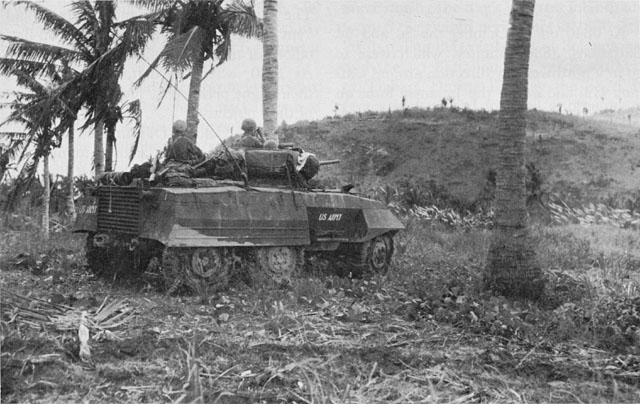
CREW OF A LIGHT ARMORED CAR M8 prepares to fire on enemy positions in the Labiranan Head sector.
Battling the Swamps
In the early morning hours of 25 October a division reconnaissance patrol, with light tanks and a motorized engineer platoon, went along Highway 1 with the mission of reconnoitering the highway as far north as the Binahaan River and making contact with the X Corps. By 1300 the patrol reached the river near Tanauan and found a damaged bridge. By 1600 the bridge had been repaired and the patrol pushed through Tanauan and made contact with Company K of the 19th Infantry, 24th Division, the first between the X and XXIV Corps since the landing.
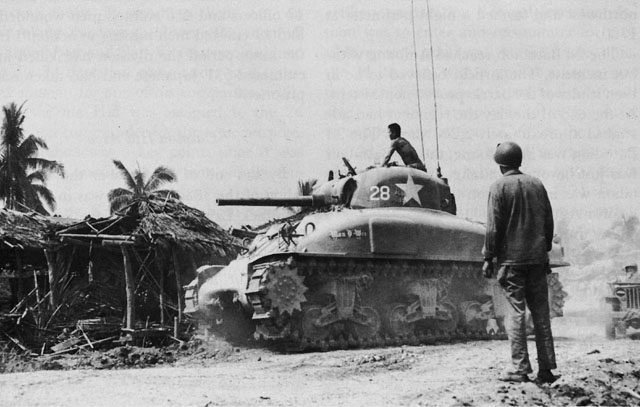
FILIPINO CIVILIAN GUIDES U.S. TANK to Japanese positions in Julita.
At 0830 the 1st and 3d Battalions, 382d Infantry, moved astride the narrow trail that led to Tabontabon, with the 3d Battalion echeloned to the right rear. The 1st Battalion passed through Bolongtohan at 0930 and moved on in a northwesterly direction toward Hindang. At 1105, as the 1st Battalion was pushing through Hindang, it came under enemy rifle fire. The Japanese had dug spider holes under the huts, and a trench extended along the western end of the barrio. The 1st Battalion, assisted by troops from Company B, 763d Tank Battalion, moved through the town, leaving the 3d Battalion the job of mopping up. The 3d Battalion reached Hindang at 1530 and immediately attacked the enemy force there. The Japanese offered only slight resistance and then fled, abandoning thirty-six well-constructed defensive positions. At 1610 the barrio was secured.
Meanwhile, the 1st Battalion, after driving through Hindang with Companies A and G abreast, came upon a strong enemy position some 200 yards beyond the town on the left flank of Company A. A platoon of the Cannon Company and some light tanks had managed to get forward. The tanks and flame throwers flushed the Japanese into the open where they were met by the fire of American riflemen who were waiting for them. By 1600 the enemy strong point was secured and the battalion moved northwest and formed a night perimeter at 1700.
On the morning of 25 October the 1st and 3d Battalions, 382d Infantry, moved out in a northwesterly direction toward Aslom, with the 3d Battalion on the right, while the 2d Battalion moved out in a northwesterly direction toward Kanmonhag. The Japanese had withdrawn during the night, leaving only scattered riflemen to oppose the advance.
Catmon Hill Area
By the end of 25 October the 1st Battalion of the 383d Infantry was in position to attack Labir Hill, while the 2d and 3d Battalions, remaining in position near Pikas, had sent vigorous patrols into Tabontabon, San Victor, and San Vicente. The 2d and 3d Battalions of the 382d Infantry were beyond Aslom while the 1st Battalion was still at that point. By this time the supply line had been opened up and the main swamps had been traversed. The 96th Division was deep in southern Leyte Valley and had isolated a strong enemy force on Catmon Hill. The way was now open for the division to launch an attack against Tabontabon, bypass the positions of the 9th Infantry Regiment on Catmon Hill, and secure the remainder of its beachhead area.
Taking Tabontabon
Company K, which had been selected by the 3d Battalion commander for the first mission, sent patrols into the Tabontabon—San Victor area on the afternoon of 24 October. The patrol sent to Tabontabon found that the 9th Infantry Regiment had extensively fortified the barrio. There were deep foxholes and machine gun emplacements dug in under the houses. None of the positions appeared to be occupied, but at the end of the town the patrol saw approximately twenty-five Japanese preparing their evening meal. Tabontabon was a fairly large barrio on the Guinarona River, with several blocks of shops and houses, including a church and several two-story buildings, the axis of the town running east and west.
On the basis of information brought by the patrol, it was decided to have Company K move out the following morning to seize Tabontabon. At 0645 on 25 October Company K, reinforced, advanced and at 0730 took covered positions 200 yards east of the barrio. Under the plan for attack the 1st Platoon was to approach the northeastern edge of the village by a covered route, and await the completion of an artillery concentration scheduled for 0800. After the artillery preparation a squad from the platoon was to enter and reconnoiter for possible enemy positions. At the same time, the 2d Platoon, with a similar mission, was to enter Tabontabon from the southeast side. The 3d Platoon was to be prepared to support the action of either the 1st or the 2d. Machine guns and mortars were placed in such a way as to give direct support to both platoons.
The rest of the 1st and 2d Platoons came up and a fire fight ensued. The 3d Platoon was sent in at 1000 to support the 1st Platoon, and in response to a request for reinforcements, a rifle platoon from Company I was brought up at 1040. The commanding officer of Company K advised the 3d Battalion by radio that he could take Tabontabon with an additional rifle company but could not do so with his present force without suffering heavy casualties. The battalion commander ordered him to withdraw. The withdrawal, under supporting fire from the 3d Platoon, Company K, the platoon from Company I, and mortar and machine gun fire from the weapons company, was successfully accomplished at 1155. At 1240 Company K rejoined the battalion.
General Bradley ordered the 383d Infantry to direct the patrols of the 3d Battalion elsewhere, since the 382d Infantry had been assigned the mission of securing Tabontabon. During the forthcoming attack the 383d Infantry was to protect the flank of the 382d, whose 2d and 3d Battalions were to launch a co-ordinated attack on the town. On 26 October the 2d Battalion of the 382d Infantry moved west and established contact with the 3d at 1200. After an artillery concentration had been placed on the town the two battalions moved out.
The 2d Battalion, which had hit the center of the town, encountered stiff and determined opposition. Company F proceeded cautiously down one street as Company G went through the middle of the second block on its right. The Japanese had riflemen and machine guns under the houses and on the second floors of the large buildings. By noon the two companies had worked their way through to the northern edge of the town, where they encountered the enemy entrenched in force.
Capture of Catmon Hill
The capture of Catmon Hill falls into two separate and distinct actions—the operations of the 383d Infantry in the San Vicente sector and the assault of the 381st Infantry against Catmon Hill.
On the morning of 26 October the 155-mm. howitzers of the 363d Field Artillery Battalion laid a ten-minute concentration on the crest of the hill. This fire was ineffective, since it was too far ahead of the troops. At 1000 the platoons of Company E moved through the tall cogon grass to the edge of an open field approximately 200 yards from the base of the hill. The men were under orders not to fire until fired upon. As the leading elements of the two platoons entered the field, the 9th Infantry Regiment opened fire with rifles and mortars. The 3d Platoon then moved up into position along the line of departure, prepared to support the attack. Since the 2d Platoon was not under heavy fire, it was ordered to move to the foot of the hill and take a position from which it could support by fire the advance of the 1st Platoon. Enemy mortars were dropping shells around the center of the area, but American mortars silenced them.
The 2d Platoon reported that it was 100 yards from the base of the hill. The 2d Battalion commander, Lt. Col. James O. McCray, moved into the company command post, about seventy-five yards behind the attacking platoons at the edge of the open field. This sector began to receive heavy fire from the right side of the hill and several men on the edge of the field were hit. Colonel McCray crawled up and started to help drag the wounded men to cover. At the same time he ordered the battalion to open fire against the hill with all weapons except artillery, but an undetermined number of enemy riflemen in the rear of the command post and on the left flank of the company started firing into the command post.
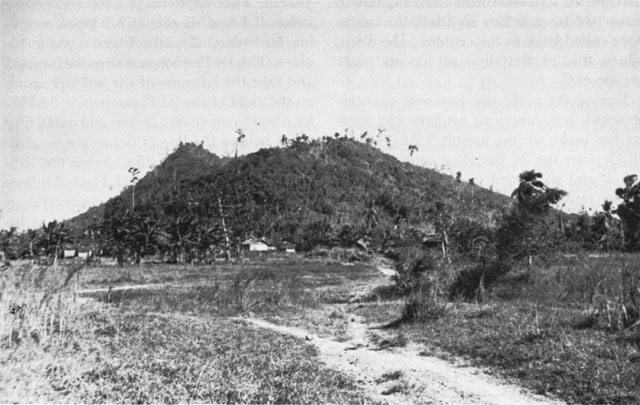
SAN VICENTE HILL
Colonel McCray continued to bring back wounded men. At this time Captain Thomas was overcome by the heat, and the executive officer of Company E, 2d Lt. Owen R. O’Neill, took over. He ordered the withdrawal of the force. It was now 1335 and the company, under continuous fire since 1000, had been unable to advance. Captain Thomas revived and again assumed command, directing the withdrawal and the bringing back of the wounded. The body of Colonel McCray, who had sacrificed his life while dragging the wounded from the hill, was found about twenty yards from the command post. The withdrawal was completed.
From 27 to 29 October, the actions of the 2d and 3d Battalions, 383d Infantry, were limited to reconnaissance patrols in the vicinity of the town of San Vicente and San Vicente Hill in attempts to find the strong positions of the enemy on the hill. At 0930 on 30 October Colonel May ordered the battalions to renew the attack from positions near the Guinarona River. The two units jumped off at 1300. The 3d Battalion advanced along the north bank of the Guinarona River, one company going through Pikas and the rest of the battalion making a wide swing through a coconut palm grove and open fields. The 2d Battalion moved along the south bank of the Guinarona River, one company following a trail from Pikas to San Vicente and the rest of the battalion going directly to San Vicente Hill, which was taken without opposition since the enemy force had withdrawn. The 3d Battalion went through the barrio of San Vicente without difficulty but encountered some small arms fire along the river 300 yards north of the village. Both battalions formed their night perimeters near the river.
At the same time, the eastern slopes of Catmon Hill were being assaulted by elements of the 381st Infantry, which had been in Sixth Army reserve through 26 October. On 27 October Sixth Army had released the 381st Infantry to XXIV Corps control. At 1330 on the same day General Bradley ordered the regiment to relieve on the following day the 1st Battalion, 383d Infantry, which had been on Labiranan Head since 22 October. It was then to attack and capture Catmon Hill.
In making his plans for the capture of Catmon Hill, Col. Michael E. Halloran, commander of the 381st Infantry, decided to have the 1st Battalion make an enveloping movement from the northeast while the 2d Battalion pushed west along the main ridge. The 1st Battalion, 383d Infantry, from its position on Labiranan Head, would support the attack by fire. On the morning of 28 October the 381st Infantry, less the 3d Battalion, moved into position for the attack. After a thirty-minute preparation by the artillery, the 381st Infantry jumped off to the attack at 1200.
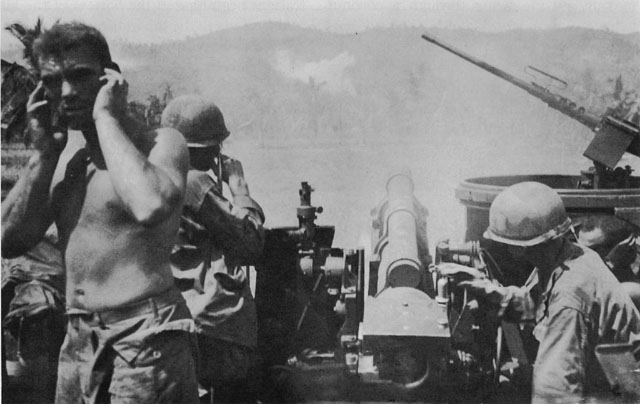
105-MM. SELF-PROPELLED HOWITZER M7 FIRING on Japanese positions on Catmon Hill.
After a thirty-minute artillery preparation, the 2d Battalion, 381st Infantry, moved out at 0830. With the support of a platoon of light tanks, the battalion easily secured both Labir and Catmon Hills. By 1300 the position had been consolidated. The 1st Battalion, 381st Infantry, supported by the massed fire of forty-five tanks and the Regimental Cannon Company, jumped off at 1200. The troops moved through a heavily fortified area, and at 1600 they established physical contact with the regiment’s 2d Battalion.
At last Catmon Hill had been secured. The 1st Battalion, 383d Infantry, was relieved and passed to the Sixth Army reserve. The 381st Infantry’s command post was moved north of San Roque, and at 1800 its 3d Battalion rejoined the regiment south of this position. During 30 and 31 October the entire Catmon Hill area was mopped up—fifty-three pillboxes, seventeen caves, and numerous smaller emplaced positions were destroyed by demolition charges. The last enemy stronghold threatening the landing beaches had been removed.
Convergence on Kiling
From Tabontabon two important roads lead to the Tanauan-Dagami road. One of these runs in a northeasterly direction and meets the Tanauan-Dagami road at Kiling; the other goes in a northwesterly direction and meets the road at Digahongan about one and a half miles east of Dagami. Colonel Dill ordered the 1st and 3d Battalions, 382d Infantry, to pass through Tabontabon on 27 October and then to proceed northwest along the latter road to Digahongan. They were then to go northeastward along the Tanauan-Dagami road and at Kiling join the 2d Battalion, which was to proceed northeast along the road from Tabontabon to Kiling.
The 1st and 3d Battalions, with the 3d Battalion in the lead, moved out of Tabontabon and advanced about three quarters of a mile to Kapahuan where they established night perimeters. During the night the Japanese charged the perimeter of the 1st Battalion. The attack was repulsed with only three casualties to the battalion, while about one hundred of the enemy were killed.
At 0830 on the 28th the 1st and 3d Battalions jumped off abreast along both sides of the narrow road for Digahongan—the 1st Battalion on the right and the 3d Battalion on the left. At 1200, when the battalions were about two miles northwest of Tabontabon, they encountered a strongly fortified position. The 16th Division had built coconut pillboxes and many spider holes, which were supported by two 70-mm. howitzers and a number of 50-mm. mortars. Flame throwers and demolition teams, supported by the artillery, knocked out this fortified area. Taking their dead and wounded, the enemy withdrew. The American troops then advanced under protection of artillery fire toward the road junction at Digahongan, which they reached at 1500. During the day the battalions had been harassed by numerous hidden riflemen, mines, and booby traps.
During the night the 9th Infantry Regiment withdrew. On 30 October the 1st Battalion, 382d Infantry, found no opposition during its advance forward to Kiling and at 1030 established contact with the 2d Battalion, 382d Infantry. The 2d Battalion, less Company G, had moved out of Tabontabon on the northeast road to Kiling on 28 October, spending the night on the outskirts of the town.