Chapter IX · Northern Leyte Valley: Part One
Reading edition
San Juanico Strait
Drive Toward Caibaan
General Krueger wished to push rapidly through Leyte Valley and secure its important roads and airfields before the Japanese could regroup and offer a firm line of resistance. In the north, securing San Juanico Strait would prevent any of the enemy from crossing over from Samar. Control of the road that led through the interior of northern Leyte Valley would give the possessor a firm hold on the northern part of the valley. With a successful two-pronged attack—elements of the 1st Cavalry Division driving north along San Juanico Strait and units of the 24th Infantry Division pushing along Highway 2—the X Corps would arrive at Carigara Bay. At that point the corps would be in position to contest any Japanese amphibious movement through Carigara Bay, and at the same time elements of the corps could drive south through Ormoc Valley and secure the important port of Ormoc.
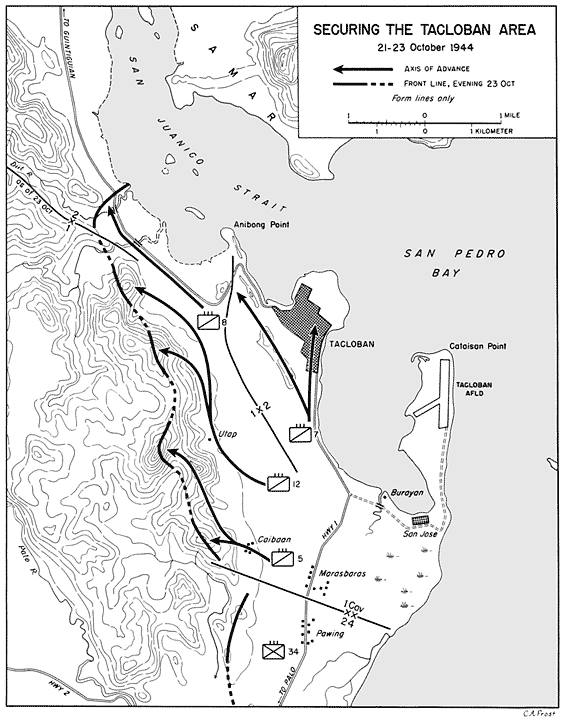
MAP 9 C. A. Frost
SECURING THE TACLOBAN AREA
21–23 October 1944
The following day, after an intensive mortar, artillery, and air bombardment on a hill southwest of Tacloban, the 2d Squadron of the 7th Cavalry moved out against the hill at 0820. Although the terrain was rugged, the position was overrun by 1100. The 1st Squadron spent the day mopping up the town in search of the enemy. At 1108 General Mudge released the 8th Cavalry, commanded by Colonel Bradley, to 2d Brigade control.
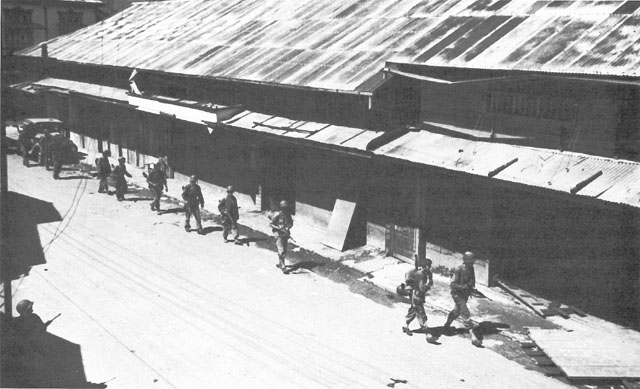
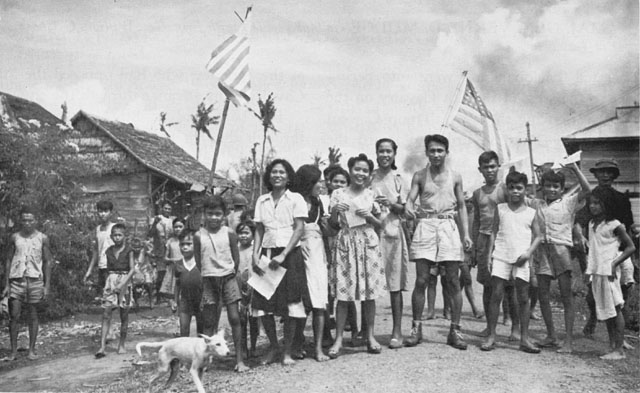
A PATROL FROM THE 7TH CAVALRY moves along Avenida Rizal in Tacloban (above). Flag-waving Filipinos greet the American troops (below).
On the morning of 22 October the 8th Cavalry made a “victory” march through liberated Tacloban and went into perimeter to the west of the 7th Cavalry on the hills overlooking the town. Troop C went to Anibong Point in order to guard the brigade flank from a suspected Japanese barge landing through San Juanico Strait.
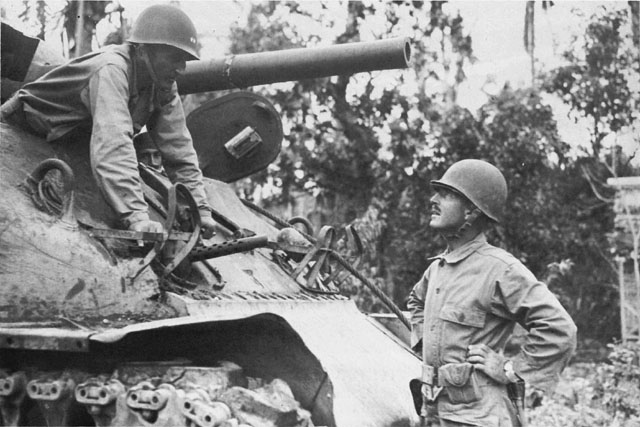
MAJ. GEN. VERNE D. MUDGE (in tank) confers with Brig. Gen. William C. Chase in Tacloban.
Shortly after the command post was opened at 1830, the 8th Cavalry received orders for the 1st Squadron to depart at 0700 on the following day. It was to pass through the 7th Cavalry and secure the bridge crossing the Diit River so as to protect the 2d Squadron, 8th Cavalry. The latter was directed to move northwest across the mountains, seize Santa Cruz, which was on Carigara Bay about sixteen miles northwest of Tacloban, and locate the remnants of the Japanese who had opposed the 7th Cavalry in its advance through the city.
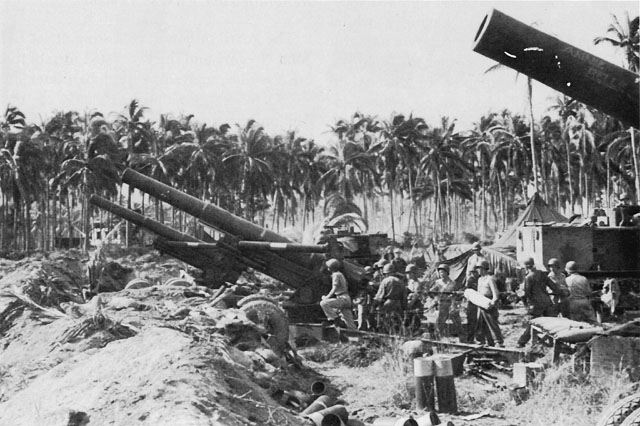
8-INCH HOWITZERS READIED FOR ACTION against an enemy strong point southwest of Tacloban.
The 1st and 2d Squadrons of the 5th Cavalry advanced abreast toward Caibaan and the high ground beyond the town. They encountered only sporadic rifle fire in Caibaan but at the foot of one of the hills they met determined opposition from about half a company of Japanese. After an exchange of fire, the Japanese signified they wished to surrender by waving a white flag. The heavy machine guns were brought into position and the American soldiers signalled for the Japanese to disrobe in order to forestall their using concealed grenades or other weapons. The Japanese opened fire and wounded five men. The automatic weapons then returned the fire, killing thirteen of the enemy. The remaining Japanese withdrew over the hill, and contact was lost.
Restoration of Civil Government
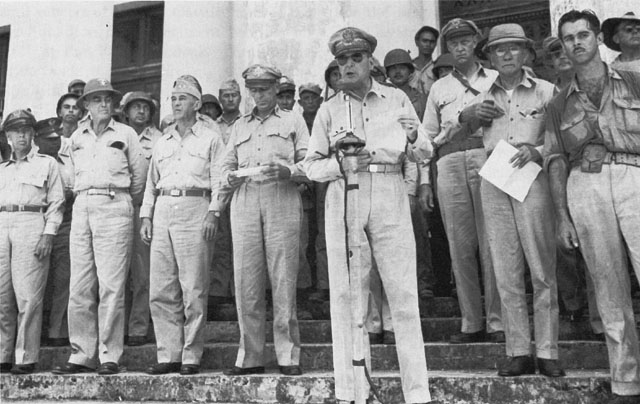
GENERAL MacARTHUR announces the establishment of the Philippine Civil Government.
Seen in the front row, left to right, are: Lt. Gen. George C. Kenney, Vice Adm. Thomas C. Kinkaid, Lt. Gen. Walter Krueger, Lt Gen. Richard K. Sutherland, General MacArthur and President Sergio Osmeña.
Drive up the Strait
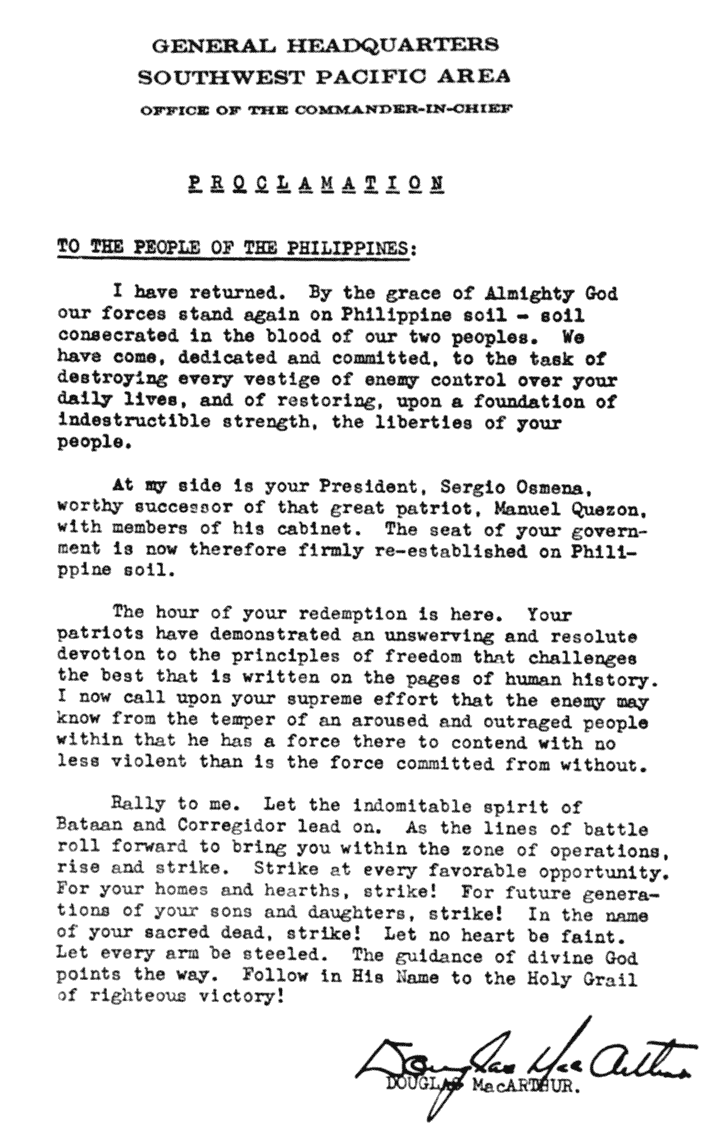
GENERAL HEADQUARTERS SOUTHWEST PACIFIC AREA OFFICE OF THE COMMANDER-IN-CHIEF
PROCLAMATION
TO THE PEOPLE OF THE PHILIPPINES:
I have returned. By the grace of Almighty God our forces stand again on Philippine soil—soil consecrated in the blood of our two peoples. We have come, dedicated and committed, to the task of destroying every vestige of enemy control over your daily lives, and of restoring, upon a foundation of indestructible strength, the liberties of your people.
At my side is your President, Sergio Osmeña, worthy successor of that great patriot, Manuel Quezon, with members of his cabinet. The seat of your government is now therefore firmly re-established on Philippine soil.
The hour of your redemption is here. Your patriots have demonstrated an unswerving and resolute devotion to the principles of freedom that challenges the best that is written on the pages of human history. I now call upon your supreme effort that the enemy may know from the temper of an aroused and outraged people within that he has a force there to contend with no less violent than is the force committed from without.
Rally to me. Let the indomitable spirit of Bataan and Corregidor lead on. As the lines of battle roll forward to bring you within the zone of operations, rise and strike. Strike at every favorable opportunity. For your homes and hearths, strike! For future generations of your sons and daughters, strike! In the name of your sacred dead, strike! Let no heart be faint. Let every arm be steeled. The guidance of divine God points the way. Follow in His Name to the Holy Grail of righteous victory!
DOUGLAS MacARTHUR.
One of the Japanese planes crashed less than 200 yards from elements of Troop C but the force got under way. The troopers, after running down and killing five Japanese in a canoe, arrived at La Paz, Samar, their destination, without further excitement and established a roadblock on the road leading to Basey.
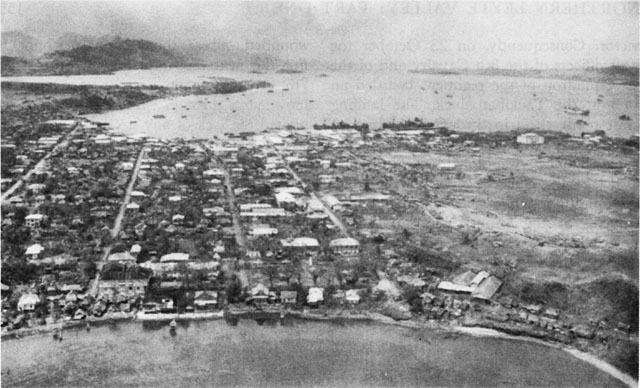
TACLOBAN from the air (above). Close-up of the dock area (below), showing San Juanico Strait and the island of Samar in the background.
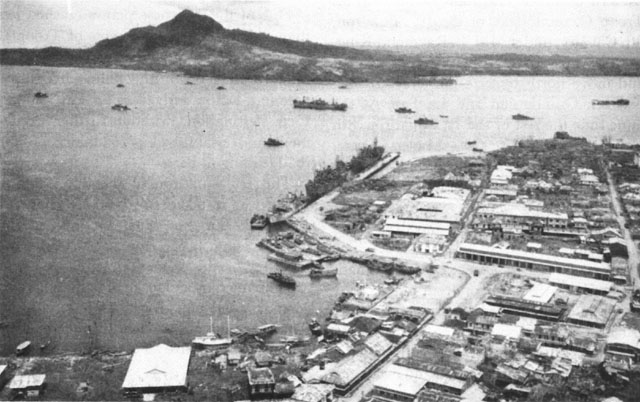
The opposition had been light—much lighter than had been expected. Elements of the division had therefore been sent south to reinforce the 24th Division, which had borne the brunt of the Japanese opposition in the X Corps sector in its drive through northern Leyte Valley toward Carigara Bay.
Leyte Valley Entrance
Defense at Pawing
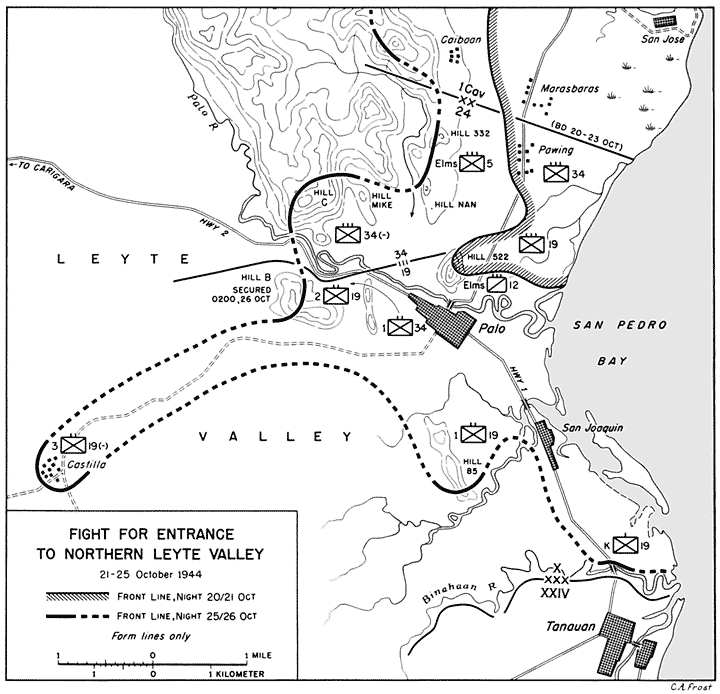
MAP 10 C. A. Frost
FIGHT FOR ENTRANCE TO NORTHERN LEYTE VALLEY
21–25 October 1944
In the meantime the enemy hit the perimeter of Company L. For several hours the Japanese felt out the company positions, and then, covered by three machine guns, they charged in platoon strength on the east side of the company’s perimeter. The company, supported by mortar fire, retaliated and assaulted the Japanese in front of the perimeter. Attempted movements around both the enemy flanks failed. A frontal assault, protected by fire from both flanks, was then successfully made by the company, and the Japanese force was routed. There were 105 enemy dead in the immediate area of the company.
Company F, commanded by Capt. Paul Austin, had more difficulty. Its objective was a steep hill, heavily covered with cogon grass ten to twelve feet high, which limited visibility to a few feet. A trail ran west from a small clump of trees to the top of the hill, and then south along the crest of the ridge where the grass was only six inches high. The company proceeded west in a column of platoons and at 1430 reached the foot of the hill. At the western edge of the group of trees, the 1st and 3d Platoons turned left and advanced directly toward the highest point of the hill. The 2d Platoon, with machine guns, continued up the path.
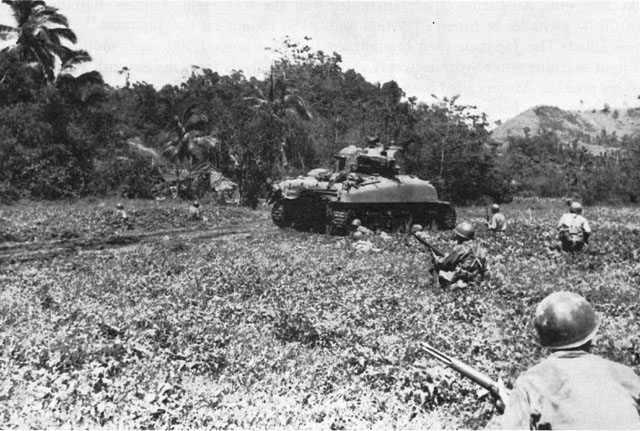
TANK-SUPPORTED INFANTRYMEN OF THE 34TH REGIMENT attack a hill near Pawing.
As the 2d Squad of the 1st Platoon reached the crest and as the 1st Squad had nearly done so, an estimated 200 Japanese from the 33d Infantry Regiment opened fire upon the troops with rifles and two machine guns that were emplaced upon a knoll overlooking the trail. Enemy riflemen also rolled grenades down upon the 1st Squad. These actions pinned down both of the squads.
Protected by the machine gun fire, other enemy riflemen worked north along the reverse slope of the ridge and began to throw grenades down upon the 2d Platoon. The Japanese possessed a seemingly inexhaustible supply of grenades, which they rolled down upon the Americans with telling effect. Company F was unable to advance. By 1500 the 1st and 2d Squads of the 1st Platoon were forced off the forward slope. The 2d Platoon also had been unable to go ahead, and the company had suffered fourteen casualties. Captain Austin ordered his company to disengage for reorganization. Since the American mortars could not fire directly upon the Japanese for fear of hitting friendly troops, they were forced to fire over the enemy and gradually shorten the range as the American troops disengaged. Consequently the fire at first was not too effective. By 1600 the reorganization was complete, but Colonel Pearsall decided to delay the attack until artillery support could be obtained. Company F formed its night perimeter 500 yards from Pawing.
Capture of Palo
At 0900 on 22 October the 3d Battalion, with Company I in the lead, attacked with the 1st Battalion, 34th Infantry, which had been released from division reserve, on its left flank. This co-ordinated advance pushed past the defensive positions of the 33d Infantry Regiment, many of which had been abandoned. The positions of the 3d Battalion, 19th Infantry, were taken over by the 1st Battalion, 34th Infantry. The latter battalion patrolled the road and eliminated scattered Japanese pockets of resistance south to the Palo River.
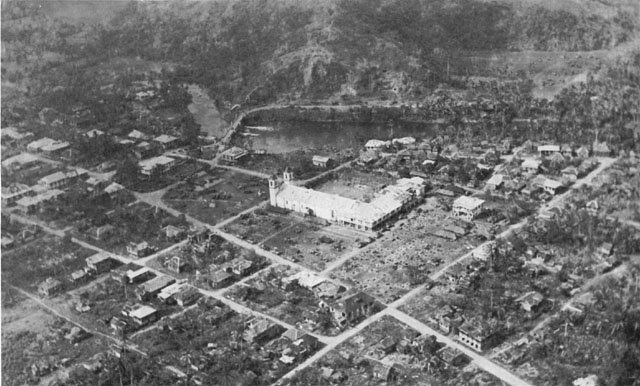
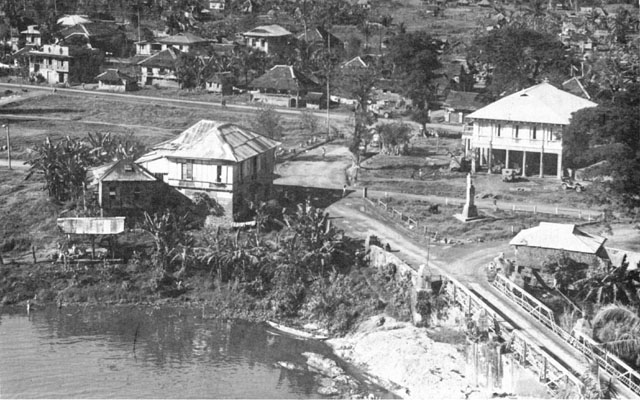
PALO, with the Palo River and the slopes of Hill 522 in the background (above), and the junction of Highways 1 and 2 (below).
Defense of Palo
The 3d Battalion, 19th Infantry, had sent Company K to reconnoiter to the south and if possible make contact with the XXIV Corps. On the morning of the 24th the company entered San Joaquin to the south of Palo. By 1600 the town had been secured and the company was prepared to defend it. Engineers began to repair the damaged bridge so that armored units could proceed southward along Highway 1. On the morning of 25 October Company K advanced south from San Joaquin and by 1200 had secured positions on the north bank of the Binahaan River, from which patrols were sent into Tanauan. At 1430 the patrols met a motorized unit of the 96th Division, establishing contact for the first time between the X and XXIV Corps. The rest of the battalion moved out of Palo the same morning and was able to advance rapidly with little opposition and set up a perimeter at Castilla, 8,000 yards southwest of Palo.
Capture of Hill C
At 1800 the company received orders to disengage so that artillery fire might be laid upon the enemy positions. The Japanese immediately counterattacked. An American lieutenant and a sergeant of the company rushed to the crest with grenades which they threw upon the advancing Japanese. This action enabled the company to disengage and return to the assembly area with only a few casualties.
During the night artillery and 4.2-inch mortar fires were placed on the ridge. As a result, on the following day, 24 October, the 1st Battalion secured it without meeting any resistance. With this ridge in American hands, the 3d Battalion was able to pass through the 1st Battalion and secure without opposition Hill Mike, the last remaining obstacle before Hill C. During the night artillery pounded Hill C.
The 2d Battalion, 34th Infantry, which had been relieved by the 1st Squadron, 5th Cavalry, moved out of Pawing at 0700 on 24 October. At 1030 it received orders to seize a small hill southeast of Hill C. With Company E in the lead, the battalion proceeded in single file up the hill, which was covered with cogon grass. As it had hitherto been the practice of the Japanese to withhold their main fire until the Americans neared the top of a hill, the troops expected little opposition before reaching the crest. But while the company was still a considerable distance from the top, elements of the 33d Infantry Regiment opened up with rifles, machine guns, and grenades. This fire pinned the company down, and the men immediately sought concealment in the cogon grass. Light machine guns were brought up, but, because of the steepness of the slope, they were ineffective. Artillery and mortars fired for two hours against the entrenched Japanese positions. At 1610 Company E renewed the attack and this time secured the hill with little opposition. The 34th Infantry now occupied the hills on the north side of Highway 2.
Seizure of Hill B
Although the hill was in American hands, the hold was very precarious. Colonel Spragins therefore moved the rest of the battalion up to Company G and ordered the latter to move out to a far ridge in order to secure the hill firmly. This move was accomplished at twilight. The rest of the battalion moved out to join Company G.
During the day the 1st Battalion, 19th Infantry, secured complete control of Hill 85 without opposition. The battalion found an abandoned position, mortar ammunition, and six dead Japanese.
By the end of 25 October the X Corps had made substantial progress toward securing northern Leyte Valley. After capturing Tacloban, the 1st Cavalry Division had pushed north and secured control over San Juanico Strait. The 24th Division had secured Palo and the hill fortresses that blocked the entrance into northern Leyte Valley. The corps was now in a position to launch a drive into the interior of the valley.