THE WOODCOCK Scolopax rusticula
Reading edition
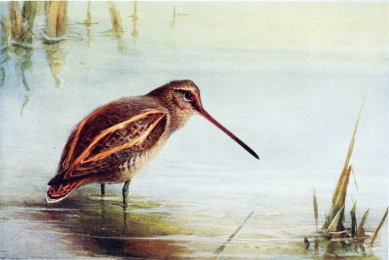
The plumage is grey below, faintly barred on flanks. The head barred on top and spotted on sides. The wings are rich chestnut-brown with transverse bars of black; a narrow stripe of rich yellow triff edged with black runs along the scapulars; tail short and pointed, barred with chestnut and black, is tipped with grey above and pure white beneath. Legs a pale flesh colour; beak reddish at base, brown at tip. Eyes, peculiarly large and of a rich brown, are placed more backward than in most birds. Total length, 14·25 inches.
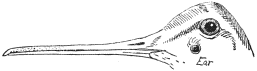
ACCOUNTS in 1907-8 show that the Woodcock has been obtained fairly frequently, and a case was told me of two being obtained literally by the side of the road from Cairo to the Pyramids in one morning. It is very usual to deplore the existence of “the man with the gun” without in the least really considering the whole matter. That certain men with guns shoot at everything and at all times, breeding season or otherwise, and without any object in killing their victims, is of course deplorable; but the killing of birds in season that can be used as food for man is no offence whatever. Further, from observant good sportsmen has come a full half of all the knowledge of birds that exists, and this cannot be too often dwelt upon, as enthusiasts run riot on this subject, and do damage to a good cause by injudicious condemnation. The accompanying illustration is a small example of what I mean. All know that birds, like ourselves, have eyes and ears, and one knows that the relative positions thereof are as in ourselves—the ear lies behind the eye. No book that I am aware of has any intimation that any other order exists; but one day, a winter or so ago, I shot a Woodcock, and for the purpose of making a minute study of the bird examined it closely, when I found that the ear was in front of the eye. I at once consulted all my bird books, but found no reference to this strange fact. I then examined ten other birds, and though they varied individually, not one but had the ear somewhat in front of the eye.
Fig. 7. Head of Woodcock, to show the position of the Ear.

The woodcock’s food is mainly obtained by
COMMON SNIPE
probing. Its bill is richly supplied with very delicate nerves, and it probes the soft mud and ooze in search of those grubs and insects that live there. It also feeds on worms that it obtains above ground, and indeed has a varied diet.