THE WHITE PELICAN Pelecanus Onocrotalus
Reading edition
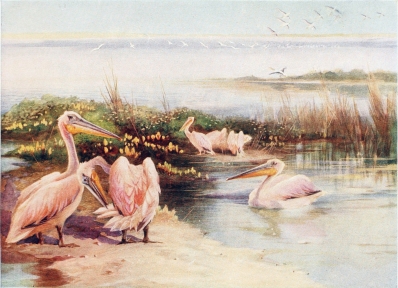
General colour of plumage a rosy white; the larger flight-feathers of wing, black; beak grey; pouch, a bright yellow; eyes red. Entire length, 60 inches.
THE Pelican has the honour of being, in Egypt, as far as sheer length of wing goes, the largest bird that flies; for the span of wings from tip to tip has been recorded as twelve feet. I believe the span of the Griffon Vulture is only about eight feet. Thirty years ago Pelicans were more often seen than they are to-day. This does not necessarily mean that they are less numerous, but only that, from some cause or another, they do not come within range of observation. I think the traffic on the river having so altered is the probable explanation. I can only recall one case of late, of seeing Pelican on a sandbank, and that was very early in the morning, practically daybreak. Years ago it was not an uncommon thing to see hundreds resting and recruiting on some lonely reach of the river. Captain Shelley says that in “April 1870, below Edfoo, we met with an immense flock of several
WHITE PELICANS

thousands, passing low along the river on their way north, and although fired at several times they still kept streaming onwards in one continuous flock.” Nowadays you will quite possibly see immense flocks going south in November, or north in the spring, but they will all be flying high and well out of gun-shot. The largest flock I ever saw was in December of 1907 when living at Deir-el-Bahari. I was working outside the hut there, when some noise made me look up, and I saw an amazing sight, hundreds and hundreds of these great birds flying round and round in circles high above the chalk cliff. This was about 2 P.M., and they remained thus slowly circling round and round till nearly 5 P.M., when gradually in small detachments they dwindled away, flying in a southerly direction. At times they came sufficiently low for me to see distinctly the yellow pouch hanging from the under-bill, but then again they would rise in great spiral curves to such a height that even with my pet glass they were almost invisible. With every new curve they showed some alteration of colour, so that sometimes they seemed a coral pink all over, and then again with some altered angle in relation to the sun they were a pure snow white. The two hours or more that they were over just this one spot where Queen Hatshepsut’s temple stands, I worked hard at trying to sketch them till my eyes got blinded by staring up into the blue, and aching with trying to follow some individual bird sweeping right above my head. None but those who have tried it knows what an exhausting thing this is; every bird is changing its place continually, one after another comes sweeping by, turning, rising, falling, interlacing, till one has to absolutely cease looking and close one’s weary eyes. I heard later the rumour that this great flock rested the night on the top of one of the hills a mile farther back, and at dawn were all away south.
Where, however, they can be still seen throughout the winter months and comparatively close at hand is on Lake Menzaleh. I saw them there in March, but by the 12th of April I could not see a single bird. The wonderful colour, a pale coral pink, that they show under the bright Egyptian sky, is something of a surprise to those who have only seen faded stuffed specimens in a museum, or the woebegone individuals in a menagerie. No one interested in birds should neglect the Cairo Zoological Gardens at Giza; there you will see all sorts of hot climate beasts and birds in the perfection of condition that they never show in our colder climes. And the colour that the Pelican displays under these perfect conditions is a revelation. To the most casual it appears pinkish, but to the artistic and observant the brilliance of the carmine-pink revealed in the shadows, and the shell-like delicacy of colour of the feathers seen in full sunlight, is simply charming. I regret, however, that no amount of artistic enthusiasm can ever find anything else to praise in its personal appearance, as it really is most desperately ugly. It is said, however, to be virtuous, and is to this day used as a symbol of beautiful self-sacrifice, and as an ecclesiastical emblem of the feeding of the Holy Catholic Church.[7]
As a child I was much troubled with “the Pelican in the wilderness,” but recently have been greatly relieved to hear, on the best authority, that though it says “wilderness” quite distinctly, it doesn’t, you know, mean wilderness at all; the ordinary wilderness means a sandy, deserty sort of place, but this wilderness, we are told, means a wet sort of watery place. How nice it is to have these clear explanations from the best authorities of all those mysteries that darkened our early years! The Pelican lives entirely on fish, and is therefore never far from water. Considering its rather clumsy form it is fairly agile, and it has been noted that it can and does perch freely on boughs that bend and swing with its weight when at large, and that in captivity at the London Zoological Gardens one habitually used to perch on the thin corrugated wire fence that bisects their small enclosure, an almost acrobatic feat one would not have expected it capable of performing.
In books the statement has been made and often repeated that the Pelican breeds in Egypt, and my visit to Lake Menzaleh was very much taken just to settle whether it and Flamingoes did or did not breed there. I found they did not, and I should think it is very unlikely that they ever did, as though the lake is large the fact that fishermen’s boats go all over it would hardly make it a safe place for these big birds ever to nest in.