SAND PARTRIDGE Ammoperdix heyi
Reading edition
The colour of the upper plumage on body is so delicate in quality that it is hard to say if it should be called a lilac grey or pinky grey, whilst in certain lights it might be called a sandy brown; the head is, with the cheeks, neck, and breast, a pearly pink; the flanks are barred with rich chestnut and black on a warm white breast; white on the ear coverts and a white spot in front of the eye in the variety known as Cholmondely; legs yellow; eyes brown; beak a brilliant orange. The hen bird is without the bright chestnut bars on the flanks, and is altogether a paler-coloured greyish-buff, and without white on the face. Total length, 9 inches.
THIS is a resident Egyptian bird, and I include it in my list because, though the traveller up the Nile may not see it, any who go across the desert around the Pyramid district, and even those who journey only a little out of Assoan, ought quite certainly to come across it. It is a most charming, lively little bird, bustling about; you rarely see it quiet for long, even in January it still keeps in coveys, and they go running along in and out of the boulders, and, if on a hillside, they are very quick and agile in hopping high up on to the rocks above them. They very seldom fly if they can possibly get out of your way by running. I very well remember seeing them on the old-time road from Kennah to Kosseir on the Red Sea. I saw them first before reaching Wady Hammamat, and then more frequently as we passed through the ancient quarries. They seem to use this old roadway as their regular feeding-ground, for there, owing to the passage of caravans backwards and forwards, they find a perpetual source of food from the frequent droppings. Their movements were so quick and their little bodies so round and plump that, even with my glass on them, I could not settle the colour of their legs, till I got a closer inspection of those in the Cairo Zoological Gardens. As they run they utter a little cheery sort of “cheep, cheep” call, and the whole party seem always happy, if not in boisterous spirits, which, when one considers the hardness of their life in these sterile wastes, seems somewhat remarkable. Grain and seeds are their staple food, but I distinctly saw one once and again make a dart at some passing insect, and no doubt here, as at home, they love the ants’ eggs that must exist, as ants are ever present with you in this hot desert country. As far as my own notes go, I do not think they ever come down even to the outskirts
HEY’S SAND-PARTRIDGE

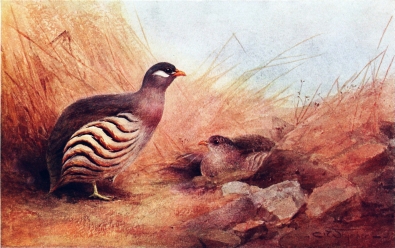
of the cultivation, but keep exclusively to the sand (possibly in spring or summer they may approach nearer to the haunts of man, but I have no evidence), which makes the fact of their being, as it is alleged they are, exceedingly good eating, very remarkable, for one would be disposed to think they would be thin, tough, and tasteless. I have it on good authority, that as a game-bird for the table, they are far to be preferred to our own Partridge, being, though small, very plump and of a fine game flavour. All Partridges seem peculiar in doing well on very little—at home one often wonders during a hard winter at their surviving at all—for they are never fed like the pampered Pheasants, and not only do they survive, but they seem to carry as much flesh when shot in a hard winter as they do in September when grain lies scattered in profusion on every stubble. Although one has praised its seeming happy way of living, no account of this bird would be complete without some notice of its extraordinary pugnacity. This is confined admittedly to the males, but with them it is, as with all so-called game-birds, a ruling passion, of which our game-cocks are of course well-known examples; but it may not be so generally known that in many countries—Greece, amongst others—Partridges are kept for this special purpose of fighting for the delectation of their owners, and though I am not aware of this little sportsman, the Sand Partridge, having been kept for this purpose, I am sure if it was it would not disgrace the traditions of its family, for a more pugnacious little bird than it never walked. The males have a peculiar habit of standing ever and anon quite upright puffing out all their breast feathers, so that they display all the beauty of their rich chestnut and black-barred plumage. The naturalists have discovered that in certain districts the birds all have a white spot over the beak on the forehead, and to this variety is given the name of Cholmondely’s Sand Partridge, whilst the other type, with only one white spot behind the eye on the cheeks, is known as Hey’s Sand Partridge. Here, as in the case of most birds, the description of the plumage is taken from the male bird, the female nearly always being very much more sober coloured. This cannot too often be repeated, as not recognizing this fact often leads to mistake; and again, in the matter of the measurements of the birds, the size given is that of the average bird, for in almost all birds you get larger or smaller individuals, and that veteran naturalist Wallace has just lately drawn attention to the quite extraordinary variations in the different parts of the Common Redwing, showing that even in twenty birds the dimensions varied considerably.