PINTAIL-DUCK Dafila acuta
Reading edition
Plumage of back and flanks grey; the large scapulars are long-pointed and edged with buff; brilliant metallic green bar on wing; head brown; neck and under-parts white; the tail long, and two centre feathers very narrow and longer than the rest; beak slate-grey; legs black; eyes brown. The female is a plain, mottled brown bird, tail pointed but not so long as the drake. Entire length, 23 inches.
AT different times of the year different birds come in gigantic flocks. Thus at one time, owing to the vast migration of these Pintail-Ducks, it might well be said they were far and away the commonest; but a little later you hardly see one, and wherever you go it is the Shoveller Duck that is met with, whilst at another time it would be the Teal, or the Pochard. So that to settle the point exactly—What is the commonest duck of the country?—is not altogether an easy one, and I do not intend to speak dogmatically; but I have placed this duck first on the list, because not only do you meet with it in enormous numbers, but you also see it represented more frequently on the walls of temples and tombs. The well-known hieroglyph
PINTAIL, TEAL, AND SHOVELLER DUCK

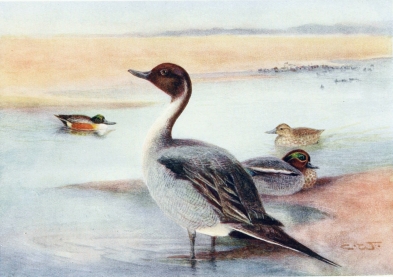
of a duck under a circle, which is translated as the Son of the Sun, was doubtless meant to represent this particular bird. Very often—not always—where the workmanship is of the finest and of a good period, the characteristics are exact, and the long pintail feathers are most plainly shown. Now, no duck that comes to this country has a long tail, other than the Pintail, therefore there can be no question that these old-time artists, for some reason best known to themselves, selected from all the various ducks they have, just this particular one to symbolize this royal conception. It is also shown on many wall-paintings in the tombs, flying with the tail spread, and the two long central feathers well marked. Going up the Nile sometimes you pass great high bare sandbanks which have on the other side of them long narrow strips of shallow pools; here, at certain times, is the place to see duck in their thousands—literally thousands. There they sit secure; the high bank screens them from the river-way with its great sailing-boats and modern steamers; they can see the tops of the spars and masts and the black smoke from the steamers’ funnels, but neither boat nor steamer can see them. If you attempt an approach by land you can rarely surprise them, as they always have sentinels well posted up and down the reach of water, and a warning quack and all heads are up on a flash; and if the quack has had a certain intonation they are all up and away at once. Then it is, if you are shooting, that you may, if you keep quiet, get a shot as they return sweeping down and round the water, which they will not completely leave unless very frightened. I have looked on to pools of this sort which have been absolutely black with birds, and amongst the whole, nine-tenths would be Pintail. Later it might be, at that same pool, all would be Shovellers or Pochard. The Pintail is what is known as a surface-feeding duck, and is placed near the common Wild Duck, the Mallard of English waters. It is distinctly peculiar in form; the neck is long, and when alarmed the head is held high, and the whole neck looks very thin. These characters, as well as the long pintail, are well shown at Deir-el-Bahari and other temples, where the wall-painting is of a really good period, and from the frequency of its pictures one can only suppose that it was as common all those years ago as it is to-day. The Zoological Gardens at Cairo are visited nearly every winter by a few Pintails. They feed on grass and water-weeds, and all the teeming larva of flies and other insects that haunt shallow pools and puddles.