THE EGYPTIAN GOOSE Chenalopex aegyptiacus
Reading edition
Centre of head light brown; upper part of throat and cheeks white, shading into brown; forehead, round the eye, and neck, a chestnut bright brown; upper parts of back, chest, and flanks, reddish buff, with dusky bars; large wing-feathers black; a metallic green bar crosses wing; lower half of back and tail black; a deep chocolate patch on centre of breast; centre of abdomen white; under-tail coverts buff; legs, dark pink; beak, dull flesh colour; eyes brown. Total length, 26 inches.
THE Egyptian Goose is a handsomely coloured bird, and when seen sunning itself on some sandbank it makes a brilliant picture. It is a real native of the Nile, and breeds in the early spring—March and April; and sportsmen’s records tell of its being a quite shootable bird in the first weeks of May. In 1907, only a quarter of a mile from the busiest part of Luxor, there might have been seen daily a charming little flotilla of the parents and four young ones swimming about round the promontory of land that there juts out. They had nested in the cultivation that at that point comes down to the very water’s edge. This is the ideal position they love, as they can, on the approach of danger, slip at once into the water, where they are
EGYPTIAN GEESE

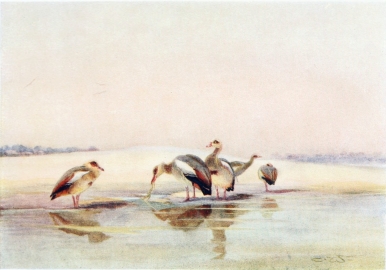
comparatively safe. Many, who may not see this bird on the river, have probably often seen it at home, as it is frequently kept with other water-fowl on the ornamental waters of our parks. It is not a lively bird, and seems to spend a large part of the day standing in a hunched-up attitude on some sandbank, well in the middle of the stream, from which position it can see the approach of any enemy. In captivity it is rather morose, and fierce with any smaller fowl it can safely bully. It lives on all sorts of water-insects and weeds, and makes excursions at night-time to the fields and cultivated grounds for grass and corn.
Fig. 10.

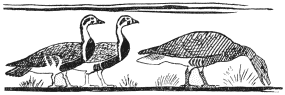
Probably no single work of art in all Egypt has been more widely copied than the picture of geese which is now in the Museum at Cairo. It came from the tomb of Ne fer maāt at Mêdûm, and is universally known as “the oldest picture in the world,” for it is ascribed to the earliest dynasty, and approximately about 4400 B.C. To a naturalist it is peculiarly interesting, but the interest is linked with sadness, as the subject of the picture being entirely of bird-life, one would have thought that bird-life would be a subject of continued interest; but the reverse is very much the case, so much so, that though this very picture is known to thousands who have never been to Egypt, and many thousands more who have been to Egypt and gone to see this very picture, and bought photographs or copies of it, few or any have really interest enough in it even to learn or inquire what are the names of the geese depicted. In the very rough little sketch on p. 175 the two geese at the extreme right and left are Bean Geese, birds that one might expect the old-time artist to be familiar with, and the same is true of the two geese in the left-hand group, which are White-fronted Geese, as both are winter migrants to Egypt, remaining till March. Of the two remaining birds, from their markings the naturalist will have no doubt but that they are Red-breasted Geese; and there is a mystery, as they never come to Egypt, and being a northern bird, one is utterly at a loss to explain why the artist of that long-distant date should depict that special Goose. That he did see the bird, and with fidelity drew it, are facts, and one can only conclude that zoological collections are no new thing, but that men, nearly six thousand years ago, must have kept rare birds in captivity for the pleasure of their beauty, and that artists went to their zoological gardens or collections, and drew pictures of the inhabitants of far-distant climes for the walls of their temples or tombs. As a realistic study of bird-life this little picture is admirable, the set of the head and peculiar curve of the Feeding Geese is singularly true, whilst the whole is carried through in a broad decorative spirit. It is curious that in a country where the earliest art took subjects from Nature, there should now be such absolute apathy that in many cases the people have no separate names for the birds around them. Egypt has other geese that visit it, but none others native to it. The White-fronted Goose is said to be the most abundant of all, the Brent Goose and the Bean Goose, all three visiting the Nile and Delta in the winter months.
Fig. 11.