LITTLE RINGED-PLOVER Aegialitis minor
Reading edition
General colour of upper plumage a delicate grey-brown; under plumage white, with a black bar through the eye, and a dark mark on the forehead, bordered at its lower and upper margin with white; and a rich black collar going nearly all round body; legs reddish. Total length, 6·5 inches.
THIS bird no one can fail to see, as, though it is in other countries a shy bird, it is here amazingly tame and familiar. By the river, by canal-side, round every small pool or watercourse, there you will see this cheerful little compact-shaped bird. All last winter, 1907-8, I had seen great numbers in the Thebes district, but in this winter of 1909 I have on Lake Menzaleh seen literally thousands of Ring-Plover. I cannot be sure they were all “the Little Ring-Plover”; that they were Ring-Plovers, I am certain, but as there are three species of Ring-Plover—the Great, the Middle, and the Little (and Captain Shelley strangely gives the dimensions of the Middle form as smaller than the Little)—it is safest not to be too dogmatic, and only call them Ring-Plovers. It is a very active bird, incessantly on the search for food,
RINGED-PLOVER

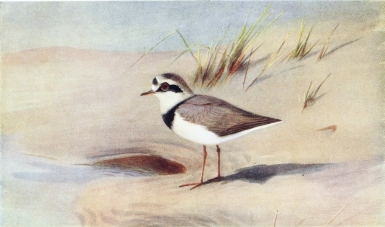
and the pace that those little legs can go, when they do their best, is amazing. It has a charming way of ever and anon stopping suddenly still and looking steadily at you, with head held very slightly aside, seeming to try to read right through you, and discover if you are friend or foe. When it flies its wings are seen to be very sharp and pointed, and bearing some resemblance to a snipe’s—a bird it is often made to do duty for by those romancers, the native gunners, who tempt the uninitiated to accompany them for snipe-shooting, and assure the new-comer these poor little Plover are Snipe—“Egyptian” Snipe.