THE COMMON HERON Ardea cinerea
Reading edition
The top of head, neck, and under-parts white; a stripe above the eye, back of head, and long, thin crest-feathers; spots on breast, and larger wing-feathers black; flanks a very light grey; rest of plumage a delicate slaty-grey shading on the wings to a darker hue; beak yellowish-green; legs greenish-black; eyes yellow. Entire length, 38 inches.
THIS is the common Heron of England, and is evenly distributed over the country. It needs water, and from that cause is more often seen in Lower than Upper Egypt. It seems to be a visitor and not a resident. Mr. M. J. Nicoll tells me that from August to April it is steadily seen either in, or flying over, the Zoological Gardens at Cairo, and if it were a resident bird it would be one of the first to make the Gardens a breeding-place, as the thick trees and quiet pools of water are all to its liking; but I have not heard that it ever occurs there during the summer months. The group I sketched were standing together at the edge of a pool on the river, gazing stolidly at a solitary pelican. At home, it always nests in colonies known as heronries, and I believe that in England
HERONS At dawn on the Nile.

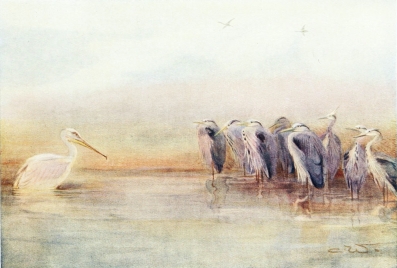
it is rather increasing than decreasing in numbers. The young birds are peculiarly ugly, and have a rather mad-looking hairy down covering on their heads, which is retained till they have become almost fully fledged. When I have been watching Herons standing, patiently waiting by the hour together, for fish to come within striking distance, I have often wondered if there was any truth in the old homely legend of their legs having some potent fascination by reason of an exuded oil which the fish love, that tempts them to come swimming round and round till they approach too near and are adroitly caught. Anyhow this is certain, it does not walk after them; they come to it. Having chosen its spot, it remains there as quiet as a mouse, and with the true fisherman’s patience bides its time. It is a curious sight to see the way in which it perches on a branch. It drops its long, thin legs and seizes it with its extended toes, but always seems to find it hard to get its balance, and as the branch sways with its weight it bends its body this way and that, all the time keeping its wings expanded as if trying to get just the right balance, and you realise then that it is no true “perching bird.” It lends its picturesque form to Egyptian scenery, just as it does to our homely English waters or wilder Scotch lochs; it always, somehow, goes well with the landscape. Shelley says, “It may be seen in considerable numbers in company with Spoonbills, Pelicans, and other waders.” And it is one of the curious facts about bird life here, that so many of the birds that we know only as solitary and not at all given to consorting in flocks, either with their own species or any other, save at their breeding stations, frequently do show a complete difference of habit in this respect in this country. From the boat I remember seeing a singular line of seven birds flying towards us. The first was a Heron, then a Spoonbill, then a Heron followed by two Spoonbills, and the straight line ended with two Herons, all so close together, the bill of one nearly touching the tail of the other, and all keeping time with the utmost precision.
To enumerate all the places I have watched this bird at is unnecessary, as at one time or another I have seen it everywhere. Its food is fish, frogs, and it is particularly fond of eels.