THE LITTLE GREEN BEE-EATER Merops viridis
Reading edition
The plumage throughout is green, with a black eye-stripe and a black marking in front on chest; legs brown, beak black, eyes crimson, two centre tail-feathers very elongated. Total length, 11 inches.
THERE are three species of Bee-eaters, but this, the Little Green Bee-eater, is chosen because it is resident, and because it must be seen by every one in Upper Egypt. The other two species are both birds of passage through Egypt, and are seldom seen or heard till April or May, when most people have left. This bird is well called the Green Bee-eater since it is green right over every part of its upper plumage, but owing to the shading of parts not in the full light of the sun it often appears as if its head were of burnished gold, and again when it flies, if the light be at all behind it, the transparent outstretched wings look a brilliant orange owing to the under-sides being of that rich warm colour. In habits it will remind any observer of our Fly-catchers at home, for it sits rather humped up on a dead twig, wall, or post till, suddenly observing some passing bee or fly, it
LITTLE GREEN BEE-EATER

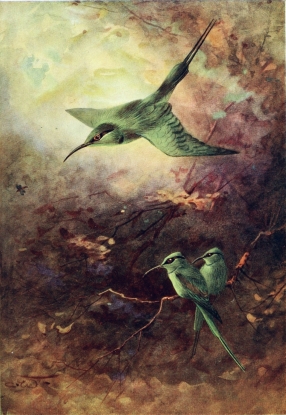
swoops down on its prey and then back again to its perch to enjoy its food. This it will continue to do by the hour together, till, first stretching out one wing and leg, and then the other, it decides to set out for pastures new, and with an easy, long, sweeping flight, rising and then falling, it disappears from view. It is a very tame little bird, and is met with literally everywhere; but it is undoubtedly most fond of the wells with a few trees growing round them, or the gardens or palm-groves. I do not remember to have seen one actually on the ground, in which matter it is similar to all very short-legged birds, and its legs are very short.
It is a melancholy fact to have to record that it is far too often shot by visitors; and worse, sometimes now native boys catch it for the delectation of tourists, and, tying a bit of string round its legs, hold it as if it were perching naturally on their hands. They then offer it to tourists as a tame, pet bird, and I fear the tourist too often buys of them, for otherwise these utterly mercenary little rascals would not indulge in this traffic. Needless to say the poor bird always dies—indeed, is more often than not half-dead when in the boy’s hand, as its half-glazed eye only too plainly shows. One hardly knows how to cure this cruelty, for the humane nearly always rebuke the boy, give him a piastre or two, and liberate the bird, and pass on thinking they have done a good deed. The bird can only flutter feebly away, and the boy of course re-catches it and goes through the same performance with the next kind-hearted, foolish visitor. It is with regret I write it, but I do not in the least now believe in the Egyptian’s love for birds, or anything other than backsheesh. Why the birds are or were so universally tame is not because of their kindliness, but simply because of their apathy. The moment it dawns on them that there is anything to be made out of birds or any other lovely thing they are as brutal as the very worst British hooligan.
I have sometimes seen Bee-eaters in the ruins and temples, and in this connection it is interesting to recall that there is a very good representation of one flying, in the celebrated series of pictures of the expedition to Punt at Deir-el-Bahari, the only case I can remember of a Bee-eater being so represented. It is entirely insectivorous, and is one of the many birds which ought, in this insect-infested country, to be strictly preserved, for it is appalling to think what an unbearable land this would be for us thin-skinned people if the teeming clouds of flies and mosquitoes were not held in some check by these industrious birds, which are all day long steadily trying to reduce their numbers.
By modern naturalists the Common Swift is not placed along with the Swallow, but comes near the Bee-eaters and Nightjars, and I therefore place my notes on this bird at this point.
When I arrived early in October 1907 at Deir-el-Bahari, I saw thousands upon thousands of Swifts flying round in never-ending circles, and all, as far as I was able to identify them, the same Swift that goes shrieking its weird song down every town and village in rural England. Night after night, in the wonderful glow that follows the actual sunset, I used to go to the top of the great cliffs that overhang Queen Hatashu’s temple, where round me raced here, there, and everywhere, these great clouds of birds, sometimes so near me, as I sat quietly hidden in a niche of the rocks, that I could easily have knocked them down with a stick; whilst others were high, high up, circling round. Every now and then so close they came, shrilly shrieking and screaming, one after another, in follow-my-leader fashion, that I felt the cool fanning of the air from their beating wings. In the early morning they were out again, but during the middle of the day they were rarely if ever to be seen. By the end of November there were but few, and when I returned after Christmas there was hardly one to be seen. About the middle of January I saw flocks of them again at Karnak, which is only just on the other side of the river.
Shelley seems to speak of the Common Swift as rare, and he is most probably right, but I have no doubt whatever of the identity of those I saw in the neighbourhood of Thebes at that particular time. The Swift that really breeds here is the Pale Swift, which, instead of being almost black all over like the Common Swift, has a more or less uniform greyish-brown plumage, and is considerably smaller; Shelley says two inches.
In the report of the Giza Zoological Society on the wild birds that have been observed in the gardens, both species of Swifts are noticed as having occurred there, and it is probable that both kinds are spread over the whole of Egypt. Why it is not generally noticed is because, as has been said, it flies out rather late, and keeps to great heights, never within my own experience flying as at home a foot or so above the ground.
The Pale Swift I have often seen, and so close to me that the main difference in plumage to the Common Swift has been definitely noted. I myself have never heard it make the wild shrieking note our own bird makes, but then I have only seen it in the mid-winter months.