THE BLACK STORK Ciconia nigra
Reading edition
The Black Stork is a bronzy black with purple and green reflections all over head, neck, back, and wings. The lower parts white, and beak and bare skin, legs and feet, bright red; eyes brown. Total length, 42 inches.
FACING page 1 is shown a White Stork flying, and the fact that all Storks, in distinction to Herons, fly with their heads and their legs stretched out to their fullest extent, has been already pointed out. This Stork is nearly always seen in large flocks, and there must be ten to one of the white to the black species. The white bird is eminently a gregarious bird, sociable with its fellows, and this sociability extends also to mankind; and most have seen the old wheels stuck on poles and rough platforms
BLACK STORK

built on the top of buildings and barns in Holland or Germany to encourage the bird to come and nest. The Stork and the Swallow know their seasons, and people love to have these messengers of the coming summer make their home with them; and in many places there are traditions of the same site having been used by them for nesting in for hundreds of years. Of all this side of their life, however, those seen in Egypt show nothing, as nearly all that come are simply migrating still farther south. A very few do remain throughout the winter in one or two exceptionally favoured feeding-grounds; Lake Menzaleh, for instance, with its great area of shallow water teeming with fish and aquatic insect life, is a favourite haunt. The profusion of life in every pool and puddle throughout Egypt is really astonishing. I have seen isolated spaces hardly exceeding a couple of square yards absolutely teeming and heaving with innumerable beetles and larvæ of flies and insects. I can also recall one little pool in the centre of one of the many small nameless islands in Lake Menzaleh: when I approached it, from its glittering whiteness I took it to be one of those salt-covered basins that are everywhere, but when I looked close the whole floor of what had been a small pool was one solid mass of dead fry, none longer than an inch and a half. The water had been all over the island, but when I was there in April it had gone down, and this mass of imprisoned little fish had died as the water gradually dried up. How long they may have been dead I do not know, but the level mass of them was so untouched that it was clear no gull or heron or stork had been there, and yet the district was full of these birds; but I presume living food being in such profusion round them, they cared not to trouble about dead. The pool looked like a large basin of the most wonderfully silvery whitebait.
Up the Nile when flocks of Storks are seen they are always either heading due north in spring, or due south in autumn. Every now and again they indulge, however, sometimes for hours together, in curious aerial exercises high up in mid-air over one spot—why this is I do not know. This, as is the case with so many of birds’ habits, is all that can be done—note the fact. Conclusions drawn from these facts are vain, as too often man reads into these birds’ actions the reasons that would occur in his life; and the life of a bird is not as that of a man, and the sooner man throws over all such ideas that he can tell anything of the causes of birds’ actions by reading himself into their lives, the sooner he may get at the real truth of the matter. I say this because I have been asked so often the question, Why do the Storks behave in this curious way? I don’t know, and at present I don’t think any man knows; for if they are on a journey the only stop you would think they would make would be for rest or food, yet for hours, sometimes almost for the best part of a day, they do stop over one spot, and you will see these vast flocks high up, so that they look like mere specks, going round and round, sometimes higher, sometimes lower, but never going far from some unseen centre of attraction till the spirit moves them; and swinging out of the great circle, they one by one take their places in the wake of some chosen leader to the land to which they would go.
The White Stork makes a curious clattering noise with its bill. Its food is mainly derived from the water; and frogs, a plague of which is always over Egypt, are favourite morsels.
If sailing down the river you chance on a large flock resting on some sandbank, you will see a picture which would be exceedingly difficult to surpass in beauty and interest. The white of the great masses of birds comes in fine contrast with the reds of their legs and the golden yellow of the sand, and if on your nearer approach they all simultaneously rise together into mid-air you will be hardly likely to forget the scene for a whole lifetime.
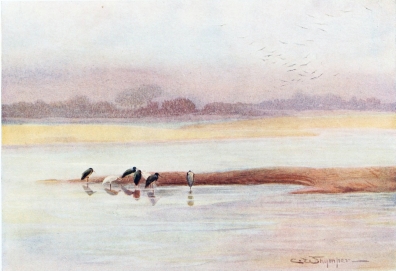
The Black Stork is not so interesting as the above, but it is a remarkably handsome bird in itself. All its peculiarities are just the opposite of the White Stork. It is not gregarious, but generally rather a solitary bird; it does not love its own species, and it certainly does not court the proximity of man. On the scale that our drawing has had to be reduced to, to suit these pages, it comes very small, but not too small to show the general disposition of the colours of its plumage. We came very early in the morning on this group standing at the end of a long sand-bar, just ten miles south of Sohag, and they never got up as the boat sailed comparatively close by them. The group was a very mixed one, as in addition to the four Black Storks there were two Spoonbills and a Heron; and I find another note that once I saw three Black Storks, one White Stork, and several Herons all in a bunch together, this also in the grey of an early March morning. These two cases of a contradiction of what we are generally told is the ordinary habit of shunning their own species is only another of the endless cases that I have met with of the variation of the individual in absolutely everything. All that can be done is to give what is believed to be the average customary habit, but ever be prepared for individuals contradicting the rule. To dogmatise as to what a child or a bird will do is always March madness. The Black Stork is like his white cousin, of great use in keeping down the Egyptian plague of frogs.