THE SPOONBILL Platalea leucorodea
Reading edition
Plumage white all over, tinged with buff on the lower part of the neck; head crested; beak flattened from above downward, and terminating in a broad spoon-shaped expansion; eye red.
WHEN seen flying the Spoonbill can be readily distinguished from the only other white Egyptian bird, i.e. the Egret, because the former flies with its neck extended, whilst the latter, being of the Heron tribe, flies with its neck drawn back close to the body.
I have seen pictures in some of the Gurnah tombs which, though crudely drawn, were undoubtedly meant for the Spoonbill. The old-time artist was apparently so struck with the flat, spoon-shaped beak that he deemed it a worthy subject for the exercise of his art. But though faithfully drawn in so far as its form is concerned, it is wrongly depicted in its relation to the head, since the head is shown in profile, while the beak is drawn as though it were seen from above! In no picture that I can recall by these ancient draughtsmen is any bird ever shown in the very slightest degree foreshortened.
SPOONBILLS On a mud-bank.

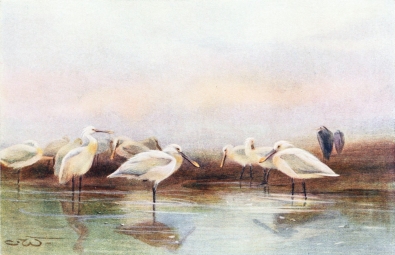
The use of this very remarkable beak is apparent when the bird is seen feeding; it is held low down on the surface of the water, and pushed along, like a shrimper’s net, in front of the bird, so as to collect the minute organisms which constitute its food. I have also seen this beak driven deep down, and brought to the surface bearing long strings of grass and other water weeds. In February 1909, when walking along the front at Luxor,—with its hotels and shops, crowds of people and noisy donkey-boys,—I was startled by quite a big flock of Spoonbills that were beaten down low by a strong wind. They passed so close over my head that I saw their big flat beaks and long extended necks quite plainly: as they got farther away their general likeness to Swans in flight was most striking.
Like all birds showing any marked peculiarity in the shape or size of the beak, the Spoonbill wears a somewhat melancholy air, and my readers will doubtless recall this appearance in the case of Herons and Storks, Pelicans and Cormorants.
Time was when the Spoonbill was once common in Great Britain; this is now, unhappily, no longer the case, but no farther away than Holland it still lives and breeds.