THE CRANE Grus communis
Reading edition
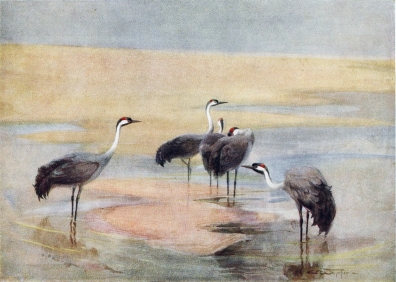
The whole of the body a delicate lilac grey, flight feathers dark. Secondary wing-feathers very long, covering with a plume-like mass the wings and tail. Sides of face white, as are the sides of neck, which is black in front; top of head black, the centre of the crown bare of feathers and of a brilliant red; beak greenish-yellow; eyes red-brown. Total length, 46 inches.
CRANES will only be seen flying in flocks high in air, or else resting after a day’s flight on some sandbank by the river-side. As soon as they have rested, fed, and refreshed themselves, they are up and away again, and, as far as I know, they do not now remain anywhere in Egypt a day longer than is necessary. They are as rapid in their visits as the most scampering of tourists, who only allot so many days for a whole continent. But owing to the enormous numbers that there are of these birds, some of the migrating armies of them may be seen either in the autumn when they are all going due south, or on the break-up of the winter when they are all going due north. It seems strange that they should get so far north as Lapland and Siberia, but that they do there is abundance of proof; and it must always be remembered that these migrant birds seem to choose the most northerly point of their migration to breed and rear their young, so that when you see flocks wending their way back in the spring-time all up the Nile valley you must picture them as on their way to their northern homes, either in North Germany, Russia, or Scandinavia. They make but a rough nest on the ground in some parts of the great marshes they love, on little islands or tussocks of coarse grass. Only two eggs are laid, of a rich brown colour with dark spots: and the young are especially lively, running about with ease a few days after being hatched. Therein they contrast strongly with the young of the Heron, which remain in the nest for long weeks, and must have every scrap of food brought right up to their nursery.
Cranes’ plumage, after the summer’s work is over, fades very greatly, and I have seen it stated that the lovely lilac-grey altogether vanishes, leaving but a very dirty, grey-brownish plumage. This is also true of the Heron, and doubtless of all birds whose delicately coloured plumage is put on for the breeding season, for the wear and tear that these delicate
CRANES

feathers have to pass through in all that long nesting period is enough to soil and spoil everything.
Their food is very varied. In captivity they seem as if they could, and would, eat anything, and I remember once seeing one trying to swallow a kid glove that had accidentally been dropped into its enclosure; possibly it thought it was some sort of dried frog! Insects, snails, frogs, and anything it can get from the water, as well as seeds and grasses, are its stock articles of diet.
M. Maspero told me that in his opinion there was a notable diminution of their number and of the time they spend in Egypt every winter—a view I also take most decidedly with my own recollections of twenty-five years ago, when I saw them so frequently that then they were one of the commonest sights on the Nile, whilst in the winters of 1907-1908 I was only once able to make drawings of them on a sandbank near Minieh, and saw but two or three flocks during the whole time flying high in air. This is entirely owing to the great increase of large steamers which, passing up and down, disturb the quiet of the water. If one is fortunate enough to hear them calling one to another as they fly above your head, one will ever afterwards be able to identify them, even though they be mere specks in high heaven, as the sound is peculiarly trumpet-like and sonorous. It carries an enormous distance, and attention may perhaps be drawn to their coming before the faintest sign of them can otherwise be seen.
Most would think, from a general glance at the Crane, that it was a Heron of some sort, but scientists tell us that it is a long way removed from them, and indeed some place it nearer the Bustards. There are many species of Cranes, and they are to be found practically the world over, for not only in Africa and Europe, but Asia, and Australia, and America all have their special Cranes.
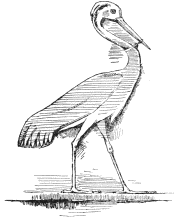
In many of the wall-paintings throughout Egypt Cranes are shown, and in none are they in more exact truth than in the temple at Deir-el-Bahari. There they are shown walking in stately fashion between slaves bearing precious burdens; whilst some carry garden produce, rich fruits, and flowers, others are laden with ready trussed fowls and ducks, and amidst them all the graceful bird walks on. One wonders it does not fly away, for these good things do but foreshadow its own end; but if you look closely you will see its bill is tied down close to its neck, for these old-time people knew well the habits of the beasts and birds, and knew that if it could not stretch out head and neck it could not fly. All Cranes, and indeed many other birds, seem unable to start flight without a certain momentum given by a run forward with wings outspread and stretched-out neck. With head tied down it could get no balance, and would flap and flop, and then fall to the ground. It is in little details such as this that the more you know the more you respect the knowledge of these old artists, and admit the truth and merit of their unrivalled art.
Fig. 8.