THE SACRED IBIS Ibis aethiopica
Reading edition
General plumage white; a mass of almost hair-like feathers falls over the wings and tail—these feathers are a rich metallic black with deep blue reflections; head and neck bare of all feathers, showing black wrinkled skin; beak and legs black; eyes brown. Length, 28 inches.
THIS is one of the birds the selection of which I fully expect to get criticism on. But I have chosen it for two reasons that, I think, justify its inclusion. The first is, that from one cause or another the Sacred Ibis is a bird so wrapped up with all our ideas of Egypt, and almost representative of the birds of Egypt, that most, although they do not know the bird, are interested in its existence. The second is one that follows this known interest, namely, the exposing of the dragoman’s oft-repeated impudent lie, that he can, and does, show the newcomer Sacred Ibises, whereas he does not and cannot.
Why, exactly, this bird was treated with reverence in its lifetime as a sacred being, and embalmed and mummified when dead, is not known. That it was is certain; and most museums can show many many examples. Then again, it was taken and placed on the body of a man, and made a symbol of the god Thoth, who presided over arts, inventions, writing, and literature. So it has come to pass that all of us, before even our first visit to the Nile, know of this bird, anyhow by name, and being here, very naturally desire to see it. The dragoman, being asked so frequently to point out Sacred Ibises, long ago settled that it would be best to please and humour his patrons, and determined to call all Egrets, Spoonbills, and Buff-backed Herons, being white birds with long necks and legs, Sacred Ibises. Time after time I have been solemnly informed that four or five, or a round dozen, Ibises had been seen at such a place. On inquiry I have been told there could be no mistake, as dear So-and-so, the dragoman, had pointed them out and assured all and sundry that they were “genuine Sacred Ibis.” And though strange, it is true, people prefer to believe a lie if it confirms what they wish, than the truth if it does not. The sad truth is, there are no Sacred Ibises in Egypt at all, and the dragomans—anyhow, most of them—know this elementary bit of ornithology perfectly well, but they prefer to lie, and live in the perpetual atmosphere of mild
SACRED IBIS AND PAPYRUS

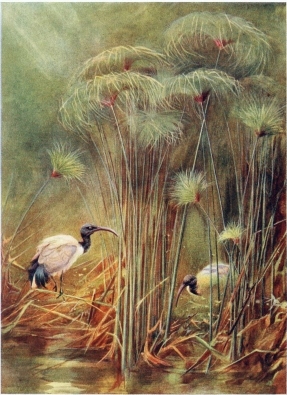
admiration and interest that follows their every utterance. No, the first place that you can at all safely look for Ibis in is south of Kartoom. It needs the great jungle-like brakes of papyrus that grow rampantly along the river-course, and which help to constitute the dread “sudd” of those waters. Immense masses of it, we are told, get torn off and detached when the new year’s flood comes rushing down, and along with other masses go floating onwards till they meet with some stoppage and then they form a dam, new masses coming down and down, till there may be miles of this floating jungle, which can, and does, get so packed and compressed by the weight behind it that it becomes nearly solid. In country like that the Ibis lives, and that is, all will see at once, not the country that Egypt is like, and therefore the Ibis is an absentee from the big, gently-flowing Nile from Assoan to Alexandria. Was it ever common in ancient Egypt? Not unless the conditions of those days were markedly different to these. The river rose each year then as now, and then as now by its rise and rush of waters must have kept the channel clear and the banks bare; but it is possible that there may have been at certain points big swamps where the papyrus grew, which have now become cultivated ground. This view might be taken from the extensive use of papyrus in dynastic days, almost implying that it grew commonly near at hand. What is certain, however, is that it does not do so now; and Ibis and papyrus are so joined together that, the one being absent, the other is also. In the plate I have therefore shown Ibis in a regular jungle of papyrus.[6] There is something strange, almost weird, about the appearance of this bird, with his bald black head; something almost priestly about the black and white drooping wings forming a vestment from which springs the thin, black, naked neck and back. Some will see none of these things, and only find a resemblance to an ugly vulture. It is rather a moody sort of bird, and does not get on over well with other birds when kept in confinement. It eats nearly anything that comes out of the water, and is especially partial to a nice young fat frog.