THE CRESTED LARK Galerita cristata
Reading edition
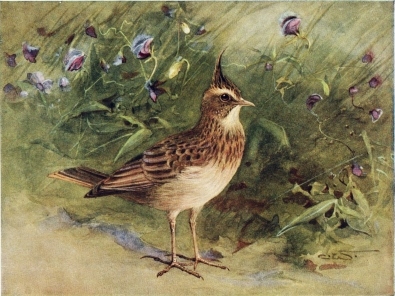
All upper plumage brown; the large feathers of wings and tail edged with a lighter buffish tone; crest of narrow dark-brown feathers with light edges; back of crest, as one sees under it when raised, tells very rich dark brown; underparts white spotted and streaked on breast with dark brown. Length, 6·7 inches.
FOR once the name does really describe the bird, so that none may be in any doubt whatever. For the crest is the one thing noticed. I have drawn one with a fine crest, but have been afraid to make it as big as I have in one or two cases seen it. Early in February I saw some that I really think had the crest a full eighth of an inch higher than my drawing shows. In each case they were undoubtedly showing off to their lady-love. The crest can be, and often is, raised at an absolute right angle as to a line horizontal with the beak. The bird is so tame that frequently it sits on the path so that you fear your donkey will tread on it, and so common that no one, however unobservant, but must notice it; it is particularly in evidence on the great Thebes plain across which all go to the Tombs of the Kings. Its song, as far as I have heard it, is distinctly pleasant; Captain Shelley calls it “but an indifferent song,” which is severe, as it is a happy little rippling series of true lark-like notes. It has a good mixed diet, animal and vegetable, hard grain and soft blade of growing things. When the weather begins to get warm you will often see this lark, as you may many other birds, sitting with its mouth open as if gasping for breath; that this is a sign they do feel the heat is certain, but I do not think that it shows they are suffering from thirst, for in the cultivation they always have water all round them in the little canals that run everywhere through the crops, and if they were thirsty they could very soon quench it. When on Lake Menzaleh, just on the very limit of Egyptian soil and Mediterranean Sea, I came across many taking a last rest on the sandbanks before migrating, and was very struck with their altered bearing. They were shy and timid, never allowed a close inspection, and flew away in hurried fashion. This was in the early weeks of April.
CRESTED LARK