THE NIGHT HERON Nycticorax griseus
Reading edition
Upper plumage dark to black, with blue-green reflections; two long plumes from head; white wings and tail grey; under-parts a grey buff-white; eyes crimson; young are dull grey and brown, mottled and spotted. Total length, 21 inches.
THIS is a really common bird, but being nocturnal it is not very often noticed. Many a sont or palm tree that people walk under may have four or five sitting so quietly among the branches that they are not observed; but towards evening—before the sun has actually dropped behind the horizon—they begin to waken up; and curious “squawk, squawk” calls, then flappings about as they move from branch to branch, will be heard, till, as the afterglow begins, they all start mounting into the air and taking great circles round and round, or away in a bee-line to some favourite feeding-ground, where they remain all night, and return at dawn to their roosting-places. In some trees in the garden of the old Luxor Hotel, there is, as I write in 1909, a colony—two of the trees they roost in hang over the very carriage roadway up to the station,—noisy and bustling for three months of the year, yet they remain in this old-time haunt undisturbed by all the changes that have taken place in this ancient town. Twenty-seven years ago I saw them there, but I have met people who declare there never was a time known when Night Herons did not frequent this spot. There is a certain seat on the front where one enters the hotel grounds, that is under some Lebekh trees these Herons love, and I was early in the season horrified to hear that the order had gone out to shoot all those that were there, as they sometimes soiled the monstrous hats that the ladies were wearing. I appealed in vain to the management—“They had had so many complaints,” etc.—it must be, and was. I never dared ask how many were shot; and I really do not see why the ladies could not take their hats off, or else put up parasols. Anyhow, just because of women’s hats, an historic colony of these interesting birds in a very remarkable situation has been in danger of being driven away. This Heron is not nearly so big as our own familiar bird, and is rather squat and dumpy in shape, but he is a fascinating, rather weird-looking creature. Occasionally, one or two stray as far as Great Britain; but here in Egypt it
NIGHT HERON

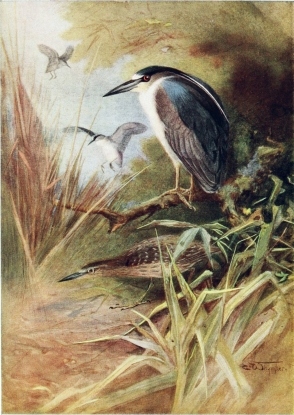
is to be met with, where it establishes a colony, in quite large numbers, and, in the report I have frequently referred to on wild birds that visit the Giza Zoological Gardens, it is stated that “Night Herons begin to arrive during August, winter here, and leave during the spring months. A few individuals, however, are seen throughout the summer. The number of these birds, which spend the daytime in the gardens, has greatly increased during the last ten years. 108 were counted on January 15, 1900; 360 on December 11, 1902. At present it is impossible to count them.”
All day long it sits moped up, out of the direct rays of the sun, in the centre of a mass of overhanging foliage, and only wakes up when most other birds are just falling to sleep. It feeds on fish, frogs, and even water-beetles and insects.