THE HOOPOE Upupa epops Arabic, Hud Hud
Reading edition
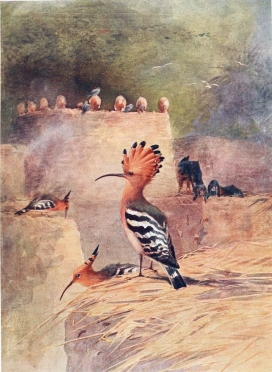
Head and crest rich rusty orange; the tips of feathers of crest black; the neck and chest rufous changing to a pink hue on breast; wings and tail black with broad white parallel bars; under-parts buff to white; legs brown; beak black; eyes brown. Length, 12 inches.
THE hoop-hoop-hoop cry of this bird is almost as curiously attractive as its varied plumage and magnificent crest. You see it everywhere, and it loves the haunts of man. It is not well to know too much of one’s heroes, and it certainly is well not to know too much of the habits of some of the wild children of the earth and air. The repulsiveness of the menu of the Hoopoe is enough to make one put one’s pen through its name and never mention it. But it is not always feeding, and when walking about in stately fashion on some mud wall, lifting its great circular crown of feathers ever and again, whilst it utters its call-name hoop-hoop-hoopoe, it is so picturesque and charming one has to pass its nasty little peculiarities by. We have to do this frequently with our own unfeathered friends for the good we presume they possess, and there is much that is good in this perky little bird.
Time was, it is said, when the Hoopoe had no crest, and he only got one granted by royal favour. The king of those days was importing a new bride from Asia, and decided to have her met at the port on the Red Sea where she landed, with unusual pomp. His army was to go down and escort her to the royal city, and all the birds of the air were instructed also to wait her arrival and form a flying sunshade with their wings, and fan the air with their pinions, whilst all should fill the heavens with their sweet songs—and thus she should come. The birds agreed, all but the Hoopoe. He objected, he knew something about the lady, and he wouldn’t consent to go. Saying he would rather not, he flew away to a cave in some far-away mountain in the desert. When the king heard of this he was very wroth. Anyhow, he had the culprit sent for, and now the poor Hoopoe is brought before his enraged majesty, but so bravely did he comport himself, and so well did he defend his position, showing that if he did that for which he had conscientious objections, he would suffer grave moral and intellectual damage, and therefore it was with all respect he begged to be excused. His Majesty was so amazed
HOOPOE On the house-tops.

with his bravery and intelligence that he took from off his own head the royal crown and placed it on the Hoopoe’s, saying, truly thou art a very king amongst birds, and shall for ever be crowned. To show the truth of this story, it is only necessary to come to Egypt, when the most sceptical will be at once converted, as he will see that every single Hoopoe to this day is indeed right royally crowned as no other bird is.[3]
The Cairo Zoological Gardens report it as “a fairly numerous visitor in spring and autumn” to the gardens, and of course most know that it is a casual visitor to the British Isles; but there it is at once shot, as soon as seen, and is then mounted by the local taxidermist. Few collections of stuffed birds, however modest, are without examples of British-killed Hoopoes. That it will ever therefore become common with us is impossible, but that it might be a regular visitor is certain, for, as long as there have been any records kept, its appearance in the summer has been noted, and no farther than the Continent it is a regular and honoured visitor. The last Hoopoe I saw in Egypt was on April 6, on Lake Menzaleh; it rose from a mere scrap of an island all soft sand, and headed to the dunes that separate the lake from the Mediterranean, and the last I saw of it, was it still flying with its head pointed to European shores.