BUFF-BACKED HERON Ardeola russata
Reading edition
General plumage white, delicately tinged with buff on head, nape, crop, and back; beak and bare skin round eye, yellow; eye, light yellow; legs, olive-black. Total length, 20·5 inches.
THIS is the bird that is most often called the Egret, and it is very similar, as in its winter plumage it is practically white all over—just a line of buff on the crown. It is of the greatest service to the cattle when feeding or resting, as it seems to know no fear, and settles on their backs, one or two at a time, and diligently searches for flies and ticks and all those parasitic things that infest the poor brutes. I have seen them walk right up to one of the recumbent buffaloes, and go solemnly picking things off it all the way round its face, even off its eyes, whilst the creature never ceased chewing the cud, and one saw its jaw going solemnly round and round whilst the bird did its best to free it from the pests. What Egypt would be without all these birds, who are ceaselessly at work clearing the air of insect life, it is appalling to contemplate, for with them the clouds of flies, midges, mosquitoes and the rest render life in some places intolerable. No one quite knows what flies are till one tries sketching out of doors here. With your palette on one hand and brushes in the other, you are an easy prey to them, and they take every advantage of the fact. They will cluster by the dozen on your face, walk in brigades over the ridge of your nose, sting you on the hand, at the back where your palette hides them from your view, and even if you have a boy with a fly-wisp they will never leave you. I have found them at their worst at the edges of the cultivated land, where trees are often growing picturesquely, tempting the artist to sit in their seductive shade; with most dire results, as one is almost eaten alive, and one envies the cattle who are being so assiduously attended to by these kindly fly-catchers.
The Egret is one of the many birds that the dragoman makes the tourist happy by calling “the Ibis,” and the number that return to their friends gleefully telling how they saw a flock of Ibises grows every season. In the article on the Ibis it is shown how ludicrously untrustworthy is the dragoman’s Natural History information.
The Buff-backed Heron may often be seen flying up or down the river in little parties of
BUFF-BACKED HERON

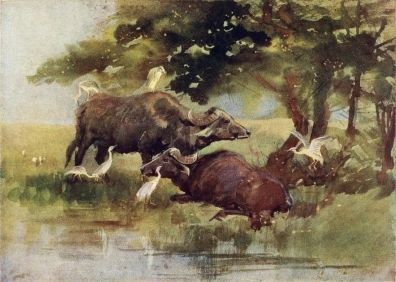
five or six. They look snow-white, and are then hard to tell from Spoonbill or Egret; but they ought not to be mistaken for the first-named bird, for, being Herons, they fly as all Herons do, with head tucked in, whilst the Spoonbill flies with extended neck. This is a real resident bird. Captain Shelley says it breeds in August in large colonies in the sont trees, and that, in addition to being useful to the poor cattle, it is of the greatest use to Egypt, as it wages war on the locusts that would otherwise devastate the green crops and all growing things.
I regret, however, that every year, according to the best evidence, this bird is less and less seen. Twenty-five years ago it was to be met with, off and on, everywhere, and in the Delta it was absolutely one of the commonest of birds. The cause of its lessening numbers is not certain, but when it is recalled that it is a form of Egret, and that from Egrets come “aigrettes,” one solution is apparent. Against that view, however, in common justice, I must say that I have no scrap of evidence that these birds are at all largely persecuted in Egypt, and they are, as already said, a resident bird. Some undoubtedly migrate north; it may be they never return, and so the annual decrease. Of the decrease there is no doubt, and I have been told that now the natives—the men who till the soil and benefit by its products—openly say that certain insect pests the much-valued cotton suffers from nowadays is due, in their opinion, to the reduced number of “little white birds” who used to come in flocks, by hundreds, and search and find and devour these same insect pests.