LESSER BLACK-BACKED GULL Larus fuscus
Reading edition
Back and wings dark slaty blackish grey; primaries black, with a large white spot on first primary near the point; rest of plumage pure white; legs and gill yellow, latter with a red spot on lower mandible; eyes yellow, eyelids red. Length, 23 inches.
IN all probability whenever a gull is seen it is most likely to be this one, as in my experience throughout Egypt it is, I think, the commonest of all. The next in order is the Black-headed Gull, but, unfortunately, in the winter months it is without its black cap, which causes it to escape notice.
The Gulls do on the water what the Kites do on the land—they act as scavengers; and it matters not whether you are arriving at Alexandria or on board a steamer at Assoan, you will, alike from end to end of Egypt, find these birds busy, searching for every scrap of waste thrown into the river, which river is the main drain of the country. The use that these birds are is therefore enormous, and they, in common with Vultures and Kites, ought to be protected and on no account shot. This year of 1909 I have seen more of these three species shot than ever before. The wily native who stalks up and down outside hotels with a gun slung over his shoulder, and seizes on unwary newcomers with great promises of apocryphal quail- and snipe-shooting, frequently—so that his patron shall not come home without any bag at all—suggests shooting every poor inoffensive bird within range. That done, the poor Kite or Gull is borne home, and laid out on the hotel steps for the further honour, glory, and kudos of the native shekarry.
It should always be remembered that the immature birds of most species differ materially from the adult: this is the case with all the Gulls, and, I own, makes their identification a matter of considerable difficulty. In the young there is no pure white and pearly grey plumage, but they are dirty-coloured, brown-spotted, rather uninteresting-looking birds, but as they have just as ravenous an appetite as their parents, and as they satisfy that appetite with the filth that is thrown out of a scavenger’s basket, they are fully as useful as the more attractively plumaged adults. Where they can get it, they like fish before anything, be it the sprat of the clear ocean water, or the sweepings of the fish-market. At Damietta, where there is a great
LESSER BLACK-BACKED GULL AND BLACK-HEADED GULL On the river at Cairo.

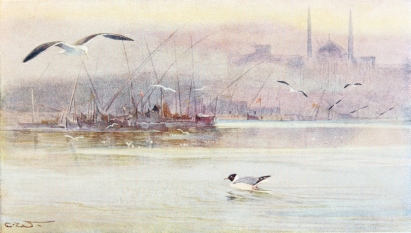
fish-market and salted fish is sent away all over Egypt, the offal from the gutted fish is simply thrown out on to the shore, and work as hard as the Gulls do, they cannot clear all away that is daily added to this pestilential heap. Wherever Gulls come into a scene they add a sort of lightness and brightness to it. This is often felt at sea, where, after days and days of dreary water, at last some Gulls appear and give the needed brightening touch, and wherever they are seen their white wings make a charming point of contrast. Those who know London know what a boon they are to the leaden Thames, and even in sunny Egypt they are a welcome addition to river scenery.