HOODED CROW Corvus cornix
Reading edition
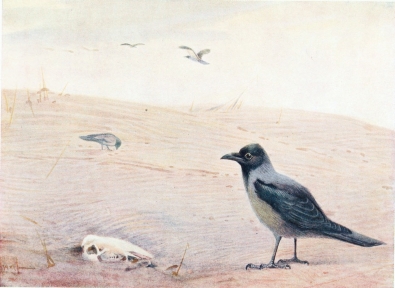
Head, throat, wings, tail, beak, and legs black, with a gloss of purple or green on most of the feathers; remainder of plumage grey, eyes dark-brown. Total length, 18 inches.
A VERY common bird throughout Egypt. It seems strange that this should be the only Crow—the pure black one has never been noticed—and if any black crow-like bird is noticed it will probably be found to be the Raven. Shelley says, “It begins breeding towards the end of February, when its nest may be procured in every clump of sont trees,”[4] but I have seen young ones with their parents flying about in early February, which would mean they must have been hatched much earlier, and it would therefore seem certain that they rear two broods in the year. It does not seem here to have quite the same character that it has elsewhere—it is less aggressive, tamer, not such a highwayman-robber sort of bird—and though it is so common I cannot ever remember to have seen a flock of them together in the real open country, they seem to go in pairs generally; but in towns and such places as the Zoological Gardens of Cairo they do foregather in large numbers. Its food is generally carrion, but it will take any living thing—lizards, mice, and even beetles—that comes in its way, and I have no doubt rob the nests of small birds, not only of eggs but also of the unfledged young. It is distinctly a handsome bird and it walks well, holding its head high, whilst its flight is strong and easy.
It was entirely owing to a certain Crow, we are told, that Cairo got its name, for it seems that when the architect was planning out the city, he arranged that the first stone of the great surrounding wall should be laid at a particular moment dictated by the astrologers. This moment was to be made known to the architect by the pulling of a cord extending from where he was to the place where the astrologers were assembled. The momentous day arrived, the architect awaited the signal, and suddenly the cord was shaken, and the stone was laid. But a horrid mistake had been made. The astrologers had not pulled the cord; a wretched old Crow had heavily perched upon it, and shaken by his weight, the unlucky signal was given! From the vexation caused by this incident
HOODED CROW

the city was called Kahira[5] (the “vexatious” or “unlucky”). Kahira softened, soon became Cairo.
The Raven, as already stated, is to be seen from time to time, and especially where the cliffs come down close to the river. It is so similar to the ordinary Raven that it is only after the feathers of the head and neck have been worn for some time that the brown look appears which has given rise to the specific name of the Brown-necked Raven. Shelley says it nests in date-palm trees, but the only nests I myself have seen have been in the lofty cliffs of Deir-el-Bahari and Abu Fêada, and again in some of the ruins of temples, at Karnak for instance. There is, further, one more Raven, the Abyssinian, which is smaller by some three inches than the Brown-necked, but it is very similar in all other respects.