THE CORMORANT Phalacrocorax carbo Arabic, Agag
Reading edition
Plumage dark bluish-black over head, breast, body; dull greenish-brown on wings, each feather margined with a darker tone; a pure white patch on cheeks, and another on the flanks; feathers on top of head elongated and edged with white; beak black at tip, yellow at base; part of the pouch which is without feathers, blue; legs black; eyes green. Length, 36 inches.
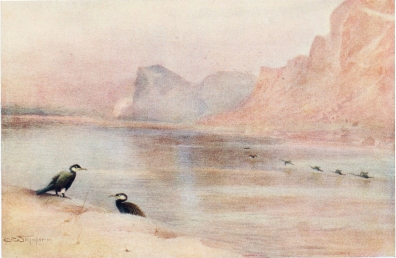
THIS is not a bird one would expect to see far away from the salt water, but there is anyhow one colony of them up the Nile at Gebel Abû Fêada—and any one going up the Nile must pass right by their breeding-place—and the birds in general seem to work rather south of that point than to the north. In March 1908 I saw them twice; once, near Manfalût, a string of six flew low over the water in single file so near that one could with the glass see the very hook at the end of their long bills. Perhaps no point on the river is quite so magnificent as these cliffs of Abû Fêada—the water rushes by their very feet, and their tops tower high in beautifully broken forms. The limestones of which they are formed seem to have weathered and perished more than in other parts, and honeycombed masses, and caves large and small, are visible everywhere on its nearly perpendicular sides. It is in these caves that birds have found a happy nesting-ground, and the extent of the deposit of guano in them shows that they have inhabited them for centuries.
The guide-books tell of these high cliffs—“sudden gusts of wind from the mountain often render great precaution necessary in sailing beneath them”; and on the last occasion of passing there was evidence of this, as a regular gale came on us just as we were passing and drove us along at a great pace. This wildness is similar to the wild windiness of the sea-coast, and the Cormorants may in this fact find some attraction to this inland home. But I should think it is far more likely still, that the founders of that colony were birds that had been reared in some of the other breeding-places that exist in the great Salt Lakes of Lower Egypt, and that by some chance taking to the river, which at Menzaleh would not be more than a mile or two away, found that the river fish were excellent, that life was pleasant, and the cliffs suitable for safely nesting in. “Stomach rules the world” is
CORMORANTS On the Nile at Gebel Aboofayda.

as true of bird life as any other. Elsewhere I have referred to the beauty and charm of Lake Menzaleh to all naturalists, and I do really think that to get anything like a complete view of Egyptian bird life a visit ought to be paid to some one or other of the lakes, and of course Menzaleh is far and away the best and biggest. But though I suggest a visit, I would not care to have it understood I recommend it as a health resort or place to live in. I write this here, because there are two considerable Cormorant rookeries or breeding-stations that I visited on Lake Menzaleh—there may be others I did not find, but these two I did find, and they will ever live in my memory as the most poisonous plots of earth I have ever stood on. I have been to Cormorant rookeries before, and well know that they don’t smell like rose-gardens. The peculiarity of this great lake is, that it is, and always has been, a great drainage-bed for the whole of Egypt. The result of having been a drainage-bed for all these untold years is that when you stick a pole, or your oar, into the mud and then pull it out, you seem to all at once take the cork out of a bottle containing the most appalling stinks and gases that ever were engendered. One day I was stalking Cormorants on a long flat island of irregular shape, and came to a point where I had to cross about ten or fifteen yards of water. The island was in the middle of the lake, and far away from town or village, and without thinking of consequences I took my boots off and started to wade across. The first step or two was on the shallow shelly shore, but three or four feet and I sank into mud, and as at each step I lifted my feet I let loose ten thousand legions of ancient stinks, the water bubbled and fizzled with them, and even slimy, blear-eyed, unwholesome fish slunk hurriedly away. Reaching the other side, I looked for some clean water to wash my feet, and did so; but it was awkward, as I had to hold my boots and socks in one hand and my nose in the other; but wash as I would the atrocious smell would not go, and I declined to put those evil-smelling things into my boots, and I couldn’t take my feet off; so there I was—the whole island was a swamp, couldn’t sit down anywhere, all puddles and wet, and the more I dabbled and washed the more it seemed to stir up new combinations of flavours never before conceived. So I shouted and shouted, and at last one of the crew heard, and brought out the small boat and rescued me; most mercifully I had carbolic soap with me, and so managed to at last get clean. The lake is nowhere very deep, but is absolutely full of fish; you constantly see them jumping out of the water for a breath of fresh air, and I don’t blame them. The pools have crowds of small fry, and the larvæ of thousands of insects; indeed, it is “a heaven for mosquitoes and a damp hell for men.” It is this extraordinary profusion of life bred in the water that causes it to be such a fine feeding-ground for the birds, but everything that comes out of that lake is slimy and smelling. In April, when I was at Menzaleh, the birds had not begun nesting, but there was every sign of quite a big Cormorant colony. I counted the sites of more than twenty nests on one island alone, and I saw Cormorants off and on nearly every day of my two weeks’ stay.
Needless to say, the Cormorant is entirely a fish-feeding bird, and usually lives on or near the sea. The fact that a colony has been for so long now established up the river is certainly interesting, and it will be curious to see if these new great water-works do cause any further extension of their area. Mr. Erskine Nicol told me he saw two Cormorants flying down the river in February of this year (1909), at Luxor—one was an adult bird showing a very white head,—and that within his seventeen years of residence he did not think he had ever seen them so far up as Luxor before. The young birds have no pure white on the head, and have the breast a more or less dull greyish-white.