EGYPTIAN TURTLE-DOVE OR PALM DOVE Turtur senegalensis
Reading edition
General plumage a dull pinky light brown, brighter on head and breast, which gradually shades off into white under the tail; wings, warm tones of dull umber brown, which colour also is on the tail coverts and two central tail feathers; the rest of the tail is blue-grey with broad white tips, a part of the wing coverts a bright blue-grey; it has a not very pronounced collar of black and bright golden brown feathers on the sides and front of neck, eyes crimson, legs and feet pink. Total length, 11 inches.
THE Doves have all had a sort of saintly character thrust on them, which they hardly deserve, as they are about the most pugnacious of birds, which is hardly a saintly qualification! It is true a pair of Doves by themselves, kept in semi-domestication, do show a sort of maudlin affection, but many of the smaller birds—Wrens, Tits, Warblers, and Swallows, and many others—all show equal, if not greater true affection to each other and absolute self-abnegation in their untiring devotion to their offspring. Why, therefore, the Dove has been peculiarly ticketed as
EGYPTIAN PALM DOVES

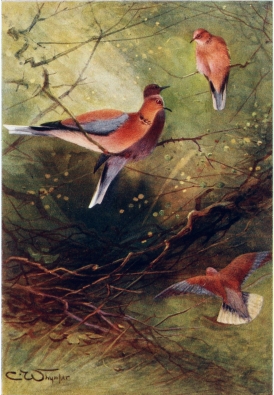
a model of connubial affection I really do not know, but it has, and I suppose it will be treated as a sort of sacred symbol to the end of time.
This particular Egyptian Turtle-dove is also sometimes called the Palm-dove; a good name, as it is always to be found wherever there are palm trees; on them it roosts and in their branches it nests. When flying it opens its tail wide, and then shows the broad white and lilac-grey of those side feathers which when sitting are all hidden away under the two central dull brown tail feathers. Its flight through and among trees is very rapid and tortuous, and it is perhaps when in the dense clump of palm trees that it is most interesting, as it is so tame that it allows of a close approach. In any of the palm groves, and palms are everywhere in Egypt, the bird lover will be able to learn something of this very Oriental Dove. The first thing he will note is that clearly some of the many that are flying here and there, and feeding on the ground around him, are quite young birds, even though it may be December or January, and it is certain that this true inhabitant of warm sunny Egypt has two broods at least in the year.