THE REED WARBLER Acrocephalus streperus
Reading edition
General plumage a greyish brown; a warmer brown on the wings, and brighter brown on rump; under parts a delicate white, shading into buff on the flanks and under tail coverts; a faint light stripe above eye; legs and beak, brown; eyes, hazel brown. Length, 5¼ inches.
THE song of any bird is one of the most certain methods, when really known, of identification. In the case of Warblers and other small birds that flit about rapidly, and always half-sheltered by vegetation, it is often exceedingly difficult to get a near and clear view, and very hard to know exactly to what species it belongs. This is particularly the case with the Reed and the Sedge Warblers; they stick so close to their beloved shelter that you rarely get a complete view of them, but if you will wait quietly and patiently you are sure to hear them burst out into a shorter or longer song—then is your chance—and if you have the very slightest sense of music, you will catch the notes peculiar to that bird and that bird alone. The Reed Warbler’s song is very peculiar; it is a running trill of notes given out exceedingly quickly, and in
REED WARBLER

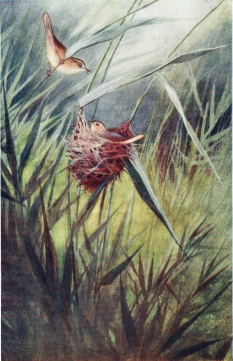
an exceedingly loud, noisy, boisterous voice, as if the bird were in the highest possible spirits. Very unlike that of many of the singers; the Nightingale, for instance, to every one sounds sad, plaintive, beautiful, but distinctly not cheerful. I have heard the Reed Warbler very often at many points on the Nile where there were no reed beds, but only stunted tamarisk or other shrubs, but in the great reed beds on and outside Lake Menzaleh I have both seen and heard it in great numbers, and the quite extraordinary penetrating noise that a number make when together is most remarkable. It is a most charming active little bird, a perfect acrobat, and it sings as blithely upside down as it does right side up. But the most attractive thing about its life-history is its nest; this it builds in the very heart of some thick clump of reeds. The accompanying picture shows how when the wind blows the cradle does rock; but it matters not how much it rocks, the wise bird builds the nest so deep that the eggs lying snug at the bottom never get tilted out. In Egypt the bird is, like the bulk of visitors, but a winter migrant. As it is insectivorous it is of some use in keeping down the host of flies great and small, and it is said to be partial to mosquitoes, which should make every one look with favour on this cheery little songster. I often think it is a mercy that practically all the song birds are small, for consider what it would mean if the large birds made noise in the same proportion to their size that the Reed Warbler does to his,—the world would be a veritable Babel.