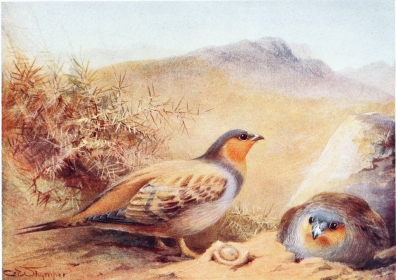
SENEGAL SAND-GROUSE Pterocles senegallus Arabic, Gutta
Reading edition
Back and general tone of feathers sandy, top of head and breast a delicate pinkish-lilac, cheeks and throat a strong brilliant orange-yellow, wings spotted with chocolate-brown markings, legs feathered, centre of chest and stomach dark dull brown, two centre tail-feathers elongated, black at points, barred at base. The female is not nearly so brightly marked, indeed, is mainly sand-coloured; eyes brown, beak dull grey. Total length, 12 inches.
THERE are three different varieties of Sand-grouse in Egypt—the Singed, the Coroneted, and the Senegal. The last has been selected as it is the one with which I am best acquainted, but either of the others have an equal claim, since, though occupying different localities, they are to be met with throughout the area covered by this book. All the Sand-grouse are very similar in their habits, they are all children of the desert, but come down, either to feed or to water, to the cultivated ground at morning and evening. Captain Shelley gives absolute localities where they might be found (he was writing in 1872), and ever since he gave
SAND-GROUSE

that information there has been each winter a regular invasion of British and other ardent sportsmen, to each of the places named, to have “a little Sand-grouse shooting.” Result: at those places there are now none whatever, and no one living there seems to know anything more about Sand-grouse than that annually large numbers of men come with shooting equipment ready to make record bags, and go away without firing a shot. This being so, the present author thinks it best not to give localities, for though there is no danger of Sand-grouse ever being exterminated, as if persecuted they have the whole of these great African deserts to fall back and back upon, yet the hunger of the modern man to go out and kill something bearing the least resemblance to a game-bird is such, that if it were told that at certain places near the river they could be got, in a single season or two that place would be absolutely cleared. It seems rather churlish perhaps, but this book is not written to aid men to shoot Egyptian birds, but simply to recognise the birds seen; and the first essential is that there should be birds to see. Sand-grouse seem to be pleasant sociable birds, happy in their family life; at the non-breeding season they foregather into large companies, in which order they fly great distances to and fro to whatever pools or water they customarily visit each evening, and it is at these places that the most deadly shooting can take place, for they are very regular in their “flighting.” Captain Tindall Lucas tells me that the Coroneted Sand-grouse drinks later in the evening and earlier in the morning than the other forms and practically when all light has gone; the more usual time being just before the sun sets. The freedom with which they fly is extraordinary, it is more with the power of the Swallow than any game-bird; they mount very high up into the air, and go wheeling round and round, now mounting nearly out of sight, then rushing headlong down in a long swooping curve till near the earth, when, perhaps, they will turn off sharp at some angle and go tearing away in some opposite direction. This is when they are in flocks, and out on the wide open desert; when coming down to water, or near cultivation, or among the coarse Halfa grass, they fly with direct intent, and waste no time about it.
Their cry must be heard to be appreciated; it is usually written as “gutta, gutta, gutta,” but no description of birds’ notes ever seems to be of much value; it is, however, so very individual that once heard would never be forgotten, and it has, as all Nature’s notes have, an entire suitability to the surroundings, and like the boundless, yellow, dry, herbless desert it is wild and weird, yet beautiful.
I remember once a quite intelligent Scotch keeper answering an inquiry, as to what Ptarmigan found to eat amongst the barren hilltops where they live with the amazing statement, delivered in the most solemn manner, “that they just lived on the little stones,” and when doubt was thrown on his information, declared that he had often cut them open to see, and had never found anything in their crops “but just the wee stones.” And the inquiry might well be made as to the source of food of the Sand-grouse when one sees a large flock in the desert places that they love to be in during the day, if one did not know of their wondrous powers of flight, which make nothing of flying scores of miles to the far-distant edges of cultivated ground.
I have watched Sand-grouse quite close at hand, and when on the ground they are rather dumpy-shaped and uninteresting; if disturbed, they pull themselves together a bit and run off to a short distance, and settle down again in a crouching position; if again disturbed they probably rise altogether, with their “gutta, gutta” cry and fly miles away. In running they go like clockwork mice; you hardly see their legs or feet, and they rise and fall over the varying contours of the ground just like a little running wave.
From Alexandria to Assoan and beyond right to the Soudan, Sand-grouse are to be met with, and though every one may not see this typical desert bird, it is there if only they know where to look for it.