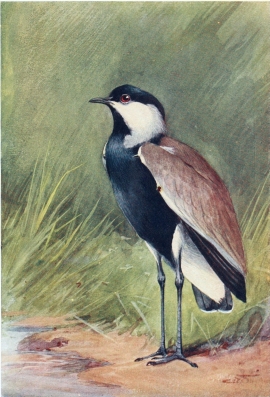
SPUR-WINGED PLOVER Hoplopterus spinosus Arabic, Zic-zac
Reading edition
Crown, nape, chin, centre of throat, breast, and tail black; white cheeks, white under and above tail, back and sides of wings a grey-brown, a sharp hard spur on point of shoulder, bill, feet and legs black, eyes rich crimson. Entire length, 12 ins.
WHETHER this or the Black-headed Plover is to have the honour of being the bird Herodotus has made famous will probably ever be a matter for the Schoolmen to argue over, but lately I came across Dr. Leith Adam’s note, explaining the reason why he insists that the Spur-winged Plover is the real friend of the crocodile and not the Black-headed,—i.e. “Codling not Short.” “The crocodile, tired of keeping its jaws wide open, just shuts them, to the everlasting peril of the bird; were it not for those two sharp spurs on his wings he of course would be suffocated and later doubtless swallowed, but by these spurs, when the roof comes down on the top of him, he just reminds his patron of his existence, by jabbing the tenderest parts of the interior of his mouth.” This is said invariably to refreshen the sleepy crocodile’s faculties, so that he remembers his faithful dentist and immediately opens his jaws and releases the prisoner, to whom one hopes he expresses profound regret.
It is to be seen on the sand-banks in Lower Egypt, but gets noticeably less frequent as one journeys into Upper Egypt, and one is disposed to think is growing less in number year by year, as so many of the pure river-side birds are, by reason of the now continually passing, noisy, wash-producing steamers.
It seems to be distinctly a quarrelsome bird, anyhow when breeding, and both male and female are more often than not to be seen having some row or another with some poor inoffensive bird who has ventured too near their nest. At times it stands up practically perpendicular, and jerks its head and body up and down with clockwork regularity till the cause of its upset has ceased, when it draws in its head and sinks it deep between its shoulders, as is shown in the accompanying drawing. Its nest is a mere depression in the sand, and it lays three or four eggs which are very similar to our common Green Plover or Lapwing.
Von Heuglin relates a Mohammedan legend: That Allah, having asked all things great and small
SPUR-WINGED PLOVER

to come to a great feast, all came except this Plover. Allah rebuked him. The Plover said he had fallen asleep and forgot all about the fixture. Allah, who knows all things, knew he lied, and answered, “Then from this time forth thou shalt know no sleep,” and he made these two spurs to grow on the points of his shoulders so that he shall suffer great pain if he try to sleep by putting his head under his wing.