THE SHOEBILL OR WHALE-HEADED STORK Balaeniceps rex Arabic name, Abu-markub, or Father of a Slipper
Reading edition
The whole plumage is a faded blue-grey running into darker tones on the wing. The primaries and tail being nearly black, eyes light yellow, legs dark brownish-black. Bill, huge, boat-shaped.
THIS bird I have included, though hardly a true Egyptian bird, its home being in the Soudan and south to Uganda, where Sir H. Johnston commonly saw it. It is the greatest show-bird the Cairo Zoological Gardens possesses, and by the ordinary person can be alone seen in Egypt. It is so exceedingly quaint and grotesque, that even when desiring to give an accurate representation of it, one is conscious that one’s drawing seems to look rather like a caricature. When it stands still there is something suggestive of a crabbed, disagreeable old person; and when it walks, the slow pedantic gait with the leg shot forward, with distended toes pointing outwards, inevitably suggests the drum-major or the dancing-master. So many people
SHOEBILL STORK

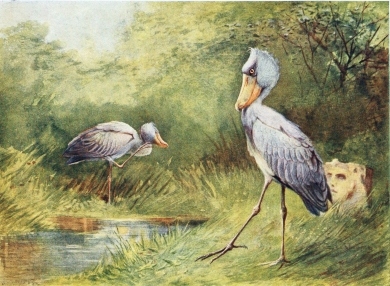
visiting the Cairo Gardens remember only this quaint bird, that it has become one of the most popular birds of the country, and is better known than very many of the true native Egyptian birds.
Captain Stanley S. Flower says “he saw perhaps as many as forty in one day” during a trip on the White Nile. “They were to be seen usually singly, sometimes two or three within a score of yards of each other, standing about on the edges of the marsh, always in the same attitude. In the motionless way in which they stand, their solitariness, and their flight, they are more like a Heron than a Stork. In fact, at a distance, unless you can see the bill, it is impossible to tell them when on the wing from the Goliath Heron.”
Mr. A. L. Butler says of it in its native wilds: “They seem of a very sluggish nature, and I seldom observed them on the wing unless put up by our steamer.” And as to its food, he writes: “I have never known it attempt to eat shell-fish; the bird is a fisher pure and simple, but doubtless, like a Heron, will eat any small mammal or young water-bird that comes within reach.” Heron-like, Balaeniceps, instead of searching for its prey, waits patiently for it to come to it. It is generally to be seen standing motionless on newly-burnt swampy ground, or short grass flooded with an inch or two of water, inside the fringe of papyrus, or “um suf” sudd which separates the channel of the Bahr-el-Ghazal from the plains. I never saw the bird actually wading in water. Its food consists principally of Polypterus senegalus, which wanders a great deal into flooded grass-land. Sometimes the bird will perch on the top of a tree, but trees are scarce in its haunts. Its flight is heavy, but powerful; the neck is drawn back like a Heron’s. “It seems to be rather a quarrelsome bird; on its first arrival at Khartoum, it seized a fox terrier which approached it so sharply that the dog fairly yelled.” Some of its habits are as peculiar as its appearance, for, later on, Mr. Butler tells us, “They have a curious trick of repeatedly bringing up their food before finally swallowing it. This often results in the disgorged fishes being snatched up by Kites”; and every visitor to the Giza Gardens must have noticed its curious habit of rattling its bill as it alternately lifts and lowers its head as a sort of welcome to its keeper. When it stands thus with its head lowered, its bill clattering, and its neck slightly swollen and held straight as a stick, it is about the most curious-looking bird possible. At the date of writing, I believe these three specimens at Giza are the only ones in any zoological gardens in the world, and the authorities are naturally very proud of them; but we do hope that some day we shall have some in our own Zoological Gardens in London, as they are birds that can stand captivity well.