Volume 2 / Part 3 — PART THIRD. HISTORY OF THE HIGHLAND REGIMENTS.
Reading edition
INTRODUCTION.
Military character of the Highlands.
Hitherto the account of the military exploits of the Highlanders has been limited to their own clan feuds and to the exertions which, for a century, they made in behalf of the unfortunate Stuarts. We are now to notice their operations on a more extended field of action, by giving a condensed sketch of their services in the cause of the country; services which have acquired for them a reputation as deserved as it has been unsurpassed. From moral as well as from physical causes, the Highlanders were well fitted to attain this pre-eminence.
“In forming his military character, the Highlander was not more favoured by nature than by the social system under which he lived. Nursed in poverty, he acquired a hardihood which enabled him to sustain severe privations. As the simplicity of his life gave vigour to his body, so it fortified his mind. Possessing a frame and constitution thus hardened, he was taught to consider courage as the most honourable virtue, cowardice the most disgraceful failing; to venerate and obey his chief, and to devote himself for his native country and clan; and thus prepared to be a soldier, he was ready to follow wherever honour and duty called him. With such principles, and regarding any disgrace he might bring on his clan and district as the most cruel misfortune, the Highland private soldier had a peculiar motive to exertion. The common soldier of many other countries has scarcely any other stimulus to the performance of his duty than the fear of chastisement, or the habit of mechanical obedience to command, produced by the discipline in which he has been trained. With a Highland soldier it is otherwise. When in a national or district corps, he is surrounded by the companions of his youth and the rivals of his early achievements; he feels the impulse of emulation strengthened by the consciousness that every proof which he displays, either of bravery or cowardice, will find its way to his native home. He thus learns to appreciate the value of a good name; and it is thus, that in a Highland regiment, consisting of men from the same country, whose kindred and connexions are mutually known, every individual feels that his conduct is the subject of observation, and that, independently of his duty as a member of a systematic whole, he has to sustain a separate and individual reputation, which will be reflected on his family, and district or glen. Hence he requires no artificial excitements. He acts from motives within himself; his point is fixed, and his aim must terminate either in victory or death. The German soldier considers himself as a part of the military machine, and duly marked out in the orders of the day. He moves onward to his destination with a well-trained pace, and with as phlegmatic indifference to the result as a labourer who works for his daily hire. The courage of the French soldier is supported in the hour of trial by his high notions of the point of honour; but this display of spirit is not always steady. A Highland soldier faces his enemy, whether in front, rear, or flank; and if he has confidence in his commander, it may be predicted with certainty that he will be victorious or die on the ground which he maintains. He goes into the field resolved not to disgrace his name. A striking characteristic of the Highlander is, that all his actions seem to flow from sentiment. His endurance of privation and fatigue,—his resistance of hostile opposition,—his solicitude for the good opinion of his superiors,—all originate in this source, whence also proceeds his obedience, which is always most conspicuous when exhibited under kind treatment. Hence arises the difference observable between the conduct of one regiment of Highlanders and that of another, and frequently even of the same regiment at different times, and under different management. A Highland regiment, to be orderly and well disciplined, ought to be commanded by men who are capable of appreciating their character, directing their passions and prejudices, and acquiring their entire confidence and affection. The officer to whom the command of Highlanders is intrusted must endeavour to acquire their confidence and good opinion. With this view, he must watch over the propriety of his own conduct. He must observe the strictest justice and fidelity in his promises to his men, conciliate them by an attention to their dispositions and prejudices, and, at the same time, by preserving a firm and steady authority, without which he will not be respected.
“Officers who are accustomed to command Highland soldiers find it easy to guide and control them when their full confidence has been obtained; but when distrust prevails severity ensues, with a consequent neglect of duty, and by a continuance of this unhappy misunderstanding, the men become stubborn, disobedient, and in the end mutinous. The spirit of a Highland soldier revolts at any unnecessary severity; though he may be led to the mouth of a cannon if properly directed, will rather die than be unfaithful to his trust. But if, instead of leading, his officers attempt to drive him, he may fail in the discharge of the most common duties.”[254]
A learned and ingenious author,[255] who, though himself a Lowlander, had ample opportunity, while serving in many campaigns with Highland regiments, of becoming intimately acquainted with their character, thus writes of them:—
“The limbs of the Highlander are strong and sinewy, the frame hardy, and of great physical power, in proportion to size. He endures cold, hunger, and fatigue with patience; in other words, he has an elasticity or pride of mind which does not feel, or which refuses to complain of hardship. The air of the gentleman is ordinarily majestic; the air and gait of the gilly is not graceful. He walks with a bended knee, and does not walk with grace, but his movement has energy; and between walking and trotting, and by an interchange of pace, he performs long journeys with facility, particularly on broken and irregular ground, such as he has been accustomed to traverse in his native country.
“The Highlanders of Scotland, born and reared under the circumstances stated, marshalled for action by clans, according to ancient usage, led into action by chiefs who possess confidence from an opinion of knowledge, and love from the influence of blood, may be calculated upon as returning victorious, or dying in the grasp of the enemy.
“Scotch Highlanders have a courage devoted to honour; but they have an impetuosity which, if not well understood, and skilfully directed, is liable to error. The Scotch fight individually as if the cause were their own, not as if it were the cause of a commander only,—and they fight impassioned. Whether training and discipline may bring them in time to the apathy of German soldiers, further experience will determine; but the Highlanders are even now impetuous; and, if they fail to accomplish their object, they cannot be withdrawn from it like those who fight a battle by the job. The object stands in their own view; the eye is fixed upon it; they rush towards it, seize it, and proclaim victory with exultation.
“The Highlander, upon the whole, is a soldier of the first quality; but, as already said, he requires to see his object fully, and to come into contact with it in all its extent. He then feels the impression of his duty through a channel which he understands, and he acts consistently in consequence of the impression, that is, in consequence of the impulse of his own internal sentiment, rather than the external impulse of the command of another; for it is often verified in experience that, where the enemy is before the Highlander and nearly in contact with him, the authority of the officer is in a measure null; the duty is notwithstanding done, and well done, by the impulses of natural instinct.
“Their conduct in the year 1745 proves very distinctly that they are neither a ferocious nor a cruel people. No troops ever, perhaps, traversed a country which might be deemed hostile leaving so few traces of outrage behind them as were left by the Highlanders in the year 1745. They are better known at the present time than they were then, and they are known to be eminent for honesty and fidelity, where confidence is given them. They possess exalted notions of honour, warm friendships, and much national pride.”
Of the disinclination from peaceful employment, and propensity for war here spoken of, Dr Jackson elsewhere affords us a striking illustration. While passing through the Isle of Skye[256] in the autumn of 1783, he met a man of great age whose shoulder had, through a recent fall, been dislocated. This condition was speedily rectified by our traveller. “As there seemed to be something rather uncommon about the old man, I asked if he had lived all his life in the Highlands? No:—he said he made one of the Forty-second when they were first raised; then had gone with them to Germany; but when he had heard that his Prince was landed in the North, he purchased, or had made such interest that he procured his discharge; came home, and enlisted under his banner. He fought at Culloden, and was wounded. After everything was settled, he returned to his old regiment, and served with it till he received another wound that rendered him unfit for service. He now, he said, lived the best way he could, on his pension.”
Dr Jackson also strongly advocates the desirability of forming national and district regiments, and of keeping them free from any foreign intermixture. Such a policy seems to be getting more and more into favour among modern military authorities; and we believe that at the present time it is seldom, and only with reluctance, that any but Scotchmen are admitted into Scotch, and especially into Highland regiments, at least this is the case with regard to privates. Indeed, it is well known that in our own country there is even now an attempt among those who manage such matters, to connect particular regiments with certain districts. Not only does such a plan tend to keep up the morale respectability and esprit de corps of each regiment, but is well calculated to keep up the numbers, by establishing a connection between the various regiments and the militia of the districts with which they are connected. Originally each Highland regiment was connected and raised from a well defined district, and military men who are conversant in such matters think that it would be advisable to restore these regiments to their old footing in this respect. On this subject, we again quote the shrewd remarks of Dr Jackson:—
“If military materials be thrown together promiscuously—that is, arranged by no other rule except that of size or quantity of matter, as it is admitted that the individual parts possess different propensities and different powers of action, it is plain that the instrument composed of these different and independent parts has a tendency to act differently; the parts are constrained to act on one object by stimulation or coercion only.
“Military excellence consists, as often hinted, in every part of the instrument acting with full force—acting from one principle and for one purpose; and hence it is evident that in a mixed fabric, composed of parts of unequal power and different temper, disunion is a consequence, if all act to the full extent of their power; or if disunion be not a consequence, the combined act must necessarily be shackled, and, as such, inferior, the strong being restrained from exertion for the sake of preserving union with the weak.
“The imperfection now stated necessarily attaches to regiments composed of different nations mixed promiscuously. It even attaches, in some degree, to regiments which are formed indiscriminately from the population of all the districts or counties of an extensive kingdom. This assumption, anticipated by reasoning, is confirmed by experience in the military history of semi-barbarous tribes, which are often observed, without the aid of tactic, as taught in modern schools, to stick together in danger and to achieve acts of heroism beyond the comprehension of those who have no knowledge of man but as part of a mechanical instrument of war. The fact has numerous proofs in the history of nations; but it has not a more decisive one than that which occurred in the late Seventy-first Regiment in the revolutionary war of America. In the summer of the year 1779, a party of the Seventy-first Regiment, consisting of fifty-six men and five officers, was detached from a redoubt at Stoneferry, in South Carolina, for the purpose of reconnoitring the enemy, which was supposed to be advancing in force to attack the post. The instructions given to the officer who commanded went no further than to reconnoitre and retire upon the redoubt. The troops were new troops,—ardent as Highlanders usually are. They fell in with a strong column of the enemy (upwards of two thousand) within a short distance of the post; and, instead of retiring according to instruction, they thought proper to attack, with an instinctive view, it was supposed, to retard progress, and thereby to give time to those who were in the redoubt to make better preparations for defence. This they did; but they were themselves nearly destroyed. All the officers and non-commissioned officers were killed or wounded, and seven of the privates only remained on their legs at the end of the combat. The commanding officer fell, and, in falling, desired the few who still resisted to make the best of their way to the redoubt. They did not obey. The national sympathies were warm. National honour did not permit them to leave their officers in the field; and they actually persisted in covering their fallen comrades until a reinforcement arriving from head quarters, which was at some distance, induced the enemy to retire.”
In the narratives which follow, we have confined ourselves strictly to those regiments which are at the present day officially recognised as Highland. Many existing regiments were originally raised in Highland districts, and formerly wore the Highland dress, which, as our readers will see, had ultimately to be changed into ordinary line regiments, from the difficulty of finding Highlanders willing to enlist; the history of such regiments we have followed only so long as they were recognised as Highland. In this way the existing strictly Highland regiments are reduced to eight—The Black Watch or 42d, the 71st, 72d, 74th, 78th, 79th, 92d, 93d.
FOOTNOTES:
42d ROYAL HIGHLAND REGIMENT. AM FREICEADAN DUBH— “THE BLACK WATCH.”
I. 1726–1775.
Embodying the Black Watch—March for England—Mutiny—Fontenoy—Embarks for the French coast—Flanders—Battle of Lafeldt—Return of the regiment to Ireland—Number changed from the 43d to the 42d—Embarks for New York—Louisbourg—Ticonderoga—The West Indies—Ticonderoga and Crown Point—Surrender of Montreal—Martinique—Havannah—Bushy Run—Fort Pitt—Ireland—Return of the 42d to Scotland.
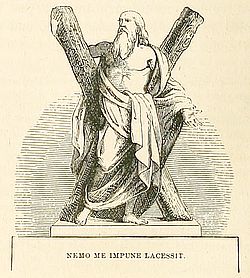
NEMO ME IMPUNE LACESSIT.
Victories.
Egypt. (With the Sphinx.) Corunna. Fuentes d’Onor. Pyrenees. Nivelle. Nive.
Orthes. Toulouse. Peninsula. Waterloo. Alma. Sevastopol. Lucknow.
The design of rendering such a valuable class of subjects available to the state by forming regular military corps out of it, seems not to have entered into the views of the government till about the year 1729, when six companies of Highlanders were raised, which, from forming distinct corps unconnected with each other, received the appellation of independent companies. Three of these companies consisted of 100 men each, and were therefore called large companies; Lord Lovat, Sir Duncan Campbell of Lochnell, and Colonel Grant of Ballindalloch, were appointed captains over them. The three smaller companies, which consisted of 75 each, were commanded by Colonel Alexander Campbell of Finab, John Campbell of Carrick, and George Munro of Culcairn, under the commission of captain-lieutenants. To each of the six companies were attached two lieutenants and one ensign. To distinguish them from the regular troops, who, from having coats, waistcoats, and breeches of scarlet cloth, were called Saighdearan Dearg, or Red soldiers; the independent companies, who were attired in tartan consisting mostly of black, green, and blue, were designated Am Freiceadan Dubh, or Black Watch,—from the sombre appearance of their dress.
As the services of these companies were not required beyond their own territory, and as the intrants were not subjected to the humiliating provisions of the disarming act, no difficulty was found in forming them; and when completed, they presented the singular spectacle of a number of young men of respectable families serving as privates in the ranks. “Many of the men who composed these companies were of a higher station in society than that from which soldiers in general are raised; cadets of gentlemen’s families, sons of gentlemen farmers, and tacksmen, either immediately or distantly descended from gentlemen’s families,—men who felt themselves responsible for their conduct to high-minded and honourable families, as well as to a country for which they cherished a devoted affection. In addition to the advantages derived from their superior rank in life, they possessed, in an eminent degree, that of a commanding external deportment, special care being taken in selecting men of full height, well proportioned, and of handsome appearance.”[257]
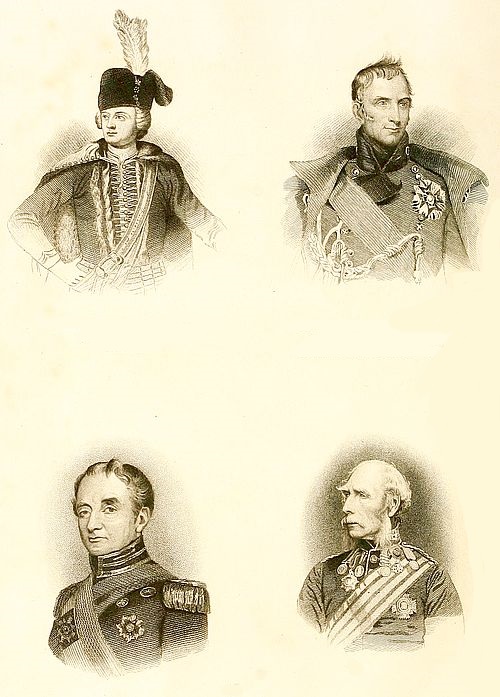
COLONELS OF THE 42nd ROYAL HIGHLANDERS.
A. Fullerton & Co London & Edinburgh.
UPPER
JOHN, EARL OF CRAWFORD. 25th Oct. 1739—1740. First Colonel.
SIR GEORGE MURRAY, G.C.B. G.C.H. 6th Sept. 1823—29th Dec. 1843. Also Col. of 72nd Highlrs 24th Feb. 1817—6th Sept. 1823.
LOWER
SIR JOHN MACDONALD, K.C.B. 15th Jan. 1844, died Col. of the Reg^t. 28th March 1850.
SIR DUNCAN A. CAMERON, K.C.B. 9th Sept. 1863—
The duties assigned to these companies were to enforce the disarming act, to overawe the disaffected, and watch their motions, and to check depredations. For this purpose they were stationed in small detachments in different parts of the country, and generally throughout the district in which they were raised. Thus Fort Augustus and the neighbouring parts of Inverness-shire were occupied by the Frasers under Lord Lovat; Ballindalloch and the Grants were stationed in Strathspey and Badenoch; the Munros under Culcairn, in Ross and Sutherland; Lochnell’s and Carrick’s companies were stationed in Athole and Breadalbane, and Finab’s in Lochaber, and the northern parts of Argyleshire among the disaffected Camerons, and Stewarts of Appin. All Highlanders of whatever clan were admitted indiscriminately into these companies as soldiers; but the officers were taken, almost exclusively, from the whig clans.
The independent companies continued to exist as such until the year 1739, when government resolved to raise four additional companies, and to form the whole into a regiment of the line. For this purpose, letters of service, dated 25th October 1739, were addressed to the Earl of Crawford and Lindsay, who was appointed to the command of the regiment about to be formed, which was to consist of 1000 men. Although the commissions were dated as above, the regiment was not embodied till the month of May 1740, when it assembled on a field between Taybridge and Aberfeldy,[258] in the county of Perth, under the number of the 43d regiment, although they still retained the country name of the Black Watch. “The uniform was a scarlet jacket and waistcoat, with buff facings and white lace,—tartan[259] plaid of twelve yards plaited round the middle of the body, the upper part being fixed on the left shoulder ready to be thrown loose, and wrapped over both shoulders and firelock in rainy weather. At night the plaid served the purpose of a blanket, and was a sufficient covering for the Highlander. These were called belted plaids from being kept tight to the body by a belt, and were worn on guards, reviews, and on all occasions when the men were in full dress. On this belt hung the pistols and dirk when worn. In the barracks, and when not on duty, the little kilt or philibeg was worn, a blue bonnet with a border of white, red and green, arranged in small squares to resemble, as is said, the fess cheque in the arms of the different branches of the Stewart family, and a tuft of feathers, or sometimes, from economy or necessity, a small piece of black bear-skin. The arms were a musket, a bayonet, and a large basket-hilted broadsword. These were furnished by government. Such of the men as chose to supply themselves with pistols and dirks were allowed to carry them, and some had targets after the fashion of their country. The sword-belt was of black leather, and the cartouch-box was carried in front, supported by a narrow belt round the middle.”[260]
The officers appointed to this regiment were:—
Colonel—John, Earl of Crawford and Lindsay, died in 1748.
Lieutenant-Colonel—Sir Robert Munro of Foulis, Bart., killed at Falkirk, 1746.
Major—George Grant, brother of the Laird of Grant, removed from the service by sentence of a court-martial, for allowing the rebels to get possession of the castle of Inverness in 1746.
Captains.
George Munro of Culcairn, brother of Sir Robert Munro, killed in 1746.[261]
Dugal Campbell of Craignish, retired in 1745.
John Campbell of Carrick, killed at Fontenoy.
Colin Campbell, junior, of Monzie, retired in 1743.
Sir James Colquhoun of Luss, Bart., retired in 1748.
Colin Campbell of Ballimore, retired.
John Munro, promoted to be Lieutenant-Colonel in 1743, retired in 1749.
Captain-Lieutenant Duncan Macfarlane, retired in 1744.
Lieutenants.
Paul Macpherson.
Lewis Grant of Auchterblair.
John Maclean of Kingarloch. { Both removed from the regiment in consequence
John Mackenzie. { of having fought a duel in 1744.
Alexander Macdonald.
Malcolm Fraser, son of Culduthel, killed at Bergen-op-Zoom in 1747.
George Ramsay.
Francis Grant, son of the Laird of Grant, died Lieutenant-General in 1782.
John Macneil.
Ensigns.
Dugal Campbell, killed at Fontenoy.
Dugal Stewart.
John Menzies of Comrie.
Edward Carrick.
Gilbert Stewart of Kincraigie.
Gordon Graham of Draines.
Archd. Macnab, son of the Laird of Macnab, died Lieutenant-General, 1790.
Colin Campbell.
Dugal Stewart.
James Campbell of Glenfalloch, died of wounds at Fontenoy.
Chaplain—Hon. Gideon Murray.
Surgeon—James Munro, brother of Sir Robert Munro.[262]
Adjutant—Gilbert Stewart.
Quarter-Master—John Forbes.
In 1740 the Earl of Crawford was removed to the Life Guards, and Brigadier-General Lord Sempill was appointed Colonel of the Highlanders.
After remaining nearly eighteen months in quarters near Taybridge,[263] the regiment was marched northward, in the winter of 1741–2 and the men remained in the stations assigned them till the spring of 1743, when they were ordered to repair to Perth. Having assembled there in March of that year, they were surprised on being informed that orders had been received to march the regiment for England, a step which they considered contrary to an alleged understanding when regimented, that the sphere of their services was not to extend beyond their native country. When the intention of employing them in foreign service came to be known, many of the warmest supporters of the government highly disapproved of the design, among whom was Lord President Forbes. In a letter to General Clayton, the successor of Marshal Wade, the chief commander in Scotland, his lordship thus expresses himself:—“When I first heard of the orders given to the Highland regiment to march southwards, it gave me no sort of concern, because I supposed the intention was only to see them; but as I have lately been assured that they are destined for foreign service, I cannot dissemble my uneasiness at a resolution, that may, in my apprehension, be attended with very bad consequences; nor can I prevail with myself not to communicate to you my thoughts on the subject, however late they may come; because if what I am to suggest has not been already under consideration, it’s possible the resolution may be departed from.” After noticing the consequences which might result from leaving the Highlands unprotected from the designs of the disaffected in the event of a war with France, he thus proceeds:—“Having thus stated to you the danger I dread, I must, in the next place, put you in mind, that the present system for securing the peace of the Highlands, which is the best I ever heard of, is by regular troops stationed from Inverness to Fort William, alongst the chain of lakes which in a manner divides the Highlands, to command the obedience of the inhabitants of both sides, and by a body of disciplined Highlanders wearing the dress and speaking the language of the country, to execute such orders as require expedition, and for which neither the dress nor the manner of the other troops are proper. The Highlanders, now regimented, were at first independent companies; and though their dress, language, and manners, qualified them for securing the low country against depredations; yet that was not the sole use of them: the same qualities fitted them for every expedition that required secrecy and despatch; they served for all purposes of hussars or light horse, in a country where mountains and bogs render cavalry useless, and if properly disposed over the Highlands, nothing that was commonly reported and believed by the Highlanders could be a secret to their commanders, because of their intimacy with the people and the sameness of the language.”[264] Notwithstanding this remonstrance, the government persisted in its determination to send the regiment abroad; and to deceive the men, from whom their real destination was concealed, they were told that the object of their march to England was merely to gratify the curiosity of the king,[265] who was desirous of seeing a Highland regiment. Satisfied with this explanation, they proceeded on their march. The English people, who had been led to consider the Highlanders as savages, were struck with the warlike appearance of the regiment and the orderly deportment of the men, who received in the country and towns through which they passed the mostly friendly attentions.
Having reached the vicinity of London on the 29th and 30th of April, in two divisions, the regiment was reviewed on the 14th of May, on Finchley Common, by Marshal Wade. The arrival of the corps in the neighbourhood of the metropolis had attracted vast crowds of people to their quarters, anxious to behold men of whom they had heard the most extraordinary relations; but, mingled with these, were persons who frequented the quarters of the Highlanders from a very different motive. Their object was to sow the seeds of distrust and disaffection among the men, by circulating misrepresentations and falsehoods respecting the intentions of the government. These incendiaries gave out that a gross deception had been practised upon the regiment, in regard to the object of their journey, in proof of which they adduced the fact of his majesty’s departure for Hanover, on the very day of the arrival of the last division, and that the real design of the government was to get rid of them altogether, as disaffected persons, and, with that view, that the regiment was to be transported for life to the American plantations. These insidious falsehoods had their intended effect upon the minds of the Highlanders, who took care, however, to conceal the indignation they felt at their supposed betrayers. All their thoughts were bent upon a return to their own country, and they concerted their measures for its accomplishment with a secrecy which escaped the observation of their officers, of whose integrity in the affair they do not, however, appear to have entertained any suspicion.
The mutiny which followed created a great sensation, and the circumstances which led to it formed, both in public and in private, the ordinary topic of discussion. The writer of a pamphlet, which was published immediately after the mutiny, and which contains the best view of the subject, and an intimate knowledge of the facts, thus describes the affair:—
“On their march through the northern counties of England, they were every where received with such hospitality, that they appeared in the highest spirits; and it was imagined that their attachment to home was so much abated, that they would feel no reluctance to the change. As they approached the metropolis, however, and were exposed to the taunts of the true-bred English clowns, they became more gloomy and sullen. Animated, even to the lowest private, with the feelings of gentlemen, they could ill brook the rudeness of boors—nor could they patiently submit to affronts in a country to which they had been called by invitation of their sovereign. A still deeper cause of discontent preyed upon their minds. A rumour had reached them on their march that they were to be embarked for the plantations. The fate of the marines, the invalids, and other regiments which had been sent to these colonies, seemed to mark out this service as at once the most perilous and the most degrading to which British soldiers could be exposed. With no enemy to encounter worthy of their courage, there was another consideration, which made it peculiarly odious to the Highlanders. By the act of parliament of the eleventh of George I., transportation to the colonies was denounced against the Highland rebels, &c. as the greatest punishment that could be inflicted on them except death, and, when they heard that they were to be sent there, the galling suspicion naturally arose in their minds, that ‘after being used as rods to scourge their own countrymen, they were to be thrown into the fire!’ These apprehensions they kept secret even from their own officers; and the care with which they dissembled them is the best evidence of the deep impression which they had made. Amidst all their jealousies and fears, however, they looked forward with considerable expectation to the review, when they were to come under the immediate observation of his majesty, or some of the royal family. On the 14th of May they were reviewed by Marshal Wade, and many persons of distinction, who were highly delighted with the promptitude and alacrity with which they went through their military exercises, and gave a very favourable report of them, where it was likely to operate most to their advantage. From that moment, however, all their thoughts were bent on the means of returning to their own country; and on this wild and romantic march they accordingly set out a few days after. Under pretence of preparing for the review, they had been enabled to provide themselves, unsuspectedly, with some necessary articles, and, confiding in their capability of enduring privations and fatigue, they imagined that they should have great advantages over any troops that might be sent in pursuit of them. It was on the night between Tuesday and Wednesday (17th and 18th May) after the review that they assembled on a common near Highgate, and commenced their march to the north. They kept as nearly as possible between the two great roads, passing from wood to wood in such a manner that it was not well known which way they moved. Orders were issued by the lords justices to the commanding officers of the forces stationed in the counties between them and Scotland, and an advertisement was published by the secretary at war, exhorting the civil officers to be vigilant in their endeavours to discover their route. It was not, however, till about eight o’clock on the evening of Thursday, 19th May, that any certain intelligence of them was obtained, and they had then proceeded as far as Northampton, and were supposed to be shaping their course towards Nottinghamshire. General Blakeney, who commanded at Northampton, immediately despatched Captain Ball, of General Wade’s regiment of horse, an officer well acquainted with that part of the country, to search after them. They had now entered Lady Wood between Brig Stock and Dean Thorp, about four miles from Oundle, when they were discovered. Captain Ball was joined in the evening by the general himself, and about nine all the troops were drawn up in order, near the wood where the Highlanders lay. Seeing themselves in this situation, and unwilling to aggravate their offence by the crime of shedding the blood of his majesty’s troops, they sent one of their guides to inform the general that he might, without fear, send an officer to treat of the terms on which they should be expected to surrender. Captain Ball was accordingly delegated, and, on coming to a conference, the captain demanded that they should instantly lay down their arms and surrender as prisoners at discretion. This they positively refused, declaring that they would rather be cut to pieces than submit, unless the general should send them a written promise, signed by his own hand, that their arms should not be taken from them, and that they should have a free pardon. Upon this the captain delivered the conditions proposed by General Blakeney, viz., that if they would peaceably lay down their arms, and surrender themselves prisoners, the most favourable report should be made of them to the lords-justices; when they again protested that they would be cut in pieces rather than surrender, except on the conditions of retaining their arms, and receiving a free pardon. ‘Hitherto,’ exclaimed the captain, ‘I have been your friend, and am still anxious to do all I can to save you; but, if you continue obstinate an hour longer, surrounded as you are by the king’s forces, not a man of you shall be left alive; and, for my own part, I assure you that I shall give quarter to none.’ He then demanded that two of their number should be ordered to conduct him out of the wood. Two brothers were accordingly ordered to accompany him. Finding that they were inclined to submit, he promised them both a free pardon, and, taking one of them along with him, he sent back the other to endeavour, by every means, to overcome the obstinacy of the rest. He soon returned with thirteen more. Having marched them to a short distance from the wood, the captain again sent one of them back to his comrades to inform them how many had submitted; and in a short time seventeen more followed the example. These were all marched away with their arms (the powder being blown out of their pans,) and when they came before the general they laid down their arms. On returning to the wood they found the whole body disposed to submit to the general’s troops.
“While this was doing in the country,” continues our author, “there was nothing but the flight of the Highlanders talked of in town. The wiser sort blamed it, but some of their hot-headed countrymen were for comparing it to the retreat of the 10,000 Greeks through Persia; by which, for the honour of the ancient kingdom of Scotland, Corporal M’Pherson was erected into a Xenophon. But amongst these idle dreams, the most injurious were those that reflected on their officers, and by a strange kind of innuendo, would have fixed the crime of these people’s desertion upon those who did their duty, and staid here.
“As to the rest of the regiment, they were ordered immediately to Kent, whither they marched very cheerfully, and were from thence transported to Flanders, and are by this time with the army, where I dare say it will quickly appear they were not afraid of fighting the French. In King William’s war there was a Highland regiment that, to avoid going to Flanders, had formed a design of flying into the mountains. This was discovered before they could put it into execution; and General M’Kay, who then commanded in Scotland, caused them to be immediately surrounded and disarmed, and afterwards shipped them for Holland. When they came to the confederate army, they behaved very briskly upon all occasions; but as pick-thanks are never wanting in courts, some wise people were pleased to tell King William that the Highlanders drank King James’s health,—a report which was probably very true. The king, whose good sense taught him to despise such dirty informations, asked General Talmash, who was near him, how they behaved in the field? ‘As well as any troops in the army,’ answered the general, like a soldier and a man of honour. ‘Why then,’ replied the king, ‘if they fight for me, let them drink my father’s health as often as they please.’ On the road, and even after they entered to London, they kept up their spirits, and marched very cheerfully; nor did they show any marks of terror when they were brought into the Tower.”
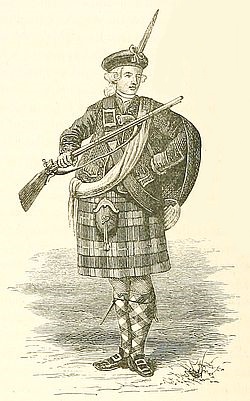
Farquhar Shaw, of the Black Watch, in the uniform of the Regiment, 1743. From the picture in the possession of Lord John Murray, Colonel of the Regiment 1745, Major-General 1755.
Though it was evident that the Highlanders were led to commit this rash act under a false impression, and that they were the unconscious dupes of designing men, yet the government thought it could not overlook such a gross breach of military discipline, and the deserters were accordingly tried before a general court-martial on the 8th of June. They were all found guilty, and condemned to be shot. Three only, however, suffered capitally. These were Corporals Malcolm and Samuel M’Pherson,[267] and Farquhar Shaw, a private. They were shot upon the parade within the Tower, in presence of the other prisoners, who joined in their prayers with great earnestness. The unfortunate men met their death with composure, and acted with great propriety. Their bodies were put into three coffins by three of the prisoners, their clansmen and connexions, and were buried together in one grave at the place of execution.[268] From an ill-judged severity, one hundred of the deserters were equally divided between the garrisons of Gibraltar and Minorca, and a similar number were distributed among the different corps in the Leeward islands, Jamaica and Georgia,—a circumstance which, it is believed, impressed the Highlanders with an idea that the government had intended to deceive them.
Near the end of May the remainder of the regiment was sent to Flanders, where it joined the army under the command of Field-Marshal the Earl of Stair. During the years 1743–44, they were quartered in different parts of that country, and by their quiet, orderly, and kind deportment, acquired the entire confidence of the people among whom they mixed. The regiment “was judged the most trustworthy guard of property, insomuch that the people in Flanders choose to have them always for their protection. Seldom were any of them drunk, and they as rarely swore. And the elector-palatine wrote to his envoy in London, desiring him to thank the king of Great Britain for the excellent behaviour of the regiment while in his territories in 1743 and 1744, and for whose sake he adds, ‘I will always pay a respect and regard to a Scotchman in future.’”[269]
Lord Sempill, who had succeeded the Earl of Crawford in the colonelcy of the regiment in 1740, being appointed in April 1745 to the 25th regiment, Lord John Murray, son of the Duke of Athole, succeeded him as colonel of the Highlanders. During the command of these officers, the regiment was designated by the titles of its successive commanders, as Lord Crawford’s, Lord Sempill’s, and Lord John Murray’s Highlanders.
Baffled in his efforts to prevent the elevation of the Grand Duke of Tuscany to the imperial throne, the King of France resolved to humble the house of Austria by making a conquest of the Netherlands. With this view he assembled an immense army in Flanders under the command of the celebrated Marshal Saxe, and having with the dauphin joined the army in April 1745, he, on the 30th of that month, invested Tournay, then garrisoned by 8000 men, commanded by General Baron Dorth, who defended the place with vigour. The Duke of Cumberland, who arrived from England early in May, assumed the command of the allied army assembled at Soignies. It consisted of twenty battalions and twenty-six squadrons of British, five battalions and sixteen squadrons of Hanoverians, all under the immediate command of his royal highness; twenty-six battalions and forty squadrons of Dutch, commanded by the Prince of Waldeck; and eight squadrons of Austrians, under the command of Count Konigseg.
Though the allied army was greatly inferior in number to the enemy, yet as the French army was detached, the duke resolved to march to the relief of Tournay. Marshal Saxe, who soon became aware of the design of the allies, drew up his army in line of battle, on the right bank of the Scheldt, extending from the wood of Barri to Fontenoy, and thence to the village of St Antoine in sight of the British army.
The allied army advanced to Leuse, and on the 9th of May took up a position between the villages of Bougries and Maulbre, in sight of the French army. In the evening the duke, attended by Field-Marshal Konigseg and the Prince of Waldeck, reconnoitred the position of Marshal Saxe. They were covered by the Highlanders, who kept up a sharp fire with French sharp-shooters who were concealed in the woods. After a general survey, the Earl of Crawford, who was left in command of the advance of the army, proceeded with the Highlanders and a party of hussars to examine the enemy’s outposts more narrowly. In the course of the day a Highlander in advance observing that one of the sharp-shooters repeatedly fired at his post, placed his bonnet upon the top of a stick near the verge of a hollow road. This stratagem decoyed the Frenchman, and whilst he was intent on his object, the Highlander approaching cautiously to a point which afforded a sure aim, succeeded in bringing him to the ground.[270]
Having ascertained that a plain which lay between the positions of two armies was covered with some flying squadrons of the enemy, and that their outposts commanded some narrow defiles through which the allied forces had necessarily to march to the attack, the Duke of Cumberland resolved to scour the plain, and to dislodge the outposts, preparatory to advancing upon the besieging army. Accordingly at an early hour next morning, six battalions and twelve squadrons were ordered to disperse the forces on the plain and clear the defiles, a service which they soon performed. Some Austrian hussars being hotly pressed on this occasion by the French light troops, a party of Highlanders was sent to support them, and the Frenchmen were quickly repulsed with loss. This was the first time the Highlanders stood the fire of the enemy in a regular body, and so well did they acquit themselves, that they were particularly noticed for their spirited conduct.
Resolving to attack the enemy next morning, the commander-in-chief of the allied army made the necessary dispositions. Opposite the space between Fontenoy and the wood of Barri, he formed the British and Hanoverian infantry in two lines, and posted their cavalry in the rear. Near the left of the Hanoverians he drew up the Dutch, whose left was towards St Antoine. The French in their turn completed their batteries, and made the most formidable preparations to receive the allies. At two o’clock in the morning of the 11th of May, the Duke of Cumberland began his march, and drew up his army in front of the enemy. The engagement began about four by the guards and the Highlanders attacking a redoubt, advanced on the right of the wood near Vezon, occupied by 600 men, in the vicinity of which place the dauphin was posted. Though the enemy were entrenched breast-high they were forced out by the guards with bayonets, and by the Highlanders with sword, pistol, and dirk, the latter killing a considerable number of them.
The allies continuing steadfastly to advance, Marshal Saxe, who had, during three attacks, lost some of his bravest men, began to think of a retreat; but being extremely unwilling to abandon his position, he resolved to make a last effort to retrieve the fortune of the day by attacking his assailants with all his forces. Being far advanced in a dropsy, the marshal had been carried about the whole day in a litter. This he now quitted, and mounting his horse, he rode over the field giving the necessary orders, whilst two men supported him on each side. He brought forward the household troops of the King of France: he posted his best cavalry on the flanks, and the king’s body guards, with the flower of the infantry in the centre. Having brought up all his field-pieces, he, under cover of their fire and that of the batteries, made a combined charge of cavalry and infantry on the allied army, the greater part of which had, by this time, formed into line by advancing beyond the confined ground. The allies, unable to withstand the impetuosity of this attack, gave way, and were driven back across the ravine, carrying along with them the Highlanders, who had been ordered up from the attack of the village, and two other regiments ordered from the reserve to support the line. After rallying for a short time beyond the ravine, the whole army retreated by order of the duke, the Highlanders and Howard’s regiment (the 19th) under the command of Lord Crawford, covering the rear. The retreat, which was commenced about three o’clock in the afternoon, was effected in excellent order. When it was over his lordship pulled off his hat, and returning thanks to the covering party, said “that they had acquired as much honour in covering so great a retreat, as if they had gained a battle.”[271] The carnage on both sides was great. The allies lost, in killed and wounded, about 7000 men, including a number of officers. The loss of the French is supposed to have equalled that of the allies. The Highlanders lost Captain John Campbell of Carrick,[272] whose head was carried off by a cannon-ball early in the action;[273] Ensign Lachlan Campbell, son of Craignish, and 30 men; Captain Robert Campbell of Finab; Ensigns Ronald Campbell, nephew of Craignish, and James Campbell, son of Glenfalloch; 2 sergeants, and 86 rank and file wounded.
Before the engagement, the part which the Highlanders would act formed a subject of general speculation. Those who knew them had no misgivings; but there were other persons, high in rank, who looked upon the support of such men with an unfavourable eye. So strong was this impression “in some high quarters, that, on the rapid charge made by the Highlanders, when pushing forward sword in hand nearly at full speed, and advancing so far, it was suggested that they inclined to change sides and join the enemy, who had already three brigades of Scotch and Irish engaged, which performed very important services on that day.”[274] All anxiety, however, was soon put an end to by the decided way in which they sustained the national honour.
Captain John Munro of the 43d regiment, in a letter to Lord-president Forbes, thus describes the battle:—“A little after four in the morning, the 30th of April, our cannon began to play, and the French batteries, with triple our weight of metal and numbers too, answered us; about five the infantry was in march; we (the Highlanders) were in the centre of the right brigade; but by six we were ordered to cross the field, (I mean our regiment, for the rest of our brigades did not march to attack,) a little village on the left of the whole, called Fontenoy. As we passed the field the French batteries played upon our front, and right and left flanks, but to no purpose, for their batteries being upon rising ground their balls flew over us and hurt the second line. We were to support the Dutch, who, in their usual way, were very dilatory. We got within musket-shot of their batteries, when we received three full fires of their batteries and small arms, which killed us forty men and one ensign. Here we were obliged to skulk behind houses and hedges for about an hour and a half, waiting for the Dutch, who, when they came up, behaved but so and so. Our regiment being in some disorder, I wanted to draw them up in rear of the Dutch, which their general would scarce allow of; but at last I did it, and marched them again to the front. In half an hour after the Dutch gave way, and Sir Robert Munro thought proper we should retire; for we had then the whole batteries from the enemy’s ground playing upon us, and three thousand foot ready to fall upon us. We retired; but before we had marched thirty yards, we had orders to return to the attack, which we did; and in about ten minutes after had orders to march directly with all expedition, to assist the Hanoverians, who had got by this time well advanced upon the batteries upon the left. They behaved most gallantly and bravely; and had the Dutch taken example from them, we had supped at Tournay. The British behaved well; we (the Highlanders) were told by his royal highness that we did our duty well.... By two of the clock we all retreated; and we were ordered to cover the retreat, as the only regiment that could be kept to their duty, and in this affair we lost sixty more; but the duke made so friendly and favourable a speech to us, that if we had been ordered to attack their lines afresh, I dare say our poor fellows would have done it.”[275]
The Highlanders on this occasion were commanded by Sir Robert Munro of Fowlis, their lieutenant-colonel, in whom, besides great military experience, were united all the best qualities of the soldier. Aware of the importance of allowing his men to follow their accustomed tactics, he obtained leave of the Duke of Cumberland to allow them to fight in their own way. He accordingly “ordered the whole regiment to clap to the ground on receiving the French fire; and instantly after its discharge they sprang up, and coming close to the enemy, poured in their shot upon them to the certain destruction of multitudes, and drove them precipitately through their lines; then retreating, drew up again, and attacked them a second time after the same manner. These attacks they repeated several times the same day, to the surprise of the whole army. Sir Robert was everywhere with his regiment, notwithstanding his great corpulency, and when in the trenches he was hauled out by the legs and arms by his own men; and it is observed that when he commanded the whole regiment to clap to the ground, he himself alone, with the colours behind him, stood upright, receiving the whole fire of the enemy; and this because, (as he said,) though he could easily lie down, his great bulk would not suffer him to rise so quickly. His preservation that day was the surprise and astonishment not only of the whole army, but of all that heard the particulars of the action.”[276]
The gallantry thus displayed by Sir Robert and his regiment was the theme of universal admiration in Britain, and the French themselves could not withhold their meed of praise. “The British behaved well,” says a French writer, “and could be exceeded in ardour by none but our officers, who animated the troops by their example, when the Highland furies rushed in upon us with more violence than ever did a sea driven by a tempest. I cannot say much of the other auxiliaries, some of whom looked as if they had no great concern in the matter which way it went. In short, we gained the victory; but may I never see such another!”[277] Some idea may be formed of the havoc made by the Highlanders from the fact of one of them having killed nine Frenchmen with his broadsword, and he was only prevented from increasing the number by his arm being shot off.[278]
In consequence of the rebellion in Scotland, eleven of the British regiments were ordered home in October 1745, among which was the 43d. The Highlanders arrived in the Thames on the 4th of November, and whilst the other regiments were sent to Scotland under General Hawley to assist in quelling the insurrection, the 43d was marched to the coast of Kent, and joined the division of the army assembled there to repel an expected invasion. When it is considered that more than three hundred of the soldiers in the 43d had fathers and brothers engaged in the rebellion, the prudence and humanity of keeping them aloof from a contest between duty and affection, are evident. Three new companies, which had been added to the regiment in the early part of the year 1745, were, however, employed in Scotland against the rebels before joining the regiment. These companies were raised chiefly in the districts of Athole, Breadalbane, and Braemar, and the command of them was given to the laird of Mackintosh, Sir Patrick Murray of Ochtertyre, and Campbell of Inveraw, who had recruited them. The subalterns were James Farquharson, the younger of Invercauld; John Campbell, the younger of Glenlyon, and Pugald Campbell; and Ensign Allan Grant, son of Glenmoriston; John Campbell, son of Glenfalloch; and Allan Campbell, son of Barcaldine. General Stewart observes that the privates of these companies, though of the best character, did not occupy that rank in society for which so many individuals of the independent companies had been distinguished. One of these companies, as has been elsewhere observed, was at the battle of Prestonpans. The services of the other two companies were confined to the Highlands during the rebellion, and after its suppression they were employed along with detachments of the English army in the barbarous task of burning the houses, and laying waste the lands of the rebels,—a service which must have been very revolting to their feelings.
Having projected the conquest of Quebec, the government fitted out an expedition at Portsmouth, the land forces of which consisted of about 8000 men, including Lord John Murray’s Highlanders, as the 43d regiment was now called. The armament having been delayed from various causes until the season was too far advanced for crossing the Atlantic, it was resolved to employ it in surprising the Port l’Orient, then the repository of all the stores and ships belonging to the French East India Company. While this new expedition was in preparation, the Highland regiment was increased to 1100 men, by draughts from the three companies in Scotland.
The expedition sailed from Portsmouth on the 15th of September, 1746, under the command of Rear-Admiral Lestock, and on the 20th the troops were landed, without much opposition, in Quimperly bay, ten miles from Port l’Orient. As General St Clair soon perceived that he could not carry the place, he abandoned the siege, and retiring to the sea-coast, re-embarked his troops.
Some of these forces returned to England; the rest landed in Ireland. The Highlanders arrived at Cork on the 4th of November, whence they marched to Limerick, where they remained till February 1747, when they returned to Cork, where they embarked to join a new expedition for Flanders. This force, which consisted chiefly of the troops that had been recalled in 1745, sailed from Leith roads in the beginning of April 1747. Lord Loudon’s Highlanders and a detachment from the three additional companies of Lord John Murray’s Highlanders also joined this force; and such was the eagerness of the latter for this service, that when informed that only a part of them was to join the army, they all claimed permission to embark, in consequence of which demand it was found necessary to settle the question of preference by drawing lots.[279]
To relieve Hulst, which was closely besieged by Count Lowendahl, a detachment, consisting of Lord John Murray’s Highlanders, the first battalion of the Royals and Bragg’s regiment, was ordered to Flushing, under the command of Major-general Fuller. They landed at Stapledyke on the 1st of May. The Dutch governor of Hulst, General St Roque, ordered the Royals to join the Dutch camp at St Bergue, and directed the Highlanders and Bragg’s regiment to halt within four miles of Hulst. On the 5th of May the besiegers began an assault, and drove the outguards and picquets back into the garrison, and would have carried the place, had not the Royals maintained their post with the greatest bravery till relieved by the Highland regiment, when the French were compelled to retire. The Highlanders had only five privates killed and a few wounded on this occasion. The French continuing the siege, St Roque surrendered the place, although he was aware that an additional reinforcement of nine battalions was on the march to his relief. The British troops then embarked for South Beveland. Three hundred of the Highland regiment, who were the last to embark, were attacked by a body of French troops. “They behaved with so much bravery that they beat off three or four times their number, killing many, and making some prisoners, with only the loss of four or five of their own number.”[280]
A few days after the battle of Lafeldt, July 2d, in which the Highlanders are not particularly mentioned, Count Lowendahl laid siege to Bergen-op-Zoom with a force of 25,000 men. This place, from the strength of its fortifications, the favourite work of the celebrated Coehorn, having never been stormed, was deemed impregnable. The garrison consisted of 3000 men, including Lord Loudon’s Highlanders. Though Lord John Murray’s Highlanders remained in South Beveland, his lordship, with Captain Fraser of Culduthel, Captain Campbell of Craignish, and several other officers of his regiment, joined the besieged. After about two months’ siege, this important fortress was taken by storm, on account of the too great confidence of Constrom the governor, who never anticipated an assault. On obtaining possession of the ramparts, the French attempted to enter the town, but were attacked with such impetuosity by two battalions of the Scottish troops in the pay of the States-General, that they were driven from street to street, until fresh reinforcements arriving, the Scotch were compelled to retreat in their turn; yet they disputed every inch of ground, and fought till two-thirds of them were killed on the spot. The remainder then abandoned the town, carrying the old governor along with them.
The different bodies of the allied army assembled in the neighbourhood of Raremond in March 1748, but, with the exception of the capture of Maestricht, no military event of any importance took place in the Netherlands; and preliminaries of peace having been signed, the Highlanders returned to England in December, and were afterwards sent to Ireland. The three additional companies had assembled at Prestonpans in March 1748, for the purpose of embarking for Flanders; but the orders to ship were countermanded, and in the course of that year these companies were reduced.
In 1749, in consequence of the reduction of the 42d regiment (Oglethorpe’s), the number of the Black Watch was changed from the 43d to the 42d, the number it has ever since retained.
During eight years—from 1749 to 1756—that the Highlanders were stationed in Ireland, the utmost cordiality subsisted between them and the inhabitants of the different districts where they were quartered; a circumstance the more remarkable, when it is considered that the military were generally embroiled in quarrels with the natives. So lasting and favourable an impression did they make, that upon the return of the regiment from America, after an absence of eleven years, applications were made from the towns and districts where they had been formerly quartered, to get them again stationed among them. Although, as General Stewart observes, the similarity of language, and the general belief in a common origin, might have had some influence with both parties, yet nothing but the most exemplary good conduct on the part of the Highlanders could have overcome the natural repugnance of a people who, at that time, justly regarded the British soldiery as ready instruments of oppression.
In consequence of the mutual encroachments made by the French and English on their respective territories in North America, both parties prepared for war; and as the British ministry determined to make their chief efforts against the enemy in that quarter, they resolved to send two bodies of troops thither. The first division, of which the Highlanders formed a part, under the command of Lieutenant-general Sir James Abercromby, set sail in March 1756, and landed at New York in June following. In the month last mentioned, 700 recruits, who had been raised by recruiting parties sent from the regiment previous to its departure from Ireland, embarked at Greenock for America. When the Highlanders landed, they attracted much notice, particularly on the part of the Indians, who, on the march of the regiment to Albany, flocked from all quarters to see strangers, whom, from the similarity of their dress, they considered to be of the same extraction as themselves, and whom they therefore regarded as brothers.
Before the departure of the 42d, several changes and promotions had taken place. Lieutenant-colonel Campbell, afterwards Duke of Argyll, who had commanded the regiment during the six years they were quartered in Ireland, having been promoted to the command of the 54th, was succeeded by Major Grant, who was so popular with the men, that, on the vacancy occurring, they subscribed a sum of money among themselves to purchase the lieutenant-colonelcy for him; but the money was not required, the promotion at that time being without purchase. Captain Duncan Campbell of Inveraw was appointed major; Thomas Graham of Duchray, James Abercromby, son of General Abercromby of Glassa, the commander of the expedition, and John Campbell of Strachur, were made captains; Lieutenant John Campbell, captain-lieutenant; Ensigns Kenneth Tolme, James Grant, John Graham, brother of Duchray, Hugh M’Pherson, Alexander Turnbull of Stracathro, and Alexander Campbell, son of Barcaldine, were raised to the rank of lieutenants. From the half-pay list were taken Lieutenants Alexander Mackintosh, James Gray, William Baillie, Hugh Arnot, William Sutherland, John Small, and Archibald Campbell; the ensigns were James Campbell, Archibald Lamont, Duncan Campbell, George MacLagan, Patrick Balneaves, son of Edradour, Patrick Stewart, son of Bonskeid, Norman MacLeod, George Campbell, and Donald Campbell.[281]
The regiment had been now sixteen years embodied, and although its original members had by this time almost disappeared, “their habits and character were well sustained by their successors, to whom they were left, as it were, in charge. This expectation has been fulfilled through a long course of years and events. The first supply of recruits after the original formation was, in many instances, inferior to their predecessors in personal appearance, as well as in private station and family connexions; but they lost nothing of that firm step, erect air, and freedom from awkward restraint, the consequence of a spirit of independence and self-respect, which distinguished their predecessors.”[282]
The second division of the expedition, under the Earl of Loudon, who was appointed commander-in-chief of the army in North America, soon joined the forces under General Abercromby; but, owing to various causes, they did not take the field till the summer of the following year.[283] Pursuant to an attack on Louisburg, Lord Loudon embarked in the month of June 1757 for Halifax with the forces under his command, amounting to 5300 men. At Halifax his forces were increased to 10,500 men, by the addition of five regiments lately arrived from England, including Fraser’s and Montgomery’s Highlanders.
When on the eve of his departure from Halifax, Lord Loudon received information that the Brest fleet had arrived in the harbour of Louisburg. The resolution to abandon the enterprise, however, was not taken till it clearly appeared from letters which were taken in a packet bound from Louisburg to France, that the force was too great to be encountered. Leaving the remainder of the troops at Halifax, Lord Loudon returned to New York, taking along with him the Highlanders and four other regiments.
By the addition of three new companies and the junction of 700 recruits, the regiment was now augmented to upwards of 1300 men, all Highlanders, for at that period none else were admitted into the regiment. To the three additional companies the following officers were appointed; James Murray, son of Lord George Murray, James Stewart of Urrard, and Thomas Stirling, son of Sir Henry Stirling of Ardoch, to be captains; Simon Blair, David Barklay, Archibald Campbell, Alexander Mackay, Alexander Menzies, and David Mills, to be lieutenants; Duncan Stewart, George Rattray, and Alexander Farquharson, to be ensigns; and the Reverend James Stewart to be assistant chaplain.
The Earl of Loudon having been recalled, the command of the army devolved on General Abercromby. Determined to wipe off the disgrace of former campaigns, the ministry, who had just come into power, fitted out a great naval armament and a military force of 32,000 men, which were placed under commanders who enjoyed the confidence of the country. The command of the fleet was given to Admiral Boscawen, and Brigadier-generals Wolfe, Townsend, and Murray, were added to the military staff. Three expeditions were planned in 1758; one against Louisburg; another against Ticonderoga and Crown Point; and a third against Fort du Quèsne.
General Abercromby, the commander-in-chief, took charge of the expedition against Ticonderoga, with a force of 15,390 men, of whom 6337 were regulars (including Lord John Murray’s Highlanders), and 9024 provincials, besides a train of artillery.
Fort Ticonderoga stands on a tongue of land between Lake Champlain and Lake George, and is surrounded on three sides by water; part of the fourth side is protected by a morass; the remaining part was strongly fortified with high entrenchments, supported and flanked by three batteries, and the whole front of that part which was accessible was intersected by deep traverses, and blocked up with felled trees, with their branches turned outwards and their points first sharpened and then hardened by fire, forming altogether a most formidable defence.[284] On the 4th of July 1758 the commander-in-chief embarked his troops on Lake George, on board 900 batteaux and 135 whale-boats, with provisions, artillery, and ammunition; several pieces of cannon being mounted on rafts to cover the landing, which was effected next day without opposition. The troops were then formed into two parallel columns, and in this order marched towards the enemy’s advanced post, consisting of one battalion, encamped behind a breast-work of logs. The enemy abandoned this defence without a shot, after setting the breast-work on fire and burning their tents and implements. The troops continued their march in the same order, but the route lying through a wood, and the guides being imperfectly acquainted with the country, the columns were broken by coming in contact with each other. The right column, at the head of which was Lord Howe, fell in with a detachment of the enemy who had also lost their way in the retreat from the advanced post, and a smart skirmish ensuing, the enemy were routed with considerable loss. Lord Howe unfortunately fell in the beginning of this action. He was much regretted, being “a young nobleman of the most promising talents, who had distinguished himself in a peculiar manner by his courage, activity, and rigid observance of military discipline, and had acquired the esteem and affection of the soldiery by his generosity, sweetness of manners, and engaging address.”[285]
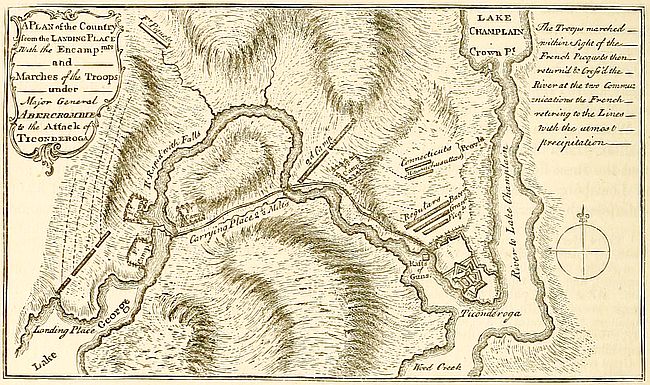
Plan of the Sieges of Ticonderoga. Facsimile from The Scots Magazine, August 1758.
Perceiving that his men were greatly fatigued, General Abercromby ordered them to march back to their landing-place, which they reached about eight o’clock in the morning. Having taken possession of a saw-mill in the neighbourhood of Ticonderoga, which the enemy had abandoned, General Abercromby advanced towards the place next morning. It was garrisoned by 5000 men, of whom 2800 were French troops of the line, who were stationed behind the traverses and felled trees in front of the fort. Receiving information from some prisoners that General Levi, with a force of 3000 men, was marching to the defence of Ticonderoga, the English commander resolved to anticipate him by striking, if possible, a decisive blow before a junction could be effected. He therefore sent an engineer across the river on the opposite side of the fort to reconnoitre the enemy’s entrenchments, who reported that the works being still unfinished, might be attempted with a prospect of success. Preparations for the attack were therefore instantly made. The whole army being put in motion, the picquets, followed by the grenadiers, the battalions and reserve, which last consisted of the Highlanders and the 55th regiment, advanced with great alacrity towards the entrenchments, which they found to be much more formidable than they expected. The breast-work, which was regularly fortified, was eight feet high, and the ground before it was covered with an abbatis or chevaux-de-frize, projecting in such a manner as to render the entrenchment almost inaccessible. Undismayed by these discouraging obstacles, the British troops marched up to the assault in the face of a destructive fire, and maintained their ground without flinching. Impatient in the rear, the Highlanders broke from the reserve, and, pushing forward to the front, endeavoured to cut their way through the trees with their broadswords. After a long and deadly struggle, the assailants penetrated the exterior defences and advanced to the breast-work; but being unprovided with scaling ladders, they attempted to gain the breast-work, partly by mounting on each other’s shoulders, and partly by fixing their feet in the holes which they made with their swords and bayonets in the face of the work. No sooner, however, did a man reach the top, than he was thrown down by the troops behind the entrenchments. Captain John Campbell,[286] with a few men, at length forced their way over the breast-work, but they were immediately despatched with the bayonet. After a desperate struggle, which lasted about four hours under such discouraging circumstances, General Abercromby seeing no possible chance of success, gave orders for a retreat. It was with difficulty, however, that the troops could be prevailed upon to retire, and it was not till the third order that the Highlanders were induced to retreat, after more than one-half of the men and twenty-five officers had been either killed or desperately wounded. No attempt was made to molest them in their retreat, and the whole retired in good order, carrying along with them the whole of the wounded, amounting to 65 officers and 1178 non-commissioned officers and soldiers. Twenty-three officers and 567 rank and file were killed.
The loss sustained by the 42d was as follows, viz.:—8 officers, 9 sergeants, and 297 men killed; and 17 officers, 10 sergeants, and 306 soldiers wounded. The officers killed were Major Duncan Campbell of Inveraw, Captain John Campbell, Lieutenants George Farquarson, Hugh MacPherson, William Baillie, and John Sutherland; Ensigns Patrick Stewart, brother of Bonskeid, and George Rattray. The wounded were Captains Gordon Graham, Thomas Graham of Duchray, John Campbell of Strachur, James Stewart of Urrard, James Murray (afterwards General); Lieutenants James Grant, Robert Gray, John Campbell, William Grant, John Graham, brother of Duchray, Alexander Campbell, Alexander Mackintosh, Archibald Campbell, David Miller, Patrick Balneaves; and Ensigns John Smith and Peter Grant.[287]
The intrepid conduct of the Highlanders on this occasion was made the topic of universal panegyric in Great Britain, and the public prints teemed with honourable testimonies to their bravery. If anything could add to the gratification they received from the approbation of their country, nothing was better calculated to enhance it than the handsome way in which their services were appreciated by their companions in arms. “With a mixture of esteem, grief, and envy (says an officer of the 55th), I consider the great loss and immortal glory acquired by the Scots Highlanders in the late bloody affair. Impatient for orders, they rushed forward to the entrenchments, which many of them actually mounted. They appeared like lions breaking from their chains. Their intrepidity was rather animated than damped by seeing their comrades fall on every side. I have only to say of them, that they seemed more anxious to revenge the cause of their deceased friends, than careful to avoid the same fate. By their assistance, we expect soon to give a good account of the enemy and of ourselves. There is much harmony and friendship between us.”[288] The following extract of a letter from Lieutenant William Grant, an officer of the regiment, seems to contain no exaggerated detail:—“The attack began a little past one in the afternoon, and about two the fire became general on both sides, which was exceedingly heavy, and without any intermission, insomuch that the oldest soldier present never saw so furious and incessant a fire. The affair at Fontenoy was nothing to it: I saw both. We laboured under insurmountable difficulties. The enemy’s breast-work was about nine or ten feet high, upon the top of which they had plenty of wall-pieces fixed, and which was well lined in the inside with small arms. But the difficult access to their lines was what gave them a fatal advantage over us. They took care to cut down monstrous large oak trees which covered all the ground from the foot of their breast-work about the distance of a cannon-shot every way in their front. This not only broke our ranks, and made it impossible for us to keep our order, but put it entirely out of our power to advance till we cut our way through. I have seen men behave with courage and resolution before now, but so much determined bravery can hardly be equalled in any part of the history of ancient Rome. Even those that were mortally wounded cried aloud to their companions, not to mind or lose a thought upon them, but to follow their officers, and to mind the honour of their country. Nay, their ardour was such, that it was difficult to bring them off. They paid dearly for their intrepidity. The remains of the regiment had the honour to cover the retreat of the army, and brought off the wounded as we did at Fontenoy. When shall we have so fine a regiment again? I hope we shall be allowed to recruit.”[289] Lieutenant Grant’s wish had been anticipated, as letters of service had been issued, before the affair of Ticonderoga was known in England, for raising a second battalion. Moreover, previous to the arrival of the news of the affair at Ticonderoga, his majesty George II. had issued a warrant conferring upon the regiment the title of Royal, so that after this it was known as the 42d Royal Highland Regiment.
So successful were the officers in recruiting, that within three months seven companies, each 120 men strong, which, with the three additional companies raised the preceding year, were to form the second battalion, were raised in three months, and embodied at Perth in October 1758.[290] The officers appointed to these seven additional companies were Francis MacLean, Alexander Sinclair, John Stewart of Stenton, William Murray, son of Lintrose, Archibald Campbell, Alexander Reid, and Robert Arbuthnot, to be captains; Alexander MacLean, George Grant, George Sinclair, Gordon Clunes, Adam Stewart, John Robertson, son of Lude, John Grant, James Fraser, George Leslie, John Campbell, Alexander Stewart, Duncan Richardson, and Robert Robertson, to be lieutenants; and Patrick Sinclair, John Mackintosh, James MacDuff, Thomas Fletcher, Alexander Donaldson, William MacLean, and William Brown, to be ensigns.
Government having resolved to employ the seven new companies in an expedition against Martinique and Guadaloupe, 200 of the 840 men, embodied at Perth, were immediately embarked at Greenock for the West Indies, under the convoy of the Ludlow Castle, for the purpose of joining the armament lying in Carlisle bay, destined for that service. The whole land force employed in this expedition amounted to 5560 men, under the command of Major-generals Hopson and Barrington, and of Brigadier-generals Armiger, Haldane, Trapaud, and Clavering. They sailed from Barbadoes on the 13th of January 1759, for Martinique, which they descried next morning; and on the following day the British squadron entered the great bay of Port Royal. About this time the other division of the seven newly raised companies joined the expedition. On the 16th, three ships of the line attacked Fort Negro, the guns of which they soon silenced. A detachment of marines and sailors landing in flat-bottomed boats, clambered up the rock, and, entering through the embrasures with fixed bayonets, took possession of the fort, which had been abandoned by the enemy. The whole French troops retired to Port Royal, leaving the beach open, so that the British forces landed next morning at Cas de Navire without opposition. No enemy being in sight, the grenadiers, the 4th or king’s regiment, and the Highlanders, moved forward about ten o’clock to reconnoitre; but they had not proceeded far when they fell in with parties of the enemy, who retired on their approach. When within a short distance of Morne Tortueson, an eminence that overlooked the town and citadel of Port Royal, and the most important post in the island, the advanced party halted till the rest of the army came up. The advancing and retiring parties had kept up an irregular fire when in motion, and they still continued to skirmish. It was observed on this occasion, “that although debarred the use of arms in their own country, the Highlanders showed themselves good marksmen, and had not forgot how to handle their arms.” The inhabitants of Martinique were in the greatest alarm, and some of the principal among them were about sending deputies to the British commander to treat for a surrender, but General Hopson relieved them from their anxiety by re-embarking his troops in the evening. The chief reason for abandoning the enterprise was the alleged impracticability of getting up the heavy cannon. The British had one officer killed and two wounded, one of whom was Lieutenant Leslie of the Royal Highlanders. Sixty privates were killed and wounded.
In a political point of view, the possession of Martinique was an object of greater importance than Guadaloupe, as it afforded, from its spacious harbour, a secure retreat to the enemy’s fleets. By taking possession of St Pierre, the whole island might have been speedily reduced; and the British commanders proceeded to that part of the island with that view; but alarmed lest they might sustain considerable loss by its capture, which might thus cripple their future operations, they absurdly relinquished their design, and proceeded to Guadaloupe. On the expedition reaching the western division of the island, it was resolved to make a general attack by sea upon the citadel, the town, and the batteries by which it was defended. Accordingly, on the 20th of January, such a fire was opened upon the place that about ten o’clock at night it was in a general conflagration.
The troops landed at five o’clock in the evening of the following day without opposition, and took possession of the town and citadel, which they found entirely abandoned. The Chevalier D’Etreil, the governor of the island, taking shelter among the mountains, yielded the honour of continuing the contest to a lady of masculine courage named Ducharmey. Arming her slaves, whom she headed in person, she made several bold attempts upon an advanced post on a hill near the town, occupied by Major (afterwards General) Melville, opposite to which she threw up some entrenchments. Annoyed by the incessant attacks of this amazon, Major Melville attacked her entrenchments, which he carried, after an obstinate resistance. Madame Ducharmey escaped with difficulty, but some of her female companions in arms were taken prisoners. Ten of her people were killed and many wounded. Of the British detachment, 12 were slain and 30 wounded, including two subaltern officers, one of whom, Lieutenant MacLean of the Highlanders, lost an arm.
Finding it impracticable to carry on a campaign among the mountains of Basseterre, the general resolved to transfer the seat of war to the eastern division of the island, called Grandeterre, which was more accessible. Accordingly, on the 10th of February, a detachment of Highlanders and marines was landed in that part of the island in the neighbourhood of Fort Louis, after a severe cannonading which lasted six hours. The assailants, sword in hand, drove the enemy from their entrenchments, and, taking possession of the fort, hoisted the English colours.
General Hopson died on the 27th. He was succeeded by General Barrington, who resolved to complete the reduction of the island with vigour. Leaving, therefore, one regiment and a detachment of artillery under Colonel Debrisay in Basseterre, the general re-embarked the rest of the army and proceeded to Grandeterre, where he carried on a series of successful operations by means of detachments. One of these consisting of 600 men, under Colonel Crump, carried the towns of St Anne and St Francis with little loss, notwithstanding the fire from the entrenchments. The only officer who fell was Ensign MacLean of the Highlanders, Another detachment of 300 men took the town of Gosier by storm, and drove the garrison into the woods. The next operation of the general was an attempt to surprise the three towns of Petit Bourg, St Mary’s, and Gouyave, on the Capesterre side, the execution of which was committed to Colonels Crump and Clavering; but owing to the extreme darkness of the night, and the incapacity of the negro guides, the attempt was rendered abortive. Resolved to carry these towns, the general directed the same commanders to land their forces in a bay near the town of Arnonville. No opposition was made to their landing by the enemy, who retreated behind a strong entrenchment they had thrown up behind the river Licorn. With the exception of two narrow passes which they had fortified with a redoubt and entrenchments mounted with cannon, which were defended by a large body of militia, the access to the river was rendered inaccessible by a morass covered with mangroves; yet, in spite of these difficulties, the British commanders resolved to hazard an assault. Accordingly, under cover of a fire from the entrenchments from their field-pieces and howitzers, the regiment of Duroure and the Highlanders moved forward, firing by platoons with the utmost regularity as they advanced. Observing the enemy beginning to abandon the first entrenchment on the left, “the Highlanders drew their swords, and, supported by a part of the other regiment, rushed forward with their characteristic impetuosity, and followed the enemy into the redoubt, of which they took possession.”[291]
Several other actions of minor importance afterwards took place, in which the enemy were uniformly worsted; and seeing resistance hopeless, they capitulated on the 1st of May, after an arduous struggle of nearly three months. The only Highland officer killed in this expedition was Ensign MacLean. Lieutenants MacLean, Leslie, Sinclair, and Robertson, were wounded; and Major Anstruther and Captain Arbuthnot died of the fever. Of the Royal Highlanders, 106 privates were killed, wounded, or died of disease.[292]
After the reduction of Guadaloupe, the services of the second battalion of Royal Highlanders were transferred to North America, where they arrived early in July, and after reaching the head quarters of the British army, were combined with the first battalion. About this time a series of combined operations had been projected against the French settlements in Canada. Whilst Major-general Wolfe, who had given proofs of great military talents at the siege of Louisburg, was to proceed up the St Lawrence and besiege Quebec, General Amherst, who had succeeded General Abercromby as commander-in-chief, was to attempt the reduction of Ticonderoga and Crown Point, after which he was to cross Lake Champlain and effect a junction with General Wolfe before Quebec. Brigadier-general Prideaux was to proceed against the French fort near the falls of the Niagara, the most important post of all French America. The army under General Amherst, which was the first put in motion, assembled at Fort Edward on the 19th of June. It included the 42d and Montgomery’s Highlanders, and when afterwards joined by the second battalion of the Royal Highlanders, it amounted to 14,500 men. Preceded by the first battalion of the last named regiment and the light infantry, the main body of the army moved forward on the 21st, and encamped in the neighbourhood of Ticonderoga. The enemy seemed at first resolved to defend that important fortress; but perceiving the formidable preparations made by the English general for a siege, they abandoned the fort, after having in part dismantled the fortifications, and retired to Crown Point.
On taking possession of this important post, which effectually covered the frontiers of New York, General Amherst proceeded to repair the fortifications; and, while these were going on, he directed batteaux and other vessels to be prepared, to enable him to obtain the command of the lakes. Meanwhile the enemy, who seems to have had no intention of hazarding an action, evacuated Crown Point, and retired to Isle aux Noix, on the northern extremity of Lake Champlain. Detaching a body of rangers to take possession of the place the general embarked the rest of the army and landed at the fort on the 4th of August, where he encamped. The general then ordered up the second battalion of the Royal Highlanders from Oswego, with the exception of 150 men under Captain James Stewart, who were left to guard that post. Having by great exertions acquired a naval superiority on Lake Champlain, the general embarked his army in furtherance of his original plan of descending the St Lawrence, and co-operating with General Wolfe in the reduction of Quebec; but in consequence of contrary winds, the tempestuous state of the weather, and the early setting in of winter, he was compelled to abandon further prosecution of active operations in the mean time. He then returned to Crown Point to winter. A detailed account of the important enterprise against Quebec will be found in the history of Fraser’s Highlanders.
After the fall of the fort of Niagara, which was taken by Prideaux’s division, and the conquest of Quebec, Montreal was the only place of strength which remained in possession of the French in Canada. General Murray was ordered to proceed up the St Lawrence to attack Montreal, and General Amherst, as soon as the season permitted, made arrangements to join him. After his preparations were completed, he ordered Colonel Haviland, with a detachment of troops, to take possession of the Isle aux Noix, and thence to proceed to the banks of the St Lawrence by the nearest route. To facilitate the passage of the armed vessels to La Galette, Colonel Haldimand with the grenadiers, light infantry, and a battalion of the Royal Highlanders, took post at the bottom of the lake. Embarking the whole of his army on the 10th of August, he proceeded towards the mouth of the St Lawrence, and, after a dangerous navigation, in the course of which several boats were upset and about eighty men drowned, landed six miles above Montreal on the 6th of September. General Murray appeared before Montreal on the evening of the same day, and the detachments under Colonel Haviland came down the following day on the south side of the river. Thus beset by three armies, who, by a singular combination, had united almost at the same instant of time, after traversing a great extent of unknown country, Monsieur Vandreuil, the governor, seeing resistance hopeless, surrendered upon favourable terms. Thus ended a series of successful operations, which secured Canada to the Crown of Great Britain.[293]
The Royal Highlanders remained in North America until the close of the year 1761, when they were embarked along with ten other regiments, among whom was Montgomery’s Highlanders, for Barbadoes, there to join an armament against Martinique and the Havannah. The land forces consisted altogether of eighteen regiments, under the command of Major-general Monckton. The naval part of the expedition, which was commanded by Rear-admiral Rodney, consisted of eighteen sail of the line, besides frigates, bomb-vessels, and fire-ships.
The fleet anchored in St Ann’s Bay, Martinique, on the 8th of January 1762, when the bulk of the army immediately landed. A detachment, under Brigadiers Grant (Ballindalloch) and Haviland, made a descent without opposition in the bay of Ance Darlet. Re-embarking his troops, General Monckton landed his whole army on the 16th near Cas de Navire, under Morne Tortueson and Morne Garnier. As these two eminences commanded the town and citadel of Fort Royal, and were their chief defence, great care had been taken to improve by art their natural strength, which, from the very deep ravines which protected them, was great. The general having resolved to attack Morne Tortueson first, he ordered a body of troops and 800 marines to advance on the right along the sea-side towards the town, for the purpose of attacking two redoubts near the beach; and to support this movement, he at the same time directed some flat-bottomed boats, each carrying a gun, and manned with sailors, to follow close along the shore. A corps of light infantry was to get round the enemy’s left, whilst, under cover of the fire of some batteries which had been raised on the opposite ridges by the perseverance of some sailors from the fleet, the attack on the centre was to be made by the grenadiers and Highlanders, supported by the main body of the army. After an arduous contest, the enemy were driven from the Morne Tortueson; but a more difficult operation still remained to be performed. This was to gain possession of the other eminence, from which, owing to its greater height, the enemy annoyed the British troops. Preparations were made for carrying this post; but before they were completed, the enemy descended from the hill, and attacked the advanced posts of the British. This attempt was fatal to the assailants, who were instantly repulsed. “When they began to retire, the Highlanders, drawing their swords, rushed forward like furies, and being supported by the grenadiers under Colonel Grant (Ballindalloch), and a party of Lord Rollo’s brigade, the hills were mounted, and the batteries seized, and numbers of the enemy, unable to escape from the rapidity of the attack, were taken.”[294] The militia dispersed themselves over the country, but the regulars retired into the town, which surrendered on the 7th of February. The whole island immediately submitted, and in terms of the capitulation all the Windward Islands were delivered up to the British.
In this enterprise the Royal Highlanders had 2 officers, viz., Captain William Cockburn and Lieutenant David Barclay, 1 sergeant, and 12 rank and file killed: Major John Reid, Captains James Murray and Thomas Stirling; Lieutenants Alexander Mackintosh, David Milne, Patrick Balneaves, Alexander Turnbull, John Robertson, William Brown, and George Leslie; 3 sergeants, 1 drummer, and 72 rank and file, were wounded.
The Royal and Montgomery’s Highlanders were employed the following year in the important conquest of the Havannah, under Lieutenant-general the Earl of Albemarle, in which they sustained very little loss. That of the two battalions of the 42d consisted only of 2 drummers and 6 privates killed, and 4 privates wounded; but they lost by disease Major Macneil, Captain Robert Menzies (brother of Sir John Menzies), and A. Macdonald; Lieutenants Farquharson, Grant, Lapsley, Cunnison, Hill, and Blair, and 2 drummers and 71 rank and file.
Shortly after the surrender of the Havannah, all the available forces in Cuba were removed from the island. The first battalion of the 42d and Montgomery’s regiment embarked for New York, which they reached in the end of October. Before leaving Cuba all the men of the second battalion of the Royal Highlanders fit for service were drafted into the first. The remainder with the officers returned to Scotland, where they were reduced the following year. The junior officers were placed on half pay.
The Royal Highlanders were stationed in Albany till the summer of 1763, when they were sent to the relief of Fort Pitt, then besieged by the Indians. The management of this enterprise was intrusted to Colonel Bouquet of the 60th regiment, who, in addition to the 42d, had under his command a detachment of his own regiment and another of Montgomery’s Highlanders, amounting in all to 956 men. This body reached Bushy Run about the end of July. When about to enter a narrow pass beyond the Run, the advanced guards were suddenly attacked by the Indians, who had planned an ambuscade. The light infantry of the 42d regiment moved forward to the support of the advanced guard, and driving the Indians from the ambuscade, pursued them a considerable distance. The Indians returned and took possession of some neighbouring heights. They were again compelled to retire; but they soon re-appeared on another position, and continuing to increase in numbers, they succeeded in surrounding the detachment, which they attacked on every side. Night put an end to the combat; but it was renewed next morning with increased vigour by the Indians, who kept up an incessant fire. They, however, avoided coming to close action, and the troops could not venture to pursue them far, as they were encumbered with a convoy of provisions, and were afraid to leave their wounded, lest they might fall into the hands of the enemy. Recourse was, therefore, had to stratagem to bring the Indians to closer action. Feigning a retreat, Colonel Bouquet ordered two companies which were in advance to retire, and fall within a square which had been formed, which, as if preparing to cover a retreat, opened its files. The stratagem succeeded. Assuring themselves of victory, the Indians rushed forward with great impetuosity, and whilst they were vigorously charged in front, two companies, moving suddenly round a hill which concealed their approach, attacked them in flank. The assailants, in great consternation, turned their backs and fled, and Colonel Bouquet was allowed to proceed to Fort Pitt without further molestation. In this affair, the loss sustained by the Royal Highlanders was as follows:—Lieutenants John Graham and James Mackintosh, 1 sergeant, and 26 rank and file, killed; and Captain John Graham of Duchray, Lieutenant Duncan Campbell, 2 sergeants, 2 drummers, and 30 rank and file, wounded.
After passing the winter in Fort Pitt, eight companies of the Royal Highlanders were sent on a new enterprise, in the summer of 1764, under Colonel Bouquet, now promoted to the rank of brigadier-general. The object of this expedition was to repress the attacks of the Indians on the back-settlers. After a harassing warfare among the woods, the Indians sued for peace, which was granted, and the detachment under Brigadier-general Bouquet returned to Fort Pitt in the month of January, after an absence of six months. Notwithstanding the labours of a march of many hundred miles among dense forests, during which they experienced the extremes of heat and cold, the Highlanders did not lose a single man from fatigue or exhaustion.[295]
The regiment passed the following year in Pennsylvania. Being ordered home, permission was given to such of the men as were desirous of remaining in America to volunteer into other regiments, and the result was, that a considerable number availed themselves of the offer. The regiment, reduced almost to a skeleton, embarked at Philadelphia for Ireland in the month of July 1767. The following extract from the Virginia Gazette of the 30th of that month shows the estimation in which the Highlanders were held by the Americans:—“Last Sunday evening the Royal Highland regiment embarked for Ireland, which regiment, since its arrival in America, has been distinguished for having undergone most amazing fatigues, made long and frequent marches through an inhospitable country, bearing excessive heat and severe cold with alacrity and cheerfulness, frequently encamping in deep snow, such as those that inhabit the interior parts of this province do not see, and which only those who inhabit the northern parts of Europe can have any idea of, continually exposed in camp, and on their marches, to the alarms of a savage enemy, who, in all their attempts, were forced to fly.... In a particular manner, the freemen of this and the neighbouring provinces have most sincerely to thank them for that resolution and bravery with which they, under Colonel Bouquet, and a small number of Royal Americans, defeated the enemy, and insured to us peace and security from a savage foe; and, along with our blessings for these benefits, they have our thanks for that decorum in behaviour which they maintained during their stay in this city, giving an example that the most amiable behaviour in civil life is no way inconsistent with the character of the good soldier; and for their loyalty, fidelity, and orderly behaviour, they have every wish of the people for health, honour, and a pleasant voyage.”