Volume 2 / Part 3 — PART THIRD. HISTORY OF THE HIGHLAND REGIMENTS. (continued 4)
Reading edition
“Of all descriptions of cavalry, certainly the lancers seem the most formidable to infantry, as the lance can be projected with considerable precision, and with deadly effect, without bringing the horse to the point of the bayonet; and it was only by the rapid and well-directed fire of musketry that these formidable assailants were repulsed.
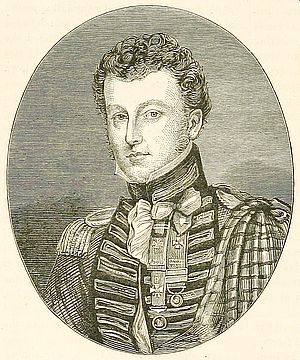
Colonel (afterwards Sir) R. H. Dick. From Miniature (painted about four years after Waterloo) in possession of William Dick, Esq. of Tullymet.
“Colonel Dick assumed the command on the fall of Sir Robert Macara, and was severely wounded. Brevet-Major Davidson succeeded, and was mortally wounded; to him succeeded Brevet-Major Campbell. Thus, in a few minutes we had been placed under four different commanding-officers.
“An attempt was now made to form us in line; for we stood mixed in one irregular mass,—grenadier, light, and battalion companies,—a noisy group; such is the inevitable consequence of a rapid succession of commanders. Our covering sergeants were called out on purpose that each company might form on the right of its sergeants; an excellent plan had it been adopted, but a cry arose that another charge of cavalry was approaching, and this plan was abandoned. We now formed a line on the left of the grenadiers, while the cavalry that had been announced were cutting through the ranks of the 69th regiment. Meantime the other regiments, to our right and left, suffered no less than we; the superiority of the enemy in cavalry afforded him a decided advantage on the open plain, for our British cavalry and artillery had not yet reached the field. We were at this time about two furlongs past the farm of Quatre Bras, as I suppose, and a line of French infantry was about the same distance from us in front, and we had commenced firing at that line, when we were ordered to form square to oppose cavalry. General Pack was at our head, and Major Campbell commanded the regiment. We formed square in an instant, in the centre were several wounded French soldiers witnessing our formation round them; they doubtless considered themselves devoted to certain death among us seeming barbarians; but they had no occasion to speak ill of us afterwards; for as they were already incapable of injuring us, we moved about them regardful of their wounds and suffering.
“Our last file had got into square, and into its proper place, so far as unequalised companies could form a square, when the cuirassiers dashed full on two of its faces: their heavy horses and steel armour seemed sufficient to bury us under them, had they been pushed forward on our bayonets.
“A moment’s pause ensued; it was the pause of death. General Pack was on the right angle of the front face of the square, and he lifted his hat towards the French officer as he was wont to do when returning a salute. I suppose our assailants construed our forbearance as an indication of surrendering: a false idea; not a blow had been struck nor a musket levelled; but when the general raised his hat, it served as a signal, though not a preconcerted one, but entirely accidental; for we were doubtful whether our officer commanding was protracting the order, waiting for the general’s command, as he was present. Be this as it may, a most destructive fire was opened; riders, cased in heavy armour, fell tumbling from their horses; the horses reared, plunged, and fell on the dismounted riders; steel helmets and cuirasses rung against unsheathed sabres, as they fell to the ground; shrieks and groans of men, the neighing of horses, and the discharge of musketry, rent the air, as men and horses mixed together in one heap of indiscriminate slaughter. Those who were able to fly, fled towards a wood on our right, whence they had issued to the attack, and which seemed to afford an extensive cover to an immense reserve not yet brought into action.
“Once more clear of those formidable and daring assailants, we formed line, examined our ammunition boxes, and found them getting empty. Our officer commanding pointed towards the pouches of our dead and dying comrades, and from them a sufficient supply was obtained.
“We lay down behind the gentle rise of a trodden down field of grain, and enjoyed a few minutes’ rest to our wearied limbs; but not in safety from the flying messengers of death, the whistling music of which was far from lulling us to sleep.
“Afternoon was now far spent, and we were resting in line, without having equalized the companies, for this would have been extremely dangerous in so exposed a position; for the field afforded no cover, and we were in advance of the other regiments. The enemy were at no great distance, and, I may add, firing very actively upon us.
“Our position being, as I have already observed, without any cover from the fire of the enemy, we were commanded to retire to the rear of the farm, where we took up our bivouac on the field for the night.
“Six privates fell into the enemy’s hands; among these was a little lad (Smith Fyfe) about five feet high. The French general, on seeing this diminutive looking lad, is said to have lifted him up by the collar or breech and exclaimed to the soldiers who were near him, ‘Behold the sample of the men of whom you seem afraid!’ This lad returned a few days afterwards, dressed in the clothing of a French grenadier, and was saluted by the name of Napoleon, which he retained until he was discharged.
“The night passed off in silence: no fires were lit; every man lay down in rear of his arms, and silence was enjoined for the night. Round us lay the dying and the dead, the latter not yet interred, and many of the former, wishing to breathe their last where they fell, slept to death with their heads on the same pillow on which those who had to toil through the future fortunes of the field reposed.”
The principal loss sustained by the Highlanders was at the first onset; yet it was by no means so severe as might have been expected. Lieutenant-colonel Sir Robert Macara, Lieutenant Robert Gordon, and Ensign William Gerrard, 2 sergeants, and 40 rank and file were killed. Including officers, there were 243 wounded.
In the battle of Waterloo, in which the regiment was partially engaged, the 42d had only 5 men killed and 45 wounded. In these last are included the following officers, viz.: Captain Mungo Macpherson, Lieutenants John Orr, George Gunn Munro, Hugh Angus Fraser, and James Brander, and Quarter-master Donald Mackintosh. “They fought like heroes, and like heroes they fell—an honour to their country. On many a Highland hill, and through many a Lowland valley, long will the deeds of these brave men be fondly remembered, and their fate deeply deplored. Never did a finer body of men take the field, never did men march to battle that were destined to perform such services to their country, and to obtain such immortal renown.”
The Duke of Wellington in his public despatches concerning Quatre Bras and Waterloo paid a high compliment to the 42d. “Among other regiments, I must particularly mention the 28th, 42d, 79th, and 92d, and the battalion of Hanoverians.”
The word “Waterloo,” borne on the colours of the regiment, by royal authority, commemorates the gallantry displayed by the regiment on this occasion; a medal was conferred on each officer and soldier; and the privilege of reckoning two years’ service, towards additional pay and pension on discharge, was also granted to the men. It may not be uninteresting to give here a list of the officers of the regiment who were present at the battle of Quatre Bras and Waterloo. It will be seen that while only 3 were killed, few escaped without a wound.
OFFICERS AT WATERLOO—1815.
Lieut.-Col.Sir Robert Macara,Killed.
MajorRobert Henry Dick,Wounded.
Capt.Archibald Menzies,Wounded.
“George Davidson,Died of Wounds.
“John Campbell.
“Mungo Macpherson,Wounded.
“Donald M’Donald,Wounded.
“Daniel M’Intosh,Wounded.
“Robert Boyle,Wounded.
Lieut.Donald Chisholm,Wounded.
“Duncan Stewart,Wounded.
“Donald M’Kenzie,Wounded.
“James Young, Adjutant,Wounded.
“Hugh A. Fraser,Wounded.
“John Malcolm,Wounded.
“Alexander Dunbar,Wounded.
“James Brander,Wounded.
“Roger Stewart,
“Robert Gordon,Killed.
“James Robertson,
“Kenneth M’Dougal,
“Donald M’Kay,
“Alexander Innes,[337]
“John Grant,
“John Orr,[337]Wounded.
“George Gunn Munro,Wounded.
“William Fraser,Wounded.
EnsignGeorge Gerard,Killed.
“Andrew L. Fraser,
“Alexander Brown,Wounded.
“Alexander Cumming,
Adjutant James Young, Lieut.,Wounded.
Quarter-Master Don. M’Intosh,Wounded.
Surgeon Swinton Macleod,
Assistant Surgeon Donald M’Pherson,
Assistant Surgeon John Stewart,
It has been observed, as a remarkable circumstance in the history of the Royal Highlanders, that on every occasion when they fired a shot at an enemy (except at Ticonderoga, where success was almost impossible), they were successful to such an extent at least, that whatever the general issue of the battle might be, that part of the enemy opposed to them never stood their ground, unless the Highlanders were by insurmountable obstacles prevented from closing upon them. Fontenoy even does not form an exception; for although the allies were defeated, the Highlanders carried the points assigned them, and then, as at Ticonderoga, they were the last to leave the field.[338]
As the battle of Waterloo terminates a period of active service and hard fighting in the case of the 42d, as well as of other regiments, and as it had a rest of many years during the long peace, we shall here give a summary of the number of men that entered the regiment, from its formation down to the battle of Waterloo, and the number of those who were killed, wounded, died of sickness, or were discharged during that period.
The grand total of men embodied in the Black Watch and 42d or Royal Highland regiment, from its origin at Tay Bridge in April 1740, to 24th June 1815, exclusive of the second battalion of 1780[339] and that of 1803,[340] was8792
Of these there were killed, during that period, exclusive of 35 officers, 816
Wounded during the same period, exclusive of 133 officers,2413
Died by sickness, wounds, and various casualties, including those who were discharged and those who volunteered into other regiments, when the 42d left America in 1767, up to 25th June 1793,2275
Died by sickness, wounds, and various casualties, from 25th June 1793 to 24th June 1815,1135[341]
Discharged during same period,1485
Unaccounted for during same period, having been left sick in an enemy’s country, prisoners, &c. 138
——8262
——
Number remaining in the first battalion on 24th June 1815, 530
When it is considered that out of seventy-five years’ service, forty-five were spent in active warfare, the trifling loss of the regiment by the enemy will appear extraordinary; and the smallness of that loss can only be accounted for by the determined bravery and firmness of the men, it being now the opinion of military men that troops, who act vigorously, suffer less than those who are slow and cautious in their operations.
After spending several months in the vicinity of Paris, the regiment marched to Calais and embarked for England, arriving at Ramsgate, December 19th 1815. The regiment proceeded by Deal and Dover to Hythe, where it lay two weeks, when it marched to Chelmsford.
After staying two weeks in Chelmsford Barracks, the regiment proceeded northwards to Scotland by easy stages, and was everywhere received with overwhelming enthusiasm and lavish hospitality. At Cambridge, for example, Sergeant Anton, in his Military Life, tells us, the bells welcomed the Royal Highlanders with joy; every table smoked with savoury viands for their entertainment, and every cellar contributed a liberal supply of its best October for their refreshment. The same thing occurred at Huntingdon and other towns, and at several places the men received a donation equal to two day’s pay. And so it was at every town through which the regiment had to pass; the men were fêted and petted as if they had saved their country from destruction.
As they approached Edinburgh, the whole population seemed to have poured to welcome them to its arms. Preceded by a guard of cavalry, with its band of music, they entered the city amidst the loud cheering and congratulatory acclamations of friends; while over their heads, “from a thousand windows, waved as many banners, plaided scarfs, or other symbols of courtly greetings.”[342] At Edinburgh they were entertained in a manner that would have made the men of any regiment but a “crack” one completely lose their heads; but the self-possessed Royal Highlanders, while heartily enjoying the many good things provided for them, and grateful for their hearty welcome, seem never to have forgotten the high reputation they had to maintain.[343]
After this, for many years, the Royal Highlanders had a rest from active service.
V. 1816–1854.
The Highland Society’s Vase—Ireland—The White-boys—Critical Service—Anecdotes—Old Manœuvres—Bad Management—The Dublin Medal—Gibraltar—Innovations—Regimental Library—Malta—Ionian Islands—Lieutenant-Colonel Middleton’s Farewell Order—Scotland—Ireland—Malta—Corfu—Death of Major-General Sir R. H. Dick—Bermuda—Halifax—Home.
We have already narrated (p. 374, vol. ii.) the proceedings at the meeting of the Highland Society, after the Egyptian campaign, with reference to the 42d. From 1811 to 1817, endeavours had been frequently made to establish a better feeling between the officers and the Highland Society, but in vain: the Egyptians would not yield, and in the meantime the vase remained at the makers.
After the return of the regiment from the Waterloo Campaign in 1816, H.R.H. The Duke of York became the mediator, and arranged that the vase should be accepted on the 21st March 1817, the anniversary of the battle of Alexandria. By this time only two of the officers who had served in Egypt were in the regiment, therefore the amicable arrangement was more easily arrived at.
It was at Armagh barracks, on Wednesday the 18th of June 1817, that the vase was presented to the regiment. At the time 5 companies were detached to Newry, and several other detachments were absent from Armagh; therefore not more than about 3 companies were present at the ceremony. The parade was in review order, in side arms, and a square of two deep was formed. On a table in the centre was the vase, covered, and several small kegs of Highland whisky, brought over from Scotland for the express purpose. A portion of the correspondence with the Highland Society was read by the Adjutant: Lieutenant-Colonel Robert Henry Dick addressed the regiment: the casks of whisky were broached, and the cup filled. The Colonel drank to the officers and men, the staff officers followed, and afterwards the captains and officers drank to the health of their respective companies, and the cup, held by both hands, and kept well replenished, went three times down the ranks. All was happiness and hilarity, not only on the parade, but for the remainder of the day.
Thus was introduced to the regiment the beautiful vase, which, for elegance and design, is hardly to be surpassed.
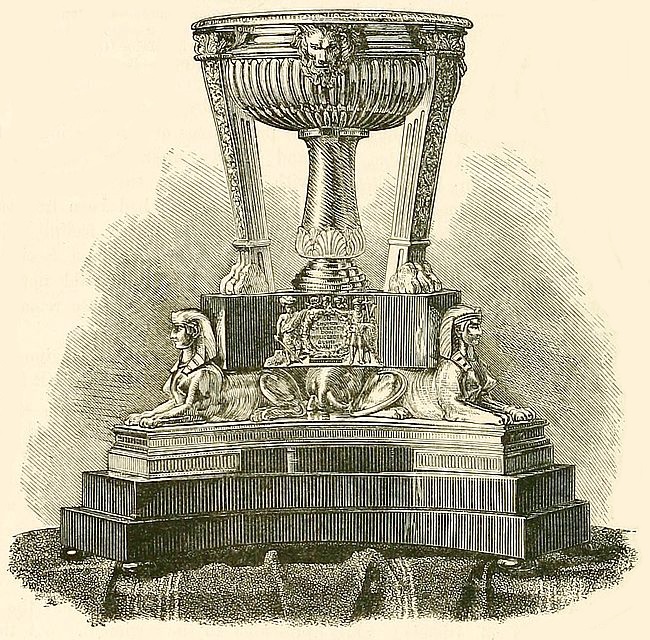
Vase presented to 42d Royal Highlanders by the Highland Society of London.
Of the officers and men present on the occasion, Lieutenant-Colonel Wheatley cannot bring to his recollection any now alive but himself and another, viz., Alexander Grant, a pensioner, living at Granton, Inverness-shire (in 1873). Of the officers in the regiment at the time, the last of them, Captain Donald M’Donald, died at Musselburgh, on the 24th September 1865, aged 82.
The day of “the Cup” was long remembered amongst the men, and it was always enthusiastically spoken of as to the quality and quantity of the whisky. The vase has lately (1869) been renovated, and placed on an ebony stand, which has given additional grandeur to its elegance.
The regiment left Glasgow in April of this year, and proceeded to Ireland, landing at Donaghadee, marching thence to Armagh, and detaching parties to all the adjacent towns. The regiment remained in Ireland till 1825, moving about from place to place, and occasionally taking part in the duties to which the troops were liable, on account of the disturbed state of the country. Many of these duties were far from pleasant, yet the 42d discharged them in such a manner as to gain the respect and goodwill of the natives among whom they sojourned.
In June 1818, the regiment marched to Dundalk; and in May 1819, to Dublin, where it remained upwards of twelve months, receiving highly commendatory notices in orders, from Major-General White, Major-General Bulwer, and Major-General Sir Colquhoun Grant.
On the 29th of January 1820, the colonelcy of the regiment was conferred on Lieutenant-General John Earl of Hopetoun, G.C.B., from the 92d Highlanders, in succession to General the Marquis of Huntly.
From Dublin the regiment marched, in August, to Kilkenny and Clonmel, and while at these stations its appearance and discipline were commended in orders by Major-General Sir Thomas Brisbane, and Major-General Egerton.
The regiment marched, in October 1821, to Rathkeale, and took part in the harassing duties to which the troops in the county of Limerick were exposed during the disturbed state of the country, and its conduct procured the unqualified approbation of the general officers under whom it served.
In July 1822, the regiment marched to Limerick, and the orders issued after the usual half-yearly inspections, by Major-General Sir John Lambert, and Major-General Sir John Elley, were highly commendatory.
From Limerick the regiment proceeded to Buttevant, in July 1823, and afterwards occupied many detached stations in the county of Cork, where it preserved its high reputation for correct discipline, and for general efficiency, which procured for it the encomiums of the inspecting generals.
On the death of General the Earl of Hopetoun, G.C.B., the colonelcy was conferred on Major-General Sir George Murray, G.C.B., G.C.H. (see portrait in steel plate of Colonels of 42d), from the 72d, or the Duke of Albany’s Own Highlanders, by commission, dated the 6th of September 1823.
The following details, for which we are indebted to Lieutenant-Colonel Wheatley, will give the reader a vivid idea of the state of Ireland at this time, as well as of the critical nature of the duties which the 42d had to perform:—
The 42d, which was quartered at Rathkeale, were joined in these duties by the 79th and 93d; the former quartered at Limerick, and the latter at Ennis, County Clare. All three regiments were highly and deservedly popular with the inhabitants.
Detachments were posted all over the country in every village or hamlet, where a house could be hired to hold from 12 to 30 men. But little could be done towards putting the White-boys down, as the only offence against the law was being caught in arms. But as soon as the Parliament met, the “Insurrection Act” was hurried through both houses, and became law on the night of the 28th February 1822. By the Act transportation for seven years was the punishment awarded to any one found out of his dwelling-place any time between one hour after sunset and sunrise. It was harassing duty patrolling over the country, sometimes all night, calling the rolls, and apprehending such as had been found absent on former occasions. The law was carried out by what was called a “Bench of Magistrates,” two or more, with a Sergeant-at-Law as president. All field officers and captains were magistrates, and seven years’ transportation was the only sentence the bench could give; the prisoner had either to be let off with an admonition or transported. When the prisoner was brought in, evidence was simply taken that he was found out of his dwelling-place at an unlawful hour, or that he was absent from his habitation on such a night when the roll was called. The local magistrates knew the character he bore, a few minutes consultation was held, when sentence was given, and an escort being already at the court-house door, the prisoner was handcuffed and put on a cart. The words were given “with cartridge prime and load, quick march,” and off to the Cove of Cork, where a ship was at anchor to receive them. This summary procedure soon put an end to the nightly depredations which had kept the country in terror and alarm for months previous. The convicted were at once sent off to Sydney,—“Botany Bay” at this time. Here is one instance of how the act was put in force.
Every road leading out of Rathkeale had a guard or outpost to prevent a surprise, and near to the Askeaton-road guard lived a character known as “the red haired man,” a noted White-boy (so named from wearing shirts over their clothes when on their nocturnal excursions), who had taken care of himself from the passing of the Insurrection Act, although still a leader and director of their doings. His house was close to the guard, and there were special orders to watch him, and at uncertain hours to visit the house, to find him absent, if possible. On an evening in June, the sentry called to the sergeant of the guard that “the red haired man,” half an hour back, had gone into a house where he was still. The sergeant walked about, the retreat beat, and watch in hand, he kept his look-out; one hour after sunset “the red haired man” came out without his hat, and laughing heartily: he was taken prisoner, and next day was on his way to the Cove of Cork!!
Pages could be filled with anecdotes connected with the doings of the several portions of the regiment in their various quarters. One more, to show the natural inborn Irish inclination for fighting.—The major commanding at Shannogalden, while standing on the street on a fair-day, was thus accosted by a tall, gaunt, wiry man, of some 60 years of age. “Good morning to your honour.” “Good morning, Mr Sullivan.” “I’ve a favour to ask of you, Major.” “Well, Mr Sullivan, what can I do for you?” “Well, your honour knows that I’ve been a loyal man, that during them disturbed times I always advised the boys to give up the foolish night-work; that I’ve caused a great many arms to be given up to yourself, Major.” Mr Sullivan’s detail of his services and his appreciation of them being much too long to go over, it ended in:—“It’s a long time, Major, since the boys have had a fight, and all that I want is, that yourself and your men will just keep out of sight, and remain at this end of the town, till me and my boys go up to the fair, and stretch a few of the Whichgeralds.” (Fitzgeralds, the opposite faction.) “Oh, then, Major, we’ll not be long about it, just to stretch a dozen or two of them Whichgeralds, and then I’ll engage we’ll go home quietly.” Much to Mr Sullivan’s disappointment, the Major replied that he could not allow the peace to be broken, and grievously crest-fallen, Mr S. went to report the failure of his request to the fine set of young Sullivans who were in sight, waiting the issue of the singular application, and ready to be let loose on the Fitzgeralds. A Mr V——, a local magistrate, who was standing with the Major, said that it would tend much to break up the combination of Whiteboyism to let the factions fight among themselves, and that he could not do better than to wink at the Sullivans having a turn with their opponents; but the Major would not entertain the idea of having, possibly, half-a-dozen murders to think of.
In 1821, on the day the head-quarters division marched out of the city of Limerick for Rathkeale, a man dropped out of the ranks without leave, to take leave of some friends belonging to the 79th (quartered at Limerick), when the rear guard came up; poor David Hill was found senseless on the road, with a deep cut on the back of his head, and his musket gone. On reaching Rathkeale, he was tried by a Court Martial held in a square, formed there and then, before the regiment was dismissed. He was sentenced to 300 lashes, and to pay for his musket. It was what would rightly now be considered an unnecessarily cruel individual suffering, though the most stringent discipline was required, as the regiment was virtually in an enemy’s country.
About three months afterwards an officer of the 79th was out snipe shooting, near to the scene of poor Hill’s misfortune. A countryman entered into conversation with the officer, watched his opportunity, knocked him over, and was off with the gun. Two of the 3d light dragoons on dispatch duty, from Rathkeale for Limerick, saw it; one of them leaped wall after wall, and apprehended the culprit. A special commission was at the time sitting in Limerick, by which he was tried next day, and hanged a day or two after. On the scaffold he confessed that it was he who had knocked over the Highlander, and told the priest where the gun was to be found. When it was recovered it was found cut down to make it a “handy gun.” It was given over to Hill.
Lieutenant-Colonel Wheatley, who was with the 42d at this time, was himself an ear-witness to the following:—About ten minutes after he and his comrade reached their billets at Rathkeale, the man of the house came in from his work, evidently not aware of the soldiers’ presence. From the kitchen and stable, one apartment, the latter overheard the following catechism between the father and a child about four years old:—“Well Dan, have you been a good boy all day?” “Yes, father.” “Come to my knee, Dan; now tell me, what will you do to the peeler, Dan?” “I’ll shoot him, father, I will.” “You’ll shoot him, will you?” “Yes, father, when I’m big like brother Phill.” “Ah, you’re a fine fellow, Dan; there’s a penny for you to buy bread.” Comment is unnecessary.[344]
In September 1823 the 42d, along with the other regiments in the Munster district, was taught the “Torrance” system of drill, which this year superseded the cumbrous old “Dundas.” This system effected an entire change in the drill, particularly in the field movements and the platoon exercise. Before this the wheeling or counter-marching of a column was unknown. He was a rash commanding officer who attempted an echelon movement in quick time, and it was not to be presumed upon before a general officer. The marching past in slow time was such a curiosity, that it is worthy of record. At every angle, the command “Halt, left wheel, halt, dress, march,” was given, and such work it was again to step off in time with the preceding company; about one in twenty could do it. Altogether, a drill book of “Dundas’s 18 manœuvres” would be a curious study for the present day; and that corps was to be admired whose Colonel could put them through “the 18 manœuvres.” At present the whole could be done in 20 minutes, and as to skirmishing it was almost unknown, except in rifle and light infantry corps.
Long marches were common in those days. The following account of a long march while in Ireland, illustrates well the sad want of system at this time in connection with the army, and the little attention paid to the men’s welfare.
In the month of May 1819, the regiment was ordered from Dundalk to Dublin. The detachment (of one subaltern and twenty men) at Cootehill, in County Cavan, was ordered, when relieved, to march to Ardee, and thence to Drogheda, to join a division under a field officer for Dublin. The relieving party of the 3d Buffs did not arrive until after mid-day on the 21st of May, when the detachment of the 42d marched by Shercock under the belief that they would halt at Kingscourt for the night, 18 miles from Cootehill. But, alas! they marched on amidst pelting rain, and reached Ardee between 11 and 12 o’clock at night, 13 miles from Kingscourt, with the pipe-clay so thoroughly washed from their belts (cross in those days), that they were quite brown. The question will naturally arise, why did they not stop at Kingscourt? even that distance being a long day’s march. There was a reason. The end of the month was the 24th day at this time, and from some neglect or mistake the officer was short of money to keep the men all night at Kingscourt. But 42d soldiers made no complaints, on any occasion, in those days. With the consolatory saying, “what we march to-day we will not have to march to-morrow,” the march was, with few exceptions, made cheerfully, although every man carried his full kit.
At this period there was a lamentable want of organisation and good management in many particulars. For instance, there was a garrison field day every Thursday (in Dublin 1819–20), and the guards who went on at ten o’clock the previous day had nothing sent to them in the way of food from the scanty dinner of Wednesday, till they reached their barracks about seven or eight the following evening.
Pay-sergeants were always consulted in all matters of interior economy, whether it regarded the supply of necessaries or improvements in messing, and they looked upon it as an innovation on their rights to propose any plan for the good of the soldiers, by which the smallest portion of the pay would have been diverted from passing through their (the pay sergeants’) hands; and thus a great portion of the men were always in debt. A baneful system it was, when men were allowed to be in debt to the sergeant to the extent of several pounds.
During the time the regiment was quartered in Dublin in 1819, a breakfast mess was established, much to the benefit of the soldier, who until this time had pleased himself regarding that meal. Bread and water satisfied some, while others indulged themselves according to their taste or ability to procure what was agreeable to them.
In 1819 a regimental medal (bearing on one side the names Corunna, Fuentes D’Onor, Pyrenees, Nevelle, Nive, Orthés, Toulouse, Peninsula) was struck in Dublin, and issued to those entitled to wear it—at their own expense. The authority of His Royal Highness the Duke of York, at the time commander-in-chief, was obtained for the wearing of it. Many good and gallant soldiers wore them in the regiment for years, but they quickly disappeared, although few of them were discharged under 19 and 20 years’ service. The last of them were discharged between 1830 and 1834. Many inquiries have been made concerning this medal, which has puzzled collectors, but on the authority of Lieutenant-Colonel Wheatley, the above is a correct account of its origin and history.
Leaving the province of Munster, in June 1825, the regiment received a highly commendatory communication from Lieutenant-General Sir John Lambert, expressing the high sense he entertained of the discipline and conduct of the corps. It afterwards marched to Dublin, where it was stationed three months.
The regiment was divided into six service and four depôt companies, and the service companies received orders to proceed to the celebrated fortress of Gibraltar. They accordingly marched from Dublin, for embarkation at the Cove of Cork, on board His Majesty’s ship “Albion,” and the “Sovereign” and “Numa” transports: the last division arrived at Gibraltar in the middle of December. The depôt companies were removed from Ireland to Scotland.
On arrival at Gibraltar, the regiment occupied Windmill-hill Barracks, and was afterwards removed to Rosia, where it was stationed during the year 1827.
In February 1828, the regiment took possession of a wing of the grand casemates. As an epidemic fever prevailed in the garrison, from which the regiment suffered severely, it encamped, in September, on the neutral ground. Its loss from the fever was, Ensign Charles Stewart, 6 sergeants, and 53 rank and file.
The regiment returned to the grand casemates on the 9th of January 1829; again encamped in the neutral ground in July, leaving in barracks the men who had recovered from the fever. It returned within the fortress in October.
As there is little or nothing to record with regard to the doings of the regiment during the six years it was at Gibraltar, where it took its share of the usual garrison work, we shall again recur to Lieutenant-Colonel Wheatley’s memoranda, and present the reader with some interesting notes on the manners, customs, &c., of the regiment about this time. Let us, however, note here, that in 1825, the regiment was armed with “The Long Land Tower” musket, being the only corps of the line to which it was issued; and again, in 1840, it was the first corps to receive the percussion musket, in both cases, through the interest of Sir George Murray, its colonel.
The bugle, for barrack duty, was introduced in 1828, whilst the 42d was encamped on the neutral ground, Gibraltar, during the epidemic fever. Before this the solitary bugler of the regiment sounded part of “quick march” for the guard, and had about half-a-dozen calls for the light company, whose knowledge of skirmishing barely extended to the covering of an advance in line. In the following year, and 1830, it was taken up in reality, and the corps soon became famous for their skirmishing: not that either the bugle calls for barracks or the light infantry drill was without its enemies. Indeed, in general, the officers were averse to the “new fangled innovations,” and, in some instances, complained that they could not understand the bugle even for the men’s breakfast, dinner, &c., and wished a return to the drum! However, the innovations, with numerous others, were supported by the commanding officers, and in due time the 42d became equal to its neighbours.
While at Gibraltar, in 1830, a regimental library was started, and continued in a flourishing condition for many years. Its history, as told by one of its originators, Lieutenant-Colonel Wheatley, is extremely interesting. It deserves to be recorded, as it was creditable to the corps, and equally so to the men who so nobly supported it. At this time, such institutions were unknown in the army; indeed, if anything, they were discouraged.
The regiment was quartered with the 43d in the grand casemates, in February 1830. The sergeant-major of that corps had a small library, his private property, collected at sales of books from time to time, from the famous garrison library; he from that formed a circulating library, lending books at a certain rate per month. It was spoken of in the orderly room one day, after the finish of the morning’s duty, and Sir Charles Gordon expressed his surprise that in a Scotch regiment nothing of the kind had been instituted. As soon as he left, the pay sergeants were called, and desired, by nine o’clock the following morning, to give a return of the number of subscribers willing to pay six days’ pay of their rank, to be levied in three monthly instalments, and after the third month, to pay a subscription of sixpence a month. A return of 224 was given in, and it having willingly been approved of by Sir Charles, immediate steps were taken to establish the library. A large order was sent off to the Messrs Tegg, of London, and within a month, what from a purchase of cast works from the garrison library, and donations of books from the officers, the regiment was in good reading order. The officers were most liberal in their donations. The members continued to increase, and various alterations were made from time to time, and in 1836 the subscriptions were reduced to fourpence. The funds were always fully able to meet any charge of conveyance whilst at home, from 1836 to 1841, and again from 1852 to 1854. On being ordered to Turkey in 1854, the whole of the books were disposed of, because the Government reading-rooms and libraries had been in force some time before this, and some corps had been ordered to do away with the regimental ones. At the time of its being broken up, it contained nearly 3000 volumes, and during its existence was highly creditable to the regiment.
In 1832, the regiment received orders to leave Gibraltar and proceed to Malta, embarking on the 13th January, when the governor, Sir William Houston, expressed in garrison orders “that the 42d Royal Highlanders had embarked in a manner fully supporting their high character for discipline and good conduct, and he regretted their departure.” After remaining at Malta till December 1834, the regiment was removed to the Ionian Islands, where it stayed till June 1836, having by that time completed a period of ten years and six months’ service in the Mediterranean.
The 42d left Corfu for Britain on the 30th of June, and was accompanied to the place of embarkation by the Lord High Commissioner, Major-General Sir Howard Douglas, who, on its being formed on the esplanade, addressed it in the following terms:—
“Colonel Middleton, Officers, Non-Commissioned Officers, and Soldiers of the Royal-Highlanders,
“I have come hither to assure you, that the conduct of the Forty-second has given me the highest degree of satisfaction during the time it has been under my orders, and I wish to express to you the deep regret I feel at the departure of this gallant and distinguished corps from the station under my command.
“The highest professional obligation of a regiment, is so to act as to render itself dreaded as well as respected by enemies. This the Forty-second has hitherto nobly and effectually done; and that power, though it exists unimpaired in the condition of this regiment, reposes for the present happily in peace.
“It is peculiarly the duty of a British soldier to conciliate, by personal demeanour and individual conduct, the esteem and regard of his fellow-subjects at home, and wherever he may be serving abroad, to cultivate the best terms, and gain the respect and good will of all classes of persons in the community of the place where he may be quartered. This, too, Forty-second, you have well done! The good terms which so happily subsist between the protector and the protected here, have not only been undisturbed, but cemented by your good conduct; and it affords me the greatest pleasure to have heard it declared by the highest authorities here, that you take with you the regard, respect, and good wishes of this population. As I was honoured by having this regiment placed under my orders, and I am highly satisfied with the conduct of the corps to the moment of its departure, so should I feel gratified if I should have the good fortune to have you again under my command. If this should be in peace, I shall have the pleasure of renewing the agreeable intercourse I have had with the officers, and the pleasing duties I have had to discharge with you. Should a renewal of the connection take place in war, it will afford me much delight and satisfaction, and I shall feel great honour conferred upon me by being again associated with a corps, which, I well know, would acquire fresh inscriptions to its own renown, and to the honour of our country, on the banners which have braved many a hard-fought battle-field, and which have waved triumphantly over many a victory! Forty-second, farewell!”
The regiment, on landing at Leith, on the 7th September 1836, was joined by the depôt companies waiting it in Edinburgh Castle. It remained in Scotland till the spring of 1838, when it embarked from Glasgow for Dublin, where it remained until the beginning of 1841. While in Ireland, new colours were presented to the regiment on March 7th, 1839.
While in Ireland, Lieutenant-Colonel Middleton was reluctantly compelled to resign his command, on doing which he issued the following pathetic farewell order:—
“New Barracks, Limerick, 12th August, 1839.
“Regimental Order.
“The Lieutenant-Colonel is persuaded that the officers, non-commissioned officers, and the soldiers of the regiment will enter into his feelings, and easily believe that it caused him many a heart-rending struggle before he brought himself to the sad conclusion of severing ties which connected his destiny for thirty-six years with that of the 42d, and which, but for one consideration, nothing on this side the grave could have induced him to do. That consideration they cannot be ignorant of, and which he is sure they will duly appreciate.
“It remains with him, therefore, only to return them, collectively and individually, the warmest expression of his thanks for the cordial and unremitting manner with which they co-operated with him in the various duties connected with his command, which made his situation truly an envious one; indeed, he may with truth assert without alloy, until now, when bidding the regiment farewell. In his sorrow, however, it affords him consolation to think that he resigns his proud and enviable charge into the hands of Major Johnstone, so capable in every way of maintaining their discipline, and watching over the best interest of the regiment. The Lieutenant-Colonel hopes the officers, non-commissioned officers, and soldiers, will give the same undeviating support to him that they have on every occasion given the Lieutenant-Colonel, the recollection of which can never be banished from his mind; and wherever his future lot may be cast, his heart will always be with the Royal Highlanders; in saying which, should a tablet be over his tomb, the only epitaph he would wish engraved upon it would be, that he once belonged to the 42d.”
In January 1841, the six service companies left Ireland for the Ionian Islands, and in May following, the depôt companies left Dublin for Scotland, being stationed at Stirling, which they quitted in March 1842, for Aberdeen.
The 42d and eight other regiments[345] having been augmented to an establishment of 1 lieutenant-colonel, 2 majors, 12 captains, 14 lieutenants, 10 ensigns, 6 staff officers, 67 sergeants, 25 drummers, and 1200 rank and file; the Royal Highlanders received upwards of 400 Scots volunteers from other corps (180 of whom were furnished by the 72d, 79th, 92d, and 93d Highland regiments), towards the completion of their new establishment; and the depôt was moved to Aberdeen in May, where it was formed into 6 companies, to be termed the Reserve Battalion, and its organisation rapidly proceeded.
In August 1842, when her Majesty the Queen Victoria visited Scotland, the reserve battalion of the Royal Highlanders furnished a guard of honour for Her Majesty at Dupplin, Taymouth, Drummond, and Stirling Castles, and the brevet rank of lieutenant-colonel was conferred on the commanding officer, Major James Macdougall.
In November 1842, the reserve battalion embarked from Gosport for Malta, to be joined by the first battalion from the Ionian Islands.
The head-quarters and three companies of the first battalion, under the command of Lieutenant-Colonel Johnstone, embarked at Cephalonia, and landed at Malta on the 20th February; the other three companies arrived at Malta from Zante on the 27th March.
When the regiment embarked at Cephalonia, the Regent, the Bishop, and all the dignitaries saw Colonel Johnstone, the officers and men to the boats, and the leave-taking was nearly as touching as the one at Corfu in 1841. The Regent of the Island and the Civil authorities subsequently sent a large gold medal to Colonel Johnstone, with Cephalos and his dog on one side of it, and the Colonel’s name on the other.[346]
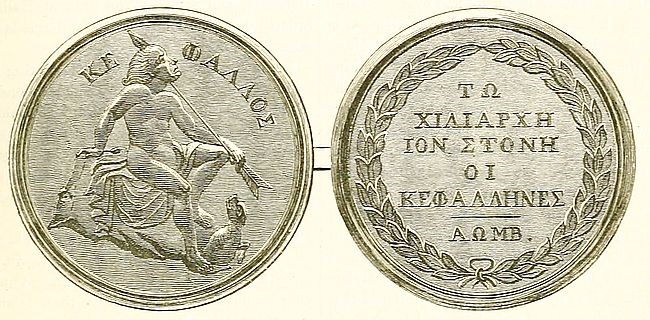
Colonel Johnstone’s Medal.
On the 29th of December 1843, General the Right Honourable Sir George Murray, G.C.B., was removed to the 1st, or the Royal Regiment of Foot, in succession to General Lord Lynedoch, deceased; and the colonelcy of the 42d Royal Highlanders was conferred on Lieutenant-General Sir John Macdonald, K.C.B. (Adjutant-General of the Forces), from the 67th regiment. Sir George Murray on his removal, addressed a letter to Lieutenant-Colonel Cameron, commanding the regiment, from which the following are extracts:—
“I cannot leave the command of the Forty-second Royal Highlanders without requesting you to express to them, in the strongest terms, how high an honour I shall always esteem it to have been for upwards of twenty years the colonel of a regiment, which, by its exemplary conduct in every situation, and by its distinguished valour in many a well-fought field, has earned for itself so large a share of esteem and of renown as that which belongs to the Forty-second regiment.
“Wherever the military service of our country may hereafter require the presence of the Royal Highlanders, my most friendly wishes and best hopes will always accompany them, and it will afford me the greatest pleasure to learn that harmony and mutual goodwill continue, as heretofore, to prevail throughout their ranks; and that discipline, so essential to the honour and success of every military body, is upheld amongst them, not more by the vigilance and the good example of those in command, than by the desire of all to discharge regularly, faithfully, and zealously, the several duties which it belongs to each respectively to perform. Whilst the Royal Highlanders persevere (as I feel confident, by my long acquaintance with them, both before and during the period of my having the honour to command them, that they always will) in the same path of duty which they have hitherto followed, they will never cease to add to that high reputation which they have already achieved for themselves, and for their native land.”
Until the 42d went to Corfu, in December 1834, according to Lieutenant-Colonel Wheatley, no Highland regiment had ever been seen there, and the natives flocked from all parts of the island to see the wonderful soldiers. Many of the natives, no doubt, had heard something of the dress, but could only think of it as being like the Albanian kilt, nor would they believe that the knees were bare. The Greeks, says the Colonel, are very stoical, but at the parade next day (Sunday), on the esplanade, they could not conceal their excitement. Both the officers and men of the 42d were very popular at Corfu; and when, after an absence of four years and a-half on home service, the regiment returned to the island in 1841, the islanders regarded it as a compliment, and declared that “the regiment had only been sent to England to get percussion muskets.”
On February 10th, 1846, was killed in action at Sobraon in India, Major-General Sir R. H. Dick, who had entered the 42d as ensign in 1800. He served with the second battalion of the 78th in Sicily in 1806; was wounded at the battle of Maida; was in Calabria and Egypt, in 1807; and was severely wounded at Rosetta. He was in the Peninsula from 1809, and was wounded at Waterloo. In the entrance of St Giles’ Church, Edinburgh, is a tablet to his memory, erected by the officers of the 42d in 1846.
The two battalions remained at Malta until 1847, when both were ordered to Bermuda. The first sailed on the 27th February, and landed three companies (head-quarters) at Hamilton, and three companies at Ireland Island on the 16th April. The reserve battalion embarked in March, and landed at St. George’s Island on the 24th of April.
On the 1st April 1850, the reserve battalion was consolidated into the first, forming a regiment of ten companies of 1000 rank and file. In May 1851, three companies were separated from the regiment to be sent to Scotland, to be joined by the depôt company from the Isle of Wight, and on 4th June, the six service companies embarked on board the “Resistance,” and on the following day sailed for Halifax, where they arrived on the 12th, sending out detachments to Prince Edward’s Island, Cape Breton, and Annapolis, in all 200 men.
The regiment was relieved by the 56th at Bermuda, and replaced the 88th at Halifax, ordered home. The depôt left Bermuda for Aberdeen on 13th July.
Before leaving, a letter, complimenting the regiment highly on its commendable conduct while in Bermuda, was forwarded to Colonel Cameron by his Excellency the governor. We give the following address from “the Corporation and other inhabitants of the town and parish of St. George,” which was presented to Colonel Cameron on June 3d, 1851.
“To Lieutenant-Colonel D. A. Cameron, 42d R. H. Commandant, &c., &c., &c.,
“Sir,—As Her Majesty’s 42d regiment under your command is about to leave these Islands, we cannot allow its departure without expressing our esteem for the kindly feelings which have existed between the inhabitants and the 42d, during the four years’ residence in this garrison. The urbanity and affability of the officers, the steady and upright conduct of the non-commissioned officers and men, have been eminently conspicuous. To our knowledge, not a man of your gallant and distinguished corps has been convicted of any crime before the civil authorities of this colony; a very gratifying circumstance, and bespeaking the high state of discipline of the regiment.
“To yourself, Sir, officers, and men, we sincerely tender our best wishes for your future welfare; and assured are we, that should the time arrive for the ‘Forty-second’ to be called into active service, they will display that loyalty and valour for which they are so justly renowned. Wishing you a safe and pleasant passage,—We have the honour to be, Sir, your obedient, humble servants:—
“(Signed by the Mayor, Corporation, and other Inhabitants of the town and parish of St George.)”
To this Colonel Cameron made a suitable reply.
This shows the esteem in which the regiment was held by the inhabitants of Bermuda, and it was well deserved. Not a man had been convicted before the civil authorities; it was something new to the Bermudans, and a subject which they often dwelt upon.
The mean strength of the regiment in the Islands for four years and two months, viz:—April 1847 to June 1857, was 1090; and the deaths, including accidents, &c., were only 31, being much less than the usual mortality at home. The regiment that the 42d had relieved (1st and reserve battalions of the 20th) sustained a heavy loss—several hundreds—from cholera; and the 56th, which replaced it, lost 6 officers and 224 men, in the autumn of 1853.
Early in 1852, the several detachments rejoined at Halifax, and on the 29th May the regiment (again in the “Resistance”) embarked to return home, and on July 16th anchored at Greenock. They landed on the 19th, and proceeded by rail to Stirling, three companies going to Perth, and two to Dundee. The depôt was waiting the arrival of the service companies in Stirling Castle. The regiment had been absent from Scotland upwards of 14 years, viz., since embarking at Glasgow for Dublin in 1838.
Early in April 1853, the regiment was ordered to be in readiness to proceed to England. On the 22d headquarters left Stirling, and proceeded to Weedon, detaching two companies to Northampton. On the 14th of June left Weedon for Chobham. It was there encamped with the 1st Life Guards; 6th Dragoon Guards; 13th Light Dragoons; 17th Lancers; 1st Battalion Grenadier Guards; 1st Battalion Scots Fusiliers; 1st Battalion Coldstreams; 38th, 50th, 93d, and 95th regiments; and 2d Battalion Rifle Brigade, &c., &c.
On the 14th July, the whole of the troops were replaced, and the regiment proceeded to Haslar and Gosport (Fort Monckton), detaching three companies, under Major Cumberland, to Weymouth.
VI. 1854–1856.
Regiment Embarks for Crimea—Landing at Kalamita Bay—March to the Alma—Russian Position—Battle of the Alma—The Highland Brigade—Sir Colin Campbell—Work done by the 42d—Sir Colin’s Bonnet—Work of the 42d before Sebastopol—Sir Colin Campbell’s Addresses—The Kertch Expedition—Return Home.
Early in 1854, the regiment was removed to Portsea, preparatory to embarking for Turkey, in consequence of hostilities with Russia.
About 200 Volunteers were received from depôts in Ireland, and for the first time for upwards of 45 years, without regard to country. The ten service companies embarked in the hired screw ship the “Hydaspes,” Captain John Baker, on the 20th May, and sailed next morning. They consisted of 32 officers, 45 sergeants, 20 Drummers and Pipers, and 850 Rank and File. On 1st June they went into Malta, and on the 7th anchored off Scutari. They landed and encamped on the 9th, joining in Brigade with the 79th and 93d.
On the 13th the division, consisting of the Brigade of Guards and the Highlanders, embarked and reached Varna next day, and disembarked on 15th, encamping near to Varna. On the 1st of July they moved to Aladyne; on the 28th to Gevrekler (“The three springs”); and on 16th August repassed Varna to Galatabourna,[347] where the regiment was in camp until the embarkation of the army on the 29th, on which day it went on board the ss. “Emeu,” and sailed with the expedition on the 5th September.
The British force consisted of 27,000 men of all arms; the French about 30,000; and the Turks 7000; making a total of 63,000 men, with 128 guns. Lord Raglan was the chief of the British forces, while Marshal St Arnaud commanded the army of France. The English infantry consisted of four divisions; the Light, First, Second, and Third Divisions. The First Division, under the command of H. R. H. the Duke of Cambridge, consisted of the third battalion of the Grenadier Guards, and the first battalions of the Coldstream and Scotch Fusilier Guards, commanded by Major-General Bentinck. Major-General Sir Colin Campbell (Lord Clyde, of whom we give a steel portrait) was commander of the other half of this division (the Highland Brigade), composed of the 42d, 79th, and 93d Highlanders. The 42d was commanded by Colonel Cameron, who had joined the regiment in 1825, and was made lieutenant-general in 1868.
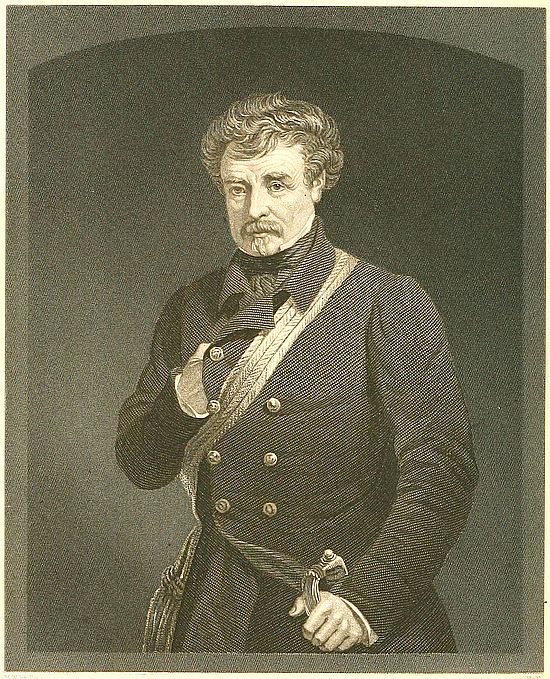
LORD CLYDE (Sir Colin Campbell). COPIED BY PERMISSION OF MR J. MITCHELL, PUBLISHER, LONDON. A. Fullarton & Co London & Edinburgh.
On the 14th of September 1854, the allied armies of England and France, landed unopposed at Old Fort, Kalameta Bay, about 30 miles north of Sebastopol.
“The seamen knew,” says Kinglake,[348] the fascinating historian of the Crimean War, “that it concerned the health and comfort of the soldiers to be landed dry, so they lifted or handed the men ashore with an almost tender care: yet not without mirth—nay, not without laughter far heard—when, as though they were giant maidens, the tall Highlanders of the Forty-second, placed their hands in the hands of the sailor, and sprang, by his aid, to the shore, their kilts floating out wide while they leapt.” It was not until the 18th that all the soldiers and their accompaniments were landed, and not until the 19th that the march southwards on Sebastopol commenced. On the first night of their march, the allies bivouacked on the banks of the stream of the Bulganak, six miles from their landing place.
“During the march, the foot-soldiers of the Allied armies suffered thirst; but early in the afternoon the troops in advance reached the long-desired stream of the Bulganak; and as soon as a division came in sight of the water, the men broke from their ranks, and ran forward that they might plunge their lips deep in the cool, turbid, grateful stream. In one brigade a stronger governance was maintained. Sir Colin Campbell would not allow that even the rage of thirst should loosen the discipline of his grand Highland regiments. He halted them a little before they reached the stream, and so ordered it that, by being saved from the confusion that would have been wrought by their own wild haste, they gained in comfort, and knew that they were gainers. When men toil in organised masses, they owe what well being they have to wise and firm commanders.”[349]
When the allied forces came in sight of the Alma, they found the Russians intrenched in what looked a very formidable position, on the hills which rise from its left or southern bank. For a short distance from the mouth of the river, the banks rise precipitously from the river and form a table-land above, accessible by several gorges or passes. Further up the river the banks rise more gently, and the slope of the hills southwards is more gradual; everywhere are the heights cut up by passes or ravines into knolls and separate rounded heights. “From the sea-shore to the easternmost spot occupied by Russian troops, the distance for a man going straight was nearly five miles and a-half; but if he were to go all the way on the Russian bank of the river, he would have to pass over more ground, for the Alma here makes a strong bend and leaves open the chord of the arc to invaders who come from the north.”[350] All over the heights extending from near the sea to this distance eastwards along the south-side of the river, the Russian force, amounting to 39,000 men and 106 guns, was massed on the side of the various slopes, in formidable looking columns. On the right of the Russian position rose gradually from the banks of the river a gentle slope, which terminated in a large rounded knoll, known as the Kourganè hill. At about 300 yards from the river, the Russians had thrown up a large breastwork armed with fourteen heavy guns; this was known as the Great Redoubt. With this work Prince Mentschikoff, the Russian commander, was delighted; indeed, he fancied his position so impregnable, that he expected to hold out for three days, by which time he was confident the allies would be utterly exhausted, and fall an easy prey to his northern legions. On the same hill, but higher up, and more to his right, the Prince threw up another slight breast-work, which he armed with a battery of field guns. This was the Lesser Redoubt. At many other points which commanded the approaches to his position he had large batteries planted, and the vineyards which skirted the north bank of the river were marked and cleared, so as to give effect to the action of the artillery.
As it would be out of place here to give a general account of the battle of the Alma, we shall content ourselves mainly with setting forth the part taken in it by the 42d Royal Highlanders, the actual strength of which regiment going into action was 27 officers, 40 sergeants, 20 pipers and drummers, and 703 rank and file. The work done by the other Highland regiments will be told in the proper place. The French and Turks, who formed the right of the allied army, were appointed to attack the left of the Russian position, while the British had to bear the brunt of the battle, and engage the enemy in front and on the right, being thus exposed to the full force of the murderous fire from the above-mentioned batteries.[351]
“The right wing of the Russian army was the force destined to confront, first our Light Division, and then the Guards and the Highlanders. It was posted on the slopes of the Kourganè Hill. Here was the Great Redoubt, armed with its fourteen heavy guns; and Prince Mentschikoff was so keen to defend this part of the ground, that he gathered round the work, on the slopes of the hill, a force of no less than sixteen battalions of regular infantry, besides the two battalions of Sailors, and four batteries of field-artillery. The right of the forces on the Kourganè Hill rested on a slope to the east of the Lesser Redoubt, and the left on the great road. Twelve of the battalions of regular infantry were disposed into battalion-columns posted at intervals and checkerwise on the flanks of the Great Redoubt; the other four battalions, drawn up in one massive column, were held as a reserve for the right wing on the higher slope of the hill. Of the four field-batteries, one armed the Lesser Redoubt, another was on the high ground commanding and supporting the Great Redoubt, and the remaining two were held in reserve. General Kvetzinski commanded the troops in this part of the field. On his extreme right, and posted at intervals along a curve drawn from his right front to his centre rear, Prince Mentschikoff placed his cavalry,—a force comprising 3400 lances, with three batteries of horse-artillery.
“Each of these bodies of horse, when brought within sight of the Allies, was always massed in column.
“Thus, then, it was to bar the Pass and the great road, to defend the Kourganè Hill and to cover his right flank, that the Russian General gathered his main strength; and this was the part of the field destined to be assailed by our troops. That portion of the Russian force which directly confronted the English army, consisted of 3400 cavalry, twenty-four battalions of infantry, and seven batteries of field-artillery, besides the fourteen heavy guns in the Great Redoubt, making together 23,400 men and eighty-six guns.”[352]
In the march from its bivouac on the night of the 19th there were two or three protracted halts, one caused by a slight brush with some Cossack cavalry and artillery. The rest we must relate mainly in the charming words of Kinglake, after whose narrative all others are stale.
“The last of these took place at a distance of about a mile and a half from the banks of the Alma. From the spot where the forces were halted the ground sloped gently down to the river’s side; and though some men lay prostrate under the burning sun, with little thought except of fatigue, there were others who keenly scanned the ground before them, well knowing that now at last the long-expected conflict would begin. They could make out the course of the river from the dark belt of gardens and vineyards which marked its banks; and men with good eyes could descry a slight seam running across a rising-ground beyond the river, and could see, too, some dark squares or oblongs, encroaching like small patches of culture upon the broad downs. The seam was the Great Redoubt; the square-looking marks that stained the green sides of the hills were an army in order of battle.
“That 20th of September on the Alma was like some remembered day of June in England, for the sun was unclouded, and the soft breeze of the morning had lulled to a breath at noontide, and was creeping faintly along the hills. It was then that in the Allied armies there occurred a singular pause of sound—a pause so general as to have been observed and remembered by many in remote parts of the ground, and so marked that its interruption by the mere neighing of an angry horse seized the attention of thousands; and although this strange silence was the mere result of weariness and chance, it seemed to carry a meaning; for it was now that, after near forty years of peace, the great nations of Europe were once more meeting for battle.
“Even after the sailing of the expedition, the troops had been followed by reports that the war, after all, would be stayed; and the long frequent halts, and the quiet of the armies on the sunny slope, seemed to harmonise with the idea of disbelief in the coming of the long-promised fight. But in the midst of this repose Sir Colin Campbell said to one of his officers, ‘This will be a good time for the men to get loose half their cartridges;’ and when the command travelled on along the ranks of the Highlanders, it lit up the faces of the men one after another, assuring them that now at length, and after long expectance, they indeed would go into action. They began obeying the order, and with beaming joy, for they came of a warlike race; yet not without emotion of a graver kind—they were young soldiers, new to battle.”[353]
The Light Division formed the right of the British army, and the duty of the Highland Brigade and the Guards was to support this division in its attack on the right of the Russian position. The 42d formed the right of the Highland Brigade, the 93d the centre, and the 79th the left. The Kourganè hill, which had to be assailed by the Light Division, supported by the Highlanders and Guards, was defended by two redoubts, by 42 guns, and by a force of some 17,000 men.
The battle commenced about half-past one P.M., and lasted a little over two hours. The French attack on the left was comparatively a failure, and their losses small, for they had but little of the fighting to sustain. The battle on the part of the English was commenced by the Light and Second Divisions crossing the Alma, the former getting first to the other or Russian side, driving the Russian skirmishers and riflemen before them at the point of the bayonet. As soon as they got out of the vineyards, double the number of guns opened upon them with grape and canister, still they moved on, keeping up a telling fire against the Russian gunners. By the time they reached the great redoubt they were terribly shattered, but, nevertheless, successfully carried it and captured two guns. Being, however, now comparatively few in number, and unsupported, they were compelled to leave the redoubt by a huge body of Russian infantry, upon whom, they never turned their backs. Other operations, with more or less success, were going on in other parts of the hillside, but our place is with the Highlanders of the First Division, who, along with the Guards, were now advancing to support the Light Division, so sore bestead. “This magnificent division, the flower of the British army, had crossed the river rather higher up than the Light Division, and consequently were on its left.... The First Division formed-up after crossing the Alma, and although they incurred considerable loss in so doing, they nevertheless advanced in most beautiful order—really as if on parade. I shall never forget that sight—one felt so proud of them.”[354] Lord Raglan had been looking on all this time from some high ground, where he and his staff were posted, and where he obtained a comprehensive view of the battle-field. When he saw the First Division coming up in support, he said, “Look how well the Guards and Highlanders advance!”[355] We must allow Mr Kinglake to tell the rest.
“Further to the left (of the Guards), and in the same formation (of line), the three battalions of the Highland Brigade were extended. But the 42d had found less difficulty than the 93d in getting through the thick ground and the river, and again the 93d had found less difficulty than the 79th; so, as each regiment had been formed and moved forward with all the speed it could command, the brigade fell naturally into direct échelon of regiments, the 42d in front.
| —————— 42d. | —————— 93d. | —————— 79th.
“And although this order was occasioned by the nature of the ground traversed and not by design, it was so well suited to the work in hand that Sir Colin Campbell did not for a moment seek to change it.
“These young soldiers, distinguished to the vulgar eye by their tall stature, their tartan uniforms, and the plumes of their Highland bonnets, were yet more marked in the eyes of those who know what soldiers are by the warlike carriage of the men, and their strong, lithesome, resolute step. And Sir Colin Campbell was known to be so proud of them, that already, like the Guards, they had a kind of prominence in the army, which was sure to make their bearing in action a broad mark for blame or for praise.[356]
“The other battalions of the Highland Brigade were approaching; but the 42d—the far-famed ‘Black Watch’—had already come up. It was ranged in line. The ancient glory of the corps was a treasure now committed to the charge of young soldiers new to battle; but Campbell knew them—was sure of their excellence—and was sure, too, of Colonel Cameron, their commanding officer. Very eager—for the Guards were now engaged with the enemy’s columns—very eager, yet silent and majestic, the battalion stood ready.
“Before the action had begun, and whilst his men were still in column, Campbell had spoken to his brigade a few words—words simple, and, for the most part, workmanlike, yet touched with the fire of war-like sentiment. ‘Now, men, you are going into action. Remember this: whoever is wounded—I don’t care what his rank is—whoever is wounded must lie where he falls till the bandsmen come to attend to him. No soldiers must go carrying off wounded men. If any soldier does such a thing, his name shall be stuck up in his parish church. Don’t be in a hurry about firing. Your officers will tell you when it is time to open fire. Be steady. Keep silence. Fire low. Now, men’—those who know the old soldier can tell how his voice would falter the while his features were kindling—‘Now, men, the army will watch us; make me proud of the Highland Brigade!’
“It was before the battle that this, or the like of this, was addressed to the brigade; and now, when Sir Colin rode up to the corps which awaited his signal, he only gave it two words. But because of his accustomed manner of utterance, and because he was a true, faithful lover of war, the two words he spoke were as the roll of the drum: ‘Forward, 42d!’ This was all he then said; and, ‘as a steed that knows his rider,’ the great heart of the battalion bounded proudly to his touch.
“Sir Colin Campbell went forward in front of the 42d; but before he had ridden far, he saw that his reckoning was already made good by the event, and that the column which had engaged the Coldstream was moving off obliquely towards its right rear. Then with his Staff he rode up a good way in advance, for he was swift to hope that the withdrawal of the column from the line of the redoubt might give him the means of learning the ground before him, and seeing how the enemy’s strength was disposed in this part of the field. In a few moments he was abreast of the redoubt, and upon the ridge or crest which divided the slope he had just ascended from the broad and rather deep hollow which lay before him. On his right he had the now empty redoubt, on his right front the higher slopes of the Kourganè Hill. Straight before him there was the hollow, or basin, just spoken of, bounded on its farther side by a swelling wave or ridge of ground which he called the ‘inner crest.’ Beyond that, whilst he looked straight before him, he could see that the ground fell off into a valley; but when he glanced towards his left front he observed that the hollow which lay on his front was, so to speak, bridged over by a bending rib which connected the inner with the outer crest—bridged over in such a way that a column on his left front might march to the spot where he stood without having first to descend into the lower ground. More towards his left, the ground was high, but so undulating and varied that it would not necessarily disclose any troops which might be posted in that part of the field.
“Confronting Sir Colin Campbell from the other side of the hollow, the enemy had a strong column—the two right battalions of the Kazan corps—and it was towards this body that the Vladimir column, moving off from the line of the redoubt, was all this time making its way. The Russians saw that they were the subject of a general officer’s studies; and Campbell’s horse at this time was twice struck by shot, but not disabled. When the retiring column came abreast of the right Kazan column it faced about to the front, and, striving to recover its formation, took part with the Kazan column in opposing a strength of four battalions—four battalions hard-worked and much thinned—to the one which, eager and fresh, was following the steps of the Highland General.
“Few were the moments that Campbell took to learn the ground before him, and to read the enemy’s mind; but, few though they were, they were all but enough to bring the 42d to the crest where their General stood. The ground they had to ascend was a good deal more steep and more broken than the slope close beneath the redoubt. In the land where those Scots were bred, there are shadows of sailing clouds skimming straight up the mountain’s side, and their paths are rugged, are steep, yet their course is smooth, easy, and swift. Smoothly, easily, swiftly, the ‘Black Watch’ seemed to glide up the hill. A few instants before, and their tartans ranged dark in the valley—now, their plumes were on the crest. The small knot of horsemen who had ridden on before them were still there. Any stranger looking into the group might almost be able to know—might know by the mere carriage of the head—that he in the plain, dark-coloured frock, he whose sword-belt hung crosswise from his shoulder, was the man there charged with command; for in battle, men who have to obey sit erect in their saddles; he who has on him the care of the fight seems always to fall into the pensive yet eager bend which the Greeks—keen perceivers of truth—used to join with their conception of Mind brought to bear upon War. It is on board ship, perhaps, more commonly than ashore, that people in peace-time have been used to see their fate hanging upon the skill of one man. Often, landsmen at sea have watched the skilled, weather-worn sailor when he seems to look through the gale, and search deep into the home of the storm. He sees what they cannot see; he knows what, except from his lips, they never will be able to learn. They stand silent, but they question him with their eyes. So men new to war gaze upon the veteran commander, when, with knitted brow and steady eyes, he measures the enemy’s power, and draws near to his final resolve. Campbell, fastening his eyes on the two columns standing before him, and on the heavier and more distant column on his left front, seemed not to think lightly of the enemy’s strength; but in another instant (for his mind was made up, and his Highland blood took fire at the coming array of the tartans) his features put on that glow which, seen in men of his race—race known by the kindling grey eye, and the light, stubborn crisping hair—discloses the rapture of instant fight. Although at that moment the 42d was alone, and was confronted by the two columns on the farther side of the hollow, yet Campbell, having a steadfast faith in Colonel Cameron and in the regiment he commanded, resolved to go straight on, and at once, with his forward movement. He allowed the battalion to descend alone into the hollow, marching straight against the two columns. Moreover, he suffered it to undertake a manœuvre which (except with troops of great steadiness and highly instructed) can hardly be tried with safety against regiments still unshaken. The ‘Black watch’ ‘advanced firing.’
“But whilst this fight was going on between the 42d and the two Russian columns, grave danger from another quarter seemed to threaten the Highland battalion; for, before it had gone many paces, Campbell saw that the column which had appeared on his left front was boldly marching forward; and such was the direction it took, and such the nature of the ground, that the column, if it were suffered to go on with this movement, would be able to strike at the flank of the 42d without having first to descend into lower ground.
“Halting the 42d in the hollow, Campbell swiftly measured the strength of the approaching column, and he reckoned it so strong that he resolved to prepare for it a front of no less than five companies. He was upon the point of giving the order for effecting this bend in the line of the 42d, when looking to his left rear, he saw his centre battalion springing up to the outer crest.”[357] This was the 93d.
“Campbell’s charger, twice wounded already, but hitherto not much hurt, was now struck by a shot in the heart. Without a stumble or a plunge the horse sank down gently to the earth, and was dead. Campbell took his aide-de-camp’s charger; but he had not been long in Shadwell’s saddle when up came Sir Colin’s groom with his second horse. The man, perhaps, under some former master, had been used to be charged with the ‘second horse’ in the hunting-field. At all events, here he was; and if Sir Colin was angered by the apparition, he could not deny that it was opportune. The man touched his cap, and excused himself for being where he was. In the dry, terse way of those Englishmen who are much accustomed to horses, he explained that towards the rear the balls had been dropping about very thick, and that, fearing some harm might come to his master’s second horse, he had thought it best to bring him up to the front.
“When the 93d had recovered the perfectness of its array, it again moved forward, but at the steady pace imposed upon it by the chief. The 42d had already resumed its forward movement; it still advanced firing.
“The turning moment of a fight is a moment of trial for the soul, and not for the body; and it is, therefore, that such courage as men are able to gather from being gross in numbers, can be easily outweighed by the warlike virtue of a few. To the stately ‘Black Watch’ and the hot 93d, with Campbell leading them on, there was vouchsafed that stronger heart for which the brave pious Muscovites had prayed. Over the souls of the men in the columns there was spread, first the gloom, then the swarm of vain delusions, and at last the sheer horror which might be the work of the Angel of Darkness. The two lines marched straight on. The three columns shook. They were not yet subdued. They were stubborn; but every moment the two advancing battalions grew nearer and nearer, and although—dimly masking the scant numbers of the Highlanders—there was still the white curtain of smoke which always rolled on before them, yet, fitfully, and from moment to moment, the signs of them could be traced on the right hand and on the left in a long, shadowy line, and their coming was ceaseless.
“But moreover, the Highlanders being men of great stature, and in strange garb, their plumes being tall, and the view of them being broken and distorted by the wreaths of the smoke, and there being, too, an ominous silence in their ranks, there were men among the Russians who began to conceive a vague terror—the terror of things unearthly; and some, they say, imagined that they were charged by horsemen strange, silent, monstrous, bestriding giant chargers. Unless help should come from elsewhere, the three columns would have to give way; but help came. From the high ground on our left another heavy column—the column composed of the two right Sousdal battalions—was seen coming down. It moved straight at the flank of the 93d.”[358] This was met by the 79th.
“Without a halt, or with only the halt that was needed for dressing the ranks, it sprang at the flank of the right Sousdal column, and caught it in its sin—caught it daring to march across the front of a battalion advancing in line. Wrapped in the fire thus poured upon its flank, the hapless column could not march, could not live. It broke, and began to fall back in great confusion; and the left Sousdal column being almost at the same time overthrown by the 93d, and the two columns which had engaged the ‘Black Watch’ being now in full retreat, the spurs of the hill and the winding dale beyond became thronged with the enemy’s disordered masses.
“Then again, they say, there was heard the sorrowful wail that bursts from the heart of the brave Russian infantry when they have to suffer defeat; but this time the wail was the wail of eight battalions; and the warlike grief of the soldiery could no longer kindle the fierce intent which, only a little before, had spurred forward the Vladimir column. Hope had fled.
“After having been parted from one another by the nature of the ground, and thus thrown for some time into échelon, the battalions of Sir Colin’s brigade were now once more close abreast; and since the men looked upon ground where the grey remains of the enemy’s broken strength were mournfully rolling away, they could not but see that this, the revoir of the Highlanders, had chanced in a moment of glory. Knowing their hearts, and deeming that the time was one when the voice of his people might fitly enough be heard, the Chief touched or half lifted his hat in the way of a man assenting. Then along the Kourganè slopes, and thence west almost home to the Causeway, the hill-sides were made to resound with that joyous, assuring cry, which is the natural utterance of a northern people so long as it is warlike and free.[359]
“The three Highland regiments were now re-formed, and Sir Colin Campbell, careful in the midst of victory, looked to see whether the supports were near enough to warrant him in pressing the enemy’s retreat with his Highland Brigade. He judged that, since Cathcart was still a good way off, the Highlanders ought to be established on the ground which they had already won; and, never forgetting that, all this while, he was on the extreme left of the whole infantry array of the Allies, he made a bend in his line, which caused it to show a front towards the south-east as well as towards the south.
“This achievement of the Guards and the Highland Brigade was so rapid, and was executed with so steadfast a faith in the prowess of our soldiery and the ascendancy of Line over Column, that in vanquishing great masses of infantry 12,000 strong, and in going straight through with an onset which tore open the Russian position, the six battalions together did not lose 500 men.”[360]
The British loss was 25 officers and 19 sergeants killed, and 81 officers and 102 sergeants wounded; 318 rank and file killed, and 1438 wounded, making, with 19 missing, a total loss of 2002. The French loss was probably not more than 60 killed and 500 wounded, while the Russian killed and wounded amounted to considerably above 6000. The 42d in killed and wounded lost only 37 men.
After the battle, it was a touching sight to see the meeting between Lord Raglan and Sir Colin Campbell. The latter was on foot, as his horse had been killed in the earlier period of the action. Lord Raglan rode up, and highly complimented Campbell and his brigade. Sir Colin, with tears in his eyes,[361] said it was not the first battle-field they had won together, and that, now that the battle was over, he had a favour to ask his lordship, which he hoped he would not refuse—to wear a bonnet with his brigade while he had the honour to command it.
The request was at once granted, and the making up of the bonnet was intrusted secretly to Lieutenant and Adjutant Drysdale of the 42d. There was a difficulty next morning as to the description of heckle to combine the three regiments of the Brigade. It was at last decided to have one-third of it red, to represent the 42d, and the remaining two-thirds white at the bottom, for the 79th and 93d. Not more than half a dozen knew about the preparation of the bonnet, and these were confined to the 42d. A brigade parade was ordered on the morning of 22d September on the field of Alma, “as the General was desirous of thanking them for their conduct on the 20th.” The square was formed in readiness for his arrival, and he rode into it with the bonnet on. No order or signal was given for it, but he was greeted with such a succession of cheers, again and again, that both the French and English armies were startled into a perfect state of wonder as to what had taken place. Such is the history of “the bonnet gained.”
The 42d had its own share in the harassing and tedious work which devolved on the British soldiers while lying before Sebastopol, although it so happened that it took no part in any of the important actions which followed Alma. Here, as elsewhere, the men supported the well-known character of the regiment in all respects. On the first anniversary of the battle of the Alma, September 20, 1855, the first distribution of medals was made to the soldiers in the Crimea, on which occasion Lieutenant-General Sir Colin Campbell issued the following stirring address, duty preventing him from being present:—
“Highland Brigade,
“On the first anniversary of the glorious battle of the Alma, our gracious Sovereign has commanded the Crimean medal to be presented to her gallant soldiers, who were the first to meet the Russians and defeat them on their own territory. The fatigues and hardships of last year are well known, and have greatly thinned our ranks since we scaled the Alma heights together; but happy am I to see so many faces around me, who, on that day, by their courage, steadiness, and discipline, so materially assisted in routing the Russian hordes from their vaunted impregnable position. To that day Scotchmen can look with pride, (and Scotchmen are everywhere). For your deeds upon that day you received the marked encomiums of Lord Raglan, the thanks of the Queen, and admiration of all. Scotchmen are proud of you! I, too, am a Scotchman, and proud of the honour of commanding so distinguished a Brigade; and still prouder, that through all the trying severities of the winter, its incessant labours, and decimating disease, you have still maintained the same unflinching courage and energy with which your discipline, obedience, and steadiness, in whatever circumstances you have been placed, make you so unrivalled (and none more so than the oldest regiment of the brigade), and your commander confident of success, however numerous and determined your foe. The young soldiers who have not this day been presented with a medal, nor shared in the glories of the Alma, may soon win equal honours, for many an Alma will yet be fought, when I hope they will prove themselves worthy comrades of those who have struck home for Scotland, and for honours for their breast.
“Many have shared the greatest portion of the hardships of this campaign, and were ready upon the 8th (September) to do their duty, and eager for the morning of the 9th, when if we had been required I am positive would have gained renown.
“The honour of these last days all are equally entitled to, and I hope soon again to be presenting the young soldiers with their medals.
“I cannot conclude without bringing to your minds, that the eyes of your countrymen are upon you. I know you think of it, and will endeavour by every effort to maintain your famed and admirable discipline; also that your conduct in private equals your prowess in the field; and when the day arrives that your services are no longer required in the field, welcome arms will be ready to meet you with pride, and give you the blessings your deeds have so materially aided to bring to your country. And in after years, when recalling the scenes of the Crimea by your ingle side, your greatest pride will be that you too were there, and proved yourself a worthy son of sires who, in by-gone days, on many a field added lustre to their country’s fame.”
The brave Sir Colin seems to have been particularly fond of the old Black Watch, “the senior regiment” of the Highland Brigade, as will be seen from the above address, as well as from the following, in which, after regretting he was not present at the distribution of medals and clasps on the 20th September, he proceeds:—
“Your steadiness and gallantry at the battle of Alma were most conspicuous and most gratifying to me, whilst your intrepidity, when before the enemy, has been equalled by the discipline which you have invariably preserved.
“Remember never to lose sight of the circumstance, that you are natives of Scotland; that your country admires you for your bravery; that it still expects much from you; and, as Scotchmen, strive to maintain the name and fame of our countrymen, who are everywhere, and who have nobly fought and bled in all quarters of the globe. In short, let every one consider himself an hero of Scotland. It is my pride, and shall also be my boast amongst the few friends which Providence has left me, and those which I have acquired, that this decoration of the order of the Bath, which I now wear, has been conferred upon me on account of the distinguished gallantry you have displayed. Long may you wear your medals, for you well deserve them! And now for a word to the younger officers and soldiers. It is not only by bravery in action that you can anticipate success; much depends upon steadiness and discipline. Remember this, for it is owing to the high state of discipline heretofore maintained in the Highland Brigade, and in the senior regiment thereof in particular, that such results have been obtained as to warrant the highest degree of confidence in you, in whatever position the fortune of war may place you.
“Endeavour, therefore, to maintain steadiness and discipline, by which you will be able to emulate the deeds of your older comrades in arms, for we may yet have many Almas to fight, where you will have the opportunity of acquiring such distinction as now adorn your comrades.”
From the 19th of October, the Highland Brigade was commanded by Colonel Cameron of the 42d, Sir Colin having been appointed to command the forces in and about Balaclava. In January 1855, the establishment was increased to 16 companies, and on the 3d of May, the regiment was embarked to take part in the Kertch expedition, but was recalled on the 6th. It again embarked on the 22d May, and landed at Kertch on the 24th, whence it marched to Yenikale. Two of the 42d men, while the regiment was at the last-mentioned place, were shot in rather an extraordinary manner. They were standing in a crowd which had assembled round a house for the purpose of “looting” it, when a Frenchman, having struck at the door with the butt of his musket, the piece went off, killing one 42d man on the spot and wounding the other. These, so far as we can ascertain, were the only casualties suffered by the regiment in this expedition. The 42d returned to Balaclava on the 9th of June, and on the 16th of the same month, took up its position in front of Sebastopol. On June 18th it formed one of the regiments of reserve in the assault of the outworks of Sebastopol, and was engaged in siege operations until August 24th, when the regiment marched to Kamara, in consequence of the Russians having again appeared in force on the flank of the allied armies. On September 8th, it marched to Sebastopol, took part in the assault and capture, returned to Kamara the following day, and remained there until the peace, 30th March 1856.
On June 15th, the regiment embarked at Kameish for England, landed at Portsmouth on the 24th of July, proceeded by rail to Aldershott, and was reviewed by Her Majesty Queen Victoria, after which it proceeded by rail to Dover, in garrison with the 41st, 44th, 79th, and 93d regiments.
The actual losses of the regiment in the Crimea from actual contact with the enemy, were nothing compared with the sad ravages made upon it, along with the rest of the army, by disease and privation, and want of the actual necessaries of life. During the campaign only 1 officer and 38 men were killed in action, while there died of wounds and disease, 1 officer and 226 men, 140 men having had to be sent to England on account of wounds and ill-health.
VII. 1856–1869.
The 42d proceeds to India—Cawnpore—Seria-Ghât—Marches and Skirmishes—Lucknow—42d Storms La Martinière—The Begum Kootee—Fort Ruhya—Bareilly—Rohilkund—Maylah Ghaut—Khyrugher Jungles—Presentation of Colours—Title of “Black Watch” restored—Cholera—Embarks for England—Reception at Edinburgh—Leave Edinburgh for Aldershot.
On December 1856, the establishment was reduced to 12 companies. On July 31st 1857, the regiment proceeded to Portsmouth, and on the 4th of August following it was reviewed by Her Majesty the Queen, who expressed herself highly satisfied with the fine appearance of the regiment. Between this date and the 14th the corps embarked in six different ships for the east, to assist in putting down the Indian Mutiny, and arrived at Calcutta in the October and November following.
The headquarters, with five companies of the 42d Royal Highlanders, had orders to march for Cawnpore on the night of the 28th November; but the news of the state of affairs at Cawnpore having reached Allahabad, the column was recalled, and ordered to form an intrenched camp at Cheemee. Next morning the work was begun, and progressed favourably until the 1st of December. Meanwhile the party was reinforced by a wing of Her Majesty’s 38th Regiment, a wing of the 3d battalion Rifle Brigade, a party of Sappers and Artillery, making in all a force of 1050 men, with two 8-inch howitzers and four field-pieces.
At 5 A.M. on the 2d December, a messenger arrived in camp with a despatch from the Commander-in-chief, ordering the column to make forced marches to Cawnpore. It marched accordingly at 8 P.M. on the same day, and reached Cawnpore about noon on the 5th, having marched a distance of 78 miles in three days, though the men were fairly exhausted through fatigue and want of sleep.
The position which the rebels held at Cawnpore was one of great strength. Their left was posted amongst the wooded high grounds, intersected with nullahs, and thickly sprinkled with ruined bungalows and public buildings, which lie between the town and the Ganges. Their centre occupied the town itself, which was of great extent, and traversed only by narrow winding streets, singularly susceptible of defence. The position facing the intrenchment was uncovered; but from the British camp it was separated by the Ganges canal, which, descending through the centre of the Doab, falls into that river below Cawnpore. Their right stretched out behind this canal into the plain, and they held a bridge over it, and some lime-kilns and mounds of brick in front of it.
The camp of the Gwalior contingent of 10,000 was situated in this plain, about two miles in rear of the right, at the point where the Calpee road comes in. The united force, amounting now, with reinforcements which had arrived, to about 25,000 men, with 40 guns, consisted of two distinct bodies, having two distinct lines of operation and retreat;—that of the Nana Sahib (and under the command of his brothers), whose line of retreat was in rear of the left on Bithoor; and that of the Gwalior contingent, whose retreat lay from the right upon Calpee.
General Windham, commanding in the fort, opened a heavy fire from every available gun and mortar from the intrenchment upon the hostile left and their centre in the town, so as to draw their attention entirely to that side and lead them to accumulate their troops there. Brigadier Greathed, with his brigade of 8th, 64th, and 2d Punjaub infantry, held the line of intrenchment, and engaged the enemy by a brisk attack. To the left, Brigadier Walpole, with the 2d and 3d battalion Rifle brigade and a wing of 38th foot, crossed the canal just above the town, and advancing, skirted its walls, marking as he reached them every gate leading into the country, and throwing back the head of every column which tried to debouch thence to the aid of the right; whilst to the left, Brigadier Hope, with his Sikhs, and Highlanders, the 42d and 93d, and the 53d foot, and Brigadier Inglis, with the 23d, 32d, and 82d, moved into the plain, in front of the brick-mound, covering the enemy’s bridge on the road to Calpee. Meanwhile the whole cavalry and horse artillery made a wide sweep to the left, and crossed the canal by a bridge two miles farther up, in order to turn the flank of the rebels.