Volume 2 / Part 2 — CHAPTER IX.
Reading edition
CHAPTER IX.
Stewart—Stewart of Lorn—Appin—Balquhidder—“Donald of the hammer”—Stewarts of Athole—Grandtully—Balcaskie—Drumin—Ardvoirlich—Steuart of Dalguise—Ballechin—Fraser—Fraser of Philorth—Lovat—Ballyfurth and Ford—Beaufort—Castle Fraser—American Frasers—Menzies—Castle Menzies—Pitfoddels—Chisholm—Cromlix or Cromleck—Murray—Athole—Tullibardine—Ochtertyre—Drummond—Bellyclone—Græme or Graham—Kincardine—Earl of Montrose—Gordon—Earl of Huntly—Duke of Gordon—“The Cock of the North”—Cumming—Ogilvy—Ferguson.
It now only remains for us to notice shortly several of those families, which, though generally admitted not to be of Celtic origin, yet have a claim, for various important reasons, to be classed among the Highland clans. Most of them have been so long established in the Highlands, they have risen to such power and played such an important part in Highland history, their followers are so numerous and so essentially Gaelic in their blood and manners, that any notice of the Highland clans would be incomplete without an account of these. We refer to the names of Stewart, Fraser, Menzies, Chisholm, and several others. To the uninitiated the three last have as genuine a Gaelic ring about them as any patronymic rejoicing in the unmistakable prefix “Mac.”
STEWART.
It is not our intention here by any means to enter into the general history of the Stewarts—which would be quite beyond our province, even if we had space—but simply to give a short account of those branches of the family which were located in the Highlands, and to a certain extent were regarded as Highland clans. With regard to the origin of the Stewarts generally, we shall content ourselves with making use of Mr Fraser’s excellent summary in the introduction to his “Red Book of Grandtully.”
Walter, the son of Alan or Fitz-Alan, the founder of the royal family of the Stewarts, being the first of that family who established himself in Scotland, came from Shropshire, in England. Walter’s elder brother, William, was progenitor of the family of Fitz-Alan, Earls of Arundel. Their father, a Norman, married, soon after the Norman Conquest, the daughter of Warine, sheriff of Shropshire. He acquired the manor of Ostvestrie or Oswestry in Shropshire, on the Welsh border. On the death of Henry I. of England, in 1135, Walter and William strenuously supported the claims of the Empress Maud, thus raising themselves high in the favour of her uncle, David I., king of the Scots. When that king, in 1141, was obliged to retire to Scotland, Walter probably then accompanied him, encouraged, on the part of the Scottish monarch, by the most liberal promises, which were faithfully fulfilled; whilst his brother William remained in England, and was rewarded by Maud’s son, Henry II. of England. From the munificence of King David I. Walter obtained large grants of land in Renfrewshire and in other places, together with the hereditary office Senescallus Scociæ, lord high-steward of Scotland, an office from which his grandson, Walter, took the name of Stewart, which the family ever afterwards retained. King Malcolm IV., continuing, after the example of his grandfather, King David, to extend the royal favour towards this English emigrant, confirmed and ratified to Walter and his heirs the hereditary office of high steward of Scotland, and the numerous lands which King David I. had granted. In the annals of the period, Walter is celebrated as the founder, probably about 1163, of the monastery of Paisley, in the barony of Renfrew. At or after the time of his establishing himself in Scotland, Walter was followed to that kingdom by many English families from Shropshire, who, settling in Renfrewshire, obtained lands there as vassals of the Stewarts. Walter married Eschina de Londonia, Lady of Moll, in Roxburghshire, by whom he had a son, Alan; and dying in 1177, he was succeeded in his estates and office as hereditary steward of Scotland by that son.
Having thus pointed out the true origin of the family of the Stewarts, our subject does not require us to trace the subsequent history of the main line.
Walter’s son and successor, Alan, died in 1204, leaving a son, Walter, who was appointed by Alexander II. justiciary of Scotland, in addition to his hereditary office of high-steward. He died in 1246, leaving four sons and three daughters. Walter, the third son, was Earl of Menteith. The eldest son, Alexander, married Jean, daughter and heiress of James, lord of Bute, and, in her right, he seized both the Isle of Bute and that of Arran.
Alexander had two sons—James, his successor, and John, known as Sir John Stewart of Bonkill, who fell at the battle of Falkirk in 1298. Sir John Stewart had seven sons. 1. Sir Alexander, ancestor of the Stewarts, Earls of Angus; 2. Sir Alan of Dreghorn, of the Earls and Dukes of Lennox, of the name of Stewart; 3. Sir Walter, of the Earls of Galloway; 4. Sir James, of the Earls of Athole, Buchan, and Traquair, and the Lords of Lorn and Innermeath; 5. Sir John, killed at Halidonhill in 1333; 6. Sir Hugh, who fought in Ireland under Edward Bruce; 7. Sir Robert of Daldowie.
James, the elder son of Alexander, succeeded as fifth high-steward in 1283. On the death of Alexander III. in 1286, he was one of the six magnates of Scotland chosen to act as regents of the kingdom. He died in the service of Bruce, in 1309.
His son, Walter, the sixth high-steward, when only twenty-one years of age, commanded with Douglas the left wing of the Scots army at the battle of Bannockburn. King Robert bestowed his daughter, the Princess Marjory, in marriage upon him, and from them the royal house of Stuart and the present dynasty of Great Britain are descended.
His son, Robert, seventh lord-high-steward, had been declared heir presumptive to the throne in 1318, but the birth of a son to Bruce in 1326 interrupted his prospects for a time. From his grandfather he received large possessions of land in Kintyre. During the long and disastrous reign of David II. the steward acted a patriotic part in the defence of the kingdom. On the death of David, without issue, February 22d, 1371, the steward, who was at that time fifty five years of age, succeeded to the crown as Robert II., being the first of the family of Stewart who ascended the throne of Scotland.
The direct male line of the elder branch of the Stewarts terminated with James V., and at the accession of James VI., whose descent on his father’s side was through the Earl of Lennox, the head of the second branch, there did not exist a male offset of the family which had sprung from an individual later than Robert II. Widely as some branches of the Stewarts have spread, and numerous as are the families of this name, there is not a lineal male representative of any of the crowned heads of the race, Henry, Cardinal Duke of York,[244] who died in 1807, having been the last. The crown which came into the Stewart family through a female seems destined ever to be transmitted through a female.
The male representation or chiefship of the family is claimed by the Earl of Galloway; also, by the Stewarts of Castlemilk as descended from a junior branch of Darnley and Lennox.
The first and principal seat of the Stewarts was in Renfrewshire, but branches of them penetrated into the Western Highlands and Perthshire, and acquiring territories there, became founders of distinct families of the name. Of these the principal were the Stewarts of
LORN
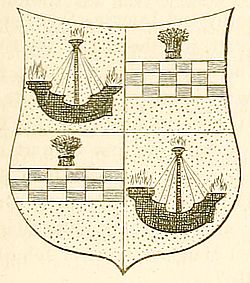
Badge—Oak or Thistle.
Lorn, the Stewarts of Athole, and the Stewarts of Balquhidder, from one or other of which all the rest have been derived. How the Stewarts of Lorn acquired that district is told in our account of clan Macdougall. The Stewarts of Lorn were descended from a natural son of John Stewart, the last Lord of Lorn, who, with the assistance of the MacLarens, retained forcible possession of part of his father’s estates. From this family sprang the Stewarts of Appin, in Argyleshire, who, with the Athole branches, were considered in the Highlands as forming the clan Stewart. The badge of the original Stewarts was the oak, and of the royal Stuarts, the thistle.
In the end of the fifteenth century, the Stewarts of Appin were vassals of the Earl of Argyll in his lordship of Lorn. In 1493 the name of the chief was Dougal Stewart. He was the natural son of John Stewart, the last Lord of Lorn, and Isabella, eldest daughter of the first Earl of Argyll. The assassination of Campbell of Calder, guardian of the young Earl of Argyll, in February 1592, caused a feud between the Stewarts of Appin and the Campbells, the effects of which were long felt. During the civil wars, the Stewarts of Appin ranged themselves under the banners of Montrose, and at the battle of Inverlochy, 2d February 1645, rendered that chivalrous nobleman good service. They and the cause which they upheld were opposed by the Campbells, who possessed the north side of the same parish, a small rivulet, called Con Ruagh, or red bog, from the rough swamp through which it ran, being the dividing line of their lands.
The Stewarts of Appin under their chief, Robert Stewart, engaged in the rebellion of 1715, when they brought 400 men into the field. They were also “out” in 1745, under Stewart of Ardshiel, 300 strong. Some lands in Appin were forfeited on the latter occasion, but were afterwards restored. The principal family is extinct, and their estate has passed to others, chiefly to a family of the name of Downie. There are still, however, many branches of this tribe remaining in Appin. The chief cadets are the families of Ardshiel, Invernahyle, Auchnacrone, Fasnacloich, and Balachulish.
Between the Stewarts of Invernahyle and the Campbells of Dunstaffnage there existed a bitter feud, and about the beginning of the sixteenth century, the former family were all cut off but one child, the infant son of Stewart of Invernahyle, by the chief of Dunstaffnage, called Cailein Uaine, “Green Colin.” The boy’s nurse fled with him to Ardnamurchan, where her husband, the blacksmith of the district, resided. The latter brought him up to his own trade, and at sixteen years of age he could wield two forehammers at once, one in each hand, on the anvil, which acquired for him the name of Domhnull nan ord, “Donald of the hammers.” Having made a two-edged sword for him, his foster-father, on presenting it, told him of his birth and lineage, and of the event which was the cause of his being brought to Ardnamurchan. Burning with a desire for vengeance, Donald set off with twelve of his companions, for each of whom, at a smithy at Corpach in Lochaber, he forged a two-edged sword. He then proceeded direct to Dunstaffnage, where he slew Green Colin and fifteen of his retainers. Having recovered his inheritance, he ever after proved himself “the unconquered foe of the Campbell.” The chief of the Stewarts of Appin being, at the time, a minor, Donald of the hammers was appointed tutor of the clan. He commanded the Stewarts of Appin at the battle of Pinkie in 1547, and on their return homewards from that disastrous field, in a famishing condition, they found in a house at the church of Port of Menteith, some fowls roasting for a marriage party. These they took from the spit, and greedily devoured. They then proceeded on their way. The Earl of Menteith, one of the marriage guests, on being apprised of the circumstance, pursued them, and came up with them at a place called Tobernareal. To a taunt from one of the earl’s attendants, one of the Stewarts replied by an arrow through the heart. In the conflict that ensued, the earl fell by the ponderous arm of Donald of the hammers, and nearly all his followers were killed.[245]
The Stewarts of Athole consist almost entirely of the descendants, by his five illegitimate sons, of Sir Alexander Stewart, Earl of Buchan, called, from his ferocity, “The wolf of Badenoch,” the fourth son of Robert II., by his first wife, Elizabeth More. One of his natural sons, Duncan Stewart, whose disposition was as ferocious as his father’s, at the head of a vast number of wild Catherans, armed only with the sword and target, descended from the range of hills which divides the counties of Aberdeen and Forfar, and began to devastate the country and murder the inhabitants. Sir Walter Ogilvy, sheriff of Angus, Sir Patrick Gray, and Sir David Lindsay of Glenesk, immediately collected a force to repel them, and a desperate conflict took place at Gasklune, near the water of Isla, in which the former were overpowered, and most of them slain.
James Stewart, another of the Wolf of Badenoch’s natural sons, was the ancestor of the family of Stewart of Garth, from which proceed almost all the other Athole Stewarts. The Garth family became extinct in the direct line, by the death of General David Stewart, author of “Sketches of the Highlanders.” The possessions of the Athole Stewarts lay mainly on the north side of Loch Tay.
The Balquhidder Stewarts derive their origin from illegitimate branches of the Albany family.
The Stewarts or Steuarts[246] of Grandtully, Perthshire, are descended from James Stewart of Pierston and Warwickhill, Ayrshire, who fell at Halidon Hill in 1333, fourth son of Sir John Stewart of Bonkill, son of Alexander, fourth lord-high-steward of Scotland, who died in 1283.
James Stewart’s son was Sir Robert Stewart of Shambothy and Innermeath, whose son, Sir John Stewart, was the first of the Stewarts of Lorn. The fourth son of the latter, Alexander Stewart, was ancestor of the Stewarts of Grandtully. “On the resignation of his father, Sir John (apparently the first Stewart of Grandtully), he received a charter from Archibald, Earl of Douglas, of the lands of Grandtully, Kyltilich, and Aberfeldy, 30th March 1414. He married Margaret, sister of John Hay (?) of Tulliebodie.”[247]
Of this family was Thomas Stewart of Balcaskie, Fifeshire, a lord of session, created a baronet of Nova Scotia, June 2, 1683. He was cousin, through his father, of John Stewart, thirteenth of Grandtully, who died without issue in 1720, and was succeeded by Sir Thomas’s son, Sir George Stewart, who also died without issue. He was succeeded by his brother, Sir John Stewart, third baronet, an officer of rank in the army, who married, 1st, Elizabeth, daughter and heiress of Sir James Mackenzie of Royston, and had by her an only surviving son, Sir John, fourth baronet; 2dly, Lady Jane Douglas, only daughter of James, Marquis of Douglas, and his son, by her, Archibald Stewart, after a protracted litigation, succeeded to the immense estates of his uncle, the last Duke of Douglas, and assuming that name, was created a peer of the United Kingdom, by the title of Baron Douglas. Sir John Stewart married, 3dly, Helen, a daughter of the fourth Lord Elibank, without issue. He died in 1764.
His son, Sir John, fourth baronet, died in 1797.
Sir John’s eldest son, Sir George, fifth baronet, married Catherine, eldest daughter of John Drummond, Esq. of Logie Almond, and died in 1827, leaving five sons and two daughters.
The eldest son, Sir John, sixth baronet, died without issue, May 20, 1838.
His brother, Sir William Drummond Steuart, born December 26, 1795, succeeded as seventh baronet. He married in 1830, and had a son William George, captain 93d Highlanders, born in February 1831, and died October 1868. Sir William died April 28, 1871, and was succeeded by his youngest brother Archibald Douglas, born August 29, 1807.
The Stewarts of Drumin, Banffshire, now Belladrum, Inverness-shire, trace their descent from Sir Walter Stewart of Strathaven, knighted for his services at the battle of Harlaw in 1411, one of the illegitimate sons of the Wolf of Badenoch, and consequently of royal blood.
The Stewarts of Ardvoirlich, Perthshire, are descended from James Stewart, called James the Gross, fourth and only surviving son of Murdoch, Duke of Albany, Regent of Scotland, beheaded in 1425. On the ruin of his family he fled to Ireland, where, by a lady of the name of Macdonald, he had seven sons and one daughter. James II. created Andrew, the eldest son, Lord Avandale.
James, the third son, ancestor of the Stewarts of Ardvoirlich, married Annabel, daughter of Buchanan of that ilk.
His son, William Stewart, who succeeded him, married Mariota, daughter of Sir Colin Campbell of Glenorchy, and had several children. From one of his younger sons, John, the family of Stewart of Glenbuckie, and from another, that of Stewart of Gartnaferaran, both in Perthshire, were descended.
His eldest son, Walter Stewart, succeeded his father, and married Euphemia, daughter of James Reddoch of Cultobraggan, comptroller of the household of James IV.
His son, Alexander Stewart of Ardvoirlich, married Margaret, daughter of Drummond of Drummond Erinoch, and had two sons, James, his successor, and John, ancestor of the Perthshire families of Stewart of Annat, Stewart of Ballachallan, and Stewart of Craigtoun.
The family of Steuart of Dalguise, Perthshire, are descended from Sir John Stewart of Arntullie and Cardneys, also designed of Dowallie, the youngest natural son of King Robert II. of Scotland, by Marion or Mariota de Cardney, daughter of John de Cardney of that ilk, sister of Robert Cardney, bishop of Dunkeld from 1396 to 1436.
The Steuarts of Ballechin, in the same county, are descended from Sir John Stewart, an illegitimate son of King James II. of Scotland. Having purchased the lands of Sticks in Glenquaich from Patrick Cardney of that ilk, he got a charter of those lands from King James III., dated in December 1486. The family afterwards acquired the lands of Ballechin.
There are many other Stewart families throughout Scotland, but as we are concerned only with these which can be considered Highland, it would be beyond our province to notice any more. The spelling of this name seems very capricious: the royal spelling is Stuart, while most families spell it Stewart, and a few Steuart and Steuard. We have endeavoured always to give the spelling adhered to by the various families whom we have noticed.
Fraser.
The first of the surname of Fraser in Scotland was undoubtedly of Norman origin, and, it is not improbable, came over with William the Conqueror. The Chronicles of the Fraser family ascribe its origin to one Pierre Fraser, seigneur de Troile, who in the reign of Charlemagne, came to Scotland with the ambassadors from France to form a league with King Achaius; but this is, of course, fabulous. Their account of the creation of their arms is equally incredible. According to their statement, in the reign of Charles the Simple of France, Julius de Berry, a nobleman of Bourbon, entertaining that monarch with a dish of fine strawberries was, for the same, knighted, the strawberry flowers, fraises, given him for his arms, and his name changed from de Berry to Fraiseur or Frizelle. They claim affinity with the family of the Duke de la Frezeliere, in France. The first of the name in Scotland is understood to have settled there in the reign of Malcolm Canmore, when surnames first began to be used, and although the Frasers afterwards became a powerful and numerous clan in Inverness-shire, their earliest settlements were in East Lothian and Tweeddale.
FRASER.
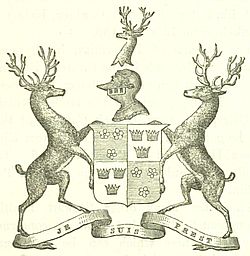
Badge—Yew.
In the reign of David I., Sir Simon Fraser possessed half of the territory of Keith in East Lothian (from him called Keith Simon), and to the monks of Kelso he granted the church of Keith.
A member of the same family, Gilbert de Fraser, obtained the lands of North Hailes, also in East Lothian, as a vassal of the Earl of March and Dunbar, and is said to have been witness to a charter of Cospatrick to the monks of Coldstream, during the reign of Alexander I. He also possessed large estates in Tweeddale.
In the reign of Alexander II., the chief of the family was Bernard de Fraser, supposed to have been the grandson of the above-named Gilbert, by a third son, whose name is conjectured to have been Simon. Bernard was a frequent witness to the charters of Alexander II., and in 1234 was made sheriff of Stirling, an honour long hereditary in his family. By his talents he raised himself from being the vassal of a subject to be a tenant in chief to the king. He acquired the ancient territory of Oliver Castle, which he transmitted to his posterity. He was succeeded by his son Sir Gilbert Fraser, who was sheriff or vicecomes of Traquair during the reigns of Alexander II. and his successor. He had three sons: Simon, his heir; Andrew, sheriff of Stirling in 1291 and 1293; and William, chancellor of Scotland from 1274 to 1280, and bishop of St. Andrews from 1279 to his death in 1297.
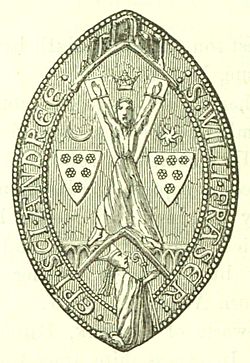
Bishop Fraser’s Seal. From Anderson’s Diplomata Scotiæ.
Sir Simon Fraser, the eldest son, was a man of great influence and power. He possessed the lands of Oliver Castle, Neidpath Castle, and other lands in Tweeddale; and accompanied King Alexander II. in a pilgrimage to Iona, a short time previous to the death of that monarch. He was knighted by Alexander III., who, in the beginning of his reign, conferred on him the office of high sheriff of Tweeddale, which he held from 1263 to 1266. He died in 1291. He had an only son, Sir Simon Fraser, the renowned patriot, with whom may be said (in 1306) to have expired the direct male line of the south country Frasers, after having been the most considerable family in Peeblesshire during the Scoto-Saxon period of our history, from 1097 to 1306.
The male representation of the principal family of Fraser devolved, on the death of the great Sir Simon, on the next collateral heir; his uncle, Sir Andrew, second son of Sir Gilbert Fraser, above mentioned. He is supposed to have died about 1308, surviving his renowned nephew, Sir Simon, only two years. He was, says the historian of the family,[248] “the first of the name of Fraser who established an interest for himself and his descendants in the northern parts of Scotland, and more especially in Inverness-shire, where they have ever since figured with such renown and distinction.” He married a wealthy heiress in the county of Caithness, then and for many centuries thereafter comprehended within the sheriffdom of Inverness, and in right of his wife he acquired a very large estate in the north of Scotland. He had four sons, namely—Simon, the immediate male ancestor of the Lords Lovat, and whose descendants and dependants (the clan Fraser), after the manner of the Celts, took the name of MacShimi, or sons of Simon; Sir Alexander, who obtained the estate of Touch, as the appanage of a younger son; and Andrew and James, slain with their brother, Simon, at the disastrous battle of Halidonhill, 22d July 1333.
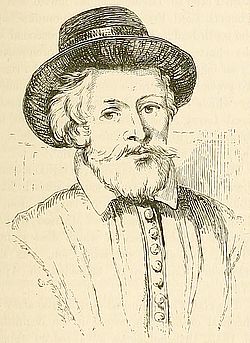
Sir Alexander Fraser of Philorth, from Pinkerton’s Scotish Gallery.
The ancient family of the Frasers of Philorth in Aberdeenshire, who have enjoyed since 1669 the title of Lord Saltoun, is immediately descended from William, son of an Alexander Fraser, who flourished during the early part of the fourteenth century, and inherited from his father the estates of Cowie and Durris in Kincardineshire.
The proper Highland clan Fraser was that headed by the Lovat branch in Inverness-shire, as mentioned above.
Unlike the Aberdeenshire or Salton Frasers, the Lovat branch, the only branch of the Frasers that became Celtic, founded a tribe or clan, and all the natives of the purely Gaelic districts of the Aird and Stratherrick came to be called by their name. The Simpsons, “sons of Simon,” are also considered to be descended from them, and the Tweedies of Tweeddale are supposed, on very plausible grounds, to have been originally Frasers. Logan’s conjecture that the name of Fraser is a corruption of the Gaelic Friosal, from frith, a forest, and siol, a race, the th being silent (that is, the race of the forest), however pleasing to the clan as proving them an indigenous Gaelic tribe, may only be mentioned here as a mere fancy of his own.
Simon Fraser, the first of the Frasers of Lovat, fell at the battle of Halidon Hill, 19th July 1333. His son, Hugh Fraser of Lovat, had four sons; Alexander, who died unmarried; Hugh, created a lord of Parliament, under the title of Lord Fraser of Lovat; John, ancestor of the Frasers of Knock in Ayrshire; and another son, ancestor of the Frasers of Foyers.
Hugh, first Lord Lovat, was one of the hostages for James I., on his return to Scotland in 1424, and in 1431 he was appointed high sheriff of the county of Inverness. His son, also named Hugh, second Lord Lovat, was father of Thomas, third lord; Alexander, ancestor of the Frasers of Fanaline, the Frasers of Leadclune, baronets, and other families of the name; and James, ancestor of the Frasers of Ballyfurth and Ford, of whom Major-General Simon Fraser, late of Ford, is the lineal male descendant and representative.
Thomas, third lord, held the office of justiciary of the north in the reign of James IV., and died 21st October 1524. He had four sons: Thomas, master of Lovat, killed at Flodden, 9th September 1513, unmarried; Hugh, fourth Lord Lovat; Alexander, fifth lord; and William Fraser of Struy, ancestor of several families of the name in Inverness-shire.
Hugh, fourth lord, the queen’s justiciary in the north, resigned his whole estates into the hands of King James V., and obtained from his majesty a new charter, dated 26th March 1539, uniting and incorporating them into the barony of Lovat, to him and the heirs male of his body, failing whom to his nearest lawful heirs male, bearing the name and arms of Fraser, and failing them to his heirs whatsoever. With his eldest son Hugh, Master of Lovat, he was killed in an engagement with the Macdonalds of Clanranald at Lochlochy, Inverness-shire, 2d June 1544.[249] His brother, Alexander, fifth Lord Lovat, died in 1558. With one daughter, the latter had three sons: Hugh, sixth lord; Thomas, ancestor of the Frasers of Strichen, from whom Lord Lovat of Lovat is descended; and James of Ardochie.
Hugh, sixth Lord Lovat, had a son, Simon, seventh lord, who was twice married, and died 3d April 1633. By his first wife, Margaret, eldest daughter of Sir Colin Mackenzie of Kintail, he had two sons,—Simon, Master of Lovat, who predeceased him, without issue, and Hugh, eighth Lord Lovat, who died 16th February 1646. By a second wife, Jean Stewart, daughter of Lord Doune, he had Sir Simon Fraser, ancestor of the Frasers of Innerallochy; Sir James Fraser of Brae, and one daughter. Hugh, eighth lord, had, with three daughters, three sons, namely,—Simon, Master of Lovat, and Hugh, who both predeceased their father, the one in 1640 and the other in 1643, and Thomas Fraser of Beaufort, eleventh Lord Lovat. The second son, Hugh, styled after his elder brother’s death, Master of Lovat, left a son Hugh, ninth lord, who succeeded his grandfather in February 1646, and married in July 1659, when a boy of sixteen years of age at college, Anne, second daughter of Sir John Mackenzie of Tarbet, baronet, sister of the first Earl of Cromarty, and by her had a son, Hugh, tenth lord, and three daughters.
Hugh, tenth lord, succeeded his father in 1672, and died in 1696, when Thomas Fraser of Beaufort, third son of the eighth lord, became eleventh Lord Lovat, but did not take the title. The tenth lord married Lady Amelia Murray, only daughter of the first Marquis of Athole, and had four daughters. His eldest daughter, Amelia, assumed the title of Baroness Lovat, and married in 1702, Alexander Mackenzie, younger of Prestonhall, who assumed the name of Fraser of Fraserdale. His son, Hugh Fraser, on the death of his mother, adopted the title of Lord Lovat, which, however, by decree of the Court of Session, 3d July 1730, was declared to belong to Simon, Lord Fraser of Lovat, as eldest lawful son of Thomas, Lord Fraser of Lovat, grand-uncle of the tenth lord. This judgment proceeded on the charter of 1539, and though pronounced by an incompetent court, was held to be right. To prevent an appeal, a compromise was made, by which Hugh Mackenzie ceded to Simon, Lord Lovat, for a valuable consideration, his pretensions to the honours, and his right to the estates, after his father’s death.
Thomas Fraser of Beaufort, by right eleventh Lord Lovat, died at Dunvegan in Skye in May 1699. By his first wife, Sibylla, fourth daughter of John Macleod of Macleod, he had fourteen children, ten of whom died young. Simon, the eldest surviving son, was the celebrated Lord Lovat, beheaded in April 1747.
The clan Fraser formed part of the army of the Earl of Seaforth, when, in the beginning of 1645, that nobleman advanced to oppose the great Montrose, who designed to seize Inverness, previous to the battle of Inverlochy, in which the latter defeated the Campbells under the Marquis of Argyll in February of that year. After the arrival of King Charles II. in Scotland in 1650, the Frasers, to the amount of eight hundred men, joined the troops raised to oppose Cromwell, their chief’s son, the Master of Lovat, being appointed one of the colonels of foot for Inverness and Ross. In the rebellion of 1715, under their last famous chief, Simon, Lord Lovat, they did good service to the government by taking possession of Inverness, which was then in the hands of the Jacobites. In 1719 also, at the affair of Glenshiel, in which the Spaniards were defeated on the west coast of Inverness-shire, the Frasers fought resolutely on the side of government, and took possession of the castle of Brahan, the seat of the Earl of Seaforth. On the breaking out of the rebellion of 1745, they did not at first take any part in the struggle, but after the battle of Prestonpans, on the 21st September, Lord Lovat “mustered his clan,” and their first demonstration in favour of the Pretender was to make a midnight attack on the Castle of Culloden, but found it garrisoned and prepared for their reception. On the morning of the battle of Culloden, six hundred of the Frasers, under the command of the Master of Lovat, a fine young man of nineteen, effected a junction with the rebel army, and behaved during the action with characteristic valour.
Lord Lovat’s eldest son, Simon Fraser, Master of Lovat, afterwards entered the service of government, and rose to the rank of lieutenant-general in the army.
General Fraser was succeeded by his half-brother, Colonel Archibald Campbell Fraser of Lovat, appointed consul-general at Algiers in 1766, and chosen M.P. for Inverness-shire on the general’s death in 1782. By his wife, Jane, sister of William Fraser, Esq. of Leadclune, F.R.S., created a baronet, 27th November 1806, he had five sons, all of whom he survived. On his death, in December 1815, the male descendants of Hugh, ninth Lord Lovat, became extinct, and the male representation of the family, as well as the right to its extensive entailed estates, devolved on the junior descendant of Alexander, fifth lord, Thomas Alexander Fraser, of Lovat and Strichen, who claimed the title of Lord Lovat in the peerage of Scotland, and in 1837 was created a peer of the United Kingdom, by that of Baron Lovat of Lovat.
The family of Fraser, of Castle Fraser, in Ross-shire, are descended, on the female side, from the Hon. Sir Simon Fraser, of Inverallochy, second son of Simon, eighth Lord Lovat, but on the male side their name is Mackenzie.
American Frasers.
We cannot close our account of the Frasers without briefly referring to the numerous members of the clan who inhabit British North America. Concerning these we have been obligingly furnished with many details by the Honourable John Fraser de Berry, of St Mark de Cournoyer, Chambly River, Vercheres Cy., District of Montreal, Member of the Legislative Council for Rougemont. The information furnished by this gentleman is very interesting, and we are sorry that the nature of this work, and the space at our disposal, permits us to give only the briefest summary.
It would seem that in the Dominion of Canada the ancient spirit of clanship is far from dead; indeed, it appears to be more intensely full of life there than it is on its native Highland mountains. From statistics furnished to us by our obliging informant, it would appear that in British North America there are bearing the old name of Fraser 12,000 persons, men, women, and children, some speaking English and some French, many Protestants and many Roman Catholics, but all, we believe, unflinchingly loyal to the British throne. Not one of these, according to the Honourable J. Fraser de Berry’s report, is a day labourer, “earning daily wages,” but all more or less well-to-do in the world, and filling respectable, and many of them responsible positions. Many are descendants of the officers and soldiers of the “Fraser Highlanders,” who settled in British North America after the American war. “They are all strong well built men, hardy, industrious, and sober, having fine comfortable houses, where quietness reigns and plenty abounds.”
Some years ago a movement was formed among these enthusiastic and loyal Frasers to organise themselves into a branch clan, to be called the “New Clan Fraser,” partly for the purpose of reviving and keeping alive the old clan feeling, and partly for purposes of benevolence. At a meeting held in February 1868, at Quebec, this movement took definite shape, and “resolutions were unanimously passed defining the constitution of the clan, pointing out its object, appointing its dignitaries, determining their duties, and the time and manner of their election.”
As “Chief of the Frasers of the whole of British North America,” was elected the Honourable James Fraser de Ferraline, Member of the Legislative Council for the Province of Nova Scotia, “a wealthy and influential merchant, born in 1802, on the Drummond estate in the braes of Stratherrick, Inverness-shire, Scotland; descended by his father from the Ferraline family of the Frasers, and by his mother from the Gorthlic Frasers. The true Fraser blood,” we are assured, “runs very pure through the veins of the worthy chief.”
The great and undoubted success of this laudable movement is, we believe, mainly owing to the exertions of the Honourable J. Fraser de Berry, whose enthusiasm and loyalty to his descent and ancient kinship are worthy of the palmiest days of clanship in the olden time on its native Highland soil. Besides the “chief” above mentioned, 111 subordinate chieftains[250] of provinces and districts have been appointed, and we are sorry that, for the reasons already mentioned, it is impossible to give a full list of them. We can only say that the gentleman just mentioned was elected Chieftain of the Province of Quebec, and also acts as “Secretary to the New Clan Fraser.” As a specimen of the unflinching thoroughness with which Mr Fraser de Berry performs his duties, and of the intense enthusiasm with which he is animated, we may state that he, founding on documents in his possession, has been able to trace his genealogy, and, therefore, the genealogy of the whole clan, as far back as the year 216 A.D.!
Altogether, we cannot but commend the main object of this organisation of the American Frasers, and think that members of other clans residing in our colonies would do well to follow their example. We believe that no member of the Fraser clan in British North America, who is really anxious to do well, need be in want of the means of success, for if he only make his position known to the authorities of the “New Clan,” all needful assistance will be afforded him. Moreover, we understand, that any one of the name of Fraser, or allied to the clan, emigrating to the dominion from the old country, by applying to any member of the Colonial clan, will be put in the way of obtaining all assistance and information necessary to his comfortable settlement and success in his new home.
Indeed, this movement of the Frasers has so much to commend it, that their example has been followed by persons of other names, in the United States as well as in Canada, and similar clan confederations are in the way of being formed under names that are certainly not Highland.
MENZIES.
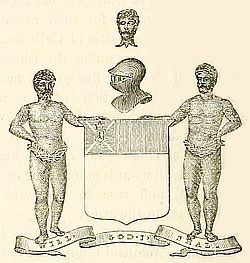
Badge—Heath (a species named the Menzies heath).
From the armorial bearings of the Menzieses it has been conjectured that the first who settled in Scotland of this surname was a branch of the Anglo-Norman family of Meyners, by corruption Manners. But this supposition does not seem to be well-founded.
The family of Menzies obtained a footing in Athole at a very early period, as appears from a charter granted by Robert de Meyners in the reign of Alexander II. This Robert de Meyners, knight, on the accession of Alexander III. (1249) was appointed lord high chamberlain of Scotland. His son, Alexander de Meyners, possessed the lands of Weem and Aberfeldy in Athole, and Glendochart in Breadalbane, besides his original seat of Durrisdeer in Nithsdale, and was succeeded by his eldest son, Robert, in the estates of Weem, Aberfeldy, and Durrisdeer, whilst his second son, Thomas, obtained the lands of Fortingal.
From the former of these is descended the family of Menzies of Castle Menzies, but that of Menzies of Fortingal terminated in an heiress, by whose marriage with James Stewart, a natural son of the Wolf of Badenoch, the property was transferred to the Stewarts.
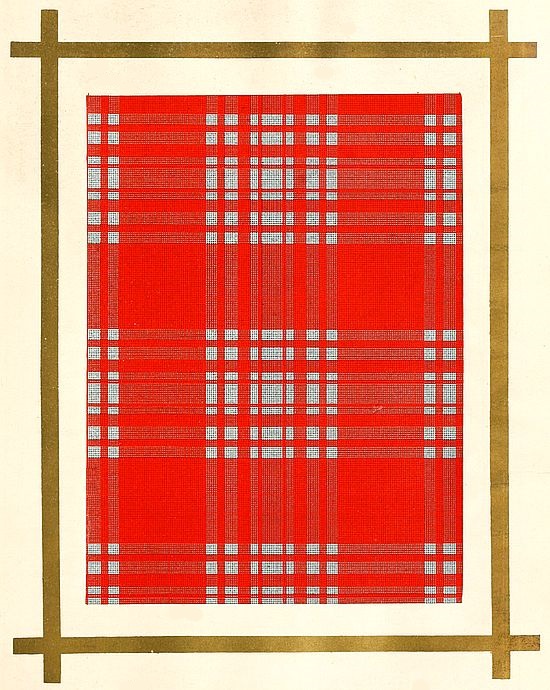
MENZIES.
In 1487, Sir Robert de Mengues, knight, obtained from the crown, in consequence of the destruction of his mansion-house by fire, a grant of the whole lands and estates erected into a free barony, under the title of the barony of Menzies. From this Sir Robert lineally descended Sir Alexander Menzies of Castle Menzies, who was created a baronet of Nova Scotia, 2d September 1665.
Sir Robert Menzies, the seventh baronet, who succeeded his father, 20th August 1844, is the 27th of the family in regular descent. The ancient designation of the family was Menzies of Weem, their common style in old writings. In 1423 “David Menzies of Weem (de Wimo)” was appointed governor of Orkney and Shetland, “under the most clement lord and lady, Eric and Philippa, king and queen of Denmark, Swedland, and Norway.”
The Gaelic appellation of the clan is Meinnarich, a term, by way of distinction, also applied to the chief. Of the eighteen clans who fought under Robert Bruce at Bannockburn, the Menzies was one.
The “Menyesses” of Athole and Appin Dull are named in the parliamentary rolls of 1587, as among “the clans that have captains, chiefs, and chieftains.” Castle Menzies, the principal modern seat of the chief, stands to the east of Loch Tay, in the parish and near to the church of Weem, in Perthshire. Weem Castle, the old mansion, is picturesquely situated under a rock, called Craig Uamh, hence its name. In 1502, it was burnt by Niel Stewart of Fortingal, in consequence of a dispute respecting the lands of Rannoch.
In 1644, when the Marquis of Montrose appeared in arms for Charles I., and had commenced his march from Athole towards Strathern, he sent forward a trumpeter, with a friendly notice to the Menzieses, that it was his intention to pass through their country. His messenger, unhappily, was maltreated, and, as some writers say, slain by them. They also harassed the rear of his army, which so exasperated Montrose, that he ordered his men to plunder and lay waste their lands and burn their houses.
During the rebellion of 1715, several gentlemen of the clan Menzies were taken prisoners at the battle of Dunblane. One of them, Menzies of Culdares, having been pardoned for his share in the rebellion, felt himself bound not to join in that of 1745. He sent, however, a valuable horse as a present to Prince Charles, but his servant who had it in charge, was seized and executed, nobly refusing to divulge his master’s name, though offered his life if he would do so. In the latter rebellion, Menzies of Shian took out the clan, and held the rank of colonel, though the chief remained at home. The effective force of the clan in 1745 was 300.
The family of Menzies of Pitfoddels in Aberdeenshire, is now extinct. Gilbert Menzies of this family, carrying the royal standard at the last battle of Montrose, in 1650, repeatedly refused quarter, and fell rather than give up his charge. The last laird, John Menzies of Pitfoddels, never married, and devoted the greater part of his large estate to the endowment of a Roman Catholic College. He died in 1843.
CHISHOLM.
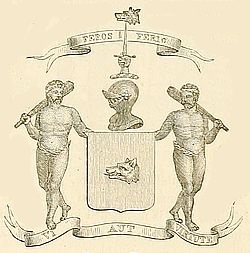
Badge—Fern.
The modern clan Chisholm or Siosal, in Inverness-shire, though claiming to be of Celtic origin, are, it is probable, descended from one of the northern collaterals of the original family of Chisholme of Chisholme in Roxburghshire, which possessed lands there as early as the reign of Alexander III.
Few families have asserted their right to be considered as a Gaelic clan with greater vehemence than the Chisholms, notwithstanding that there are perhaps few whose Lowland origin is less doubtful. Their early charters suffice to establish the real origin of the family with great clearness. The Highland possessions of the family consist of Comer, Strathglass, &c., in which is situated their castle of Erchless, and the manner in which they acquired these lands is proved by the fact, that there exists a confirmation of an indenture betwixt William de Fenton of Baky on the one part, and “Margaret de la Ard domina de Erchless and Thomas de Chishelme her son and heir” on the other part, dividing between them the lands of which they were heirs portioners, and among these lands is the barony of the Ard in Inverness-shire. This deed is dated at Kinrossy, 25th of April, 1403.
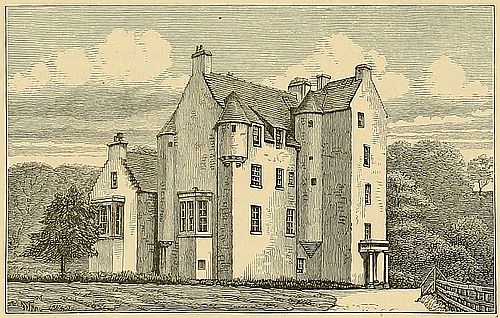
Erchless Castle.
In all probability, therefore, the husband of Margaret must have been Alexander de Chishelme, who is mentioned in 1368 as comportioner of the barony of Ard along with Lord Fenton.
The Chisholms came into prominence in the reign of David II., when Sir Robert de Chisholm married the daughter of Sir Robert Lauder of Quarrelwood, and ultimately succeeded him in the government of Urquhart Castle. In 1376 he occupied the important position of justiciar north of the Forth.
Wiland de Chesholm obtained a charter of the lands of Comer dated 9th April 1513. In 1587, the chiefs on whose lands resided “broken men,” were called upon to give security for their peaceable behaviour, among whom appears “Cheisholme of Cummer.” After the battle of Killiecrankie in 1689, Erchless castle, the seat of the chief, was garrisoned for King James, and General Livingstone, the commander of the government forces, had considerable difficulty in dislodging the Highlanders. In 1715, Ruari, or Roderick MacIan, the chief, signed the address of a hundred and two chiefs and heads of houses to George the First, expressive of their attachment and loyalty, but no notice being taken of it, he engaged very actively in the rising under the Earl of Mar; and at the battle of Dunblane, the clan was headed by Chisholm of Crocfin, an aged veteran, for which the estates of the chief were forfeited and sold. In 1727, he procured, with several other chiefs, a pardon under the privy seal, and the lands were subsequently conveyed, by the then proprietor, to Roderick’s eldest son, who entailed them on his heirs male. In 1745, this chief joined the standard of the Pretender with his clan, and Colin, his youngest son, was appointed colonel of the clan battalion. Lord President Forbes thus states the strength of the Chisholms at that period. “Chisholms—Their chief is Chisholm of Strathglass, in Gaelic called Chisallich. His lands are held crown, and he can bring out two hundred of the men.”
Alexander Chisholm, chief of the clan, who succeeded in 1785, left an only child, Mary, married to James Gooden, Esq., London, and dying in 1793, the chiefship and estates, agreeably to the deed of entail, devolved on his youngest brother, William, who married Elizabeth, eldest daughter of Duncan MacDonnell, Esq. of Glengarry, and left two sons and one daughter. On his death in 1817 he was succeeded by the elder son, Alexander William, once member of parliament for Inverness-shire, who died, prematurely, in September 1838. He was succeeded by his brother, Duncan MacDonnell Chisholm, who died in London 14th September 1858, aged 47, when the estate devolved on James Sutherland Chisholm, the present Chisholm, son of Roderich, son of Archibald, eldest son of the above Alexander, who resides at Erchless Castle, Inverness-shire.
The common designation of the chief of the house is The Chisholm, and, whatever be its antiquity, it is a title which is very generally accorded to him, and, like the designation of “The O’Connor Don,” has ever been sanctioned by use in the senate. An old chief of the clan Chisholm once not very modestly said that there were but three persons in the world entitled to it—‘the Pope, the King, and the Chisholm.’
One of the chiefs of this clan having carried off a daughter of Lord Lovat, placed her on an islet in Loch Bruirach, where she was soon discovered by the Frazers, who had mustered for the rescue. A severe conflict ensued, during which the young lady was accidentally slain by her own brother. A plaintive Gaelic song records the sad calamity, and numerous tumuli mark the graves of those who fell.
The once great family of Chisholme of Cromlix, sometimes written Cromleck, in Perthshire, which for above a century held the hereditary bailie and justiciary-ship of the ecclesiastical lordship of Dunblane, and furnished three bishops to that see, but which is now extinct, was also descended from the border Chisholmes; the first of that family, Edmund Chisholme of Cromlix, early in the fifteenth century, being the son of Chisholme of Chisholme in Roxburghshire.
Into the history of other families—for they can scarcely be called clans—living on the Highland borders, and who have at one time played an important part in Highland history, and some of whom at the present day are regarded as genuine Highland families, it would be out of place for us to enter here. We refer to such families as the Murrays, Drummonds, Grahams, Gordons, Cumings, &c. We shall conclude this account of the Highland clans by referring briefly to the origin of these houses.
MURRAY (ATHOLE).
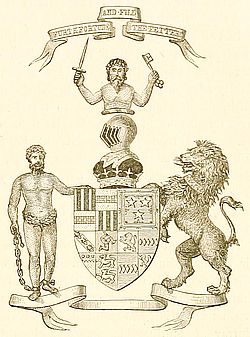
Badge—Broom (butcher’s).
The acknowledged chieftainship of the great family of Murray, or Moray (originally Murreff) is vested in Moray-Stirling of Abercairney and Ardoch, both in Perthshire. The Murrays are generally supposed to have descended from Freskine, a Fleming, who settled in Scotland in the reign of David I. (1122–1153), and acquired from that monarch the lands of Strathbroch in Linlithgowshire, and of Duffus in Moray.
The Athole Murrays are descended from Sir William de Moravia, who acquired the lands of Tullibardine, an estate in the lower part of Perthshire, with his wife Adda, daughter of Malise, seneschal of Strathern, as appears by charters dated in 1282 and 1284.
His descendant, Sir William Murray of Tullibardine, succeeded to the estates of his family in 1446. He was sheriff of Perthshire, and in 1458, one of the lords named for the administration of justice, who were of the king’s daily council. He married Margaret, daughter of Sir John Colquhoun of Luss, great chamberlain of Scotland, by whom he had a numerous issue. According to tradition they had seventeen sons, from whom a great many families of the name of Murray are descended. In a curious document entitled “The Declaration of George Halley, in Ochterarder, concerning the Laird of Tullibardine’s seventeen sons—1710,” it is stated that they “lived all to be men, and that they waited all one day upon their father at Stirling, to attend the king, with each of them one servant and their father two. This happening shortly after an act was made by King James Fifth, discharging any person to travel with great numbers of attendants besides their own family, and having challenged the laird of Tullibardine for breaking the said act, he answered he brought only his own sons, with their necessary attendants: with which the king was so well pleased that he gave them small lands in heritage.”
The eldest of Tullibardine’s seventeen sons, Sir William Murray of Tullibardine, had, with other issue, William, his successor, and Sir Andrew Murray, ancestor of the Viscounts Stormont. His great-grandson, Sir William Murray of Tullibardine, was a zealous promoter of the Reformation in Scotland. George Halley, in the curious document already quoted says that “Sir William Murray of Tullibardine having broke Argyll’s face with the hilt of his sword, in King James the Sixth’s presence, was obliged to leave the kingdom. Afterwards, the king’s mails and slaughter cows were not paid, neither could any subject to the realm be able to compel those who were bound to pay them; upon which the king cried out—‘O, if I had Will. Murray again, he would soon get my mails and slaughter cows;’ to which one standing by replied—‘That if his majesty would not take Sir William Murray’s life, he might return shortly.’ The king answered, ‘He would be loath to take his life, for he had not another subject like him!’ Upon which promise Sir William Murray returned and got a commission from the king to go to the north, and lift up the mails and the cows, which he speedily did, to the great satisfaction of the king, so that immediately after he was made lord comptroller.” This office he obtained in 1565.
His eldest son, Sir John Murray, the twelfth feudal baron of Tullibardine, was brought up with King James, who, in 1592, constituted him his master of the household. On 10th July 1606 he was created Earl of Tullibardine. His lordship married Catherine, fourth daughter of David, second Lord Drummond, and died in 1609.
His eldest son, William, second Earl of Tullibardine, married Lady Dorothea Stewart, daughter of the fifth Earl of Athole of the Stewart family, who died in 1595, and on the death in 1625 of James, second Earl of Athole, son of John, sixth Lord Innermeath, created Earl of Athole by James VI., he petitioned King Charles the First for the earldom of Athole, as his countess was the eldest daughter and heir of line of Earl John, of the family of Innermeath, which had become extinct in the male line. The king received the petition graciously, and gave his royal word that it should be done. The earl accordingly surrendered the title of Earl of Tullibardine into the king’s hands, 1st April 1626, to be conferred on his brother Sir Patrick Murray, as a separate dignity, but before the patents could be issued, his lordship died the same year. His son John, however, obtained in February 1629 the title of Earl of Athole, and thus became the first earl of the Murray branch, and the earldom of Tullibardine was at the same time granted to Sir Patrick. This Earl of Athole was a zealous royalist, and joined the association formed by the Earl of Montrose for the king at Cumbernauld, in January 1641. He died in June 1642. His eldest son John, second Earl of Athole of the Murray family, also faithfully adhered to Charles the First, and was excepted by Cromwell out of his act of grace and indemnity, 12th April 1654, when he was only about nineteen years of age. At the restoration, he was sworn a privy councillor, obtained a charter of the hereditary office of sheriff of Fife, and in 1663 was appointed justice-general of Scotland. In 1670 he was constituted captain of the king’s guards, in 1672 keeper of the privy seal, and 14th January 1673, an extraordinary lord of session. In 1670 he succeeded to the earldom of Tullibardine on the death of James, fourth earl of the new creation, and was created Marquis of Athole in 1676. He increased the power of his family by his marriage with Lady Amelia Sophia Stanley, third daughter of the seventh Earl of Derby, beheaded for his loyalty 15th October 1651. Through her mother, Charlotte de la Tremouille, daughter of Claude de la Tremouille, Duke of Thouars and Prince of Palmont, she was related in blood to the Emperor of Germany, the kings of France and Spain, the Prince of Orange, the Duke of Savoy, and most of the principal families of Europe; and by her the family of Athole acquired the seignory of the Isle of Man, and also large property in that island.
John, the second Marquis, and first Duke, of Athole, designated Lord John Murray, was one of the commissioners for inquiring into the massacre of Glencoe in 1693. He was created a peer in his father’s lifetime, by the title of Earl of Tullibardine, Viscount of Glenalmond, and Lord Murray, for life, by patent dated 27th July 1696, and in April 1703 he was appointed lord privy seal. On the 30th July of that year, immediately after his father’s death, he was created Duke of Athole, by Queen Anne, and invested with the order of the Thistle. His grace died 14th November 1724. He was twice married; first to Catherine, daughter of the Duke of Hamilton, by whom he had six sons and a daughter, and secondly to Mary, daughter of William Lord Ross, by whom he had three sons and a daughter. His eldest son John, Marquis of Tullibardine, died in 1709. His second son William, who succeeded his brother, was the Marquis of Tullibardine who acted the prominent part in both the Scottish rebellions of last century, which is recorded in the former part of this work. In 1745 he accompanied Prince Charles Edward to Scotland, and landed with him at Borodale 25th July. He was styled Duke of Athole by the Jacobites. After the battle of Culloden he fled to the westward, intending to embark for the isle of Mull, but being unable, from the bad state of his health, to bear the fatigue of travelling under concealment, he surrendered, on the 27th April 1746, to Mr Buchanan of Drummakill, a Stirlingshire gentleman. Being conveyed to London he was committed to the Tower, where he died on the 9th July following.
James, the second Duke of Athole, was the third son of the first duke. He succeeded to the dukedom on the death of his father in November 1724, in the lifetime of his elder brother William, attainted by parliament. Being maternal great-grandson of James, seventh Earl of Derby, upon the death of the tenth earl of that line, he claimed and was allowed the English barony of Strange, which had been conferred on Lord Derby by writ of summons, in 1628. His grace was married, first to Jean, sister of Sir John Frederick, Bart., by whom he had a son and two daughters; secondly to Jane, daughter of John Drummond of Megginch, who had no issue. The latter was the heroine of Dr Austen’s song of ‘For lack of gold she’s left me, O!’ She was betrothed to that gentleman, a physician in Edinburgh, when the Duke of Athole saw her, and falling in love with her, made proposals of marriage, which were accepted; and, as Burns says, she jilted the doctor. Having survived her first husband, she married a second time, Lord Adam Gordon.
The son and the eldest daughter of the second Duke of Athole died young. Charlotte, his youngest daughter, succeeded on his death, which took place in 1764, to the barony of Strange and the sovereignty of the Isle of Man. She married her cousin John Murray, Esq., eldest son of Lord George Murray, fifth son of the first duke, and the celebrated generalissimo of the forces of the Pretender in 1745. Though Lord George was attainted by parliament for his share in the rebellion, his son was allowed to succeed his uncle and father-in-law as third duke, and in 1765 he and his duchess disposed of their sovereignty of the Isle of Man to the British government, for seventy thousand pounds, reserving, however, their landed interest in the island, with the patronage of the bishopric and other ecclesiastical benefices, on payment of the annual sum of one hundred and one pounds fifteen shillings and eleven pence, and rendering two falcons to the kings and queens of England upon the days of their coronation. His grace, who had five sons and two daughters, died 5th November 1774, and was succeeded by his eldest son John, fourth duke, who in 1786 was created Earl Strange and Baron Murray of Stanley, in the peerage of the United Kingdom. He died in 1830. The fourth duke was succeeded by his eldest son John, who was for many years a recluse, and died single 14th September 1846. His next brother James, a major-general in the army, was created a peer of the United Kingdom, as baron Glenlyon of Glenlyon, in the county of Perth, 9th July 1821. He married in May 1810, Emily Frances, second daughter of the Duke of Northumberland, and by her he had two sons and two daughters. He died in 1837. His eldest son, George Augustus Frederick John, Lord Glenlyon, became, on the death of his uncle in 1846, sixth Duke of Athole. He died in 1864, and was succeeded by his only son, John James Hugh Henry, seventh Duke of Athole. The family residence of the Duke of Athole is Blair Castle, Perthshire, a view of which, as restored in 1872, is here given.
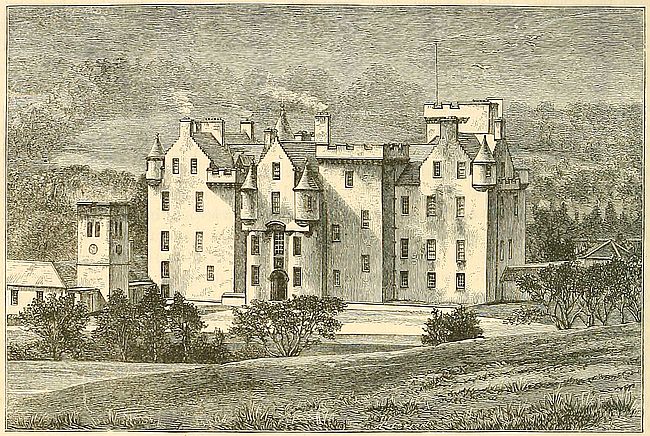
Blair Castle.
The first baronet of the Ochtertyre family was William Moray of Ochtertyre, who was created a baron of Nova Scotia, with remainder to his heirs male, 7th June 1673. He was descended from Patrick Moray, the first styled of Ochtertyre, who died in 1476, a son of Sir David Moray of Tullibardine. The family continued to spell their name Moray till 1739, when the present orthography, Murray, was adopted by Sir William, third baronet.
Drummond.
The name of Drummond may be derived originally from the parish of Drymen, in what is now the western district of Stirlingshire. The Gaelic name is Druiman, signifying a ridge, or high ground.
An ancestor of the noble family of Perth thus fancifully interprets the origin of the name: Drum in Gaelic signifies a height, and onde a wave, the name being given to Maurice the Hungarian, to express how gallantly he had conducted through the swelling waves the ship in which prince Edgar and his two sisters had embarked for Hungary, when they were driven out of their course, on the Scottish coast. There are other conjectural derivations of the name, but the territorial definition above-mentioned appears to be the most probable one.
The chief of the family at the epoch of their first appearing in written records was Malcolm Beg (or the little), chamberlain on the estate of Levenax, and the fifth from the Hungarian Maurice, who married Ada, daughter of Malduin, third Earl of Lennox, by Beatrix, daughter of Walter, lord high steward of Scotland, and died before 1260.
Two of his grandsons are recorded as having sworn fealty to Edward the First.
The name of one of them, Gilbert de Dromund, “del County de Dunbretan,” appears in Prvnne’s copy of the Ragman Roll. He was Drummond of Balquapple in Perthshire, and had a son, Malcolm de Drummond, who also swore fealty to Edward in 1296, and was father of Bryce Drummond, killed in 1330 by the Monteiths.
DRUMMOND.
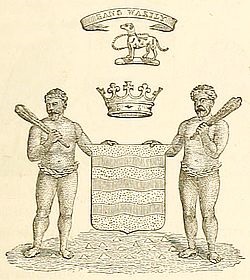
Badge—Thyme (or mother of thyme).
The other, the elder brother of Gilbert, named Sir John de Dromund, married his relation, a daughter of Walter Stewart, Earl of Menteith, and countess in her own right.
His eldest son, Sir Malcolm de Drummond, attached himself firmly to the cause of Bruce. King Robert, after the battle of Bannockburn, bestowed upon him certain lands in Perthshire. He married a daughter of Sir Patrick Graham of Kincardine, elder brother of Sir John Graham, and ancestor of the family of Montrose. He had a son, Sir Malcolm Drummond, who died about 1346. The latter had three sons, John, Maurice, and Walter. The two former married heiresses.
Maurice’s lady was sole heiress of Concraig and of the stewardship of Strathearn, to both of which he succeeded.
The wife of John, the eldest son, was Mary, eldest daughter and co-heiress of Sir William de Montefex, with whom he got the lands of Auchterarder, Kincardine in Monteith, Cargill, and Stobhall in Perthshire. He had four sons, Sir Malcolm, Sir John, William, and Dougal; and three daughters—Annabella, married, in 1357, John, Earl of Carrick, high steward of Scotland, afterwards King Robert the Third, and thus became Queen of Scotland, and the mother of David, Duke of Rothesay, starved to death in the palace of Falkland, in 1402, and of James the First, as well as of three daughters; Margaret, married to Sir Colin Campbell of Lochow, Jean, to Stewart of Donally, and Mary, to Macdonald of the Isles.
About 1360, in consequence of a feud which had long subsisted between the Drummonds and the Menteiths of Rusky, the residence of the family seems to have been transferred from Drymen, in Stirlingshire, where they had chiefly lived for about two hundred years, to Stobhall, in Perthshire, which had some years before come into their possession by marriage.
Sir Malcolm Drummond, the eldest son, succeeded to the earldom of Mar in right of his wife, Lady Isabel Douglas, only daughter of William, first Earl of Douglas. His death was a violent one, having been seized by a band of ruffians and imprisoned till he died “of his hard captivity.” This happened before 27th May 1403. Not long after his death, Alexander Stewart, a natural son of “the Wolf of Badenoch,” a bandit and robber by profession, having cast his eyes on the lands of the earldom, stormed the countess’ castle of Kildrummie; and, either by violence or persuasion, obtained her in marriage. As Sir Malcolm Drummond had died without issue, his brother, John, succeeded him.
John’s eldest son, Sir Walter Drummond, was knighted by King James the Second, and died in 1455. He had three sons: Sir Malcolm his successor; John, dean of Dunblane; and Walter of Ledcrieff, ancestor of the Drummonds of Blair-Drummond (now the Home Drummonds, Henry Home, the celebrated Lord Kames, having married Agatha, daughter of James Drummond of Blair-Drummond, and successor in the estate to her nephew in 1766); of Cairdrum; of Newton, and other families of the name.
The eldest son of the main stem, that is, the Cargill and Stobhall family, Sir Malcolm by name, had great possessions in the counties of Dumbarton, Perth, and Stirling, and died in 1470. By his wife Marion, daughter of Murray of Tullibardine, he had six sons. His eldest son, Sir John, was first Lord Drummond.
Sir John, the eldest son, was a personage of considerable importance in the reigns of James the Third and Fourth, having been concerned in most of the public transactions of that period. He died in 1519.
By his wife, Lady Elizabeth Lindsay, daughter of David, Duke of Montrose, the first Lord Drummond, had three sons, and six daughters, the eldest of whom, Margaret, was mistress to James the Fourth. Malcolm, the eldest son, predeceased his father. William, the second son, styled master of Drummond, suffered on the scaffold.
William had two sons, Walter and Andrew, ancestor of the Drummonds of Bellyclone. Walter died in 1518, before his grandfather. By Lady Elizabeth Graham, daughter of the first Earl of Montrose, he had a son, David, second Lord Drummond, who was served heir to his great-grandfather, John, first lord, 17th February 1520. Of his two sons, Patrick, the elder, was third Lord Drummond; James, the younger, created, 31st January 1609, Lord Maderty, was ancestor of the viscounts of Strathallan.
Patrick, third Lord Drummond, embraced the reformed religion, and spent some time in France. He died before 1600. He was twice married, and by his first wife, Elizabeth, daughter of David Lindsay of Edzell, eventually Earl of Crawford, he had two sons and five daughters.
The elder son, James, fourth Lord Drummond, passed a considerable portion of his youth in France, and after James the Sixth’s accession to the English throne he attended the Earl of Nottingham on an embassy to the Spanish court. On his return he was created Earl of Perth, 4th March 1605. John, the younger son, succeeded his brother in 1611, as second Earl of Perth.
The Hon. John Drummond, second son of James, third Earl of Perth, was created in 1685 Viscount, and in 1686 Earl of Melfort; and his representative Captain George Drummond, duc de Melfort, and Count de Lussan in France, whose claim to the earldom of Perth in the Scottish peerage was established by the House of Lords, June 1853, is the chief of the clan Drummond, which, more than any other, signalised itself by its fidelity to the lost cause of the Stuarts.
GRAHAM.
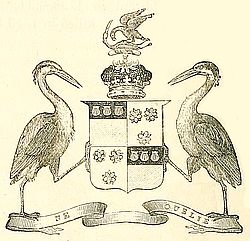
Badge—Laurel spurge.
The surname Græme, or Graham, is said to be derived from the Gaelic word grumach, applied to a person of a stern countenance and manner. It may possibly, however, be connected with the British word grym, signifying strength, seen in grime’s dyke, erroneously called Graham’s dyke, the name popularly given to the wall of Antoninus, from an absurd fable of Fordun and Boece, that one Greme, traditionally said to have governed Scotland during the minority of the fabulous Eugene the Second, broke through the mighty rampart erected by the Romans between the rivers Forth and Clyde. It is unfortunate for this fiction that the first authenticated person who bore the name in North Britain was Sir William de Græme (the undoubted ancestor of the Dukes of Montrose and all “the gallant Grahams” in this country), who came to Scotland in the reign of David the First, from whom he received the lands of Abercorn and Dalkeith, and witnessed the charter of that monarch to the monks of the abbey of Holyrood in 1128. In Gaelic grim means war, battle. Anciently, the word Grimesdike was applied to trenches, roads, and boundaries, and was not confined to Scotland.
This Anglo-Norman knight, Sir William de Graham, had two sons, Peter and John, in whom the direct line was carried on. The elder, Peter de Graham, styled of Dalkeith and Abercorn, had also two sons, Henry and William. Henry the elder, witnessed some of the charters of King William the Lion. He was succeeded by his son Henry, whose son, also named Henry, by marrying the daughter of Roger Avenel (who died in 1243), acquired the extensive estates of Avenel, in Eskdale. His grandson, Sir John de Graham of Dalkeith, had a son, John de Graham, who dying without issue, was the last of the elder line of the original stock of the Grahams.
The male line of the family was carried on by the younger son of Sir William de Graham first above mentioned, John de Graham, whose son, David de Graham, obtained from his cousin, Henry, the son of Peter de Graham, the lands of Clifton and Clifton Hall in Mid-Lothian, and from King William the Lion those of Charlton and Barrowfield, as well as the lordship of Kinnaber, all in Forfarshire. This was the first connection of the family with the district near Montrose, whence they subsequently derived their ducal title. His eldest son, also named Sir David de Graham, had, from Patrick, Earl of Dunbar, in the reign of King Alexander the Second, with other lands, those of Dundaff, in Stirlingshire. The son of Sir David de Graham last mentioned, also named Sir David de Graham, who appears to have held the office of sheriff of the county of Berwick, acquired from Malise, Earl of Strathearn, the lands of Kincardine, in Perthshire, which became one of the chief designations of the family. He died about 1270. By his wife, Annabella, daughter of Robert, Earl of Strathearn, he had three sons, namely, Sir Patrick, who succeeded him; the celebrated Sir John the Graham, the companion of Wallace; and Sir David, one of the nominees, his eldest brother being another, of Baliol, in his competition for the crown of Scotland, 1292. His eldest son, Sir Patrick Graham of Kincardine, fell in battle against the English at Dunbar, 28th April 1296. Another son, Sir David de Graham, a favourite name among the early Grahams, was also designed of Kincardine. From Robert the First, in consideration of his good and faithful services, he had several grants, and exchanged with that monarch his property of Cardross in Dumbartonshire for the lands of “Old Montrose” in Forfarshire. He died in 1327.
Sir William Graham of Kincardine, his great-grandson, was frequently employed in negociations with the English relative to the liberation of King James the First. He was twice married. By his first wife he had two sons, Alexander,—who predeceased him, leaving two sons,—and John. His second wife was the princess Mary Stewart, second daughter of King Robert the Second, widow of the Earl of Angus and of Sir James Kennedy of Dunure; after Sir William Graham’s death she took for her fourth husband Sir William Edmonstone of Duntreath. By this lady he had five sons, namely, 1. Sir Robert Graham of Strathcarron, ancestor of the Grahams of Fintry, of Claverhouse, and of Duntrune. 2. Patrick Graham, consecrated bishop of Brechin, in 1463, and three years after translated to the see of St. Andrews. 3. William, ancestor of the Grahams of Garvoch in Perthshire, from a younger son of whom came the Grahams of Balgowan, the most celebrated of which family was the gallant Sir Thomas Graham, Lord Lynedoch, the hero of Barossa. 4. Henry, of whom nothing is known. 5. Walter, of Wallacetown, Dumbartonshire, ancestor of the Grahams of Knockdolian in Carrick, and their cadets.
Patrick Graham, of Kincardine, the son of Alexander, the eldest son, succeeded his grandfather, and was created a peer of parliament in 1451, under the title of Lord Graham. He died in 1465. His only son, William, second Lord Graham, married lady Anne Douglas, eldest daughter of the fourth Earl of Angus, and had two sons, William, third Lord Graham, and George, ancestor of the Grahams of Calendar.
William, third Lord Graham, sat in the first parliament of King James the Fourth, 1488; and on 3d March, 1504–5, he was created Earl of Montrose, a charter being granted to him of that date, of his hereditary lands of “Auld Montrose,” which were then erected into a free barony and earldom to be called the barony and earldom of Montrose. It is from these lands, therefore, and not from the town of Montrose, that the family take their titles of earl and duke. He fell at the battle of Flodden, 9th September 1513. He was thrice married. By his first wife, Annabella, daughter of Lord Drummond, he had a son, second Earl of Montrose; by his second wife, Janet, a daughter of Sir Archibald Edmonstone of Duntreath, he had three daughters; and by his third wife, Christian Wavance of Segy, daughter of Thomas Wavance of Stevenston, and widow of the ninth Lord Halyburton of Dirleton, two sons, Patrick, ancestor of the Græmes of Inchbrakie, Perthshire; and Andrew, consecrated bishop of Dunblane in 1575, and the first protestant bishop of that see.
From the third son of the second Earl of Montrose came the Grahams of Orchil, and from the fourth son the Grahams of Killearn. From the second son of the third earl descended the Grahams of Braco, who once possessed a baronetcy of Nova Scotia, conferred on the first of the family, 28th September 1625. From the third son of the same earl, the Grahams of Scottistoun derived their descent.
The Grahams of the borders are descended from Sir John Graham of Kilbryde, called, from his bravery, Sir John “with the bright sword,” second son of Malise, Earl first of Strathearn, and afterwards of Menteith, by his wife, the Lady Ann Vere, daughter of Henry, Earl of Oxford.
Sir John “with the bright sword” was also ancestor of the Grahams of Gartmore in Perthshire. Sir William Graham of Gartmore, created a baronet of Nova Scotia in 1665, married Elizabeth, second daughter of John Graham, Lord Kilpont (son of the Earl of Airth), who was slain by one of his own vassals, James Stewart of Ardvoirlich, in the camp of the Marquis of Montrose, in 1644; and had a son, Sir John Graham, second baronet of Gartmore, declared insane in 1696. On his death, 12th July 1708, without issue, the baronetcy became extinct, and the representation of the family devolved upon his sister Mary, wife of James Hodge, Esq. of Gladsmuir, advocate. Their only daughter, Mary Hodge, married, in 1701, William, son of John Graham of Callingod, and had a son, William Graham, who assumed the title of Earl of Menteith.
The castle of Kilbryde, near Dunblane, built by Sir John “with the bright sword,” in 1460, was possessed by his representatives, the Earls of Menteith, till 1640, when it was sold. The Menteith Grahams were called the Grahams “of the hens,” from the following circumstances. An armed party of the Stewarts of Appin, headed by Donald Nan Ord,[251] called Donald of the Hammer, in their retreat from the disastrous field of Pinkie in 1547, in passing the lake of Menteith, stopped at a house of the Earl of Menteith, where a large feast, consisting principally of poultry, was prepared for a marriage party, and ate up all the provisions; but, being immediately pursued, they were overtaken in the gorge of a pass, near a rock called Craig-Vad, or the Wolf’s cliff, where a bloody encounter took place. The earl and nearly the whole of his followers were killed, and Donald of the Hammer escaped, amidst the darkness of the night, with only a single attendant. From the cause of the fight the Highlanders gave the name of Gramoch na Geric, or “Grahams of the hens,” to the Menteith branch ever after.
The clan Graham were principally confined to Menteith and Strathearn.
GORDON.
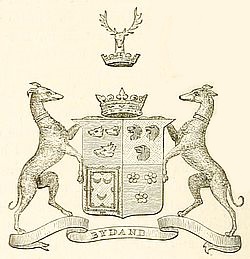
Badge—Rock ivy.
The Gordons are an ancient and distinguished family, originally from Normandy, where their ancestors are said to have had large possessions. From the great antiquity of the race, many fabulous accounts have been given of the descent of the Gordons. Some derive them from a city of Macedonia, called Gordonia, whence they went to Gaul; others find their origin in Spain, Flanders, &c. Some writers suppose Bertrand de Gourdon who, in 1199, wounded Richard the Lion-heart mortally with an arrow before the castle of Chalus in the Limoges, to have been the great ancestor of the Gordons, but there does not seem to be any other foundation for such a conjecture than that there was a manor in Normandy called Gourdon. It is probable that the first persons of the name in this island came over with William the Conqueror in 1066. According to Chalmers,[252] the founder of this great family came from England in the reign of David the First (1124–53), and obtained from that prince the lands of Gordon (anciently Gordun, or Gordyn, from, as Chalmers supposes, the Gaelic Gordin, “on the hill”). He left two sons, Richard, and Adam, who, though the younger son, had a portion of the territory of Gordon, with the lands of Fanys on the southern side of it.
The elder son, Richard de Gordon, granted, between 1150 and 1160, certain lands to the monks of Kelso, and died in 1200. His son, Sir Thomas de Gordon, confirmed by charter these donations, and his son and successor, also named Thomas, made additional grants to the same monks, as well as to the religious of Coldstream. He died in 1285, without male issue, and his only daughter, Alicia, marrying her cousin Adam de Gordon, the son of Adam, younger brother of Richard above mentioned, the two branches of the family thus became united.
His grandson, Sir Adam de Gordon, Lord of Gordon, one of the most eminent men of his time, was the progenitor of most of the great families of the name in Scotland. In reward of his faithful services, Bruce granted to him and his heirs the noble lordship of Strathbolgie (now Strathbogie), in Aberdeenshire, then in the Crown, by the forfeiture of David de Strathbogie, Earl of Athole, which grant was afterwards confirmed to his family by several charters under the great seal. Sir Adam fixed his residence there, and gave these lands and lordship the name of Huntly, from a village of that name in the western extremity of Gordon parish, in the Merse, the site of which is now said to be marked only by a solitary tree. From their northern domain, the family afterwards acquired the titles of Lord, Earl, and Marquis of Huntly, and the latter is now their chief title. Sir Adam was slain, fighting bravely in the vanguard of the Scotch army at the battle of Halidonhill, July 12, 1333. By Annabella, his wife, supposed to have been a daughter of David de Strathbolgie above mentioned, he had four sons and a daughter. The eldest son, Sir Alexander, succeeded him. The second son, William, was ancestor of the Viscounts of Kenmure.
Sir John Gordon, his great-grandson, got a new charter from King Robert the Second of the lands of Strathbogie, dated 13th June 1376. He was slain at the battle of Otterbourne in 1388. His son, Sir Adam, lord of Gordon, fell at the battle of Homildon, 14th September 1402. By his wife, Elizabeth, daughter of Sir William Keith, great mareschal of Scotland, he had an only child, Elizabeth Gordon, who succeeded to the whole family estates, and having married Alexander Seton, second son of Sir William Seton of Seton, ancestor of the Earls of Winton, that gentleman was styled lord of Gordon and Huntly. He left two sons, the younger of whom became ancestor of the Setons of Meldrum.
Alexander, the elder, was, in 1449, created Earl of Huntly, with limitation to his heirs male, by Elizabeth Crichton, his third wife, they being obliged to bear the name and arms of Gordon. George, the sixth earl, was created Marquis of Huntly, by King James, in 1599. George, the fourth marquis, was made Duke of Gordon in 1684. George, fifth duke, died without issue on 28th May 1836. At his death the title of Duke of Gordon became extinct, as well as that of Earl of Norwich in the British peerage, and the Marquisate of Huntly devolved on George Earl of Aboyne, descended from Charles, fourth son of George, second Marquis of Huntly, while the Duke of Richmond and Lennox, son of his eldest sister, succeeded to Gordon castle, Banffshire, and other estates in Aberdeenshire and Inverness-shire.
The clan Gordon was at one period one of the most powerful and numerous in the north. Although the chiefs were not originally of Celtic origin, as already shown, they yet gave their name to the clan, the distinctive badge of which was the rock ivy. The clan feuds and battles were frequent, especially with the Mackintoshes, the Camerons, the Murrays, and the Forbeses. Their principal exploits have been noticed in the first volume.
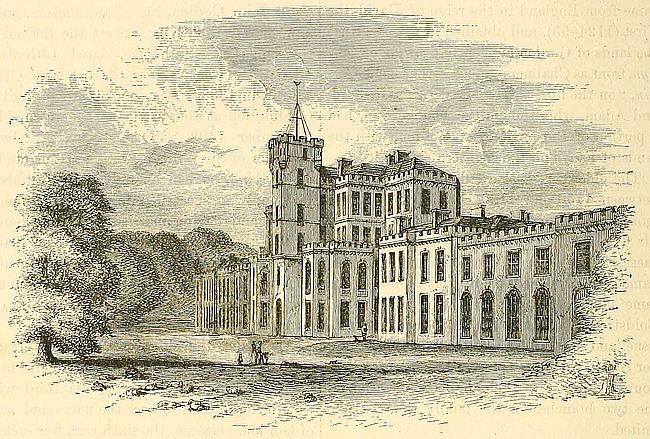
Gordon Castle. From Nattes’ Scotia Depicta.
The Duke of Gordon, who was the chief of the clan, was usually styled “The Cock of the North,” His most ancient title was the “Gude-man of the Bog,” from the Bog-of-Gight, a morass in the parish of Bellie, Banffshire, in the centre of which the former stronghold of this family was placed, and which forms the site of Gordon castle, considered the most magnificent edifice in the north of Scotland. The Marquis of Huntly is now the chief of the clan Gordon. Of the name of Gordon, there are many ancient families belonging to Aberdeenshire, Banffshire, and the north of Scotland.
CUMMING.
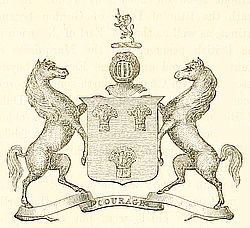
Badge—Cumin plant.
The family of Cumyn, Comyn, Cumin, Cummin, or Cumming, merit notice among the septs of the north of Scotland, from the prominent figure which they made there in early times. But almost all authors agree in representing them as having come from England, and having been of either Norman or Saxon descent originally. The time when they migrated northwards is also well marked in history. The event occurred in the reign of David I. That prince still claimed a large part of the north of England, and, besides, had engaged deeply in the contests betwixt King Stephen and the Empress Matilda, which agitated South Britain in the twelfth century. He was thus brought into frequent contact with the barons of Northumberland and the adjoining districts, some of whom were properly his vassals, and many of whose younger sons followed him permanently into Scotland. In this way were founded various northern families in the time of King David, and among others, seemingly, the Cumyns. William Cumyn is the first of the name authentically mentioned in the Scottish annals. He had been trained clerically by Gaufred, bishop of Durham, some time chancellor to Henry I.; and his abilities and experience appear to have recommended Cumyn to David of Scotland for the same high office in the north. He was nominated chancellor of Scotland in 1133; though we find him seizing on the bishopric of Durham in 1142, under countenance of a grant from the Empress Maude. But he soon after resigned it to the proper incumbent, reserving only certain of the episcopal estates for behoof of his nephew and heir, Richard.
Richard Cumyn, properly the founder of the line of the Scottish Cumyn, rose high in the service of William the Lion, and long acted as chief minister and justiciary of Scotland. During his life he held the lands of Northallerton and others, secured to him by his uncle in England; and he also obtained estates in Roxburghshire, the first property of the family in Scotland. That the Cumyns must have been of high importance in England is proved by, and in part explains, their sudden elevation in the north. Richard Cumyn even intermarried with the royal family of Scotland, wedding Hexilda, great-granddaughter of the “gracious” King Duncan of “Macbeth.”[253]
In the reign of Alexander III., as stated by Fordun, there were of the name in Scotland three Earls—Buchan, Menteith, and Athole, and one great feudal baron, Cumyn lord of Strathbogie, with thirty knights all possessing lands. The chief of the clan was lord of Badenoch and Lochaber, and other extensive districts in the Highlands. Upwards of sixty belted knights were bound to follow his banner with all their vassals, and he made treaties with princes as a prince himself. One such compact with Lewellyn of Wales is preserved in Rymer’s Fœdera.
The Cummings, as the name is now spelled, are numerous in the counties of Aberdeen, Banff, and Moray; but a considerable number, in consequence of being prevented, for some reason, from burying their relatives in the family burial-place, changed their names to Farquharson, as being descended from Ferquhard, second son of Alexander the fourth designed of Altyre, who lived in the middle of the fifteenth century. It is from them that the Farquharsons of Balthog, Haughton, and others in the county of Aberdeen derive their descent.
From Sir Robert Comyn, younger son of John lord of Badenoch, who died about 1274, are descended the Cummings of Altyre, Logie, Auchry (one of whom in 1760 founded the village of Cuminestown in Aberdeenshire), Relugas, &c.
OGILVY.
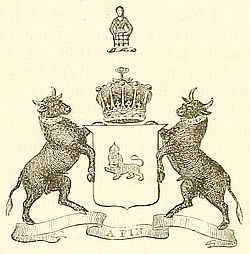
Badge—Alkanet.
Ogilvy is a surname derived from a barony in the parish of Glammis, Forfarshire, which, about 1163, was bestowed by William the Lion on Gilbert, ancestor of the noble family of Airlie, and, in consequence, he assumed the name of Ogilvy. He is said to have been the third son of Gillibrede, or Gilchrist, maormor of Angus. In the charters of the second and third Alexanders there are witnesses of the name of Ogilvy. Sir Patrick de Ogilvy adhered steadily to Robert the Bruce, who bestowed upon him the lands of Kettins in Forfarshire. The barony of Cortachy was acquired by the family in 1369–70. The “gracious gude Lord Ogilvy,” as he is styled in the old ballad of the battle of Harlaw, in which battle the principal barons of Forfarshire fought on the side of the Earl of Mar, who commanded the royal army, was the son of Sir Walter Ogilvy of Auchterhouse, slain in a clan battle with the Robertsons in 1394.
“Of the best amang them was The gracious gude Lord Ogilvy, The sheriff-principal of Angus, Renownit for truth and equity— For faith and magnanimity He had few fellows in the field, Yet fell by fatal destiny, For he nae ways wad grant to yield.”
His eldest son, George Ogilvy, was also slain.
Lord Ogilvy, the first title of Airlie family, was conferred by James IV., in 1491, on Sir John Ogilvy of Lintrathen.
James, seventh Lord Ogilvy, was created Earl of Airlie, in 1639.
The title of Lord Ogilvy of Deskford was conferred, 4th October 1616, on Sir Walter Ogilvy of Deskford and Findlater, whose son, James, second Lord Deskford, was created Earl of Findlater, 20th February 1638. He was descended from Sir Walter Ogilvy of Auchleven, second son of Sir Walter Ogilvy of Lintrathen, high treasurer of Scotland.
The clan Ogilvy are called “the Siol Gilchrist,” the race or posterity of Gilchrist. In 1526, the Mackintoshes invaded the country of the Ogilvies, and massacred no fewer than 24 gentlemen of the name. A feud between the Campbells and the Ogilvies subsisted for several centuries. In Pitcairn’s Criminal Trials we find James Ogilvy complaining, on 21st October, 1591, that a body of Argyll’s men had attacked him when residing peaceably in Glenisla, in Forfarshire, which anciently belonged to the Ogilvies, killed several of his people, ravaged the country, and compelled him and his lady to flee for their lives.
The Ogilvies had their revenge in 1645, for the burning of “the bonnie house of Airlie,” and the other strongholds of the Ogilvies, when Castle Campbell, near Dollar, or the Castle of Gloom, its original name, was destroyed by them and the Macleans, and the territory of the Marquis of Argyll was overrun by the fierce and ruthless clan that followed Montrose, and carried fire and sword throughout the whole estates of the clan Campbell.
FERGUSON.
Badge—Little Sunflower.
Ferguson, or Fergusson, is the surname (son of Fergus) of a Highland sept (whose arms we have been unable to obtain), which had its seat on the borders of the counties of Perth and Forfar, immediately to the north of Dunkeld, and the distinctive badge of which was the little sunflower. In the Roll of 1587, they are named as among the septs of Mar and Athole, where their proper seat as a clan originally lay, having chiefs and captains of their own. In Galloway, the Craigdarroch Fergussons have flourished from an early date, and in Fife the Fergusons of Raith have long held a high position as landholders.