Volume 2 / Part 3 — PART THIRD. HISTORY OF THE HIGHLAND REGIMENTS. (continued 18)
Reading edition
Information having been received that the Boers were encamped in force at Touw Fontein, about thirty-five miles from Philippolis, the detachment marched on the night of the 23rd of April for the camp, within four miles of which camp the Boers and Griquas were found skirmishing, the former, 500 strong, being mounted. Dispositions were made to attack the camp, but the troops of the 7th Dragoon Guards and the company of the Cape Rifles pushed forward, and the Boers fled in all directions, after offering a very slight resistance. The detachment of the 91st remained encamped until the 30th of June, when it was ordered to Grahamstown.
On Nov. 25th of this year the 1st battalion was inspected by Colonel Hare, who, at the same time, presented the regiment with new colours, and expressed in a few words his entire approval of the battalion.
At the commencement of the Kaffir war, in March 1846, the battalion proceeded to Fort Peddie, in the ceded territory,[543] and shortly afterwards it was joined by detachments of the corps from various outposts. The grenadier company at the commencement of the war was attached to the field force under Colonel Somerset, K.H., and was engaged in the Amatola Mountains with the enemy on the 16th, 17th, and 18th of April, when Lt. J. D. Cochrane was severely wounded. What details we have been able to collect concerning the part taken by the 91st in this long and arduous engagement we shall record in speaking of the reserve battalion, which was also largely engaged during these three days.
After this the grenadier company was attached to the reserve battalion, with the exception of a few men, who accompanied Captain Hogg’s Hottentot levy to Makassa’s Country.
The headquarters of the battalion was engaged in protecting the Fingoe settlement at Fort Peddie, being stationed there when the post was attacked, on the 28th of May 1846, by upwards of 8000 Kaffirs. The strength of the battalion consisted of 254 officers and men; there was also a weak troop of cavalry at the post. The details of this attack will be best told in the words of a writer quoted by Mrs Ward:—[544]
“Finding their scheme of drawing the troops out did not succeed, small parties advanced in skirmishing order, and then the two divisions of Páto and the Gaikas moved towards each other, as if intending a combined attack on some given point. Colonel Lindsay was superintending the working of the gun himself, and, as soon as a body of the Gaikas came within range, a shot was sent into the midst of them, which knocked over several, disconcerted them a little, and threw them into confusion; rapid discharges of shot and shell followed. The Kaffirs now extended themselves in a line six miles in length. These advancing at the same time, so filled the valley that it seemed a mass of moving Kaffirs; rockets and shells were poured rapidly on them, and presently a tremendous fire of musketry was poured, happily, over our heads. The enemy, however, did not come near enough for the infantry to play upon them, and only a few shots were fired from the infantry barracks.
“The dragoons were ordered out, and, though rather late, followed up some of Páto’s men, who fled at their approach, Sir Harry Darell galloping after them with his troop. The daring Fingoes followed the Kaffirs to the Gwanga river, four miles off.
“Upwards of 200 of the enemy fell, and more were afterwards ascertained to be dead and dying, but they carried off the greater part of the cattle.”
Towards the end of June the battalion furnished to the second division of the army, under Colonel Somerset, three companies under a field officer, which proceeded with the division as far as the Buffalo affluents in Kaffraria, and rejoined headquarters, when the division fell back for supplies, on Waterloo Bay in September. The whole force was under the command of Sir Peregrine Maitland, and, after encountering many difficulties, hardships, and privations, successfully effected the object of the expedition.
Soon after this the battalion furnished detachments for the Fish River line, from Trompeter’s Drift to Fort-Brown; and, after the second advance of the 2nd division into the enemy’s country, performed a very considerable amount of escort duty in guarding convoys of supplies for the Kei river and other camps.
During the remainder of the stay of the 1st battalion at the Cape, we have no record of its being engaged in any expedition. On January 12th, 1848, it marched from Grahamstown to Algoa Bay, and thence proceeded to Cape Town, where headquarters and three companies embarked for home on the 23rd of February, followed on the 10th of March by the other three companies, arriving at Gosport on the 28th of April and 11th of May respectively. The dépôt was consolidated with the battalion on the 1st of May.
By a memorandum, dated “Horse Guards, 5th May 1846,” a second lieut.-colonel was appointed to the 91st, as well as to all the regiments having reserve battalions; he was to have the command of the reserve battalion.
II. 1842–1857.
The reserve battalion—Captain Bertie Gordon cures desertion—Grahamstown—Fort Beaufort—Kaffir War—Amatola Mountains—The Tyumie River—A daring deed—Trompeter’s Hill—Amatola and Tabindoda Mountains—“Weel done, Sodger!”—The Kei River—The Rebel Boers—Grahamstown—The Second Kaffir War—Fort Hare—The Yellow Woods—Amatola Mountains—Fort Hare attacked—Kumnegana Heights—The Waterkloof—The Kumnegana again—Amatola Mountains and the Tyumie—The Waterkloof—The Waterkloof again—Patrol work—The Waterkloof again—Eland’s Post—The Kei—The Waterkloof again—Blinkwater and other posts—From Beaufort to Port Elizabeth—The battalion receives an ovation—Home—Redistribution of regiment—Aldershot—The Queen visits the lines of the 91st—“The Queen’s Hut”—Duke of Cambridge compliments the regiment—Second visit of the Queen—Berwick—Preston—Final absorption of the second battalion.
To return to the reserve battalion. During Oct. and Nov. 1842 desertions had taken place among the young soldiers of the reserve battalion, then at Cape Town, to an unusual extent. At length, when eighteen soldiers had deserted in less than six weeks, and every night was adding to the number, Captain Bertie Gordon volunteered his services to the Major commanding, offering to set off on the same day on a patrolling expedition, to endeavour to apprehend and bring the deserters back. Captain Gordon only stipulated to be allowed the help of one brother officer and of a Cape Corps soldier as an interpreter, with a Colonial Office Order addressed to all field-coronets, directing them to give him such assistance, in the way of furnishing horses for his party and conveyances for his prisoners, as he might require. Captain Gordon’s offer was accepted.
Captain Gordon had not the slightest trace or information of the track of a single deserter to guide his course over the wide districts through which his duty might lead his patrol. In taking leave of his commanding officer before riding off, Major Ducat said to him,—“Gordon, if you do not bring them back we are a ruined battalion.” The patrol was absent from headquarters for eight days, during which Captain Gordon rode over 600 miles; and when, on the evening of the 16th of Nov., his tired party rode into the barracks of Cape Town, just before sunset, after a ride of 80 miles in 13 hours, 16 out of 18 deserters had been already lodged in the regimental guard-room as the result of his exertions. Two more deserters, hearing that Captain Gordon was out, had come in of their own accord, and thus all were satisfactorily accounted for. The desertions in the reserve battalion from that period ceased.
The battalion embarked on the morning of Feb. 22nd, 1842, for Algoa Bay, but the ship did not sail till the 27th, anchoring in Algoa Bay on March 4th, the battalion disembarking at Port Elizabeth on the 5th. On the 7th the reserve battalion set out for Grahamstown, which it reached on the 13th, and took up quarters at Fort England with the 1st battalion of the regiment.
In the beginning of Jan. 1844 the reserve battalion left Grahamstown for Fort Beaufort, which became its headquarters for the next four years, detachments being constantly sent out to occupy the many posts which were established, and keep the turbulent Kaffirs in check.
In the early part of 1846 the Kaffir war was commenced, and on April 11th the headquarters of the reserve battalion, augmented to 200 rank and file by the grenadier company of the 1st battalion, marched from Fort Beaufort into Kaffirland with the division, under command of Col. Richardson of the 7th Dragoon Guards; and, on the 14th, the detachment joined Col. Somerset’s division near the Debè Flats. The object of this expedition was to chastise the Kaffirs for some outrages which they had committed on white settlers,—one of which was the murder of a German missionary in cold blood, in open day, by some of the people of the chief named Páto.
The attack on the Kaffirs in the Amatola mountains having been ordered for an early hour on April 16th, and the rendezvous having been fixed at the source of the Amatola River, the 91st, of the strength already given, under command of Major Campbell, with about an equal number of Hottentot Burghers, crossed the Keiskamma river, and ascended the Amatola valley. During the greater part of the way the march was through dense bush, with precipitous and craggy mountains on each hand. On reaching the head of the valley the Kaffirs, estimated at from 2000 to 3000, were seen on the surrounding heights, closing in upon the force. The ascent to the place of rendezvous was by a narrow rugged path, with rocks and bush on both sides, and, when the party had got about half-way up the hill, it was attacked on each flank, and was soon exposed to a cross-fire from three sides of a square, the enemy having closed on the rear. The height was gained, however, and the party then kept its ground until joined by Colonel Somerset with the rest of the force shortly afterwards; while waiting for the latter the party was repeatedly attacked. In the performance of this service the 91st had 3 privates killed, and several wounded, 3 severely.
During the night of the 16th a division, under Major Gibsone of the 7th Dragoon Guards, which had been left in charge of the baggage at Burns’ Hill, was attacked and the recklessly brave Captain Bambrick of the same regiment killed.
“Major Gibsone’s despatch states further—‘About seven o’clock, just as I had diminished the size of my camp, we were attacked by a considerable body of Kaffirs, whom we beat off in six or seven minutes, I am sorry to say, with the loss of 4 men of the 91st killed, and 4 wounded.’
“On the 17th, Major Gibsone, in compliance with Colonel Somerset’s instructions, moved from Burns’ Hill at half-past ten A.M. From the number of waggons (125), and the necessity of giving a support to the guns, Major Gibsone was only enabled to form a front and rear baggage-guard, and could not detach any men along the line of waggons. After proceeding about a mile, shots issued from a kloof by the side of the road; Lieut. Stokes, R.E., ran the gun up to a point some 300 yards in advance, and raked the kloof with a shell. When half the waggons had passed, the Kaffirs made a dash upon one of them, firing at the drivers and some officers’ servants, who were obliged to fly; then took out the oxen, and wheeled the waggon across the river. An overpowering force then rushed down from the hills in all directions, keeping up an incessant fire, which was returned by the 7th Dragoon Guards and the 91st with great spirit. The gun was also served with much skill; but, owing to the Kaffirs’ immense superiority in numbers, Major Gibsone, to prevent his men from being cut off, was obliged to return to Burns’ Hill, where he again put the troops in position. A short time after this, a company of the 91st, under Major Scott, advanced in skirmishing order, keeping up a heavy fire; but the waggons completely blocking up the road, the troops were obliged to make a détour, and, after considerable difficulty, succeeded in getting the ammunition-waggons into a proper line, but found it quite impracticable to save the baggage-waggons, the Kaffirs having driven away the oxen. One of the ammunition-waggons broke down, but the ammunition was removed to another; the troops then fought their way, inch by inch, to the Tyumie camp, where they were met by Colonel Somerset’s division, and where they again encamped for the night.”[545]
On the 18th the camp, with captured cattle, was moved to Block Drift; the guard on the large train of waggons consisted of a detachment of the 91st regiment, under Captain Scott. The rear of the retiring column was brought up by Captain Rawstorne of the 91st and his company, assisted by Lieut. Howard of the 1st battalion. The enemy vigorously attacked the waggons and the division whenever they found cover from the dense bush, which extended the greater part of the distance to Block Drift. Captain Rawstorne was wounded in the stomach by a musket ball, and 1 man of the 91st was killed and 1 mortally wounded.
On approaching the Tyumie river, the ammunition of Captain Rawstorne’s company being all expended, it was relieved from protecting the rear by the grenadier company of the 91st. The waggons crossed the river, the drift being held by the reserve battalion of the 91st and a few dismounted dragoons, the guns of the royal artillery firing from the higher ground on the opposite side of the river.
Again to quote Mrs Ward—[546]
“Thus, scarcely 1500 men, not all regular troops, encumbered with 125 waggons, made their way into the fastnesses of these savages, who were many thousands in number; and although unable to follow up the enemy, of whom they killed at least 300, succeeded in saving all their ammunition, captured 1800 head of cattle, and finally fought their way to the original ground of dispute.
“Among the slain was afterwards discovered a soldier of the 91st, who had probably been burned to death by the savages, as his remains were found bound to the pole of a waggon, and horribly defaced by fire.”
The headquarters of the reserve battalion remained at Block Drift until the July following. On the 12th of May it was attacked by the Kaffirs, who were repulsed, with the loss of a chief and 60 men killed; the 91st had 1 man mortally wounded.[547]
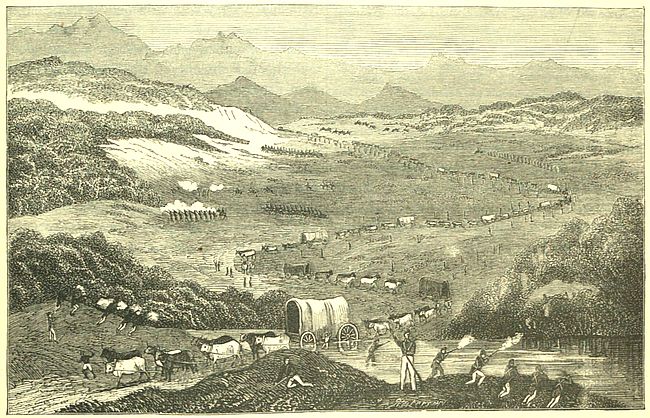
Crossing the Tyumie or Chumie River. From a drawing by Major Ward, 91st.
Lieut. Dickson of the reserve battalion of the 91st, while commanding at Trompeter’s Drift, frequently obtained the approbation of Sir Peregrine Maitland and Lt.-Col. Johnston for his great zeal and activity; and on the 21st of May, when a convoy of waggons, proceeding from Grahamstown and Fort Peddie, was attacked and captured by the enemy on Trompeter’s Hill, the gallant conduct of Lt. Dickson, who had voluntarily joined the escort, was highly commended by his Excellency the commander-in-chief, in general orders. In reference to this incident, Mrs Ward writes as follows:—
“On this occasion Lieut. Dickson, 91st Regiment, who had been ordered to assist in escorting the waggons a certain distance, till the other escort was met, nobly volunteered to proceed further, and led the advance; nor did he retire till his ammunition was expended. On reaching the rear, he found the commanding officer of the party retreating, by the advice of some civilians, who considered the defile impassable for so many waggons, under such a fire. Lieut. Dickson’s coolness, courage, and energy, in not only leading the men, but literally ‘putting his shoulder to the wheel’ of a waggon, to clear the line, were spoken of by all as worthy of the highest praise. His horse, and that of Ensign Aitchison, were shot under their riders.”
On July 27th, the battalion proceeded with Colonel Hare’s division to the Amatola mountains, and was present in the different operations undertaken against the Kaffirs between that time and the end of December, when the battalion returned to Block Drift, and thence proceeded to Fort Beaufort, where it remained stationary until the renewal of hostilities against the Kaffirs in the following year.
The head-quarters and two companies entered Kaffirland with Col. Campbell’s column, and were present in the operations undertaken in the Amatola and Tabindoda mountains during the months of Sept. and Oct.[548] As a result of these operations the Kaffir chief, Sandilli, surrendered, the 91st having had only 3 men wounded. Lt.-Col. Campbell and the above column received the warmest approbation of Lt.-Gen. Sir George Berkeley in Orders of Dec. 17th, 1847, at the close of the war.
At the end of Oct. the two companies above mentioned, under the command of Capt. Scott, marched to King-Williamstown to join the force about to proceed to the Kei river, under the commander-in-chief, Lt.-Gen. Sir George Berkeley. They were attached to Col. Somerset’s division, and served therewith until the end of December, when peace was concluded, and the detachment of the 91st returned to Fort Beaufort.
We regret that we have been unable to obtain more details of the part taken by the 91st during the Kaffir War of 1846–47, in which it was prominently employed. Among those who were honourably mentioned by Sir Peregrine Maitland, in general orders, for their conduct in defending their respective posts when attacked, were Lts. Metcalfe and Thom, and Sergeants Snodgrass and Clark of the 91st.
The reserve battalion removed from Fort Beaufort to Grahamstown in Jan. 1848, nothing of note occurring until the month of July. In that month two companies under the command of Capt. Rawstorne marched from Grahamstown to Colesberg, to co-operate with a force under the immediate command of the Governor, Lt.-Gen. Sir Harry Smith, against the rebel Boers in the N.E. district. After an arduous and protracted march, owing to the inclement season, and swollen state of the rivers, the companies reached the Governor’s camp on the Orange river, on August 24th. Detachments under Lt. Owgan, from Fort Beaufort, and under Ensign Crampton, from Fort England, here joined, so that the strength of the party of the 91st amounted to 178 officers and men.
After the troops had crossed, Captain Rawstorne remained at Bothas Drift, on the Orange river, with a party of 40 men of the 91st, to guard the Drift, and keep open the communication with the colony. The remainder of the party, furnished by the reserve battalion, under Lt. Pennington, proceeded with the Governor’s force in pursuit of the rebels, and was engaged in a most severe and spirited skirmish with the enemy at Boem Plaats on Aug. 29th, when Ensign Crampton, Lt. Owen, and 5 privates were wounded. The enemy held a very strong position, occupying a series of koppies on the right of the road, from which they kept up a heavy fire, against which the Rifle Brigade advanced, supported by the 45th Regiment and artillery. The 91st remained with the guns till the enemy appeared among the ridges on the left, when they were immediately ordered to fix bayonets and charge, which they did in the most gallant manner, causing the enemy to retreat in the greatest confusion, and driving them from every successive hill on which they took up a position, until nightfall. The pursuit was continued with untiring energy, and severe loss to the enemy. Lt. Pennington’s name was mentioned by the Commander-in-Chief in his despatch as commanding on that occasion a detachment of the reserve battalion of the 91st, which shared in the praise bestowed by His Excellency on the troops.
The companies returned to Grahamstown on the 15th of October, and from this date the headquarters of the battalion remained at Fort England and Drostdy’s Barracks, Grahamstown, for upwards of two years, sending out detachments to perform the ordinary outpost duties of the frontier.
At the outbreak of the second Kaffir war, at the end of 1850, every available man was required for active operations in the field, and the reserve battalion of the 91st marched en route to Fort Hare on Dec. 12th. On the 26th a small detachment of the regiment, under Lt. Mainwaring, marched from Fort Hare to patrol the vicinity of the “military villages,”[549] about six miles distant. As Kaffirs were observed to be assembling in force, a reinforcement from Fort Hare was sent for; on the arrival of this, the patrol proceeded across the country to the Tyumie (or Chumie) Missionary Station, where it halted for a short time. On the patrol leaving the missionary station, a fire was opened on its rear, which was kept up until the party got in sight of Fort Hare, when a company was sent out to assist.
On Dec. 29th a detachment of the 91st, led by Colonel Yarborough, marched towards Fort Cox, under Colonel Somerset, for the purpose of opening a communication with the Commander of the Forces, who was surrounded by the enemy, and of throwing in a supply of cattle for the troops. When nearing the Kamka or Yellow-Woods river, the Kaffirs opened a heavy fire upon this force, when two companies were thrown out in extended order, and advanced till they reached the base of the hill which surmounts the Umnassie (or Peel’s) Valley, where a formidable force of the enemy had taken up a position behind rocks which skirt the summit of the hill. It was then found necessary to retire, the Kaffirs endeavouring to outflank and cut off the retreat. A reinforcement was sent from Fort Hare to the assistance of the patrol, which enabled it to return to the fort after a severe struggle, in which Lts. Melvin and Gordon, and 20 men were killed, and Lt. Borthwick, 2 sergeants, and 16 men were wounded; 2 of the latter dying of their wounds.
On the 7th of January 1851, Fort Beaufort, in which was a small detachment of the 91st, under Captain Pennington, was attacked by a numerous force of Kaffirs, under the Chief Hermanes, when the latter was killed in the square of the fort.
On Feb. 24th, the Kaffirs in force, from 5000 to 7000, surrounded Fort Hare, and endeavoured to capture the Fingoes’ cattle, but were repulsed by 100 men of the 91st, under Ensign Squirl.
For the next few months the regiment furnished frequent detachments for the performance of patrol duty, which required considerable tact, and was attended with considerable danger. On one of these occasions, June 27th, when a detachment of the 91st was with Colonel Eyre’s division, Ensign Pickwick and 1 private were wounded.
On the 24th of June, a detachment of 180 men of the 91st, under Major Forbes, proceeded to the Amatola mountains, under command of Major-General Somerset, and was engaged with the enemy on the 26th, 27th, and 28th of June, and the 2nd of July. A General Order was issued on July 3rd, in which the Commander-in-Chief spoke in high terms of the conduct of the troops on this occasion, when the operations were crowned with signal success and the complete discomfiture of the enemy; 2200 head of cattle and 50 horses fell into the hands of the troops, while the enemy were driven with considerable loss from every one of the strong and almost insurmountable passes they attempted to defend.
“The accuracy and energy,” the Order says, “with which Major-General Somerset carried into effect with the 1st division [to which the 91st Regiment belonged], the part assigned to him in the complicated and combined movements, deserve the Commander-in-Chief’s highest praise. His column sustained the chief opposition of the enemy, principally composed of rebel Hottentots, who resisted our troops with great determination.”
Previous to this, on June 6th, Captain Cahill of the 91st, with a small detachment, joined a patrol under Lt.-Col. Michell, which was attacked by a body of the enemy at Fort Wiltshire. It joined Colonel M’Kinnon’s division on the Debè, captured a number of cattle and horses, and patrolled Seyolo’s country, returning to Fort Peddie on the 12th.
On the 14th of June the enemy, taking advantage of Major-General Somerset’s absence from Fort Hare, assembled their bands in the neighbourhood, with the intention of carrying off the Fingoe’s cattle. Lt.-Col. Yarborough promptly despatched all the Fingoes, supported by 160 men of the 91st, under Lt. Mainwaring, for the protection of the herds. The Fingoes gallantly attacked the Kaffirs, completely routing them, killing 14 of their number, and re-capturing the whole of the cattle.
On the 8th of August a detachment of the 91st, under Lt. Rae, proceeded from Fort Peddie to escort cattle and waggons to Gentleman’s Bush, and after handing them over returned and joined a patrol under Lt.-Col. Michell. The patrol on the following morning marched to Kamnegana Heights, and on arriving there lay concealed till 9 A.M., and afterwards descending to reconnoitre were nearly surrounded by the enemy, when Major Wilmot’s life was saved by Sergeant Ewen Ferguson of the 91st. The patrol retired, and attacked the enemy again on the following morning, returning to Fort Peddie on the 11th.
From October 13th to the 23rd a detachment of the 91st, consisting of 318 of all ranks under Lt.-Col. Yarborough, was engaged with the enemy in a series of combined movements at the Waterkloof, as also on the 6th and 7th of November. An idea of the nature of the work which the regiment had to perform may be obtained from the following extract from the “Precis,” transmitted to the Commander-in-Chief by Major-General Somerset, who commanded the expedition. On the night of the 13th the force had encamped on one of the spruits of the Kaal Hoek river, and on the 14th Major-General Somerset writes:—
“Marched at 1 A.M.; very thick fog. Gained the ascent above Bush Nek by 5 A.M. At 7 A.M. moved to the bush at the head of the Waterkloof; observed the enemy in force along the whole face of the ridge. At half-past 7 I observed Lt.-Col. Fordyce’s brigade on the opposite ridge; moved up Lt. Field’s guns, and opened on the enemy, who showed at the head of the Blinkwater. Ordered Lt.-Col. Michel’s brigade forward, and sent a squadron of Cape Mounted Rifles and two battalions forward, directing a strong body of skirmishers to be thrown into and line the forest. These were immediately received by a smart fire from the enemy at several points. This sharp attack drove the enemy from their position, which they evacuated, and retired into Blinkwater and Waterkloof. The enemy continued to show themselves. I reinforced the skirmishers with two companies of the 91st, dismounted a troop of the Cape Mounted Rifles, and ordered the whole to push through the ravine, and to communicate with Lt.-Col. Fordyce’s brigade, and to order them through. This movement was well effected. In the meantime the enemy continued their efforts to annoy us. Having brought the brigade through, and the enemy being beaten, and all the troops having been under arms from 1 A.M., I retired to form camp at Mandell’s Farm, leaving one squadron, one battalion, and two guns of the Royal Artillery to cover the movement. On commencing our move the enemy came out in force and opened a smart fire, following the rear-guard. The enemy were driven off. The troops encamped at Mandell’s at 5 o’clock, after being under arms for eighteen hours.”
So in all the operations of the succeeding days, in and around the almost inaccessible Waterkloof, the 91st, to judge from the merest hints in Major-General Somerset’s despatches, must have performed important services, especially when acting as skirmishers. The fighting continued almost without intermission up to the 7th of November, the loss to the regiment being 1 private killed, and Ensign Ricketts and 8 privates wounded; the ensign afterwards died of his wound, and was buried in the little group of graves at Post Retief.
The next operations in which the 91st seems to have been engaged was on the 30th of December, when Lt. Mackenzie and a small detachment joined a patrol under Major Wilmot, which proceeded from Fort Peddie to the Goga, where it arrived at daylight on the following morning. The patrol lay concealed in the bush until the morning of the 1st of January 1852, and then proceeded to the Kamnegana, scouring the bush and destroying a number of huts. On entering a path lined on both sides with huts the patrol commenced to destroy them, and was vigorously opposed by the Kaffirs, who commenced a heavy fire on its advance, when Major Wilmot was killed by a musket ball fired from one of the huts. Lt. Mackenzie immediately assumed command of the patrol, which was between three camps occupied by the enemy, when he found it necessary to retreat to Fort Peddie, carrying Major Wilmot’s body with him.
On the 26th of Jan. a detachment of 416 of all ranks of the 91st under Lt.-Col. Yarborough marched from Fort Hare, and was employed in destroying the enemy’s crops on the Amatola mountains and Tyumie until the end of Feb., when it proceeded to Haddon. On the 4th of March the force proceeded to the Waterkloof, and was engaged in a combined movement[550] against the Kaffirs from daylight on that morning until evening, the casualties to the regiment being 1 sergeant and 3 privates killed, and Lt.-Col. Yarborough, Ensign Hibbert, 3 sergeants, and 12 privates wounded, 1 of the sergeants and 1 private ultimately dying of their wounds.[551] Sir Harry Smith in writing to Earl Grey said, “Lt.-Col. Yarborough of the 91st is a steady officer, and greatly distinguished himself on the day he was wounded;” and in reference to this occasion a Division Order, dated March 5th, was issued by Major-General Somerset, from which the following is an extract:—
“The movement was most ably and gallantly conducted by Lt.-Col. Yarborough.... He attributes the comparatively small loss to the manner in which the enemy was charged, checked, and driven back when pressing on in great force, although with every advantage of ground.”
We may mention here that on board the “Birkenhead” when she was wrecked on the morning of Feb. 26, 1852,[552] were Captain Wright and 41 privates of the 91st.
Brass Tablet erected in Chelsea Hospital.
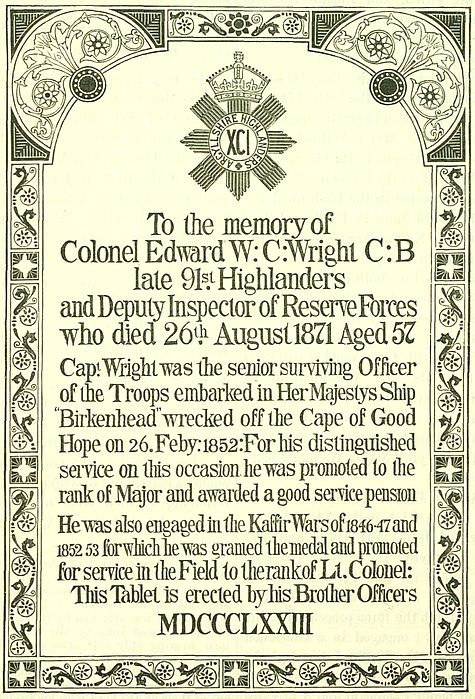
To the memory of Colonel Edward W:C:Wright C:B late 91st Highlanders
and Deputy Inspector of Reserve Forces who died 26th August 1871 Aged 57.
Capt Wright was the senior surviving Officer of the Troops embarked in Her Majestys Ship Birkenhead wrecked off the Cape of Good Hope on 26. Feby:1852: For his distinguished service on this occasion he was promoted to the rank of Major and awarded a good service pension
He was also engaged in the Kaffir wars of 1846–47 and 1852–53 for which he was granted the medal and promoted for service in the Field to the rank of Lt. Colonel:
This Tablet is erected by his Brother Officers MDCCCLLXXIII
On the 10th of March a force of 375 of all ranks of the 91st, under Major Forbes, was again engaged at the Waterkloof in a combined movement,[553] in which 11 rank and file of the regiment were wounded. The Commander-in-Chief, in writing of these operations, said:—
“Lt.-Col. Napier moved on the 10th up the Waterkloof Valley, and on entering the narrow and difficult ground towards its head, it was evident that the enemy meditated an attack upon the rear, and Colonel Napier accordingly placed the 91st regiment, under Major Forbes, in a position to resist it. This was most effectually done after a short fight, and Colonel Napier gained and maintained his position.”
On the 17th of March the battalion, under Major Forbes, proceeded from Blinkwater en route to Thorn river with Colonel Napier’s division, patrolling the country, capturing the enemy’s cattle, and destroying the crops. The following extracts from a report of Colonel Napier, dated “Camp, Quantie River, 8th April 1852,” gives some details of the work done by the force, of which the 91st formed part:—
“I marched from the camp at the Thomas river at 9 A.M. on the 5th instant, and encamped at the Quantie river at 4 P.M. Next morning I sent Captain Tylden’s force, the whole of the mounted Burghers and Fingoes, before daylight to scour the country between the Thomas river and the Kei, while I followed in support with the Cape Mounted Rifles, 60 of the 74th regiment, 200 of the 91st regiment, and the Kat River levy, leaving Captain Robinson, R.A., with the gun and 100 of the line to take charge of the camp. At noon I perceived Captain Tylden on a hill to my front, and the Burghers on another to my left, who made a signal (previously agreed upon) that they saw cattle and wanted support.”
The cattle, however, were too far off to attempt to capture them that afternoon, and the infantry remained on the heights. The attack was resumed next day, when the Kaffirs were made to retreat, and a great quantity of cattle, horses, and goats were captured.
“The infantry, under Major Forbes, 91st regiment,” the report states, “were not engaged with the enemy; but, from the judicious position the Major took up, were of great use in preventing the cattle escaping from Captain Tylden.”
The battalion returned to Blinkwater on the 16th of May. During the greater part of July operations were carried on against the enemy in the Waterkloof region, in which a detachment of the 91st formed a part of the force engaged. It was probably during these operations that an attack by a body of rebels upon Eland’s Post was gallantly repulsed by a small detachment of the 91st stationed there under Captain Wright (the survivor of the “Birkenhead.”) The enemy appeared in considerable force, and manœuvred with all the skill of disciplined troops, extending, advancing, and retiring by sound of bugle. After endeavouring, almost successfully, to draw the little garrison into an ambuscade, they sounded the “close” and the “advance,” and moved on to the fort. Captain Wright, with only 23 men of the 91st, then marched out to meet them, and, being joined by a party of the Kat River levy, drove them off with loss.
On the 30th of July the battalion marched from Blinkwater, under Major Forbes, on an expedition which lasted during a great part of August, across the Kei, to capture cattle from the chief Kreli. The expedition was very successful, having captured many thousand head of cattle.
On the 14th of September the battalion, under Major Forbes, marched from Blinkwater to unite with a force under His Excellency General Cathcart to expell the Kaffirs and rebel Hottentots from the Waterkloof. The troops having been concentrated in the neighbourhood of the Waterkloof, were so posted as to command every accessible outlet from the scene of the intended operations, which consisted of an irregular hollow of several miles in extent, nearly surrounded by precipitous mountains, the bases of which, as well as the greater part of the interior basin, were densely wooded. The arduous nature of the duty imposed upon the troops of dislodging such an enemy from such a position may thus be faintly imagined. Four companies of the 91st and Cape Mounted Rifles were posted on the northern heights of the Waterkloof, while another detachment of the regiment and some irregulars from Blinkwater were to move up the Fuller’s Hoek ridge; other troops were judiciously posted all around the central position of the enemy. The dispositions having been completed, the several columns moved upon the fastnesses they were to clear at daylight on the 15th.
“The operations of that and the following day,” to quote General Cathcart’s order, “were conducted with unabated vigour and great judgment on the part of the officers in command. The troops bivouacked each night on the ground of their operations, and pursued on the following day, with an alacrity which cannot be too highly commended, the arduous task of searching for and clearing the forest and krantzes of the enemy. These appeared to be panic-stricken, offering little resistance, but endeavouring to conceal themselves in the caverns and crevices of the wooded hills, where many of them were killed. The results of the three days’ operations have been, the evacuation of the Waterkloof and other fastnesses by the Tambookie chief Quashe and the Gaika chief Macomo and his adherents, and the expulsion and destruction of the Hottentot marauders.”
Among those specially mentioned by the Commander-in-chief was Major Forbes of the 91st.
The battalion returned to Blinkwater on the 20th of September, where it stayed till the 29th, when it proceeded to Fort Fordyce, sending out detachments to the Waterkloof, Port Retief, and various other posts. The headquarters of the battalion remained at Fort Fordyce till the 10th of November 1853, when it marched to garrison Fort Beaufort, where it remained till July 1855, sending out detachments regularly to occupy various frontier posts.
On July 6th 1855 the battalion marched, under command of Major Wright, from Fort Beaufort en route for embarkation at Port Elizabeth, having been ordered home, after a stay of thirteen years in the colony. Previous to its march, the Commander of the forces issued a General Order highly complimentary to the battalion; and the inhabitants of Fort Beaufort presented an address to the officers and men, which spoke in the highest terms of the conduct of the regiment during the Kaffir wars.
In marching through Grahamstown the battalion received a perfect ovation from the inhabitants and from the other regiments stationed there. About the middle of the pass which leads out of the town a sumptuous luncheon had been prepared for officers and men by the inhabitants; before partaking of which, however, the regiment was presented with an address, in the name of the inhabitants, expressive of their high regard and admiration for the officers and men of the 91st.
A very large number must have remained behind as settlers, as the battalion, when it embarked at Port Elizabeth on the 30th of July, numbered only 5 captains, 7 lieutenants, 4 staff, 21 sergeants, 14 corporals, 9 drummers, and 340 privates. Nothing of importance occurred during the voyage, the battalion disembarking at Chatham on the 29th of September.
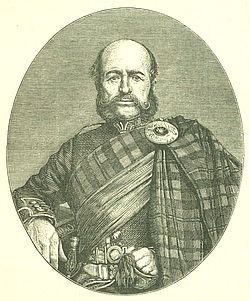
Lieutenant-Colonel Bertie Edward Murray Gordon. From a Photograph.
On the 10th of Nov., a letter was received from the Horse-Guards, directing a redistribution of the regiment into 6 service and 6 dépôt companies, each of 60 rank and file, besides officers and non-commissioned officers, the term “reserve battalion” being thenceforth discontinued, though, practically, the battalion seems to have lasted till 1857, when the dépôt companies of the two battalions were incorporated. We shall briefly carry the history of this battalion up to that time.
On the 4th of April 1856, the dépôt companies, as the reserve battalion was now called, left Chatham for Aldershot, under command of Lt.-Col. Gordon, and took up their quarters in the North Camp (Letter M).
On the 19th and 20th of April the troops in camp, including the 91st, were reviewed by Her Majesty, and on July the 16th the Queen visited the lines of the 91st. The royal carriage stopped in the centre of the 91st lines, where Her Majesty alighted, and entered one of the soldiers’ huts. The Queen walked quite through the hut, and asked questions of Lt.-Col. Gordon, and made observations indicating Her Majesty’s Gracious satisfaction. After leaving this hut, which belonged to No. 2 company (Capt. Lane’s), the Queen signified her desire to see the soldiers’ cook-house, which she entered, expressing her praise of its cleanliness and order, and of the excellence of the soup. The Queen then re-entered her carriage and proceeded at a foot pace through the other portions of the lines, Lt.-Col. Gordon walking by the side of Her Majesty, and pointing out various other excellent arrangements. After the Queen had departed the soldiers visited the hut which had received the royal visit, and surveyed it with a sort of wondering and reverential interest.
The following inscriptions were afterwards placed on the doors at each end of the hut (No. 6 hut, M lines, North Camp), which had been honoured by Her Majesty’s visit. On the front door:—
“Her Most Gracious Majesty, the Princess Royal, and the Princess Alice, visited the lines of Her Majesty’s faithful soldiers of the 91st Argyll Regiment, and deigned to enter this hut. 16th June 1856.”
On the door in the private street:—
“Henceforth this hut shall be a sacred place, And its rude floor an altar, for ’twas trod By footsteps which her soldiers fain would trace,— Pressed as if the rude planking were a sod, By England’s monarch; none these marks efface, They tell of Queenly trust, and loyalty approved of God.”
Orders were afterwards issued to the troops in camp at Aldershot, by direction of H.R.H. the Duke of Cambridge, calling attention to the manner in which the lines of the 91st camp were kept, and desiring that the same order and the same efforts to procure occupation and amusement for the soldiers might be made by the other regiments. The strictest orders were also issued to the barrack department to maintain the inscription on the “Queen’s Hut,” as it is called.
On the 7th of July, the lieutenant-general commanding made an unexpected visit of inspection of the lines of the regiment. Lt.-General Knollys expressed himself satisfied in the highest degree with the order of the lines, and with the companies’ huts, as also with the works completed by the dépôt to give amusement to the men.
On the same day Lt.-Col. Gordon received orders to be ready to proceed to Berwick-on-Tweed early on the following morning, and on the same evening the Queen, without warning, again passed down through the lines of the 91st, the royal carriage stopping opposite the door of the hut previously visited by Her Majesty, who read the inscription which had been placed over the door.
On the morning of July 8th the companies of the 91st left Aldershot by train for Berwick, stopping at Peterborough and York, and reaching Berwick on the 10th.
On Jan. 20th, 1857, Lt.-General Sir Harry Smith inspected the dépôt companies, and addressed Lt.-Col. Gordon and the battalion in a speech which was highly complimentary, afterwards assuring Lt.-Col. Gordon in a private note, that his words of praise “were as fully merited as they were freely bestowed.”
The dépôt companies remained in Berwick till the 3rd of March, when they proceeded by train to Preston, almost the entire population of Berwick accompanying the dépôt to the railway station. The Mayor and Sheriff had previously expressed to Lt.-Col. Rawstorne the general respect with which the conduct of all ranks had inspired the citizens, and the general regret which was felt at the removal of the 91st. At Preston, on the 30th of March 1857, the remains of the dépôt companies were incorporated with the dépôt battalion at Preston, commanded by Lt.-Col. Smith, C.B., while under the command of Brevet Lt.-Col. Rawstorne.
Thus ends the somewhat chequered history of the reserve battalion of the 91st; and now we shall return to the point at which we left off the history of the 1st battalion of the regiment.
III. 1857–1874.
The first battalion—Gosport—Dover—The regiment deprived of its bagpipes—The northern district—Belfast—Excellent conduct of the regiment—Enniskillen—Dublin—Cork—Furnishes volunteers to Crimean regiments—Malta—Greece—The Piræus—Useful works of the 91st while in Greece—Major Gordon the moving spirit—Encampment at Salamis Bay and Pentelicus—Reading-room started—Works executed at the Piræus by the regiment—New system of promotion—Discovery of the old Waterloo Roll—Old Colours—Highland dress and designation restored—Home—The Queen’s attentions—Col. Gordon’s retirement—He is succeeded by Lt.-Col. Sprot—His energy and efficiency—Marriage of the Princess Louise—The 91st as her guard of honour—The presents from the officers and men—Aldershot—Inverary Castle—The Queen’s mark of approbation—The change of designation—Regimental Museum—The Tontine Snuff-Box, &c.
We left the 1st battalion at Gosport in May 1848, and on Oct. the 13th of the same year Lt.-Col. Lindsay retired from the service, when the command of the battalion devolved upon Lt.-Col. Yarborough. The regiment remained at Gosport till April 1850, during which time there is nothing remarkable to record.
The 91st proceeded to Dover in three divisions, on the 4th, 6th, and 9th of April; headquarters, under the command of Lt.-Col. Campbell, occupying the Heights’ Barracks, other companies being located in the Castle.
After the arrival of the regiment at Dover it was inspected by Major-General G. Brown, C.B., K.H., Adjutant-General to the Forces, who, for some inscrutable reason, ordered the immediate abolition of the bagpipes, which had been fondly clung to as the last relic that remained of the origin, the history, and the nationality of the corps. To the unofficial mind this must appear an exceedingly harsh, and quite uncalled for measure, though, as will be seen, ample amends was in the end made to the regiment for this “unkindest cut of all.” In the meantime the 91st lost its bagpipers.
The 91st did not stay long at Dover; having received orders to move to the northern district, it proceeded by detachments, in the end of Dec. 1850 and beginning of Jan. 1851, to Preston, Liverpool, and Manchester, moving about among these three towns for the next few months, the grenadier company, under Captain Bayly, being sent to the Isle of Man. After about six months’ duty in the northern district, the regiment proceeded to Fleetwood, and embarked in detachments on the 22nd and 24th of July for Belfast, whence a draft of 1 sergeant and 60 rank and file, under Captain Wright, proceeded to Cork on the 26th Dec., and embarked on board the ill-fated “Birkenhead,” on Jan. 7th, 1852, to join the the reserve battalion at the Cape of Good Hope.
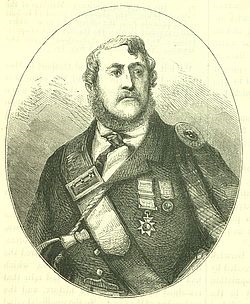
Major-General John Francis Glencairn Campbell. From a Photograph.
The stay of the regiment in Belfast was comparatively short; but during that time officers and men won the respect and attachment of the inhabitants for their excellent behaviour, their kindliness, and their liberality to charitable institutions. On the occasion of the regiment’s leaving Belfast, an address, signed by the Mayor, the Earl of Belfast, and about 200 of the leading citizens, was presented to Lt.-Col. Campbell and the other officers, expressive of their gratitude and esteem for the “high-toned gentlemanly conduct” of the officers, and the soldierlike and exemplary conduct of the men.
Between the 26th of April and the 3rd of May the regiment marched in detachments to Enniskillen, where it was next to be stationed. On several occasions, during its stay at Enniskillen, the 91st had to perform the delicate, and not very agreeable duty of aiding the civil power to maintain order at elections as well as on other occasions. This duty the regiment always performed with admirable promptness, great tact, and excellent effect.
The 91st remained at Enniskillen until the month of March 1853, when, between the 19th and 30th of that month, it marched in detachments to Dublin, and was there quartered in Richmond Barracks. The 91st was, of course, regularly inspected while in Ireland, the reports of the inspecting officers being invariably of the most favourable kind.
After a year’s stay in Dublin the 91st left that city by railway, in detachments, for Cork, and out-stations, between the 25th of April and the 1st of May 1854, detachments being sent from headquarters to Spike Island, Haulbowline Island, and Carlisle Fort. The regiment, although as a body it did not take part in the Crimean war, liberally furnished volunteers to the three Highland regiments that bore so distinguished a part in that contest, and also to the 50th Regiment. In this way it parted with about 250 of its best men.
On the 23rd of June Lt.-Col. J. F. G. Campbell was promoted to the rank of Colonel.[554]
The 91st made but a short stay at Cork, as on the 15th of December it embarked, under command of Col. Campbell, on board H.M.S. “Saint George,” en route for Malta, and this heavy old-fashioned three-decker did not cast anchor in the harbour of Valetta till Jan. 11th 1855. Besides 26 officers and staff, the strength of the regiment, as it landed at Malta, was 649 non-commissioned officers and privates, 39 women, and 51 children.
After a stay of about two months at Malta the 91st embarked on the 20th of March for the Piræus, in Greece, which it reached on the 23rd. The regiment took up its quarters in the miserable warehouses that formed the barracks of the British soldiery. Colonel Straubenzee of the 3rd Regiment handed over the command of the British Force in Greece to Colonel Campbell, who also retained the command of the regiment; but he was ordered by the general commanding-in-chief to hand it over, on the 3rd of June, to Major Bertie Gordon.
The 91st was located in Greece for about two years, during which time it was engaged in operations which were of the highest benefit, not only to the men, but also to the district in which they were stationed. We regret that space prevents us from giving a detailed account of the various ways in which the regiment rendered itself useful, and staved off the ennui and consequent demoralisation which always attend the idle soldier. The presiding genius of the regiment during its stay in Greece, and, indeed, during the whole time that he had any important connection with it, was Major Bertie Gordon.
The relations of the 91st with the French force stationed in Greece, officers and men, were particularly cordial, both as regards work and enjoyment.
The accommodations allotted to the regiment were very defective in every detail that is deemed necessary for the permanent barrack occupation of British soldiers, while, owing to a peculiar arrangement with the commissariat department, the evil could not be remedied. It was, no doubt, the thoughtful ingenuity of Major Gordon that discerned a happy remedy for the evil, by selecting a spot at Salamis Bay, about three miles from the Piræus, on a slope close to the sea, for the construction of a camp in which a detachment of the regiment might take up its quarters, and thus remedy to some extent the stinted accommodation provided in the town. To this place the grenadiers and No. 1 company marched on the 4th of April, under the command of Major Gordon, who commenced at once a system of road-making, throwing up field-works, the construction of a small landing place, and other works, which employed and interested both officers and men; thus the little camp soon became a cheerful and accessible spot. The only difficulty that they had to encounter was the want of tools, of which the supply from headquarters was very stinted indeed; it consisted of three spades and three pickaxes. But by dint of persistent applications. Major Gordon obtained an additional supply from the Greek authorities. An ancient well, which may have watered part of the fleet of Xerxes, was at the bottom of the hill, and furnished excellent water.
To this delightful little encampment detachments were sent in rotation at intervals during the stay of the regiment in the Piræus; and it was no doubt greatly owing to this and to the other exertions of Major Gordon for the good of his men, that the regiment was in such excellent condition, notwithstanding its miserable quarters in the town.
Another excellent service of Major Gordon, one which both benefited the health of the men and trained them to the practical duties of the soldier, was to take a detachment occasionally to a considerable distance from camp where it bivouacked as best it could, and sometimes slept out all night on extemporised couches of heath and branches, arranged round the bivouac fires.
On the 15th of June, another encampment was formed at a spot selected near the monastery of Pentelicus, on Mount Pentelicus, nine miles from Athens, and fifteen miles from the Piræus, the ground having been previously selected by Major Gordon. To this camp also detachments were sent in regular rotation.
In September 1855 Major Gordon was very deservedly promoted to the rank of Brevet Lieutenant-Colonel.
We should have stated before, that, on the 29th of June, a reading-room for the soldiers was established for the first time in the regiment. A sergeant and his wife were placed in charge, a roll of members was prepared, and a subscription of 6d. a month was charged from each member. Periodicals and newspapers were procured, and coffee and light drinks were prepared by the sergeant’s wife for those who cared to pay for them.
Lt.-Col. Gordon, after repeatedly urging it upon those in authority, at length gained permission to commence the reconstruction and elevation of the whole surface-level of the wide projecting quay which formed the parade of the battalion; also to raise, drain, and level the roadways of the streets, in which the barracks of the battalion were situated. These useful works were commenced on the 18th of December, and ten days later, Lt.-Col. Gordon went home to take command of the six dépôt companies, when the command of the service companies devolved on Major W. T. L. Patterson, who had recently been promoted from captain.
The 91st embarked in two divisions on the 28th of Feb. 1857 for the Ionian Islands, where it was stationed for the next eighteen months, detachments being located in Corfu, Vido, Zante, and latterly, Cephalonia. Here, also, the regiment was employed in the construction of useful works. Among these was an approach from the esplanade at Argostoli, in Cephalonia, in the shape of steps upon a large scale, formed from the materials of a useless five-gun battery, which work was described by the Resident of Cephalonia as a “great public improvement,” and, with his authority, obtained the appellation of “The Argyll Steps.”
Lt.-Col. Bertie Gordon arrived at Corfu in April 1857, and assumed command of the regiment, Colonel Campbell having obtained leave of absence in the previous March.
In taking leave of the headquarters companies on the 17th of August, they having been ordered from Corfu to the Southern Islands, Major-General Sir George Buller, C.B., told them “he had selected the 91st for the service of the Southern Islands, partly because it was a more formed regiment, a finer body of men, and better drilled than the others.”
The 91st, having received orders to proceed to India by the overland route, embarked at Corfu, and sailed on the 5th of Sept. 1858, arriving at Alexandria on the 8th; but it seems to have remained on board H.M.S. “Perseverance” until the 18th. On that day headquarters, with 5½ companies, disembarked at 1.30 P.M., and at once entered railway carriages prepared for their conveyance, and proceeded towards Suez. The left wing disembarked on the following day. Partly by railway, and partly on donkeys, the two wings were conveyed to Suez, where they embarked on board two vessels, which arrived at Bombay on the 7th and 9th of October respectively. Both detachments were reunited at Poonah on the 11th.
On Oct. 28th Colonel Campbell, C.B., having been appointed to the command of a brigade at Toogoo, in Burmah, Major Patterson assumed command of the regiment.
On Nov. 3rd the 91st commenced its march to Kamptee, where it did not arrive till the 11th of the following month. On its march, while at Jafferabad, on Nov. 20th, an order was received by telegraph from the Commander-in-Chief of the Madras army to leave a wing at Jaulnah. The left wing, under command of Major Savage, accordingly returned to that place, and did not arrive at headquarters until the 25th of Feb. 1859. It had been employed during the latter part of January and the beginning of February in operations against insurgent Rohillas, to the south of Jaulnah, and had made long marches, without, however, being engaged with the enemy.
On the 7th of March Lt.-Colonel Bertie Gordon arrived from England and assumed the command, and on the 9th a small detachment, under Lieut. Gurney, proceeded to Chindwarrah, a village about 84 miles north of Kamptee. On the same day No. 5 company, under Captain Battiscombe, marched as part of a field-force directed on Mooltye and Baitool. On the 27th Major Patterson joined and took command of the field-force, which remained out till the 18th of April. A similar field-force was sent out on April 22nd for a short time to the same districts.[555]
It was about this time that Colonel Bertie Gordon inaugurated his new system of promotion in the non-commissioned ranks of the regiment. Competitive examinations of lance and full corporals, under a strictly organised system, were the basis of this plan. During the period extending from Sept. 1860 to Jan. 1861, seventy corporals and lance-corporals were examined, twenty-five of whom obtained promotion out of their regular turn, owing to their position on the merit roll.
The 91st remained in India till the year 1868, and we can note only in the briefest possible manner the principal occurrences in connection with the regiment during that period.
An event of very great interest to the regiment occurred on the 27th of Aug. 1871; this was the discovery of the old Waterloo roll of the regiment among the orderly-room papers. It had been saved from destruction by Sergeant Hirst in 1848, when a quantity of old books and papers had been ordered to be burned. The interesting document was now sent to London, where it was so handsomely bound as to ensure, we hope, its preservation in all time coming.
On the 16th of Oct. of the same year, Col. Gordon received from the daughters of the late Lt.-Col. Lindsay an offer of the old colours of the 91st. Col. Gordon gladly accepted this graceful offer, and sent the colours, which had seen many a hard-fought field, to Ellon Castle, Aberdeenshire, there to find a permanent home, and to be preserved as an heirloom in his family.
In Aug. 1861, Lt.-Col. Gordon was promoted to be colonel by brevet. He had succeeded to the command of the regiment in Nov. 1860, on the promotion of Lt.-Colonel Campbell to the rank of Major-General. There had been for some time, in accordance with the regulations for the augmentation of the Indian establishment, two Lt.-Cols. to the 91st, Major W. T. L. Patterson having been raised to that rank on the retirement of Col. Campbell.[556]
On the 24th of April 1862, Col. Gordon proceeded on leave to England. During his absence, in Feb. 1863, the 91st left Kamptee for Jubbulpoor, which it reached on the 19th, after a march of fifteen days. The regiment was now in the Bengal Presidency, and under the command of Gen. Sir Hugh Rose, G.C.B. then Commander-in-Chief in India.
One of the most notable and gratifying events in the history of the 91st during the régime of Col. Bertie Gordon was the restoration to it of its original Highland designation, along with the Highland dress, the tartan trews, however, taking the place of the more airy kilt. So far back as 1833, an ineffectual effort had been made to have its nationality restored to the regiment. Col. Gordon resumed the attempt shortly after he obtained command of the regiment at Kamptee in 1859, and with the most determined perseverance, amid discouragements that would have daunted any ordinary man, he did not cease his solicitations until they resulted in complete success in the year 1864. Col. Gordon found a powerful and willing supporter in his Grace the Duke of Argyll, who was naturally anxious to have the regiment raised by his ancestors once more recognised by its original name, “the Argyllshire Highlanders.” The voluminous correspondence carried on between Col. Gordon, the War Office authorities, and the Duke of Argyll, we cannot reproduce here. The letters of Col. Gordon show clearly his ability, his enthusiasm, his perseverance, and his intense nationality and love for his regiment. We can only say that, after a long correspondence, Col. Gordon’s efforts resulted in triumph, as will be seen in the following War Office memorandum, notifying the restoration to the 91st of its Highland designation and dress, of which it had been deprived fifty years before:—
“War Office, Pall Mall, May 3, 1864.
“Her Majesty has been graciously pleased to approve of the 91st Foot resuming the appellation of the 91st Argyllshire Highlanders, and being clothed and equipped as a non-kilted Highland corps, as follows:—Tunic, as worn in all Highland regiments; Trews, of the Campbell tartan; Chaco, blue cloth, with diced band and black braid; Forage Cap, Kilmarnock, with diced band. The officers to wear plaids and claymores. The alteration of the dress is to take place from 1st April 1865. The white waistcoat with sleeves, issued to other Highland regiments, will not be worn by the 91st Foot.”
In Jan. 1866 Col. Gordon arrived at Jubbulpoor, and assumed command of the regiment. In Dec. of the same year the 91st left its quarters at Jubbulpoor and proceeded partly on foot and partly by train to Dumdum, which it reached on the 11th. While at Dumdum Col. Gordon’s health broke down, and on the recommendation of a medical board, he left India for Europe in Oct. 1866, handing over the command of the regiment to Major Battiscombe.
After staying a year at Dumdum, the 91st was removed in Jan. 1867 to Hazareebagh. Here the 91st remained until the end of the year, setting out on Dec. 1st for Kamptee again, which it reached after a long and tedious journey, partly on foot and partly by train, on the 26th of January 1868.
After a stay of a few months at Kamptee, the 91st got the welcome route for home, setting out in two detachments on the 7th and 8th of Oct. for Bombay, where it embarked on the 12th. The regiment proceeded by Suez, and arrived at Portsmouth on Nov. 13th, disembarking on the 15th, and proceeding by rail to Dover, where Col. Bertie Gordon resumed command. The 91st had been on foreign service for the long period of fourteen years, and it is very remarkable that during all that time there were only ten desertions. The dépôt companies removed from Fort George and were amalgamated at Dover with the service companies on Nov. 25th.
In August of this year Her Majesty was pleased to place the name of Col. Bertie Gordon on the list of officers receiving the reward of £100 a year for distinguished service.
The 91st remained at Dover until June 1870, during which time two events occurred of some importance in its domestic history. The first of these was the presentation of new colours on the 24th of Aug. 1869, on the glacis of the Western Heights, Dover. As the Duke and Duchess of Argyll were unable to be present, the colours were presented to the regiment by Mrs Bertie Gordon, as her Grace’s representative. The Archbishop of Canterbury consecrated the colours, being assisted by five other clergymen in full canonicals. After an impressive prayer by his Grace the Archbishop, the colours were received by Mrs Gordon at the hands of Major Penton and Major Sprot, and by her given to Ensigns Lloyd and Gurney, with these words:—
“Colonel Gordon, officers, non-commissioned officers, and soldiers of the 91st Argyllshire Highlanders,—Proud as I am this day to present to you your new colours, I would fain have had my place better filled by her Grace the Duchess of Argyll. Soldiers, your colours have been well earned, not alone in the protracted struggle of three Kaffir campaigns, but also by long service in tropical climes under a burning sun. I know you will receive them as a sacred trust. Guard them carefully. Fight manfully around them when called upon. Be foremost, as you have always been, in serving your Queen and country; and be the pride, as you are at this moment, of your commanding officer.”
After a fervent address by Col. Gordon, thanking Mrs Gordon for the service she had performed, which was only one of “many acts of unobtrusive kindness” by which she showed her interest in the welfare of the regiment.
The old colours having been gladly accepted by the Duke of Argyll, were, in the month of October, taken by an escort to Inverary Castle, in the great hall of which they now occupy a conspicuous position.
The other important event in the history of the regiment while it was stationed at Dover, was the retirement of Colonel Bertie Gordon. This was indeed an event of very great moment in the career of the 91st, and we therefore must find space for the pathetic order in which Colonel Gordon bade farewell to the regiment he loved so dearly. He had left on leave on the 11th of Nov. 1869, handing over the command of the regiment to Major Sprot, and his farewell order is dated “Ellon Castle, Ellon, 29th January 1870:”—
“His Royal Highness the Field Marshal Commanding-in-Chief having been pleased to grant compliance with the request preferred by Colonel Bertie Gordon, to be permitted to retire on the half-pay of the army, Colonel Gordon bids farewell to the noble regiment in which he has served for more than seven and thirty years, and in which he has held command ever since April 1855. Colonel Gordon’s service in the 91st Highlanders comprises exactly one-half the period of its existence as a corps, and he has held command in his regiment during a fifth part of its history. Years have gone by since every officer, non-commissioned officer, and private soldier with whom he stood in these noble ranks, when he commenced his career in the army, have passed away. For twelve years Colonel Gordon has been the very last of the 800 who formed the Argyllshire regiment in 1832, and in its ranks of the present day he leaves behind him but one soldier (Lt. Grant) who shared with him those hours of impending death, when he commanded the Reserve Battalion of the regiment in 1842, cast away on the shores of Africa in that dark night of tempest, when its discipline and devotion came forth from the shattered wreck unbroken and undiminished by that sorest trial. Colonel Gordon calls to mind that he has served under three stands of colours presented to the regiment, and that at the recommendation of His Royal Highness the Field Marshal Commanding-in-Chief, he was permitted, by the favour of Her Most Gracious Majesty, to announce to his old regiment, seven years ago, the restoration of that nationality in its designation and uniform, under which it was embodied by its ducal chieftain in the last century.
“Colonel Gordon believes that the time has come to retire from the regiment he has loved, and to leave its fortunes in younger and stronger hands. But, although severed from its noble ranks, Colonel Gordon will still feel that the words of his regimental order of 1863 must ever prove true—‘The Argyllshire regiment has ever served their sovereign and their country steadily;’ while he calls upon all ranks to remember those that the late Lieut.-General Sir George Napier addressed to the Reserve Battalion in 1842—‘Ninety-first, I have known you in camp and quarters, and I have seen you in action, and I have never known or seen a better.’”
In such words did this brave, noble-minded, and accomplished soldier bid farewell to his dear old regiment. He survived the “farewell” only a few months, having died at Ellon Castle on the 27th of July of the same year, at the comparatively early age of 57 years. So long as the name of the 91st Argyllshire Highlanders remains on the roll of the British Army, the memory of Colonel Bertie Gordon ought to be cherished in its ranks.
As we have already said, Colonel Gordon found a successor in every way worthy of him in Major Sprot, who succeeded to the lieutenant-colonelcy of the regiment on the 29th of January 1870. Captain Wood succeeded to the vacant majority, Lieutenant Alison to the company, and Ensign Chater to the lieutenancy and adjutancy, in which latter capacity he had acted for one year.[557]
On succeeding to the command of the regiment Colonel Sprot issued an order, dated “Dover, 29th January 1870,” in which he said—
“With two exceptions I have seen the troops of all the states of Europe. Full half my service was spent with our armies in India. I have become intimate with the greater portion of our regiments, and I have seen no body of soldiers of whom I have formed a higher opinion than of the Argyllshire Highlanders.... I have now under my care a regiment in the highest state of discipline and efficiency.... Let us then join together in one continued effort to attain this end, that the 91st Argyllshire Highlanders may ever be second to none.”
The remainder of the distinctive history of the 91st may be very briefly told. The regiment left Dover on the 18th of June 1870 and proceeded to Aldershot, marching the greater part of the way, and reaching the camp on the morning of the 25th. Notwithstanding the excessive heat of the weather, and that the men marched fully accoutred, the column came in each day to its halting-place with the greatest regularity, a compact body of men without a single straggler.
As soon as it was announced that a marriage was to take place between the Princess Louise and the Marquis of Lorne, Lt.-Col. Sprot wrote to the Duke of Argyll, offering to send a detachment of the regiment to form a guard of honour at the wedding. The Duke replied very graciously, and only a few days before the wedding was to take place, Colonel Sprot learned that Her Majesty had been graciously pleased to order that a detachment of the 91st should attend at Windsor on the day of the marriage, March 21st, 1871.
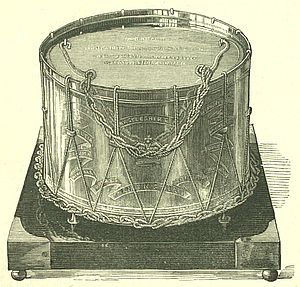
Inscription.—From the Soldiers of the 91st Argyllshire Highlanders, presented by the kind permission of Her Majesty to Her Royal Highness The Princess Louise, on her Marriage, 21st March 1871.
On Saturday morning, the 17th of March, a body of 100 picked men, with band, pipers, and full complement of officers, after having been inspected by Colonel Sprot, marched off to the tune of “Haste to the Wedding,” amidst the encouraging cheers of their less fortunate comrades. The guard was commanded by Captain Gregg, and marched by Bagshot and Ascot Heath, reaching Windsor at 4 P.M. When the detachment arrived at Windsor it found that everything had been prepared for it by the Grenadier Guards; the officers of the latter corps invited the officers of the 91st to be their guests, and the soldiers had not only drawn rations and fitted beds, but had even cooked dinner for the Highlanders.
On Monday the 20th, Lt.-Col. Sprot rode over from Aldershot to Windsor, and on arriving at the Castle received Her Majesty’s command to meet her at 3 o’clock P.M., in the private apartments, where she would be prepared to receive the wedding present for her daughter, which the officers and men of the 91st intended to give. The gift of the officers consisted of a Brooch, the fac-simile of that worn by them to fasten their plaids, but in pure gold, and with a very handsome cairngorm pebble, set transparently, together with a copy in miniature of the regimental dirk, in Scotch pebble, suited for a shawl pin. On the back of the brooch were engraved the names of all the officers then serving. The gift from the soldiers, to which they unanimously subscribed, was a Silver Biscuit-Box, in the shape of one of their own drums, with the honours of the regiment engraved on the side, and an appropriate inscription on the head. It was mounted on a stand of Scotch bog oak, with silver corners and feet.
Colonel Sprot, in his audience with the Queen, was accompanied by Captain Gregg, Lt. Grant, Sergeant-Major Fasinidge, and Pipe-Major M’Dougal. Her Majesty was accompanied by the Princess Louise, Prince Arthur, Prince Christian, and others. Lt.-Col. Sprot, in a few appropriate and well-chosen words, presented the officers’ present, which the Princess graciously accepted, and desired Colonel Sprot to convey to the officers “her sincere thanks for their very pretty present.” Colonel Sprot then intimated to Her Majesty the wish of the non-commissioned officers and men to offer the present above mentioned, at which Her Majesty expressed much gratification.
On the day of the ceremony the guard of Highlanders was drawn up at the entrance to St George’s Chapel, Windsor, Colonel Sprot having command of the troops at the chapel. After the ceremony, the officers of the guard had the honour of being present at the déjeuner, the bagpipes and drums of the 91st playing alternately with the band of the Grenadier Guards.
The guard of the 91st returned to Aldershot on the 22nd by the way it came. During its stay at Aldershot it went through the usual routine of field-days, inspections, and other duties, invariably winning the genuine approbation of every officer that had the opportunity of witnessing its training. On the 10th of July, when the Queen reviewed the troops at Aldershot, the 91st marched past by double companies of 70 file, and marched so well, that Her Majesty sent a complimentary message to the regiment by the General commanding the brigade.
In August, while the festivities consequent on the wedding of the Marquis of Lorne were going on at Inverary,[558] the soldiers’ present was sent to the Princess Louise, who, as well as the Marquis, cordially accepted and acknowledged it. On the application of the Duke of Argyll, three pipers of the regiment, with the Pipe-Major, attended these rejoicings, and were much admired both for their soldier-like appearance and good playing.
In September 1871 the 91st formed part of the force which was called out for field manœuvres, immediately after the conclusion of which, the regiment received orders to proceed to Aberdeen and Fort George.
On the 27th and 30th the regiment left Aldershot in two detachments for London, and embarked the same day at Wapping, and reached Aberdeen on the 29th of September and the 4th of October respectively; the second detachment was delayed by stormy weather. The former detachment, headquarters, reached Fort George on the day of its arrival at Aberdeen, but the second detachment, of four companies, remained at Aberdeen.
Shortly after the marriage of the Princess Louise, Her Majesty expressed a desire to confer some distinguishing mark on the 91st Argyllshire Highlanders to commemorate the event, and desired Lt.-Col. Sprot to be communicated with as to what the regiment would like. Colonel Sprot, after consulting with his oldest officer, suggested the kilt, to which Her Majesty readily agreed, but to which the military authorities objected. Colonel Sprot then intimated that the regiment would like to be designated “the Princess Louise Argyllshire Highlanders,” and bear on its colour the boar’s head, with the motto “Ne Obliviscaris” (crest and motto of the Argyll family). To this there could be no objection, and a War-Office memorandum, of April 2nd, 1872, authorised the regiment to indulge its wish, the Princess Louise’s coronet and cypher to be also placed on the three corners of the regimental colour.
After staying about eighteen months at Fort George, the 91st proceeded to Edinburgh in May 1873. The regiment arrived at Granton on the morning of May the 12th, and after landing in the most orderly manner, commenced its march under Colonel Sprot up the hill to the old castle on the rock. On the route the 91st passed the 93rd Sutherland Highlanders, who were marching out of the castle, and were on their way to embark at Granton; each corps shouldered arms to the other, and the pipers struck up a merry greeting. The large crowds of people who had collected along the route to witness the departure of the 93rd, waited to give a hearty welcome to the Princess Louise Highlanders.
During its stay in Edinburgh the regiment gained the respect and admiration of the inhabitants for their steady conduct and soldierly bearing. The efforts made by Colonel Sprot to keep his troops up to the highest state of efficiency won the praise both of the press and the citizens.[559]
For the first time in Edinburgh the military stationed in the Castle had a field-day in the prosecution of drill in outpost duty, which excited a deal of interest and curiosity on the part of the citizens, who had not been made aware of the arrangements. Col. Sprot of the 91st so highly appreciates this method of training, which is frequently practised at Aldershot and other large military stations, that at Fort George he had frequent recourse to it. A variety of exciting movements took place, ranging from Duddingston and Arthur Seat all along the route to the Castle Esplanade. The crowd attracted by the firing in the streets gradually augmented both in numbers and excitement. The whole proceedings lasted over seven hours, and the troops being drawn up in square, were complimented on their conduct throughout the engagement.
During the time that the 91st were in Edinburgh they had repeatedly been out on field-days, and besides such strategic movements as above, have also been systematically exercised in throwing up trenches, tent-pitching, flag-signalling, &c.
After remaining in Edinburgh for about a year only, to the great regret of the inhabitants, the 91st left for Newry in Ireland on the 29th of June 1874.
In conclusion, we should mention, that belonging to the officer’s mess of the Argyllshire Highlanders is quite a little museum of precious and artistic curiosities. One of the most valuable and interesting of these is a tontine snuff-box of silver gilt, casket-shape, 8¼ inches long, 6 inches wide, and 3 inches deep. This very handsome box was originated by the officers who were in the regiment in the year 1810, on the condition that it could be claimed by the last survivor, if replaced by a similar box. It was claimed in 1841 by Colonel Anderson, who replaced it by a similar box, the original box being now in Edinburgh, in possession of General Anderson, late R.A., the nephew of the late Colonel Anderson. In 1870 Colonel Bertie Gordon was the last survivor of those whose names were inscribed on the box of 1841, and as it was not claimed by him, it became the property of the officers then serving in the regiment, whose names are inscribed on the inner lids of the box. On the outside of the lid is the arms of the regiment, surmounted by the crown, and on the oval the names of the victories up to the Peninsula. On the bottom of the box, underneath the Rose, Shamrock, and Thistle, and the date 1810, are the names of those who started the original box, headed by Lt.-Col. William Douglas. There are 50 names in all, and of these 11 are Campbells, and 17 others belong to various Highland clans; of the remainder, 11 seem distinctly Scotch. On the inside of the lid are the names of the officers of the regiment in 1841, when the new box was presented, headed by Colonel Gabriel Gordon and Lt.-Col. R. Anderson. Here there are in all 41 names, only 2 of them being Campbells, although 15 seem certainly Scotch, 3 being Gordons. On the inner lids of the box, as we have said, are the names of the officers who were in the regiment in 1870, when Colonel Bertie Gordon, failing to claim it, it became the property of the officers. The list is headed by Lt.-Col. Sprot, and there are 37 in all. Let us hope that it will be long before there will be a last survivor to claim it.
Among the mess plate there are several other articles of beautiful characteristic and artistic design. Of these we may mention the following:—
A large punch-bowl, of repoussé work, silver; height, 9 inches, diameter, 13½ inches, presented by General Duncan Campbell of Lochnell. It is handsomely embossed with a design of flowers, grapes, and other fruits, and is supposed to have been originally taken by the French from a Spanish convent during the Peninsular war, and to have afterwards fallen into the hands of General Campbell. The ladle belonging to the bowl is of very ancient and peculiar design, having a Spanish coin, date 1758, at the bottom.
A silver snuff-box in two divisions, the gift of Lt.-Col. Catlin Crawfurd, who commanded the 91st in the Peninsula. Several silver mounted horn snuff-mulls, presented at different periods, including a very large and handsome ram’s head, mounted with silver, studded with cairngorms, as a snuff and cigar box, the joint gift of Lieutenants W. Grant and C. L. Harvey in the year 1864, bearing the names of the officers then serving in the regiment. The width across the horns is 17 inches.
A cigar-lighter in the form of a boar’s head, the regimental crest in silver, mounted on an oval ebony stand with wheels. The upper part of the head forms a receptacle for spirits of wine. The tushes are removable and tipped with asbestos. This is the joint gift of Captain C. G. Alison and Lieutenant and Adjutant Vernor Chater, date 1870.
Lastly, we shall mention a large silver quaich, 4½ inches in diameter, with straight projecting handles, with the boar’s head engraved on them. It is of ancient Highland pattern, and has engraved round the upper portion a tracing taken from one of the remarkable stones of Argyll. It bears this inscription in Gaelic,—“From the Officers of the Highland Rifle Regiment (Militia) to the Officers of the 91st Princess Louise’s Highlanders, Fort George, May 1872.”
A fine example of the spirit of friendly rivalry and mutual good feeling subsisting between the line and the volunteers was shown on the 23rd of May and the 6th of June 1874, in a competition between ten sergeants of the 91st (Princess Louise Argyllshire Highlanders) and an equal number of the 1st Mid-Lothian Rifle Volunteers, which took place at the Seafield Ranges. At the conclusion of the first match the volunteers entertained their military friends and competitors at dinner; and at the conclusion of the second match, which came off at the ranges in Hunter’s Bog, when there was only one point of difference in the scores, the Mid-Lothian team were invited by their military friends to the castle, where they were entertained at dinner in a very handsome and cordial manner. Before separating, the Leith men presented the team of the 91st with a beautiful gold cross, to be competed for by those who had shot in both matches, the conditions to be arranged by themselves. It was much regretted that the early departure of the 91st prevented a third trial of skill, the more especially as the competitors were so equally matched.
A portrait of General Duncan Campbell of Lochnell, after the painting by Sir Henry Raeburn, R.A., is given on the plate of Colonels of the 91st, 92nd, and 93rd Regiments.
SUCCESSION LIST OF COLONELS AND LIEUTENANT-COLONELS OF THE 91ST PRINCESS LOUISE ARGYLLSHIRE HIGHLANDERS.
COLONELS.
Names.Date of Appointment.Age when Appointed.Of what Country.Date of First Commission in the Army.
General Duncan CampbellMay3,1796—ScotlandNot known.
General G. GordonApril10,1837—Do.Jan.6,1781
Lieut.-General C. GoreAug.8,1855—Ireland
Major-General C. Murray HayMarch9,1861—Scotland
Lieut.-General C. G. J. ArbuthnotJuly15,1864—
General James R. CraufurdAug.27,1870—
(Second part of table)
Names.By whose vacancy, and by what means.Remarks.
General Duncan CampbellNew appointment.Promoted to Major-General, April 29, 1802; Lt.-General, April 25, 1808; General, August 12, 1819.
General G. GordonVice General D. Campbell deceased.Died Aug. 7, 1855.
Lieut.-General C. GoreVice General Gordon deceased, Aug. 7, 1855.Transferred to 6th Regiment, March 9, 1861.
Major-General C. Murray HayVice Lt.-General Sir Charles Gore removed.Promoted Lt.-General, Aug. 24, 1861.
Lieut.-General C. G. J. ArbuthnotVice Lt.-General C. Murray Hay deceased.Transferred from 86th, July 15, 1864.
General James R. CraufurdVice Lt.-General C. G. J. Arbuthnot transferred to 72nd.
LIEUTENANT-COLONELS.
Names.Date of Appointment.Age when Appointed.Of what Country.Date of First Commission in the Army.
D. MacneilAug.23,181841ScotlandApril17,1794
J. M’DonaldSept.23,182436Do.Dec.17,1803
J. M. SutherlandSept.16,182744Do.Nov.27,1794
R. AndersonDec.2,183142Do.July9,1803
C. BurneJuly2,184146IrelandOct.4,1810
R. MacneilJuly16,1841——Never joined.
M. G. T. LindsayApril15,184246EnglandDec.16,1813
J. F. G. CampbellApril14,184636ScotlandOct.25,1827
C. C. YarboroughOct.13,184840EnglandJune9,1825
Bertie GordonAug.31,185842ScotlandOct.26,1832
W. T. L. PattersonNov.12,186038Do.Feb.22,1859
J. SprotJan.29,187039Do.Oct.17,1851
(Second part of table)
Names.By whose vacancy, and by what means.Remarks.
D. MacneilVice Douglas deceased.Removed Sept. 23, 1824.
J. M’DonaldVice Macneil retired.Army rank, Sept. 4, 1817; retired on Half-pay.
J. M. SutherlandVice Dalyell.Army rank, May 1825; retired Dec. 2, 1831.
R. AndersonVice Sutherland retired.Retired July 2, 1841.
C. BurneVice Anderson retired.Exchanged to Half-pay, July 16, 1841.
R. MacneilVice Burne to Half-pay.Exchanged to 78th Regiment, April 15, 1842.
M. G. T. LindsayVice Macneil, 78th Regiment.Retired Oct. 13, 1848.
J. F. G. CampbellWithout purchase.Colonel, June 20, 1854, Augmentation Reserve Battalion; promoted Major-General, Nov. 12, 1860.
C. C. YarboroughWith purchase; vice Lindsay retired.Reduced to Half-pay, 1855; Colonel, Nov. 28, 1853.
Bertie GordonAugmentation to the Indian Establishment.Retired by sale, Jan. 29, 1870.
W. T. L. PattersonWithout purchase; vice Campbell promoted.Seconded April 1, 1861; to Half-pay on reduction.
J. SprotWith purchase; vice Gordon retired on Half-pay.
FOOTNOTES:
THE 92ND GORDON HIGHLANDERS.
I. 1794–1816.
Raising the regiment—The Duchess of Gordon’s bounty—The Lochaber men and Captain John Cameron—First list of officers—Thoroughly Highland character of the Gordon Highlanders—M’Kinnon the bard—First five years of service—Ireland—Holland—Egmont-op-Zee—Sir John Moore’s regard for the regiment—Egypt—Severe losses of the regiment—M’Kinnon’s poem on the battle of Alexandria—Ireland—Glasgow—Weeley—Copenhagen—Sweden—Portugal—Walcheren—Peninsula—Fuentes d’Onor—Arroyo de Molinos—Almaraz—Alba de Tormes—Vittoria—Pyrenees—Maya—92nd disregards orders—Nive—Orthes—Aire—Ireland—2nd battalion disbanded—Brussels—Quatre Bras—Colonel John Cameron—Waterloo—Paris—Home.
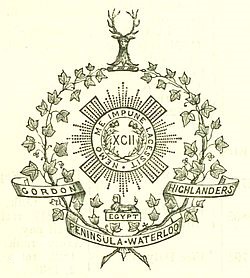
Egmont-op-Zee. Mandora. Egypt with Sphinx. Corunna. Fuentes d’Onor. Almarath.
Vittoria. Pyrenees. Nive. Orthes. Peninsula. Waterloo.
The Marquis of Huntly,[560] whilst a captain in the 3rd Foot Guards, having offered to raise a regiment for general service, letters were granted to him for this purpose on the 10th of February 1794. In his zeal for the service the marquis was backed by his father and mother, the Duke and Duchess of Gordon, both of whom, along with the marquis himself, took an active share in the recruiting. It is quite a true story that the beautiful Duchess of Gordon recruited in person on horseback at markets, wearing a regimental jacket and bonnet, and offering for recruits the irresistible bounty of a kiss and a guinea. The result was, that, within the short space of four months, the requisite number of men was raised, and on the 24th of June the corps was inspected at Aberdeen[561] by Major-General Sir Hector Munro, and embodied under the denomination of the “Gordon Highlanders.” The officers appointed were:—
Lieutenant-Colonel Commandant.
George, Marquis of Huntly.
Majors.
Charles Erskine of Cadross, killed in Egypt in 1801.
Donald Macdonald of Boisdale, died in 1795.
Captains.
Alexander Napier of Blackstone, killed at Corunna in 1809.
John Cameron of Fassifern, killed at Quatre Bras, 16th June, 1815.
Honourable John Ramsay, son of Lord Dalhousie.
Andrew Paton.
William Mackintosh of Aberarder, killed in Holland in 1799.
Alexander Gordon, son of Lord Rockville, killed at Talavera in 1808, Lieutenant-Colonel 83rd regiment.
Simon Macdonald of Morar.
Captain-Lieutenant.
John Gordon, retired as Major.
Lieutenants.
Peter Grant, died in 1817, Major on half-pay.
Archibald Macdonell, died in 1813, Lieutenant-Colonel of veterans.
Alexander Stewart.
Sir John Maclean, Major-General, K.C.B., 1825.
Peter Gordon, died 1806.
Thomas Forbes, killed at Toulouse in 1814, Lieutenant-Colonel of the 45th regiment.
Ewan Macpherson.
George H. Gordon.
Ensigns.
Charles Dowie, died of wounds in Egypt in 1801.
George Davidson, killed at Quatre Bras in 1815, then Captain in the 42nd regiment.
Archibald Macdonald.
Alexander Fraser, killed 2nd October 1799.
William Tod.
James Mitchell, Lieutenant-Colonel in 1815, retired in 1819.
Staff.
Chaplain.—William Gordon.
Adjutant.—James Henderson, died in 1796.
Quarter-master.—Peter Wilkie, died in 1806.
Surgeon.—William Findlay, died in Egypt in 1801.
COLONELS OF THE 91ST 92ND AND 93RD HIGHLANDERS.
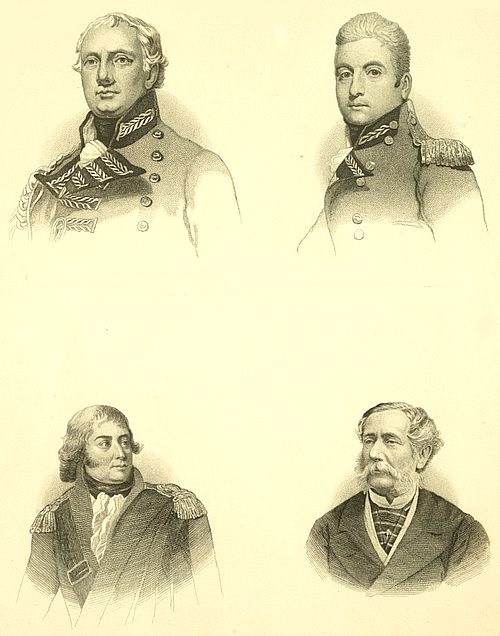
A. Fullerton & Co London & Edinburgh.
UPPER
GENL DUNCAN CAMPBELL OF LOCHNELL. Col. of 91st Highlrs 10th Feb. 1794—9th April 1837. First Colonel.
GEORGE, MARQUIS OF HUNTLY. Col. of 92nd Highlrs 3rd May 1796—3rd Jan. 1806. Also Col. of 42nd Highlrs 3rd Jan. 1806—29th Jan. 1820.
LOWER
MAJOR GENL. W. WEMYSS OF WEMYSS. Col. of 93rd Highlrs 25th Aug^t 1800—Feb. 1822. First Colonel.
SIR H. W. STISTED, K.C.B. Col. of 93rd Highlrs 28th Sep^t 1873—
It is apt to be supposed that because the Gordon estates now lie only in Aberdeen and Banff, and because the regiment was first collected at Aberdeen, that it belongs particularly to that district; but this is quite a mistake. The 92nd was raised principally in the highland districts of the Gordon estates, and from the estates of the officers or their relations; but it should be remembered that these estates then extended, or the Duke had seignorities over the lands, as far west as Ballachulish and Lochiel, taking in Strathspey, and Lochaber, and it was from these highland districts, of which Fort-William is the centre, that it was mostly raised and for a long time after recruited. It also drew very many of its men from Argyll and the Western Isles. The 92nd along with the 79th should be classed with the Inverness-shire, &c., Militia, and, in conjunction with the 91st and 74th, along with the Argyllshire; the 92nd being connected with North Argyll and Isles, the 91st with Lorn, and the 74th with Cowal and Kintyre. It has always been particular in its recruiting; even after giving nearly all its men as volunteers to regiments going to the Crimea, and stress being laid upon it to fill up quickly, the commanding officers determined to enlist, as usual, only Scotchmen, and hence the great popularity of the corps in Scotland. Although the men (with the exception of volunteers from other regiments), are still all Scotch, they are not so entirely from the Highlands as formerly; yet the regiment is quite an example in spirit and feeling of the old Highland clan, and M’Donald is still the most common name in its ranks. Several Gaelic poets or “bards” have worn its tartan, the most distinguished being Corporal Alexander M’Kinnon, a native of Arasaig, in Inverness-shire, whose descriptions of the battles of Bergen-op-Zoom and the war in Egypt are among the most spirited modern Gaelic poems. The officers have all along been mostly taken from among good Scottish families; and so highly were its non-commissioned officers thought of in the army, that it was, and is, no uncommon thing for them to be promoted as sergeant-majors and as adjutants into other corps, and to be selected as adjutants of militia and volunteers.
The regiment embarked at Fort-George on the 9th of July 1794, and joined the camp on Netley Common in August, when it was put on the list of numbered corps as the 100th regiment. The first five years of its service were spent at Gibraltar, Corsica, Elba, and Ireland, in which latter place it had most arduous and trying duties to perform; these, however, it performed with the best results to the country.
The Gordon Highlanders left Ireland in June 1799 for England, to join an armament then preparing for the coast of Holland. The number of the regiment was changed about this time to the 92nd, the former regiment of that number, and others, having been reduced.
The first division of the army, of which the 92nd formed part, landed on the Dutch coast, near the Helder, on the morning of the 27th of August, without opposition; but the troops had scarcely formed on a ridge of sand hills, at a little distance from the beach, when they were attacked by the enemy, who were however driven back, after a sharp contest of some hours’ duration. The 92nd, which formed a part of General Moore’s brigade, was not engaged in this affair; but in the battle which took place between Bergen and Egmont on the 2nd of October it took a very distinguished share. General Moore was so well pleased with the heroic conduct of the corps on this occasion, that, when he was made a knight of the Bath, and obtained a grant of supporters for his armorial bearings, he took a soldier of the Gordon Highlanders in full uniform as one of them.[562] In the action alluded to, the 92nd had Captain William Mackintosh, Lts. Alexander Fraser, Gordon M’Hardy, 3 sergeants, and 54 rank and file, killed; and Colonel, the Marquis of Huntly, Captains John Cameron, Alexander Gordon, Peter Grant, John Maclean, Lieutenants George Fraser, Charles Chadd, Norman Macleod, Donald Macdonald, Ensigns Charles Cameron, John Macpherson, James Bent, G. W. Holmes, 6 sergeants, 1 drummer, and 175 rank and file, wounded.
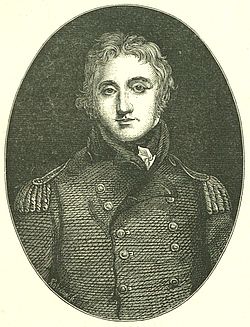
General Sir John Moore. (From a painting by Sir Thomas Lawrence.)
After returning to England, the regiment again embarked on the 27th of May 1800, and sailed for the coast of France; but no landing took place, and the fleet proceeded to Minorca, where the 92nd disembarked on the 20th of July. It formed part of the expedition against Egypt, details of which will be found in the account of the service of the 42nd regiment. The Gordon Highlanders particularly distinguished themselves in the battle of the 13th of March 1801. The British army moved forward to the attack in three columns of regiments; the 90th, or Perthshire regiment, led the advance of the first or centre column, and the Gordon Highlanders that of the second or left, the reserve marching on the right, covering the movements of the first line, and running parallel with the other two columns. The enemy were strongly fortified on a rising ground, and well appointed with cavalry and artillery. As soon as the regiments in advance had cleared some palm and date trees they began to deploy into line; but before the whole army had formed the enemy opened a heavy fire of cannon and musketry, and descended from the heights to attack the 92nd, which had by this time formed in line. The fire was quickly returned by the Gordon Highlanders, who not only firmly maintained their ground singly against the attacks of the enemy supported by a powerful artillery, but drove them back with loss. In this action the 92nd had 19 rank and file killed; and Lt.-Col. Charles Erskine (who afterwards died of his wounds), Captains the Honourable John Ramsay, Archibald Macdonald, Lts. Norman Macleod, Charles Dowie (both of whom also died of their wounds), Donald Macdonald, Tomlin Campbell, Alexander Clarke (the two last died of their wounds), Ronald Macdonald, Alexander Cameron, Ensign Peter Wilson, 10 sergeants, and 100 rank and file wounded.
The regiment had suffered much from sickness during the voyage from Minorca to Egypt, and with this and its recent loss in battle it was so reduced in numbers that General Abercromby ordered it to the rear on the night of the 20th of March, in order to take post upon the shore at Aboukir. Major Napier, on whom the command of the 92nd had devolved in consequence of the death of Col. Erskine, did not, however, remain long in this position, but hurried back as soon as he heard the firing, and assumed his former place in the line. The regiment lost 3 rank and file killed, and Captain John Cameron, Lt. Stewart Matheson, and 37 rank and file wounded.
At the battle of Alexandria, Corporal M’Kinnon, the Gaelic poet already alluded to, was severely wounded, and was nearly buried for dead, when his friend, Sergeant M’Lean, saved him. He composed a Gaelic poem, full of spirit, on the battle, part of which we give in a translation by the Rev. Dr Maclauchlan:—
A Song of the Battle in Egypt.
It was not heard in the course of history, In the conflict or strife of arms, That fifteen thousand men so famous as you Drew swords under their King. Glorious was the Scottish champion Who had that matter entrusted to him; They were not clowns who were chosen with him, To bring their deeds of arms to an issue. The brave heroes were drawn Into a heavy, fierce body; Powerful, strong were the hands, The fine spark going off; Seeking a place where they might kneel, If any enemy were to meet them, The ground would be left bloody With steel that pierces men’s bodies. There were hearty, vigorous lads there, Who never yielded in fear, Following them as best they might. Fifty horse were turned by their exploits. It was a vain thought for the horsemen That they could not find men to contend with them; And the heroes, who could not be shaken, Chasing them out on the hill. We were ready on our legs, To pursue with all speed, On the thirteenth morning which they fixed, With our noble fearless commander. The two youngest of our regiments— The Grahams and the Gordons— Running swiftly to meet them Pouring down from the hill. Heavy was the flight for them, Hard as ever was heard of; Abercromby was up with them, With his men who were ready at hand. Were it not for the town which they reached With cannon all surrounded, More of them were in their graves, And had got cold upon the hill.