Volume 2 / Part 3 — PART THIRD. HISTORY OF THE HIGHLAND REGIMENTS. (continued 13)
Reading edition
LIEUTENANT-COLONELS.
NAMES.Date of Appointment to Regiment.Date of Removal.Remarks.
George ForbesOct.12,1787Dec.14,1788Died.
Hamilton MaxwellDec.15,1788June8,1794Died.
Marlborough Parsons SterlingJune9,1794Dec.4,1795Died.
Alexander RossDec.5,1795Dec.3,1796Died.
Robert ShawSept.1,1795Dec.24,1798Exchanged to 12th Foot.
Alexander CampbellDec.4,1796July25,1810Promoted Major-General.
William HarnessDec.24,1798June7,1800Returned to 18th Foot, 7th June 1800.
Robert ShaweJune7,1800Dec.1,1803Resumed his situation in the Regiment 7th June 1800. Retired 1st Dec. 1803.
Samuel SwintonDec.1,1803May13,1805Promoted in 75th Regiment.
Malcolm M’PhersonMay14,1807Sept.21,1809Exchanged to Inspecting Field Officer, Canada.
Hon. Sir Robt. Le Poer TrenchSept.21,1809Mar.14,1823 Died.[458]
John Alexander MeinMar.20,1823Nov.5,1841Died.
Eyre John CrabbeNov.6,1841May1,1846Retired on Full-pay.
William White CrawleyMay1,1846July10,1846Retired.
John FordyceJuly10,1846Nov.6,1851Killed in action, 6th of Nov. 1851, at Waterkloof, Cape of Good Hope.
Alexander SetonNov.7,1851Feb.26,1852Drowned in the wreck of the Birkenhead.
G. W. FordyceFeb.27,1852July30,1852Retired.
John MacDuffJuly30,1852Jan.24,1862Promoted Major-General; since dead.
George MonklandJuly29,1853Nov.4,1859Exchanged to Half-pay.
James VilliersNov,4,1859May10,1862Died.
W. D. P. PattonMay11,1862Sept.9,1864Retired on Half-pay.
William Kelty M’LeodSept.9,1864—Now (1874) commanding.
MAJORS.
Francis SkellyNov.5,1788Nov.30,1793Died.
Robert ShaweDec.1,1793Mar.28,1795Exchanged to 76th Foot.
Alexander RossMar.28,1795Dec.4,1795Promoted Lieut.-Colonel.
Alexander CampbellDec.25,1795Dec.4,1796Promoted Lieut.-Colonel.
William WallaceSept.2,1795Nov.22,1803Promoted in the 19th Dragoons.
William DouglasDec.4,1796May17,1799Promoted in 85th Foot.
Samuel SwintonMay17,1799Dec.1,1803Promoted Lieut.-Colonel.
James RobertsonNov.22,1803Nov.14,1804Retired.
Francis R. WestDec.1,1803Nov.15,1804Retired.
Malcolm M’PhersonNov.14,1804May13,1807Promoted Lieut.-Colonel.
Hon. M’Donnell MurrayNov.15,1804Mar.10,1808Died.
Edward BroughtonMay14,1807April14,1810Retired.
Russell Manners[459] May11,1808April18,1822Retired.
Allan William Campbell[460] April5,1810Nov.10,1813Died of wounds.
John Alexander MeinNov.11,1813Mar.20,1823Promoted Lieut.-Colonel.
David StewartApril18,1822Dec.4,1828Exchanged to 65th Foot.
William Moore[461] Mar.20,1823Jan.31,1828Retired.
Eyre John CrabbeJan.31,1828Nov.6,1841Promoted Lieut.-Colonel.
John William HutchinsonDec.4,1828Oct.22,1830Died.
Donald John M’QueenOct.23,1830Oct.3,1834Retired.
Thomas ManninOct.3,1834Oct.12,1839Died at sea.
William White CrawleyOct.13,1839May1,1846Promoted Lieut.-Colonel.
John Casamir HaroldNov.6,1841Oct.22,1844Exchanged to 11th Foot.
John FordyceOct.22,1844July10,1846Promoted Lieut.-Colonel.
Augustus Francis AnsellMay1,1846May24,1850Retired on Half-pay.
Hon. Thomas O’GradyJuly10,1846Mar.14,1851Retired.
Alexander SetonMay24,1850Nov.7,1851Promoted Lieut.-Colonel.
G. W. FordyceMar.14,1851Feb.27,1852Promoted Lieut.-Colonel.
G. MonklandNov.7,1851July29,1853Promoted Lieut.-Colonel.
W. D. P. PattonFeb.27,1852May11,1862Promoted Lieut.-Colonel.
E. W. L. HancockJuly29,1853Jan.26,1858Died.
William Kelty M’LeodJan.27,1858Sept.9,1864Promoted Lieut.-Colonel.
John Jago[462] May11,1862——
H. W. PalmerSept.9,1864Oct.4,1864Exchanged to 90th.
L. H. L. IrbyOct.4,1864Feb.4,1871Exchanged to Half-pay.
Robert F. MartinFeb.4,1871——
FOOTNOTES:
SEVENTY-FIFTH REGIMENT.
1787–1809.
Raising of the Regiment—India—Home—Ceases to be a Highland Regiment.
While Major-General Sir Archibald Campbell was appointed Colonel of the 74th, the colonelcy of its coeval regiment, the 75th, was conferred on Colonel Robert Abercromby of Tullibody. He had commanded a light infantry brigade during six campaigns in the American war; and as several companies of this brigade had been composed of the light infantry of the Highland regiments then in America, the colonel was well known to the Highlanders, and had acquired an influence among them rarely enjoyed by officers born south of the Grampians. There are instances, no doubt, such as those of the Marquis of Montrose and Viscount Dundee, and others of modern date, “where Highland corps have formed attachments to officers not natives of their country, and not less ardent than to the chiefs of old;”[463] and if the instances have been few, it must be attributed entirely to want of tact in officers themselves, who, from ignorance of the Highland character, or from some other cause, have failed to gain the attachment of the Highland soldiers.
From personal respect to Colonel Abercromby, many of the Highlanders, who had served under him in America, and had been discharged at the peace of 1783, enlisted anew, and with about 300 men who were recruited at Perth, and in the northern counties, constituted the Highland part of the regiment. According to a practice which then prevailed, of fixing the head-quarters of a regiment about to be raised in the neighbourhood of the colonel’s residence, if a man of family, the town of Stirling was appointed for the embodying of the 75th; it was accordingly regimented here in June 1788, and being immediately ordered to England, embarked for India, where it arrived about the end of that year.
For eighteen months after its arrival in India, the regiment was subjected to extreme severity of discipline by one of the captains, who appears to have adopted the old Prussian model for his rule. A more unfortunate plan for destroying the morale of a Highland regiment could not have been devised, and the result was, that during the existence of this discipline, there were more punishments in the 75th than in any other corps of the same description. But as soon as the system was modified by the appointment of an officer who knew the dispositions and feelings of the Highlanders, the conduct of the men improved.
The regiment took the field in 1790, under the command of Colonel Hartley, and in the two subsequent years formed part of the force under Major-General Robert Abercromby, on his two marches to Seringapatam. The regiment was also employed in the assault on that capital in 1799, the flank companies having led the left columns.[464] From that period down to 1804, the regiment was employed in the provinces of Malabar, Goa, Goojerat, and elsewhere, and in 1805 was with General Lake’s army in the disastrous attacks on Bhurtpoor.
The regiment was ordered home in 1806; but such of the men as were desirous of remaining in India were left behind. In 1809 there were not one hundred men in the regiment who had been born north of the Tay; on which account, it is believed, the designation of the regiment was at that time changed.
The regiment, however, still retains its old number, and is known as the “Stirlingshire Regiment.” It has had a distinguished career, having been present in many of the engagements which we have had to notice in connection with the existing Highland regiments. As will be seen in our account of the 78th Highlanders, the 75th formed part of the force with which Sir Colin Campbell marched to the relief of Lucknow in November 1857, it having been left to guard the Alum Bagh while Sir Colin, with the rest of the force, made his way to the besieged garrison on the 14th of that month.
FOOTNOTES:
THE 78th HIGHLANDERS, OR ROSS-SHIRE BUFFS.[465]
I. 1793 to 1796.
The Clan Mackenzie—The various Battalions of the 78th—Offers from F. H. Mackenzie, Esq. of Seaforth, to raise a Regiment for Government—Letter of service granted to F. H. Mackenzie, Esq., to raise a Regiment of Highlanders, to be numbered the 78th—The 1st Battalion—List of officers—Inspected and passed by Sir Hector Munro—Under Lord Moira in Guernsey—The Campaign of 1794–95 in Holland—The Regiment joins the Duke of York on the Waal—Nimeguen—Disastrous retreat on Deventer—The Regiment returns home—The Loyalist war in La Vendée—The Quiberon Expedition—Occupation of L’Île-Dieu—The Regiment returns home—Colonel F. H. Mackenzie’s proposals to raise a 2nd Battalion for the 78th—Letter of Service granted to him for that purpose—List of Officers—Inspected and passed by Sir Hector Munro—Granted the title of the Ross-shire Buffs—Ordered to England—Difficulties prior to embarkation at Portsmouth—The Regiment sails on secret service—Capture of the Cape of Good Hope—The Regiment goes into quarters at Capetown, until the arrival of the 1st Battalion.
Assaye. Maida. Java.
Persia. Kooshab. Lucknow.
The clan Mackenzie was, next to the Campbells, the most considerable in the Western Highlands, having built its greatness upon the fallen fortunes of the Macdonalds. Its military strength was estimated in 1704, at 1200 men; by Marshal Wade in 1715, at 3000 men; and by Lord President Forbes in 1745, at 2500 men; but probably all these conjectures were below the mark.[466]
The clan Mackenzie furnished large contingents to the present 71st and 72nd Regiments when they were first raised.
In 1793, Francis Humberstone Mackenzie, heir-male of the family, and afterwards Lord Seaforth, raised the present 78th Highlanders, and a second battalion in the following year, when nearly all the men enlisted were from his own or his clansmen’s estates in Ross-shire and the Lewis. Another second battalion was subsequently raised in 1804, when, Lord Seaforth being absent as Governor of Demerara, his personal influence was not of so much avail. However, again the greater part of the men were recruited on the estates of the clan by his brother-in-law, Colonel Alexander Mackenzie of Belmaduthy (who afterwards adopted the additional surname of Fraser, on succeeding to the Castle Fraser estates in right of his mother) and Colonel J. R. Mackenzie of Suddie. Several Fencible, Militia, and local Volunteer regiments were also raised among the Mackenzies at the end of the last and beginning of the present century.
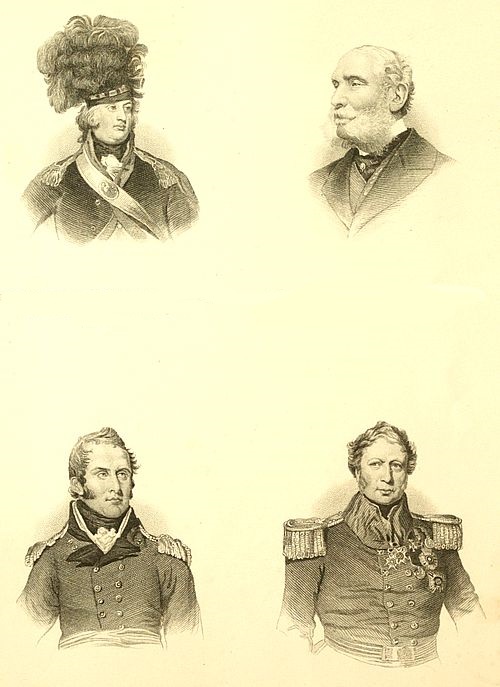
COLONELS OF THE 78TH AND 79TH HIGHLANDERS.
A. Fullerton & Co London & Edinburgh.
UPPER
F. H. MACKENZIE OF SEAFORTH. LORD SEAFORTH. Col. of 78th Highlrs 7th March 1793—May 1796. First Colonel.
SIR PATRICK GRANT, G.C.B. G.C.M.G. Col. of 78th Highlrs 23rd Octr 1863—
LOWER
SIR RONALD CRAUFURD FERGUSON, G.C.B. Col. of 79th Highlrs 24th March 1828—10th April 1841.
SIR JAMES MACDONELL, K.C.B. K.C.H. Col. of 79th Highlrs 14th July 1842—8th Feb. 1849. Also Col. of 71st Highlrs 8th Feb. 1849—15th May 1857.
As the early history of the 78th is a little complicated, owing to its having been twice augmented with a 2nd battalion, it is as well to remember the following chronology:—
1st Battalion—Letter of Service dated 7th March 1793.
2nd Battalion—Letter of Service dated 10th February 1794.
Both Battalions amalgamated, June 1796.
2nd Battalion—Letter of Service, dated 17th April 1804.
Both Battalions amalgamated, July 1817.
The regiment has ever since remained as a single battalion.
As early as the autumn of 1787 (when the 74th, 75th, 76th, and 77th Regiments were ordered to be raised for service in India), Francis Humberstone Mackenzie of Seaforth, lineal descendant and representative of the old earls of Seaforth, had made an offer to the King for the raising of a Highland corps on his estates in Ross-shire and the Isles, to be commanded by himself. As the Government, however, merely accepted his services in the matter of procuring recruits for the regiments of Sir Archibald Campbell and Colonel Abercromby (the 74th and 75th), he did not come prominently forward. On the 19th of May 1790, he again renewed his offer, but was informed that Government did not contemplate raising fresh corps, the establishment of the army having been finally fixed at 77 regiments.
Undismayed, however, by the manner in which his offers had been hitherto shelved, he was the first to step forward, on the declaration of war, and place his great influence in the Highlands at the disposal of the Crown. Accordingly, a Letter of Service, dated 7th March, 1793, was granted to him, empowering him, as Lieut.-Colonel Commandant, to raise a Highland battalion, which, as the first to be embodied during the war, was to be numbered the 78th. The strength of the battalion was to be 1 company of grenadiers, 1 of light infantry, and 8 battalion companies. Seaforth immediately appointed as his major his brother-in-law, Alexander Mackenzie of Belmaduthy, son of Mackenzie of Kilcoy, a captain in the 73rd Regiment, and a man in every way fitted for the post. A notice was then posted through the counties of Ross and Cromarty, and the island of Lewis.
Applications for commissions now poured in upon Seaforth; and, besides his own personal friends, many who were but slightly known to him solicited favours for their relatives. The following is a list of those whose names were approved by the King:—
FIRST LIST OF OFFICERS.
Lieut.-Colonel Commandant.—F. H. Mackenzie, afterwards Lord Seaforth, Lieut.-Gen. 1808. Died 1815. [His portrait is on the Plate of the Colonels of the 78th and 79th Regiments.]
Lieut.-Colonel.—Alexander Mackenzie of Belmaduthy, afterwards of Castle Fraser, when he assumed the name of Fraser. Lieut.-General 1808. Died 1809.
Majors.
George, Earl of Errol, died 1799.
Alexander Mackenzie of Fairburn, Lieut.-General 1809.
Captains.
Alexander Malcolm, died 1798.
Thomas Fraser of Leadclune.
John Mackenzie (Gairloch).
Gabriel Murray, Brevet-Major, killed at Tuil, 1794.
Alexander Grant, died 1807.
J. R. Mackenzie of Suddie, Major-General, killed at Talavera 1809.
Alexander Adams, Major-General 1814.
Hon. Geo. Cochrane, son of the Earl of Dundonald.
Captain-Lieutenant—Duncan Munro of Culcairn.
Lieutenants.
Colin Mackenzie.
James Fraser, retired 1795.
Charles Rose.
Hugh Munro, Captain of Invalids.
Charles Adamson.
William Douglas, son of Brigton, Lieut.-Colonel 91st Regiment.
George Bayley, promoted to 44th.
Thomas, Lord Cochrane, Captain Royal Navy.
Ensigns.
Duncan Macrae.
John Macleod, Colonel 1813.
J. Mackenzie Scott, Captain 57th, killed at Albuera, 1811.
Charles Mackenzie (Kilcoy).
John Reid.
David Forbes, Lieut.-Colonel, H.P.
Alexander Rose, Major of Veterans.
John Fraser.
Chaplain—The Rev. Alexander Downie, D.D.
Adjutant—James Fraser.
Quarter-Master—Archibald Macdougall.
Surgeon—Thomas Baillie. He died in India.
Notice posted throughout the Counties of Ross and Cromarty and the Island of Lewis.
Engraved from a photograph of the original poster.
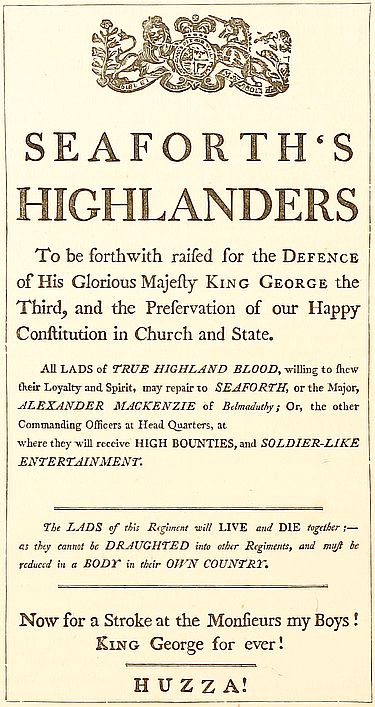
SEAFORTH’S
HIGHLANDERS
To be forthwith raised for the Defence of His Glorious Majesty King George the Third, and the Preservation of our Happy Constitution in Church and State.
All LADS of TRUE HIGHLAND BLOOD, willing to shew their Loyalty and Spirit, may repair to SEAFORTH, or the Major, ALEXANDER MACKENZIE of Belmaduthy; Or, the other Commanding Officers at Head Quarters, at _____________ where they will receive HIGH BOUNTIES, and SOLDIER-LIKE ENTERTAINMENT.
The LADS of this Regiment will LIVE and DIE together;—as they cannot be DRAUGHTED into other Regiments, and must be reduced in a BODY in their OWN COUNTRY.
Now for a Stroke at the Monsieurs my Boys! King George for ever!
HUZZA!
The martial spirit of the nation was now so thoroughly roused, and recruits poured in so rapidly, that, on the 10th of July, 1793, only four months after the granting of the Letter of Service, the regiment was inspected at Fort George, and passed by Lieut.-General Sir Hector Munro. Orders were then issued to augment the corps to 1000 rank and file, and 5 companies, including the flank ones, under the command of Major Alexander Mackenzie, were embarked for Guernsey. In October of the same year the remaining 5 companies were ordered to join their comrades.
“This was an excellent body of men, healthy, vigorous, and efficient; attached and obedient to their officers, temperate and regular; in short, possessing those principles of integrity and moral conduct which constitute a valuable soldier. The duty of officers was easy with such men, who only required to be told what duty was expected of them. A young officer, endowed with sufficient judgment to direct them in the field, possessing energy and spirit to ensure the respect and confidence of soldiers, and prepared on every occasion to show them the eye of the enemy, need not desire a command that would sooner and more permanently establish his professional character, if employed on an active campaign, than that of 1000 such men as composed this regiment.
“Colonel Mackenzie knew his men, and the value which they attached to a good name, by tarnishing which they would bring shame on their country and kindred. In case of any misconduct, he had only to remonstrate, or threaten to transmit to their parents a report of their misbehaviour. This was, indeed, to them a grievous punishment, acting like the curse of Kehama, as a perpetual banishment from a country to which they could not return with a bad character.”[467]
After being stationed a short time in Guernsey and the Isle of Wight, the 78th, in September 1794, embarked with the 80th to join Lord Mulgrave’s force in Walcheren. While detained by contrary winds in the Downs, fever broke out on board the transports, which had recently brought back prisoners of war from the West Indies, and had not been properly purified; thus several men fell victims to the disease.
The British troops had landed in Holland, on the 5th of March, 1793, and since then the war had been progressing with varying success. Without, therefore, giving details of their operations during the first year and a half, we shall merely sketch the position they occupied when the 78th landed at Flushing.
On the 1st of July, 1794, the allies having decided to abandon the line of the Scheldt, the Duke of York retired behind the Dyle, and was there joined by Lord Moira and 8000 men. On the 22nd the Duke, having separated from the Austrians, established himself at Rosendaal, and there remained inactive in his camp the whole of August and the early part of September; but, on the 15th of September, Boxtel having fallen into the hands of General Pichegru, he was constrained to break camp and retire across the Meuse, and finally across the Waal, establishing his head-quarters at Nimeguen.
At this juncture the 78th and 80th reached Flushing, and found that Lord Mulgrave was ordered home. They therefore embarked with the 79th, 84th, and 85th, to join the Duke’s army. Early in October the 78th landed at Tuil, and proceeded to occupy the village of Rossem in the Bommeler-Waart, or Island of Bommel, where they first saw the enemy, scarcely one hundred yards distant, on the opposite side of the river. Here, through the negligence of a Dutch Emigrant Officer, a sad accident occurred. This person hearing voices on the bank of the river, and dreading a surprise, ordered his gunners to fire an iron 12-pounder, loaded with case shot, by which discharge the officer of the day, Lieut. Archibald Christie, 78th, and a sergeant, were seriously wounded while visiting a sentry. They both recovered, but were unable to serve again; strange to say, the sentry escaped untouched. While quartered here, by a tacit understanding, the sentries exchanged no shots, but it was observed that the French frequently fired howitzers with effect when the troops were under arms, and that, before the fire commenced, the sails of a certain windmill were invariably put in motion. The owner was arrested, found guilty as a spy, and condemned to death, but was reprieved through the lenity of Lieut.-Colonel Mackenzie, the commandant, with the full understanding that, on a repetition of the offence, the last penalty would be enforced.
About the end of October the 78th proceeded to Arnheim, the Duke of York’s headquarters, and thence, by a night march, to Nimeguen, against which place the French were erecting batteries. On the 4th of November a sortie was made, when the 78th was for the first time under fire, and did such execution with the bayonet, as to call forth the highest encomiums from experienced and veteran officers. The loss of the regiment in this engagement was Lieutenant Martin Cameron (died of his wounds) and seven men, killed; wounded, Major Malcolm, Captain Hugh Munro, Captain Colin Mackenzie, Lieutenant Bayley, 4 sergeants, and 56 rank and file.
On the 6th the regiment marched from Nimeguen to Arnheim, and finally to Dodewaart on the Waal, where they were brigaded with the 12th, the 33rd, under Lieut.-Colonel Arthur Wellesley (afterwards Duke of Wellington), and the 42nd under Major Dickson. The General going home on leave, the command devolved on Colonel Alexander Mackenzie of the 78th, who, however, still remained with his regiment.
On the 2nd of December the Duke of York quitted Arnheim for England, and handed over his command to Lieut.-General Harcourt.
On the 29th of December General Daendels, having crossed the Waal on the ice and driven back the Dutch, Major-General Sir David Dundas was ordered to dislodge him. He, therefore, marched towards Thiel by Buren and Geldermalsen, and came up with the enemy at Tuil, which village he carried at the point of the bayonet with comparatively little loss, though Brevet Major Murray and three men of the light company, 78th, were killed by the bursting of a shell thrown from a distant battery. After the action the troops lay on their arms in the snow until the evening of the 31st, and the French recrossed the Waal.
On the 3rd of January 1795 the French repossessed themselves of Tuil, and on the 5th they drove in the British outposts at Meteren, capturing two three-pounders, which were, however, recovered later in the day. They then attacked Geldermalsen. The 78th were in advance, supported by the 42nd, when they were charged by a Republican cavalry corps, dressed in the same uniform as the French Emigrant Regiment of Choiseul. They advanced towards the Highlanders with loud cries of “Choiseul! Choiseul!” and the 78th, believing them to be that regiment, forbore to fire upon them until they were quite close, when, discovering the mistake, they gave them a warm reception, and those of the enemy who had penetrated beyond their line were destroyed by the 42nd. The infantry then came up, the officers shouting “Avançez, Carmagnoles!” but the 78th, reserving their fire till the foe had almost closed with them, poured in such a withering volley, that they were completely demoralised and retreated in great confusion. It was remarked that in this action the French were all half drunk, and one officer, who was wounded and taken, was completely tipsy. The loss of the 78th was four men killed, and Captain Duncan Munro and seven men wounded. It was on this occasion that a company of the 78th, commanded by Lieutenant Forbes, showed an example of steadiness that would have done honour to the oldest soldiers, presenting and recovering arms without firing a shot upon the cavalry as they were coming down. The whole behaved with great coolness, and fired nearly 60 rounds per man.
On the night of the 5th the troops retired to Buren. On the 6th the British and Hanoverians retired across the Leck, with the exception of the 6th Brigade, Lord Cathcart’s, which remained at Kuilenburg. On the 8th both parties assumed the offensive, but the British advance was countermanded on account of the severity of the weather. It happened, however, luckily for the picquet of the 4th Brigade, which was at Burenmalsen, opposite to Geldermalsen, that the order did not reach Lord Cathcart until he had arrived at Buren, as being driven in, it must otherwise have been taken. Here a long action took place, which ended in the repulse of the French. The 4th and a Hessian Brigade went into Buren, and the British into the castle.
The day the troops remained here, a man in the town was discovered selling gin to the soldiers at such a low price as must have caused him an obvious loss, and several of the men being already drunk, the liquor was seized, and ordered by General Dundas to be divided among the different corps, to be issued at the discretion of commanding officers. Thus what the French intended to be a means of destruction, turned out to be of the greatest comfort and assistance to the men during their fearful marches through ice and snow. During the afternoon a man was apprehended at the outposts, who had been sent to ascertain whether the trick had taken effect, and whether the troops were sufficiently drunk to be attacked with success.
Abercromby and Hammerstein having been unable to reach Thiel, were, with Wurmb’s Hessians, united to Dundas at Buren. On the 10th the French crossed the Waal, and General Regnier crossing the Oeg, drove the British from Opheusden, back upon Wageningen and Arnheim, with a loss of fifty killed and wounded. Abercromby, therefore, withdrew, and the British retired across the Rhine at Rhenen. This sealed the fate of Holland, and on the 20th General Pichegru entered Amsterdam.
The inclemency of the season increased, and the rivers, estuaries, and inundations froze as they had never been known to do before, so that the whole country, land and water, was one unbroken sheet of ice.
The Rhine was thus crossed on the ice on the night of the 9th of February, and for two more nights the 78th lay upon their arms in the snow, and then marched for Wyk. On the 14th Rhenen was attacked by the French, who were repulsed by the Guards, with a loss of 20 men; however, the same night it was determined to abandon the Rhine, and thus Rhenen, the Grand Hospital of the army, fell into the hands of the French, who, nevertheless, treated the sick and wounded with consideration. After resting two hours in the snow during the night, the 78th resumed their march, passed through Amersfoort, and about 11 A.M. on the 15th lay down in some tobacco barns, having marched nearly 40 miles. It had been decided to occupy the line of the Yssel, and Deventer therefore became the destination. On the 16th at daybreak the regiment commenced its march across the horrible waste called the Veluwe. Food was not to be obtained, the inhabitants were inhospitable; with the enemy in their rear, the snow knee deep, and blown in swirls by the wind into their faces, until they were partially or entirely blinded, their plight was most pitiable.
They had now a new enemy to encounter. Not only was the weather still most severe, and the Republicans supposed to be in pursuit, but the British had, in consequence of French emissaries, a concealed enemy in every Dutch town and village through which they had to pass. Notwithstanding the severity of the climate,—the cold being so intense that brandy froze in bottles—the 78th, 79th (both young soldiers), and the recruits of the 42nd, wore their kilts, and yet the loss was incomparably less than that sustained by the other corps.
After halting at Loo to allow the officers and men to take off their accoutrements, which they had worn day and night since the 26th December, they on the 18th marched to Hattem on the Yssel. Finally, on the 28th of March the 78th entered Bremen, and the army being embarked, the fleet sailed on the 12th of April. On the 9th of May, 1795, the shores of Old England brought tears into the eyes of the war-worn soldiers, and the first battalion of the Ross-shire Buffs landed at Harwich, and proceeded to Chelmsford, where they took over the barracks. After making up the returns, and striking off the names of all men supposed to be dead or prisoners, the regiment, which had embarked on the previous September 950 strong, and in excellent health, was found to be reduced to 600 men, which number included the disabled and sick who had not been yet invalided. The 78th remained three weeks at Chelmsford, and marched to Harwich, where it was brigaded with the 19th, under command of General Sir Ralph Abercromby. It then proceeded to Nutshalling (now Nursling) Common, where a force was assembling under the Earl of Moira, with a view to making a descent on the French coast.
On the 18th of August the 78th, in company with the 12th, 80th, and 90th Regiments, and some artillery, embarked under the command of Major-General W. Ellis Doyle, and sailed for Quiberon Bay; the design was to assist the French Royalists. They bore down on Noirmoutier, but finding the island strongly reinforced, and a landing impracticable, they made for L’Île-Dieu, where they landed without opposition. Here they remained for some time, enduring the hardships entailed by continued wet weather and a want of proper accommodation, coupled with an almost total failure of the commissariat, but were unable to assist Charette or his royalist companions in any way. Finally, the expedition embarked in the middle of December, joined the grand fleet in Quiberon Bay, and proceeded with it to Spithead.
On the 13th of October 1793, Seaforth made an offer to Government to raise a second battalion for the 78th Highlanders; and on the 30th Lord Amherst signed the king’s approval of his raising 500 additional men on his then existing letter of service. However, this was not what he wanted; and on the 28th of December he submitted three proposals for a second battalion to Government.
On the 7th of February 1794, the Government agreed to one battalion being raised, with eight battalion and two flank companies, each company to consist of “one hundred private men,”[468] with the usual complement of officers and non-commissioned officers. But Seaforth’s services were ill requited by Government; for while he contemplated raising a second battalion to his regiment, Lord Amherst had issued orders that it was to be considered as a separate corps. The following is a copy of the letter addressed to Mr Secretary Dundas by Lieut.-Colonel Commandant F. H. Mackenzie[469]:—
“St Alban’s Street, “8th Feb. 1794.
“Sir,—I had sincerely hoped I should not be obliged to trouble you again; but on my going to-day to the War Office about my letter of service (having yesterday, as I thought, finally agreed with Lord Amherst), I was, to my amazement, told that Lord Amherst had ordered that the 1000 men I am to raise were not to be a second battalion of the 78th, but a separate corps. It will, I am sure, occur to you that should I undertake such a thing, it would destroy my influence among the people of my country entirely; and instead of appearing as a loyal honest chieftain calling out his friends to support their king and country, I should be gibbeted as a jobber of the attachment my neighbours bear to me. Recollecting what passed between you and me, I barely state this circumstance; and I am, with great respect and attachment, Sir, your most obliged and obedient servant,
“F. H. Mackenzie.”
This argument had its weight; Lord Amherst’s order was rescinded, and on the 10th February 1794, a letter of service was granted to Seaforth, empowering him, as Lieut.-Colonel Commandant, to add a second battalion to the 78th Highlanders, of which the strength was to be “one company of grenadiers, one of light infantry, and eight battalion companies.”[470]
Stewart states that of this number 560 men were of the same country and character as the first, and 190 from different parts of Scotland; but he alludes to the first six companies, as the regiment was almost entirely composed of Highlanders.
The following is a list of the officers appointed to the regiment:—
Lieutenant-Colonel Commandant.
F. H. Mackenzie of Seaforth.
Lieutenant-Colonel.
Alexander Mackenzie of Fairburn, from first battalion.
Majors.
J. R. Mackenzie of Suddie, from first battalion.
Michael Monypenny, promoted to 73d, dead.
Captains.
J. H. Brown, killed in a duel in India.
Simon Mackenzie.
William Campbell, Major, killed in Java, 1811.
John Mackenzie, Major-General, 1813.
Patrick M’Leod (Geanies), killed at El Hamet, 1807. [His portrait will be found on page 650.]
Hercules Scott of Benholm, Lieut.-Colonel 103d Regiment, 1814, killed in Canada.
John Scott.
John Macleod, Colonel, 1813, from first battalion.
Lieutenants.
James Hanson.
Alexander Macneil.
Æneas Sutherland.
Murdoch Mackenzie.
Archd. C. B. Crawford.
Norman Macleod, Lieut.-Colonel Royal Scots.
Thomas Leslie.
Alexander Sutherland, sen.
Alexander Sutherland, jun.
P. Macintosh.
John Douglas.
George Macgregor.
B. G. Mackay.
Donald Cameron.
James Hay.
Thomas Davidson.
William Gordon.
Robert Johnstone.
Hon. W. D. Halyburton, Colonel, half-pay.
John Macneil.
John Dunbar.
Ensigns.
George Macgregor, Lieut.-Colonel 59th Regiment.
Donald Cameron.
John Macneil.
William Polson.
Alexander Wishart.
Chaplain.—The Rev. Charles Proby.
Adjutant.—James Hanson.
Quarter-Master.—Alexander Wishart.
The records of this battalion having been lost many years since, the only knowledge we can derive of its movements is to be obtained from the Seaforth papers. The regiment was inspected and passed at Fort-George by Sir Hector Munro in June 1794. In July his Majesty authorised the regiment to adopt the name of “The Ross-shire Buffs” as a distinctive title. In August six companies embarked for England, and proceeded to Netley Camp, where they were brigaded with the 90th, 97th, and 98th. The troops suffered much from fever, ague, and rheumatism, the situation being very unfavourable; but here again the 78th was found to be more healthy than their neighbours. The young battalion was chafing at this enforced idleness, and longed to go on active service. On the 5th of November, the regiment marched from Netley, four companies proceeding to Poole, one to Wimborne, and one to Wareham, Corff Castle, &c.
In the end of February 1795, the second battalion of the 78th Highlanders, Lieut.-Colonel Alexander Mackenzie of Fairburn in command, embarked, under Major-General Craig, with a secret expedition. Major J. R. Mackenzie of Suddie, writing to Seaforth under date “Portsmouth, 4th March 1795,” narrates the following unpleasant circumstance which happened on the day previous to embarkation:—
“The orders for marching from Poole were so sudden that there was no time then for settling the men’s arrears. They were perfectly satisfied then, and expressed the utmost confidence in their officers, which continued until they marched into this infernal place. Here the publicans and some of the invalids persuaded the men that they were to be embarked without their officers, and that they would be sold, as well as lose their arrears. This operated so far on men who had never behaved ill before in a single instance, that they desired to have their accounts settled before they embarked. Several publicans and other villains in this place were guilty of the most atrocious conduct even on the parade, urging on the men to demand their rights, as they called it. Fairburn having some intimation of what was passing, and unwilling that it should come to any height, addressed the men, told them it was impossible to settle their accounts in the short time previous to embarkation, but that he had ordered a sum to be paid to each man nearly equal to the amount of their credit. This was all the publicans wanted, among whom the greatest part of the money rested. Next morning the men embarked in the best and quietest manner possible, and I believe they were most thoroughly ashamed of their conduct. I passed a most miserable time from receiving Fairburn’s letter in London till I came down here, when it had all ended so well; for well as I knew the inclinations of the men to have been, it was impossible to say how far they might have been misled.
“There is little doubt of the expedition being intended for the East. It is said the fleet is to run down the coast of Guinea, proceed to the Cape, which they hope to take by negotiation; but if unsuccessful, to go on to the other Dutch possessions.”
The fleet sailed on the morning of Sunday the 1st of March. 1 major, 1 ensign, 4 sergeants, 1 drummer, and 124 privates were left behind; and the most of them, with others, were incorporated with the first battalion, on its amalgamation with the second battalion.
Holland having entirely submitted to France, as detailed in the record of the first battalion, and Britain being fully aware that submission to France became equivalent to a compulsory declaration of war against her, it behoved her to turn her attention to the Dutch colonies, which, from their proximity to India, would prove of immense importance to an enemy.
In June 1795 a British fleet under Sir G. Elphinstone arrived off the Cape, having Major-General Craig and the 78th Highlanders (second battalion) on board; and the commanders immediately entered into negotiations with Governor Slugsken for the cession of the colony to Great Britain in trust for the Stadtholder. A determination to resist the force having been openly expressed, the commanders determined to disembark their troops and occupy a position. Accordingly, the 78th and the Marines were landed at Simon’s Bay on the 14th, and proceeded to take possession of Simon’s Town without opposition. The Dutch were strongly posted in their fortified camp at Muysenberg, six miles on this side of Capetown; and accordingly a force of 800 seamen having been sent to co-operate with the troops on shore, the whole body moved to its attack; while the ships of the fleet, covering them from the sea, opened such a terrific fire upon the colonists that they fled precipitately. Muysenberg was taken on the 7th of August, and on the 9th a detachment arrived from St Helena with some field-pieces; but it was not till the 3rd of September, when Sir A. Clarke, at the head of three regiments, put into the bay, that an advance became practicable. Accordingly, the Dutch position at Wineberg was forced on the 14th, and on the 15th Capetown capitulated, the garrison marching out with the honours of war. Thus, after a two months’ campaign, during which they suffered severely from the unhealthiness of their situation, the scarcity of provisions, and the frequent night attacks of the enemy, this young battalion, whose conduct throughout had been exemplary in the highest degree, saw the object of the expedition accomplished, and the colony taken possession of in the name of his Britannic Majesty.
Under date “Cape of Good Hope, 19th September 1795,” Lieut.-Colonel Alexander Mackenzie of Fairburn, commanding the second battalion of the 78th Highlanders, sends a long account of the transactions at the Cape to Lieut.-Colonel F. H. Mackenzie of Seaforth. We are sorry that our space permits us to give only the following extracts:—
“I think if you will not be inclined to allow that the hardships have been so great, you will at all events grant that the comforts have been few, when I assure you that I have not had my clothes off for nearly nine weeks, nor my boots, except when I could get a dry pair to put on.
“ ... If the regiment is put on the East India establishment, which is supposed will be the case, it will be equally the same for you as if they were in India. I must observe it is fortunate for us that we are in a warm climate, as we are actually without a coat to put on; we are so naked that we can do no duty in town....
“I cannot tell you how much I am puzzled about clothing. The other corps have all two years’ clothing not made up, and I should not be surprised if this alone was to turn the scale with regard to their going to India. General Clarke advises mo to buy cloth, but I fear putting you to expense; however, if the clothing does not come out in the first ship I shall be obliged to do something, but what, I am sure I don’t know. I hope your first battalion may come out, as there cannot be a more desirable quarter for the colonel or the regiment. We are getting into excellent barracks, and the regiment will soon get well of the dysentery and other complaints. They are now immensely rich, and I shall endeavour to lay out their money properly for them. I shall bid you adieu by saying that I do not care how soon a good peace may be brought about. I think we have at last turned up a good trump card for you, and I daresay the Ministry will play the negotiating game well.”
In Capetown the regiment remained quartered until the arrival of the first battalion in June 1796.
II. 1796–1817.
1st and 2d Battalions amalgamated—The Regiment sails for the Cape—The consolidation completed—Capture of a Dutch fleet—Ordered to India—Lucknow—Cession of Allahabad—Various changes of Quarters—Colonels Alexander Mackenzie and J. R. Mackenzie quit the Regiment—Ordered to Bombay—Join General Wellesley’s Army—The Mahrattas—The Treaty of Bassein—Lake and Wellesley take the field—War between the British and the Mahrattas—Ahmednuggur taken—Battle of Assaye—Colours granted to the 74th and 78th—Wellesley’s pursuit of the Enemy—Battle of Argaum—Gawilghur taken—The Regiment goes to Goojerat—From Bombay to Goa—Excellent conduct—Ordered to Madras and thence to Java—Landing near Batavia, which is invested—The Cantonment of Waltevreeden forced—The Fortification of Cornelis captured, when General Jansens flies—Colonel Gillespie defeats Jansens—The French army surrender and evacuate the Island—Rebellion of the Sultan of Djokjokarta—His Capital is taken, and he is deposed—Colonel Fraser and Captain Macpherson murdered by Banditti at Probolingo—Major Forbes defeats the Insurgents—Thanks of Government to the Regiment—Expeditions against the Islands of Bali and Celebes—The Regiment sails for Calcutta—Six Companies wrecked on the Island of Preparis—General Orders by the Indian Government—The Regiment lands at Portsmouth and proceeds to Aberdeen—Unfounded charge against the Highland Regiments.
On the 28th of November, 1795, the Duke of York had issued orders for the consolidation of both battalions, and accordingly, on the arrival of the 1st battalion from L’Île-Dieu, the work was commenced by the attachment to it of that part of the 2nd battalion which had been left behind. On the 26th of February, 1796, only seven weeks after its return from abroad, the battalion proceeded from Poole to Portsmouth, where it embarked for the Cape in two divisions under the command of Lieut.-Colonel Alexander Mackenzie of Belmaduthy, and sailed on the 6th of March. On the 30th of May the 78th arrived in Simon’s Bay, and on the 1st of June landed and commenced its march to Capetown. Here the work of consolidation was completed, and the supernumerary officers and men ordered home. The regiment now presented the appearance of a splendid body of men, and mustered 970 Highlanders, 129 Lowlanders, and 14 English and Irish, the last chiefly bandsmen. The Batavian Republic had formally declared war against England in May; and, accordingly, on the 3rd of August, apparently with the view of attempting the recapture of the Cape, a Dutch fleet under Admiral Lucas anchored in Saldanha Bay. General Craig, the commander of the troops, marched up a force, which included the grenadier and light battalions of the 78th. As the Dutch fleet, however, surrendered, the troops marched back to a place called Groenekloof, about half-way to Capetown, where they remained encamped for three or four weeks, when the 78th marched to Capetown, and occupied the hill near the Castle until the transports were ready to convey them to India.
On the 4th of November the regiment embarked, and sailed on the 10th; it had a long passage, during which scurvy made its appearance, but to no formidable extent. On the 10th of February 1797 the transports reached Calcutta, and the following day the regiment marched into Fort William. Ten days later it embarked in boats on the Hoogly, and proceeded to Burhampoor, the voyage occupying fourteen days. About the 1st of August, on the embarkation of the 33rd Regiment with the expedition intended against Manilla, the 78th proceeded to Fort William. In the beginning of October six companies were again embarked in boats, and proceeded to Chunar. From Chunar, about the end of November, the division, having drawn camp equipment from the magazine, was ordered to drop down to Benares, there to land, and form part of a large escort to the Governor-General (Sir John Shore), and the Commander-in-Chief (Sir A. Clarke), about to proceed to Lucknow. The division accordingly landed at Benares on the 6th of December and marched to Sheopoor, six miles on the road, where it halted to complete its field equipment. In the beginning of November, the 33rd having returned to Fort William, the second division of the 78th embarked and proceeded to Chunar, where it was landed and encamped until the following March.
On the 9th of December the first division was joined by a part of the 3rd Native Infantry, some artillery with field-pieces, and two russallahs or squadrons of Irregular Hindoostani Cavalry, formerly the body-guard of General De Boigne, a Savoyard in Sindiah’s service, and marched forward, forming the escort above mentioned. The march was continued without halting for fifteen days, which brought the force to the race-course of Lucknow, where it was joined by the remainder of the 3rd Native Infantry. It is unnecessary to enter here into the complications of native Indian politics. It is enough to say that on the death, in 1797, of the troublesome Asoph-ud-Dowla, the Nawaub Vizir of Oudh, he was succeeded by his equally troublesome and weak-minded son, Mirza Ali.
The young prince had barely ascended the throne, however, ere reports were brought to the Governor-General of his incapacity, faithless character, and prodigality. It was on receiving these reports, therefore, that Sir John Shore determined to proceed to Lucknow in person, and, by actual observation, satisfy himself of the merits of the case. The narrative is resumed from the regimental records of the 78th.
“On the frontier of the Nawaub Vizir’s dominions, we had been met by the new Nawaub Vizir, Ali, a young lad of known faithless principles, with a large force; and his intentions being considered very suspicious, each battalion furnished a captain’s outlying picquet, for the security of the camp at night, which was continued until after his deposition and the elevation of his successor, Saadut Ali, on the 22nd January 1798.”
By skilful management Vizir Ali was secured without violence, and his uncle, Saadut Ali, placed in his stead.
On the 23rd of February, the 78th, the 1st Battalion Native Infantry, and a company of Artillery, under the command of Colonel Mackenzie of the 78th, marched for the Fort of Allahabad, which had lately been ceded to the British by Saadut Ali.
After various movements, the 78th found itself in garrison at Fort William in December 1800. In the October of that year Lieut.-Colonel Alexander Mackenzie had left for England, handing over his command to Lieut.-Colonel J. Randoll Mackenzie of Suddie.[471] And in the latter part of November Lieut.-Colonel Mackenzie also went to England, and was succeeded in the command of the regiment by Lieut.-Colonel Adams. The regiment remained in quarters at Fort William during the whole of 1801 and 1802.
In the middle of January, 1803, the 78th received orders to prepare for embarkation for Bombay, where head-quarters arrived on the 26th of March, and immediately received orders to prepare for field service. The regiment re-embarked on the 4th of April, and proceeded to Bassein, where it landed on the 7th, and marched at once to join the camp of Colonel Murray’s detachment at Sachpara, 7 miles from the town; being formed as an escort to His Highness the Peshwah, who had been driven from his dominions by Holkar during the previous October.
The detachment set out on the 18th of April, and marched by Panwell and the Bhore Ghât. In the beginning of June the 78th joined at Poonah the army under General Wellesley, destined to act against Sindiah and the Mahrattas. The regiment was posted to the brigade commanded by Lieut.-Colonel Harness, 80th Regiment, which was called the 4th brigade, with reference to the Grand Madras Army, from which General Wellesley was detached, but which formed the right of the General’s force. Its post in line was the right of the centre, which was occupied by the park, and on the left of the park was the 74th Highlanders, in the brigade commanded by Colonel Wallace, 74th, and called the 5th Brigade. Besides these two brigades of infantry there was one of cavalry, commanded by Lieut.-Colonel Maxwell, 19th Light Dragoons; each brigade consisted of 1 European and 3 native regiments. The train consisted of four iron and four brass 12-pounders, besides two 5½-inch howitzers, and some spare field-pieces.
A very few days after the army moved forward the rainy season commenced, but was by no means a severe one; the great want of forage, however, at the commencement of this campaign, destroyed much cattle, and the 78th Highlanders, who were by no means so well equipped as the other corps, were a good deal distressed at first. The movements of the army were slow, making long halts, and not keeping in a straight direction till the beginning of August, when it encamped about 8 miles south of Ahmednuggur, in which position it was when negotiations were broken off and war declared with Dowlut Rao Sindiah and the Rajah of Berar, Ragojee Bhoonslah.
On the 8th of August the advanced guard was reinforced by the flank companies of the 74th and 78th Highlanders, and the city of Ahmednuggur was attacked and carried by storm in three columns, of which the advanced guard formed one, the other two being led by battalion companies of the same regiments. “The fort of Ahmednuggur is one of the strongest in India, built of stone and a strong Indian cement called chunam. It is surrounded by a deep ditch, with large circular bastions at short intervals, and was armed with guns in casemated embrasures, and with loopholes for musketry. The escarp was unusually lofty, but the casemates were too confined to admit of their being effectively employed, and the glacis was so abrupt that it offered good shelter to an enemy who could once succeed in getting close to the walls. The Pettah was a large and regular Indian town, surrounded by a wall of stone and mud 18 feet high, with small bastions at every hundred yards, but with no rampart broad enough for a man to stand upon. Here, both in the Pettah and the fort, the walls were perceived to be lined by men, whose appointments glittered in the sun. The Pettah was separated from the fort by a wide space, in which Sindiah had a palace and many valuables, surrounded with immense gardens, where the remains of aqueducts and many interesting ruins of Moorish architecture show the once flourishing condition of the Nizam’s capital in the 16th century.”[472] Having determined on taking the Pettah by escalade, General Wellesley ordered forward the stormers, who were led by the advanced guard. Unfortunately, on account of the height and narrowness of the walls, and the difficulty of obtaining footing, the men, having reached the top of the scaling ladders, were, one after the other as they came up, either killed or thrown down. At length, Captain Vesey, of the 1/3rd Native Infantry, having secured a bastion, a party of his men leaped down within the walls, and, opening a gate, admitted the remainder of the force; some skirmishing took place in the streets, but the enemy was speedily overcome, and though the fort continued to fire round shot, it was with but little precision, and occasioned no damage.[473] The army lost 140 men, the casualties of the 78th being Captains F. Mackenzie Humberstone and Duncan Grant (a volunteer on this occasion), Lieut. Anderson of the Grenadier Company, and 12 men killed; and Lieut. Larkin of the Light Company, and 5 men wounded.
After the action the army encamped a long shot’s distance from the fort, which was reconnoitred on the 9th, and a ravine having been discovered, not 300 yards from the wall, it was occupied, and a battery erected, which opened with four iron 12-pounders on the morning of the 10th. During that night the battery was enlarged, and two howitzers added to its armament, and the fire re-opened on the 11th, on the evening of which day the Killedar capitulated; and next morning the garrison, to the number of 1400 men having marched out, the grenadiers of the 78th and a battalion of Sepoys took possession. The victorious troops proceeded to the plunder of Sindiah’s palace. Its treasures can have been surpassed only by those of the Summer Palace at Pekin. “There were found in it, besides many objects of European manufacture and luxury, the richest stuffs of India—gold and silver cloths, splendid armour, silks, satins, velvets, furs, shawls, plate, cash. &c.”[474] Here, as afterwards, General Wellesley set his face against all such demoralising practices, but it was only after hanging a couple of Sepoys in the gateway, as a warning to the rest, that order could be restored and the native troops restrained.
Along with the fort and city of Ahmednuggur, a province of the same name became subject to British authority. This fortress, long regarded as the key of the Deccan, besides covering his communications with Poonah, afforded General Wellesley an invaluable depôt from which to draw supplies; and from its position overawed the surrounding population, and formed a bulwark of defence to the western territories of the Nizam.[475]
The army remained for some days in the neighbourhood of Ahmednuggur, and then marching down the Nimderrah Ghât, directed its route to Toka, on the Godavery. On the 24th it crossed the river in boats. On the 17th of September the army encamped at Goonjee, the junction of the Godavery and Galatty, and thence moved to Golah Pangree on the Doodna, which it reached on the 20th.
On the 24th of August the united armies of Sindiah and the Rajah of Berar had entered the territories of the Nizam by the Adjunteh Ghât, and were known to be occupying the country between that pass and Jalnah. General Wellesley’s plan of operations now was, if possible, to bring the enemy to a general action; but, if he failed in that object, at least to drive them out of the Nizam’s country and secure the passes. On the 19th of September he wrote to Colonel Stevenson, directing that officer to march upon the Adjunteh Ghât, he himself moving by Jafferabad upon those of Bhaudoola and Laukenwarra. On the 21st, having obtained intelligence that the enemy lay at Bokerdun, he, after a personal interview with Colonel Stevenson at Budnapoor, arranged that their forces should separate, marching on the 22nd, and traversing two parallel roads about 12 miles apart. On the 22nd both officers broke camp, the General proceeding by the eastern route, round the hills between Budnapoor and Jalnah, and Colonel Stevenson moving to the westward. On the 23rd General Wellesley arrived at Naulniah, and found that, instead of being 12 or 14 miles distant from the enemy’s camp, as he had calculated, he was within 6 miles of it. General Wellesley found himself unable to make a reconnaissance without employing his whole force, and to retire in the face of the enemy’s numerous cavalry would have been a dangerous experiment; but the hircarrahs having reported that the cavalry had already moved off, and that the infantry were about to follow, the General determined to attack at once, without waiting for Colonel Stevenson. He, however, apprised Stevenson of his intention, and desired him to move up without delay. On coming in sight of the enemy he was rudely undeceived as to his intelligence, for, instead of the infantry alone, the whole force of the allied Rajahs was drawn up on the further bank of the river Kaitna, ready to receive him.
“The sight was enough to appal the stoutest heart: thirty thousand horse, in one magnificent mass, crowded the right; a dense array of infantry, powerfully supported by artillery, formed the centre and left: the gunners were beside their pieces, and a hundred pieces of cannon, in front of the line, stood ready to vomit forth death upon the assailants. Wellington paused for a moment, impressed but not daunted by the sight. His whole force, as Colonel Stevenson had not come up, did not exceed 8000 men, of whom 1600 were cavalry; the effective native British were not above 1500, and he had only 17 pieces of cannon. But feeling at once that retreat in presence of so prodigious a force of cavalry was impossible, and that the most audacious course was, in such circumstances, the most prudent, he ordered an immediate attack.”[476]
Before receiving intelligence of the enemy, the ground had been marked out for an encampment, and the cavalry had dismounted: General Wellesley ordered them to remount, and proceeded with them to the front. Of the infantry, the 1/2nd Native Infantry was ordered to cover the baggage on the marked ground, and to be reinforced by the rearguard as it came up. The 2/12th Native Infantry was ordered to join the left, in order to equalise the two brigades, which were to follow by the right, and the four brass light 12-pounders of the park were sent to the head of the line.
These dispositions did not cause above ten minutes’ halt to the column of infantry, but the cavalry, moving on with the General, came first in sight of the enemy’s position from a rising ground to the left of the road. This was within cannon-shot of the right of their encampment, which lay along the further bank of the river Kaitna, a stream of no magnitude, but with steep banks and a very deep channel, so as not to be passable except at particular places, chiefly near the villages. Sindiah’s irregular cavalry formed the right; the troops of the Rajah of Berar, also irregulars, the centre; and Sindiah’s regular infantry, the left. The latter was composed of 17 battalions, amounting to about 10,500 men, formed into 3 brigades, to each of which a body of regular cavalry and a corps of marksmen, called Allygoots, were attached. 102 pieces of their artillery were afterwards accounted for, but they probably had a few more.[477] The infantry were dressed, armed, and accoutred like British Sepoys; they were very fine bodies of men, and though the English officers had quitted them, they were in an admirable state of discipline, and many French and other European officers held command among them. Their guns were served by Gollundaze, exactly like those of the Bengal service, which had been disbanded some little time previously, and were probably the same men. It was soon found that they were extremely well trained, and their fire was both as quick and as well-directed as could be produced by the British artillery. What the total number of the enemy was cannot be ascertained, or even guessed at, with any degree of accuracy; but it is certainly calculated very low at 30,000 men, including the light troops who were out on a plundering excursion, but returned towards the close of the action. The two Rajahs were in the field in person, attended by their principal ministers, and, it being the day of the Dusserah feast, the Hindoos, of which the army was chiefly composed, had religious prejudices to make them fight with spirit and hope for victory.
The force of General Wellesley’s army in action was nearly 4700 men, of whom about 1500 were Europeans (including artillery), with 26 field-pieces, of which only four 12 and eight 6-pounders were fired during the action; the rest, being the guns of the cavalry and the battalions of the second line, could not be used.
On General Wellesley’s approaching the enemy for the purpose of reconnoitring, they commenced a cannonade, the first gun of which was fired at twenty minutes past one o’clock P.M., and killed one of his escort. The General, although he found himself in front of their right, determined to attack their left, in order to turn it, judging that the defeat of their infantry was most likely to prove effectual, and accordingly ordered his own infantry column to move in that direction. Meanwhile some of the staff looked out for a ford to enable the troops to pass the Kaitna and execute this movement, and found one, which the enemy had fortunately left undefended, scarcely half a mile beyond their left flank, near the old fort of Peepulgaon, where the ground, narrowing at the confluence of the Kaitna and Juah, would prevent them from attacking with overwhelming numbers. The whole of this march was performed considerably within range of their cannon, and the fire increased so fast that by the time the head of the column had reached Peepulgaon, it was tremendously heavy, and had already destroyed numbers.
For some time the enemy did not discover Major-General Wellesley’s design; but as soon as they became aware of it, they threw their left up to Assaye, a village on the Juah, near the left of their second line, which did not change its position. Their first line was now formed across the ground between the Kaitna and the Juah, the right resting upon the Kaitna, where the left had been, and the left occupying the village of Assaye, which was garrisoned with infantry and surrounded with cannon. They also brought up many guns from their reserve and second line to their first.
The British being obliged to cross the ford in one column by sections, were long exposed to the cannonade. After passing the river, their first line was formed nearly parallel to that of the enemy, at about 500 yards distance, having marched down the alignment to its ground. The second line rather out-flanked the first to the right, as did the third (composed of the cavalry) the second. The left of the first line was opposite the right of the enemy during the formation, and their artillery fired round-shot with great precision and rapidity, the same shot often striking all three lines. It was answered with great spirit by the first British line, but the number of gun-bullocks killed soon hindered the advance of the artillery, with the exception of a few guns which were dragged by the men themselves. The British lines were formed from right to left as follows:—
First Line.
The picquets, four 12-pounders, the 1/8th and 1/10th Native Infantry, and the 78th Highlanders.
Second Line.
The 74th Highlanders and the 2/12th and 1/4th Native Infantry.
Third Line.
The 4th Native Cavalry, the 19th Light Dragoons, and the 5th and 7th Native Cavalry.
Orders were now given for each battalion to attach a company to the guns, to assist and protect them during the advance. These orders, though immediately afterwards countermanded, reached the 78th, and, consequently, the 8th battalion company, under Lieutenant Cameron, was attached to the guns.
Major-General Wellesley then named the picquets as the battalion of direction, and ordered that the line should advance as quickly as possible consistent with order, and charge with the bayonet without firing a shot. At a quarter to three the word was given for the line to advance, and was received by Europeans and Natives with a cheer. Almost immediately, however, it was discovered that the picquets were not moving forward as directed, and the first line received the word to halt. This was a critical moment, for the troops had got to the ridge of a small swell in the ground that had somewhat sheltered them, particularly on the left; and the enemy, supposing them to be staggered by the fire, redoubled their efforts, discharging chain-shot and missiles of every kind. General Wellesley, dreading the consequences of this check in damping the ardour of the troops, rode up to one of the native corps of the first line, and, taking of his hat, cheered them on in their own language, and repeated the word “March!” Again the troops received the order with loud cheers, and the three battalions of the first line, followed by the 1/4th, advanced in quick time upon the enemy with the greatest coolness, order, and determination.
The 78th, on coming within 150 yards of the enemy’s line, withdrew its advanced centre sergeant, and the men were cautioned to be ready to charge. Soon after the battalion opposed to them fired a volley, and about the same time some European officers in the enemy’s service were observed to mount their horses and ride off. The 78th instantly ported arms, cheered, and redoubled its pace, and the enemy’s infantry, deserted by its officers, broke and ran. The 78th pushed on and fired, and coming to the charge, overtook and bayonetted a few individuals. The gunners, however, held firm to their guns, many being killed in the acts of loading, priming, or pointing; and none quitted their posts until the bayonets were at their breasts. Almost at the same moment the 1/10th Native Infantry closed with the enemy in the most gallant style; but the smoke and dust (which, aided by a high wind, was very great) prevented the troops from seeing further to the right.
The 78th now halted for an instant to complete their files and restore exact order, and then moved forward on the enemy’s second line, making a complete wheel to the right, the pivot being the right of the army, near the village of Assaye. The picquets having failed to advance, the 74th pushed up, in doing which they were very much cut up by grape, and were charged by the Mahratta cavalry, led by Sindiah in person. They suffered dreadfully, as did also the picquets and 2/12th; and they were only saved by a brilliant charge, headed by Lieut.-Colonel Maxwell. This part of the British line, though it broke the enemy’s first line, did not gain much ground; and the enemy still continued in possession of several guns about the village of Assaye, from which they flanked the British line when it arrived opposite their second line.
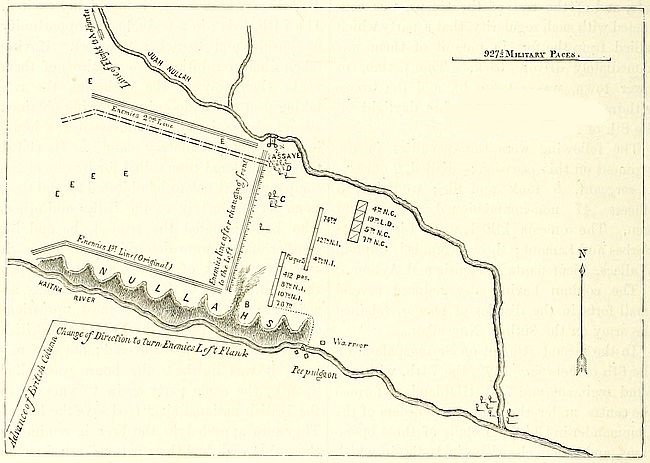
A, the ford from Peepulgaon to Waroor; B, the rising ground which protected the advance; C, four old mangoes; D, screen of prickly pear, covering Assaye; E E E E, 30,000 of the enemy’s cavalry.
Several of the enemy also coming up from the bed of the river and other ways, attacked and killed a good many of the British artillerymen. A considerable number also who, after the fashion of Eastern warfare, had thrown themselves on the ground as dead, regained possession of the guns of their first line, which had been taken and passed, and from them opened a fire of grape upon the British rear. The guns of the 78th, with the escort under Lieutenant Cameron, escaped, and joined the regiment as it halted opposite to the enemy’s second line.
The British infantry was now in one line, the 78th on the left of the whole; and as it had the longest sweep to make in the wheel, it came up last. When the dust cleared a body of the enemy’s best cavalry was seen a little in advance of the left flank, purposing to turn it, on which the left wing of the 78th was thrown back at a small angle, and preparations were made for opening the two guns, which at that moment came up. It is impossible to say too much for the behaviour of the infantry at this awful crisis. Deprived of the assistance of their own artillery, having the enemy’s second line, untouched and perfectly fresh, firing steadily upon them, flanked by round-shot from the right, grape pouring upon their rear, and cavalry threatening their left, not a word was heard or a shot fired; all waited the orders of the General with the composure of a field-day, amidst a scene of slaughter scarcely ever equalled. This, however, was not of long duration; for the British cavalry came up and drove off the body of horse which threatened the left, and which did not wait to be charged, and General Wellesley ordered the principal part of the line to attack the enemy in front, while the 78th and 7th Native Cavalry moved to the rear and charged the guns which were firing thence. The enemy’s second line immediately retired, one brigade in perfect order—so much so, that it repulsed an attack of the 19th Light Dragoons, at the head of which Colonel Maxwell was killed.
The 78th had great difficulty in clearing the field towards the rear and recovering the guns. The enemy strongly resisted, and three times forced them to change their front and attack each party separately, as none would give way until they were so attacked. Meanwhile, as the regiment marched against the one, the remainder kept up a galling fire of grape, till they were all driven off the field. The enemy’s light troops, who had been out plundering, now appeared upon the ground, and the Mysore horse were ordered to attack them; however, they did not wait for this, but made off as fast as possible. About half-past four the firing entirely ceased, and the enemy set fire to his tumbrils, which blew up in succession, many of them some time later. The corps which retired at first in such good order soon lost it, and threw its guns into the river, four of which were afterwards found, exclusive of ninety-eight taken on the field of battle. Seven stand of colours were taken from the enemy. After plundering their dead, their camp, and bazaar, they retreated along the Juah for about ten miles and made a halt, but on moving again the flight became general. Then casting away their material of every kind, they descended the Adjunteh Ghât into Candeish, and made for the city of Burhanpoor, when they were described as having no artillery, nor any body of men that looked like a battalion, while the roads were strewed with their wounded and their dying.
The loss of the British was most severe. No part of the Mysore or Mahratta allies was actually engaged. Their infantry was with the baggage, and their cavalry not being in uniform, the General was apprehensive of mistakes should any part of them come into action. Between one-half and one-third of the British actually in the field were either killed or wounded. The 78th was fortunate in having but a small proportion of the loss to bear. Lieutenant Douglas and 27 men were killed, and 4 officers, 4 sergeants, and 73 men were wounded. The officers wounded were Captain Alexander Mackenzie, Lieutenant Kinloch, Lieutenant Larkin, and Ensign Bethune (Acting Adjutant). Besides those mentioned, Colonel Adams received a contusion of the collar-bone which knocked him off his horse; Lieutenant J. Fraser a contusion of the leg; and all the other officers were more or less touched in their persons or their clothes. The sergeant-major was very badly wounded, and died a few days afterwards.
General Wellesley had two horses killed under him; and nearly all the mounted officers lost horses, some as many as three.
The loss of the enemy must have been terrible. The bodies of 1200 were found on the field, and it was said that 3000 were wounded. Owing to the part they played in the action, the cavalry were unable to pursue, and the enemy suffered much less in their retreat than they should otherwise have done. This fact, too, enabled many of their wounded to creep into the jungle, whence very few returned; but it is impossible to conjecture the total loss, and all computations probably fall short of the actual amount. Jadoon Rao, Sindiah’s first minister, and the chief instigator of the war, was severely wounded, and died a few days afterwards; and Colonel Dorsan, the principal French officer, was also killed.
Such was the battle of Assaye, one of the most decisive as well as the most desperate ever fought in India.
Major-General Wellesley and the troops under his command received the thanks of the Governor-general in Council for their important services. His Majesty was pleased to order that the corps engaged should bear upon their colours and appointments an elephant, superscribed “Assaye,” in commemoration of the victory; and honorary colours were granted to the 19th Light Dragoons, and the 74th and 78th Highlanders, by the government of India in a general order.[478] For some unknown reason the 78th ceased to use these special colours after leaving India, the 74th being the only one of the three regiments still possessing them.
After various independent movements, Colonel Stevenson, on the 29th of November, formed a junction with General Wellesley at Parterly, on which day the whole of the enemy’s force was discovered drawn up on the plains of Argaum about six miles distant. Their line extended five miles, having in its rear the gardens and enclosures of Argaum, while in its front was the uncultivated plain, which was much cut up by watercourses. The Berar cavalry occupied the left, and the artillery and infantry the left centre. Sindiah’s force, which occupied the right, consisted of one very heavy body of cavalry, with a number of pindarries or light troops on its right again.
The enemy, though nearly as numerous as at Assaye, were neither so well disciplined nor so well appointed, and they had besides only thirty-eight pieces of cannon. The British army, on the other hand, was more numerous than in the late engagement, having been reinforced by Colonel Stevenson’s division. The British moved forward in one column to the edge of the plain. A small village lay between the head of the British columns and the line. The cavalry formed in close column behind this village; and the right brigade formed line in its front, the other corps following and forming in succession. The moment the leading picquet passed the village, the enemy, who was about 1200 yards distant, discharged 21 pieces of cannon in one volley. The native picquets and two battalions, alarmed by this noisy demonstration, which was attended with no injurious consequences, recoiled and took refuge behind the village, leaving the picquets of the 78th and the artillery alone in the field. By the exertions of the officers these battalions were again brought up into line,—not, however, till the 78th had joined and formed into line with the picquets and artillery.
The army was drawn up in one line of fifteen battalions, with the 78th on the right, having the 74th on its immediate left, and the 94th on the left of the line, supported by the Mysore horse. The cavalry formed a reserve or second line. In the advance, the 78th directed its march against a battery of nine guns, which supported the enemy’s left. In the approach, a body of 800 infantry darted from behind the battery, and rushed forward with the apparent intention of passing through the interval between the 74th and 78th. To close the interval, and prevent the intended movement, the regiments obliqued their march, and with ported arms moved forward to meet the enemy; but they were prevented by a deep muddy ditch from coming into collision with the bayonet. The enemy, however, drew up alongside the ditch, and kept up the fire until his last man fell. Next morning upwards of 500 dead bodies were found lying by the ditch. Religious fanaticism had impelled these men to fight.
With the exception of an attack made by Sindiah’s cavalry on the left of Colonel Stevenson’s division, in which they were repulsed by the 6th Native Infantry, no other attempt of any moment was made by the enemy. After this attack the whole of the enemy’s line instantly gave way, leaving all their artillery on the field. They were pursued by the cavalry by moonlight till nine o’clock.
The loss of the British was trifling; no European officer was killed, and only nine wounded, one of whom had his thigh broken. The number of killed and wounded was small, and fell principally upon the 78th, which had eight men killed and about forty wounded; but no officer among the number. In the orders thanking the army for its exertions on this day, General Wellesley particularised the 74th and 78th:—“The 74th and 78th regiments had a particular opportunity of distinguishing themselves, and have deserved and received my thanks.” Colonel Harness being extremely ill, Lieut.-Colonel Adams of the 78th commanded the right brigade in the action; and Major Hercules Scott being in command of the picquets as field-officer of the day, the command of the 78th fell to Captain Fraser. In this action, as at the battle of Assaye, a scarcity of officers caused the colours of the 78th to be carried by sergeants; and it is noticeable that not a shot penetrated the colours in either action, probably owing to the high wind which prevailed and caused them to be carried wrapped closely round the poles. The names of the sergeants who carried the colours at Assaye were Sergeant Leavoch, paymaster’s clerk, afterwards quarter-master; and Sergeant John Mackenzie, senior sergeant of the regiment, and immediately afterwards quarter-master’s sergeant. At Argaum, Sergeant Leavoch, and Sergeant Grant, regimental clerk, afterwards an ensign, and now (1815, says the Record), a lieutenant in the regiment.
“At the battle of Assaye,” General Stewart tells us, “the musicians were ordered to attend to the wounded, and carry them to the surgeons in the rear. One of the pipers, believing himself included in this order, laid aside his instrument and assisted the wounded. For this he was afterwards reproached by his comrades. Flutes and hautboys they thought could be well spared; but for the piper, who should always be in the heat of the battle, to go to the rear with the whistlers was a thing altogether unheard of. The unfortunate piper was quite humbled. However, he soon had an opportunity of playing off this stigma; for in the advance at Argaum, he played up with such animation, and influenced the men to such a degree, that they could hardly be restrained from rushing on to the charge too soon, and breaking the line. Colonel Adams was indeed obliged to silence the musician, who now in some manner regained his lost fame.”
The next, and, as it turned out, the last exploit of General Wellesley’s army, was against the strong fort of Gawilghur, which was taken by assault on the 13th of December. It, however, continued in the field, marching and counter-marching, till the 20th of July, 1804, when the 78th reached Bombay.
The regiment remained in quarters at Bombay till May, 1805, when five companies were ordered to Baroda in the Goojerat. The strength of the regiment was kept up by recruits, chiefly from the Scotch militia, and latterly by reinforcements from the second battalion, 800 strong, added to the regiment in 1804. In July, 1805, a detachment of 100 recruits arrived from Scotland. The regiment removed to Goa in 1807, whence it embarked for Madras in March, 1811.
“The numerical strength of this fine body of men was less to be estimated than their character, personal appearance, efficiency, and health. Upwards of 336 were volunteers from the Perthshire and other Scotch militia regiments, and 400 were drafts from the second battalion, which had been seasoned by a service of three years in the Mediterranean. Such was the stature of many of the men that, after the grenadier company was completed from the tallest men, the hundred next in height were found too tall and beyond the usual size of the light infantry. The harmony which so frequently subsisted between Highland corps and the inhabitants of the countries where they have been stationed, has been frequently observed. In Goa it appears to have been the same as elsewhere. The Condè de Surzeela, Viceroy of Portuguese India, on the departure of the regiment from under his command, embraced that opportunity ‘to express his sentiments of praise and admiration of the regular, orderly, and honourable conduct of His Britannic Majesty’s 78th Highland regiment during the four years they have been under his authority, equally and highly creditable to the exemplary discipline of the corps, and to the skill of the excellent commander; and his Excellency can never forget the inviolable harmony and friendship which has always subsisted between the subjects of the regent of Portugal and all classes of this honourable corps.’”[479]
On the 14th of March, 1811, the regiment embarked, and sailed in three transports for Madras. Very few men were left behind sick. The strength embarked was 1027, of whom 835 were Highlanders, 184 Lowlanders, and 8 English and Irish.
The transports arrived at Madras on the 10th of April, but the regiment was not landed, and sailed on the 30th with the last division of troops detailed for the expedition under the command of Lieut.-General Sir Samuel Auchmuty, destined for the capture of Java.
On the 5th of June the last division of the troops arrived at Malacca, when the army was formed into four brigades as follows:—The first or advanced brigade, under Colonel Gillespie, was composed of the flank battalions (formed by the rifle and light companies of the army), a wing of the 89th, a battalion of marines, of Bengal Light Infantry, and of volunteers, three squadrons of the 22nd Dragoons, and some Madras Horse Artillery. The left flank battalion was formed by the rifle and light companies of the 78th, the light company of the 69th, and a grenadier company of Bengal Native Infantry, and was commanded by Major Fraser of the 78th. The second brigade, commanded by Colonel Gibbs of the 59th, consisted of the 14th and 59th, and a battalion of Bengal Native Infantry. The third brigade, commanded by Colonel Adams of the 78th, was composed of the 69th and 78th, and a battalion of Bengal Native Infantry. The 78th was commanded by Brevet Lieut.-Colonel Campbell, and the light battalion by Major Forbes of the 78th. At Goa, a company of marksmen had been formed in the 78th, under the command of Captain T. Cameron, and at Madras they had received a rifle equipment and clothing. The reserve, under Colonel Wood, was composed entirely of Native Infantry. Attached to the army were detachments of Bengal and Madras Artillery and Engineers; and the whole force amounted to about 12,000 men, of whom about half were Europeans.
Early in June the fleet sailed from Malacca, and on the 4th of August came to anchor off the village of Chillingching, about twelve miles to the eastward of Batavia, and the troops landed without opposition. On the 7th the advance took up a position within two miles of Batavia, and on the 8th the magistrates surrendered the city at discretion.
It was understood that General Jumelle, with 3000 men, held the cantonment of Weltevreeden, about three miles from the city; and that about the same distance further on lay the strongly entrenched camp of Cornelis, where the greater portion of the French force, about 10,000 men, were posted under command of General Jansen, the governor.
Before daybreak, on the morning of the 10th, the advance marched against Weltevreeden, and the enemy was discovered strongly posted in the woods and villages. His right was defended by the canal called the Slokan; his left was exposed, but the approach in front and flank was defended by a marsh and pepper plantations, and the road rendered impassable by a strong abbatis of felled trees. The enemy’s infantry, enforced by four field-pieces served with grape, was drawn up behind this barrier, and commenced a destructive fire upon the head of the column as it advanced. Captain Cameron, who was in advance with his rifle company, was severely wounded, and a number of his men killed or disabled while entangled in the abbatis. Captain Forbes, with the aid of the light company, was then ordered to charge the obstacle; but he met with such resistance, that, after losing 15 out of 37 men, Colonel Gillespie directed him to retire and cross the ditch to the enemy’s left. Lieutenant Munro was killed here while in command of a party detailed to cover the British guns. An order was now given to turn the enemy’s left, which after a little delay succeeded,—“the grenadier company of the 78th, as in every Eastern field of fame, heading the attack.”[480] The grenadiers, in company with a detachment of the 89th, under Major Butler, carried the enemy’s guns after a most obstinate resistance, the gunners being cut down or bayoneted almost to a man. The general wrote—“The flank companies of the 78th (commanded by Captains David Forbes and Thomas Cameron) and the detachment of the 89th, particularly distinguished themselves.” The main body of the force shortly after came up, and the villages having been fired, the camp was occupied, and its war material, consisting of 300 guns, and a vast quantity of stores, taken possession of. The enemy’s loss was said to be very heavy, and the Brigadier-General Alberti was dangerously wounded. The British loss fell principally upon the 78th and 89th, the former having 33 men killed and wounded, besides the officers mentioned. By the occupation of Weltevreeden, the army obtained a good communication with Batavia and the fleet, a healthy situation, the command of the country and supplies, and a base of operations against the main position of Cornelis.
On the night of the 21st, when in company with the 69th, the 78th relieved Colonel Gillespie’s brigade in the advance. Early on the morning of the 22nd, three English batteries being nearly completed, the enemy made a sortie from Cornelis, and obtained possession of two of them, whence they were driven by a party of the 78th, which happened, fortunately, to be in the trenches at the time, under Major Lindsay and Captain Macleod. The battery on the right was energetically defended by Lieutenant Hart and a company of the 78th, who repulsed the enemy’s attack with considerable loss.
The camp of Cornelis was an oblong of 1600 by 900 yards. It was strongly entrenched: the river Jacatra or Liwong flowed along its west side, and the canal, called the Slokan, washed the east. Neither was fordable, and the banks of the river were steep and covered with jungle, while on the canal and beyond it powerful batteries were raised. The north and south faces were defended by deep ditches, which could be inundated at pleasure, and were strengthened with palisades, fraises, and chevaux de frise. These faces between the river and canal were further protected by seven formidable redoubts, constructed by General Daendels, and numerous batteries and entrenchments. A strong work also covered and protected the only bridge which communicated with the position, and which was thrown across the Slokan. The entire circumference of the works was about five miles; they were mounted with 280 pieces of cannon, and were garrisoned by over 10,000 men, of whom about 5000 were Europeans, and the remainder disciplined native regiments, commanded by French and Dutch officers.
Sir Samuel Auchmuty had broken ground on the 20th, at 600 yards distance from the works; and on the 24th, though no practicable breach had been made, the general being apprehensive of the danger of delay, determined upon an assault. The command of the principal attack was entrusted to Colonel Gillespie. The advance guard was formed by the rifle company of the 14th, while the grenadiers of the 78th led the column, to which the light and rifle companies also belonged. Immediately after midnight of the 25th Colonel Gillespie marched, but his advance was impeded by the darkness of the night and the intricacy of the country, which was parcelled out into pepper and betel gardens, and intersected with ravines, so that the troops were frequently obliged to move in single file. Towards daylight it was found that the rear division, under Colonel Gibbs, had strayed, but as it was impossible to remain long concealed, and to retreat would have been to abandon the enterprise, it was determined to assault without them. With the earliest streak of dawn the column was challenged, but the men, advancing with fixed bayonets at the double, speedily annihilated the enemy’s picquets, and obtained possession of the protecting redoubt No. 3. At the same time the grenadiers of the 78th rushed up on the bamboo bridge over the Slokan, mingling with the fugitives, and thus prevented its destruction by them. Owing to the darkness still prevailing, many of the men fell over the bridge into the canal, and were with difficulty rescued; while everywhere the carnage was terrific, the road being enfiladed by numerous pieces of artillery. The left of the attack now stormed and carried a large redoubt, No. 4, to the left of the bridge, which was strongly palisaded, and mounted upwards of twenty 18-pounders, besides several 24 and 32-pounders. Colonel Gibbs also came up at this moment, and his force was joined by a portion of the 78th, under Captain Macleod and Lieut. Brodie, who carried the redoubt No. 1 to the right; but scarcely had his advance entered when it blew up with a tremendous explosion, by which many of both parties were killed. It was said that a train had been fired by some of the enemy’s officers, but this has never been proved. Lieut.-Colonel Macleod’s (69th) attack against redoubt No. 2 was also completely successful, though the army had to deplore the loss of that gallant officer in the moment of victory. “Major Yule’s attack was equally spirited, but after routing the enemy’s force at Campong Maylayo, and killing many of them, he found the bridge on fire, and was unable to penetrate further.”[481] He therefore had to content himself with firing across the river. The two attacks now joined, and, under Colonel Gillespie, advanced to attack a body of the enemy inforced by a regiment of cavalry, which was stationed on a rising ground above the fort, and protected their park of artillery. The fire was very heavy, and though the British actually reached the mouths of the enemy’s guns, they were twice driven back, but rallying each time, they made a final charge and dislodged the enemy. Here Lieutenants Hart and Pennycuik of the 78th were wounded, the former having his thigh broken in two places by a grape-shot. The commander-in-chief now ordered a general attack upon the north face, which was led by Colonel Adams’ brigade, and “the heroic 78th, which, though long opposed, now burst in with loud shouts in the front of the line, and successively carried the works on either hand.”[482] The regiment, under Lieut.-Colonel Campbell, advanced along the high road, crossed the ditch and palisade under a very heavy fire of grape and musketry, and carried the enemy’s work in that direction. Two companies, under Colonel Macpherson, proceeded along the bank of the Slokan and took possession of the dam-dyke, which kept back the water from the ditch, thus preventing the enemy from cutting it, and leaving the ditch dry for the main body of the regiment to cross. In this service “Captain Macpherson was wounded in a personal rencontre with a French officer.”[483] The loss of the 78th in this part of the action was very heavy. Lieutenant-Colonel Campbell had both his thighs shattered by a grape-shot, and died two days afterwards, and Captain William Mackenzie and Lieutenant Matheson were also wounded. The regiment was necessarily much broken up in crossing the ditch and palisades, but soon re-formed, and completed the rout of the enemy.
In the space of three hours from the commencement of the action, all the enemy’s works were in the possession of the British.
The loss of the enemy in killed, during the attack and pursuit, was nearly 2000. The wounded were estimated at about 3000, while between 5000 and 6000 prisoners were taken, mostly Europeans, including a regiment of Voltigeurs lately arrived from France.
The main body of the 78th lost 1 field officer (Lieut.-Colonel Campbell) and 18 rank and file killed, and 3 sergeants and 62 rank and file wounded; its total of killed and wounded, including the three companies with Colonel Gillespie’s attack, being 164.
A force, which had been sent by sea to Cheribon to intercept General Jansen’s retreat into the eastern portion of the island, having arrived two days after he had passed, Sir Samuel Auchmuty determined to undertake the pursuit. Accordingly, on the 5th of September, he embarked at Batavia with the 14th and 78th Regiments, the grenadiers of the 3rd Volunteer Regiment, and some artillery and pioneers, less than 1000 men in all, with six field-pieces. The headquarters, grenadier, rifle, and one battalion company of the 78th sailed in the “Mysore,” under Major Fraser, and the remaining seven companies, under Major Lindsay, in the “Lowjee Family.” On the 12th the troops commanded by Major Lindsay landed at Samarang, and occupied the town without opposition, and learnt that a considerable body of the enemy, principally cavalry, was strongly posted upon the hills of Serondole, about 5 or 6 miles distant. On the 16th the whole force, under the command of Colonel Gibbs, advanced against Serondole at an early hour. Although the position of the enemy was most formidable, his troops gave way on all hands.
On the morning of the 18th a flag of truce arrived from General Jansen, accepting unconditionally any terms Sir Samuel Auchmuty might suggest. These were that the governor should surrender himself and his army prisoners of war, resign the sovereignty of Java and all the Dutch and French possessions in the East Indies into the hands of Great Britain, who should be left free with regard to the future administration of the island, the guarantee of the public debt, and the liquidation of paper money.
Thus the fertile island of Java and its rich dependencies, the last colonial possession of France, was wrested from her by British prowess.
The regiment remained in Java till September 1816, when it embarked for Calcutta. The only other enterprise we need mention in which the 78th was engaged while in Java was an expedition against the rebellious Sultan of Djokjokarta, when a great amount of treasure was captured, including two solid silver soup-tureens of antique design and exquisite finish, which the regiment still possesses. We must also mention the melancholy death, at Probolingo, on the 18th of May, 1813, of Lieut.-Colonel Fraser and Captain Macpherson at the hands of some fierce banditti, these officers being on a visit to a friend at Probolingo, when the banditti approached the place. Next day a detachment, consisting of 100 of the most active of the grenadier, rifle, and light companies, under Major Forbes of the 78th, marched against the banditti. After marching 64 miles in 18 hours the detachment came up with the main body of the banditti, and the commanding officers thought it advisable to make a halt, in order that the men might obtain some water before proceeding to the attack. The enemy seeing this, and mistaking the motive, advanced boldly and rapidly, headed by their chiefs. When within about 100 yards they halted for a moment, and again advanced to the charge at a run, in a close compact body, at the same time setting up a most dreadful yell. The men on this occasion showed a steadiness which could not be surpassed, not a shot being fired until the enemy was within a spear’s length of their line, when they gave their fire with such effect that it immediately checked the advance, and forced the enemy to retreat with terrible loss. Upwards of 150 lay dead on the spot; one of their chiefs was killed, and two more, who were taken alive that afternoon, suffered the merited punishment of their rebellion. Only a few of the 78th were wounded. The detachment now moved on to Probolingo House, which it was supposed the insurgents would defend, but having lost their principal leaders they dispersed without making any further stand. Their force was estimated to have amounted to upwards of 2500 men. The same evening the bodies of Colonel Fraser and Captain Macpherson were brought in and interred in the square of Probolingo.
During the period of its residence in Java the men of the regiment had suffered extremely from the climate. Of that splendid body of men, which in 1811 had left Madras 1027 strong, about 400 only now remained, and strange to say, it had been observed that the stoutest and largest men fell the first victims to disease.
The headquarters, in the “Guildford,” sailed from Batavia roads on the 18th of September, and arrived safely at Calcutta on the 29th of October.
The “Frances Charlotte,” with the remaining six companies, under Major Macpherson, had a fine passage up the Bay of Bengal, until the night of the 5th of November, when the vessel struck upon a rock about 12 miles distance off the island of Preparis. Fortunately the weather was moderate, but the ship carrying full sail at the time, struck with such violence that she remained fast, and in fifteen minutes filled to her main-deck.
“Now was displayed one of those examples of firmness and self-command which are so necessary in the character of a soldier. Although the ship was in the last extremity, and momentarily expected to sink, there was no tumult, no clamorous eagerness to get into the boats: every man waited orders, and obeyed them when received. The ship rapidly filling, and appearing to be lodged in the water, and to be only prevented from sinking by the rock, all hope of saving her was given up. Except the provisions which had been brought up the preceding evening for the following day’s consumption, nothing was saved. A few bags of rice and a few pieces of pork were thrown into the boats, along with the women, children, and sick, and sent to the island, which was so rocky, and the surf so heavy, that they had great difficulty in landing; and it was not until the following morning that the boats returned to the ship. In the meantime, a small part of the rock on which the ship lay was found dry at low water, and covered with little more than a foot of water at full tide. As many as this rock could admit of (140 men) were removed on a small raft, with ropes to fix themselves to the points of the rock, in order to prevent their being washed into the sea by the waves at high water. The highest part of the rock was about 150 yards from the ship. It was not till the fourth day that the boats were able to carry all in the ship to the island, while those on the rock remained without sleep, and with very little food or water, till the third day, when water being discovered on the island, a supply was brought to them.