Volume 2 / Part 3 — PART THIRD. HISTORY OF THE HIGHLAND REGIMENTS. (continued 12)
Reading edition
The 74th embarked at Cork for Halifax, Nova Scotia, on the 13th of May, leaving one depôt company, which was sent to the Isle of Wight. The companies were divided between St John’s, Newfoundland, St John’s, New Brunswick, and Frederickton, where were headquarters and five companies. The regiment remained in North America till 1828, in August of which year proceeding to Bermudas, which it left at the end of the next year for Ireland, where it arrived in the beginning of 1830. In 1818 the regiment had been reduced to ten companies of 65 rank and file each, and in 1821 it was further reduced to eight companies of 72 rank and file. In 1825, however, the strength was augmented to ten companies—six service companies of 86 rank and file, and four depôt companies of 56 rank and file each.
The regiment remained in Ireland till 1834, during part of which time it was actively employed in suppressing the outrages consequent on the disturbed state of the country. In the latter part of 1834 the regiment was divided into four depot and six service companies; three of the latter were sent to Barbadoes, while the headquarter division, consisting of the three remaining companies, was sent to the island of Grenada. In November 1835 the two service divisions were sent to Antigua, where they remained till February 1837. From thence the headquarter division proceeded to St Lucia, and the other three companies to Demerara, both divisions being sent to St Vincent in June of the same year. The regiment was kept moving about among these western islands till May 1841, when it proceeded to Canada, arriving at Quebec at the end of the month. While the regiment was stationed at Trinidad it was attacked by fever and dysentery, which caused great mortality; and fever continued to prevail among the men until the regiment removed to Trinidad. With this exception the 74th remained remarkably healthy during the whole of its residence in the West Indies.
The 74th remained in the North American colonies till 1845, being removed from Canada to Nova Scotia in May 1844, and embarking at Halifax for England in March 1845. On arriving in England in the end of that month, the service companies joined the depot at Canterbury.
While the regiment was stationed in Canterbury, Lieutenant-Colonel Crabbe, commanding the regiment, submitted to the Commander-in-Chief, through the colonel (Lieutenant-General Sir Phineas Ryall), the earnest desire of the officers and men to be permitted to resume the national garb and designation of a Highland regiment, under which the 74th had been originally embodied.
The lieutenant-colonel having himself first joined the regiment as a Highland corps in the year 1807, and having served with it continuously during the intervening period, knew by his own experience, and was able to certify to the Commander-in-Chief, how powerfully and favourably its character had been influenced by its original organisation; and also that throughout the varied services and changes of so many years, a strong national feeling, and a connection with Scotland by recruiting, had been constantly maintained. Various considerations, however, induced an application for permission to modify the original dress of kilt and feathered bonnet, and with the resumed designation of a Highland corps, to adopt the trews and bonnet as established for the 71st regiment.
His Grace the Duke of Wellington was pleased to return a favourable answer to the application, in such terms as to render his consent doubly acceptable to the corps, causing it to be intimated to the colonel, by a letter from the adjutant-general, bearing date ‘Horse Guards, 13th August 1845,’ that he would recommend to Her Majesty that the 74th Regiment should be permitted to resume the appellation of a Highland regiment, and to be clothed “accordingly in compliment to the services of that regiment so well known to his Grace in India and in Europe.”
In the “Gazette” of the 14th November 1845 the following announcement was published:—
“War Office, 8th November 1845.
“Memorandum,—Her Majesty has been graciously pleased to approve of the 74th foot resuming the appellation of the 74th (Highland) Regiment of foot, and of its being clothed accordingly; that is, to wear the tartan trews instead of the Oxford mixture; plaid cap instead of the black chaco; and the plaid scarf as worn by the 71st Regiment. The alteration of the dress is to take place on the next issue of clothing, on the 1st of April 1846.”
The national designation of the regiment was of course immediately resumed, and the recruiting has been since carried on solely in Scotland with uniform success.
It was directed by the Adjutant-General that the tartan now to be worn by the 74th should not be of the old regimental pattern, that being already in use by two other regiments (the 42nd and 93rd), but that it should be distinguished by the introduction of a white stripe. The alteration of the regimental dress took place as ordered, on the 1st of April 1846.
In May 1846, Lieutenant-Colonel Crabbe, who had been connected with the regiment for forty years, retired on full pay, and took leave of the regiment in a feeling order. Major Crawley was promoted to the lieutenant-colonelcy in his place.
II. 1846–1853.
Return to Scotland—United at Glasgow—Ireland—South Africa—Hottentot outbreak—Change of dress of the Regiment—Field operations—At the Quesana—The Amatola Heights—Hottentots repulsed—Another engagement—Lieutenant-Colonel Fordyce left in command at Riet Fontein—The Kaffirs at Fort Beaufort—Captain Thackeray’s testimony—Movements of Lieutenant-Colonel Fordyce—His death—Major-General Somerset’s Movements in the Amatolas—Loss of the “Birkenhead.”
After being stationed a short time at Canterbury and Gosport, the 74th removed to Scotland in detachments in the months of August and September 1846, two companies being sent to Dundee, three to Paisley, one to Perth, headquarters and three companies to Aberdeen, and detachments to Stirling and Dunfermline. In November of the same year, all the companies united at Glasgow, and in July 1847 the regiment proceeded to Ireland. While stationed at Dublin, the 74th, in consequence of the disturbed state of Tipperary, was sent to that county on July 29th, to be employed as part of a movable column under Major-General Macdonald. The regiment, along with the 75th and 85th, a half battery of Artillery, a detachment of Sappers, and three companies of the 60th Rifles, the whole forming a movable column, was kept moving about in the neighbourhood of Thurles and Ballingarry during the month of August. Happily, however, the column had none of the stern duties of war to perform, and returned to Dublin in the beginning of September, after having suffered much discomfort from the almost incessant rain which prevailed during the time the men were under canvas.
The 74th remained in Ireland till March 1851, on the 16th of which month it sailed in the “Vulcan” from Queenstown, having been ordered to South Africa to take part in the sanguinary Kaffir War of that period, in which, as will be seen, the regiment maintained its well-won reputation for valour in the faithful performance of its duty. The 74th arrived in Simon’s Bay, Cape of Good Hope, on the 11th of May, when it was ordered to proceed to Algoa Bay to join the first division at Fort Hare, under Major-General Somerset, who was engaged in active operations against the Kaffirs and Hottentots. Having arrived at Algoa Bay on the 16th, the regiment disembarked at Fort Elizabeth, where, owing to the want of transport for the camp equipage, it remained for a few days before proceeding to Grahamstown, which, from want of grass and the consequent weak condition of the oxen, it did not reach till the 27th of May.[452]
While the 74th was at Grahamstown, a sudden outbreak of the Hottentots at the mission station of Theopolis occurred. Four companies of the regiment, under the command of Lieutenant-Colonel Fordyce, together with a few native levies, proceeded to the scene of disturbance, and succeeded in destroying the rebel camp, and capturing about 600 head of cattle; the Hottentots, however, made their escape.
The regiment having resumed its march for Fort Hare, arrived at that place on June 12th, and encamped near the fort. Though but a few days in the country, Colonel Fordyce saw that the ordinary equipment of the British soldier was in no way suited to African campaigning, and while at Fort Hare he made a complete change in the appearance of the regiment. The dress bonnets, scarlet tunics, black pouches, and pipe-clayed cross belts, were put away in the quartermaster’s stores. Common brown leather pouches and belts were issued, while an admirable substitute for the tunic was found in the stout canvas frocks of which a couple are served out to each soldier proceeding on a long sea voyage. These had been carefully preserved when the regiment landed, and now, with the aid of copperas and the bark of the mimosa bush, were dyed a deep olive brown colour, which corresponded admirably with that of the bush, and was the least conspicuous dress of any regiment in the field, not excepting the Rifle Brigade and 60th, both of which corps had a battalion engaged. The cuffs and shoulders were strapped with leather, and this rough-looking but most serviceable tunic was worn by both officers and men as long as they were actively employed in the field. The forage cap, with a leather peak, completed the costume.
On the 18th of June Major-General Somerset ordered the following troops, divided into brigades, to form a camp in advance for field operations:—
First Brigade—Lieutenant-Colonel Fordyce, 74th Highlanders: the 74th Highlanders; the 91st Regiment; the 1st European Levy; and the Alice European Levy.
Second Brigade—Lieutenant-Colonel Sutton, Cape Mounted Riflemen: the George Levy, the Graaff Reynett Levy, the Kat River Levy, and the Fingo Levies.
Cavalry Brigade-Major Somerset, Cape Mounted Riflemen: the Royal Artillery, the Cape Mounted Riflemen, the George Mounted Levy, and Blakeway’s Horse; and besides, a detachment of Royal Sappers and Miners, under the orders of Lieutenant Jesse, R.E., Deputy Quartermaster-General.
These troops marched from Fort Hare on the 24th for the Quesana River; near the base of the Amatola Mountains, where a standing camp was formed.
The division moved before daylight on the 26th of June, and ascended in two columns the western range of the Amatola heights, halting on the ridge while Major-General Somerset reconnoitered the position of the enemy. While doing so, his escort was attacked, but on the arrival of a reinforcement the enemy was driven from his position, and forced into the valley below. While these operations were in progress, the 74th Highlanders, Cape Mounted Rifles, European and Kat River Levies, with the Alice and Port Elizabeth Fingoes, were moved into the Amatola basin. A formidable body of the enemy, chiefly Hottentots, were now seen strongly posted on the extreme point of the ridge of the northern range of the Amatolas, partly concealed and well covered by large stones and detached masses of rock; these the 74th, flanked by the Alice and Port Elizabeth Fingoes, under Lieutenant-Colonel Fordyce, was ordered to dislodge. The enemy opened a galling fire upon the advancing troops, but the 74th deployed into extended line, and having opened fire, drove the Hottentots from their position and gained the summit. After moving along the ridge, which was intersected by a narrow strip of forest bush, the troops were again attacked, and three men of the 74th killed. Having halted for a short time to refresh themselves, the 74th, flanked by the Fort Beaufort Fingoes, was again moved on the enemy’s position, when some sharp firing took place, and the enemy was compelled to abandon his position altogether, retiring into the forest and mountains. The division descended into the Amatola basin, and at 5 P.M. bivouacked for the night. It was reported that some Gaika chiefs and a considerable number of the enemy were killed on this occasion; while the casualties in the 74th were one corporal and two privates killed, and one officer, Lieutenant W. W. Bruce, and nine men wounded. Nothing of importance occurred during the next two days, and on the 29th the division marched to the camp on the Quesana.
The conduct of the 74th in the above services was highly spoken of in various orders, but we need only quote from a general order by Lieutenant-General Sir Harry Smith, Bart., dated “Headquarters, King William’s Town, 3rd of July, 1851:—
“Lieutenant-Colonel Fordyce and the 74th Highlanders seized every opportunity of assailing them and driving them before them, and the Major-General reports in the strongest terms of admiration the gallantry and the discipline of the corps.”
On the 2nd of July the division again ascended the Amatolas, and its operations were thus detailed by Major-General Somerset in the following letter to the Deputy Quarter-master-General:—
“Camp on the Kamka or Yellow Woods, “3d July 1851.
“Sir,—I have the honour to acquaint you, for the information of his Excellency the Commander-in-Chief, that I proceeded with my division yesterday morning, and ascended the Amatola, with the view of clearing the eastern range of the Victoria Heights, and also of again attacking the enemy’s fastnesses in the forest, at the southern point of Hogg’s Back Ridge. This latter point was thoroughly cleared by the European Levy and a company of the 91st under Lieutenant Mainwaring. The enemy abandoned the forest when their huts were destroyed, and took refuge in the extreme and highest points of the Chumie Mountains. I then directed my attention to the southern point of the Victoria Heights, placing a gun under Lieutenant Field; the 74th Highlanders, under Lieutenant-Colonel Fordyce; and the Cape Mounted Rifles, under Major Somerset, in position on the middle ridge. I detached the Graaff Reynett Levy, under Captain Heathcote, senior, the Fort Beaufort Fingoes, under Captain Verity, and destroyed all the kraals east of the Victoria range. While this movement was going on, I detached Captains Cumbers and Ayliff with their levies, and Captain Hobbs with the Kat River Levy, down the valley of the Amatola, destroying all the kraals at the base of the middle ridge, and nearly succeeded in capturing the Kaffir chief Oba or Waba, Tyali’s son, whom I saw lately with the Commander-in-Chief at Fort Cox, as it was his kraal that was surprised by the Kat River Levy under Captain Hobbs, and his wives and family, with all their household property, were captured, including the chief’s crane feathers for his tribe, his smart forage cap and jacket, given to him by his Excellency, and much other property; and distinctly saw the chief ride off from his kraal just before the patrol got there. The enemy was completely routed, and made off in every direction. In my attack on the Amatola position on the 26th instant, the chiefs Beta and Pitoi, the son of Vongya (brother of the late Tyali), were killed, and many others of less note. This information I have received from the Kaffir Dakana, residing at the Quilli station.”
In a despatch from the Governor, Lieutenant-General Sir Harry Smith, Bart., to Earl Grey, the regiment is mentioned as follows:—
“Major-General Somerset speaks in the highest terms of Lieutenant-Colonel Fordyce and the 74th Regiment, recently arrived from England, upon whom the brunt of these operations fell in the first division.”
During the next month the standing camp of the division was moved about from place to place, and patrolling parties were constantly sent out to check the depredations of the enemy. About the middle of August, when the standing camp was fixed at Riet Fontein, Major-General Somerset proceeded to Lower Albany with a large portion of the division, leaving Lieutenant-Colonel Fordyce, of the 74th Highlanders, in command of the troops remaining in camp.
Lieutenant-Colonel Sutton, Cape Mounted Rifles, commanding at Fort Beaufort, communicated with Lieutenant-Colonel Fordyce, about the beginning of September, regarding many bold and frequently successful attempts at the robbery of cattle made by the hordes of Kaffirs in the neighbourhood of that post, which it became necessary, if possible, to check. A force, consisting of 11 officers and 245 men of the 74th Highlanders, 3 officers and 36 men of the Cape Mounted Rifles, and 22 officers and 372 men of the various levies in camp and at Fort Beaufort, were assembled at Gilbert’s farm, on the Klu Klu, on the night of the 7th of September, and marched about 2 o’clock A.M. on the 8th, under Lieutenant-Colonel Fordyce, to the lower edge of the Kroome, where they arrived at dawn, but found none of the enemy in that locality. The force ascended the Kroome heights by the steep and difficult ridge called the Wolf’s Head. It being well known that the enemy, under the Gaika chief Macomo, were in great force in the adjacent valleys of the Waterkloof, Fuller’s Hoek, and Blinkwater, it was determined to halt in a hollow, where there was good water, until future operations were determined upon. Strong picquets were posted on the surrounding ridges, and the usual precautions taken to guard against surprise. Some large bodies of the enemy were seen collecting at various points, and about 3 P.M. the alarm was given that the Kaffirs were approaching in great force. They ran almost with the speed of greyhounds, but the troops, many of whom had to toss away their half-cooked dinners, got under arms with the utmost promptitude, and were soon posted in extended order on the ridges surrounding the bivouac, reinforcing the picquets. The enemy approached in swarms from all quarters of the contiguous bush, and as soon as they were within range, opened fire, which they kept up without intermission for about half an hour. Their force, at the lowest computation, was about 2000 men, and was led by Macomo in person, who was seen riding about on a white charger, well out of range. The troops being posted behind a ridge, were enabled to keep up a sharp fire without much danger to themselves, and the enemy were soon compelled to withdraw to the bush. Nearly half of the ammunition being now expended, the troops were ordered to retire; and Lieutenant-Colonel Sutton, with a few mounted men, was directed to occupy the pass leading from Kroome heights to Niland’s farm. Between two and three hundred mounted Kaffirs were now seen endeavouring to turn the left flank, but they were kept in check, and all the troops were enabled to gain the pass—a narrow defile, in many parts of which not more than four or five men could walk abreast. The retreat was going on with perfect regularity, when a strong force of the enemy opened fire from the bush, and a detachment of the Fort Beaufort Fingoes became panic-stricken, rushing among the regular troops in great disorder, and thereby preventing them from using their arms with effect against the enemy. This no doubt encouraged the Kaffirs, who, seizing the advantage, rushed from the bush and stabbed many of the men with their assegais. The enemy continued their fire until the troops cleared the bush, but they scarcely showed themselves beyond it. The ammunition being nearly expended, the retreat was continued until the force arrived at Gilbert’s farm, which they did shortly after dark, and bivouacked there for the night, sending an express to Riet Fontein for waggons to convey the wounded to camp. The casualties in the regiment on this occasion were 8 privates killed, and 1 officer, Lieutenant John Joseph Corrigan, 1 corporal, and 8 privates wounded. Hans Hartung, who had for many years been bandmaster of the regiment, and was much respected by all ranks, lost his life on this occasion; he had accompanied the force as a volunteer.
The troops returned to Riet Fontein and Fort Beaufort, on the following day.
An officer,[453] who was with the regiment during the whole of this war, states that this was the only instance in which the 74th really met the Kaffirs face to face, and the latter even then had the advantage of possessing a thorough knowledge of the intricacies of the bush, and were in overwhelming numbers. There were numerous hand-to-hand conflicts, and several of the enemy were killed with the bayonet.
Major-General Somerset having arrived at Riet Fontein in September, the division marched on the 3rd of October to Fort Beaufort and encamped there, awaiting the arrival of reinforcements from the second division, under Lieutenant-Colonel Michel, of the 6th Regiment, intended to act with the first division in a combined attack on the Waterkloof, Kroome Heights, and Fuller’s Hoek.
The necessary preparations having been made, Lieutenant-Colonel Fordyce marched on the 13th of October with the Reserve Battalion 12th Regiment, Beaufort West Levy, Graaf Reynett Mounted Levy, and Fort Beaufort Mounted Troop. The Major-General had previously proceeded with the Cape Mounted Riflemen and Fort Beaufort Fingo Levy to meet Lieutenant-Colonel Michel on his march from King William’s Town.
The force under Lieutenant-Colonel Fordyce arrived at the Gola River on the afternoon of the 13th, and on the southern point of the Kroome Heights about sunrise next morning. The Waterkloof and Kroome Heights were that morning enveloped in a dense fog, which for a time prevented Lieutenant-Colonel Fordyce from acting in concert with the Major-General, according to previous arrangement; but about noon the fog cleared away, and the Major-General was then seen to be engaged with the enemy at the head of the Waterkloof. Lieutenant-Colonel Fordyce joined him with his brigade, and the enemy having been dispersed, they all marched to Mandell’s farm, where they remained until the morning of the 16th.
The force was now divided. Lieutenant-Colonel Fordyce’s brigade, reinforced by the Reserve Battalion 91st Regiment, marching by the Bush Nek to the entrance of the Waterkloof; while the remainder of the division, under the personal command of the Major-General, proceeded to the head of the Waterkloof. Lieutenant-Colonel Fordyce, on his arrival at the entrance of the Waterkloof, extended a line of skirmishers across the valley, seeing but few of the enemy, and meeting with no opposition until they emerged from the bush at the head of the Waterkloof, when a brisk fire was opened upon them; fresh skirmishers were thrown out, and the enemy dispersed. The force then joined the Major-General near Mount Misery, and the division marched to Eastland’s Farm and bivouacked. The casualties in the regiment on this occasion were 2 privates killed, and 1 lance-corporal and 1 private wounded.
In another skirmish at the head of the Waterkloof, on the 23rd, 2 privates were killed and 2 wounded.
Various operations were carried on at the head of the Waterkloof and Kroome heights until the 28th, when Lieut.-Colonel Fordyce’s brigade was ordered to the Blinkwater, where it arrived the same day, having been in the field exposed to heavy rains, and frequently with only one blanket per man, and since the 13th without tents.
The Commander-in-Chief, Sir Harry Smith, spoke, in his general order of October 31, in deservedly high terms of the conduct of the officers and men in these most trying duties; for this kind of desultory warfare, entailing constant marches from place to place without shelter, amid almost constant frost, snow, wind, and rain, and frequently with short supplies of food, and even of ammunition, against an immense number of savages, with whom it is impossible to come to close quarters, is far more trying to the temper and endurance of soldiers than a series of pitched battles with a powerful, well-disciplined, and well-equipped enemy.
This particular post of the enemy, at the head of the Waterkloof, was one which seemed almost impregnable, although it was held by only a few hundred Hottentots. The rebels had taken up a position near the summit of the Kloof, which they had fortified with a breastwall of detached rocks, from behind which they long bade defiance to all efforts to eject them. Occasionally, when the British soldiers were receding from the bush, the enemy would appear in the open ground, firing at the former with fatal precision, and seeming as if to invite them to open combat. Our brave soldiers accepting the challenge, and returning towards the Hottentots, or “Totties,” as they were facetiously called, the latter would precipitately retreat to their stronghold, reappearing when their opponents’ backs were turned, sending death to many a poor fellow, whose brave comrades could never get a chance to avenge him. Such a mode of warfare is harassing in the highest degree. It was at the deathful Waterkloof that the 74th sustained the loss of one of its bravest and best-beloved officers.
The troops belonging to the second division having marched to King William’s Town, and the Major-General having assembled at the Blinkwater all the available force of the first division, he ascended the Blinkwater Hill on the 4th of November, and bivouacked at Eastland’s Farm, leaving the tents and baggage at the Blinkwater under a guard.
On the morning of the 6th of November the infantry under Lieutenant-Colonel Fordyce marched about two hours before daylight, the cavalry under the Major-General following at dawn, to the head of the Waterkloof, where, as we have said, a considerable party of the enemy was seen posted in strong positions. The infantry, under Lieutenant-Colonel Fordyce, were ordered to attack the position. The Colonel led his men in column into the Waterkloof, when suddenly his march was arrested by a rocky precipice which flanked him in the form of a semicircle, where he found the enemy in considerable force, and these knew too well the rules of military tactics to let so favourable an opportunity escape for inflicting a penalty. Though the bayonets of our brave soldiers seemed powerless in such a position—for they had to contend against an enemy concealed among inaccessible rocks—yet Colonel Fordyce placed his men in position for an assault, and it was while calmly surveying them to see that all was ready for the desperate work, that he was struck in the side by a ball, which proved fatal to him in a quarter of an hour. His last words, it is said, were, “What will become of my poor regiment?” He was indeed the father of his regiment, looking with parental solicitude after the comforts of men, women, and children, and by all he was lamented with unfeigned sorrow.[454] His men, notwithstanding their irreparable loss, stood firm against the enemy, and the Major-General having arrived and assumed the command, the enemy was driven from his position, and the troops bivouacked for the night on Mount Misery, near the scene of the day’s operations.
The casualties in the regiment on this occasion were 2 officers (Lieutenant-Colonel Fordyce and Lieutenant Carey), 2 sergeants, and 2 privates killed; and 1 officer, Lieutenant Gordon (who died shortly afterwards), and 8 men wounded. The greater number of the casualties on this occasion occurred in No. 2 company, under the command of Lieutenant Carey, until he was mortally wounded, and then of Lieutenant Philpot. They were opposed to a strong body of the enemy posted behind rocks, but being assisted by the light company, they succeeded in dislodging it.
The bodies of the dead were next day carried in a mule waggon for burial at Post Retief—15 miles across the table-land. “The funeral will never be forgotten by those who were present. The thunder, mingled with the booming artillery, rolled grandly and solemnly among the mountains. As the rough deal coffins were borne out, the ‘firing party,’ dripping wet, and covered with mud, presented arms, the officers uncovered, and we marched in slow time out of the gate and down the road—the pipers playing the mournful and touching ‘Highland Lament’—to where the graves had been dug, a few hundred yards from the Post.”
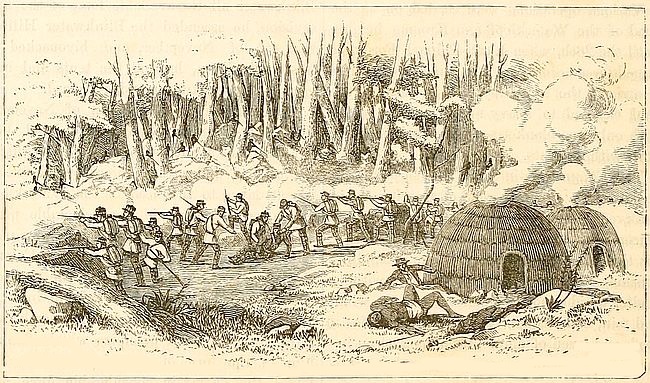
Death of Lieutenant-Colonel Fordyce. From “Campaigning in Kaffirland,” by Captain William Ross King, 74th Highlanders (now Lieut.-Col. unattached).
The following division order by Major-General Somerset by no means exaggerates the soldierly merits of Colonel Fordyce:—
“Camp Blinkwater, “Nov. 9th, 1851.
“It is with the deepest regret that Major-General Somerset announces to the division the death of Lieutenant-Colonel Fordyce, commanding the 74th Highlanders. He fell, mortally wounded, in action with the enemy, on the morning of the 6th, and died on the field.
“From the period of the 74th Highlanders having joined the first division, their high state of discipline and efficiency at once showed to the Major-General the value of Lieutenant-Colonel Fordyce as a commanding officer; the subsequent period, during which the Major-General had been in daily intercourse with Lieutenant-Colonel Fordyce, so constantly engaged against the enemy in the field, had tended to increase in the highest degree the opinion which the Major-General had formed of Lieutenant-Colonel Fordyce as a commander of the highest order, and one of Her Majesty’s ablest officers, and whom he now so deeply laments (while he truly sympathises with the 74th Highlanders in their irreparable loss), as an esteemed brother soldier.”
Small parties of the enemy having again taken up positions near the head of Fuller’s Hoek, they were attacked and dislodged on the 7th; and on the following day the division marched to its camp at the Blinkwater.
The 74th was engaged in no enterprise of importance for the next two months, headquarters having meantime been removed to Fort Beaufort. In January 1852 preparations were made under Major-General Somerset, by the first and second divisions, for a combined movement to destroy the enemy’s crops in the Chumie Hoek, Amatolas, and on the left bank of the Keiskamma River. The Major-General marched from Fort Beaufort on the 26th of January 1852 for that purpose, with a force which included upwards of 250 of all ranks of the 74th. Detachments of the regiment were left at Post Retief, Blinkwater, Riet Fontein, and Fort Beaufort.
The Major-General, with the force under his command, arrived at the Amatolas on the 27th, and on the 28th commenced the destruction of the enemy’s crops, which was carried on at the Amatolas, Chumie Hoek, and near the Gwali Mission Station, up to the 24th of February, with little interruption from the enemy and no loss to the regiment.
The destruction of that part of the crops allotted to the first division having been completed, the Major-General marched on the 25th en route for Haddon on the Koonap River, where he arrived on the 29th, and formed a standing camp.
At about two o’clock on the morning of the 4th of March, a patrol under Lieutenant-Colonel Yarborough, 91st Regiment, consisting of all the available men of that corps and of the 74th Highlanders, together with a troop of the Cape Mounted Riflemen, marched to the Waterkloof to destroy a number of kraals belonging to a party of the enemy who had located themselves on the sides of the mountain near Browne’s Farm. This force arrived at the scene of operations about sunrise, and immediately attacked the kraals, which they completely destroyed, and captured a number of horses and cattle which were concealed in a dense bush in an adjacent kloof. These kraals were well defended by the enemy, and the time necessarily occupied in securing the horses and cattle allowed the enemy to collect in large numbers from every part of the Waterkloof. They kept up an incessant fire upon the troops until their arrival at Nel’s Farm, where a position was taken up by the 74th and 91st Regiments, which kept the enemy in check until the horses and cattle were driven beyond their reach, after which the enemy dispersed, and the troops returned to camp. The casualties in the regiment on this occasion were 1 private killed and 4 wounded.
On the 7th of March the Commander-in-Chief arrived at the Blinkwater with all the available force of the 2nd division, for the purpose of carrying out, in connection with the 1st division, a combined movement against the Fuller’s Hoek, the Waterkloof, and Kroome Heights, which were still occupied by Macomo and his best warriors. These operations were carried on between the 10th and the 16th of the month, and the regiment was engaged with the enemy on several occasions during that time, but happily without sustaining any loss. 410 women, among whom was Macomo’s great wife, many children, 130 horses, 1000 head of cattle, and a number of goats were captured, together with some arms and ammunition, and all the property in Macomo’s Den.
The Commander-in-Chief, in referring to these six days’ operations in a general order, spoke of them as a success which may well be expected to lead to a permanent and lasting peace. “The Kaffir tribes,” he said, “have never been previously thus punished, and the expulsion over the Kei being effected, tranquillity on a permanent basis may be hoped for. No soldiers ever endured greater fatigues, or ever encountered them with more constant cheerfulness and devotion to their sovereign and country.”
On the 16th of March the 1st division returned to its standing camp, which had been removed on the 13th to the Gola River, near the entrance of the Waterkloof; and the troops belonging to the 2nd division returned to their stations.
The Waterkloof, Fuller’s Hoek, and Blinkwater being now considered cleared of the enemy, the Commander-in-Chief ordered a combined movement to take place against large bodies of the enemy that had established themselves between the Kaboosie Mountains and the Kei River. To effect this, the 1st division marched on the morning of the 18th of March; and having been joined on the 26th at the Thorn River by a burgher force, which was to co-operate with the troops, reached the Thomas River on the 29th, where a standing camp was formed. The 2nd division, at the same time, sent patrols to the Kaboosie Nek, Keiskamma Hoek, and the banks of the Kei River, and a large number of burghers was in the field co-operating with the troops.
On the 5th of April a patrol, under Lieutenant-Colonel Napier, Cape Mounted Riflemen, consisting of 162 men, from the headquarters of the 74th, along with detachments of the various other corps, marched for the junction of the Thomas and the Kei Rivers, where it was supposed large numbers of the enemy’s cattle were concealed.
This force arrived at and bivouacked on the Quantine, a branch of the Thomas River, on the evening of the 5th, and on the following morning resumed their march in three separate columns. Large herds of cattle were seen about ten o’clock in the morning near the junction of the Thomas and the Kei Rivers, and signal fires were lighted up by the enemy in various directions. After a successful contest of several hours’ duration, in which 100 of the enemy were supposed to have been killed, this force captured, with little loss, large numbers of cattle, horses, and goats, with which they returned to the standing camp on the Thomas River. The Commander-in-Chief, Lieutenant-General Sir Harry Smith, Bart., in a general order, spoke in the highest terms of these services, as being of such a character that a speedy termination of the war might be looked for, which must lead to the establishment of permanent peace to the country.
The standing camp was moved on the 10th of April to the Windvogel, a branch of the Kei River. Lieutenant-General the Hon. George Cathcart, appointed Governor and Commander-in-Chief of the Cape of Good Hope in succession to Sir Harry Smith, who was recalled, having assumed the command and arrived at King William’s Town, Major-General Somerset proceeded to that town to receive instructions regarding future operations.
Lieutenant-General Sir Harry George Wakelyn Smith, G.C.B., Bart., on resigning the command, bade farewell to the army which he had so efficiently commanded in a general order, in which he said:—
“I have served my Queen and country many years; and, attached as I have ever been to gallant soldiers, none were ever more endeared to me than those serving in the arduous campaign of 1851 and 1852 in South Africa. The unceasing labours of night marches, the burning sun, the torrents of rain, have been encountered with a cheerfulness as conspicuous as the intrepidity with which you have met the enemy in so many enterprising fights and skirmishes in his own mountain fastnesses and strongholds, and from which you have always driven him victoriously.”[455]
During the next few months the 74th was kept incessantly moving about in detachments from one post to another, the bare recital of which movements would only fatigue the reader. The regiment was constantly employed either on patrol, in waylaying parties, or on escort duties, the work involved in such movements being, as we have already said, far more trying and fatiguing to the soldier than a regular series of field operations against a large and thoroughly disciplined army. The high value of these irritating duties could only be fully appreciated by the superior officers who were watching the progress of the operations from day to day, and by the terrified colonists, whose lives and property the brave soldiers were doing their best, under great hardship, to protect. That the 74th, as well as the other regiments, really were the protectors of the colonists in South Africa, and performed their duties as such with honour and credit to themselves, all who were in a position to form an opinion concur in admitting. We have only heard of one instance in which an attempt was made to sully the honour and honesty of the 74th: that was by the Rev. Henry Renton, a Scotch missionary, who at a public meeting in Glasgow made some remarks reflecting on the conduct of the 74th Highlanders. We cannot believe that a Scotchman would maliciously attempt to sully the honour of a Highland regiment; and, of course, a Christian minister never so far should forget himself as to give utterance to a statement which he does not believe has a foundation in truth, especially when that statement, as in the present case, involves the reputation of so many of his fellow-countrymen, and, it is to be presumed, fellow-Christians. That the Rev. Henry Renton, whose honesty of intention, then, we cannot doubt, was under a misapprehension when he rashly—perhaps in a gush of “holy rapture,” as Burns puts it—made this statement at the public meeting in Glasgow, is clear from the following letter written on the subject by Major-General Somerset:—
“Grahamstown, August 18, 1852.
“Sir,—Having observed in several of the public journals that, at a recent public meeting, Mr Renton, a Scotch minister, took occasion to attack the character of the 74th Highlanders for their conduct when encamped at the Gwali Station on the Chumie River, in the month of February last, stating that the men of that corps had plundered and destroyed the garden of the widow Chalmers while the savage enemies had always spared her property; I desire to state, in justice to the 74th Highlanders under your command, that the statement is a false and gratuitous attack on your gallant regiment, whose unvaried discipline and excellent conduct have ever met my fullest approbation.
“Shortly after the troops arrived in camp at Gwali, a guard was detached to afford Mrs Chalmers protection, and if any produce was taken out of her garden, it must have been in total ignorance that any person was residing on the property—the Kaffirs who had been residing on the grounds having all fled into the bush.
“I consider the attack of Mr Renton, whose character is so well known on the frontier, to be an attempt to enhance the value of his statements in favour of those barbarians whose atrocities he has attempted to palliate, and whose cause he so earnestly patronises.
“You will be good enough to make this expression of my sentiments known to the 74th Highlanders under your command.
“I have the honour to be, &c., “H. Somerset, “Major-General.
“To Major Patton, “Commanding 74th Highlanders.”
Major-General Somerset having been appointed to the Staff in India, Colonel Buller, C.B., Rifle Brigade, assumed the command of the 1st division on the 27th of August 1852.
Lieutenant-Colonel John Macduff, from the St Helena Regiment, having been appointed to the 74th Highlanders, joined at Fort Beaufort on the 17th of October 1852, and assumed the command of the regiment.
The Commander-in-Chief having determined upon sending an expedition into the Abasutus country against Moshesh, to enforce the payment of a fine of cattle and horses imposed upon that chief, the detachments from Fort Browne, Koonap Port, Riet Fontein, Post Retief, joined headquarters at Fort Beaufort in the beginning of November, and on the 10th of that month the headquarters, under Lieutenant-Colonel Macduff—strength, 2 captains, 5 subalterns, 3 staff, 12 sergeants, 5 buglers, and 244 rank and file—marched for Burghersdorp, where the forces intended for the expedition were to assemble under the personal command of His Excellency the Commander-in-Chief. A detachment was left at Fort Beaufort under Major Patton, consisting of 2 captains, 1 subaltern, 2 staff, 11 sergeants, 4 buglers, and 141 rank and file.
On the 11th of November, the force was joined by a detachment of artillery and 2 guns under Captain Robinson, and a detachment of the Cape Mounted Rifles, under Major Somerset, the whole being under the command of Lieutenant-Colonel Macduff. Proceeding by stages towards its destination, the force was joined on the 16th by Captain Brydon’s company from Whittlesea, consisting of about 150 men, increasing the strength to 1 lieutenant-colonel, 3 captains, 6 subalterns, 3 staff, 17 sergeants, 7 buglers, and 404 rank and file; on the 17th to the Honey Klip River; on the 18th to Klaas Smidts River; on the 19th to the Vleys on the Stormberg Mountains; on the 20th to the Stormberg River, on the 22nd it reached Burghersdorp, and joined the troops under Lieutenant-Colonel Eyre of the 73rd regiment, who had arrived at Burghersdorp on the previous day.
On the 23rd, the headquarters of the Cape Mounted Rifles joined the force, and on the 28th, His Excellency the Commander-in-Chief arrived, and the troops were divided into brigades, the 74th Highlanders, the 2nd (Queen’s Regiment), and one Rocket Battery, forming the first brigade of infantry, under Lieutenant-Colonel Macduff, 74th Highlanders.
On the 28th of November, the march was recommenced by brigades, and the village of Plaatberg was reached on the 13th.
Moshesh’s sons, Nehemiah and David, arrived in camp the same evening, and on the 15th, that chief himself appeared and had an interview with the governor, who informed him that if his fine of horses and cattle was not paid within three days, he would be obliged to go and take them.
On the 18th, Nehemiah arrived with 3450 head of cattle; but the remainder not having been sent within the stipulated time, the cavalry and 2nd brigade advanced on the 19th to the Drift on the Caledon River, leaving the camp and cattle at Plaatberg in charge of the 1st brigade. This force moved against Moshesh on the morning of the 20th, and after a sanguinary contest on the Berea Mountain, which lasted during the day, captured 4500 head of cattle, and some horses and goats. During that night Moshesh sent a letter to the Governor, saying that he had been severely punished, and suing for peace, which the Governor granted on the 21st, and the troops returned to camp on the 22nd.
One company of the 2nd, or Queen’s, and one of the 74th, under Captain Bruce, marched for Plaatberg on the afternoon of the 19th, and reinforced the troops engaged. The cattle were sent for distribution to Bloem Fontein, and the troops commenced their march on their return to the colony on the 24th of December. On their arrival at the Orange River, it was found so swollen from recent rains that the troops, waggons, and baggage had to be conveyed across on two pontoons, which operation occupied six days.
The troops marched on their return to the colony by nearly the same route by which they had advanced, a detachment of the regiment, under Captain Bruce, of 2 sergeants, 1 bugler, and 40 rank and file, being left at Whittlesea.
The Governor and Commander-in-Chief took his leave of the troops in a general order dated “Camp Boole Poort, 26th December 1852,” in which he spoke in the highest terms of their conduct during the expedition.
Lieutenant-Colonel Eyre also, on resigning command of the division, published a division order, in which he spoke of the general character of all non-commissioned officers and soldiers as having been most exemplary. “To the officers generally he feels that his thanks are especially due; their example and exertions have rendered his task of commanding very easy.” Among the officers particularly named by Lieutenant-Colonel Eyre were,—Lieutenant-Colonel Macduff of the 74th Highlanders, commanding the 1st brigade, from whose judgment and experience he derived great assistance; Captain Hancock, 74th Highlanders; Lieutenant and Adjutant Falconer, 74th Highlanders, acting Brigade-Major, and Dr Fraser, 74th Highlanders, &c.
The first brigade, under Lieutenant-Colonel Macduff, arrived at Bryce’s Farm, on the Kat River, on the 19th of January, 1853. On the following day the regiments composing the brigade returned to their stations; the 74th proceeding to Fort Beaufort, where it arrived on the 21st, and where, on the 20th, a small detachment from the regimental depôt had joined.
In the beginning of February orders were received for the regiment to proceed to King William’s Town to reinforce the 2nd division. It accordingly marched from Fort Beaufort on the 3rd, under Lieutenant-Colonel Macduff, leaving a small detachment at Fort Beaufort. The regiment arrived at King William’s Town on the 7th, and was ordered to proceed to the Duhne or Itembi Mission Station, accompanied by detachments from the 12th Royal Lancers, the Royal Artillery, and the Cape Mounted Riflemen; the whole under the command of Lieutenant-Colonel Macduff, of the 74th Highlanders, the intention being to form a connecting link in a chain of posts surrounding the Amatolas. Numerous patrols were sent out to keep up a communication with the post at Kaboosie Nek, and to examine the country near the sources of the Kaboosie and the Buffalo rivers, and the valley between the Iseli range and Murray’s Krantz.
Peace, however, having been established in March, the regiment marched from the Duhne Station to Fort Beaufort, arriving there on the 26th.
On the termination of the war, His Excellency published a general order, which we shall give at length, as serving to convey the idea formed by a competent judge of the urgent nature of the duties which the soldiers engaged in the Kaffir War had to perform, and also showing the important results of the operations in which the 74th bore so conspicuous a part.
“Headquarters, Grahamstown, “March 14, 1853.
“The Commander of the Forces congratulates the army under his command on the termination of the war of rebellion which has troubled the eastern frontier of Her Majesty’s South African Dominions for more than two years, and which at one time assuming the character of a war of races, had it not been arrested by their gallantry, perseverance, and unparalleled exertions, must have overwhelmed the inhabitants of the eastern district of the colony. And indeed it is impossible to calculate the extent to which it might have reached.
“In conveying his thanks to the army for their meritorious services, His Excellency desires to include those of the Colonial service, Europeans, Fingoes, and Loyal Hottentots, who, under gallant leaders, nobly emulated the brilliant examples set them by Her Majesty’s troops.
“The field of glory opened to them in a Kaffir war and Hottentot rebellion is possibly not so favourable and exciting as that which regular warfare with an open enemy in the field affords; yet the unremitting exertions called for in hunting well-armed yet skulking savages through the bush, and driving them from their innumerable strongholds, are perhaps more arduous than those required in regular warfare, and call more constantly for individual exertions and intelligence.
“The British soldier, always cheerfully obedient to the call, well knows that when he has done his duty, he is sure to obtain the thanks and good opinion of his gracious Queen.
“It is His Excellency’s duty, and one which he has had the greatest pleasure in performing, to call Her Majesty’s attention, not only on particular occasions, but generally, to the noble conduct of all officers, non-commissioned officers, and soldiers of this army, throughout the arduous contest in which they have been engaged; and they may rest assured it will not pass unheeded.
“It cannot fail to be an additional gratification to them to reflect that the result of their exertions has been the total and final clearance of the Waterkloof, Fish River, and all the other strongholds of the enemy within the colony. The surrender of the rebel chiefs, Sandilli, Macomo, and the Gaika people, who have been expelled from all their former territories, including the Amatolas, which now remain in possession of Her Majesty’s troops, and the removal of that hitherto troublesome race to the banks of the Kei; the complete submission of the Bassutus, the Sambookies, and the Anna-Galiekas, and the extinction of the Hottentot rebellion; and that thus, thanks to their noble exertions, where all was war and rebellion two years ago, general and profound peace reigns in South Africa.
“A. J. Cloete, “Quartermaster-General.”
Colonel Buller, C.B., Rifle Brigade, commanding 1st Division, made his inspection of the regiment on the 5th of May, when he expressed to Lieutenant-Colonel Macduff his entire satisfaction with the regiment in every respect.
Before concluding our account of the doings of the 74th Highlanders during the Kaffir War, we must tell the story of an action which sheds more glory upon those who took part in it than a hundred well-fought battles, or the taking of many cities; an action in which discipline and self-denial triumphed gloriously over the love of dear life itself.
On the 7th of January 1852, the iron paddle troopship “Birkenhead,” of 1400 tons and 556 horse-power, commanded by Master Commanding Robert Salmond, sailed from the Cove of Cork, bound for the Cape of Good Hope, with detachments from the depôts of ten regiments, all under the command of Lieutenant-Colonel Seton of the 74th Highlanders. Altogether there were on board about 631 persons, including a crew of 132, the rest being soldiers with their wives and children. Of the soldiers, besides Colonel Seton and Ensign Alexander Cumming Russell, 66 men belonged to the 74th.
The “Birkenhead” made a fair voyage out, and reached Simon’s Bay, Cape of Good Hope, on the 23rd of February, when Captain Salmond was ordered to proceed eastward immediately, and land the troops at Algoa Bay and Buffalo River. The “Birkenhead” accordingly sailed again about six o’clock on the evening of the 25th; the night being almost perfectly calm, the sea smooth, and the stars out in the sky. Men, as usual, were told off to keep a look-out, and a leadsman was stationed on the paddle-box next the land, which was at a distance of about 3 miles on the port side. Shortly before two o’clock on the morning of the 26th, when all who were not on duty were sleeping peacefully below, the leadsman got soundings in 12 or 13 fathoms: ere he had time to get another cast of the lead, the “Birkenhead” was suddenly and rudely arrested in her course; she had struck on a sunken rock, surrounded by deep water, and was firmly fixed upon its jagged points. The water immediately rushed into the fore part of the ship, and drowned many soldiers who were sleeping on the lower troop deck.
It is easy to imagine the consternation and wild commotion with which the hundreds of men, women, and children would be seized on realising their dangerous situation. Captain Salmond, who had been in his cabin since ten o’clock of the previous night, at once appeared on deck with the other naval and military officers; the captain ordered the engine to be stopped, the small bower anchor to be let go, the paddle-box boats to be got out, and the quarter boats to be lowered, and to lie alongside the ship.
It might have been with the “Birkenhead” as with many other passenger-laden ships which have gone to the bottom, had there not been one on board with a clear head, perfect self-possession, a noble and chivalrous spirit, and a power of command over others which few men have the fortune to possess; this born “leader of men” was Lieutenant-Colonel Seton of the 74th Highlanders. On coming on deck he at once comprehended the situation, and without hesitation made up his mind what it was the duty of brave men and British soldiers to do under the circumstances. He impressed upon the other officers the necessity of preserving silence and discipline among the men. Colonel Seton then ordered the soldiers to draw up on both sides of the quarter-deck; the men obeyed as if on parade or about to undergo inspection. A party was told off to work the pumps, another to assist the sailors in lowering the boats, and a third to throw the poor horses overboard. “Every one did as he was directed,” says Captain Wright of the 91st, who, with a number of men of that regiment, was on board. “All received their orders, and had them carried out, as if the men were embarking instead of going to the bottom; there was only this difference, that I never saw any embarkation conducted with so little noise and confusion.”
Meanwhile Captain Salmond, thinking no doubt to get the ship safely afloat again and to steam her nearer to the shore, ordered the engineer to give the paddles a few backward turns. This only hastened the destruction of the ship, which bumped again upon the rock, so that a great hole was torn in the bottom, letting the water rush in volumes into the engine-room, putting out the fires.
The situation was now more critical than ever; but the soldiers remained quietly in their places, while Colonel Seton stood in the gangway with his sword drawn, seeing the women and children safely passed down into the second cutter, which the captain had provided for them. This duty was speedily effected, and the cutter was ordered to lie off about 150 yards from the rapidly sinking ship. In about ten minutes after she first struck, she broke in two at the foremast—this mast and the funnel falling over to the starboard side, crushing many, and throwing into the water those who were endeavouring to clear the paddle-box boat. But the men kept their places, though many of them were mere lads, who had been in the service only a few months. An eye-witness, speaking of the captain and Colonel Seton at this time, has said—“Side by side they stood at the helm, providing for the safety of all that could be saved. They never tried to save themselves.”
Besides the cutter into which the women and children had been put, only two small boats were got off, all the others having been stove in by the falling timbers or otherwise rendered useless. When the bows had broken off, the ship began rapidly to sink forward, and those who remained on board clustered on to the poop at the stern, all, however, without the least disorder. At last, Captain Salmond, seeing that nothing more could be done, advised all who could swim to jump overboard and make for the boats. But Colonel Seton told the men that if they did so, they would be sure to swamp the boats, and send the women and children to the bottom; he therefore asked them to keep their places, and they obeyed. The “Birkenhead” was now rapidly sinking; the officers shook hands and bade each other farewell; immediately after which the ship again broke in two abaft the mainmast, when the hundreds who had bravely stuck to their posts were plunged with the sinking wreck into the sea. “Until the vessel totally disappeared,” says an eye-witness, “there was not a cry or murmur from soldiers or sailors.” Those who could swim struck out for the shore, but few ever reached it; most of them either sank through exhaustion or were devoured by the sharks, or were dashed to death on the rugged shore near Point Danger, or entangled in the death-grip of the long arms of sea-weed that floated thickly near the coast. About twenty minutes after the “Birkenhead” first struck on the rock, all that remained visible were a few fragments of timber, and the main-topmast standing above the water. Of the 631 souls on board, 438 were drowned, only 193 being saved: not a single woman or child was lost. Those who did manage to land, exhausted as they were, had to make their way over a rugged and barren coast for fifteen miles, before they reached the residence of Captain Small, by whom they were treated with the greatest kindness until taken away by H.M. steamer “Rhadamanthus.”
The three boats which were lying off near the ship when she went down picked up as many men as they safely could, and made for the shore, but found it impossible to land; they were therefore pulled away in the direction of Simon’s Town. After a time they were descried by the coasting schooner “Lioness,” the master of which, Thomas E. Ramsden, took the wretched survivors on board, his wife doing all in her power to comfort them, distributing what spare clothes were on board among the many men, who were almost naked. The “Lioness” made for the scene of the wreck, which she reached about half-past two in the afternoon, and picked up about forty-five men, who had managed to cling to the still standing mast of the “Birkenhead.” The “Lioness,” as well as the “Rhadamanthus,” took the rescued remnant to Simon’s Bay.
Of those who were drowned, 357, including 9 officers, belonged to the army; the remaining 81 formed part of the ship’s company, including 7 naval officers. Besides the chivalrous Colonel Seton and Ensign Russell, 48 of the 66 men belonging to the 74th perished.
Any comment on this deathless deed of heroic self-denial, of this victory of moral power over the strongest impulse, would be impertinent; no one needs to be told what to think of the simple story. The 74th and the other regiments who were represented on board of the “Birkenhead,” as well as the whole British army, must feel prouder of this victory over the last enemy, than of all the great battles whose names adorn their regimental standards.
The only tangible memorial of the deed that exists is a monument erected by Her Majesty Queen Victoria in the colonnade of Chelsea Hospital; it bears the following inscription:—
“This monument is erected by command of Her Majesty Queen Victoria, to record the heroic constancy and unbroken discipline shown by Lieutenant-Colonel Seton, 74th Highlanders, and the troops embarked under his command, on board the ‘Birkenhead,’ when that vessel was wrecked off the Cape of Good Hope, on the 26th of February 1852, and to preserve the memory of the officers, non-commissioned officers, and men who perished on that occasion. Their names were as follows:—
“Lieutenant-Colonel Alexander Seton, 74th Highlanders, commanding the troops; Cornet Rolt, Sergeant Straw, and 3 privates, 12th Lancers; Ensign Boylan, Corporal M’Manus, and 34 privates, 2nd Queen’s Regiment; Ensign Metford and 47 privates, 6th Royals; 55 privates, 12th Regiment; Sergeant Hicks, Corporals Harrison and Cousins, and 26 privates, 43rd Light Infantry; 3 privates 45th Regiment; Corporal Curtis and 29 privates, 60th Rifles; Lieutenants Robinson and Booth, and 54 privates, 73rd Regiment; Ensign Russell, Corporals Mathison and William Laird, and 46 privates, 74th Highlanders; Sergeant Butler, Corporals Webber and Smith, and 41 privates, 91st Regiment; Staff-Surgeon Laing; Staff Assistant-Surgeon Robinson. In all, 357 officers and men. The names of the privates will be found inscribed on brass plates adjoining.”
Lieutenant-Colonel Seton, whose high-mindedness, self-possession, and calm determination inspired all on board, was son and heir of the late Alexander Seton, Esq. of Mounie, Aberdeenshire, and represented the Mounie branch of the old and eminent Scottish house of Pitmedden. His death was undoubtedly a great loss to the British army, as all who knew him agree in stating that he was a man of high ability and varied attainments; he was distinguished both as a mathematician and a linguist. Lord Aberdare (formerly the Right Honourable H. A. Bruce) speaks of Colonel Seton, from personal knowledge, as “one of the most gifted and accomplished men in the British army.”[456]
III. 1853–1874.
Embarkation for India—Ten years in India—Malabar—Canara—New stand of Colours—Mrs Anson—A desperate duel—Lieut.-General Shawe becomes Colonel of the 74th—Indian Rebellion—The Kaffir War Medals—Storm of Sholapoor—Kopál—Nargoond—Leave to be discharged in 1858—The 74th embarks for England in 1864—Captain Thackeray in command of the 74th—Edinburgh—Aldershot—Receives the special commendation of H.R.H. Commanding-in-Chief.
Orders having been received that the 74th should hold itself in readiness to proceed to India, all the outlying detachments joined headquarters at Fort Beaufort. The regiment set out on November 10, 1853, to march for Port Elizabeth, where it arrived on the 18th, and from which, on the 20th, the headquarters and right wing were conveyed to Cape Town, where they embarked on board the freight-ship “Queen.”
The “Queen” sailed from Table Bay on the 25th of November, and arrived at Madras on the 12th of January 1854. The 74th was destined to remain in India for the next ten years, during which time the movements of its various detachments were exceedingly complicated, and are difficult to follow even with the aid of a good map. Indeed, few regiments, we are sure, have been more broken up into small detachments than was the 74th, during its services at the Cape, and for the greater part of the time that it remained in India; for eight years from 1850, when the regiment was at Fermoy, in Ireland, it was broken up into small detachments, and it was only on the repeated petition of the commanding-officer to the War Office authorities that, in 1858, all the companies once more found themselves together: this was at Bellary, in the Madras Presidency, where headquarters had been stationed for some time.
After the arrival of headquarters and the right wing at Madras, the regiment was joined by a detachment from England, under Captain Jago. After headquarters had been about a week at Madras, it, along with four companies, re-embarked, on January 19, for Negapatam, about 180 miles further south, where it arrived next day, and remained till the 24th, when it set out to march for Trichinopoly, which it reached on the 2nd of February.
On the 7th of February a detachment, under Captain Brydon, consisting of 4 officers and 205 men, proceeded to Jackatalla (now Wellington, about ten miles south of Ootakemund, in the Neelgherri Hills), there to be stationed for the purpose of assisting in the building of barracks at that place.
Captain Jago, with the two companies which had been left at Madras, joined headquarters on the 13th, and a small detachment from England, under Lieutenant Davies, landed at Madras on the 13th, and arrived at Trichinopoly on the 27th of February.
The left wing of the service companies, which had left Cape Town some time after the rest of regiment, landed at Madras on the 19th of February, and embarked for Tranquebar. This detachment, on its march from Tranquebar to Trichinopoly, was unfortunately attacked by cholera, and lost 3 sergeants, 2 corporals, and 15 privates.
The headquarters marched for Jackatalla on the 15th of March, and arrived there on the 30th, having left a detachment at Trichinopoly, consisting of 2 captains, 5 subalterns, 1 assistant-surgeon, 10 sergeants, 4 drummers, and 220 rank and file, under command of Major Hancock, who was relieved of the command by Lieutenant-Colonel Monklands on the 3rd of April.
It would be tedious to follow the movements of the various detachments of the regiment in the performance of the ordinary routine duties which devolve on the British soldier when stationed in India. The headquarters remained at Jackatalla—where it was gradually joined by the various detachments which remained at Trichinopoly—till 1857. At frequent intervals during this time, and while the regiment remained in India, it was joined by detachments of recruits from the depôt companies at home, and by volunteers from other regiments in India—it being a common custom, when a regiment was ordered home, to allow those of the men who wished to remain in India to volunteer into other regiments. If we may judge from the large detachments which the 74th received in this way, it must have had a very high reputation among the other regiments of Her Majesty stationed in India. Among the other additions which the 74th received while at Jackatalla was one which was made by Her Majesty’s gracious pleasure, much, no doubt, to the gratification of the regiment, and one which to a Highland regiment is of no mean importance. The addition we refer to consisted of 1 pipe-major and 5 pipers, who joined in May 1854, and whose strains, no doubt, served often to remind the many Highlanders in the regiment of their homes far away in dear old Scotland. This accession was in addition to a pipe-major and a piper for each company, which have always been maintained in the regiment, and dressed at the expense of the officers.
In November of the same year that the regiment received the above important addition, it was inspected by Major-General J. Wheeler Cleveland, commanding the Southern Division, who, in a division order afterwards issued, expressed himself in complimentary and justly merited terms towards this distinguished regiment.
Colonel Macduff, having been appointed a brigadier of the 2nd class, and ordered to assume the command of the provinces of Malabar and Canara, handed over command of the regiment to Captain Brydon on the 7th of February 1855,—Lieutenant-Colonel Monkland, the next senior officer, having proceeded to Bangalore on sick-leave. But Captain and Brevet-Major Robert Bruce having joined, from leave of absence, on the 28th of February, assumed command of the regiment, and was relieved on the 9th of April by Lieutenant-Colonel Monkland.
A wing of the regiment having been ordered to relieve the 25th (King’s Own Borderers) Regiment—132 volunteers from which joined the 74th—at Cannanoor, a detail of 8 officers, 1 surgeon, 13 sergeants, 16 corporals, 6 drummers, 3 pipers, and 304 privates, under command of Captain Jago, marched from headquarters on the 14th of February, and arrived at Cannanoor on the 1st of March, having en route detached No. 5 Company, under Captain Augustus Davies, to Malliapooram. The wing thus stationed at Cannanoor, on the Malabar coast, had to furnish so many strong detachments to the provinces of Malabar and Canara that it was necessary frequently to reinforce it from headquarters, as well as from England, so that very soon the number of companies at headquarters was reduced to four, the other six being with the left wing.
The 24th of May, being the anniversary of the birth of Her Most Gracious Majesty, was selected by the Hon. Mrs George Anson for presenting a stand of new colours to the regiment. His Excellency Lieutenant-General the Honourable George Anson, Commander-in-Chief of the Madras Army, and the staff of the Most Noble the Governor-General of India, the Marquis of Dalhousie, and a large concourse of spectators, were to be present, but the Governor-General was unfortunately prevented by illness from attending.
The new colours having been consecrated by the Rev. John Ruthven Macfarlane, the chaplain of the regiment, were handed to Lieutenants R. H. D. Lowe and H. R. Wolrige (the two senior subalterns present) by the Honourable Mrs Anson, who, in doing so, mentioned the various services of the regiment in a most complimentary manner; and His Excellency the Commander-in-Chief, after the review, was pleased to express himself in the most flattering terms with regard to the gallantry, efficiency, soldier-like bearing, and good conduct of the regiment.
In the month of September, the detachment stationed at Malliapooram, under the command of Captain Augustus Davies, was employed against some insurgent Moplahs in the neighbourhood, who had murdered Mr Conolly, Collector of Malabar, and in an affair on the 17th of that month 1 private was killed and 1 wounded.
During the performance of this duty a very remarkable incident occurred which is well worth putting on record. Captain Davies’ company having been sent in quest of the Moplahs, came upon them, after a hot mid-day march of about eight or ten miles, at the house of a high caste Nair, which they had taken possession of after murdering the servant who had been left in charge. The house was no sooner surrounded by the soldiers than the Moplahs rushed forth, fired what arms they possessed at the 74th, killing a private; they then attacked the men with the Moplah war-knives. All the Moplahs were speedily despatched, not, however, before one of them had attacked Private Joseph Park, who transfixed the Moplah through the chest with his bayonet. The Moplah thereupon, although mortally wounded, seized the muzzle of Park’s firelock—for the 74th was still armed with the old Brown Bess—and with a fierce blow of his war-knife, whilst still transfixed with the bayonet, cut Park’s throat almost from ear to ear. Staggered with the blow, the firelock dropped from Park’s hands, and the Moplah fell dead at his feet. After hovering between life and death for some weeks, Park ultimately recovered.
Colonel Macduff, having been relieved from the provinces of Malabar and Canara by the return of Brigadier Brown, rejoined headquarters, and assumed command of the regiment on the 31st of January 1856, and Lieutenant-Colonel Monkland proceeded to Cannanoor for the purpose of assuming command of the left wing. On the 14th of November, however, Colonel Macduff, as senior officer in the Presidency, having been ordered to proceed to Bellary as acting Brigadier in place of Colonel Brown of the 43d Foot, who had died, the command of the headquarters devolved upon Lieutenant-Colonel Monkland, who, however, retained it only a few weeks, as Colonel Macduff, having been relieved from the command of the Bellary Brigade by Colonel Pole, 12th Lancers, his senior, returned to headquarters at Jackatalla, and reassumed the command of the regiment on the 6th of February.
On the 16th of February 1857 notification of the appointment of Lieutenant-General Shawe to the colonelcy of the regiment, in place of Lieutenant-General Thomson, was received by the regiment.
During all this time, of course, the regular half-yearly inspection was made by Major-General Cleveland, who on every occasion was able to express himself perfectly satisfied with the state of the regiment.
On the 12th of April 1857, Enfield rifles were first issued to a portion of the regiment in accordance with the instructions from home directing their partial introduction into the army as an experiment.
On the 22d of July, in accordance with instructions received, the right wing and headquarter companies proceeded en route to Bangalore by Mysore; but on arriving at the latter place, their destination having been changed to Bellary (with the exception of 150 men, who, under command of Captain Falconer, followed by marches in charge of the families and baggage), the regiment was pushed on by transit to that station, Government being apprehensive of a rising among the Rajah’s zemindars in the Mahratta country. As the sequel shows, the services of the regiment were soon called into requisition. A movable column having been formed under the command of Brigadier Whitlock, the grenadier company, made up to 100 men immediately on its arrival, proceeded on the 12th of August to join the force by way of Kurnool; and as soon as the arrival of the detachment under Captain Falconer, above referred to, rejoined headquarters on the 30th, the light company, also made up to 100 men, proceeded to join the column. These companies were all armed with the Enfield rifle—the right wing, on passing through Bangalore, having been furnished with this weapon. These two companies being on field service, and a wing of six companies being at Cannanoor, the headquarters of the regiment at Bellary was reduced to a skeleton of two weak companies.
On the 16th of September, Colonel Macduff being appointed Brigadier of the 2nd class on the permanent establishment of the Presidency, the command of the corps again devolved upon Colonel Monkland, at this time in command of the left wing at Cannanoor, but who now assumed the command at headquarters. On the following day a letter, considerably augmenting the establishment of the regiment, was received; and on the 29th the headquarters, consisting of the two attenuated companies above referred to, was inspected by Major-General Donald Macleod,[457] commanding the ceded districts, who on the occasion expressed himself satisfied with everything that came under his notice.
Instructions having been received for the left wing at Cannanoor to join headquarters at Bellary, on the arrival of the 66th Foot at that station from England, the various detachments rejoined the wing, and the whole six companies marched, under the command of Captain Jago, on the 12th of January 1858, having all been furnished with the new Enfield rifle. The wing arrived at Bellary in daily batches by the 20th of February.
The regiment having been scattered in detachments, the medals which it had so honourably won in the Kaffir war of 1851–53 had not been presented to many of the men; therefore, upon the six companies joining headquarters, Lieutenant-Colonel Monkland took an early opportunity of distributing to the meritorious those rewards for their distinguished conduct during that trying campaign.
Intimation having been received that the Rajah of Sholapoor was in arms against the Government, the two companies of the regiment, with Brigadier Whitlock, previously referred to, were detached to Sholapoor, at the storm and capture of which, on the 8th and 9th of February, they were present and took a prominent part.
On the 2nd, 3rd, and 4th of March, the regiment being, by good fortune, all together for a brief period, with the exception of two companies, Nos. 1 and 10, on field service, Major-General Donald Macleod again inspected it, and was pleased, as previously, to express himself much gratified with the discipline and interior economy of the regiment, as well as with its appearance on parade.
The day following the inspection, the 15th of March 1858, a detachment, under Captain Falconer, consisting of 2 captains, 4 subalterns, 1 staff-officer, 12 sergeants, 12 corporals, 3 pipers, and 280 privates, proceeded on field-service to the southern Mahratta country, being placed at the disposal of the Bombay Government, and being ultimately stationed at Darwar.
On the 28th of May, a petty rajah or zemindar having taken possession of the Fort of Kopál, a field force from Bellary was immediately put in motion—No. 9 Company, under Captain Menzies, composing the European infantry with the force. Major Hughes, deeming it politic to nip in the bud this outbreak before it spread further in the Madras Presidency, pushed on the force as quickly as possible by forced marches, and arrived before Kopál on the 31st. The fort was stormed and recaptured on the 1st of June by No. 9 Company, which formed the storming party on the occasion, having 1 sergeant and 6 privates wounded, one of the latter dying on the 5th.
The same day on which the storm and capture of Kopál took place, Companies 2 and 6, under Captain Davies, having been, by direction of the Bombay Government, detached from the contingent stationed at Darwar, proceeded to Noorgoond, and stormed and captured the fort of that name, on which occasion only 1 private was wounded.
Government being apprehensive that the rebel leader, Tantéa Topee, was endeavouring to enter the Deccan and incite the Mahrattas, a field force under the command of Brigadier Spottiswood of the 1st Dragoon Guards, who had temporarily succeeded Brigadier Macduff in command of the Bellary Brigade, marched from Bellary on the 9th of November. The force consisted of the 74th Highlanders, 47th Regiment Native Infantry, one battery of Royal Artillery, 5th Light Cavalry, and one regiment of Mysore Horse. It proceeded by way of Kurnool to Hyderabad, arriving there on the 3rd of December. This force remained fully equipped and ready to move on any point until the 21st of January 1859, when it was broken up and taken on the strength of the Hyderabad subsidiary force. The 74th left Hyderabad on February 3rd, and reached Bellary on the 22nd of the same month.
Shortly before this, Major-General Macleod left his district, and it must be exceedingly gratifying to the 74th that an officer of his penetration, knowledge, and honesty of speech, felt himself able to issue an order so highly complimentary as the following, dated “Headquarters, Ceded Districts, October 8th, 1858:”—
“The Major-General thanks Colonel Monkland for the excellent state of discipline and good behaviour of the men of the 74th Highlanders while the regiment remained at Bellary. The conduct of the men has been strikingly correct. A single case of irregularity in any soldier’s conduct out of quarters has never been observed.... As the Major-General thinks it probable that during his period of command he will not again have the troops composing the column under his orders, he deems it right to express his high opinion of those composing it, and feels confident that opportunity is only wanting to prove that the Bellary column is second to none on field-service.”
It was at this time that, at the repeated request of the commanding officer, the whole regiment was reunited at Bellary, where the strength of the regiment was found to be as follows:—1 colonel, 2 lieutenant-colonels, 2 majors, 10 captains, 14 lieutenants, 2 ensigns, 6 staff, 55 sergeants, 44 corporals, 20 drummers, 6 pipers, 942 rank and file, being a total of 1067; and on the 14th of June a draft of 16 recruits joined headquarters from England.
The period of service, under the “Limited Service Act” (of June 1847), of many of the men having long expired, and the country being considered quiet, authority for the discharge of such as desired it having been received, the regiment lost a large number of its best soldiers, and by the end of 1859 was considerably reduced in numbers.
Colonel Macduff—the division under Major-General Whitlock, including the 2nd Infantry brigade which he commanded, having been broken up—returned to Bellary, and assumed the command of the brigade at that station, having been repeatedly, during his absence on field-service, successfully engaged against the rebels.
There is but little to record out of the even tenor of the regiment’s way from this time until it embarked for England in 1864. The 74th was of course regularly inspected every half-year by the superior officer whose duty it was to do so; and invariably a good report was given, not only of the discipline and bearing of the men, their knowledge of their business, and their smart and soldierly appearance, but also of their personal cleanliness, and the excellent interior economy of the regiment, and of the unanimity and good feeling that existed among all its ranks. Indeed, the terms in which Major-General Coffin, whose duty it was at this time frequently to inspect the regiment, spoke of the character and efficiency of the 74th, were such that Colonel Villiers seems to have been afraid that the men would be spoiled by so much praise, and in a regimental order of November 1860 sincerely hopes the high encomiums passed by the Major-General may not lead either officers or men to rest satisfied with the present state of the efficiency of their corps, but act as an additional incentive to renewed exertion on the part of every one concerned to render perfect what is now in their estimation considered good.
In a letter dated Horse Guards, 27th of March 1860, it is intimated that “the small amount of crime has been specially remarked by the Duke of Cambridge.”
During this period some important changes took place among the superior officers of the regiment. Lieutenant-Colonel Monkland, who had been with the regiment since first he entered the army, exchanged in November 1859 to half-pay, with Lieutenant-Colonel James Villiers, who joined regimental headquarters from England in February 1860. This latter officer, however, was not destined to be long connected with the regiment, as he had the misfortune to be cut off by brain fever at Ramdroog on May 10, 1862.
The senior Lieutenant-Colonel of the regiment, Major-General (local rank) John Macduff, C.B., commanding the Oudh division of the Bengal Presidency, had been placed on half-pay on the 24th of January of this year, the date of his appointment to the Bengal staff, and the supernumerary Lieutenant-Colonelcy was thereby absorbed.
On the death of Lieutenant-Colonel Villiers, Major William Kelty Macleod, who had been in temporary command since that officer’s departure on leave of absence on the 23rd of March, succeeded to the command, Colonel Patton being absent in command of a brigade at Thagetmyo in Burmah.
The depôt of the regiment was during this period stationed at Aberdeen, and sent out frequent detachments of recruits to supply the deficiencies created in the service companies by men who left on the expiry of their term, and by the numerous batches of invalids whom it was found necessary to send home for the sake of their health.
A pattern dress bonnet had been supplied to the companies at Aberdeen in 1861 on trial, but not having been found durable, a new pattern was designed by Captain Palmer, commanding the depôt, and submitted by him to the clothing department for the approval of His Royal Highness the General Commanding-in-Chief, who was pleased to direct a letter to be sent to Captain Palmer, thanking him for his suggestion, and directing the pattern to be sealed and adopted by the regiment as its future head-dress.
The Indian mutiny medals having been received for the officers and men of the regiment who were engaged at the capture of the forts of Shorapoor, Noorgoond, and Kopál in 1858, they were presented at Bellary, in presence of the division, on the 23rd of September (being the sixtieth anniversary of the victory of Assaye), by Major-General Armstrong, commanding the ceded districts. He addressed the regiment in the following terms:—
“Major Macleod, officers, and men of the 74th Highlanders,—This is the anniversary of a memorable day in the annals of your regiment, and consequently I have selected it to perform a duty most agreeable to myself; that is, to present in the presence of the assembled division the medals to so many officers and men of your distinguished regiment with which Her Most Gracious Majesty, our beloved Queen, has been pleased to reward the good and gallant services and conduct of her troops during the recent disturbances in Bengal and other parts of India. But before fulfilling this duty, I feel called upon to say a few words to you.”
Major-General Armstrong then glanced rapidly at all the brilliant services performed by the 74th Highlanders, from Assaye to the Indian Mutiny, concluding as follows:—
“Bravery is the characteristic of the British soldier, but the 74th Highlanders possesses also another claim to distinction, such as in all my long service I have never seen surpassed, and which has justly obtained for the regiment a high reputation—I mean that very best criterion of the good soldier, steady good conduct, obedience to orders, and the most perfect discipline at all times, whether in camp or quarters. You have now served in this division under my command for a year and a half, and it is particularly gratifying to me to be the medium of presenting so many of you with medals, honourable tokens of your service to your country, and the approbation of your Queen.”
The medals were then fastened on the left breast of the officers and men by the General, assisted by several ladies, after which General Armstrong spoke again as follows:—
“I am quite sure there is not a man now wearing the decoration just fixed upon your breasts that will hereafter willingly be guilty of any act to tarnish this token of your Sovereign’s favour. Long may you live, one and all, to wear the honours you have won! I greatly regret to think that the time is rapidly approaching when I shall lose the 74th Regiment from my command on its return to England. Many of you, no doubt, will volunteer for other regiments in India, and you may be assured that every well-conducted man will find a good recommendation to his new corps in his having served in a regiment possessing the high reputation of the 74th Highlanders. But others will be returning with the regiment to your native land, whither, if my life is spared, I may follow you at no distant period, when I hope to beat up the quarters of the regiment, and if so, I trust to see many of the medals I have this day presented to you still decorating the ranks of the corps. It will always be to me a proudly gratifying recollection that a regiment so gallant, so well behaved, and in every way distinguished, has served under my command.
“Major Macleod, and officers of the 74th, you may well feel a pride in your Highlanders. I trust that you, Major Macleod, will long be permitted to retain the command of them—a command which you have so ably and efficiently exercised for the advantage of the service, and the happiness and well being of all ranks during the whole period the regiment has been under my orders.”
On the 1st of January 1864, 261 men who had volunteered to other corps in the Madras Presidency were struck off the strength of the regiment; and on the 4th of the same month the regiment marched from Bellary en route to Madras, where it arrived on the 13th of February, and was ordered to encamp till the vessels were ready to convey it to England.
While in camp cholera broke out, and several deaths having occurred, the camp was at once removed to Palaveram, where, happily, the disease disappeared.
On the 7th of March the regiment proceeded to Madras and embarked for England—the headquarters and right wing under Major Jago (Major Macleod having been permitted to proceed to England by the overland route), and the left wing under Captain Thackeray.
On the 19th of June, the headquarters reached Spithead, where orders were received for the vessel to proceed to Gravesend, on arrival at which place the wing was transhipped, without landing, to the “Princess Royal” steamer, and proceeded to Leith, disembarking at Granton Pier on the 24th of June, and marching to Edinburgh Castle, there to be stationed. The left wing did not reach Edinburgh till the 29th of July, having been delayed at St Helena by the illness of the commander of the “Hornet.”
Brevet-Colonel Patton, who had gone home from India on sick leave some weeks previously, joined headquarters on the 25th of June, and assumed the command; but on the 9th of September he retired upon half-pay, and Major Macleod was promoted to the lieutenant-colonelcy of the regiment.
The movements of the regiment, from its arrival in Edinburgh up to the present time, may be very briefly recorded, as there is but little to tell except its movements from one quarter to another. Its stay in Edinburgh was very brief, for in less than a year after its arrival, on May 1, 1865, it re-embarked at Granton for Portsmouth en route for Aldershot, where it arrived on the evening of the 4th. The 74th left behind its old colours, which were deposited in the armoury of Edinburgh Castle.
After a stay at Aldershot of a few months, the regiment got short notice to proceed to Dover, which it did on February 20, 1866, the admirable manner in which it turned out eliciting the special commendation of His Royal Highness the Commander-in-Chief. On its arrival at home, the strength of the regiment was of course considerably reduced, and in April 1866 it was still further reduced by two companies, the new establishment consisting of only 640 privates, with a proportionate number of officers and non-commissioned officers.
After a stay of six months at Dover, the 74th was ordered to Ireland, arriving at Cork, whence it proceeded to Limerick, where it stayed till September 26, 1867, on which day it went by rail to Dublin, where it occupied Richmond barracks. While at Limerick, detachments had been told off to do duty at Clare Castle and Nenagh. In consequence of Fenian riots, flying columns were sent out on several occasions, of which various companies of the 74th formed a part.
In November 1867, orders had been received for the regiment to hold itself in readiness to proceed to New Brunswick; its destination was, however, changed about a month later, when it received orders to make ready to proceed to Gibraltar; the depôt companies, consisting of 92 men, under Captain Thackeray and 3 subalterns, having, on January 27, 1868, sailed for Greenock in order to proceed to Fort-George, where it was to be stationed. The regiment sailed from Kingstown on February 2nd, on board H.M. ship “Himalaya,” for Gibraltar, where it arrived on February 7th, disembarked on the 8th, and encamped on the North Front until the 13th, when it was removed to the South Barracks.
The 74th remained at Gibraltar till February 1872, on the 17th of which month headquarters and four companies under Colonel Macleod sailed for Malta, where it arrived on the 22nd. The left wing, under Major Jago, followed on the 7th of March, arriving at Malta on the 12th.
SUCCESSION LISTS OF COLONELS AND FIELD OFFICERS OF THE 74TH HIGHLANDERS.
COLONELS.
Sir Archibald Campbell, K.C.B.,Oct. 12,1787.
He was a Major-General, and the first Colonel of the 74th, which he raised. He died on the 31st of March 1791, and a monument was erected to his memory in Westminster Abbey.
Charles O’Hara,April 1,1791.
From the 22nd Regiment in1791.
Appointed Lieut.-General in1793.
Governor of Gibraltar in 1798, and promoted to the rank of General. He died at Gibraltar, Feb. 21, 1802.
John, Lord Hutchinson, K.B., March 21,1802.
M.P. for Cork in1777.
Lieut.-Colonel of the Athole Highlanders in1783.
Colonel of the 94th in1794.
Major-General in1796.
Second in command in Egypt.
Chief in Egypt on the death of Abercromby,1801.
Baron Hutchinson,Dec. 5,1801.
Governor of Stirling Castle in1803.
Lieut.-General in1803.
Colonel of the 57th in1806.
Colonel of the 18th Royal Irish in1811.
General in1813.
In 1825 became Earl of Donoughmore; and died June 29, 1832.
Sir John Stuart, K.B., Count of Maida,Sept 8,1806.
Ensign 3d Foot Guards,1779.
Lieut.-Colonel,1793.
Colonel in1796.
Brigadier-General in1800.
Major-General in1802.
Gained the victory over the French at Maida, July 4, 1806; received the freedom of the city of London, and was appointed Colonel of the 74th, Sept. 8, 1806; Lieut.-General, April 25, 1808; Colonel of the 20th Dec. 29, 1808; Commander of the Western District of Great Britain, June 10, 1813; and died in 1815.
The Hon. Sir Alexander Hope, G.C.B.,Dec. 29,1809.
Ensign in the 63d Regiment,March 6,1786.
Lieut.-Colonel of the 14th,Aug. 27,1794.
Governor of Tynemouth and Glifford’s Fort,1797.
Lieut.-Governor of Edinburgh Castle,1798.
Deputy Adjutant-General,1799.
Colonel in the Army,Jan. 1,1800.
Colonel of 5th West India Regiment,Oct. 30,1806.
Major-General,1808.
Colonel of the 74th,Dec. 29,1809.
Colonel of the 47th,April1813.
Lieut.-General,June1813.
General,July 22,1830.
Colonel of the 14th,1835.
G.C.B. and Lieut.-Governor of Chelsea Hospital. He died on the 19th of May 1837.
James Montgomerie, April 26,1813.
Ensign in the 51st,Sept. 13,1773.
Exchanged into the 13th Foot,1775.
Lieutenant,1779.
Promoted to the late 93rd,1780.
To the 10th Foot,1786.
Brigade-Major,1794.
Brevet-Major and Lieut.-Colonel of 6th West India Regiment,1795.
Volunteered with Sir Ralph Abercromby,1796.
Commander of the troops at St Kitt’s till 1798, when he exchanged into the 45th Regiment.
Brevet-Colonel,April 29,1802.
Lieut.-Colonel of the 64th,1804.
Brigadier-General in the West Indies,1804.
Governor of these Colonies till1808.
Major-General,Oct. 25,1809.
Colonel of the 74th,April 26,1813.
Lieut.-General,June 4,1814.
Colonel of the 30th Regiment,June 13,1823.
Which he retained till his death in 1829.
The Hon. Sir Charles Colville, G.C.B., G.C.H.,June 13,1823.
Ensign in the 28th,Dec. 26,1781.
Lieutenant,1787.
Major in the 13th,1795.
Lieut.-Colonel,Aug. 26,1796.
Brevet-Colonel,Jan. 1,1805.
Brigadier-General,Dec. 25,1809.
Major-General,July 25,1810.
Col. of the 5th Garrison Battalion,Oct. 10,1812.
Colonel of the 94th,April 29,1815.
Lieut.-General,Aug. 12,1819.
Colonel of the 74th,June 13,1823.
Governor of the Mauritius,Jan.1828.
Removed to the 14th Regiment of Foot,1834.
Col. of the 5th Regiment of Foot,March 25,1835.
General,Jan. 10,1837.
Died March 27, 1843.
Sir James Campbell, K.C.B., K.C.H.,Dec. 12,1834.
Ensign 1st Royal Regiment of Foot,March 30,1791.
Lieutenant,March 20,1794.
Half-pay,Jan.1790.
42nd Highland Regiment,Dec.1797.
Major in the Argyll Fencibles,June1799.
Removed to the 94th,April 7,1802.
Lieutenant in the 94th,Sept. 27,1804.
Brevet-Colonel,June 4,1813.
Major-General,Aug. 12,1819.
K.C.B.,Dec. 3,1822.
Colonel of the 94th,April 13,1831.
Removed to the 74th Regiment,Dec. 12,1834.
Died in Paris, May 6, 1835.
Sir Phineas Riall, K.C.H.,May 20,1835.
Ensign,Jan. 31,1792.
Lieutenant,Feb. 28,1794.
Captain,May 31,1794.
Major,Dec. 8,1794.
Lieut.-Colonel,Jan. 1,1800.
Colonel,July 25,1810.
Major-General,June 4,1813.
Lieut.-General,May 27,1825.
Colonel of the 74th Regiment,May 20,1835.
General,Nov. 23,1841.
Sir Phineas Riall received a medal and one clasp for Martinique and Guadaloupe; served in America in 1813, and was severely wounded at the battle of Chippawa.
Sir Alexander Cameron, K.C.H., April 24,1846.
Ensign,Oct. 22,1799.
Lieutenant,Sept. 6,1800.
Captain,May 6,1805.
Major,May 30,1811.
Lieut.-Colonel,April 27,1812.
Colonel,July 22,1830.
Major-General,June 28,1838.
Died at Inverailort, Fort-William,July 26,1850.
Served in Holland, 1799; expedition to Ferrol, 1800; Egypt, 1801 (severely wounded at the battle of Alexandria); expedition to Germany, 1805; Copenhagen and battle of Kiöge, 1807; Portugal in 1808; battles of Vimeiro and Corunna; Peninsula in 1809; present at Busaco, Torres Vedras, Coa, Almeida, Fuentes d’Onor, &c., till severely wounded at Vittoria and obliged to return to England; served in the campaign of 1814 and 1815, including Quatre Bras and Waterloo (severely wounded).
Alexander Thomson, C.B.,Aug. 15,1850.
Ensign,Sept. 23,1803.
Lieutenant,Feb. 29,1804.
Captain,May 14,1807.
Major,April 9,1812.
Lieut.-Colonel,Sept. 21,1813.
Colonel,July 22,1830.
Major-General,Nov. 23,1841.
Lieut.-General,Nov. 11,1851.
Colonel 74th Regiment,Aug. 15,1850.
Died 1856.
Lieut.-General Thomson accompanied the 74th to the Peninsula, landing at Lisbon in Jan. 1810, and was present at the battle of Busaco, retreat to the lines of Torres Vedras, advance of the army on Massena’s retreat therefrom, action at Foz d’Arouce (wounded), battle of Fuentes d’Onor, siege and capture of Ciudad Rodrigo, where he served as assistant engineer, and for his services was promoted to the rank of Brevet-Major; siege and capture of Badajoz, where he served as assistant engineer, and was slightly wounded when leading about 300 men of the party that stormed and took the raveline of St Roque to reinforce the 3rd division of the army which had taken the castle; siege and capture of the forts of Salamanca, where he served as assistant engineer, and was slightly wounded; battle of Salamanca (severely wounded); siege of Burgos and retreat therefrom; served as assistant engineer, and had the blowing-up of the bridge of Villa Muriel and the bridge at Cabezon entrusted to him; battle of Vittoria, as second in command of the 74th; siege of St Sebastian, where he served as assistant engineer, and for his conduct was promoted to the brevet rank of Lieut.-Colonel; battles of the Nivelle and the Nive, passage of the Bidassoa, and battle of Orthes, besides several skirmishes with his regiment at Alfayates, Villa de Pastores Albidos, and other places. He received the gold medal for St Sebastian, and the silver war medal with nine clasps for the other battles and sieges.
Charles Augustus Shawe,Nov. 24,1856.
Ensign,May 26,1808.
Lieutenant and Captain,April 23,1812.
Captain and Lieut.-Colonel,April 28,1825.
Major and Colonel,Aug. 8,1837.
Major-General,Nov. 9,1846.
Lieut.-General,June 20,1854.
General,March 6,1863.
Colonel 74th Foot,Nov 24,1856.
General Shawe served in the campaigns of 1810 and 1811, and part of 1812, in the Peninsula, including the battle of Busaco. Served also in Holland and Belgium from Nov. 1813 to 1814, and was severely wounded at Bergen-op-Zoom. He received the war medal, with three clasps, for Busaco, Fuentes d’Onor, and Ciudad Rodrigo.