Volume 2 / Part 3 — PART THIRD. HISTORY OF THE HIGHLAND REGIMENTS. (continued 20)
Reading edition
We should mention here that, on Nov. 30, 1852, died Lt.-General William Wemyss, who for two years had been colonel of the regiment, and who from infancy had been associated with it, his father having been Major-General Wemyss, who raised the Sutherland Highlanders. Lt.-General Wemyss had all along taken an intense interest in the regiment, in which he had been almost born. He was succeeded in the colonelcy by Major-General Edward Parkinson, C.B.
Once more had the war-trumpet sounded, calling the nations of Europe to take sides and do battle with each other, after a long, long rest. The Sutherland Highlanders were destined to have their own share in the struggle, being one of the first Highland regiments selected to meet the Russians in the East. In connection with the 42nd and 79th, the other two regiments of the famous Highland Brigade, we have given some general details of the movements of the army in the East, and especially in the Crimea, that we shall confine ourselves here strictly to the work of the 93rd, more especially so as, before it could again lay down its arms and take breath, it had harder, if not bloodier, work to perform than has fallen to its lot since it was first embodied. In the Indian mutiny the Sutherland Highlanders had a magnificent opportunity (perhaps their first real one) of showing what sort of stuff they were made of. How gloriously they came out of their trial will be seen in the sequel.
II. 1854–1857.
Embarks for the East—Gallipoli—Scutari—Varna—Sickness and cholera—Crimea—Battle of the Alma—Sebastopol—Balaklava—Battle of Balaclava—The “Thin Red Streak”—Heavy duties—Discomforts—Terrible hurricane—Disease—Kertch—First assault on Sebastopol—Second assault—Evacuation of Sebastopol—Exploit of Lt. M’Bean—Return home—Aldershot—Visited by the Queen—Dover—Presentation of Colours by H.R.H. the Duke of Cambridge—Embarkation for China—Destination changed for India—The Indian Mutiny—Lands at Calcutta.
On the 12th of February 1854, orders were received to prepare for embarkation on active service; and as the establishment of the regiment was on the peace footing, it received 170 volunteers from the 42nd and 79th, including a few men from the dépôt battalion. On the 27th of February, when the regiment embarked at Plymouth, it consisted of 1 lieut.-colonel (Ainslie), 2 majors, 8 captains, 9 lieutenants, 7 ensigns, and 6 staff officers, 41 sergeants, 20 drummers, and 850 rank and file. After it had been in the East for a few months, this establishment was considerably increased. After staying at Malta for a few weeks, the regiment, on the 6th of April, sailed for Gallipoli, where it encamped, and where it had the first taste of official mismanagement in the shape of miserably inadequate rations. The 93rd stayed at Gallipoli, part of the time engaged in throwing up entrenchments, till May 6th, when it was removed to Scutari, where it had the misfortune to lose Lieut. M’Nish, who was drowned in a swollen stream.
After a few weeks’ stay at Scutari, the 93rd was sent, on the 13th of June, to Varna, in the neighbourhood of which it remained till it embarked for the Crimea, along with the rest of the allied army, and where, in common with many other regiments, it suffered severely from sickness, cholera here first making its appearance. From this cause the regiment lost, while at Varna, 21 men and 1 officer (Lieut. Turner). From this and other causes, a general depression of spirits prevailed in the brigade; for the 93rd had been joined by the 42nd and 79th. This temporary feeling, however, rapidly disappeared when it became certainly known, towards the end of August, that active operations were about to take place in the Crimea.
When, on the 31st of August, the 93rd was transferred to the transports in which it was to be taken to the Crimea, it numbered 792 officers and men; 102 non-commissioned officers and men, and 20 soldiers’ wives being left behind at Varna, with most of the baggage, under Ensign M’Bean. The landing of the armies at Old Fort, Kalamita Bay, has been already described in connection with the 42nd,[571] as well as what happened until the allied army came face to face with the Russians entrenched on the left bank of the Alma.
We should mention here, that at the time of landing in the Crimea the general health of the regiment was much impaired by the sickness and exposure it had been subjected to while in Bulgaria: on the passage to the Crimea it lost several men from cholera. Its first night in the Crimea gave the 93rd a taste of the hardships and privations which it, like other British regiments, was destined to undergo. It passed the night, a very tempestuous and wet one, without shelter of any kind.
On the 19th of Sept. the allied armies commenced their march towards Sebastopol, over an undulating plain, the English being on the left, the post of danger, as Kinglake so forcibly points out, the French in the centre, and the Turks on the right, close to the sea. As our readers know, the 93rd, along with the 42nd and 79th, formed the Highland brigade, under Sir Colin Campbell, which, with the Guards, constituted the First Division under H.R.H. the Duke of Cambridge. After bivouacking near the small stream Boolganak, where the first brush with the enemy occurred, the 93rd, with the rest of the army, advanced, about mid-day on the 20th, towards the river Alma, on the left bank of which the Russians had already been descried, entrenched on formidable-looking and strongly-fortified heights. On coming to within a short distance of the river, the English army deployed into line successively of divisions. The First Division thus became the second line, the Light Division forming the first. The Highland brigade formed the extreme left of the allied army, and was thus opposed to the Russian right, the 93rd being in the centre of the brigade, having the 42nd on the right, and the 79th on the left. Full general details of the advance will be found in the history of the 42nd,[572] and here we shall confine ourselves to the work of the 93rd.
The battle commenced about half-past one P.M. After the Light and Second Divisions had crossed the river, the First Division advanced, the Guards in front, and the three Highland regiments on the left in échelon. The latter, after advancing a short distance under heavy fire, were ordered to lie down in rear of the wall of a vineyard. After remaining there for a few minutes, the order to advance was again given, and was promptly complied with, the Highland regiments, led by their brigadier, the gallant and much-beloved Sir Colin Campbell, pushing through a vineyard into and across the river, the water in many places coming up to the men’s waists. After a momentary delay in reforming, the three regiments advanced up the hill, in échelon, the 42nd leading on the right, the 93rd close behind on the left. The hill was steep, and the fire from the battery in front of the enemy’s battalions very severe. Yet the Highlanders continued to advance for nearly a mile without firing a shot, though numerous gaps in their ranks showed that that of the enemy was doing its work. A short distance above the river, the 93rd passed the 77th regiment, part of the Light Division, halted in line, and thus found itself immediately opposed to the enemy. Having nearly gained the summit of the heights, the regiment opened a brisk fire upon the battalions immediately in its front, accompanied by a hearty Highland cheer as it still advanced. After a hesitating delay of a few minutes the enemy fell back, and commenced their retreat in great confusion, suffering fearfully from the destructive volleys of the newly-tried Minie. The command was then given to halt, a brisk fire being kept up until the enemy had fled out of range; and in less than an hour from this time no vestige of the Russian army remained in sight but the dead and wounded.
The 93rd in this battle lost 1 officer (Lieut. Abercromby), 1 sergeant, and 4 rank and file killed; 2 sergeants and 40 rank and file wounded.
After a halt to bury the dead and look after the wounded, the army continued its march in the direction of Sebastopol, reaching Balaklava on the 26th, where it bivouacked for the night. The 93rd was at first posted before the village of Kadikoi, at the entrance of the gorge leading to Balaklava, partly to protect the position, but principally for the purpose of being employed in fatigue duty. It was only on the 3rd of Oct. that a few tents, barely sufficient to hold the half of the men, were issued to the regiment. On the 6th of the same month the 93rd had to deplore the loss from cholera of Major Robert Murray Banner, an officer universally beloved and respected.
On the 13th of October a large force of the enemy having concentrated in the valleys of Baidar and the Tchernaya, and threatening Balaklava, Sir Colin Campbell was sent down by Lord Raglan to assume command of the troops in Balaklava. He immediately ordered a force of 331 officers and men of the 93rd, under Major Charles Henry Gordon, to proceed to the heights eastward of Balaklava to assist in intrenching and strengthening the position there already occupied by the marines. Below these heights, eastward of Balaklava, and on the western heights, a number of intrenched batteries had been raised, to command the approaches to Balaklava. Each of these was manned by a force of about 250 Turks, and they formed a sort of semicircle, being numbered from the eastward from No. 1 to 6.
About 7 o’clock on the morning of Oct. 25th, a large force of the enemy debouched from the direction of the Tchernaya and Baidar valleys, and attacked the Turkish redoubts with a large body of skirmishers and artillery. The British force, which had been under arms since before daylight, consisted of about 800 marines on the heights, with the detachment of the 93rd under Major Gordon. The main body of the regiment under Lt.-Col. Ainslie, was drawn up in line on a small hill in front of its encampment, covering the approach to Balaklava from the plain, having some Turkish regiments on the right and left; and on the left front the brigades of light and heavy cavalry were drawn up in columns. The action commenced by the Russians concentrating a severe fire of artillery upon No. 1, the eastward redoubt, from which, after a short resistance, the Turks were dislodged, and the redoubt, containing three guns, was captured by the enemy. In obedience to an order previously received in case of such a casualty, Major Gordon with his detachment at once proceeded to join Lt.-Col. Ainslie in the plain, a distance of about two miles. The capture of No. 1 redoubt was speedily followed by that of Nos. 2 and 3, when the Russians commenced a severe fire upon the flying Turks. The 93rd, now joined by the detachment from the heights, was directed to advance, covered by the light company, and throwing forward the left. The enemy then opened upon the regiment with round shot and shell from the redoubts from which they had driven the Turks. This caused some casualties, and the 93rd was ordered by Sir Colin Campbell—who at the moment may be said to have commanded in person—to retire under cover of a small rising ground immediately in the rear, where the regiment remained for a short time lying down under a fire of artillery, till a large body of cavalry appeared on the opposite side of the plain, about 1000 yards in front. The order was then given to the regiment, which was in line, to advance a short distance to the summit of the rising ground in front, and to commence firing upon the cavalry, which were bearing down upon it at a rapidly increasing gallop. To quote the words of Dr Russell, the well-known Times’ correspondent, who witnessed the action:—
“The Russians in one grand line charged in towards Balaklava. The ground flies beneath their horses’ feet; gathering speed at every stride, they dash on towards that thin red streak tipped with a line of steel. The Turks fire a volley at 800 yards and miss; as the Russians came within 600 yards, down goes that line of steel in front, and out rings a volley of Minie musketry. The distance is too great, the Russians are not checked, but still sweep onwards through the smoke with the whole force of horse and man, here and there knocked over by the shot of our batteries alone. With breathless suspense every one awaits the bursting of the wave upon the line of Gaelic rock; but ere they came within 200 yards, another deadly volley flashes from the levelled rifle, and carries terror into the Russians. They wheel about, open files right and left, and fly back faster than they came. ‘Brave Highlanders! Well done,’ shout the spectators. But events thicken, the Highlanders and their splendid front are soon forgotten. Men scarcely have a moment to think of this fact, that the 93rd never altered their formation to receive that tide of horsemen. ‘No,’ said Sir Colin Campbell, ‘I did not think it worth while to form them even four deep.’ The ordinary British line, two deep, was quite sufficient to repel the attack of these Muscovite cavaliers.”
Another attack by the Russians was gallantly repulsed by the heavy cavalry, and about 10 o’clock A.M. the Guards, along with the 42nd and 79th Highlanders, came up under H.R.H. the Duke of Cambridge. It was about this time that the heroic but disastrous charge of the light cavalry under Lord Cardigan took place, after which the First and Fourth Divisions advanced, the enemy retiring and concentrating on Nos. 1 and 3 redoubts. At nightfall the First and Fourth Divisions returned to their position before Sebastopol, the 42nd and 79th remaining behind at Balaklava. In this engagement the 93rd had only 2 privates wounded. The Russian force was estimated at about 18 battalions of infantry, with from 30 to 40 guns, and a large body of cavalry.
Sir Colin Campbell in his despatch drew Lord Raglan’s special attention to the gallantry and eagerness of the 93rd under Lt.-Col. Ainslie, and Lord Raglan in his despatch to the Duke of Newcastle spoke in high terms of the conduct of “that distinguished regiment.”
After this the 93rd, along with the rest of the Highland brigade, had heavy duties to perform in intrenching the position at Balaklava; and now that the weather began to break, and the clothes of the men were in tatters, and the accommodation afforded by the tents miserably insufficient, their condition was wretched indeed. The climax came on the 14th of Nov., when the ever-memorable hurricane swept almost every kind of shelter off the face of the ground, and tore the tents to rags, leaving the poor soldiers completely exposed to its violence. All this, combined with the wretched and insufficient food, soon told sadly on the health of the soldiers. It was only in the spring of 1855 that anything was done to remedy this state of matters. With the erection of huts, and the arrival of good weather, the health of the regiment began to improve. Meantime, from Oct. 1854 to March 1855, nearly the whole regiment must have, at one time or other, been on the sick list, and nearly 100 died from disease. Among the latter was Lt. Kirby, who arrived in the Crimea on Dec. 2nd, and died on Feb. 15th following. We may also mention here the deaths of Lt. James Wemyss, of cholera, on June 13, and that of Lt. Ball, of fever, on June 18.
It is unnecessary to enter into the details of the siege of Sebastopol, in which the 93rd, like all the other regiments in the Crimea, had to do its share of harassing and dangerous duty. The regiment took part in the expedition by the Straits of Yenikale to Kertch in the end of May and beginning of June, returning to Balaklava on the 14th of the latter month. In the first assault on Sebastopol on June 18th, 1855, the 93rd, with the rest of its division under Sir Colin Campbell, held a position close to the Woronzoff Road, in rear of the 21 gun battery, ready to act as circumstances might require. This attack, as is known, was unsuccessful; and from the 18th of June to the 22nd of August, the duties in the trenches of the right attack were entirely performed by the First, Second, and Light Divisions alternately, and during this period the 93rd sustained a loss of 6 killed and 57 wounded, several of the latter dying of their wounds. On the night of the 6th of August Bt.-Major J. Anstruther M’Gowan of the 93rd was unfortunately severely wounded and taken prisoner, while visiting some sentries posted in front of the advanced trench right attack. It was a considerable time after his capture that it was ascertained that Major M’Gowan had died of his wounds on August 14th at Simpheropol.
Lt.-Col. Ainslie was compelled twice to proceed on sick leave; first on the 28th of June, when Major Ewart assumed command of the regiment, and again on August 17th, when Lt.-Col. Leith Hay occupied his place. We may state here that Lt.-Col. Ainslie did not return to the regiment, retiring on Jan. 25th, 1856, when he was succeeded by Lt.-Col. Leith Hay.
On the 8th of Sept. the second grand assault upon Sebastopol took place, and early in the morning of that day the whole of the Highland brigade marched from Kamara to their old encampment on the heights before Sebastopol, where the knapsacks were deposited. The brigade then proceeded at once to the trenches of the right attack, remaining in support during the attack, in which, however, the Highlanders took no part. The assault on the Redan having again failed, the Highland brigade was pushed on to occupy the advanced trenches of the right attack, remaining there during the night, ready to repel any sortie that might be made. On the 9th it was the intention again to assault the Redan, the four Highland regiments to form the storming party; but on the night of the 8th the Russians evacuated the south side of Sebastopol, and the brigade in consequence returned to Kamara on the evening of the 9th.
A circumstance connected with the evacuation of Sebastopol should be mentioned. About midnight on the 8th, the Russian fire having previously ceased, and everything appearing unusually quiet, Lt. W. M’Bean, the adjutant of the 93rd, left the advanced trench and approaching the Redan, was struck with the idea that it was deserted by the Russians. He accordingly gallantly volunteered to enter it, which he did with a party of 10 volunteers of the light company, under Lt. Fenwick, and a like number of the 72nd, under Capt. Rice; they found no one in the Redan but the dead and wounded left after the assault. The party, however, had a narrow escape, as an explosion took place in the Redan shortly after.
The loss of the 93rd on the 8th of Sept. was 2 rank and file killed and 7 wounded.
During the winter of 1855–56, the regiment was employed in erecting huts, making roads, draining camps, and latterly in brigade drill and target practice with the Enfield rifle, which had been issued to the regiment in Sept. 1855; the health of the battalion was very good.
During its stay in the Crimea, 158 non-commissioned officers and privates were invalided to England; 11 officers and 323 non-commissioned officers and privates were either killed in action or died of wounds or disease; and 92 non-commissioned officers and privates were wounded.
The 93rd left the Crimea on June 16th, 1856, and arrived at Portsmouth on July 15th, proceeding to Aldershot on the same day. Next day the regiment was inspected by The Queen, who walked down the line accompanied by Prince Albert and a numerous staff, minutely noticing everything, and asking many questions regarding the welfare of the corps. Again, on the 18th, Her Majesty, attended by the Princess Royal, visited the huts of the regiment, several of which she was pleased to enter; she also tasted the rations prepared for the dinners of the men.
As the next episode in the history of the Sutherland Highlanders is the most important in its career, as they had, in the Indian Mutiny, an opportunity of showing what mettle they were made of, such as they never had since their embodiment, we feel bound to give it considerable prominence, and must therefore pass briefly over events both before and after.
On the 23rd of July the regiment left Aldershot for Dover, where shortly after it was joined by the depôts from Malta (under Bt. Lt.-Col. Gordon), and from Dundee, under Captain Middleton. On Jan. 31st, 1857, orders were received for the 93rd to hold itself in readiness for immediate embarkation for India, on which occasion it received 201 volunteers from the 42nd, 72nd, 79th, and 92nd. On the 6th of March, however, orders were received that the 93rd hold itself in immediate readiness for embarkation for China, and a few days after, Lt.-Col. the Hon. Adrian Hope was brought in from half-pay as second lieutenant-colonel.
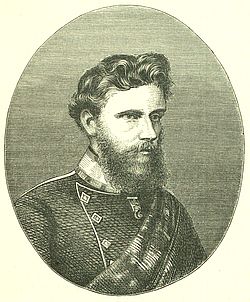
Lieutenant-Colonel the Hon. Adrian Hope. From a photograph.
On the 22nd May, H.R.H. the Duke of Cambridge was graciously pleased to present new colours to the 93rd, in lieu of the now tattered ensigns that, twenty-three years before, had been presented at Canterbury by the Duke of Wellington. After the usual ceremony, H.R.H. made an appropriate address, in which he expressed his confidence that, should the services of the 93rd be required, it would guard the new colours with the same zealous feeling of honour and nobleness of conduct as it displayed in the late campaign.
By the 25th of May all the service companies were collected at Portsmouth, one depôt company being left behind at Dover, under Captain Brown. On the 1st of June, Nos. 3, 7, and 8 companies, under Lt.-Col. Hope, proceeded to Plymouth, and embarked on board H.M.’s ship “Belleisle” for China, sailing on the 3rd of June.
On the 4th of June the remaining service companies, under Lt.-Col. Leith Hay, proceeded to the Clarence dockyard, Gosport, where, drawn up in line, they received Her Majesty on her landing from the Isle of Wight. After a royal salute, Her Majesty was pleased to walk down the whole line, minutely inspecting every man. The regiment then marched in slow and quick time past the Queen, who expressed to Lt.-Col. Leith Hay how much pleased she was with its appearance.
On the 16th of June, the grenadiers, Nos. 1, 2, 4, and 6, and light companies, with part of No. 5, embarked on board the s.s. “Mauritius,” and sailed the following morning for China, under Lt.-Col. Leith Hay. The remainder of No. 5 company followed with the next transport. The strength of the regiment on embarkation for China was 52 officers and 1069 non-commissioned officers and men. The “Mauritius” entered Simon’s Bay, Cape of Good Hope, where she found the “Belleisle” at anchor. Here Lt.-Col. Hope conveyed to the detachment on board the “Mauritius” the startling intelligence of the mutiny of the Bengal Native Army, and that orders had been received for the 93rd to proceed with all possible despatch to Calcutta, instead of China. The “Mauritius” anchored in the Hooghly, opposite Fort William, on the 20th of Sept. 1857, the anniversary of the battle of the Alma, and the 93rd was welcomed by its old brigadier, the newly appointed Commander-in-Chief, Sir Colin Campbell. The detachment under Lt.-Col. Adrian Hope did not arrive until the 26th.
III. 1857–1875.
On the road to Cawnpoor—Engagement near Futtehpoor—Attack on Buntara—Force assembled on the Plain of the Alum Bagh—Sir Colin Campbell’s address to 93rd—Disposition of the force—on the road to Lucknow—Lucknow—The Dilkoosha—The Martinière—Banks’s Bungalow—The Secunder Bagh—A terrible fight—Capt. Stewart—The Shah Nujeef—Adrian Hope’s last effort—Sergeant Paton—Meeting of Campbell, Outram, and Havelock—Back to Cawnpoor—Dispersion of the rebel army—Second attack upon Lucknow—93rd in Lucknow—The Dilkoosha taken—The Martinière taken—The Begum Kotee—Terrible slaughter—Individual bravery—The 93rd at Rohilcund—Death of Adrian Hope—At Bareilly—March into Oude—Rebel hunting—End of the Mutiny—Losses—Peshawur—Cholera—Conduct of the men—Medical officers—Sealkote—The Umbeyla Campaign—Jhansi—Surgeon-Major Munro—Bombay—93rd sails for home—New colours—Duke and Duchess of Sutherland—Ball at Holyrood—The Queen’s interest in the regiment—Honours to officers—The Autumn Manœuvres—Strength of the regiment.
No time was lost in sending the 93rd up the river to Chinsurah, and by the 10th of October, the whole regiment in detachments was hurrying along the grand trunk road towards Cawnpoor, distant about 600 miles. By October 31st, the main body of the regiment, with Cols. Hay and Hope, had reached Cawnpoor, and in a day or two had crossed the Ganges and joined the column under Brigadier Hope Grant, assembling in Oude, for operations against Lucknow; the force was encamped between Bunnee Bridge and the Alum Bagh, about 10 miles in rear of the latter place. At Futtehpoor, three companies, under Brevet Lt.-Col. Gordon, were left to garrison that place, and to hold in check a considerable force of rebels, known to be in the neighbourhood. On the 1st of Nov. one of these companies, under Captain Cornwall, formed part of a small force which had a severe but successful engagement with a considerable body of the rebels at Khaga, near Futtehpoor. This was a severely contested affair, and the men were exhausted by a long march before reaching the enemy’s position, but nevertheless fought with such spirit and gallantry as to excite the admiration of Captain Peel, R.N., who had command of the force. The casualties of the 93rd company (No. 3) in this action were severe, being 3 men killed, and Ensign Cunningham and 15 men wounded.
On the following day, Nov. 2nd, the detachment under Lt.-Col. Adrian Hope, consisting of the grenadiers, Nos. 1, 2, and 4 companies, was also engaged in an attack on a fortified village in Oude, Buntara, and drove the enemy from the position, killing a number of them, and destroying the village. The casualties of the 93rd were 1 man killed and 3 wounded.
By Nov. 13th the detachment under Brevet Lt.-Col. Gordon had come up, and the whole of the regiment was thus once more together. On the 11th of Nov. the entire force assembled in the plain of the Alum Bagh, divided into brigades, and was reviewed by the commander-in-chief. The brigade to which the 93rd was posted consisted of headquarters of the 53rd, the 93rd, and the 4th Punjab Rifles, and was commanded by Lt.-Col. the Hon. Adrian Hope of the 93rd, appointed brigadier of the 2nd class. The little army, numbering about 4200 men, was drawn up in quarter distance column facing Lucknow. The 93rd stood in the centre of the brigade, on the extreme left, and after passing in front of the other regiments and detachments, Sir Colin Campbell approached the regiment, and thus addressed it:—
“93d, we are about to advance to relieve our countrymen and countrywomen besieged in the Residency of Lucknow by the rebel army. It will be a duty of danger and difficulty, but I rely upon you.”
This short and pointed address was received by the regiment with such a burst of enthusiasm that the gallant old chieftain must have felt assured of its loyalty and devotion, and confident that wherever he led, the 93rd would follow, and if need be, die with him to the last man. The 93rd was the first regiment on that occasion that made any outward display of confidence in their leader, but as the veteran commander returned along the line, the example was taken up by others, and cheer upon cheer from every corps followed him as he rode back to the camp.
All the sick and wounded having been sent into the Alum Bagh on the 13th, preparations were made for the advance, which commenced next day. The army marched in three columns, viz., the advance, the main column, and the rear guard. The 93rd, along with the 53rd, 84th, 90th, 1st Madras Fusiliers, and 4th Punjab Rifles, constituted the 4th Infantry Brigade forming part of the main column, and was under command of Brigadier Adrian Hope. The regiment had already lost, of sick, wounded, and killed, about 140 men, so that its strength as it entered the desperate struggle was 934 men. A detachment of 200 men of the 93rd formed part of the rear guard, which also contained 200 of the 5th Brigade under Lt.-Col. Ewart of the 93d.[573]
Instead of approaching by the direct Cawnpoor road to Lucknow, Sir Colin determined to make a flank march to the right, get possession of the Dilkoosha and Martinière, on south side of the city, which the enemy occupied as outposts, push on thence to attack the large fortified buildings Secunder Bagh, Shah Nujeef, &c., lying between the former and the Residency, and thus clear a path by which the beleaguered garrison might retire.
As the narrative of the advance and succeeding operations is so well told in the Record Book of the regiment, we shall transcribe it almost verbatim, space, however, compelling us to cut it down somewhat.[574]
At nine o’clock A.M. of November 14, 1857, the flank march commenced. As the head of the advance column neared the Dilkoosha, a heavy musketry fire was opened on it from the left, and the enemy made some attempt to dispute the advance, but were soon driven over the crest of the hill sloping down to the Martinière, from the enclosures of which a heavy fire of artillery and musketry opened upon the advancing force. This was soon silenced, and the infantry skirmishers rushed down the hill, supported by the 4th Infantry Brigade, and drove the enemy beyond the line of the canal.
During the early part of the day two companies of the 93rd were detached, viz., the Grenadiers, under Capt. Middleton, close to the Cawnpoor road, to command it, while the baggage, ammunition, &c., were filing past; and No. 1, under Capt. Somerset Clarke, was pushed on to the left to seize and keep possession of a village so as to prevent the enemy from annoying the column in that quarter.
While the leading brigade, in skirmishing order, was gradually pushing the enemy beyond the Dilkoosha, the 4th Brigade followed in support, at first in open column, and while doing so, the 93rd lost 1 man killed and 7 wounded. After the enemy had been driven down the hill towards the Martinière, the 93rd was allowed to rest under cover of some old mud walls to the left rear of the Dilkoosha, until the order was given for the brigade to advance upon the Martinière itself. Then the 4th Punjab Rifles moved first in skirmishing order, supported by the 93rd, the Naval Brigade keeping up a heavy fire on the left, the result being that the enemy were driven back upon their supports beyond the canal. The Punjab Rifles pushed on and occupied part of a village on the other side of the canal, while the 93rd, with the Madras Fusiliers occupied the wood and enclosures between the Martinière and the canal. Immediately on taking up this position, three companies of the regiment under Capt. Cornwall were sent to an open space on the left of the Martinière, close to the Cawnpoor road, for the purpose of protecting the Naval Brigade guns, while the headquarters, reduced to three companies under Col. Hay, remained within the enclosure. Towards evening the enemy from the other side of the canal opened a sharp artillery and musketry fire on the whole position, part of it coming from Banks’s Bungalow. This continued till nearly seven P.M., when the Commander-in-Chief rode up and called out the Light Company and part of No. 8, and desired them to endeavour to seize Banks’s Bungalow. As soon as the Naval Brigade guns were fired, this party under Col. Hay, in skirmishing order, made a rush towards the canal, which, however, was found too deep to ford. As the night was closing in, the Light Company remained extended in skirmishing order behind the bank of the canal, while Col. Hay with the remainder returned to the Martinière compound. Capt. Cornwall with the three detached companies also returned; but the Grenadiers and No. 1 company remained, holding detached positions to the left of the army.
During the day the rear-guard (of which 200 of the 93rd formed part), under Lt.-Col. Ewart, was several times hotly engaged with the enemy, but drove them back on each occasion, with no loss and few casualties on our side. The casualties of the regiment throughout the day’s operations amounted to 1 man killed and 11 men wounded.
On the 15th, the 93rd was not actively engaged; but in its position behind the Martinière compound was exposed to a constant fire, by which only 1 man was killed and 2 men were wounded. By this time headquarters was joined by the 200 who formed part of the rearguard. Late in the evening all the detached parties were called in, and the regiment bivouacked for the night in a position close under the Martinière.
At six o’clock A.M. on the 16th the force was under arms, and formed in the dry bed of the canal en masse, at quarter-distance column, and about nine o’clock advanced, close along the western bank of the Goomtee, for about two miles, when the head of the column encountered the enemy in a wood, close to a large village, on the southern outskirts of the city, and drove them in on their own supports. The 93rd—nearly every available officer and man being present—was the leading regiment of the main column, and, in consequence of the press in the narrow lanes, it was some time before it could be got up to support the skirmishers of the 53rd that were struggling with the enemy among the enclosures. Having driven the enemy back in this quarter, the 93rd emerged from the tortuous lanes of the village into an open space, directly opposite the Secunder Bagh, a high-walled enclosure, about 100 yards square, with towers at the angles, and loopholed all round. Here the regiment deployed into line, exposed to a biting musketry fire from the loopholed building, to avoid which Col. Hay was ordered to move the regiment under cover of a low mud wall about 30 yards from the southern face of the Secunder Bagh, while some guns were being placed in position in an open space between the Secunder Bagh and another building opposite on the west side, for the purpose of breaching the south-western angle of the former.
As the last company of the 93rd—the 8th, under Capt. Dalzell—was moving into its place in line, the Commander-in-Chief called upon it to drag up a heavy gun to assist in breaching the wall; and gallantly and willingly was the difficult and dangerous duty performed, and the huge gun wheeled into position under a most withering fire. When the breach was being made, two companies, under Col. Leith Hay, took possession of a large serai or mud enclosure opposite the Secunder Bagh, driving the enemy out before them. In the meantime, the breach having been considered practicable, the assault was given by the 4th Punjab Rifles and the 93rd, supported by part of the 53rd and the battalion of detachments.
It was a glorious and exciting rush. On went, side by side in generous rivalry, the Sikh and the Highlander—the 93rd straining every nerve in the race, led gallantly by the officers. The colours, so lately confided to the regiment by H.R.H. the Duke of Cambridge, were opened to the breeze, and carried proudly by Ensigns Robertson and Taylor.
The greater part of the regiment dashed at the breach, and among the first to enter were Lt.-Col. Ewart and Capt. Burroughs. At the same time, three companies advanced between the Secunder Bagh and the serai on the left, so as to keep down the artillery fire opened on the British flank by the enemy from the direction of the European barracks. The opening in the wall of the Secunder Bagh was so small that only one man could enter at a time; but a few having gained an entrance, they kept the enemy at bay, until a considerable number of the Highlanders and Sikhs had pushed in, when in a body they emerged into the open square, where commenced what was probably the sternest and bloodiest struggle of the whole campaign.
Shortly after the breach had been entered, and while the men were struggling hand to hand against unequal numbers, that portion of the 93rd which had driven the enemy out of the serai, under Col. Hay, succeeded in blowing open the main gate, killing a number of the enemy in two large recesses on each side; and pressing their way in, rushed to the support of those who had passed through the breach. Away on the right also of the building, the 53rd had forced an entrance through a window. Still, with desperate courage and frightful carnage, the defence went on, and for hours the sepoys defended themselves with musket and tulwar against the bayonets and fire of the Highlanders, and 53rd, and the Punjab Rifles; but there was no escape for them, and the men, roused to the highest pitch of excitement, and burning to revenge the butchery of Cawnpoor, dashed furiously on, gave no quarter, and did not stay their hands while one single enemy stood to oppose them. No, not until, at the close of the day, the building formed one mighty charnel house—for upwards of 2000 dead sepoys, dressed in their old uniforms, lay piled in heaps, and on almost all was apparent either the small but deadly bayonet wound, or the deep gash of the Sikh tulwar.
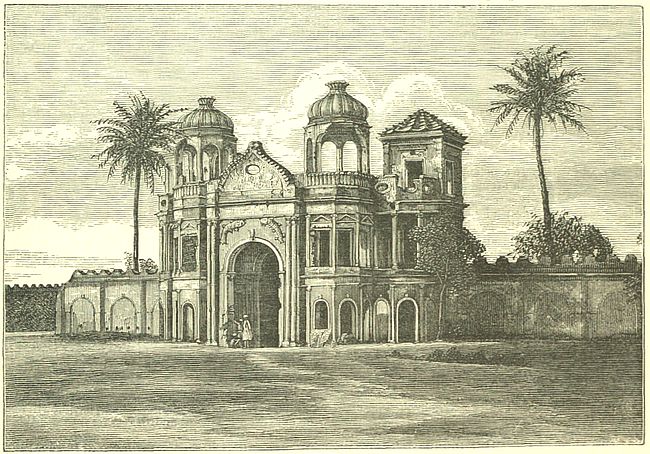
The Secunder Bagh. From a photograph in possession of the Regiment.
As might be guessed, the regiment did not pass scatheless through this fiery contest; not a few were killed, and many wounded. The sergeant-major, Donald Murray, was one of the first to fall; he was shot dead as he advanced in his place in the regiment. Then fell Capt. Lumsden, of the H.E.I.C.S., attached to the 93rd as interpreter. Within the building, Capt. Dalzell was killed by a shot from a window above. Lts. Welch and Cooper were severely wounded; and Lt.-Col. Ewart, Capt. Burroughs, and Ensign Macnamara bore away with them bloody reminiscences of the dreadful fray.
A large number of officers and men were recommended for the Victoria Cross, though few of the former obtained it; for although all richly deserved the honour, it is well known that mere personal adventure is discouraged on the part of those who are in command. Of the men of the regiment the coveted honour was conferred on Lance-Corporal John Dunley, Private David Mackay, and Private Peter Grant, each of whom performed a feat of bravery which contributed not a little to the success of the day. They were elected for the honour by the vote of the private soldiers. No doubt many others deserved a similar honour, and it seems almost invidious to mention any names, when every one doubtless did his best and bravest.
During the desperate struggle within, one of the boldest feats of arms of the day was performed by Capt. Stewart of the 93rd, son of the late Sir W. Drummond Stewart of Murthly. Of the three companies which had moved out between the Serai and the Secunder Bagh, to keep down the flank fire of the enemy while the breaching was going on, two, with a few of the 53rd, led on by Capt. Stewart, in the most gallant style, dashed forward, seized two of the enemy’s guns, which were raking the road, and immediately after effected a lodgment in the European barracks, thus securing the position on the left. For this splendid and useful feat of bravery he was elected by the officers of the regiment for the honour of the Victoria Cross, which was most deservedly conferred on him.
All this was effected by three o’clock P.M.
The regimental hospital had been established early in the day beneath the walls of the Secunder Bagh, and throughout the desperate struggle, in the midst of the hottest fire, the Assistant-Surgeons Sinclair, Menzies, and Bell, were constantly to be seen exposing themselves fearlessly in attendance on the wounded.
Almost immediately after the above operations, the 4th Brigade was withdrawn by Brigadier Adrian Hope, with the exception of the two companies of the 93rd occupying the barracks; and after a short rest, was sent to clear a village on the right of the road leading to the Residency, and between the Secunder Bagh and the Shah Nujeef. This was easily effected, and the brigade remained under cover in the village, while preparations were being made to take the Shah Nujeef. It having been found impossible to subdue the enemy’s musketry fire from the latter building by artillery, the Commander-in-Chief collected the 93rd around him and said, “I had no intention of employing you again to-day, but the Shah Nujeef must be taken; the artillery cannot drive the enemy out, so you must, with the bayonet.” Giving the regiment some plain directions as to how they were to proceed, he said he would accompany them himself.
At this moment the Naval Brigade redoubled its fire, and Middleton’s troop of Horse Artillery poured a continuous stream of grape-shot into the brushwood and enclosures around the building. Under this iron storm the 93rd, under Col. Hay, all excited to the highest degree, with flashing eye and nervous tread, rolled on in one vast wave, the greyhaired warrior of many fights, with drawn sword, riding at its head surrounded by his staff, and accompanied by Brigadier Adrian Hope. As the regiment approached the nearest angle of the building, the men began to drop under the enemy’s fire, poured forth from behind the loopholed walls; but still not a man wavered, and on went the regiment without a check, until it stood at the foot of the wall, which towered above it 20 feet, quite uninjured by the artillery fire.
There was no breach and no scaling-ladders; and unable to advance, but unwilling to retire, the men halted and commenced a musketry battle with the garrison, but of course at great disadvantage, for the Sepoys poured in their deadly volleys securely from behind their cover, while the 93rd was without shelter or protection of any kind, and therefore many fell. By this time nearly all the mounted officers were either wounded or dismounted. Brigadier Hope, his A.D.C. and Brigade Major, had their horses shot under them; Lt.-Col. Hay’s horse was disabled by a musket shot; and two of the Commander-in-Chief’s staff were dangerously wounded. As there was no visible means of effecting an entrance on this side, a party of the regiment pushed round the angle to the front gate, but found it was so well covered and protected by a strong work of masonry as to be perfectly unassailable. One more desperate effort was therefore made by artillery, and two of Peel’s guns were brought up under cover of the fire of the regiment, dragged along by a number of men of the 93rd, Brigadier Hope, Colonel Hay, and Sir David Baird heartily lending a hand. Still, though the guns hurled their shot in rapid succession at only a few yards distance, no impression could be made.
Success seemed impossible, the guns were withdrawn, and the wounded collected, in which last duty Lt. Wood and Ensign Macnamara rendered good service under a galling fire at considerable risk to themselves. Evening was fast closing in, and the assault must necessarily soon be given up, but Brigadier Hope resolved to make one last effort. He collected about fifty men of the 93rd, and crept cautiously through some brushwood, guided by Sergeant Paton, to a part of the wall in which the sergeant had discovered a spot so injured that he thought an entrance might be effected. The small party reached this unperceived, and found a narrow rent, up which a single man was pushed with some difficulty. He reported that no enemy was to be seen near the spot, and immediately Brigadier Hope, accompanied by Colonel Hay and several of the men, scrambled up and stood upon the inside of the wall. The sappers were immediately sent for to enlarge the opening, when more of the 93rd followed, and Brigadier Hope with his small party gained, almost unopposed, the main gate, threw it open, and in rushed the 93rd, just in time to see the enemy in their white dresses gliding away into the darkness of the night. Sergeant Paton for the above daring service deservedly received the Victoria Cross. Thus ended the desperate struggle of the day, and the relief of the Residency was all but secured. Lts. Wood and Goldsmith were here severely wounded, and a number of men killed and wounded. A deep silence now reigned over the entire position, and the little army, weary and exhausted by its mighty efforts, lay down upon the hard-won battle-ground to rest, and if possible to sleep.
The casualties throughout the day to the 93rd were very great. Two officers and 23 men killed, and 7 officers and 61 men wounded. As many of the latter died of their wounds, and most of the survivors were permanently disabled, they may be regarded as almost a dead loss to the regiment.
Early on the following morning, as soon as daylight had sufficiently set in to enable anything to be seen, the regimental colour of the 93rd was hoisted on the highest pinnacle of the Shah Nujeef, to inform the garrison of the Residency of the previous day’s success. The signal was seen and replied to. This act was performed by Lt. and Adjt. M’Bean, assisted by Sergeant Hutchinson, and it was by no means unattended with danger, for the enemy, on perceiving their intention, immediately opened fire, but fortunately without injury to either.
The 93rd was not employed on the 17th further than in holding the different positions taken on the previous day. The 53rd and 90th captured the Mess-house, Hospital, and Motee Mahul. The communication with the Residency was now opened, and there was great joy among the relieving force when Generals Outram and Havelock came out to meet the Commander-in-Chief.
On the evening of Nov. 18th, 1857, the distribution of the 93rd, which was now completely broken up, was as follows:—Head-quarters under Col. Hay, consisting of 120 men, occupied the Serai in rear of the European barracks; three companies under Lt.-Col. Ewart held the barracks; one company under Capt. Clarke held the Motee Mahul, while part of the garrison of the Residency held the Hern Khanah and Engine-house. These two latter positions secured the exit of the garrison. One company and part of the light company, under Capt. Dawson, held the Shah Nujeef, and kept in check the enemy’s batteries placed close down on the eastern bank of the Goomtee. All these parties were constantly on the alert, and exposed night and day to the fire of the enemy’s artillery and musketry. On the 18th only 1 man was wounded.
During the 19th, 20th, and 21st the evacuation of the Residency was carried on, and by the night of the 22d all was ready for the garrison to retire. The whole was successfully accomplished, the retirement taking place through the lane by which the relieving force had approached the Secunder Bagh on the 16th. The brigade to which the 93rd belonged had the honour of covering the retreat as it had led the advance of the main body on the 16th;[575] and, early on the morning of the 23d, the whole regiment was once more together in the grounds round the Martinière, but retired and bivouacked behind the Dilkoosha during the afternoon. From the 19th to the 23rd the 93rd had 6 men wounded and 1 man killed. Two unfortunate accidents occurred on the 23d: a corporal and 3 men were blown up by the explosion of some gunpowder, and Colour-Sergeant Knox, who answered to his name at daylight, did not appear again; it is supposed that in the uncertain light he had fallen into one of the many deep wells around Lucknow.
Thus was accomplished one of the most difficult and daring feats of arms ever attempted, in which, as will have been seen, the 93rd won immortal laurels. But its work was by no means done.
On the 24th the army continued its retrograde movement towards Cawnpoor, staying three days at the Alum Bagh, removing the baggage and the sick, to enable preparations to be made for the defence of that position. On the 27th the march was resumed by the Bunnee bridge, the army encumbered with women, children, sick, and baggage, which, however, after a little confusion, the main column got clear of. Next day, as the march went on, the sound of heavy firing was heard; and when the troops were told that it was the Gwalior rebel contingent attacking Cawnpoor, they, fatigued as they were, braced themselves for renewed exertions. About ten o’clock on that night (the 28th) the main column arrived at within a short distance of the bridge of boats at Cawnpoor. Between heat, and dust, and hunger, and exhaustion the march was a dreadfully trying one, yet not a man was missing by twelve o’clock that night. A short but welcome sleep came to renew the strength of the brave and determined men.
At daylight on the 29th the enemy commenced a heavy fire on the entrenched camp and bridge of boats. Peel’s guns immediately opened fire, under cover of which the 53rd and 93rd approached the bridge, and, under a perfect storm of shot, shell, and bullets, succeeded in crossing it, and in gaining the open plain close to the artillery barracks, taking up a position between this and the old sepoy lines in front of the city of Cawnpoor, and near that sacred spot where General Wheeler had defended himself so long and nobly against the whole power of Nana Sahib. By this movement the communication with Allahabad was reopened, the only casualty to the 93rd being Ensign Hay slightly wounded. All the convoy of women, wounded, &c., was got over, and by December 3rd the greater portion were safely on their way to Allahabad, and everything nearly ready for an attack on the rebel army.
On the morning of December 1, as the 93rd was turning out for muster, the enemy opened fire upon it with shrapnel, by which Captain Cornwall, Sergeant M’Intyre, and 5 privates were severely wounded. The regiment, therefore, took shelter under cover of the old lines, returning, except the picquet, at night to the tents, and continuing so to do until the morning of the 6th.
On the morning of the 6th the 93rd paraded behind the old sepoy lines, afterwards moving to the left and keeping under cover until the whole disposable force of the army was formed in mass on the left, under cover of the new barracks and some ruins behind them. Brigadier Greathead kept the line of the canal, extending from the fort; Walpole crossed the canal on Greathead’s left, so as to secure all the passes from the city. While these operations were being carried out, Hope’s brigade, consisting of the 42nd, 53rd, and 93rd, supported by Brigadier Inglis, moved away to the left, towards the open plain where the enemy’s right rested, while the cavalry and horse artillery, making a wide sweep, were to turn the enemy’s right flank, and unite their attack with that of Hope. On debouching into the plain, the enemy opened fire, when the 53rd and Sikhs were immediately thrown to the front in skirmishing order, and pressed eagerly forward, while the 93rd and 42nd, in successive lines, followed rapidly up. Notwithstanding the unceasingly hot fire of the enemy, which began to tell upon the men, still onward in majestic line moved the Highlanders, for a time headed by the Commander-in-Chief himself, who rode in front of the 93rd.
On approaching the broken ground near the bridge, it was found necessary to alter the formation somewhat. The enemy disputed the passage of the bridge by a heavy shower of grape, which, however, caused little loss. As the regiment cleared the bridge, the enemy retired, and at the same time Peel’s heavy guns came limbering up, and as they passed along the left of the 93rd, a number of the men seized the drags, pulled them to the front, and helped to place them for action. They opened, and caused the enemy to retire still further, when the 93rd again formed into line, as also did the 42nd, and both continued to advance still under a heavy fire, for the enemy’s artillery disputed every inch of ground. But gradually, steadily, and surely the Highlanders pressed on, urging the enemy back, until at last the standing camp of the Gwalior contingent opened to view, when the Commander-in-Chief ordered Nos. 7 and 8 companies to advance at a run and take possession. It was empty, but no preparations had been made to carry off anything. The hospital tents alone were tenanted by the sick and wounded, who, as the soldiers passed, held up their hands and begged for mercy; but the men turned from them in disgust, unable to pity, but unwilling to strike a wounded foe.
After passing through the camp, the 93rd formed line again to the right and advanced, still annoyed by a galling fire of round shot and shrapnel. During a momentary halt, Lieut. Stirling was struck down by a round shot, and General Mansfield, who was with the regiment at the time, was struck by a shrapnel bullet. The advance continued, and the enemy drew back, disputing every foot of ground. General Mansfield with some guns, the rifles, and 93rd secured the Subadar’s Tank in rear of the enemy’s left, while Sir Colin Campbell with a small force, including two companies of the 93rd, pressed the pursuit of the routed Gwalior contingent along the Calpee road. By sunset the rebels in the city, and on the left beyond it, had retired by the Bithoor road.
The casualties to the 93rd were 2 officers and 10 men wounded. That night the regiment bivouacked in a large grove of trees which had been occupied in the morning by the enemy, who, unwittingly, had prepared an evening meal for their opponents, for beside the many little fires which were still burning were found half-baked cakes, and brazen vessels full of boiled rice.
The centre and left of the rebel army retreated during the night by the Bithoor road, but were followed on the 8th by General Hope Grant with the cavalry, light artillery, and Hope’s brigade, and early on the morning of the 9th, after a long march of twenty hours, they were overtaken at the Serai Ghât on the Ganges, attacked, dispersed, and all their guns, 15 in number, and ammunition taken.
Thus was defeated and dispersed the whole of the rebel army which but a few days before had exultingly laid siege to the entrenched camp at Cawnpoor: broken, defeated, pursued, and scattered, it no longer held together or presented the semblance of an organised body. That evening the force encamped close to the river, and next day fell back on Bithoor, where it remained till the end of the month.
The next few days were occupied in clearing the rebels from the whole district around Lucknow, the British force advancing as far as Futtehgurh. Here it was encamped till the 1st of February 1858, when the camp was broken up. The Commander-in-Chief returned to Cawnpoor, and the troops commenced to move by different routes towards Lucknow, now become the centre of the rebel power. Hope’s brigade marched to Cawnpoor, and on arriving there was broken up, the 53d being removed from it. This was a source of great disappointment both to that corps and the 93rd. The two regiments having been together in so many dangers and difficulties, and having shared in the glorious relief of the Residency of Lucknow, a feeling of attachment and esteem had sprung up between them, which was thoroughly manifested when the 93rd left Cawnpoor and passed into Oude on the 10th of February; the band of the 53rd played it to the bridge of boats, by which the 93rd crossed the Ganges, and both officers and men of the former lined the road in honour of their old comrades.
From the middle to the end of February, the army destined to attack the city of Lucknow was collecting from all quarters, and stationed by regiments along the road leading thither from Cawnpoor, to protect the siege train in its transit. By the end of the month the largest and best equipped British army ever seen in India, led by the Commander-in-Chief in person, was collected in the Alum Bagh plains, prepared for the attack. A new organisation of the army now took place, new brigades and divisions were formed, and new brigadiers and generals appointed to each.
On February 28, 1858, the 93rd arrived at the Alum Bagh, and on the following morning, March 1, moved, with two troops of horse artillery, the 9th Lancers, and 42nd Highlanders, round Major-General Outram’s rear and right flank, behind the fort of Jelalabad, and, making a sweep of some miles, came suddenly upon an outlying picquet of the enemy about a mile to the south of the Dilkoosha. The enemy, taken by surprise, fell back fighting, but in the end fled in disorder to the Martinière, leaving the Dilkoosha and the villages and enclosures on both sides to be occupied by their pursuers. Towards the afternoon other brigades and regiments followed, and took up positions on the left, extending so as to communicate with Major-General Outram’s right. In this position the whole force bivouacked for the night; and in a day or two the regimental camp was formed close to the river Goomtee, where it remained till March 11. From March 2nd the regiment was employed every other day as one large outlying picquet, and posted in a dense tope of trees surrounded by a high wall. A constant fire was kept up on this position by the enemy, happily with no loss to the 93rd. The regiment was also kept constantly employed in other duties. On the 9th, along with its brigade, the 93rd took part in the storming of the Martinière, which was given up by the enemy after a very slight resistance, only a few of the 93rd being wounded. The enemy were pursued by the 42nd and 93rd, the latter pushing on beyond Banks’s bungalow, and taking possession of a large garden close to the enemy’s second chain of works, which was formed by the Begum’s Palace, the Mess House, the Motee Mahul, the old Barracks, the Shah Nujeef, and the Secunder Bagh. While this was being effected, the 53rd, which had been allowed to rejoin their comrades of the 93rd, made a dash at the Secunder Bagh and took possession, just as a large body of the enemy was approaching to garrison it. The 93rd bivouacked in the garden for the night. During the day the enemy had been driven close up to the city by other sections of the army, and the next day was employed in making breaches in the Begum Kotee or Palace, a large pile of buildings and enclosures in front of and covering the celebrated Kaiser Bagh, known to be strongly garrisoned, and fortified and protected, as the enemy considered it to be the key of the whole position.
At 3 o’clock P.M., on the 11th, it was announced to the 93rd that the honour of assaulting the position was allotted to them by the Commander-in-Chief. The regiment formed up in a patch of thick wood close to road leading directly to the front of the Begum Kotee, and thence to the Kaiser Bagh. It was told off by Brigadier Adrian Hope into two divisions,—the right wing, under Col. Leith Hay, consisting of the grenadiers, Nos. 1, 2, 3, and 4 companies, and the left wing, under Bt. Lt.-Col. Gordon, consisting of Nos. 5, 6, 8, and light companies; the former to assault and enter by the front breach, and the latter by that on the right flank of the position made by the battery from Banks’s bungalow. No. 7 company was left to guard the camp. At 4 P.M. the large guns became silent, and at the same time the enemy’s musketry fire slackened. At this moment the 93rd wound out of the enclosures, advanced up the road, and, without a shot fired at it, got under cover of some ruined buildings,—Col. Hay’s division almost in front of the gate, and Col. Gordon’s to the right flank.
At a signal given by Brigadier Adrian Hope, both storming parties emerged from their cover, and each dashed at headlong speed, and with a deafening cheer, right at its respective breach. The enemy were taken by surprise, but quickly manning the walls and loop-holes, poured a perfect storm of musketry on the advancing columns. Not a man fell, for the enemy fired too high; not a man wavered, and, under a storm of bullets hissing over and around them, the gallant stormers came close up to the breaches, but were suddenly, though only for a moment, checked by a broad ditch, the existence of which was not known before. A moment of surprise, not hesitation, ensued, when a few of the grenadiers, headed by Capt. Middleton, leapt into the ditch, and were immediately followed by the whole. Colonel Hay, Capt. Middleton, and a few more having gained the other side of the ditch, dragged the others up, and then, one by one, they commenced to enter the narrow breach. At the same time the left wing storming party, with equal rapidity and daring, had gained the breach on the right, and the leading files, headed by Capt. Clarke, effected an entrance.
Every obstacle that could be opposed to the stormers had been prepared by the enemy; every room, door, gallery, or gateway was so obstructed and barricaded that only one man could pass at a time. Every door, every window, every crevice that could afford the slightest shelter, was occupied by an enemy; and thus, in threading their way through the narrow passages and doorways, the men were exposed to unseen enemies. However, one barrier after another was passed, and the men in little parties, headed by officers, emerged into the first square of the building, where the enemy in large numbers stood ready for the struggle.
No thought of unequal numbers, no hesitation for a moment, withheld the men of the 93rd, who, seeing their enemy in front, rushed to the encounter; and for two hours the rifle and the bayonet were unceasingly employed. From room to room, from courtyard to courtyard, from terrace to terrace, the enemy disputed the advance; at one moment rushing out and fighting hand to hand, at another gliding rapidly away, and taking advantage of every available shelter. No one thought of giving or asking quarter; and useless would any appeal for mercy have been, for the Highlanders, roused to the highest state of excitement, were alike regardless of personal danger, and deaf to everything but the orders of the officers. There were two wickets by which the enemy could escape, and to these points they crowded, many of them only to meet destruction from parties of the regiment stationed outside. One wicket was to the right rear, and the other was to the left front, both opening to roads that led to the Kaiser Bagh. The left wing, on gaining an entrance through the right breach, drove the enemy with great slaughter across to the wicket on the left flank of the buildings, and followed hard in pursuit up the road leading along this flank of the Begum Kotee to the Kaiser Bagh; then retired, and taking up positions along the side of this road, kept in check the enemy’s supports that attempted to come down this road, and destroyed such of the garrison as attempted to escape. As the leading companies of the right wing were effecting their entrance at the front breach, Capt. Stewart led his company, No. 2, along the ditch round to the right flank of the position, seeking another entrance. He failed in finding one, however, but met a small party of the 93rd belonging to the left wing, supported by the 42nd, engaged with a large body of Sepoys. The enemy had been driven back by a rush, and a large brass gun taken from them and turned upon themselves in their retreat. The enemy, reinforced, returned to the attack, and obliged their opponents to retire slowly. A party of the regiment under Capt. Middleton arriving, the enemy again retired, leaving their brass gun in possession of the 93rd. At this moment, and at this point, numbers of the enemy were shot down or blown up in attempting to escape by the wicket on this side of the buildings. At last, about 7 o’clock P.M., as darkness was closing in, the masses of the enemy had disappeared, the fire had slackened, the position was won, and the regiment rested from its struggle.
The wounded were all collected and taken by Dr Munro to the regimental camp. All the medical officers were present throughout the day, the assistant-surgeons Sinclair and Bell with the right wing, and Menzies with the left, accompanied the stormers; Dr Munro remained outside to receive the wounded.
The casualties amounted to 2 officers (Capt. C. W. M’Donald and Lt. Sergison), and 13 men killed; 2 officers (Lt. Grimstone and Ensign Hastie), and 45 men wounded. The losses of the enemy must have been enormous, as next day 860 dead bodies were buried, all found within the different enclosures; many must have escaped wounded. It was afterwards known that the garrison consisted of eight picked Sepoy regiments, altogether amounting to nearly 5000 men, who had sworn to die in defence of this position of the city. The 93rd numbered about 800 men.
Several individual acts of bravery, performed both by officers and men, are well worthy of being recorded. Lt. and Adjt. M’Bean encountered eleven of the enemy in succession, and after a hand-to-hand fight killed them all; for this he received the Victoria Cross. Young Captain M’Donald had been wounded severely in the early part of the day by a splinter of a shell in his sword arm, but refused to retire to hospital. On entering the breach at the head of his company, cheering them on, he was shot through the thigh, and in this disabled state, was being carried to the surgeon, when a bullet passed through his neck and killed him. Lt. Sergison, in attempting to break open a door, behind which a number of the enemy were concealed, was shot dead. Lt. Grimstone received a wound while in hot and deadly pursuit of an enemy, whom he overtook and killed. Capt. Clarke, several paces in front of his company, was the first man of his party to enter the breach. Indeed, almost all the officers had hand-to-hand encounters with single enemies. The pipe-major, John M’Leod, was the first to force his way in at the front breach, and no sooner was he in than he began and continued throughout the whole of the fighting, in places perfectly exposed, to cheer and encourage the men with the wild notes of his bagpipes. No words are sufficient to express the gallantry and devotion and fearless intrepedity displayed by every man in the regiment; and well deserved indeed was the meed of high praise contained in the general orders of Major-General Lingard and the Commander-in-chief. All the operations connected with the storming of the place were conducted by Brigadier Adrian Hope, and the position was carried by the 93rd Highlanders exclusively, supported at first by part of the 42nd, and the 4th Punjab Rifles.
The Commander-in-Chief, Sir Colin Campbell, colonel of the regiment, was sitting in Durbar with Jung Bahadoor,[576] when an aide-de-camp hastily entered his presence, with the intelligence that the Begum Kotee was taken after a hard struggle and severe loss. The gallant chief sprang from his seat, and exclaimed, “I knew they would do it.”
On the afternoon of the 13th the regiment was relieved and returned to camp, where it remained till the evening of the 20th, when, with the exception of No. 7 company, it returned and took up a position around the Imambarah, preparatory to an attack which was to be made next day on the last position held by the enemy on the north side of the city. During the interval between the 13th and the 20th, the Kaiser Bagh, Imambarah, and other positions had been taken from the enemy; the regiment, however, had no share in these operations.
On the 21st the 93rd, supported by the 4th Punjab Rifles, after some severe skirmishing and street fighting, succeeded in expelling the enemy from several large mosques and enclosures, situated at the north end of the city. Only 11 of the 93rd were wounded.
This terminated the fighting within the city, which was now completely in possession of the British. The 93rd returned to the Dilkoosha, and remained in camp till April 7th, when it was ordered to prepare to form part of a force destined for Rohileund, under Brigadier-General Walpole.
It will have been seen that no regiment was more frequently employed than the 93rd in all the operations against Lucknow, under the Commander-in-Chief, who intrusted to this trustworthy regiment some of the most difficult duties.
At daylight on April 7th, the regiment moved from the Dilkoosha, and joined the rest of the force about five miles on the north-west side of Lucknow. This force consisted of the old Crimean Highland brigade, the 42nd, 79th, and 93rd, two troops of horse artillery, some heavy siege guns, the 9th Lancers, some Native Infantry, Sappers, and Native Cavalry, all under Brigadier-General Walpole. The strength of the 93rd was 41 officers and 833 men.
The “Old Highland Brigade” thus reunited, was commanded by Brigadier the Hon. Adrian Hope. The force continued to march in a north-west direction till April 16th, a day which can never be forgotten by the 93rd, for with every certainty of success, energy, ability, and desire to fight, the force was entirely mismanaged.
Before the regiment marched from Lucknow, Bt. Lt.-Col. Charles Gordon, C.B., the senior major, an officer who had served many years in the 93rd, took leave, having effected an exchange with Bt. Lt.-Col. Ross, commanding a depôt battalion in Scotland.
Long before daylight on the 16th of April 1858 the force was under arms, and moved cautiously a few miles across country, when a halt was called, the baggage collected, and a strong guard told off to protect it; this guard consisted of two guns and detachments from every corps. About 10 o’clock A.M., the whole force cautiously advanced through some thick wood, and came suddenly on a native mud fort, the garrison of which immediately opened fire with guns and musketry. The 42nd was in advance, supported by the 93rd, the 79th being in reserve. The guns were quickly placed in position, and opened a rapid fire on the fort, while the 42nd and two companies of the 93rd and 4th Punjab Rifles were pushed forward close to the walls, under cover of some low banks, and commenced a brisk fire on the garrison. The 42nd occupied the cover in front, the 93rd on the left flank, and the Punjab Rifles on the right flank of the fort. During the whole day things remained in this state; the guns played on the fort without the least effect, and the skirmishers exchanged shots with the garrison, with but little loss to the enemy, while that of the 93rd and the rest of the force was severe and irreparable.
Brigadier the Hon. Adrian Hope, a leader not only admired but beloved by his brigade, and by the 93rd especially, fell while endeavouring to find out the arrangements of the fort, and see if there was any means of entering; not that any order had been given to assault, but it is more than probable that had he lived a few hours longer, an assault would have taken place. For an hour or two the guns played upon the fort, but after the death of Hope nothing was done, and the force outside only continued to get the worst of it. While the other regiments suffered severely in officers and men, the 93rd thus lost their much-beloved brigadier, while 6 men were wounded.
At sunset the force was withdrawn, and to the amazement of all (the enemy firing at the force as it retired), the camp was formed within a mile of the fort. Next morning the fort was empty, the enemy having vacated it during the night, evidently at leisure, for nothing was left except the ashes of their dead and a broken gun-carriage. The force having taken possession of the place, measures were at once taken to destroy it. Originally it had been a square enclosure, but had fallen into decay; it was so open and unprotected by any work behind, that a regiment of cavalry might have ridden in. And before this paltry place was lost the brave Adrian Hope, who had passed unscathed through the fierce fires of Lucknow and Cawnpoor. In the evening his remains were buried with military honours, along with two officers of the 42nd.
On the death of Brigadier Hope, Col. Hay, C.B., of the 93rd assumed command of the Highland Brigade, and Major Middleton that of the 93rd. Next day, April 17th, the force resumed its march, and in three days afterwards, at the village of Allahgunge, the enemy in force were again encountered, attacked, and dispersed, with a very large loss to them, but none to their assailants. Here Bt. Lt.-Col. Ross took command of the 93rd.
The force stayed at Allahgunge for three days, during which it was strongly reinforced, and the Commander-in-Chief himself took command of the entire army. On the 27th of April the largely augmented force moved en route for Bareilly and Shahjehanpoor, where it arrived on the 30th of April. The army moved again next day, and on the 4th of May was joined by another brigade. On the 5th it encountered a rebel army on the plains east of Bareilly, which after an engagement of some hours retired. This was a most trying day, for the heat was tremendous; the 93rd was the only regiment that did not lose men from the effects of the heat, neither had it any casualties during the engagement. On the 7th the city of Bareilly was taken possession of. On that day a wing of the regiment, under Lt.-Col. Ross, was employed to dislodge a body of the enemy which had occupied some buildings in the city. After a struggle of some hours the enemy were all dislodged and killed, the casualties of the 93rd being only 3 men wounded.
The regiment had now a rest of five months, during which it remained at Bareilly, where, however, the men suffered extremely from fever; and there were also a good many cases of sunstroke, a few of which were fatal.
On October 17th, the 93rd marched to Shahjehanpoor to form a brigade along with the 60th Royal Rifles and 66th Ghoorkas; along with this were some guns, cavalry, and regular troops, all under command of Brigadier Colin Troup. Two days after the junction of the regiments the whole column entered Oude, and in the second day’s march encountered a large body of rebels at a village called Poosgawah, in which they had entrenched themselves. From this position they were quickly expelled, and the force breaking up into small columns followed in pursuit. No sooner had the bulk of the force passed through the village than a body of rebel cavalry appeared in the rear, and attacked the baggage as it was struggling through the narrow entrance into the village. The main body of the baggage guard was far in the rear, and the enemy was at first mistaken for the irregulars of the force, until they began to cut up the camp followers. At this moment, the sick of the 93rd, 12 in number, who at Surgeon Munro’s request had been armed the night before, turned out of their dhoolies, and kept up a sharp fire, which held the enemy in check until the arrival of the Mooltanee Cavalry, which had been sent from the front, and which immediately dispersed the enemy’s cavalry. The regiment lost 1 man killed.
The force remained in the vicinity of the village for a few days. At daylight on October 26th it was under arms, and the enemy was found in position at a village called Russellpoor, on the opposite side of a deep nullah, flanked on one side by a large village, and on the other by some rising ground. The guns and the 6th Rifles attacked, the main body of the 93rd being held in reserve; one company, under Captain M’Bean, supported the heavy guns. The enemy were driven from their position and put to flight, with considerable loss to themselves, particularly on the right, where Captain M’Bean’s company was engaged.
Next day the force moved on to Noorungabad, where it remained till Nov. 8, 1858, and where the Royal proclamation was read, transferring the government of India to H.M. the Queen. On the 8th, at midnight, the force got under arms and marched towards Meethoolee, a strong mud fort belonging to one of the Rajahs of Oude, who had refused to surrender. By a circuitous route, the force felt its way towards the fort, upon which it suddenly came about mid-day on the 10th. Firing immediately commenced on both sides, and active preparations were made for an assault next day; but it was found that the enemy had slipped off during the night.
After this the 93rd, until the beginning of February 1859, was constantly employed under General Troup, sometimes united and sometimes detached, hunting the rebels out of their hiding-places, ultimately driving them beyond the Gogra (or Sarúj). Thus ended the work of the Sutherland Highlanders in the suppression of the Indian Mutiny, in which it took, at least, as prominent a part as did any other regiment, and in which it won for itself never-dying fame. Not, however, did it gain its glory cheaply; between Sept. 30, 1857, and Dec. 31, 1859, the 93rd lost in killed, died of disease, wounded, accidents, and missing, 180 men, besides 58 who were invalided to England. The remainder of its history we must run over with the utmost brevity.
After its great exertions and sufferings, the 93rd stood much in need of rest, and means of restoration for the jaded constitutions of officers and men. Therefore, the route to Subhatoo, a hill station near Simla, was welcomed by the regiment, which set out for its new quarters on Feb. 27th, 1859, and arrived on April 13th. Here it remained till the beginning of November, when it was ordered to Umballah for drill and musketry instruction.
The 93rd was destined to make an unusually long stay in India, as not till 1870 did it again set foot on its native shores. During this time it was kept constantly moving from place to place, but these movements we need not, even if we had space, follow minutely. The two main events which marked this period of the regiment’s history, were a most severe attack of cholera while at Peshawur, and a short campaign against the Mussulman fanatics of the Mahaban hills.
The regiment left Umballah in January 1860, its next station being Rawul Pindee, where it arrived on March 9th, leaving it again on November 14, 1861, for Peshawur, which it reached on the 22nd. The health of the regiment here was at first particularly good, but in May 1862 rumours of the approach of cholera began to circulate. The rumours turned out to be too true, as an undoubted case of cholera occurred in the regiment on the 7th of July; and between this and the beginning of November, it was attacked four separate times, so that there was scarcely a man, woman, or child who did not suffer to a greater or less extent. Among the men there were 60 deaths, among the women 13, and among the children 12. Nor did the officers escape; several of them were attacked, of whom 4 succumbed,—Col. Macdonald, Major Middleton, Ensign Drysdale, and Dr Hope—making 89 in all. It was only by moving out and encamping at a distance from the pestilential town that the epidemic was got rid of, though for a long time after it the regiment was in a very feeble condition.
On the death of Col. Macdonald, Major Burroughs took command of the regiment, till the arrival shortly after of Col. Stisted.
The Record-Book pays a high and well-merited tribute to the admirable conduct of the men during this terrible and long continued attack from a mysterious and deadly foe, far more trying than the bloodiest struggle “i’ the imminent deadly breach.” There was scarcely a man who did not feel the workings of the cholera poison in his system; yet, notwithstanding, there was never any approach to panic, no murmuring or shrinking from duties of the most trying and irksome kind. At one time the same men would be on hospital fatigue duty almost every day, rubbing the cramped limbs of groaning, dying men. Yet no one ever complained or tried to hold back. So long as their strength held out, they not only performed the duties assigned to them willingly, but with a kindness, tenderness, and devotion which can never be forgotten by those who witnessed it.
It is only simple justice, also, to enter upon record a statement of the distinguished services rendered during this trying period to the regiment, by the surgeon, Dr Munro, and the assistant-surgeons, Bouchier, Hope, and Baxter. No man could have worked more faithfully than did Dr Munro. Night and day his thoughts were with the men, his zeal never flagged, his resources never failed, and he seemed never to think he had done enough. Even when his own strength gave way, and he was reduced to a shadow, he still clung to his post. None who witnessed his energy, skill, and love for the men will ever forget it.
On Nov. 3rd the regiment had reached Kuneh Khâl, from which it proceeded to Sealkote by Hattee on the Grand Trunk road, where the detachments from Peshawur, Chumkunah, and Cherat were waiting to receive it. Sealkote was reached on December 30, 1862.
Into the details of the Umbeyla campaign against the Mussulman fanatics we need not enter, as the 93rd had really no fighting to do. The 93rd, under command of Col. Stisted, set out to join Sir Neville Chamberlain’s force in the Umbeyla Pass, on November 3rd, reaching Permowli, in the Yuzufzai country, on November 25th. Thence a long detachment of the regiment with some artillery, by means of elephants, camels, mules, and ponies, under command of Major Dawson of the 93rd, set out on December 9th to join the force in the Umbeyla Pass, which was reached after a most fatiguing march.
The 93rd remained at the camp in the Umbeyla Pass until December 20th, taking its share in the camp and picquet duties. On December 15th, General Garvock, who had succeeded to the command, advanced with half his force against the enemy, leaving the other half behind to guard the camp. Among the latter half was the 93rd. After General Garvock’s advance, the enemy attacked the camp, with a very trifling loss on the side of the British. General Garvock was completely successful, and the 93rd detachment joined the rest of the regiment at Nowakilla. From this, on December 23rd, under Col. Stisted, the regiment set out for Durbund, where it remained encamped till the end of January 1864. It again set out on February 1st, and after a long march reached Sealkote once more on the 27th.
At all the official inspections of the regiment the reports of the inspecting-officers were perfectly satisfactory.
The 93rd made a long stay at Sealkote, during which it sent detachments to garrison various forts in the surrounding district. It quitted Sealkote on Nov. 1st, 1866, and, under command of Col. Burroughs, proceeded to Jhansi, which, after a long march and many encampments, it reached on January 18, 1867.
During its stay at Jhansi, the regiment sustained a great loss, in the promotion, in March 1867, of Surgeon-Major William Munro, M.D., C.B., to be a Deputy Inspector-General of Hospitals. Dr Munro had been surgeon of the Sutherland Highlanders since 1854, when he joined the regiment whilst on its march from Old Fort to the River Alma. He was present with the regiment throughout the Crimean and Indian campaigns, and we have already referred to his conduct during the attack of cholera at Peshawur. By his zeal, ability, and heroic devotion to duty, Dr Munro had endeared himself to every officer and man of the regiment, by all of whom, whilst rejoicing at his well-earned promotion, his departure was sincerely deplored. At his departure he expressed a wish to be enrolled as an honorary member of the officer’s mess, a request that was acceded to with acclamation.
While at Jhansi, the colonel, General Alex. Fisher M’Intosh, K.H., died, Aug. 28, 1868. He had formerly been a major in the regiment, and was succeeded in the colonelcy by Lt.-General Charles Craufurd Hay.
In August 1869, the regiment was again scourged with cholera, a very large number being attacked, both at Jhansi and among the detachment at Sepree; the deaths, however, were only 11. During the latter part of September, moreover, and throughout October, the regiment was prostrated by a fever, which though not deadly, was very weakening. On October 20th, 50 per cent. of the soldiers at headquarters were on the sick list.
The 93rd, under Col. Burroughs, left Jhansi on December 27, 1869, en route for Bombay, to embark for home, after an absence of 12½ years. Partly by road and partly by rail, it proceeded leisurely by Cawnpoor, so full of sad memories, Allahabad, Jubbulpoor, Nagpoor, and Deolalee, to Bombay, which it did not reach till February 14, 1870.[577] On the same evening, officers, men, wives, and children, 681 in all, were safely on board the troop-ship “Jumna,” which steamed out of the harbour on the following morning. By Suez, Alexandria (where the 93rd was transferred to the “Himalaya”), and Gibraltar, the regiment arrived off Portsmouth on March 21, sailing again next day for Leith, which it reached on the 25th, but did not disembark till the 28th. One detachment, under Col. Dawson, and another, under Bt. Lt.-Col. Brown, disembarked at Burntisland, the former proceeding to Stirling, and the latter to Perth. Headquarters, under Col. Burroughs, disembarked in the afternoon, and proceeded by rail to Aberdeen, and, after an absence of 19 years, was welcomed home to Scotland with unbounded enthusiasm by the citizens. Before leaving India, 117 non-commissioned officers and men had volunteered into other regiments remaining in the country.
After a stay of upwards of a year at Aberdeen, the 93rd was removed to Edinburgh, where on its arrival on June 15, 1871, notwithstanding the miserable state of the weather, it met with a warm welcome. One company was left at Ballater, as a guard of honour to the Queen, one at Aberdeen, one at Fort George, and another was sent to Greenlaw.
On Aug. 4, 1871, while the regiment was stationed at Edinburgh, it was presented with new colours by Her Grace the Duchess of Sutherland. The ceremony in the Queen’s Park was witnessed by about 10,000 spectators. Accompanying the Duchess were the Duke of Sutherland and the Marquis of Stafford. After the old colours, worn and tattered by service in India, had been trooped, and the usual ceremonies gone through, Ensigns Cunliffe and Hannay advanced, and kneeling, were presented with the new colours by the Duchess, who addressed the regiment in a few appropriate and touching words. Colonel Burroughs made an exceedingly appropriate reply, in which he offered for Her Grace’s acceptance the old colours of the regiment, which had waved over so many deadly struggles. The Duchess accepted the colours, returning the Queen’s colour, however, to be placed over the memorial erected in St Giles’ Cathedral to the officers and soldiers who fell in the Crimea. Shortly after, however, it was decided that, owing to the little care taken of the colours at St Giles, they should be removed and sent to Dunrobin, to be placed beside the others. The Duke of Sutherland, in January 1873, was elected an honorary member of the officer’s mess of the 93rd.
The Duke and Duchess, and a large party of ladies and gentlemen, were entertained at luncheon by the officers in the Picture Gallery of Holyrood. After a number of appropriate toasts had been drunk, the tables were cleared away, and reel dancing commenced, and entered into enthusiastically. It is said that till then, no dancing had taken place in Holyrood since the days of Bonnie Prince Charlie; according to some even, not since the days of the “braw gallant” Charles II. The Duke and Duchess of Sutherland afterwards went to the Castle, and visited the non-commissioned officers and soldiers, and their wives and families, by all of whom they were enthusiastically received. A few days after, the sergeants gave a very successful ball to their friends to celebrate the occasion.
In the autumn of 1870, we may mention here, Her Majesty the Queen, having noticed that a detachment of the regiment, under, Capt. M. W. Hyslop, H.M.’s guard of honour at Ballater, wore kilts and plaids of hard tartan, and that after a march in wind and rain the men’s knees were much scratched and cut by the sharp edge of this tartan, the Queen was graciously pleased to direct that soft instead of hard tartan be in future supplied to Highland regiments. Accordingly, as soon as the hard tartan in store was used up soft tartan kilts and plaids were issued to the non-commissioned officers and men of the 93rd; this took place in April 1872.
Another instance of Her Majesty’s womanly disposition, and of her thoughtfulness and care for all about her, we shall mention. During her stay at Holyrood in August 1872, a captain’s guard of the 93rd Highlanders was stationed at the palace. Her Majesty walked across from the palace to the guard-room, and satisfied herself that the guard was comfortably housed and properly taken care of, entering into conversation with the soldiers cooking the day’s rations.
On Monday May 12, 1873, the 93rd left Edinburgh for Aldershot. On the previous Saturday, the Lord Provost (the Right Hon. James Cowan) and magistrates of Edinburgh publicly bade farewell in the name of the citizens to the regiment, the Lord Provost addressing officers and men in the courtyard of the Council Chambers, in a few appropriate and highly complimentary words, to which Col. Burroughs made a brief but feeling reply. The officers were then invited to a banquet in the Council Chambers, and the soldiers were also liberally regaled with refreshments.
On their way to Granton, on the 12th December, to embark on board the “Himalaya,” the 93rd marched through crowds of admiring spectators, and passed the 91st Argyllshire Highlanders on the way to take their place.
It reached Aldershot on the 15th, and occupied D, G, and H lines of the North Camp.
Among the list of recipients of Her Majesty’s favour on her 54th birthday (1873), Col. Burroughs’ name appeared as nominated a C.B., making the ninth officer of the regiment who had been thus honoured.
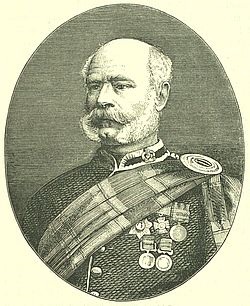
Lieutenant-Colonel William M’Bean, V.C. From a Photograph.
In July and August 1873, the 93rd, commanded by Colonel Burroughs, took part in the “Autumn Manœuvres” in Dartmoor, and received great praise from the generals under whom it served, as well as special notice from H.R.H. the Field Marshal, Commanding-in-Chief, for its smart appearance on parade, and the excellency of its skirmishing.
On August 8th Lt.-Col. J. M. Brown retired on full pay, after a service of 45 years in the regiment.
On Sept. 28th, Lt.-General Sir H. W. Stisted, K.C.B., was appointed honorary colonel, vice Lt.-General C. C. Hay deceased.
On Oct. 29th, Col. Burroughs, C.B., retired on half-pay, and was succeeded in command by Lt.-Col. M’Bean, V.C., who has well earned the honourable position he now fills.
Lieut.-Col. M’Bean commanded the 93rd during the manœuvres of 1874 at Aldershot, where it remained till the 2nd of July, when it removed to Cambridge Barracks, Woolwich.
The strength of the 93rd, one of the finest Highland regiments, at the present time (1875) is 31 officers, and 642 non-commissioned officers and men, including the depôt.
On the next page we give an engraving of the splendid Centre-Piece of plate belonging to the officer’s mess, which was designed by one of the officers of the regiment. The sculpture on one side is supposed to represent the shot-riven wall of an outwork at Sebastopol, where an officer of the 93rd contemplates the dead body of a Russian soldier lying near a private of the regiment, who reclines severely wounded, the regimental pipe-major, in a commanding position above the group, playing “the gathering.” The other side (which we engrave) has an exact reproduction from a photograph of one of the gateway towers of the Secunder Bagh at Lucknow, for an account of the storming of which place in November 1857, see pages 790, 791. An officer and private of the 93rd, and a dead Sepoy, emblematise that terrible Indian struggle and its result. Ornamental silver shields on each side of the ebony pedestal bear on one side the badge of the regiment, and on the other the presentation inscription, describing it as a memorial from some of the officers (whose names run round a silver rim on the top of the pedestal) of the part taken by the regiment in the Crimean war of 1854, and suppression of the Indian Mutiny in 1857.
This splendid work of art was inspected by Her Majesty the Queen at Windsor Castle in July 1870, when she was graciously pleased to express her approval both of the design and workmanship. It cost the subscribers nearly £500; and when we consider that it exactly reproduces the dresses, &c., of the regiment at the period represented, time will greatly enhance its present value. The uniform and accoutrements of the Russian soldier are of one of the regiments overthrown by the 93rd at the Alma, and those of the Sepoy the dress of one of those rebel corps entirely annihilated in the Secunder Bagh.
We have the pleasure of giving, on the Plate of Colonels of the 91st, 92nd, and 93rd regiments, the portrait of Major-General Wm. Wemyss of Wemyss, from a painting by Raeburn, at Wemyss Castle, Fife; and that of Sir Henry W. Stisted, K.C.B., from a photograph.