Volume 2 / Part 3 — PART THIRD. HISTORY OF THE HIGHLAND REGIMENTS. (continued 19)
Reading edition
In a short time the regiment recovered its health, and shared in all the movements of the army in Egypt till the termination of hostilities, when it embarked for Ireland, and landed at Cork on the 30th of January 1802.
For their services in Egypt, King George III. conferred upon the 92nd and other regiments the honour of bearing on their colours and appointments the “Sphinx,” and the word “Egypt.” The Grand Seignior established the order of the Knighthood of the Crescent, of which the general officers were made members; and gold medals were presented to the field-officers, captains, and subalterns.
The regiment was removed from Ireland to Glasgow, where it arrived on June 6th, and remained until the renewal of hostilities in 1803, when it was marched to Leith, and embarked for the camp which was then forming at Weeley. At this time was embodied a second battalion of 1000 men, raised under the Army of Reserve Act, in the counties of Nairn, Inverness, Moray, Banff, and Aberdeen. This corps served as a nursery for the regiment during the war.
In January 1806 Major-General the Honourable John Hume was made colonel, in room of the Marquis of Huntly removed to the 42nd.
The regiment formed part of the expedition sent against Copenhagen in 1807, and served in Sir Arthur Wellesley’s brigade. The only instance which offered on this occasion to the regiment to distinguish itself was a spirited and successful charge with the bayonet, when it drove back a greatly superior number of the enemy.
In the year 1808 the regiment embarked for Sweden under Sir John Moore, but its services were not made use of; and immediately upon the return of the expedition to England the troops employed were ordered to Portugal under the same commander, landing on the 27th of August. The 92nd accompanied all the movements of General Moore’s army, and had the misfortune to lose its commanding officer, Col. Napier of Blackstone, who was killed at Corunna, where the first battalion was posted towards the left of the army on the road leading to Betanzos, “and throughout the day supported its former reputation.” Col. Napier was adored by the regiment, to which he was more like a father than a commanding officer. The regiment had only 3 rank and file killed, and 12 wounded; among the latter was Lt. Archibald Macdonald, who afterwards died of his wounds.
On its return to England the regiment was quartered at Weeley, where it received a reinforcement of recruits, which increased the strength of the corps to rather more than 1000 men. This number was, however, greatly reduced in the Walcheren expedition, only 300 out of the 1000 returning fit for duty; but the loss was speedily supplied by recruits from the second battalion. The regiment embarked for Portugal on the 21st of September 1810, and joined the British army under Lord Wellington at the lines of Torres Vedras, in the following month.
The service of the 92nd in the Spanish Peninsula and the south of France is so blended with the operations of Lord Wellington’s army that, to give a complete idea of it, it would be necessary to enter into details which the limited space allotted to this division of the history will not admit of, and the most important of which have been given in our notices of the other Highland regiments, especially the 42nd and 71st. In all the actions in which they were engaged, the Gordon Highlanders upheld the high military reputation which they had acquired in Egypt, and supported the honour of their native country in a manner worthy of Highlanders.
The 92nd was brigaded with the 50th and 71st under the command of Sir William Erskine at Fuentes d’Onor, May 5th, 1811. The first battalion of the 92nd was stationed to the right of the town, covering a brigade of nine-pounders, and was exposed to a very heavy cannonade. The regiment had 7 rank and file killed, and 2 officers, Major Peter Grant and Lt. Allan M’Nab, and 35 rank and file wounded. Lt.-General Rowland Hill having driven the French from their post at Caceres, the latter, on the approach of the British, retired, halting at Arroyo de Molinos. After a very fatiguing march from Portalegre, the first battalion of the 92nd arrived close to Arroyo on the 27th of October 1811, and next day took part in a well fought battle. The 92nd was placed in the centre of its brigade, and was ordered to proceed to the market-square, and, if possible, to the other side of the town. As the regiment was proceeding along one of the streets, the French, taken by surprise, came out to see what was the matter, and the Prince D’Aremberg was taken prisoner in a half-naked state by a sergeant of the 92nd. The French, however, soon assembled, threw themselves across the head of the street, and commenced firing upon the advancing regiment, the shot taking deadly effect, owing to the narrowness of the street. By this time great confusion and uproar prevailed in the town. The 71st moved down to the assistance of the 92nd, while the 50th secured all the passages to the town, and captured the French artillery. The 92nd thus reinforced now pushed its way through the suburbs, and cleared the town of the enemy. The latter, however, afterwards formed in a field, and fired down a lane upon the advancing regiment. The 92nd had 3 men killed, and Col. Cameron, Brevet-Major Dunbar, and Captains M’Donald and M’Pherson, and 7 rank and file wounded.
At Almaraz, on May 19th, 1812, the 92nd again did good service in assisting materially to destroy the bridge and fortifications. This point was of great importance to the enemy, as it secured the only direct communication between his two armies, which were now in effect placed several days more distant. The 92nd had only 2 rank and file wounded.
At Alba de Tormes, on November 10th and 11th, the 92nd had 8 rank and file killed, and 1 officer and 33 rank and file wounded.
At the battle of Vittoria, fought on June 21st, 1813, the 92nd distinguished itself by seizing the height occupied by the village of Puebla, holding it against a most determined resistance, and, after a fierce struggle, put the enemy to flight. Its casualties were 4 rank and file killed, and 16 wounded. A medal was conferred on Lt.-Col. John Cameron of the 92nd.
In the various actions connected with the passage of the Pyrenees the 92nd took a prominent part, behaving itself in its usual valorous manner; in the words of Sir William Napier, “the stern valour of the 92nd would have graced Thermopylæ.”
On the 25th of July 1813, the 92nd was stationed in the Maya Pass, on the right of the road leading from Urdax, and the 71st still farther to the left. The enemy collected a force of about 15,000 men behind some rocky ground in front of the British right, and with this overwhelming force drove in the light companies of the second brigade, gaining the high rock on the right of the allied position before the arrival of the second brigade from Maya, which was therefore compelled to retrace its steps towards the village, instead of falling back to its left on the first brigade. Lt.-Col. Cameron detached the 50th to the right the moment the action commenced. That regiment was severely engaged, and was forced to retire along the ridge. The right wing of the 92nd, under Major John M’Pherson, was sent to its support, and for some time had to stand the whole brunt of the enemy’s column. The right wing of the 71st regiment was also brought up, but such was the advantage of the position the enemy had gained by separating the two brigades, and in a manner descending upon the Pass of Maya, while a fresh division was pushing up to it from the direction of Urdax, that the small body of troops received orders to retire to a high rock on the left of the position. This movement was covered by the left wings of the 71st and 92nd regiments, which, relieving each other with the utmost order and regularity, and disputing every inch of ground, left nothing for the enemy to boast of. The brigade continued to hold the rock until the arrival of Major-General Edward Barnes’ brigade, when a general charge was made, and every inch of ground recovered as far as the Maya Pass.
On this occasion the 92nd was ordered by Lt.-General the Honourable Sir William Stewart not to charge, the battalion having been hotly engaged for ten successive hours, and in want of ammunition. The 92nd, however, for the first time disregarded an order, and not only charged, but led the charge.[563]
The 92nd behaved with equal bravery on July 30th and 31st and August 1st, its casualties altogether during the passage of the Pyrenees being 53 rank and file killed, 26 officers and 363 rank and file wounded.
In the passage of the Nive the 92nd had its full share of the fighting. On the 13th of December, besides being exposed during the day to a continued fire of musketry and artillery, the battalion made four distinct charges with the bayonet, each time driving the enemy to his original position in front of his entrenchments. At one time the 92nd while pressing onwards was arrested by a fearful storm of artillery. Of one of these charges Sergeant Robertson writes:—
“The order was given to charge with the left wing of the 92nd, while the right should act as riflemen in the fields to the left of the road. The left wing went down the road in a dashing manner, led by Col. Cameron, who had his horse shot under him, and was obliged to walk on foot. As soon as we came up to the French many of them called out for quarter, and were made prisoners. After the enemy had maintained their ground for a short time, they saw that it was impossible for them to stand against us. The road was soon covered with the dead and dying. The French now broke off to their own right, and got into the fields and between the hedges, where they kept up the contest until night. Although the action ended thus in our favour, we did not gain any new ground. After the battle was over, we were formed on a piece of rising ground about a mile to our own rear, when Lord Wellington came in person to thank the 92nd for their gallant conduct and manly bearing during the action, and ordered a double allowance of rum, and that we should go into quarters on the following day.”[564]
On this occasion Lts. Duncan M’Pherson, Thomas Mitchell, and Alan M’Donald were killed. Major John M’Pherson (mortally), Captains George W. Holmes, Ronald M’Donald, and Donald M’Pherson; Lts. John Catenaugh, Ronald M’Donald, James John Chisholm, Robert Winchester, and George Mitchell, and Ensign William Fraser were wounded. 28 rank and file were killed, and 143 wounded.
In commemoration of this action an honorary badge was conferred by His Majesty on Lt.-Col. Cameron, bearing the word “Nive,” and the senior captain of the regiment (Captain James Seaton) was promoted to the brevet rank of major. The royal authority was also granted for the 92nd to bear the word “Nive” on its regimental colour and appointments.
On the morning of the 15th of Feb., the 92nd marched in pursuit of the enemy, who was discovered late in the evening, strongly posted on the heights in front of Garris, which the division attacked and carried in gallant style. The French obstinately disputed their ground, and made several attempts to recover it after dark, but finding the British troops immovable, they retreated with considerable loss through St Palais. On this occasion Major James Seaton was mortally wounded, and expired on the 22nd of the following month. The other casualties were 3 rank and file wounded.
During the night the enemy destroyed the bridge at St Palais, and every exertion was made to repair it. On the 16th of Feb., the 92nd crossed in the afternoon, and occupied a position in advance.
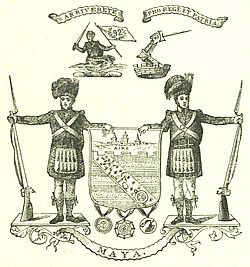
Colonel John Cameron’s Coat of Arms.
On the 17th of Feb., the enemy was discovered in the village of Arriverete, on the right bank of the Gave de Mauléon, endeavouring to destroy the bridge over it. A ford was discovered a little higher up, which the 92nd crossed under cover of the British artillery, and immediately attacking the troops in the village with its usual success, drove the enemy out of it, and secured the bridge by which the troops were enabled to cross. The enemy retired across the Gave d’Oléron, and the battalion, which had 10 rank and file wounded in this enterprise, was cantoned in Arriverete and the neighbouring villages.
Tn honour of this occasion, it was granted by royal warrant, that Lt.-Col. Cameron should bear for his crest a Highlander of the 92nd regiment, up to the middle in water, grasping in his right hand a broad sword, and in his left a banner inscribed 92nd, within a wreath of laurel; and as a motto over it the word “Arriverete.”
At Orthes the 42nd, 79th, and 92nd met for the first time in the Peninsula, and a joyful meeting it was, as the men of the three regiments were almost all Scotchmen, many of whom were old friends. Lord Wellington was so much pleased with the scene at the meeting of these regiments that he ordered them to encamp beside each other for the night.
In the affair at Aire there were 3 rank and file killed, and 3 officers and 29 men wounded. His Majesty granted permission to Lt.-Col. Cameron to bear upon his shield a view of the town, with the word “Aire.” Both in Division and General Orders the 92nd was specially mentioned, along with the 50th, as deserving to have “the good fortune of yesterday’s action decidedly attributed to it.” Moreover, a special letter from the Mayor of Aire warmly thanked Col. Cameron for the conduct of his men, and for having preserved the town from pillage and destruction. The losses of the regiment in these actions were not great, being altogether, according to General Stewart, 2 rank and file killed, and 5 officers and 55 rank and file wounded.
On the 10th of April the 92nd advanced by the Muret road to the vicinity of Toulouse, and drove Marshal Soult’s outposts into his entrenchments on that side. The services of the battalion were not again required during this day; it however witnessed the gallant conduct of its comrades on the opposite bank of the river, driving the enemy from his redoubts above the town, and gaining a complete victory.
During the 11th of April nothing particular occurred beyond a skirmish, and confining the enemy to the suburbs. The French evacuated Toulouse during the night, and the white flag was hoisted. On the 12th of April the Marquis of Wellington entered the city amidst the acclamations of the inhabitants. The 92nd followed the enemy on the Villa Franche road, and encamped in advance of that town.
In the course of the afternoon of the 12th of April, intelligence was received of the abdication of Napoleon: had not the express been delayed on the journey by the French police, the sacrifice of many valuable lives would have been prevented.
A disbelief in the truth of this intelligence occasioned much unnecessary bloodshed at Bayonne, the garrison of which made a desperate sortie on the 14th of April, and Lt.-General Sir John Hope (afterwards Earl of Hopetoun), the colonel of the 92nd regiment, was taken prisoner. Major-General Andrew Hay was killed, and Major-General Stopford was wounded. This was the last action of the Peninsular war.
On April 20, 1814, the 92nd marched into Villa Franche; on the 24th to Beziège; and on the 25th occupied quarters in Toulouse.
After peace had been established between Britain and France, the 92nd returned home, disembarking at Monkstown, Ireland, on the 29th of July, and proceeding to Fermoy Barracks, at which the thanks of Parliament were communicated to the regiment for “the meritorious and eminent services it had rendered to the King and country during the course of the war.”
On the 24th of October 1814, the second battalion was disbanded at Edinburgh, and 12 sergeants, 13 drummers, and 161 rank and file were transferred to the first battalion.
The 92nd, however, had not long to rest at home, being called again into active service, to take part in the grand concluding act of the drama enacted by Napoleon for so many years on the theatre of Europe. The regiment sailed from the Cove of Cork on the 1st May 1815, and arrived at Ostend on the 9th. On the 11th the regiment went to Ghent, where it stayed till the 28th, when it removed to Brussels, the men being billeted throughout the city. Here they were served with four days’ bread, and supplied with camp-kettles, bill-hooks, and everything necessary for a campaign, which, according to all accounts, was fast approaching. The inhabitants of Brussels like those of Ghent treated the Highlanders with great kindness, the latter, by their civility and good behaviour, making themselves great favourites.
On the evening of the 15th of June the alarm was sounded in Brussels, and hasty preparations were made to go out to meet the enemy. Col. Cameron, who had that day been invested with the order of the Bath, and who was present at the famous ball given by the Duke of Wellington when the alarm was given, was quickly at the head of the regiment. The march was commenced at daybreak on the 16th by the Namur gate. Lt.-General Sir Thomas Picton’s division, to which the 92nd belonged, came under fire about two o’clock in front of Genappe, at Quatre Bras, where the main road from Charleroi to Brussels is crossed by another from Nivelles to Namur, and which served as the British communication with the Prussians on the left. The 92nd was formed in front of Quatre Bras farm-house on the road, lining a ditch, with its rear to the walls of the building and garden, its right resting on the crossroads, and its left extending down the front. Shortly after the 92nd was thus formed, the Duke of Wellington and his staff came and dismounted in the rear of the centre of the regiment. The enemy poured a very hot fire of artillery on this post, and his cavalry charged it, but was received by a well-directed volley from the regiment, and forced to retire with great loss of men and horses. Immediately after this the French infantry attacked the position on the right and in front, and the Gordon Highlanders, who had been standing impatiently eager for action, were now ordered to charge the advancing enemy: “92nd, you must charge these fellows,” the Duke said, and with one bound the regiment was over the ditch advancing at full speed, and making the French give way on all sides. The 92nd continued to pursue the enemy, and was hotly engaged till nightfall, when the action ceased. It was very much cut up both in officers and men, as it was among the first to go into action, and, along with the other Highland regiments, had for a long time to resist the attack of the entire French army. Undoubtedly its greatest loss on this hot day was the brave and high-minded Col. Cameron, concerning whom we give a few details below.[565]
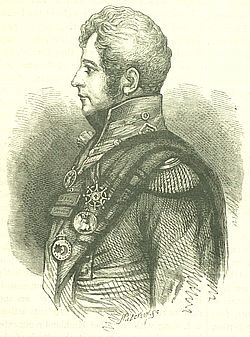
Colonel John Cameron. From Original Painting in possession of Mrs Cameron Campbell of Monzie.
Besides their colonel, the 92nd lost in the action Captain William Little, Lt. J. J. Chisholm, Ensigns Abel Becker and John M. R. Macpherson, 2 sergeants, and 33 rank and file. The wounded officers were Major James Mitchell (afterwards lieutenant-colonel); Captains G. W. Holmes, Dugald Campbell, W. C. Grant (who died of his wounds); Lts. Thomas Hobbs, Thomas Mackintosh, Robert Winchester, Ronald Macdonnell, James Kerr Ross, George Logan, John Mackinlay, George Mackie, Alexander Macpherson, Ewen Ross, Hector M’Innes; Ensigns John Barnwell, Robert Logan, Angus Macdonald, Robert Hewit, and Assistant-Surgeon John Stewart; also 13 sergeants, 1 drummer, and 212 rank and file.
On the morning of the 17th Lord Wellington had collected the whole of his army in the position of Waterloo, and was combining his measures to attack the enemy; but having received information that Marshal Blucher had been obliged, after the battle of Ligny, to abandon his position at Sombref, and to fall back upon Wavre, his lordship found it necessary to make a corresponding movement. He accordingly retired upon Genappe, and thence upon Waterloo. Although the march took place in the middle of the day the enemy made no attempt to molest the rear, except by following, with a large body of cavalry brought from his right, the cavalry under the Earl of Uxbridge. On the former debouching from the village of Genappe, the earl made a gallant charge with the Life Guards, and repulsed the enemy’s cavalry.
Lord Wellington took up a position in front of Waterloo. The rain fell in torrents during the night, and the morning of the 18th was ushered in by a dreadful thunder-storm; a prelude which superstition might have regarded as ominous of the events of that memorable and decisive day. The allied army was drawn up across the high roads from Charleroi and Nivelles, with its right thrown back to a ravine near Merke Braine, which was occupied, and its left extended to a height above the hamlet Ter-la-Haye, which was also occupied. In front of the right centre, and near the Nivelles road, the allies occupied the house and farm of Hougoumont, and in front of the left centre they possessed the farm of La Haye Sainte. The Gordon Highlanders, who were commanded by Major Donald Macdonald, in consequence of the wound of Lt.-Col. Mitchell, who had succeeded Col. Cameron in the command, were in the ninth brigade with the Royal Scots, the Royal Highlanders, and the 44th regiment. This brigade was stationed on the left wing upon the crest of a small eminence, forming one side of the hollow, or low valley, which divided the two hostile armies. A hedge ran along this crest for nearly two-thirds its whole length. A brigade of Belgians, another of Hanoverians, and General Ponsonby’s brigade of the 1st or Royal Dragoons, Scotch Greys, and Inniskillings, were posted in front of this hedge. Bonaparte drew up his army on a range of heights in front of the allies, and about ten o’clock in the morning he commenced a furious attack upon the post at Hougoumont. This he accompanied with a very heavy cannonade upon the whole line of the allies; but it was not till about two o’clock that the brigades already mentioned were attacked. At that time the enemy, covered by a heavy fire of artillery, advanced in a solid column of 3000 infantry of the guard, with drums beating, and all the accompaniments of military array, towards the position of the Belgians. The enemy received a temporary check from the fire of the Belgians and from some artillery; but the troops of Nassau gave way, and, retiring behind the crest of the eminence, left a large space open to the enemy. To prevent the enemy from entering by this gap, the third battalion of the Royal Scots, and the second battalion of the 44th, were ordered up to occupy the ground so abandoned; and here a warm conflict of some duration took place, in which the two regiments lost many men and expended their ammunition. The enemy’s columns continuing to press forward, General Pack ordered up the Highlanders, calling out, “Ninety-second, now is your time; charge.” This order being repeated by Major Macdonald, the soldiers answered it by a shout. Though then reduced to less than 250 men, the regiment instantly formed two men deep, and rushed to the front, against a column ten or twelve men deep, and equal in length to their whole line. The enemy, as if appalled by the advance of the Highlanders, stood motionless, and upon a nearer approach they became panic-stricken, and, wheeling to the rear, fled in the most disorderly manner, throwing away their arms and every thing that incumbered them. So rapid was their flight, that the Highlanders, notwithstanding their nimbleness of foot, were unable to overtake them; but General Ponsonby pursued them with the cavalry at full speed, and cutting into the centre of the column, killed numbers and took nearly 1800 prisoners. The animating sentiment, “Scotland for ever!” received a mutual cheer as the Greys galloped past the Highlanders, and the former felt the effect of the appeal so powerfully, that, not content with the destruction or surrender of the flying column, they passed it, and charged up to the line of the French position. “Les braves Ecossais; qu’ils sont terribles ces Chevaux Gris!” Napoleon is said to have exclaimed, when, in succession, he saw the small body of Highlanders forcing one of his chosen columns to fly, and the Greys charging almost into his very line.
During the remainder of the day the 92nd regiment remained at the post assigned it, but no opportunity afterwards occurred of giving another proof of its prowess. The important service it rendered at a critical moment, by charging and routing the élite of the French infantry, entitle the 92nd to share largely in the honours of the victory.
“A column of such strength, composed of veteran troops, filled with the usual confidence of the soldiers of France, thus giving way to so inferior a force, and by their retreat exposing themselves to certain destruction from the charges of cavalry ready to pour in and overwhelm them, can only be accounted for by the manner in which the attack was made, and is one of the numerous advantages of that mode of attack I have had so often occasion to notice. Had the Highlanders, with their inferior numbers, hesitated and remained at a distance, exposed to the fire of the enemy, half an hour would have been sufficient to annihilate them, whereas in their bold and rapid advance they lost only four men. The two regiments, which for some time resisted the attacks of the same column, were unable to force them back. They remained stationary to receive the enemy, who were thus allowed time and opportunity to take a cool and steady aim; encouraged by a prospect of success, the latter doubled their efforts; indeed, so confident were they, that when they reached the plain upon the summit of the ascent, they ordered their arms, as if to rest after their victory. But the handful of Highlanders soon proved on which side the victory lay. Their bold and rapid charge struck their confident opponents with terror, paralysed their sight and aim, and deprived both of point and object. The consequence was, as it will always be in nine cases out of ten in similar circumstances, that the loss of the 92nd regiment was, as I have just stated, only 4 men, whilst the other corps in the stationary position lost eight times that number.”[566]
At Waterloo the 92nd had 14 rank and file killed, and Captains Peter Wilkie and Archibald Ferrier, Lts. Robert Winchester, Donald Macdonald, James Kerr Ross, and James Hope, 3 sergeants, and 96 rank and file wounded.
After Waterloo, the 92nd, along with the rest of the army, proceeded to Paris, in the neighbourhood of which it encamped on the 3rd of July. Shortly after leaving Waterloo, while halting near a small village for the night, the Duke of Wellington in person came up and thanked the 92nd for the manner in which the men had conducted themselves during the engagement, and lavished upon them the highest eulogiums for their exertions to uphold the reputation of the British army. The Highland Society of Scotland unanimously passed a vote of thanks “for the determined valour and exertions displayed by the regiment, and for the credit which it did its country in the memorable battles of the 16th and 18th of June 1815.”
The 92nd stayed at Paris till the end of November, when it was marched to Boulogne, and on December 17th it embarked at Calais, landing at Margate on the 19th. After staying at various places in England, it marched from Berwick-on-Tweed to Edinburgh on the 7th of September 1816, and took up its quarters in Edinburgh Castle on the 12th, this being the second visit to its native country since its embodiment. Like the 42nd in similar circumstances, the men of the 92nd were treated with the greatest kindness, and entertained with profuse hospitality at almost every place on the way. On their entry into Edinburgh, a vast crowd assembled in the roads and streets. The 42nd, between which and the 92nd there has always been a friendly rivalry, had been there shortly before, and a man of that regiment standing among the crowd cried in banter to a passing company of the 92nd, “This is nothing to what it was when we came home; we could hardly make our way through the crowd.” A 92nd man quickly retorted, “You should have sent for us to clear the way for you, as we have often done before.”
II. 1816–1874.
Ireland—Jamaica—Terrible losses from Yellow Fever—Colonelcy of the 92nd—Scotland—Ireland—New Colours—Gibraltar—Malta—Barbadoes—Scotland—Ireland—Ionian Islands—Gibraltar—Large numbers volunteer into Crimean regiments—Re-enlist in 92nd at first opportunity—Regiment goes to the Crimea—Return to Gibraltar—India—The Mutiny—Employed in Central Provinces—Performs much harassing work—Field service—Oojein—Harassing marches—Engagement near Rajghur—Mungrowlee—Combined movements—Sindwaho—Koraya—Rajpoor—Fatigueing work in the Bunswarra country—Mhow—Jhansi—Lullutpoor—Seepree—the Bundelcund Jungle—Importance of work performed by 92nd—Dugshai—Its various stations in India—Authorised to use designation of “Gordon Highlanders”—Home—Gosport—Edinburgh—Presentation of New Colours—Glasgow—Aldershot—Ireland—Aids the civil power—Leaves its New Year’s dinner cooking—India again—Julinder—Camp of exercise at Delhi—Chukrata—Portrait of the Marquis of Huntly, the last Duke of Gordon.
The regiment was quartered in Edinburgh till April 1817, when it was sent to Ireland, where it remained till 1819, performing duties somewhat similar to those already recorded of the 42nd. On the 16th April the 92nd sailed for Jamaica, where it arrived on June 2nd. On its march to Up-Park Camp, it was followed by the whole population of Kingston and vicinity, who crowded from all quarters to witness so novel a sight as a Highland regiment in Jamaica. Shortly after its arrival in Jamaica the regiment suffered fearfully from yellow fever in its most virulent form. Indeed, such was the sickness and mortality, that the regiment was, in August, in a manner ordered to be dispersed. On the 28th of that month, a strong detachment, chiefly composed of convalescents, embarked on board the “Serapis” guard-ship, then at anchor off Port-Royal.
The total loss sustained by the regiment from the 25th of June to the 24th of December 1819, consisted of 10 officers,—namely, Majors Archibald Ferrier, and John Blainey (Brevet Lt.-Col.), Lts. Andrew Will, Thomas Gordon, Hector Innes, George Logan, Richard M’Donnell, and George Mackie (Adjutant), Ensign Francis Reynolds, and Assistant-Surgeon David Thomas; 13 sergeants, 8 drummers, and 254 rank and file. This considerably exceeds the total number of men of the regiment killed in all the engagements, from the time of its formation in 1794 down to Waterloo in 1815.
In January 1820, Lt.-Gen. John Hope succeeded the Earl of Hopetoun as Colonel of the 92nd; the latter being removed to the 42nd. General Hope continued to be Colonel till 1823, when he was removed to the 72nd, and was succeeded in the colonelcy of the 92nd by Lt.-Gen. the Hon. Alexander Duff.
The regiment remained in Jamaica till 1827, and from the exemplary conduct and orderly demeanour of the officers and men, gained the respect and good wishes of the inhabitants wherever it was stationed. In the summer of 1825 it had again been attacked with fever, and lost in the course of two months Major Charlton, Captain Donaldson, Lt. Deans, and 60 men. The gaps then made in the regiment were, however, regularly filled up by considerable detachments of recruits from England, so that the strength of the 92nd was never far below the proper mark.
Owing to the terrible death-rate in the West Indies and other causes, Lt.-Col. Gardyne writes, as the 92nd had fallen into comparatively bad order for a time, and on its return home, Lt.-Col. John M’Donald, of Dalchoshnie, afterwards General Sir John M’Donald, K.C.B., was appointed to the command; an officer who had served with great distinction in Spain, a thorough soldier, and a true Highlander, he soon brought the 92nd back to its natural condition of perfect discipline, and remained in command till he was promoted Major-General.
In February and March 1827, the regiment embarked in detachments at Kingston for England, on reaching which it was sent to Scotland, the whole of the regiment, depôt and service companies, joining at Edinburgh in the end of May. In the beginning of 1828 the 92nd was removed to Glasgow, from which it sailed to Ireland in July, landing at Dublin August 4th. It remained in Ireland till 1834.
In 1829, orders having been received directing that steel-mounted swords should be adopted by Highland regiments, the officers of the 92nd immediately supplied themselves with the claymore, a sword similar to that originally used in the regiment. In 1830, the regiment was authorised to adopt trousers of the regimental tartan for all occasions when the kilt was not worn. While in Jamaica, white trousers alone were allowed to be used.
At all the inspections that took place while in Ireland, the 92nd, like the other Highland regiments, received the unqualified praise of the inspecting officers. It also gained for itself the respect and esteem of all classes of the inhabitants in performing the disagreeable duty of assisting the civil power in suppressing the “White Boy” outrages, to which we have referred in our account of the 42nd. Once only were the men compelled to resort to the last military extremity.
On the 13th of December 1830, the anniversary of the battle of the Nive, a new stand of colours was presented to the regiment in Dublin by His Excellency Lt.-Gen. the Right Hon. Sir John Byng, who complimented the regiment on its brilliant and distinguished conduct in all its engagements.
In July 1831 Lt.-Gen. Duff was succeeded in the colonelcy of the regiment by Lt.-Gen. Sir John Hamilton Dalrymple (afterwards Earl of Stair).
In August 1833 the regiment was divided into six service and four depôt companies, preparatory to the embarkation of the former for Gibraltar. The depôt companies proceeded to Scotland in October, where they remained till 1836, when they returned to Ireland.
The service companies embarked at Cork in February 1834 for Gibraltar, where they arrived on the 10th of March. Here they remained till January 1836, when the regiment removed to Malta, where it was stationed till 1841.
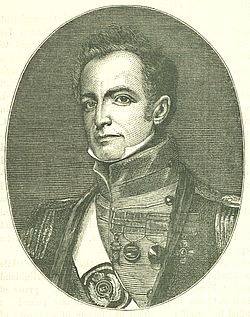
Sir John M’Donald, C.B. From Original Painting at Dunalastair.
In May 1840 the depôt companies were again removed from Ireland to Scotland. In January 1841, the service companies left Malta for Barbadoes, where they arrived in April. In May 1843 the headquarters and one company removed to Trinidad, while detachments were stationed at Grenada and Tobago. In the same month, Lt.-Gen. Sir William Maclean succeeded the Earl of Stair as colonel of the regiment, the former being removed to the 46th.
The service companies embarked in December 1843 for Scotland, arriving in February 1844 at Aberdeen, where they were joined by the depôt companies from Dundee. From Aberdeen the 92nd went to Glasgow, and in July 1845 to Edinburgh, where it remained till April 1846, when it removed to Ireland, where it remained till March 5th, 1851, when headquarters and 4 companies under command of Lt.-Col. Atherley sailed from Queenstown for the Ionian Islands. A complimentary address was received from the mayor and citizens of Kilkenny, on the 92nd quitting that city, expressive of the regret they experienced in parting with the regiment, the conduct of which had gained the esteem of all classes.
The regiment disembarked at Corfu on March 29th, and on May 17th was joined by the other two service companies under command of Major Lockhart.
While in the Ionian Islands, the 92nd received notice that kilted regiments were to use the Glengarry bonnet as a forage cap, with the regimental band or border similar to that on the feather bonnet.
The 92nd remained in the Ionian Islands until March 1853, embarking in three detachments for Gibraltar on the 21st, 23rd, and 28th of that month, respectively. During its stay in the Ionian Islands it was regularly inspected, and was invariably complimented, we need scarcely say, by the inspecting officer, on its high state of efficiency in all respects.
While the regiment was in Gibraltar, the war between this country and Russia broke out, and in consequence the 92nd was augmented to 1120 of all ranks, and subsequently to 1344. This increase, however, was soon destined to be considerably reduced, not by the casualties of war,—for the 92nd was not fortunate enough to be in the thick of the fray,—but by the large numbers who volunteered into other regiments destined for the Crimea. So large a number of men volunteered into those regiments about to proceed to the scene of the struggle, that little more than the officers’ colours and band remained of what was the day before one of the finest, best drilled, and best disciplined regiments in the army. The depôt companies, stationed at the time at Galway, volunteered almost to a man into the 42nd and 79th. The men of the service companies entered English regiments, and on their arrival at Varna asked to be allowed to enter Highland corps. This, however, could not be done, and on the conclusion of the war many of those that were left unscathed petitioned to be allowed to rejoin their old corps, saying they had volunteered for active service, and not to leave their regiment. Their request was not granted; but so strong was their esprit de corps, that at the expiration of their first period of service many of them re-enlisted in the 92nd, two of their number bringing back the Victoria cross on their breasts. Such a loss to the regiment as these volunteers occasioned almost broke the spirit of the officers and of the soldiers left; but by unsparing exertions the regiment was recruited in an incredibly short time with a very superior class of men, mostly from the Highland counties, but all from Scotland.
On the 25th of June 1855 Lt.-General John M’Donald, C.B., was appointed to the colonelcy of the regiment, in room of the deceased Sir William M’Bean, K.C.B.
The 92nd was, after all, sent to the Crimea, but too late to take any part in active operations. At the request of Lord Clyde the regiment was sent out to join his division before Sebastopol, and about 600 officers and men left Gibraltar during September 1855, landing at Balaklava just after the taking of Sebastopol. Though the 92nd was actually under fire in the Crimea, it did not obtain any addition to the numerous names on its colours. It remained in the Crimea till May 1856, on the 23rd of which month it embarked at Balaklava for Gibraltar, where it remained for eighteen months longer before embarking for India, previous to which the establishment of the regiment was considerably augmented, the service companies alone numbering upwards of 1100 officers and men. The 92nd embarked on the 20th of January 1858, to take part in quelling the Indian Mutiny; and before leaving, both in general orders and in brigade orders, Lt.-Col. Lockhart and the officers and men were eulogised in the highest terms for the splendid character of the regiment.
The light companies of the 92nd disembarked at Bombay on the 6th of March, under the command of Col. Atherley; the other two companies, under the command of Lt.-Col. Mackenzie, joined head-quarters at Bombay on the 30th of March. The 92nd, during its stay in India, was employed in the Central Provinces, under Sir Hugh Rose, formerly a 92nd officer, and distinguished itself by the rapidity of its forced marches and steadiness under fire; but although it took part in many combats, skirmishes, and pursuits, doing good and important service to its country, it had not the good fortune to be in any great victory such as to be thought worthy of being recorded on the colours beside such glorious names as Egypt and Waterloo. Lt.-Col. Lockhart was made a C.B. for his services while commanding the 92nd in this campaign. We shall endeavour briefly to indicate some of the services performed by the regiment while taking its share in the suppression of the mutiny.
On the 30th of March a detachment, under the command of Major Sutherland, proceeded to Surât on field-service, rejoining headquarters on the 8th of June. Four days after, the right wing of headquarters, under command of Lt.-Col. Archibald Inglis Lockhart, proceeded to Mhow on field service, but must have returned before the 22nd of August, on which day headquarters, consisting of Nos. 1, 3, 7, and 10 companies, marched upon Oojein, to the north of Indore, having received sudden orders to that effect on the afternoon of the 21st. The companies formed part of a field-force column, which was required to put down some rebellious symptoms that had shown themselves near Oojein. The column was placed under the command of Lt.-Col. Lockhart, and reached Oojein on the 25th. Here all was found quiet, and the column was directed toward Mundesoor, but on its march intelligence was received that the rebels had crossed to the right bank of the Chumbul river, and in consequence the march of the column was directed upon Agoor, which place it reached on the 28th, having marched 50 miles through a most difficult country in 38 hours. After remaining here for three days the column advanced to Soosneer, 16 miles to the northward; and intelligence having been received that a force of 15,000 rebels, with 38 guns, had taken possession of the fortified town of Jhalra Patun, it was resolved to wait at Soosneer until support arrived. On the 9th of Sept. a squadron of H.M.’s Lancers and 2 guns of the Bengal Artillery joined the camp; on the morning of the 10th, a change in the enemy’s movements having meantime taken place, the reinforced column marched to Zeerapoor, about 10 miles south of Machilpoor, to which the enemy had moved, both towns being on the right bank of the Kallee Sind. At Zeerapoor the column was joined by another force under the command of Lt.-Col. Hope of the 71st Highland Light Infantry, which was also under Col. Lockhart’s orders. On the same night, the 10th, Major-General Michel, C.B., commanding the Malwah division, joined and assumed command, entirely approving of the arrangements which had been made. The united column set out in pursuit of the rebels on the 12th, and marching by Bullwarrah and Rajghur, on the 15th came upon the enemy’s camp at a short distance from the latter town, but found it had been quite recently abandoned, the rebels having evidently beat a precipitate retreat. The European infantry was left here to breakfast and grog, and the Major-General, with the cavalry, native infantry, and artillery, pushed on and brought the enemy to a stand in a jungly country. The latter opened a well-sustained fire upon their pursuers, which, however, proved nearly harmless. On the European infantry coming up, the 92nd, under Captain Bethune, and the 4th Bombay Rifles deployed into line and advanced, covered by their own skirmishers, and supported by the 71st Highlanders and the 19th Bombay Native Infantry. According to orders not a shot was fired until the jungle thinned so much as to enable the skirmishers to see the enemy. After a few rounds from the guns, the infantry again advanced, and the rebels abandoned their position and fled, pursued by the cavalry. The infantry proceeded to Bhowra, where they encamped, having marched 20 miles in the course of the day under a burning sun, by which many of the men were struck down. The only casualties of the 92nd in the above action were 2 men wounded.
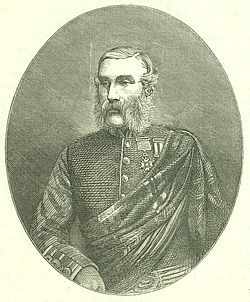
Colonel (now Major-General) Lockhart, C.B. From a Photograph.
The force halted at Bhowra until the 18th of Sept., the whole being formed into one brigade under Lt.-Col. Lockhart. Setting out on that day, the force marching by Seronj reached Mungrowlee on the 9th of Oct., when just as the tents had been pitched, it was reported that the rebels were advancing in force, and were within half a mile of the camp. The squadron of the 17th Lancers was immediately pushed forward, rapidly followed by the artillery and infantry, the 92nd being commanded by Captain Bethune. The enemy, taken by surprise, retreated, and took up position on an eminence 3 miles distant from Mungrowlee, and crowned by the ruins of a village. The rebels covered their front with guns placed in a strip of jungle, which was filled with cavalry and infantry. The British infantry deployed into line, and, covered by skirmishers, advanced upon the enemy’s position. The guns of the latter at once opened, and there was also a well-sustained but not very effective fire of small arms kept up from the jungle. The skirmishers directing their fire on the enemy’s guns (whose position could only be ascertained from their smoke), steadily advanced. After an ineffectual attempt to turn the left wing of the British by the enemy’s cavalry, the latter gave way, leaving their infantry to be severely handled by the Lancers. The line continued to advance, and six guns were taken by a rush of the skirmishers, many of the gunners being shot and bayoneted when endeavouring to escape. The guns being now brought up, the rebels soon were in rapid retreat. There appears to have been no casualties to the 92nd in this well-fought action.
It having been ascertained that the rebels had crossed the Betwa, and were now located on the right bank of that river, Major-General Michel arranged with Brigadier Smith, commanding a field column in the Chundaree district, that the two forces should make a combined movement, and for this purpose they were divided into three columns. The left column, consisting of the infantry of his brigade, under Brigadier Smith, was to move down the left bank of the river towards the Chundaree, prepared to cross to the right bank if necessary. The cavalry and horse artillery of both brigades, forming the centre column, under the immediate command of Major-General Michel, was to cross at the ford by which the enemy had retreated. The right column, consisting of the infantry and artillery of Lt.-Col. Lockhart’s brigade, under that officer, was to cross the river by the Khunjea Ghaut and proceed to Nurat. This place it reached on the 17th of October, and on the 18th was joined by the centre column, which had been unable to penetrate the very dense jungle.
On the morning of the 19th, the 92nd being led by Captain A. W. Cameron, the two combined columns marched upon the village of Sindwaho, about 12 miles distant, and where the enemy were reported to be in strength. The force halted within half a mile of the village, to the right of which the enemy were discovered drawn up in order of battle. The cavalry and horse artillery advanced to the attack, and the infantry, who were to advance upon the village, under Lt.-Col. Lockhart, were deployed into line, covered by skirmishers. The 71st passed to the right of the village, the 92nd through the village and thick enclosures on the left, and the 19th Bombay Native Infantry were on more open ground to the left of the 92nd. The enemy were found to have abandoned the village, but many were shot down in the advance of the skirmishers through the enclosures. When clear of the village, the infantry advanced in echelon of battalions from the right. While the 71st took ground to the right, and the 19th Bengal Native Infantry went to the help of the Bombay Artillery, the 92nd, under Captain Cameron, advanced in the face of a large body of cavalry, who had posted themselves under a large tope of trees on a rising ground and frequently threatened to charge. By this time the 92nd was quite separated from the rest of the force. A battery of artillery having been sent to join the 92nd, and as the enemy still threatened to charge, the skirmishers were recalled, and fire opened from right to left; as shot and shell were at the same time thrown into the tope, the enemy retired, and were soon in rapid retreat, pursued by the cavalry.
During the 20th the force halted at Tehree and on this as on previous occasions the Major-General issued an order congratulating the troops on their success, and justly praising the exertions and bravery of officers and men. On this last occasion, Col. Lockhart’s ability in handling his brigade elicited the Major-General’s warmest approbation.
The force set out again on the 21st, and marching each day reached Dujorial on the 24th. The Major-General having heard that the enemy were at Kimlasa, moved on Kuraya at 2 A.M. on the 25th, and at dawn the whole of the rebel army was discovered crossing in front just beyond Kuraya. When the cavalry, which had started an hour later than the infantry, came up, they found that the infantry under Col. Lockhart, having cut through the enemy’s line of march, had just wheeled to the right and part advanced skirmishing. The infantry had indeed dispersed the enemy when the cavalry arrived; the latter therefore set out in rapid pursuit, the infantry following for about five miles and clearing the villages of the rebels.
The force remained at Kuraya till the 27th, when it proceeded south, and reached Bhilsa on the 2nd of November. On the 4th the Major-General proceeded with the cavalry in pursuit of the rebels, who had crossed the Nerbudda, leaving the infantry and Le Marchant’s battery of artillery to watch Bhilsa and Bhopal, both being threatened by bodies of local rebels. The infantry remained at Bhilsa until the 9th, when, proceeding by Goolgong, they reached Bhopal on the 17th, leaving it on the 23rd for Sehore.
The rebels, in the meantime, after crossing the Nerbudda, had been again repulsed by the troops in Candeish. One hundred men of the 92nd, part of a small column under Major Sutherland, proceeded on the 20th of November to cross the Nerbudda, and on the 24th reached Jeelwana, where they were joined by another 50 men of the 92nd and a like number of the 71st mounted on camels. On the morning of the 24th Major Sutherland proceeded with 120 Highlanders and 80 sepoys, partly on camels, and soon ascertaining that the rebels, under Tantéa Topee, with two guns, were on the road to Rajpoor, pushed on in pursuit. On approaching Rajpoor, the rebel force was perceived passing through it, and the Highlanders, on camels, pushing rapidly forward, came on the enemy in half an hour. Before the men, however, could dismount for the attack, the rebels again retired. By this time the men following on foot, both Europeans and natives, having marched at a very rapid pace in rear, overtook the men on camels. The whole now advanced together direct upon the enemy, who had taken up a strong position, in order of battle, on a rocky and wooded ridge, their two guns on the road commanding the only approach. The Highlanders, supported by the native troops, at once advanced, and rushing up the road under a shower of grape, in a very short time captured the guns, on which the rebels precipitately abandoned their position. In this attack, Lt. and Adjutant Humfrey was wounded.
Major Sutherland’s force remained in the neighbourhood of Kooksee until the 27th of December, when it was ordered to join headquarters at Mhow.
Lt.-Col. Lockhart’s column left Sehore and marched upon Indore on the 29th of November, that town being considered in danger of an attack by the rebels. Indore was reached on December 4th, and the column halted there until the 6th, when it returned to quarters at Mhow, having detached No. 10 and part of No. 3 companies under Captain Bethune to join a small force proceeding towards Rutlâm. These companies were subsequently attached to Brigadier Somerset’s column, and mounted on camels, they underwent great privations and severe fatigue during the rapid pursuit in the Banswarra country. On the morning of the 1st of January 1859, the column came up with the rebels at daylight at Baroda, but the men had scarcely dismounted ere the rebels had, as usual, commenced a rapid retreat; this, however, they did not effect before being considerably cut up by the cavalry and guns attached to the force. These companies did not rejoin headquarters until the 24th of May 1859.
On the 2nd of March, headquarters, numbering about 1000 officers and men, marched from Mhow to Jhansi, there to be quartered; but, on reaching Bursud, they were directed by Brigadier-General Sir R. Napier to assist in clearing that neighbourhood of some rebels said to be located in the jungles. For this purpose all the heavy baggage was left at Bursud in charge of a company, and the remainder proceeded in light order to Ummeerghur and subsequently to Karadev. The jungles were in vain searched for any rebels, and on the 25th the force again got on to the main road at Goona and proceeded towards Jhansi, which it reached on the 7th of April. Nos. 8 and 9 companies proceeded direct to Lullutpoor, where they were stationed on detached duty under Major Sutherland. Remnants of rebels who had, after being broken up into small parties, reunited under Feroze Shah, and taken refuge in the dense jungles, were by the junction of forces from Lullutpoor and other places driven from their refuge, without, however, their having been actually come in contact with. The duty was, nevertheless, of a harassing nature, and was rendered more so by the sickness which had latterly prevailed at Lullutpoor and reduced the men stationed there to a weak condition.
On the 1st of June 1859, No. 7 company was detached to Seepree, and on the evening of the 30th, 40 men of that company under Ensign Emmet, mounted on elephants, proceeded with a mixed native force, the whole under the command of Major Meade, to surprise a numerous party of rebels who had located themselves in a village about 28 miles distant. The village, which was situated on an eminence and surrounded by thick jungle, was reached by 5.30 A.M. on the 1st of July, and the attack immediately commenced. The rebels in considerable numbers took refuge in a large house well loop-holed, and kept up a warm fire of musketry on their assailants; they were not finally subdued until the house caught fire. Of the 92nd, 4 rank and file were wounded, and Major Meade, in reporting the affair to the commanding officer, said:—“I cannot speak too highly of Ensign Emmet and your men; their coolness and steadiness was most conspicuous.”
On the 14th of October, Nos. 1 and 2 companies proceeded, mounted on camels, as part of a small force ordered from Jhansi under command of Col. Lockhart, in conjunction with 6 other columns, to clear the Bundelcund jungles of rebels. The force continued in the field until the 14th of December. Some difficult and harassing marches were performed in the course of these operations, but the rebels having broken through the circle to the north-east, the Jhansi column, being stationed on the west, did not come in contact with them.
Thus it will be seen that the 92nd performed important and harassing duties during the suppression of the great Indian Mutiny, and certainly seem to have deserved some outward mark of the services they then rendered to their country. Brigadier-General Sir Robert Napier, in bidding farewell to the officers and men of the Gwalior division on the 11th of January 1860, specially acknowledged the important assistance he had received from Col. Lockhart and the men under his command. Notwithstanding the fatiguing work the 92nd had to undergo, both Sir Robert Napier and Lord Clyde, in reporting on their inspection, spoke in the highest terms of the condition of the regiment.
The various detachments having joined headquarters at Jhansi, the regiment, numbering about 960 officers and men, under command of Col. Lockhart, C.B., left Jhansi on the 15th of March for Dugshai, there to be quartered.
The 92nd remained in India for nearly three years longer, during which little occurred in connection with the regiment calling for special notice. Besides the places already mentioned, it was stationed at Umballa, Benares, Rajghaut, and Calcutta, and, on its half-yearly inspection, invariably elicited the unqualified commendation of the inspecting officers and the War Office authorities; the regimental school gained the special praise of the latter.
While stationed at Dugshai, in September 1861, the regiment received the gratifying intelligence that Her Majesty had been graciously pleased to authorise the 92nd being designated “The Gordon Highlanders,” by which name it was popularly known at the period of its being raised and for some time afterwards; indeed we suspect it had never ceased to be popularly known by this title.
The Gordon Highlanders embarked at Calcutta for England in two detachments on the 24th and 28th of January 1863, respectively, and rejoined at Gosport on the 20th of May. This was the first time the regiment had been quartered in England since the 22nd of August 1816. Before the 92nd left India, 396 men volunteered into regiments remaining in the country; the deficiency was, however, soon filled up, as, on its being made known, Scotchmen serving in English regiments gladly availed themselves of the opportunity of serving in so distinguished a corps.
The 92nd did not remain long at Gosport. It embarked at Portsmouth on the 10th of July for Edinburgh, arriving off Granton Pier on the 13th, and marching to the Castle through an enthusiastic crowd. It was 17 years since the Gordon Highlanders had last been in Edinburgh. Shortly after its arrival the regiment was inspected by its Colonel, General Sir John M’Donald, K.C.B., who had formerly commanded the 92nd for the long period of 18 years.
The regiment remained scarcely a year in Edinburgh, during which time only one event occurred to mark the “even tenor of its way;” this was the presentation of new colours on the 13th of April 1864. The Highlanders, on that day, were formed in review-order on the Castle Esplanade, shortly after which Major-General Walker, C.B., commanding in Scotland, arrived on the ground accompanied by his staff. General Sir John M’Donald, K.C.B., the veteran colonel of the regiment, was also present, along with Lady M’Donald and other members of his family. After the usual ceremony had been gone through with the old colours, and after the Rev. James Millar, Chaplain of Edinburgh Castle, had offered up an appropriate prayer, the Major-General placed the new colours in the hands of Lady M’Donald, who addressed the regiment in a few most appropriate words:—
“It would be, I believe,” she said, “according to established custom, that, in placing these colours in your hands, I should remind you of the duty you owe to them, your Queen, and your country; but, to the Gordon Highlanders, any such counsel would, I feel, be superfluous; their glorious deeds of the past are sufficient guarantee for the future, that wherever and whenever these colours are borne into action, it will be but to add new badges to them and fresh honour to the regiment. I cannot let this opportunity pass without touching on the many happy years I spent among you, without assuring you of the pleasure it gives me to see you again, and of my warmest wishes for your welfare and prosperity.”
On the 25th of May 1864, the 92nd left Edinburgh for Glasgow under the command of Col. A. I. Lockhart, C.B. Detachments were also sent to Paisley and Ayr. The 92nd remained in Glasgow till March 1865, during which time it took part in a large sham fight in Renfrewshire, and was present at the inauguration by the Queen of a statue of Prince Albert at Perth, the first erected in the kingdom. On the 25th of January 1865, the depôt joined headquarters from Stirling. It is unnecessary to say that in all its public appearances, and at all inspections while in Scotland, as elsewhere, the Gordon Highlanders received, and that deservedly, the highest encomiums on their appearance, discipline, and conduct.
On the 6th of March 1865, the 92nd, consisting of 1033 officers, men, women, and children, embarked on the Clyde for Portsmouth, en route for Aldershot, arriving at the Camp on the 10th of the same month. While at Aldershot, Major C. M. Hamilton was promoted to Lieutenant-Colonel, and succeeded to the command of the regiment in place of Col. Lockhart, C.B.
The 92nd after remaining a year at Aldershot, during which nothing of note occurred, left for Portsmouth on the 1st of March 1866, and embarked on the same day for Ireland, Lt.-Col. Hamilton commanding. The regiment disembarked at Kingstown on the 5th, and proceeded to the Curragh Camp, where it remained till the 9th, when it removed to Dublin, with the exception of A and C companies, which were left at the Curragh to go through a course of musketry instruction. On the regiment leaving Aldershot, a most gratifying report concerning it was sent to headquarters; the 92nd Highlanders, the Brigade General reported,—
“Are well drilled, their conduct sober, orderly, and soldierlike; discipline good, and all one could desire in a well regulated corps.”
During its stay in Ireland the 92nd had a taste of the unpleasant duty of aiding the civil power. On the 31st of December 1867, two detachments were sent out for this purpose from the Curragh Camp, where the whole regiment was then stationed, one, under command of Major A. W. Cameron, to Cork; and the other, under command of Captain A. Forbes Mackay, to Tipperary. These detachments seem to have performed their duty effectively and without the sad necessity of resorting to extreme measures;[567] they did not return to Dublin, the former remaining at Cork and the latter proceeding to that place on the 18th of January 1868. Here these detachments were joined by the rest of the regiment on the 25th of January, on which day it embarked at Queenstown for India, sailing next day under command of Lt.-Col. Hamilton. The regiment proceeded by the overland route, and landed at Bombay Harbour on the 26th of February. Here the 92nd was transhipped into three vessels to be taken to Kurrachee, where headquarters arrived on the 8th of March. From Kurrachee this detachment made its way partly by river (the Indus), partly by rail, and partly by road, to Julinder, in the Punjaub, which it reached on the 30th of March, and was joined by the remaining portion of the regiment on the 7th of April. During its stay at Julinder the 92nd furnished detachments regularly to garrison Fort Govindghur, Umritsur, and had the honour, in February 1870, to take part in the reception at Meean Meer of H.R.H. the Duke of Edinburgh; on this occasion the regiment was commanded by Lt.-Col. M’Bean, who had been promoted to the command of the 92nd in room of Lt.-Col. Hamilton. Detachments, consisting mostly of young and sickly men, were also sent occasionally to Dalhousie to be employed in road-making in the Chumba Hills.
The 92nd remained quartered at Julinder until the 18th of December 1871, on which day headquarters and three companies under command of Major G. H. Parker, proceeded by rail to Delhi to form part of the force collected there at the Camp of Exercise. Here it was posted to the 1st brigade (Col. N. Walker, C.B., 1st Buffs) of the 2nd division commanded by Major-General M’Murdo, C.B. The remaining three companies joined headquarters on the following day. The camp of exercise was broken up on the 1st of February 1872, and in the brigade order issued on the occasion by Col. Walker, he stated that—
“The last six weeks have added to the interest I have for many years taken in the career of my old friends the 92nd Highlanders;”
he also specially mentioned the name of Captain Chalmer of the 92nd, for the valuable services which the latter invariably rendered him.
On the 2nd of February the regiment set out on its march to Chukrata, which it reached on the 2nd of March.
We have much pleasure in referring our readers to the plate of Colonels of the 91st, 92nd, and 93rd regiments, on which we give a portrait of the Marquis of Huntly, who raised the regiment, and was afterwards the last Duke of Gordon, from a painting by A. Robertson, miniature painter to H.R.H. the late Duke of Sussex, and kindly lent us by the Duke of Richmond for our engraving. The portrait was painted in 1806 A.D., and exhibited the same year at the Royal Academy.
The Duke of Gordon’s statue stands in Castle Street, Aberdeen, with the inscription “First Colonel 92nd Gordon Highlanders” at the foot of the granite pedestal. His familiar name in his own district was “The Cock of the North.”
The 92nd uniform is the full Highland costume of Gordon tartan. The officers have a black worm through their lace, as a token of mourning for Sir John Moore.
SUCCESSION LISTS OF COLONELS AND LIEUTENANT-COLONELS OF THE 92ND GORDON HIGHLANDERS.
COLONELS.
George, Marquis of Huntly,May3,1796 Sir John Hope, G.C.H.,Jan.29,1820
Served as Brigadier-General in Ireland in1798 Cadet in Houston’s Brigade,1778
Went to Holland,1799 Ensign,1779
Wounded at Egmont-op-Zee,Oct.2,1799 Captain,1782
Major-General,Jan.1,1801 Captain 60th Foot,1787
Colonel of the 42nd,Jan.3,1806 Captain 13th Light Dragoons,June30,1788
Lieut.-General,April1808 Aide-de-Camp to Sir Wm. Erskine,1793and1794
General,Aug.1809 Major 28th Light Dragoons,1795
To the 1st (Royal Foot),1820 Lieut.-Colonel,1796
K.G.C.B., Duke of Gordon,1827 Served at the Cape,1798–1799
Governor of Edinburgh Castle and Keeper of the Great Seal of Scotland,1834 To 32nd Foot,1799
Removed to the Scots Fusilier Guards,1834 In the West Indies,1800–1804
Died,May28,1836 Assistant Adjutant-General in Scotland,1805
John, Earl of Hopetoun, G.C.B.,Jan.3,1806 Deputy Adjutant-General to Copenhagen,1807
Cornet Light Dragoons,May28,1784 Brigadier-General to the Staff, N. Britain,1808
Lieutenant in 27th Foot,1786 And then Deputy Adjutant-General there,1809
Captain 17th Light Dragoons,1789 Major-General,1810
Major in 1st Foot,1792 On the Peninsular Staff,1812
Lieut.-Col. 25th,1793 For Salamanca, a medal.
M.P. for Linlithgowshire,1796 On the Staff in Ireland and N. Britain till 1819; made Lieut.-General and G.C.H.,1819
Deputy Adjutant-General in Holland,1799 Colonel of the 92nd,Jan.29,1820
Adjutant-General to the Army in the Mediterranean,1800 To the 72nd Highlanders,Sept.6,1823
Served in Egypt,1801 Died,Aug.1,1836
Colonel of the Lowland Fencible Infantry and Major-General,1802 Hon. Sir Alexander Duff, G.C.H.,Sept.6,1823
Deputy Governor of Portsmouth,1805 Removed to the 37th Regiment,July20,1831
Lieut.-General,April25,1808 John, Earl of Stair, K.T.,July20,1831
Commanded under Moore in Spain,1809 Removed to the 46th Regiment,May31,1843
Succeeded in command on Moore’s death,1809 Sir Wm. M’Bean, K.C.B.,May31,1843
Last on board the fleet at Corunna; K.C.B.,1809 Sir John Macdonald, K.C.B.,June25,1855
Commander-in-Chief in Ireland,1813 Lord Strathnairn, G.C.B., G.C.S.I.,June25,1866
At Nivelle, Nive, Bayonne,1813 Sir John Campbell,March1869
Baron Niddry and Earl of Hopetoun,1814 Lieut.-General. Died,Dec.28,1871
General,1819 Lieut.-General George Staunton,Dec.29,1871
Colonel of the 42nd,1820
Died at Paris,Aug.27,1823
LIEUTENANT-COLONELS.
Names.Date of Appointment.Date of Removal.Remarks.
The Marquis of Huntly, Lieut.-Col. CommandantFeb.10,1794May3,1796Promoted Colonel 92nd, May 3, 1796.
Charles ErskineMay1,1795March13,1807Died of wounds received in action near Alexandria, March 13, 1801.
James RobertsonOct.11,1798Aug.3,1804Retired on Half-pay.
Alexander NapierApril5,1801Jan.16,1809Killed at Corunna, Jan. 16, 1809.
James Willoughby GordonAug.4,1804June13,1808Quarter-Master General of the Forces, and promoted Lieut.-Col. Commandant of the Royal African Corps.
John CameronJune23,1808June16,1815Killed at Quatre Bras.
John LamontMar.30,1809Dec.25,1814Retired on Half-pay.
James MitchellJune13,1815Sept.1,1819Retired.
Sir Frederick StovinSept.2,1819Aug.8,1821Removed to the 90th Foot.
William Brydges NeynoeAug.9,1821Oct.3,1821Exchanged to H. P. of the 4th Foot.
David WilliamsonOct.4,1821Nov.20,1828Retired.
John MacdonaldNov.21,1828Nov.8,1846Promoted Major-General, Nov. 9, 1846.
John Alex. ForbesNov.9,1846Nov.22,1849Retired.
Mark Kerr AtherleyNov.23,1849Sept.25,1855
Geo. Edward ThoroldSept.25,1855Nov.10,1856Retired on Half-pay; 42nd, July 23, 1857; retired on full-pay, March 16, 1858. See 42nd R. H.
Archibald Inglis LockhartDec.26,1857March1865Retired.
E. E. HainesMar.4,1865Sept.1,1865Retired.
Christian Monteith HamiltonSept.1,1865Dec.14,1865Retired.
Forbes M’BeanDec.15,1869Dec.23,1873Retired.
Arthur Wellington CameronDec.24,1873
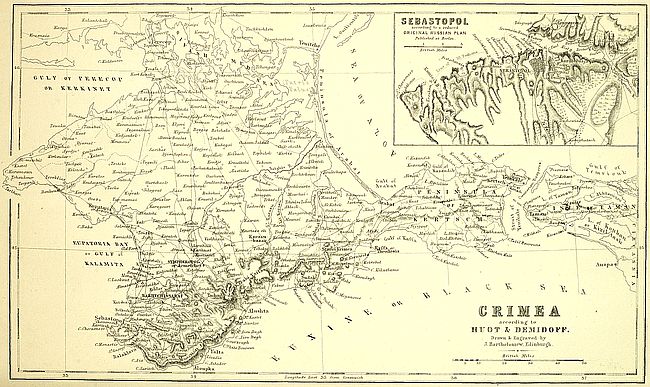
View Larger Image Here.
Crimea
FOOTNOTES:
THE 93RD SUTHERLAND HIGHLANDERS.
I. 1800–1854.
Curious method of raising the regiment—Character of the men—Guernsey—Ireland—Cape of Good Hope—Battle of Blauw-Berg—High character of the regiment—A regimental church formed—Its benevolence—England—America—New Orleans—Dreadful carnage—Ireland—West Indies—Canterbury—Presentation of New Colours by the Duke of Wellington—Weedon—The northern district—Ireland—Canada—Stirling—Edinburgh—Glasgow—Aberdeen—Portsmouth—Chobham—Devonport—War with Russia.
Cape of Good Hope. Alma.
Balaklava. Sevastopol.
Lucknow.
This, perhaps the most Highland of the Highland regiments, was raised in the year 1800, letters of service having been granted for that purpose to Major-General Wemyss of Wemyss,[568] who had previously raised the Sutherland Fencibles, many of the men from which joined the new regiment. The strength at first fixed upon was 600 men, which number was in a short time raised, 460 being obtained from Sutherland, and the remainder from Ross-shire and the adjoining counties. The regiment was however, soon augmented to 1000 men, with officers in proportion; and in 1811 it numbered 1049 officers and men, of whom 1014 were Highlanders and Lowlanders, 17 Irish, and 18 English.
One striking peculiarity in the constitution of the 93rd consists in its having probably furnished the last instance of the exercise of the clan influence on a large scale in the Highlands. The original levy was completed not by the ordinary modes of recruiting, but by a process of conscription. A census having been made of the disposable population on the extensive estates of the Countess of Sutherland, her agents lost no time in requesting a certain proportion of the able-bodied sons of the numerous tenantry to join the ranks of the Sutherland regiment, as a test at once of duty to their chief and their sovereign. The appeal was well responded to; and though there was a little grumbling among the parents, the young men themselves seem never to have questioned the right thus assumed over their military services by their chief. In a very few months the regiment was completed to its establishment.
As a crucial proof of the high character of the first levy for the 93rd it may be stated, that until the final inspection of the corps the recruits were never collected together. They were freely permitted, after enrolling their names, to pursue their callings at home, until it was announced in the various parish churches that their presence was required, when a body of 600 men was assembled, and marched, without a single absentee, to Inverness, where the regiment was inspected by Major-General Leith Hay in August 1800.
During the sojourn of the regiment at Inverness there was no place of confinement in connection with it, nor were any guards mounted, the usual precautions necessary with soldiers being quite inapplicable to the high-principled, self-respecting men of Sutherland. Many of the non-commissioned officers and men were the children of respectable farmers, and almost all of them of reputable parentage, the officers being mostly well-known gentlemen connected with Ross and Sutherland. Indeed, the regiment might be regarded as one large family, and a healthy rivalry, and stimulus to the best behaviour was introduced by classifying the different companies according to parishes. While the characteristics referred to seem to have strongly marked the Sutherland Highlanders, our readers will have seen that to a greater or less degree they belonged to the original levies of all the Highland regiments.
In Sept. 1800 the 93rd embarked at Fort George for Guernsey, where it was for the first time armed and fully equipped, and where it made rapid progress in military training.[569]
In February 1803 the 93rd was removed to Ireland, where it continued till July 1805. While in Dublin, like most of the other Highland regiments at one time or another in Ireland, it had to assist in quelling an attempted insurrection, performing the disagreeable duty kindly, but firmly and effectually.
In July 1805 the 93rd joined the armament against the Cape of Good Hope, under Major-General Sir David Baird, referred to already in connection with the 71st and 72nd, which took part in the expedition.
The expedition sailed early in August, and, after a boisterous voyage, arrived and anchored in Table Bay on Jan. 4th, 1806. The troops formed two brigades, one of which, consisting of the 24th, 38th, and 83rd regiments, was under the command of Brigadier-General Beresford; the other, called the Highland brigade, comprehending the 71st, 72nd, and 93rd regiments, was commanded by Brigadier-General Ronald C. Ferguson. On the 5th, General Beresford, who had been detached to Saldanha Bay, in consequence of the violence of the surf in Table Bay, effected a landing there without opposition; and on the 6th the Highland brigade landed in Lospard Bay, after a slight resistance from a small body of light troops stationed on the adjoining heights. In landing, 35 men of the 93rd were drowned by the upsetting of a boat in the surf, and Lt.-Colonel Pack of the 71st, and a few men, were wounded.
Having landed his stores on the 7th, General Baird moved forward the following day, and ascending the summit of the Blauw-Berg (Blue Mountain), he found the enemy, to the number of about 5000 men, drawn up in two lines on a plain, with twenty-three pieces of cannon. Forming his troops quickly in two columns, he thereupon directed Lt.-Colonel Joseph Baird, who commanded the first brigade, to move with that brigade towards the right, while the Highland brigade, which was thrown forward upon the high road, advanced against the enemy. Apparently resolved to retain their position, the enemy opened a heavy fire of grape, round shot, and musketry, which was kept up warmly as the British approached, till General Ferguson gave the word to charge. This order was obeyed with the accustomed alacrity of the Highlanders, who rushed upon the enemy with such impetuosity as at once to strike them with terror. After discharging the last volley without aim or effect, the enemy turned and fled in great confusion, leaving upwards of 600 men killed and wounded. The loss of the British was only 16 men killed and 191 wounded. The 93rd had only 2 soldiers killed, and Lt.-Col. Honyman, Lts. Scobie and Strachan, Ensigns Hedderick and Craig, 1 sergeant, 1 drummer, and 51 rank and file wounded. After this victory the colony surrendered.
The Sutherland Highlanders remained in garrison at the Cape till 1814, when they embarked for England. During this long period nothing occurred to vary the quiet and regular life of the regiment. This life was, indeed, remarkably regular, even for a Scottish regiment, and, we fear, would find no parallel in any corps of the present time. The men, who were mostly actuated by genuine religious principle, such principle as is the result of being brought up in a pious Scottish family, conducted themselves in so sedate and orderly a fashion, that during their stay at the Cape severe punishments in their case were unnecessary, and so rare was the commission of crime, that twelve and even fifteen months have been known to elapse without a single court-martial being assembled for the trial of any soldier of the 93rd. Moreover, as an emphatic compliment to the steadiness of the men, their presence was generally dispensed with when the other troops of the garrison were commanded to witness the infliction of corporal punishment.
But the most remarkable proof of the intensity and genuineness of the religious feeling in the regiment, as well as of its love of all that was peculiar to their native land, remains to be told. There being no divine service in the garrison except the customary one of reading prayers to the troops on parade, these Sutherland men, in addition to their stated meetings for reading the Bible and for prayer, in 1808 formed a church among themselves, appointed elders and other office-bearers, engaged and paid a stipend to a minister of the Church of Scotland, and had divine service regularly performed according to the forms of the Presbyterian Church. As a memorial of this institution there still remains in possession of the sergeants’ mess the plate used in the communion service, and until recently there existed among the regimental records the regulations intended for the government of its members. This establishment had an excellent effect, not only on its immediate members, who numbered several hundreds, but also upon those who made no pretence of being guided by religious principle.
Such men were not likely to forget the claims of relationship and benevolence, and indeed such was their frugality, that in addition to their contributing to the support of their minister and to the charitable funds formed in the regiment, the men were in the habit of lodging in a trusted officer’s hands savings amounting to from £5 to £50, until an opportunity occurred of forwarding the money to their relatives at home; upon one occasion, in particular, £500 were remitted to Sutherland, exclusive of many minor sums sent home through the post-office.
In the month of April 1814, the 93rd embarked for Europe, amid, as may easily be believed, the general regret of the colony; it landed at Plymouth on August 15th of the same year. Of the 1018 non-commissioned officers and men who disembarked, 977 were Scotch.
The regiment had not been many weeks at home when it was again ordered on foreign service, this time, alas, of a much more disastrous kind than that which it performed during its long stay at the Cape. Although it had not the good fortune to take part in the stormy events which were shortly to take place on the field of Europe, and share in the glory accruing therefrom, yet the work it was called upon to perform, so far as bravery, endurance, and suffering are concerned, deserved as great a meed of praise as if it had been performed on the field of Quatre Bras or Waterloo.
Early in September 1814,[570] the 93rd had received orders to hold itself in readiness for immediate embarkation, and on the 16th it embarked in three divisions as part of the armament under Major-General Sir John Keane, destined to operate in North America; for at this time, unfortunately, Britain was at war with the United States. The fleet sailed on the 18th, and on November 23rd, joined, at Jamaica, the squadron under Vice-Admiral the Honourable Alexander Cochrane.
The united forces, the command of which was now assumed by General Keane, amounted to 5400 men. With this force he sailed from Jamaica on the 27th of November, and on December 13th landed near Cat Island, at the entrance of a chain of lakes leading to New Orleans. On the 23rd the troops landed without opposition at the head of the Bayonne; but were attacked on the following night by a large body of infantry, supported by a strong corps of artillery. After a spirited contest the enemy were repulsed with loss. On the 27th, Major-General the Honourable Sir Edward Pakenham, who had arrived and assumed the command of the army on the 25th, moved the troops forward in two columns, and took up a position within six miles of New Orleans, in front of the enemy’s lines. The position of the Americans was particularly favourable, having a morass and a thick wood on their left, the Mississippi on their right, and a deep and broad ditch in front, bounded by a parapet and breast-works, extending in a direct line about a thousand yards, and mounted with artillery, and a flanking battery on the right bank of the river.
For several hours on the 28th, the force was kept in front of these works, under insufficient shelter, and, allowed neither to advance nor retire, suffered considerable loss from the storm of shot and shell poured upon it; the 93rd lost 3 men killed and several were wounded. On the three following days, the 93rd, as did every other corps, lost several men in their encampment, from the guns of the enemy, which were placed in battery on the right bank of the Mississippi. We shall give the rest of this narrative in the words of the well-kept Record-Book of the regiment, which, we believe, quotes from the journal kept by Captain Charles Gordon, one of the early officers of the 93rd.
On the 1st of January 1815, long before daybreak, the army was in motion, and placed in position similar, but closer to the American lines than on the 28th of December. Forming in close column of regiments, the troops were ordered to lie down and wait for the favourable issue of the British batteries against the enemy’s works, the former opening with a brisk fire at daylight, but unfortunately all in vain. After a cannonade of several hours, the greater part of the guns were silenced and dismounted, and after a harassing day, the army was ordered to retire to its former bivouac. The 93rd lost 1 subaltern, 1 sergeant, and 6 rank and file killed, and several wounded.
Nothing was done for the next few days, though the army underwent great fatigue in the carriage of guns, stores, &c., and were continually annoyed by the batteries of the enemy on the opposite side of the Mississippi. On the afternoon of the 7th, the army had its hopes again raised by the orders issued for a general attack on the following morning, but, in the words of Captain Gordon, “as this expedition commenced, so did it terminate, in disappointment—utter disappointment and calamity.”
On the 8th of January the main body of the 93rd, flushed with the hope of measuring bayonets with their hitherto concealed opponents, advanced in compact close column towards the centre of the American lines, from which poured a tremendous fire of grape and musketry (including buckshot); but its patience and discipline were again put to the test when within about 80 yards of the enemy’s breastworks, by an order to halt. In this unenviable position, without permission or even power to fire with any effect whatever, with nothing visible but the murderous muzzles of thousands of American rifles, only the tops of the men’s caps being seen as they loaded and fired resting upon their parapets, a staff-officer was heard to exclaim as he hurriedly came up and rode away,—“93rd, have a little patience and you shall have your revenge.” But, alas! it was decreed otherwise; the regiment continued in its fatal position without receiving any further orders, officers and men being mowed down in all directions, until Sir John Lambert, the senior surviving general officer, thought it advisable to order the army to retire. In this most disastrous affair, action it could not well be termed, the regiment was dreadfully cut up.
The following is a list of the killed and wounded in this sadly mismanaged affair, in which the gallant 93rd probably lost more officers and men in a few hours than it did throughout the whole of the Indian Mutiny campaign, in which, as will be seen, it had perhaps hotter work to do than ever fell to the lot of any single regiment. The killed were Lt.-Col. Dale, commanding the 93rd, Captains Hitchins and Muirhead, Lieutenants Munro and Phaup (both prisoners, who died of their wounds), Volunteer Johnston, 4 sergeants, 1 drummer, and 115 rank and file, including those who died next day of their wounds. There were wounded, Captains Ryan, Boulger, M’Kenzie, and Ellis; Lieuts. John M’Donald, Gordon, Hay, Graves, M’Lean, Spark, and D. M’Pherson, Volunteer John Wilson, 17 sergeants, 3 drummers, and 348 rank and file. It is sad to think that neither gain nor glory resulted from this dreadful carnage.
The army having re-embarked, the fleet weighed anchor again on the 7th of February, and made for the mouth of the Bay of Mobile, where the greater part of the army disembarked on the Dauphin Isle. Preparations were here being made to attack the fortified town of Mobile, when news arrived that preliminaries of peace had been signed between Great Britain and the United States. After being encamped about six weeks, the army was ordered to embark for Europe. The 93rd, at least the fragment left of it, arrived at Spithead on the 15th of May 1815, and being in too weak a state to take part in the stirring events taking place on the Continent, it was ordered to Ireland, disembarking at Cork on the 28th of May, and proceeding to Birr Barracks.
The second battalion having been disbanded at Sunderland, the ranks of the first battalion were filled up by a large draft of non-commissioned officers and privates from the former. As the history of the regiment is comparatively uneventful up to the time of the Crimean War and Indian Mutiny, we shall rapidly run over its movements previous to these stirring periods.
The 93rd appears to have moved about successively from Birr to Athlone, Nenagh, and Limerick, sending out numerous detachments, and in June 1818, to have proceeded to Dublin, where it remained till the following May (1819). On leaving Dublin, it was again detached to the southern counties, where it was frequently called upon to perform the most delicate and harassing duties.
Between the 3rd and 8th of November 1823, the regiment embarked at the Cove of Cork in four transports for the West Indies, without having lost a single man by desertion. It may be taken as a proof of the continued good conduct of the regiment during the eight years it was stationed in Ireland, that Lieutenant-General Lord Combermere, in his general order issued on its departure, stated that
“No regiment in the service stands in greater estimation, or has been more conspicuous for its discipline and soldier-like conduct, than the 93rd.”
Only one detachment proceeded to Demerara, the others being landed at Barbados in December 1823; the former, however, shortly afterwards joined the latter. The regiment remained in garrison at Barbados till the month of February 1826, when it was removed to Antigua and St Christopher, sending a detachment from the former island to Montserrat. These stations the 93rd occupied till February 1830, when it was removed to St Lucia and Dominica, where it remained till January 1832, when all the service companies were again collected together at Barbados, where they were stationed for upwards of two years longer. After having spent ten and a half years in the Windward and Leeward Island, the regiment embarked for England in two detachments on the 26th of March and the 3rd of April 1834, leaving behind it 117 of its men as volunteers to other regiments. On its arrival at Spithead on the 6th of May, the strength of the regiment was only 371, having been thus reduced by death, the discharge of invalids, and volunteers to other corps. The proportions of deaths in the regiment, however, while stationed in the West Indies, was considerably below that of other regiments.
It was originally intended that the regiment should proceed at once to Scotland, where it had not been quartered since its first formation; but on account of the serious demonstrations that were made by the populace in London about the period of the regiment’s return to England, it was deemed expedient to draw as many troops as possible around the capital. The 93rd was consequently sent to Canterbury, where it arrived on the 8th of May 1834, and where it was shortly afterwards joined by the depôt companies from Scotland.
During the stay of the Sutherland Highlanders in Canterbury, the most notable incident in its history was the presentation of new colours to the regiment by his Grace the Duke of Wellington, an event which seems even now to be looked back upon as marking a red-letter day in the calendar of the 93rd. The presentation took place on the 7th of October 1834, and immense preparations were made for the ceremony. The day fortunately turned out particularly favourable, and not fewer than 10,000 persons must have turned out to witness the presentation, including many of the nobility and gentry of the county. We regret that space forbids us entering into details, or giving at length the wise and stirring address of the “Great Duke.” Suffice it to say, that after referring to the past achievements of the 93rd, and of the soldier-like appearance and orderly conduct of individuals of the regiment who had attracted his attention in passing through the town, he urged upon officers and men, as the result of his long and valuable experience, the inestimable value of discipline in maintaining the efficiency of a regiment, without which no amount of personal valour would be of avail.
“I have passed,” the Duke said, “the best years of my life in the barracks and the camps of the troops. The necessities of the service and my duty have compelled me to study the dispositions and the wants of the soldiers, and to provide for them. And again I repeat to you, enforce the observance of the rules of discipline, subordination, and good order, if you mean to be efficient, to render service to the public, to be respectable in the eyes of the military world as a military body, to be respected by the community, to be comfortable and happy among yourselves, and, above all, if you mean to defend to the last your colours which I have presented to you, the person of your sovereign, and the institutions, dominions, and rights of your country, and to promote its glory (as your predecessors have in this same regiment), by your actions.”
Lt.-Col. M’Gregor having replied in feeling and most appropriate terms, the regiment performed several evolutions before the Duke, who expressed his approbation of the soldier-like appearance of the men, and of their steadiness under arms. The rest of the day, both by officers and men, was given up to festivity and rejoicing. The officers entertained the Duke and upwards of 200 guests at a magnificent banquet in the mess-room, which had been ingeniously enlarged for the occasion. On the opposite side of the barrack-yard tables were laid for nearly 700, including the non-commissioned officers, privates, their wives and children, who enjoyed an excellent dinner of roast beef and plum-pudding, with an allowance of beer, given by the amiable and benevolent lady of Col. M’Gregor. It was altogether a proud day for the Sutherland Highlanders. The whole terminated with the greatest good humour and conviviality. The soldiers continued to enjoy themselves to a late hour, dancing their native dances to their national music.
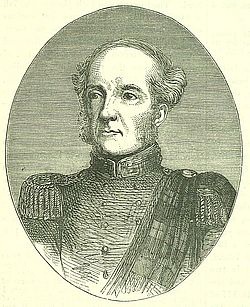
Lieutenant-Colonel (now General) Sir Duncan M’Gregor, K.C.B. From a painting in possession of the 93rd.
A few days after this memorable occasion, the regiment left Canterbury for Weedon, in Northamptonshire, where it was stationed till the spring of the following year (1835), detaching three companies to Newcastle-under-Lyme. In the end of May 1835, the 93rd left Weedon for the northern district of England, headquarters being stationed at Blackburn, and detachments at Bolton, Rochdale, Burnley, and Nottingham. In the following September headquarters was removed to Liverpool, and the other companies to Haydock Lodge, Wigan, and Chester Castle. The whole regiment was collected at Liverpool in October, on the 27th and 29th of which month it embarked in two detachments for Dublin. Here the 93rd remained till October 1836, when it was removed to Newry; after being stationed at which town for upwards of a year, it was removed, in the end of November and beginning of December 1837, to Cork, preparatory to its embarkation for Canada, to quell the serious insurrection which was threatening the British power in that colony.
The 93rd in two divisions, under Lt.-Col. M’Gregor and Major Arthur, sailed from Cork on the 6th and 23d of January 1838 respectively. The division under Major Arthur reached Halifax on the 29th of January; but that under Lt.-Col. M’Gregor met with so boisterous a passage, that it did not reach its destination till the 5th of March. On the following day the two divisions were reunited at Halifax. It is unnecessary to follow the various and complicated movements of the regiment during the suppression of the Canadian rebellion, more especially as it never had a chance of coming into contact with the rebels, except at Prescott, on the 16th of November 1838, when it was present at the attack and capture of the brigands in the Windmill, in which affair it suffered no casualties. The 93rd, in the performance of its duties at this period, was often much divided, and frequently had to endure great hardships in its movements about the country. No. 4 company was, throughout the whole rebellion, in the Lower Provinces, attached to the 71st Highland Light Infantry.
The regiment was re-united at Toronto on the 28th of November, and the women, children, and baggage arrived on the 13th of December, just before the closing of the navigation. On the 4th of the latter month Lt.-Col. Spark arrived at Toronto, and assumed the command of the regiment, in succession to Lt.-Col. M’Gregor.
The 93d remained at Toronto till the 17th of June 1843, with the exception of one year—from May 1840 till May 1841—when it was stationed at Drummondsville, Falls of Niagara. It is scarcely necessary to say that, during this time, as always indeed, the Sutherland Highlanders received the unqualified approbation of the officers whose duty it was to inspect it.
“This fine regiment still continues,” to use the words of an order issuing from the Horse Guards, in December 1842, “to maintain its character for comparative sobriety and good order amidst the dissipation with which it appears to be surrounded; and that it is as remarkable for its splendid appearance in the field, and the correctness of its evolutions, as for the quiet and orderly habits of its men in their quarters.”
On leaving Toronto, in May 1845, the 93rd went to Montreal, a wing which was sent to Kingston in the previous June joining headquarters there. On this wing leaving Canada West, Major-General Sir Richard Armstrong issued an order, in which he spoke of the appearance (“superb,” he called it) and conduct of the regiment in the highest possible terms.
The 93rd continued for other four years in Canada, leaving Montreal in July 1846—the same month that the regiment received its first supply of percussion muskets—for Quebec, where it remained till August 1, 1848, when it embarked for home, after an absence of more than ten years. On the arrival of the “Resistance” at Portsmouth, it was ordered to proceed to Leith, where it arrived on the 30th of August. The regiment disembarked next day, and proceeded to Stirling Castle, where, in a few weeks, it was joined by the dépôt companies. During its stay at Stirling detachments were sent to Perth and Dundee, and the regiment was twice selected to furnish a guard of honour for her Majesty the Queen,—in the summer of 1849, during her stay at Balmoral, and in August of the same year, when Her Majesty paid a visit to Glasgow.
The 93rd remained at Stirling till April 5, 1850, when it was removed to Edinburgh, where it was stationed for only one year, during which it again furnished a guard of honour to Ballater, as well as to Holyrood, during her Majesty’s stay at that historical palace. From Edinburgh the regiment went to Glasgow, on the 15th of April 1851, and on the 23rd of the following February removed to Weedon. The 93rd remained at Weedon for only six months, proceeding, on the 11th of August and two following days, to Portsmouth, where it occupied the Anglesea Barracks. After a stay at Portsmouth of about ten months, the 93rd, on June 14, 1853, proceeded to Chobham Common, to form part of a force which was encamped there under the command of General Lord Seaton, C.B., for the purpose of manœuvring. On leaving Cobham, on July 15, the regiment proceeded to Devonport, part of it being stationed at Dartmoor Prison, and another part at Millbay, Plymouth.