Volume 2 / Part 3 — PART THIRD. HISTORY OF THE HIGHLAND REGIMENTS. (continued 21)
Reading edition
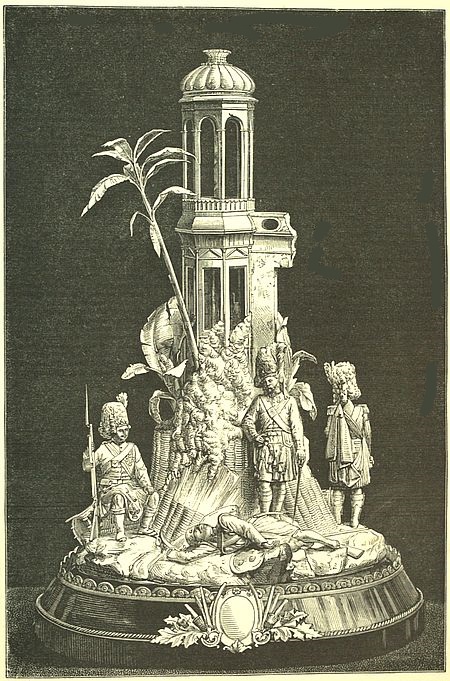
Centre-Piece of Officers’ Plate. Described on page 800.
SUCCESSION LIST OF COLONELS AND LIEUTENANT-COLONELS OF THE 93RD SUTHERLAND HIGHLANDERS.
COLONELS.[578]
Names and Titles.Date of Appointment.Date of Retirement.Remarks.
William Wemyss of WemyssAug.25,18001822Died.
Sir Thomas Hislop, Bart., G.C.B.Feb.8,1822June4,1822Removed to 51st Foot.
Sir Hudson Lowe, K.C.B.June4,1822
Sir John Cameron, K.C.B.July23,1832May31,1833Removed to 9th Foot.
Sir Jasper Nicolls, K.C.BMay31,1833July15,1840Removed to 38th Foot.
Sir James Douglas, K.C.B.June15,1840April10,1850Removed to 42nd Royal Highlanders.
William WemyssMar.10,1850Nov.30,1852Died Colonel.
Lt.-General Edward Parkinson, C.B.Dec.10,18521858Died Colonel.
Lord Clyde (Sir Colin Campbell), G.C.B., K.S.I., D.C.L.Jan.15,1858June22,1860Removed to Coldstream Guards. Raised to the Peerage, Aug. 16, 1858. Died Aug. 14, 1863.
Lt.-General William Sutherland,June4,18601862Died Colonel.
Lt.-General Alex. Fisher Macintosh, K.HJune3,1862Aug.28,1868Died Colonel.
Lt.-General Charles Craufurd HayAug.29,1868Died Colonel.
Lt.-General Sir Henry William Stisted, K.C.B.Sept.28,1873
LIEUTENANT-COLONELS.
Alexander HalketAug.25,1800May3,1810To 104th Foot.
George JohnstoneMay3,1810
Andrew CreaghSept.29,1814Mar.7,1822Removed to 81st Foot.
William WemyssMar.16,1815
Henry MillingMar.7,1822Dec.26,1822From 81st Foot. Retired without joining the regiment.
The Hon. Sir Charles GordonDec.26,1822Retired on Half-pay. Died in command of 42nd in 1835.
Duncan M’GregorMar.23,1826
Robert SparkJuly28,1838
Lorenzo RotheFeb.21,1852
William Bernard Ainslie, C.B.Oct.21,1853Jan.25,1856Retired.
Alex. Sebastian Leith HayApril16,1855
The Hon. Adrian HopeJan.25,1856April16,1858Retired on Half-pay, Nov. 10, 1856, and in March 1857 brought in from Half-pay as second Lt.-Col. Killed in action, April 16, 1858.
John A. Ewart, C.B.April16,1858Sept.30,1859Exchanged to 78th.
Henry William Stisted, C.B.Sept.30,1859Exchanged from 78th.
Robert Lockhart RossDec.21,1860
Frederick William Traill Burroughs, C.B.Aug.10,1864Oct.29,1873Retired on Half-pay.
Erskine Scott Francis G. DawsonNov.29,1864
William M’Bean, V.C.Oct.29,1873
FOOTNOTES:
APPENDIX TO THE 42ND ROYAL HIGHLAND REGIMENT, THE BLACK WATCH.
1873–1875.
The Ashantee Campaign—Malta.
We left the Black Watch at Devonport in the beginning of 1873, with no likelihood then of its being called upon to engage in actual service. On the Gold Coast of Africa, however, mischief had been brewing for many years, and during the course of 1873 the conduct of Coffee Calcallee, king of the barbarous country of Ashantee, had been such that unless a decisive blow were immediately struck, Britain would be compelled to resign possession of her territory in that part of the African coast; and, as our readers no doubt know, that territory had been considerably increased by the cession to Britain, in 1872, of the Dutch possessions on the Gold Coast. Thus in 1873 the coast for many miles, both east and west of Cape Coast Castle, the seat of government, was under the British protection. The principal native population of the territory are the Fantees, who from years of oppression had been reduced to a state of abject cowardice, as was but too well shown in the brief campaign against their inland enemy, the King of Ashantee. The Ashantee territory extends northwards from the Gold Coast to a distance of about 300 miles, its middle being traversed by the River Prah, which flows in the upper part of its course from east to west, but turns at Prah-su towards the south, and reaches the sea at Chamah, to the west of Cape Coast Castle. The capital of the Ashantee territory is Coomassie, about 100 miles directly north from Cape Coast Castle, and about half that distance north of the bend of the Prah, at the town of Prah-su. The population of Coomassie had been very much exaggerated. At the commencement of the campaign it was probably between 20,000 and 30,000. Here the despotic King of Ashantee lived in great state, and in the indulgence of the superstitious and terribly cruel practices known as the Ashantee “Customs.” It is hoped that the lesson which has been read him by a handful of British soldiers will ultimately lead to the abolition of these “Customs,” and to a general amelioration of the miserable lot of the peoples in that part of Africa.
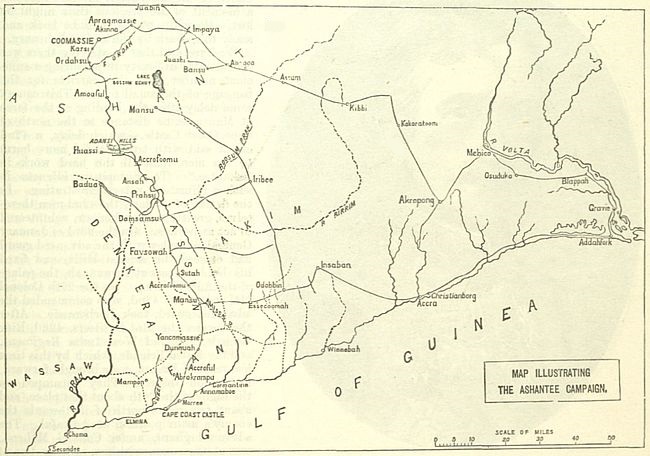
MAP ILLUSTRATING THE ASHANTEE CAMPAIGN.
We need not enter upon the very complicated event which led to the British Government sending out an expedition, under the determined, clear-headed, and accomplished Sir Garnet Wolseley, C.B., to let this barbarous despot know the strength of the British arm. The measures hitherto taken to keep the Ashantees in their place had been so inadequate, that their kings had become intolerably bold and confident, and had indeed acquired an utter contempt of the British power as exhibited on the Gold Coast. King Coffee Calcallee resolved, about the end of 1872, to strike such a blow as would utterly stamp out the British rule on that coast. And in January 1873 an army of 60,000 warriors—and the Ashantees though cruel are brave and warlike—was in full march upon Cape Coast Castle. The whole force at the disposal of Colonel Harley, in whom the administration was vested, was about 1000 men, mainly West India troops and Houssa police, with some marines. It was estimated that a contingent of about 60,000 would be raised from the friendly tribes, but this number figured only on paper. By April the Ashantees were within a few miles of Cape Coast Castle. Things were getting desperate, when a small force of marines, under Lt.-Col. Festing, arrived from England in the beginning of June. With this and other small reinforcements, the English managed to keep the barbarians at bay until the arrival, on October 2nd, on the Gold Coast of Major-General Sir Garnet J. Wolseley, who had been selected to command a force which was being organised in England to sweep back the threatening horde. He was accompanied only by his staff, and immediately on landing set about clearing the Ashantees out of several towns in the neighbourhood of Cape Coast Castle. Sir Garnet’s clear-headedness and admirable power of organisation soon inspired the few troops at his command with perfect confidence; and by the time the force of which the 42nd formed part arrived at the Gold Coast, everything was prepared for an advance towards the capital of the Ashantee kingdom. We cannot linger over the preliminary work in which Lord Gifford, Colonel Festing, the unfortunate Lieut. Eardley-Wilmot, and other officers whose names are now familiar to the British public, played a prominent part. By the end of November the Ashantee force was in full retreat on Coomassie, and by the end of December General Wolseley with his staff and some 500 sailors and marines was at Prah-su.
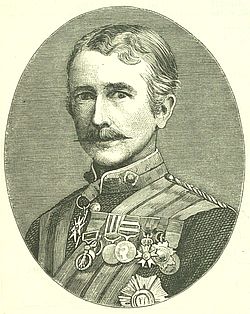
Major-General Sir Garnet J. Wolseley, K.C.M.G., C.B. From a photograph taken Oct. 22, 1874.
Meantime the small force which had been organising in England was on its way to the scene of operations. The 42nd was the principal regiment of the line, as a large part of the 23rd Welsh Fusileers had to re-embark, owing to the desertion of some thousands of native carriers who had been engaged to carry the necessary baggage through the unwholesome country. As we said at the conclusion of the history of the 79th, a considerable number of volunteers from that regiment accompanied the Black Watch, which left Portsmouth on the 4th of December 1873, and arrived off Cape Coast Castle on the 17th, disembarking on the 3rd and 4th of January 1874. Besides the 23rd, 42nd, and 2nd battalion Rifle Brigade, there were detachments of Royal Artillery, Royal Engineers, and Royal Marines, which, with the force already on the ground, formed the army with which Sir Garnet Wolseley was to pierce into the very heart of the Ashantee kingdom, through a country of marshes and matted forests, the growth of centuries, and forming an almost impenetrable ambush for the enemy, who knew how to take advantage of it. As Lord Derby remarked, this was to be “an engineers’ and doctors’ war.” The engineers worked admirably in the construction of roads, bridges, telegraphs, and camps; and it became simply a question whether the British soldiers would be able to hold out against the pestiferous climate long enough to enable them to reach Coomassie and return to the Gold Coast ere the heavy rains set in in the early spring. Happily the energy, skill, and knowledge of General Wolseley were quite equal to the emergency; and backed by an able and determined staff, and his small force of brave and willing soldiers, he accomplished his mission with complete success. All possible preparations were made on the road to Prah-su, previous to the commencement of the march of the main body, in order that not a moment of the precious time might be lost,—the white troops must be back, and ready to embark by the end of February.
We have said that at starting there was considerable difficulty in procuring a sufficient number of native carriers for the baggage of the small force. This caused some delay after the landing of the force at Mansu, some distance to the north of Cape Coast Castle,—which delay, a 42nd officer said with truth, “did more harm to our men than all the hard work in Ashantee.” To Europeans idleness in such a climate is utterly prostrating. In the dearth of carriers, the 42nd men themselves, greatly to their honour, volunteered to act as porters. On the 23rd of January General Wolseley with the advanced guard had crossed the Adansi Hills, and fixed his headquarters at Fomannah, the palace of the Adansi king. On the 26th Colonel M’Leod of the 42nd, who commanded the advanced guard, took Borborassie. After this service the 23rd Fusileers, 42nd, Rifle Brigade, the 2nd West India Regiment, and the Naval Brigade, which by this time had reached Prah-su, were brought forward, resting on Insarfu. They encamped on the night of the 30th about that place, and about two miles north of it, towards the enemy’s main position at Amoaful. The advanced guard, under Colonel M’Leod, was at Quarman, within a mile or two of the enemy’s position.
The entire country hereabout is one dense mass of brush, penetrated by a few narrow lanes, “where the ground, hollowed by rains, is so uneven and steep at the sides as to give scanty footing. A passenger,” to quote the London News’ narrative, “between the two walls of foliage, may wander for hours before he finds that he has mistaken his path. To cross the country from one narrow clearing to another, axes or knives must be used at every step. There is no looking over the hedge in this oppressive and bewildering maze. Such was the battlefield of January 31st. The enemy’s army was never seen, but its numbers are reported by Ashantees to have been 15,000 or 20,000. Its chief commander was Amanquatia, the Ashantee general. The Ashantees were generally armed with muskets, firing slugs; but some had rifles. As they were entirely concealed in the bush, while our countrymen stood in the lane or in the newly-cut spaces, precision of aim was no advantage to our side.”
The main body of the enemy was encamped on the hill rising towards the town of Amoaful; but thousands of them also must have been skulking in the bush through which the small British force had to march before reaching the encampment. At early dawn on the 31st the British force moved upon the village of Egginassie, where the first shots were fired from an Ashantee ambush. The force was carefully arranged to suit the nature of the ground, with a front column, a left column, a right column, and a rear column, all so disposed that when they closed up they would form a square, the columns taking in spaces to the right and left of the central line of advance, so as to prevent any attack on the advancing front centre.
The front column was commanded by Brigadier-General Sir Archibald Alison, Bart., C.B. It consisted of the 42nd, under Major Baird, Major Duncan Macpherson, and Major Scott, a detachment of the 23rd Fusileers, Captain Rait’s Artillery, manned by Houssas, and a detachment of the Royal Engineers. The left column was commanded by Brigadier-Colonel M’Leod of the 42nd, and the right column by Lt.-Col. Evelyn Wood, 90th Light Infantry; part of the right column consisted of miscellaneous native African levies, under Captain Furze of the 42nd. The paths through the jungle were cut for each column of troops by large parties of native labourers.
Thus clearing their way through the jungle, and often scarcely able to obtain foothold from the slippery state of the marshy ground, the force advanced against the enemy. When the front of the small force had got a few hundred yards beyond the village of Egginassie, it was assailed by a tremendous fire of musketry from an unseen foe, very trying to the nerves even of an experienced and well-trained soldier. By this time five companies of the 42nd were in skirmishing order. The slugs were dropping thick and fast; had they been bullets, scarcely a man of the Black Watch would have lived to tell the tale. As it was, there were few of the officers who did not receive a scratch, and nearly 100 of the men were wounded. Major Macpherson was shot in the leg, but limped on with a stick, and kept the command for some time, when he was compelled to give it up to Major Scott. It was at this critical moment that Capt. Rait’s gun—there was no room for two—came into action at 50 yards from the enemy, on the direct line of advance. The shells fired at that short distance, with deadly effect, soon forced the enemy to clear the road. In a moment, as they gave way upon their own left upon the road, the 42nd pushed them in thence along the whole line, and they began to yield another 50 yards or more, and Rait’s gun again came into action against the enemy, who had at once taken up a fresh position, as the bush prevented the Black Watch from forming quickly.
Again the enemy per force gave way before the shells along the road. Again the 42nd took instant advantage of it, and the enemy rolled back. The men were now in such high spirits, according to the account of one who was present, that the terrors of the bush were no more. Sir Archibald Alison saw that the moment had come. He ordered the pipers to play. Down together, with a ringing cheer, went the splendid regiment under his orders, straight at the concealed foe. Away rolled every Ashantee in front of them; away down one hill and up another, on which stood the village of Amoaful itself. By half-past eleven the village was in the hands of the British force. It was not, however, till after two that the fighting was over, as the flank parties, the left as we have said, commanded by the Colonel of the 42nd, had much more trouble and numerous casualties in fighting and clearing their way through the bush. By the time mentioned, however, the last Ashantee had shown his heels in full retreat. Of the 42nd Bt.-Major Baird was severely wounded, from which he died at Sierra Leone on the 6th of March, Major Macpherson, Captains Creagh and Whitehead, Lts. Berwick, Stevenson, Cumberland, and Mowbray, and 104 men wounded.
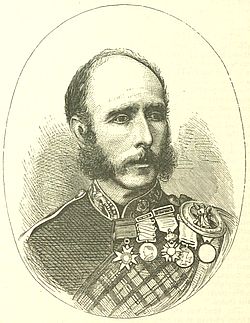
Sir John M’Leod, K.C.B. From a photograph.
On Feb. 1st, the day after this signal victory, the adjacent village of Becqueh was captured and destroyed by Col. M’Leod, with the naval brigade and several detachments, supported by portions of the 42nd and 23rd. On the 2nd, the army was at Agemanu, six miles beyond Amoaful, every inch of the ground between the two places being disputed by the enemy. On this day Lt. Wauchope of the 42nd was slightly wounded. On the 3rd, Sir Garnet moved by the westerly road, branching off to the left from Agemanu, through Adwabin and Detchiasa to the river Dah or Ordah, the enemy again opposing the advance and hanging round the flanks of the force. King Coffee Calcallee had tried to stop the advance of the British by offering to pay an indemnity, but in vain, as no reliance whatever could be put in any of his promises; the King therefore resolved to dispute the passage of the river. The battle of Ordah-su, as it is called, was fought on Feb. 4th, and lasted seven hours. When the troops reached the Dah on the evening of the 3rd, it was a tremendous downpour of rain, and it was not till next morning that the engineers managed to complete their bridge over the river. By this bridge, on the morning of the 4th, the advanced guard, the rifle brigade and some native troops under Colonel M’Leod, crossed the bridge, and soon found itself fiercely engaged with very large numbers of the enemy, who had crowded into the villages on each side of the road, from which it was found exceedingly difficult to dislodge them. The first shots were fired about 7 A.M., and Sir Garnet Wolseley in his official despatch, dated Coomassie, Feb. 5th, thus describes the rest:—
“The advanced guard, under the command of Col. M’Leod, 42nd Highlanders, was brought to a stand still shortly after the advance began; and a general action soon developed itself, lasting for more than six hours. The enemy did not, however, fight with the same courage as at Amoaful, for although their resistance was most determined, their fire was wild, and they did not generally attack us at such close quarters as in the former action.
“The village of Ordahsu having been carried by the rifle brigade at nine o’clock, I massed all my force there, having previously passed all the reserve ammunition, field hospitals, and supplies through the troops, who held the road between the river and the village, a distance of about a mile. The enemy then attacked the village with large numbers from all sides, and for some hours we could make no progress, but steadily held our ground. The 42nd Highlanders being then sent to the front, advanced with pipes playing, and carried the enemy’s position to the north of the village in the most gallant style; Captain Rait’s artillery doing most effective service in covering the attack, which was led by Col. M’Leod.
“After some further fighting on the front line, a panic seems to have seized the enemy, who fled along the road to Coomassie in complete rout. Although the columns they had detailed to assault our flanks and rear continued for some time afterwards to make partial attacks upon the village, we followed close upon the enemy’s heels into Coomassie. The town was still occupied by large numbers of armed men, who did not attempt to resist. The King had fled no one knew whither. Our troops had undergone a most fatiguing day’s work, no water fit for drinking having been obtained during the action or the subsequent advance, and the previous night’s rest having been broken by a tornado, which drenched our bivouac. It was nearly six o’clock when the troops formed up in the main street of Coomassie, and gave three cheers for the Queen.”
The 42nd was the first to enter the capital, the pipers playing at its head, about half-past four in the afternoon; by half-past seven the whole force was inside Coomassie, and the discomfiture of the Ashantees was complete, the king himself having fled.
Mr H. M. Stanley, the well-known correspondent of the New York Herald, in describing the advance on Coomassie, wrote as follows of the bravery of the Black Watch:—
“The conduct of the 42nd Highlanders on many fields has been considerably belauded, but mere laudation is not enough for the gallantry which has distinguished this regiment when in action. Its bearing has been beyond praise as a model regiment, exceedingly disciplined, and individually nothing could surpass the standing and gallantry which distinguished each member of the 42nd or the Black Watch. They proceeded along the well ambushed road as if on parade, by twos. ‘The Forty-second will fire by companies, front rank to the right, rear rank to the left,’ shouted Col. Macleod. ‘A company, front rank fire! rear rank fire!’ and so on, and thus vomiting out twoscore of bullets to the right and twoscore to the left, the companies volleyed and thundered as they marched past the ambuscades, the bagpipes playing, the cheers rising from the throats of the lusty Scots until the forest rang again with discordant medley of musketry, bagpipe music, and vocal sounds. It was the audacious spirit and true military bearing on the part of the Highlanders, as they moved down the road toward Coomassie, which challenged admiration this day. Very many were borne back frightfully disfigured and seriously wounded, but the regiment never halted nor wavered; on it went, until the Ashantees, perceiving it useless to fight against men who would advance heedless of ambuscades, rose from their coverts, and fled panic-stricken towards Coomassie, being perforated by balls whenever they showed themselves to the hawk-eyed Scots. Indeed, I only wish I had enough time given me to frame in fit words the unqualified admiration which the conduct of the 42nd kindled in all who saw or heard of it. One man exhibited himself eminently brave among brave men. His name was Thomas Adams. It is said that he led the way to Coomassie, and kept himself about ten yards ahead of his regiment, the target for many hundred guns; but that, despite the annoying noise of iron and leaden slugs, the man bounded on the road like a well-trained hound on a hot scent. This example, together with the cool, calm commands of Col. Macleod, had a marvellous effect upon the Highland battalion.”
In the action on the 4th, Capt. Moore and Lts. Grogan and Wauchope of the 42nd were wounded, the latter severely this time; 14 men were also wounded.
Thus, in the space of about a month, by the decision and energy of the leader of the expedition, and the willingness of his officers and troops, was the great object of the campaign accomplished in the most masterly manner, and the Ashantees humbled as they had never been before, and taught a lesson they are not likely soon to forget. As during the 5th there seemed no hope of the treacherous king coming to terms, and as it was absolutely necessary for the safety of the troops that the return march should be immediately commenced, Sir Garnet resolved to destroy Coomassie, and set out at once. Having, therefore sent off all the wounded, he issued orders for an advance on the morning of the 6th. Early on that morning the homeward movements commenced, headed by the naval brigade, and covered by a rear guard of the 42nd, which did not retire till the town had been set on fire in every quarter, and the mines which had been placed under the palace fired. A tornado had raged during the previous night, but the destruction of the town by fire was complete.
Thus the campaign was virtually at an end, and Gen. Wolseley made all possible haste to bring his little army back to Cape Coast Castle, which, notwithstanding the swollen state of the rivers, he accomplished by February 19th. While on his way back Gen. Wolseley received the unqualified submission of the humbled king. No time was lost in getting the troops out of the influence of the deadly climate. Without delay, therefore, the embarkation took place. The 42nd embarked in the “Nebraska” on the 23rd, and sailed on the 27th in the “Sarmatian,” the steamer which brought them from England. It arrived at Portsmouth on March 23rd, where it was received with tremendous enthusiasm. All had suffered more or less from the effects of the climate, but what with good constitutions and care, the 42nd in course of time regained its “wonted health and strength.” Previous to its embarkation for Ashantee the 42nd, like the other regiments, was provided with suits of dark grey (retaining in the head dress their red feather), as being much more appropriate for the work to be done than the usual regimental costume. The men’s kits were, however, on board the “Sarmatian,” and the national garb was therefore donned before landing, so that the regiment came ashore in all the glory of its national garb.
Among the officers specially mentioned by Sir Garnet Wolseley for having performed prominent services during the campaign were Col. Macleod, C.B., who was afterwards made a K.C.B.; Majors Macpherson and Scott; Capts. Farquharson, V.C., Furze, and Kidston; and Lt. Wauchope. The special thanks of Parliament were awarded to the troops, and honours were showered upon the Commander by the Queen and country. Major Macpherson and Scott were made Lieutenant-Colonels and C.B.’s., and had the brevet of lieutenant-colonel conferred on them. Captains Bayly, Farquharson, V.C., and Furze, were made Bt.-Majors. The Victoria Cross was conferred on Sergt. Samuel M’Gaw. The non-commissioned officers and men selected to have medals “for distinguished conduct in the field” at the hand of the Sovereign—and had them presented by Her Majesty the Queen at Windsor Castle on the 16th of May 1874, in presence of Colonel Sir John M’Leod, K.C.B., commanding the regiment, were—Wm. Street, sergt.-instructor of musketry; sergt. Henry Barton; privates John White, George Ritchie, George Cameron, and William Bell; piper James Wetherspoon; privates Henry Jones, Wm. Nichol, and Thomas Adams. Also, Sergeant-Major Barclay was awarded the medal for “meritorious services” for distinguished conduct during the campaign.
In conclusion, we think the following is worth recording; it is told in a letter from a soldier of the 42nd, which appeared in the Inverness Advertiser:—
“We were the objects of great curiosity on the part of the Fantees (natives of this bit of the country), who hung round the camp all day in crowds, and numbers of whom had followed us from a large village through which we passed just as the sun was rising, our pipes making the whole street ring with the tune of ‘Hey, Johnnie Cope,’ which they struck up just as we entered the village; the whole place was in an uproar at once, the people rushing out of their huts in the utmost consternation, evidently thinking the Ashantees were on them. The pipes were something new; bugles they had heard something of, but bagpipes were unknown instruments of warfare to them. As soon as they realised that it was not their dreaded foes who were present, they began to approach cautiously, but catching sight of the pipers, who still adhere to the garb of old Gaul in defiance of War-Office regulations, a fresh stampede took place, to the intense amusement of our men; nor did the boldest of them venture to come near until the rear of the detachment was clear of the village. By the time, however, that we reached our halting-place, we were surrounded by a considerable crowd, the pipers still forming the attraction, the natives evidently looking on these as officers or dignitaries of the very highest importance, and the pipes themselves as some kind of mysterious instrument by which the enemy is to be vanquished. So far, indeed, did their respect for these personages carry them, that a war-dance in their honour was got up, and carried on with great vigour, to the evident disgust of big Duncan, our pipe-major, who wanted to know what he was made a peep show of for, and if they had never seen a kiltie before.”
The regiment remained at Portsmouth until Nov. 15th, when it embarked for Malta under command of Sir John Macleod, K.C.B. Its strength on embarkation was 26 officers, 43 sergeants, 21 drummers and pipers, and 630 rank and file. It arrived at Malta, after calling at Queenstown, on the 27th, and, after being a few days under canvas, went into Isola barracks, &c., the same that was occupied by the regiment in 1832, and again in 1844.
FENCIBLE CORPS.
The plan of raising Fencible corps in the Highlands was first proposed and carried into effect by Mr Pitt (afterwards Earl of Chatham), in the year 1759. During the three preceding years both the fleets and armies of Great Britain had suffered reverses, and to retrieve the national character great efforts were necessary. In England county militia regiments were raised for internal defence in the absence of the regular army; but it was not deemed prudent to extend the system to Scotland, the inhabitants of which, it was supposed, could not yet be safely entrusted with arms. Groundless as the reasons for this caution undoubtedly were in regard to the Lowlands, it would certainly have been hazardous at a time when the Stuarts and their adherents were still plotting a restoration to have armed the clans. An exception, however, was made in favour of the people of Argyll and Sutherland, and accordingly letters of service were issued to the Duke of Argyll, then the most influential and powerful nobleman in Scotland, and the Earl of Sutherland to raise, each of them, a Fencible regiment within his district. Unlike the militia regiments which were raised by ballot, the Fencibles were to be raised by the ordinary mode of recruiting, and like the regiments of the line, the officers were to be appointed and their commissions signed by the king. The same system was followed at different periods down to the year 1799, the last of the Fencible regiments having been raised in that year.
The following is a list of the Highland Fencible regiments according to the chronological order of the commissions, with the date of their embodiment and reduction:—
1. The Argyll Fencibles (No. 1), 1759–1763.
2. The Sutherland Fencibles (No. 1), 1759–1763.
3. The Argyll or Western Fencibles (No. 2), 1778–1783.
4. The Gordon Fencibles, 1778–1783.
5. The Sutherland Fencibles (No. 2), 1779–1783.
6. The Grant or Strathspey Fencibles, 1793–1799.
7. The Breadalbane Fencibles (three battalions), 1793 and 1794–1799 and 1802.
8. The Sutherland Fencibles (No. 3), 1793–1797.
9. The Gordon Fencibles (No. 2), 1793–1799.
10. The Argyll Fencibles (No. 3), 1793–1799.
11. The Rothesay and Caithness Fencibles (two battalions), 1794 and 1795–1802.
12. The Dumbarton Fencibles, 1794–1802.
13. The Reay Fencibles, 1794–1802.
14. The Inverness-shire Fencibles, 1794–1802.
15. The Fraser Fencibles, 1794–1802.
16. The Glengarry Fencibles, 1794–1802.
17. The Caithness Legion, 1794–1802.
18. The Perthshire Fencibles, 1794–1802.
19. Argyll Fencibles (No. 4), 1794–1802.
20. Lochaber Fencibles, 1799–1802.
21. The Clan-Alpine Fencibles, 1799–1802.
22. The Ross-shire Fencibles, 1796–1802.
23. Regiment of the Isles, or Macdonald Fencibles, 1799.
24. Argyll Fencibles (No. 5), 1796–1802.
25. The Ross and Cromarty Rangers, 1799–1802.
26. The Macleod Fencibles, 1799–1802.
INDEX.
Abercromby, Sir Ralph, his portrait, ii. 372; Major-General, at Ticonderoga, 338; his expedition against the West Indies, 362; Egypt, 366; his fatal wound, 372. “Abercrombie Robinson,” The, its voyage with the 91st, ii. 732. Aberdeen, Montrose’s march upon it, i. 169; Covenanters expelled from, 172; Farquharson’s “Hieland Men” at, 174; Covenanters at, 187; battle and sack of, 188; deputation from, to Montrose, 202; Covenanting officers killed at, 246. Aberdeen, Old, view of, i. 246. Aberdeenshire Highland Regiment, or Old 81st, ii. 565. Aberdour, in Aberdeenshire, i. 39. Aboukir taken by the British ii. 367. Aboyne, the viscount’s force, i. 161; appointed lieutenant of Highlands, 173; landing in Aberdeen, 173; proclamation to Covenanters, 173; his escape from Carlisle, 208; Montrose deserted by him, 229; interview with Montrose, 234; escape, 254. Achnacarry, the seat of Cameron of Lochiel, engraving of it, i. 709. A fin (“to the end”), the motto of the Ogilvy, ii. 319. Agricola in Britain, i. 3; his invasion of Scotland, 6; his voyage and death, 9. Agriculture in the Highlands, ii. 9. Ahmednuggur, this fortress attacked and taken, ii. 575; taken (1803), 627; the Hon. Mrs Stewart Mackenzie’s memorial slab to the 78th in the Pettah wall, 628. Ahwaz, captured (Apr. 1, 1857), ii. 665, 666. Aire, The, the fight here in 1814, ii. 729. Alba or Scotland, i. 34. Alba de Tormes, the allies’ retreat from, ii. 584; the battle of, 760. Alban or Scotland, i. 26; note, 34. Albania or Scotland (note), i. 34, 50. Albany, Count of, this title is assumed by Prince Charles, i. 758. Albany, Duke of, i. 69; Regent, 71; his victory at Harlaw, ii. 140. Albany’s Highlanders, see 72nd. Albinn or Britain, i. 17. Alexander III., his coronation at Scone, i. 61; his portrait, 62. Alexander of the Isles, Inverness destroyed by, i. 73; he surrenders to James I., 73. Allahabad, the 78th proceed thither, ii. 667; Havelock’s march against the insurgents, 667; the 79th here (1867), 716. Alma, the battle of the, 42nd, ii. 410; the 79th, 711; the 93rd, 785; —the River, the position of the Russians, 711; —Medals, their distribution, 417. Almarez, Lord Hill carries, ii. 381; the 92nd here (1812), 760. Alpine, Siol, several clans, ii. 242. Alum Bagh, The, the sick and wounded guarded here, ii. 676. Am Freiceadan Dubh (“the Black Watch”), the Gaelic name of the 42nd, ii. 324. Amoaful, the battle here, ii. 804. Anderson, General Paul, the 78th receive new colours and accoutrements from his estate, ii. 659. Anglo-Norman jurisdiction, i. 59. Anglo-Saxon colonisation of Scotland, i. 56. “Another for Hector,” origin of the saying, i. 324. Anrias or Ross, Clan, its history, crest, arms, and motto, ii. 235. Anson, Hon. Mrs George, she presents new colours to the 74th Highlanders, ii. 608. Antonine, Wall of, map and profile of, i. 10; stone from, 11. Antwerp, allied commanders’ object against (1811), ii. 651. Arapiles, Los, near Salamanca, ii. 583; Pakenham’s obstinate fight here, 383. Ard Choille (“the wooded hill”), motto and slogan of the Macgregors, ii. 243. Ardoch Moor, i. 7; battle of, 8; view of Roman Camp at, 15. Ardvraick Castle, Montrose imprisoned here, i. 268; view of, 269. Argaum, battle of (1803), ii. 633. Argyll, i. 34; settlement of Scots from Ireland here, 33; the proper orthography (note), ii. 177. Argyll, Campbell, the clan, history, arms, crest, and motto, ii. 175. Argyll, Archibald, the 5th Earl, ii. 179. Argyll, 2nd Duke of, portrait, i. 472. Argyll, the 7th Earl of, his portrait, i. 338; defeated at Glenlivet, 109; the 8th Earl and 1st Marquis, his portrait, 178; defeated at Tippermuir, 184; at Aberdeen, 188; at Fyvie, 192; his conduct towards Montrose, 271; declines to serve in the Scots army in England, 289; declaration of the 9th Earl against Government. See Campbell, Clan. Argyll, 1st Marquis of, arrested, i. 332. Argyll Highlanders, or Old 74th Highland Regiment, their history, ii. 519. Argyllshire Highlanders, the 91st Princess Louise’s Regiment, see Ninety-first. Argyll’s Stone (note), i. 339. Arinez, the action here in 1813, ii. 596. Arkaig, Loch, view of, i. 709. Armour, ancient Caledonians’, i. 5. Army sub-districts of Highland Regiments, see Brigade Centre. Arriverète, the battle here (1814), ii. 762. Arroyo de Molinos, the battle here, ii. 496. Ashantee Campaign (1874), map, ii. 803. Ashantee War, volunteers from the 79th share in its dangers, ii. 721. Assaye, battle and plan of, ii. 574, 631. Athole, 2nd Duke of, with President Forbes at Blair Castle, i. 323; the 4th Duke raises a regiment in 1778, ii. 522; note from the 7th Duke on the death of Dundee, i. 376; his accepting the care of the monument to the fallen of the 42nd, ii. 435. Athole Highlanders at Culloden, i. 663. Athole Highlanders, see 77th Regt., Old. Athole, Marquis of, created duke, i. 410. Athole, Stewarts of, their descent, ii. 300. Attainted estates, i. 478. Audaces juvo (“I favour the brave”), scroll motto of the Buchanans, ii. 281. Audentes Fortuna juvat (“fortune aids the daring”), Mackinnon’s motto, &c., ii. 256. Augustus, Fort, view of, i. 485. Auldearn, battle of, i. 210. Aut pax aut bellum (“either peace or war”), motto of Gunn, &c., ii. 278. Badajoz, its siege and capture, ii. 581. Bagh, “garden,” of frequent occurrence in Indian names, ii. 530. Bagpipe, history of, in Highlands, ii. 109. Bagpipe-playing in the Highlands, i. 312. Baird, Major-General, his portrait, ii. 482; commands against Hyder Ali, 481; at the assault on Seringapatam, 570; commands at the Cape of Good Hope, 778. Balaklava, battle of, ii. 418, 713, 785. Balloch, Donald, Lord of Isla, i. 76; sends his own head to Edinburgh, ii. 141. Balmerino, his letter to the Chevalier de St George, i. 726; his execution, 727. Balmoral, Highland residence of Her Majesty, steel engraving of, i. 775. Balnagowan, Ross of, and Pitcalnie, their claims to the chiefship, ii. 237. Bangalore, the storming in 1791, ii. 527. Bannockburn, battle of, i. 63. Bannockburn House—Prince Charles passes a night here, i. 616. Bards’ influence on the Highlanders, i. 315. Bareilly, its final reduction, ii. 686. Bayonne—the battle in 1813, ii. 729; last action of the Peninsular war, ii, 763. Bede, the Venerable, i. 20, 22; dialect, 21. Belhaven, “the fiery Lord,” i. 411. Ben, beann, ban, bean, bain, bane,—literally “white, beautiful;” applied to amountain, it refers to the snow-cap, ii. 216. Bengal army—the mutiny, ii. 666. Beresford, Major-General, at Buenos-Ayres, ii. 488; at the siege of Badajoz, 496; his brigade in 1808, 727. Bergen-op-Zoom, attack on, ii. 451. Berridale, Lord, prosecution of, i. 126; imprisoned, 137-8; and his creditors, 145; his wounds at Charlestown, ii. 521. Bithoor, its evacuation before Hope-Grant, ii. 420; the march against, 674. “Birkenhead,” wreck of the, ii. 604. Bi se mac an t’slaurie (“Be thou son of the crook”), the scroll motto of the Maclaurins, ii. 279. Bishops, Scottish, Anti-Popery mandates to their clergy (1745), i. 582; recognise the Hanoverian Government, 769. “Black Camp,” before Inverary, i. 434. Blackmail in the Highlands, i. 321; levying of it, 483; cessation of its payment, 488; its amount, ii. 2. “Black Watch,” the, see Forty-Second Royal Highlanders, ii. 324. Blair-Athole, Prince Charles here, i. 635. Blair Castle abandoned by the Duke of Athole, and seized by the Marquis of Tullibardine, i. 534; the family residence of the Dukes of Athole, with engravings of as it stood in 1745–6 before being dismantled, 643; and as restored in 1872, ii. 312. Blantyre, Lord, deputed to London, Queen Elizabeth refuses to see him, i. 409; his experience of Highlanders, ii. 380. Blauw-Berg, the battle in 1806, ii. 778. “Bloody Preacher,” the, David Dickson, i. 238; John Nave or Neaves, ii. 252. Bog of Gight, Earl of Murray here, i. 156; the castle taken by Leslie, 251; the site of Gordon Castle, ii. 318. Bondage, Manerial, predial service in Harris, ii. 35. Bones, Highland superstitions about, i. 309. “Bonnet gained,” the, its history, ii. 417. “Bonnie Dundee,” song of (note), i. 350. “Bonnie House o’ Airly,” the, destroyed by the Earl of Argyll, i. 178. Book of Deer, the, (note), i. 22, 38. Borlum, Old, Brigadier Mackintosh, Laird of, i. 437; ordered by Mar to the Borders, 445. Boyd, Lord, incident at Culloden, i. 667. Boyne, King James’s defeat at the, i. 393. Brahan Castle, the Highlanders lay down their arms here, i. 486. Brandywine Creek—the battle, ii. 353. Breadalbane Campbells, their motto, history, arms, &c., ii. 186; first earl, 187. Breadalbane, his portrait, i. 394; his policy for the winning side, 395; imprisoned for high treason, i. 402. Bridge of Dee (note), i. 85; battle of the, 175; skirmish at, 202. Brigade Centres, or “Army Sub-districts” of the Highland regiments—the 42nd and 79th is Perth; the 71st and 78th is Fort George; the 72nd and 91st is Stirling; the 74th is Hamilton; and the 92nd and 93rd is Aberdeen. Brooklyn, battle of (1776), ii. 349, 467. Bruce, Robert, i. 63. Buchanan, Clan, its history, arms and mottoes, ii. 281. Buchanan, George, on Highland dress and armour, i. 327. Burgos, the siege in 1812, ii. 383, 703. Burton, Major, his melancholy fate, ii. 551. Burt’s Letters on Highland dress, i. 330; their value, ii. 20. Busaco—the battle, A.D. 1810, ii. 578. Busheer, its surrender, ii. 660. Bydand (“permanent”), motto of the Gordons, ii. 316. Byng, Lt.-General Sir John, presents new colours to the 92nd, Dec. 13, 1830, ii. 767. Caber Feidh, or “Gathering of the 72nd Highlanders,” the music arranged for the bagpipes, ii. 532. Cadogan, Colonel, mortally wounded at La Puebla—engraving of his monument in Glasgow Cathedral, ii. 498. Caffraria, map of the eastern part, ii. 564. “Caisteal Foulis na theine”—Castle Foulis in flames—slogan of the Munroes, ii. 434. Caithness and Sutherland, Earls of, feud between, i. 100; reprisals, 110; differences, 128; agreement, 136. Caledonians, Ancient, their habits, i. 1, 4; weapons, armour, government, physique, 5; engravings of two sculptured stones representing them, 4. Callernish Circle in Lewis—view of, i. 37. Callum More, Colin Mòr or Mohr, ii. 178. Cambridge, H.R.H. the Duke of, in the Crimea, ii. 784; he presents new colours to the 93rd, 788. Cameron (or Chameron), Clan, its history, arms, crest, mottoes, and branches, ii. 217; clan muster in 1745, i. 522; defeat of Clan Chattan by, 106. Cameron, Alan (of Erracht), raises the 79th Regiment, ii. 697; his candid and stern refusal to allow the king to draft the 79th Regiment (note), 698; his letter on abolishing the kilt, 699. Cameron, Sir Duncan A., K.C.B., his portrait on steel as colonel of the “Black Watch,” ii. 325; at the Alma, 413; succeeds Sir Colin Campbell in command of the Highland Brigade (1855), 547, 713; succeeds Sir Colin in command of a division, 548; his war services, 437. Cameron, Col. John, 92nd, his portrait, ii. 763; —his part and death at Quatre Bras, June 16, 1815—some details of his life and bravery, 764; his coat of arms, 762; Sir Walter Scott’s lines upon, 765. Cameron, Donald (Lochiel), “The Gentle Chief,” see Lochiel. Cameron, Dr Arch., portrait, i. 718; execution at Tyburn—reluctance of George II. to sign his death warrant, 756. Cameron Highlanders, “the 79th Queen’s Own,” see 79th Regiment. Cameron, John Dhu, Sergeant Mòr, i. 325. Cameron, Sir Ewen, of Lochiel (or “Ewan Dhu”), his character and achievements, i. 296, 297, ii. 220-222; with his second son at Killiecrankie, i. 371; his foster brother at Killiecrankie (note), 377; Byron’s mention of him, ii. 706. Cameronian Volunteers, the first designation of the 79th, ii. 697. “Cameronians,” origin of the name, the test, i. 335; become partisans of the Stuarts, their warlike movements, i. 414. Camerons, their conduct before the battle of Prestonpans, i. 555, 562. Campbell—its etymology, ii. 175. Campbell, Clan, Argyll Branch, arms, crest, and motto, ii. 175; its prominent men, 177-185. Campbell, Clan, Breadalbane Branch, arms, crest, and motto—its prominent men, ii. 186-189. Campbell, Clan, Offshoots, ii. 189-190. Campbell, Castle, burned by the Macleans, i. 221. Campbell, Colin (of Carwhin), he succeeds to the Breadalbane peerage, ii. 188. Campbell, General Duncan, of Lochnell, first colonel of the 91st—his portrait on steel, ii. 756; his punch-bowl, 754. Campbell, Major-General John Francis Glencairn—his portrait, ii. 746; his bravery, 738; his becoming colonel, 91st, 746. Campbell, Major-General Sir Archibald, K.C.B., first colonel of the 74th Highlanders, ii. 571; his portrait, 572. Campbell of Lochnell at Glenlivet, i. 108. Campbell, Sir Archibald Ava, Bart., the representative of the Robertsons, ii. 172. Campbell, Sir Colin (Lord Clyde), his portrait on steel plate, ii. 409; his career (note), ii. 413; his generalship, 416, 417, 682, 684, 713, 784, 785, 790. Campbell’s Highlanders, or Old 88th Regiment, history of, ii. 475. Campbells, Macdougall, of Craignish, ii. 167. Campobello, Sir Nigel de, the head of the Clan Campbell (in 1320 A.D.), ii. 176. Camps, Roman, i. 14, 15. Canada, plan for its conquest (1759), ii. 460. Cannon, Colonel, joined by Farquharsons, Frasers, Gordons, Macphersons, i. 380; defeated at Dunkeld, 384. Canute in Scotland, i. 53. Cape of Good Hope, the Dutch yield it up, ii. 624. Carlisle, occupied by Duke of Hamilton, i. 256; surrenders to Prince Charles, 589; engraving of the city (1745), 604; surrenders to Cumberland, 610. Carpenter, General, he intercepts the Jacobite army, i. 146, 449; commander of the forces in North Britain, 480. Caschroim, the crooked Scotch spade (woodcut), ii. 9. Cassilis, Earl of, i. 88; his flight from Linlithgow, 258; at Queensferry, 258. Cat, the Great, a name of the Sutherland chief, ii. 273. Cathcart, Colonel, is despatched against the rebels by the Duke of Argyll; he surprises the Jacobites, i. 457; his skilful attack at Sheriffmuir, 463. Catholic religion, restoration of, i. 329. Cattanachs, the, ii. 217. Cattle-lifting in the Highlands, i. 321; ii. 1. Cattle raids in the Highlands (1724), i. 483. Cawnpore, more correctly Cawnpoor. Cawnpoor, siege and second massacre of, ii. 667; view of Suttee Chowra Ghât, the scene of second massacre, 668; the third massacre, 669; view of mausoleum over the well, 670; and its monumental inscription, 669; plan to illustrate the action near Cawnpoor, 16th July 1857, 669. Caw, Lewis, assumed name of Prince Charles (in Skye), i. 700. Cean Ciknith, “Head of the Lineage,” ii. 117. Ceanmore, Malcolm, i. 54. Cearnachs or Caterans, i. 321. Celtic and feudal names, i. 72, 299. Celtic MSS., their archives, ii. 67. Ceylon, Stuart’s expedition, ii. 531. Chariot, ancient British war chariot, i. 6. Charles I. and the Covenanters, i. 175; and the Marquis of Huntly and people of Scotland, 251; prisoner at Newport, 259; his reverses in England—taken prisoner. 247; writes to Montrose, 248. Charles II., his arrival in Scotland, i. 331. Charles Edward, Prince, his portrait engraved on steel, from a miniature given to Lochiel, frontispiece to vol. i.; his portrait in old age, taken at Florence in 1776, i. 758; portraits of the Prince and his wife Louisa, ii. 753; his parentage, i. 499; leaves Rome for the invasion of England, 507; his spirit in 1745, 510; aspires to the throne, 511; his companions in the invasion of Great Britain, 512; in a naval battle, 513; his dress and manners on landing in 1745, 515; resolve to raise his standard, 520; proclamation to apprehend, 528; encamps at Loch Lochy—his proclamation to apprehend George II., 532; his Highland army (1745)—adopts the Highland dress—his resolve to meet Sir John Cope, 533; enters Perth, 535; shows his last coin, 536; his entry into Edinburgh, 547; description of him, 549; his prudence at Prestonpans, 555; his address to his army at Prestonpans, 559; his humanity after the battle—at Pinkie House, 565; his clemency in Edinburgh, 570; marches to England, 576: deportment at Holyrood—orders a review of his army on Leith Links—final departure from Holyrood, 584; enters Carlisle, 569; progress in England, 594; proposes to march into Wales, 599; dejection after the decision to retreat from Derby, 600; reviews his army on Glasgow Green, 615; flight of his troops, 634; loss of his war treasure, 645; pecuniary difficulties, 647; energy and strategetic ability, 648; account of battle of Culloden, 650 to 663; conduct after Culloden, 665; flight and proceedings after Culloden, 671 to 673; reasons for returning to France—meeting the chiefs in Glenboisdale—and departure from the mainland, 675; his narrow escape to Harris—his assumed name and disguise, 683; his skill as a cook—his linens, 684; ability as a sportsman, 686; adventures in making his escape, 689-691; his social manners, 693; resumes his male attire—his old shoes sold for £21, 694; buys 4 oz. of “pigtail,” 696; parts with Flora Macdonald, 697; his wound at Culloden—his estimate of the Highland corps—his return to Skye, 699; recognised in his disguise, 701; a Highland servant washes his feet, 702; is entertained in a cave by Mackinnon—parts with his faithful guide, and gives him his old pipe, 703; leaves Skye in Mackinnon’s boat, 704; narrow escapes, 710-712; wanderings in Glengarry, 714; French officers meet him, and his narrow escape, 716; rashness, impatience, and escape, 718-720; career in Great Britain, 721; arrives at Paris, 740; goes to Madrid, 744; returns to Paris—his non-success with Louis XIV.—wishes to marry the Czarina, 745; ceases to drink his brother’s health—pecuniary difficulties—obstinacy against Louis’ pension, 746, 747; strikes a medal as Prince of Wales, 748; arrest and expulsion from France—his prison, 751, 752; his assumed name on the Continent, 753; visits Paris and London incognito—wanderings on the Continent, 754; visits London in 1752 and 1760, 755; his mistress, Walkinshaw, 756; assumption of the Stuart doctrine of divine right, 757; marriage to a princess in 1772—fixes his abode at Florence in 1766—gets his daughter to live with him—removes to Rome—becomes a paralytic and dies, 759; his real character, 760; known and loved by the Highlanders, 770. Chattan, dissension in clan, i. 85; in Knoydart and Moydart, 88; defeated by clan Cameron, 106; joins the Macdonalds, ii. 143; its history, 197; its component clans, 201; its force in 1704, 1715, and 1745, 217. Chevalier de St George, the title assumed by the son of James II, i. 414; his claim to succeed Queen Anne, 421; reward for his apprehension, 422; proclaimed at Aberdeen, Castle Gordon, Brechin, Montrose, and Dundee, 436; the Master of Sinclair’s description of, 468; utter failure of his cause, 475; contract of marriage, 481; letters to Clementina, 500; proclaimed as James VIII., 523; his death, 758. Chiefs, Highland, their status and authority, i. 322; their power and influence previous to 1745, ii. 3; their idea of land rights, 34; sometimes deposed, 130. Chieftains, their position and status, ii. 6. Chisholm, clan, its history, arms, crest, and mottoes, ii. 307; view of Erchless Castle, the family seat, 308. Chumie or Tyumie—this river (Kaffraria) crossed by the troops in 1846 (an illustration), ii. 737. Ciudad Rodrigo, its siege in 1811, ii. 579. Clan, Gaelic and Erse, Clann or Cland Manx = Cloan (note), literally “children,” or “offspring,” “tribe,” ii. 117. Clan, legal status of, decision given by Lord Ardmillan in 1860, ii. 213. Clan and clanship, Highland import, ii. 116; Clan influence, latest instance, 777. Clanranald, its arms, history, and mottoes, ii. 153. Clanranald of Lochaber, ii. 142, 147; its suppression by Argyll, 182. Clan regiments, mode of commanding—list of them for invading England, i. 585. Clans, origin of the Highland clans, ii. 117; division of people into, i. 316; matrimonial arrangements—power of chiefs—warlike spirit—military ranks, 317; places of rendezvous—The Fiery Cross—war cry or slogan—effects of omens in—number of fighting men, 318; succession of chiefs—fidelity of followers to chiefs—administration of laws—feuds, 319; union and opposition among—degrees of insult among—feeling of revenge, 320; fidelity to their chiefs, 325; a list of Breadalbane’s proposed forces of the Highland chieftains (note), 404; their valour in 1745, 533; their disputes anent rank and precedence, 659; their costume by Sobieski and Charles Edward Stuart, 761; the forfeited estates of clansmen, 769; Border clans early broken up—chief works respecting them, ii. 116. Clarior hinc honos (“hence brighter honour”), arms motto of Buchanan, ii. 281. Claverhouse, Graham of, see Dundee. Clephane, Lieut.-Col., his anecdotes of the 79th, ii. 722. Cluny, Macpherson of, chief of Clan Macpherson—is called in the Highlands Mac Mhurich Chlanidh, ii. 212; The Cluny meets the Prince in Lochiel’s hut, i. 746; nine years of cave life, 719; commands the Clan Pherson at Dalkeith, 584. Cluny Castle, relics of the rebellion of 1745 in, ii. 212. Clyde, Lord. See Campbell, Sir Colin. Cnoc elachan (“willow hill”), the slogan of Colquhoun, ii. 284. “Cock of the North,” the Marquis of Huntly, i. 170; the Duke of Gordon, ii. 318, 775. Cògaidh nà Sith (“war or peace”), Kenneth Mackay plays it at Waterloo, ii. 707. Colonsay island, and Lord Colonsay, ii. 165. Colquhoun Clan, its history, arms, crest, and mottoes, ii. 284. Colquhouns and Macgregors at feud, i. 113. Columba, St, birth, i. 37; preaching to the Picts, 21; landing at Aberdour, 22; conversion of Picts, 33; death, 39. Comyn, Cumin, Cummin, Cumming, ii. 318. Comyn, John, Earl of Buchan, i. 61. Coomassie, the capital of Ashantee, ii. 803; its capture and cremation, 805. Cope, Sir John, commander-in-chief in Scotland, i. 527; his progress in the Highlands, 530; his autograph, 531; Prince Charles resolves to encounter him—his flight, 533; Prince Charles drinks his health, 534; his march to Aberdeen, 537; at Prestonpans, 559. Cornwallis, Lord, his victory at Jeffrey’s Ford, ii. 353; his command in America in 1780, 471; commander-in-chief in 1791, 485; his arrival in India, 527. Corunna, Moore’s retreat thither, and his death, ii. 377; battle of, in 1809, 490. “Courage,” motto of the Cummings, ii. 318. Covenant, Charles II. signs it, i. 279. Covenanters, ii. 177-217, 219-232, 233-246, 257-280, 335. Craggan an Fhithich (“the raven’s rock”), scroll motto of Macdonnell, ii. 156. Craigellachie (“rock of alarm”), the slogan of the Grants, ii. 256. Craigievar Castle, engraving of, ii. 294. Crawford, John, Earl of, the first colonel of the “Black Watch,” his portrait on steel, ii. 325. Creachs, or predatory excursions, i. 321. Creag Dhu, or Cragi Dhu (“black rock”), the slogan of the Macphersons, ii. 212. Crimea, Map of, ii, 777; invasion in 1854, 409; evacuation in 1856, 548. See Highland Regiments. Cro (“fine,” “ransom,” or “forfeit”), Celtic = Eric in the Brehon Law, i. 46. Cromwell, Oliver, Scotch army surrender to him, i. 256; his siege of Berwick, 259; crosses the Tweed, 279; his fortress at Leith, 442; his narrow escape at Ribble Bridge, 451. Culloden, Forbeses of, ii. 295; battle of, i. 657, 664, 667, 669; plan of the field of battle, 661. Culloden House, engraving of it, i. 657; Prince Charles occupies, 651. Cumberland, Duke of, his portrait engraved on steel, i. 631; his movements, 602; presented with the freedom of the city of Edinburgh, 631, 636, 639; his measures and rapacity, 648; at Culloden, 661-666; his futile efforts to capture Prince Charles, 676; his movements in suppressing the rebellion, 678. “Cumberland and Murray’s Descent into Hell,” a song, i. 773. Cumming, sept or family of, its history, arms, and motto, ii. 318; adopt the name of Farquharson, 319. Cymric origin of the Picts, i. 22, 28, 30. Cymric roots of the Pictish tongue, i. 28. Dalcross Castle, an engraving of it, one of the seats of the Mackintosh, ii. 209. Dalkeith, insurgents’ camp (1745), i. 564. Dalkeith House, surrender of, i. 167. Dalriads, or Irish Scots, i. 33. Dalrymple, Master of Stair, his treachery to Glencoe, i. 396; bears the blame of the massacre of Glencoe, 402. Dalrymple, Sir David, his inquiry about the medal presented to the Advocates by the Duchess of Gordon, i. 419. Danish Fleet in the Clyde, i. 50. Daoine Shith, or men of peace, i. 304. Daoine Matha, or good men, i. 307. Data fata secutus (“following the allotted fates”), scroll motto of Mackenzies, ii. 238. David I., his influence, i. 57. David II., i. 64; recalled from France, ii. 138. Davidsons’ and Macphersons’ feud, i. 66. Davidsons, the, their fate at the battle of Invernahavon, ii. 203. Davoch-lands in the Highlands, ii. 16. Dawson, Jemmy, origin of “Shenstone’s Ballad” of, i. 723. Dear or Deer, its site and antiquity, i. 39. Dee, Bridge of, battle of the, i. 85, 175. Deemster or judge, the Brehon, ii. 129. Deer, Book of, its character, ii. 68, 70. Deer-forests, their recent formation, ii. 63. Defoe on the Highland dress, i. 328. Depopulation (Highland), its progress, ii. 54. Derby, arrival here of Prince Charles on foot—the crisis of his enterprise, i. 598. Derwentwater, Earl of, his espousal of the Chevalier’s cause, i. 436; his Jacobite zeal, 452; sent to General Willis as a hostage, 455; beheaded, 477. Dettingen, battle (June 1743), i. 509. Dh’aindheoin co theireadh è (“in spite of, who would gainsay”), motto of Clanranald, ii. 153. Dick, Colonel (afterwards Sir) R. H., 42nd, his portrait, ii. 396; his death and tablet to his memory in St Giles’ Cathedral, Edinburgh, 408. Dingwalls of Ross-shire, i. 62. Dirk, the Highland, i. 301. Disarming Act (in 1716), i. 495 and 489. Donald, Clan, its history, arms, crest, and motto, ii. 136. Donald Dubh escapes from prison, ii. 144. Donald Gorme (of Sleat), claims the lordship of the Isles, ii. 145. Donald, Lord of the Isles, i. 69. Donnachie, Clan, their name, ii. 170. Donnibristle Castle, Huntly attacks, i. 105. Donolly—cadets of this family, ii. 161. Dornoch, the Duke of Perth advances on, and Lord Loudon abandons (1746), i. 641. Dornoch Castle, view of, i. 117; town besieged, i. 91, 92. Douglas, Chevalier, an assumed name of Prince Charles, i. 509. Douglas, Lady, she presents new colours to the 79th, ii. 709. Douglas, Major-General Sir John, K.C.B., his portrait as colonel of the 79th, ii. 711. Douglas, Sir Neil, K.C.B., K.C.H., colonel of the 72nd, his portrait on steel, ii. 479; colonel of the 78th, 694. Drammach, peculiar preparation, i. 685. “Dread God,” motto of Munro of Foulis, ii. 231. Dress, Highland, its advantages, i. 300, 302, 699; remarks on, 326; Highland armour, 327; Highland women’s dress, 302. Druid, derivation of the word (note), i. 36. Druidheachd, Gaelic term, i. 307. Drummond, origin of the name and clan, ii. 312; history, arms, and motto, 313. Drummond, Captain James, falls at Prestonpans, his dying address, i. 562. Drummond, the first Lord, ii. 314; his confinement in Castle Drummond, i. 421; his attempt to seize Edinburgh Castle, 431; he embarks with the Pretender, 475; attainted, 478. Drummond’s Edinburgh Volunteers, i. 544. Drummossie Moor, Culloden battlefield, i. 651; plan of this moor, 661. Duart Castle, view of, i. 98; Argyll unable to take it, 393. Duffie, history of this clan, ii. 261. Duffus, Laird of, i. 91, 150, 152. Duinewassels, ii. 129. Dulcius ex asperis (“sweeter out of adversity”), the motto of the Ferguson or Fergussons, ii. 320. Dumbarton Castle taken, i. 167. Dunadd, capital of Dalriadda, i. 34. Dunaverty Castle, siege of, i. 252; seized by James IV., ii. 143. Dunbar, battle of (1650), i. 283. Dunbeath Castle taken, i. 265. Dunblane, engravings of, about 1715, i. 460; burnt by the Danes, i. 49. Dunchattan, Macintosh of, murdered, i. 85. Duncrei (Crieff), i. 40. Dundee, Viscount, John Graham of Claverhouse, his portrait—steel plate of armour worn by him at Killiecrankie, i. 376; antecedents, 350; education at Seneffe—Prince of Orange saved by—appointed captain in Scotland by Charles II., raised to the peerage, 351; outlawed, 352; resumé of his character (note), 353; joined by Macdonald of Keppoch and clan, 355; before Dundee, 356; joined by various clans in Lochaber, 357; men desert from, 358; joined by Athole men and enters Athole, 366; movements at Killiecrankie, 369; at Urrard House, 369; battle of Killiecrankie, 372; death—note from present Duke of Athole on death of Dundee, 376; alleged letter from to the king (note)—character, 377; buried at Blair-Athole, 378. Dunfermline, seat of government, i. 57. Dunkeld, view of, as in the 17th century, i. 384; church built by Kenneth, i. 49. Dunolly Castle, i. 34. Dunottar Castle, Earl Marshal shut up in, i. 204; view of in the 17th century, 205. Dunrobin Castle, Old, view of, besieged, i. 83; an ancient seat of Sutherland chiefs, ii. 273; view of, from a photograph by Collier & Park, 277. Dunstaffnage Campbells, ii. 190; the castle taken by the Bruce, 161; castle, i. 34. Dunyveg Castle, view of, taken by Angus Oig, i. 129; by Campbell of Calder, 131; by Sir James Macdonald, 131. Edgar Ætheling, seal of, i. 55. Edgar, Secretary, on Charles incog., i. 754. Edinburgh captured from the English, i. 51; approach of Prince Charles, 542; freedom of the city presented to the Duke of Cumberland, 631. Edinburgh Castle, view of, as in 1715, i. 432; surprised by General Leslie, 167; Montrose imprisoned in, 268; siege by Cromwell, 285; surrender of, 287, 362; attempt to seize it by Jacobites, 431. Edinburgh city guard, i. 352. Edinburgh, Duke of, visits India, ii. 775. Edward, son of Malcolm III., i. 55. Edward the Confessor, i. 55, 57. Edward the Constable, i. 59. Eglinton, Earl of, advances on Edinburgh, i. 257; offers to assist the Stewarts, 481. Egypt, battle of, March 21st, 1800, ii. 369. Eigg, all its inhabitants suffocated, ii. 195. Eighty-first, Old, ii. 565. Eighty-fourth, Old, ii. 565. Eighty-seventh Regiment, Old, ii. 475. Eighty-eighth Regiment, Old, ii. 475. Eighty-ninth Highland Regiment, history and reduction of, ii. 478. Elephant, the, His Majesty’s order that the troops engaged at Assaye should bear it on their colours—the regiments thus honoured, ii. 632. El Hamet, the battle here (1807), ii. 648. Enfield Rifles, their first issue to the 74th, ii. 609; to the 78th (1857), 664. English soldiery, their ferocity after Culloden, i. 665; their brutality at Culloden, 667; their barbarities in Scotland, 680. Episcopacy, attempt to introduce, into Scotland, i. 165. Episcopalians, stringent laws and stern penal enactments against them, i. 769. Erchless Castle, the seat of the Chisholm (with an engraving), ii. 308. Erig, or compensation tribunals, i. 321. Errol, Earl of, attainted, i. 107; restored, 110. Erskine, Rev. Ebenezer, commanded two companies of Seceders at defence of Stirling, i. 616. Erskine, John, Earl of Mar, see Mar. Espoir, Comte d’—one incognito of Prince Charles, i. 753. Euzofzai, an erroneous orthography of Yûzûfzai, ii. 511; engraving of a monument to the 71st Regiment, 517. Fairies of Shetland (note), i. 306. Fairy legends in the Highlands, i. 304. Falkirk, the field of battle in 1746, i. 624. Famine, the Highland, in 1750, ii. 24. Fantees, a tribe on the Gold Coast, ii. 803. Farmwork in the Highlands (1760), ii. 11. Farquhar, progenitor of the Shaws, ii. 213. Farquharson, Clan, their history, arms, crest, and motto, ii. 215. Farquharson (of Invercauld), opposed General Wills at Ribble Bridge, i. 451. Farquharson of Inverey in Cromar, i. 293. Farquharsons join Colonel Cannon, i. 380. Fassifern, Sir Ewen Cameron of, the first Baronet (father of Colonel John Cameron, 92nd Regiment), ii. 222. Fencible Corps, chronological list, ii. 807. Ferguson or Fergusson, a Highland sept, their badge, ii, 320. Ferguson, Lt.-Gen. Sir R. C., his portrait on steel plate of the colonels of the 78th and 79th, ii. 617; colonel of the 79th, 708; his death in 1841, 709. Feros ferio (“I strike the cruel”), Chisholm’s scroll motto, ii. 307. Feudal and Celtic manners, i. 72. Feudalism differs from clanship, ii. 119. Feudality, its remnant abolished, i. 768. Feuds among clans, their causes, i. 319. Fide et fortudine (“by fidelity and fortitude”), motto of the Farquharsons, ii. 215. Fide parta fide aucta (“acquired by fidelity, increased by fidelity”), the crest motto of the Mackenzies, ii. 238. Field of Shirts, battle of, i. 87. Fiery Cross, last instance of its use, i. 318. Fighting men, number of, in clans, i. 318. Findlater, Earl of, i. 202. Fingall, Gallgael, and Dugall, ii. 131. “Fire and Sword, Letters of,” how easily obtained, i. 404. Fish, supply of a century ago, ii. 26. Fletcher of Saltoun, Scottish patriot, i. 410. Flight Cairn or Carn-Teiche, i. 112. Flodden, the Highlanders there, i. 80. Flora Macdonald. See Macdonald. “Follow me,” the motto of the Breadalbane Campbells, ii. 186. Fontenoy, victory of the French, i. 511; the Black Watch at, ii. 333. Forays, Highland, i. 321. Forbes, Clan, their history, arms, and motto, origin of the name, ii. 290. Forbes, Duncan, his defence of Culloden fortalice, i. 457; hanged after the battle of Culloden, 668. Forbes, Lord President, i. 323; portrait, 679; his worth, sagacity, and opinion of the Highlanders, 765. Forbes of Craigievar taken prisoner, i. 168; released, 191; ii. 293. Fordyce, Lt.-Col., 74th, his death, Nov. 6, 1851, ii. 597; engraving of the scene, 598. Forres, town of, burned by Badenoch, i. 68. Fort Augustus, with illustrations, i. 485; its erection, 489; Prince Charles determines to reduce it, 640. Forteviot, battle of, i. 43. Fort George, its capture, i. 638, 670. Fortis et fidus (“brave and trusty”), motto of Maclachlan, &c., ii. 165. Fortitudine (“with fortitude”), motto of the Macraes, &c., ii. 280. Forty-Second Royal Highland Regiment (“The Black Watch”), its history, ii. 324-445; Appendix, Ashantee Campaign, 803. For details of history see contents of—
Ch. I.1772–1775,ii. 324.
II.1775–1795,349.
III.1795–1811,362.
IV.1811–1816,380.
V.1816–1854,399.
VI.1854–1856,the Crimea, 409.
VII.1856–1859,Indian Mutiny, 419.
VIII.1817–1873,429.
and Appendix, 1874–1875, Ashantee War, &c.,803.
Succession lists of colonels, field and staff officers, ii. 437. Steel plate of colonels opposite page 325. Alphabetical list of all the officers who have served in “The Black Watch,” from 28th May 1817–1874, 439. Highland pibroch played by the 42nd while marching to Quatre Bras, 446. Forty-Second, Second Battalion, now the 73rd Regiment, history of, ii. 566. “Frances Charlotte,” The, her wreck on the Island of Preparis—compare the “Birkenhead” wreck (ii. 604), ii. 638. Fraser, Clan, its history, arms, crest, motto, and branches, ii. 302; new clan in America, 305; massacre of, by Clan Ranald, i. 87. Fraser, Duke of, a title of Lord Lovat, i. 734. Fraser (Inverallachie), killed at Culloden, i. 666. Fraser, Lt.-Gen. Alexander Mackenzie, 78th, his portrait, ii. 642; his death, 650. Fraser, Simon, see Lovat, Lord. Fraser, Sir Alexander, of Philorth, his portrait, ii. 303. Fraser’s, Bishop, seal, engraving of, ii. 302. Fraser’s Highlanders, or Old 78th, their history, ii. 457; discharged, 465. Fraser’s Highlanders, or Old 71st, their history, ii. 465; discharged, 1783, 474. Fraser’s Hill, near Seringapatam, ii. 531. Frasers of Stratherrick, their assistance of Prince Charles, i. 533. French Invasion, dread of, in 1744, i. 507. Frendraught, disasters at, i. 162, 202. Frendraught House, view of, i. 156; burned, 156; Spalding’s account (note), 157; ballad on, 158. Fuaran u trupar or “Horseman’s Well,” at Killiecrankie, i. 368. Fuel in the Highlands, ii. 19. Fuentes de Onoro (or Fuentes d’Onor), the battle of, ii. 495, 579, 700. Fullarton, Colonel, besieges, attacks, and takes Palghatcherri (1783), ii. 525. Furth fortune and fill the fetters (“the future is unknown”), motto of Murray or Moray (Athole), ii. 309. Fyvie, battle of, i. 192. Gaelic-Picts, i. 26; roots of Pictish language, 28; language and literature, chap. xlv., ii. 66; charter of 1408 A.D., MSS. of the 15th century, 77; antiquities (Dr Smith’s), 87; literature (modern), 91; Bible and Confession of Faith, 93; prose writings, 94; poetry, exclusive of the Ossianic, 99; grammars, 100; dictionaries, 101; music, its different species, 106; sacred music, 108; musical instruments, 109; MSS., catalogue of them, 110. Gael of the coasts, peculiar device, ii. 159. Galley, oared, a special device of the Maclachlans, ii. 166. Gallgael, Fingall, and Dugall, ii. 131. “Gang warily,” the scroll motto of the Drummonds, &c., ii. 313. “Garb of Old Gaul,” the, words of this song in Gaelic and English, ii. 347. Gardiner, Colonel, at Prestonpans, i. 560; his portrait and death, 563; view of his house, 566. Garmoran, Macdonalds of, ii. 154; earldom, 175. Garrons, ancient Highland horses, ii. 14. Gartmore MS., its account of the Highlands in 1747, ii. 2. “General Band,” Act of Parliament, i. 160. Gilchrist, progenitor of Maclachlans, ii. 165. Gilchrist, the Siol, Clan Ogilvy, ii. 320. Gillevray, Clan or Siol, its branches, ii. 162; a tribe of the Macpherson, 212. Girnigo Castle, i. 102; view of, 125. Glasgow Highland Light Infantry, origin of this appellation of the 71st, ii. 488. Glenbucket, his command at Sheriffmuir, i. 461; his escape to Norway, 683. Glencairn, 9th Earl of, i. 292. Glencoe, his appearance at Fort-William i. 395; account of the massacre, 397; engraving of the glen of the massacre, 400; commission of inquiry, 402. Glenfinnan, here Prince Charles raised his standard, i. 520. Glengarry and Kenzie clans, i. 114. Glengarry, Macdonnell of, the history, arms, crest, and mottoes of, ii. 156. Glenlivet, battle of, i. 108. Glenurchy family, their genealogy, ii. 186. Gordon (Avochy) at Culloden, i. 662. Gordon Castle, an engraving of it, ii. 318. Gordon, Bertie, portrait as colonel of the 91st, ii. 744; personal details of his life, 749; his death, 751. Gordon, Mrs Col. Bertie, presents new colours to the 91st (1869), ii. 750. Gordon, Clan, its history, arms, crest, and motto, ii. 316. Gordon, Duchess of, her Jacobite medal to the Faculty of Advocates, i. 419; her assistance in raising the 92nd, ii. 757. Gordon (Glenbucket) joins Glenalladale, i. 522; blows up Ruthven Barrack, 637. Gordon Highlanders, see 92nd Regiment. Gordon, Sir Patrick, of Auchindun, i. 100, 103, 107; Sir Robert, commission to from James I., 144; march upon Caithness, 146; Sir Alexander, at Broray Bridge, 152; of Rothiemay, outlawed, killed, 154; Sir Nathaniel, in Aberdeen, 202; Sir Adam, of Strathbogie, ii. 317. Gordons and Grants, their feud, i. 105. Gothic roots in the Pictish language, i. 28. Gows, their traditional descent, ii. 217. “Grace me guide” and “Grace my guide,” the motto of Clan Forbes, &c., ii. 290. Graddaning, preparing grain for food, ii. 18. Graham or Græme, Clan, history, arms, and motto, and branches, ii. 314. Graham, James. See Montrose. Graham, John, of Claverhouse. See Dundee. “Graham of the Hens,” ii. 316. Grampius, Mons, battle of, i. 5; site of, 7. Grant, Clan, history, arms, and motto, ii. 250; various branches, 255; their slogan “Craigellachie,” 256; view of castle, from a photograph, 254. Grant, Sir Hope-, K.C.B., commands the Lucknow field force, ii. 686; a Brigadier-General, 716. Grant, Lieut.-General Sir Patrick, G.C.B., his portrait on steel, ii. 617; colonel of the 78th, 690. Grants and Gordons, feuds between, i. 105. Gregor, Clan, hunted down, i. 401. Gunn, Clan—its history, arms, crest, and motto, ii. 278. Gwalior, its capture in 1858, i. 509. Haco, King of Norway, 1263 A.D., i. 62. Hallowe’en, i. 35. Hal o’ the Wynd, i. 67. Hamilton, Duke of, i. 255; his trial and execution, 1649, i. 260. Hand-fasting, its nature, ii. 124. Hanover, House of, proposal to put the Scottish Crown upon, i. 410. Hare, Colonel, presents the 91st with new colours, ii. 734. Harlaw, battle of (1411 A.D.), i. 70; ii. 140. Harrow, the, its use and utility, ii. 10. Havelock, K.C.B., Brig.-Gen., his portrait, ii. 644; his arrival at Busheer in 1857—his high opinion of the 78th Highlanders, 666; sketch map to illustrate his military operations during July and August 1857, 671; his death, 683. Havelock, Lady, presents the Indian Mutiny medals to the 78th in Edinburgh, ii. 688. Hawley, General, sends armed boats to Stirling, i. 617; moves from Edinburgh, 618; his apathy and dilatoriness, 620; his low estimate of Highland pluck, 622; his command at Culloden, 658. Hay, ancestor of the Kinnoul family, i. 51. Hay, John, his account of the conduct of Charles, i. 634; occasional secretary to Prince Charles, 634; his account of the retreat to Culloden (note), 656. Hay, Sir Francis, his execution, i. 278. Hebrides, boundaries of, i. 2; Earl Ross proclaimed King of, 77; rebellion here, 1614–15, 129; Dr Johnson in, 311. Henry, Prince, his portrait, i. 745; his letter to his father about Lord George Murray, 744; he becomes a cardinal, 745. Henry IX., King of England, his medal engraved, i. 760. Hepburn of Keith, his Jacobite proclivities, i. 440; he urges an attack on Cumberland, 656; meeting Prince Charles, 550. Hereditary jurisdictions abolished, i. 766. Hereditary succession introduced, i. 49. Highland Brigade in the Crimea, composed of the 42nd, 79th, and 93rd Highlanders, ii. 410; it meets at Lucknow (1858), 796; curious coincidence (1874), 693; the 72nd attached to it, 547; under Brigadier-Gen. Ronald C. Ferguson, 778. Highland Chiefs seized by James I., i. 72; executed, 73; their reply to General Mackay (note), 305; their meeting in Paris, 494; their mutual league for defence, 677; their treatment of their clansmen, ii. 27; those who fell into the hands of the English Government, i. 681. Highland Regiments, introduction to their histories, ii. 321. See 42nd, 71st, 72nd, 74th, 78th, 79th, 91st, 92nd, and 93rd. Highland Society’s vase presented to the 42nd—an engraving of it, ii. 400; their present to the 78th. Highlanders, their character in 1066, i. 57. Highlanders, agreements and bargains, i. 313; arming in 1745, 521; armour, 327; bagpipe playing, 312; bard’s (influence), 315; bonnet, 301; character, 299; false estimate of it, 763; chiefs: see Chiefs; chieftains: see Chieftains; clothing, 327; courage (at Preston), 454; courage (in retreat), 606; cowardice (punishment), 314; death (feelings about), 215; Dunkeld (at), 382; employments (aversion to peaceful), ii. 323; fidelity, i. 86, 324; fiery cross, 318; fighting (mode of), 585; fighting (with cavalry), 623; filial affection, 313; forays, 321; Cumberland (forbearance towards), 679; garters, 301; German (notice of), ii. 477; habits and manners, i. 299; honesty (note), 313; hospitality, 316; idiosyncrasy (Parliament would deprive them of it), 764; insult and revenge, 320; integrity, 313; laws (administration of), 319; love of country, 314, ii. 66; loyalty, 473, 699; manners and habits, i. 72, 299; mercy to the vanquished, 564; opposition and union, 320; predatory excursions, 321; prowess as soldiers, 565; retreat (in 1746), 635; revenge and insult, 320; robbery (rarity of), 321; shirts, 302; shoes and stockings, 301; social condition, ii. 1; spirit broken, i. 763; attempt to suppress them, 291; treachery (detested), 300, 325; trial after the rebellion of 1745, 722; union and opposition, 320; valour, ii. 483; war-cry or slogan, i. 318; wealth, 321; worth against invasion, &c., 404. Highlands, ancient state, i. 298; bailies, 323; boundaries, 1; Campbell’s “Popular Tales” about, ii. 88; condition in 1424, i. 72; disease-curing in, 309; history (modern), ii. 2, 30; insurrections, i. 285, 421; law in the (disrespected), 87; laws (of Malcolm Mackenneth), i. 323; military characteristics, ii. 321; pasture lands, 44; Peace Act in, i. 478; physical aspects, 1; progress since 1800 A.D., ii. 54; question (Highland) both sides, ii. 38-43; Scots-Norman, i. 72; Wedding ceremonies in, 311. Hodgson, Lt.-Col., 79th, portrait, ii. 719. “Hold Fast,” scroll motto of Macleod, ii. 191. Holland, British troops land here, ii. 619. Holyrood House, Bothwell attacks, i. 105. Holyrood Palace, engraving of it in 1745, i. 550; Prince Charles enters—his hearty welcome, 548; his deportment, receptions, and entertainments here, 579. Home (author of “Douglas”), made a prisoner of war, i. 629. Home (of Polwarth), his attempt to alter the succession to the throne, i. 409. Hope, Brigadier Adrian, his portrait as Lt.-Col. of 93rd, ii. 778; his death wound, 796. Hope, Sir John (afterwards Earl of Hopetoun), taken prisoner at Bayonne (1814), ii. 763; colonel of the 92nd, 759. Hope-Grant, Sir. See Grant. Hopetoun, G.C.B., Lt.-Gen. the Earl of becomes colonel of the 42nd (Jan. 29, 1820)—his death, ii. 401. “Horseman’s Well” at Killiecrankie, i. 368. “Hunting Match,” Lovat’s plot, i. 411. Huntly, origin of the title among the Gordons, ii. 317. Huntly, Countess of, she beheads Wm. Mackintosh, ii. 206. Huntly, George Gordon, 1st Marquis of, his portrait with that of his Marchioness, i. 163; his death in 1636, and remarkable character, 165. Huntly, 2nd Marquis of, his portrait, i. 254; raises the royal standard in the north and takes Aberdeen, 167; meeting with Montrose, 169; “The Cock of the North,”—arrest, 170; manifesto on the Covenant, 171; Aberdeen and Montrose taken by him, 180; position of his three sons, 191; captured, 253; beheaded at Edinburgh (1647), 260. Huntly, 5th Marquis of, his confinement in Brahan (1714), i. 421; joins Mar (1715), 438; his descent before the battle of Sheriffmuir, 461. Huntly, 9th Marquis of, afterwards 5th Duke of Gordon—his portrait on Plate of Colonels of the 91st, 92nd, and 93rd, ii. 756; he raises the 92nd, 756; his removal to the 42nd, 759. Hurry, General, Aberdeen surprised by him, i. 203; his retreat, 209; defeated at Fettercairn and Auldearn, 205, 211; Dunbeath Castle taken by him, 265; executed at Edinburgh, 277. Husbandry in the Highlands in 1760, ii. 11. Hutchinson, Gen., invests Alexandria, ii. 373. Hyder Ali, he invades the Carnatic, ii. 481. Iàn Vòr, the Clan, ii. 150. I-columb-ell, or Iona, i. 37. Ierne, or Ireland, i. 17. “I hope in God,” the motto of Macnaughton, ii. 229. Indemnity, the Act of, passed in 1703, i. 410; in 1747, 738; exceptions to the Act (1747), note, 738. Indian Mutiny, Highland regiments engaged in suppressing it, the 42nd, ii. 419; the 71st, 509; the 72nd, 549; the 74th, 609; the 75th, formerly a Highland regiment, also engaged, 616; the 78th, 667; the 79th, 715; the 91st, 748; the 92nd, 769; and the 93rd, 789. Innes, Cosmo, Critical Essay on Scotland, i. 23; on the Picts, 25. Insolvency, punishment of, in the Highlands, i. 313. Inver, “confluence,” i. 29. Invergarry, here Prince Charles arrives in his flight from Culloden, his reception, disguise, &c., i. 671. Inverlochy, view of, i. 199; battle here, 198; castle taken, 252; Major Ferguson’s expedition against—General Mackay arrives at—reconstruction of the castle, 390; here the Glencoe murderers divide the spoil, 401. Inverness destroyed by Alexander of the Isles, i. 73; castle besieged, 90; taken by the Laird of Borlum, 437; capture by the Royalists in 1715—view of, at the end of the 17th century, 456; Prince Charles takes possession of (1746), and lays siege to Fort George (the Castle), 638; its capture after Culloden, 670. Iona or Iova, i. 37; view of the monastery and ruins, 38; attacked by Norsemen, 41. Ireland, its invasion by Donal, i. 42; its state in 1821, ii. 402. Irish massacred by the Covenanters, i. 233. Irish MSS., a catalogue of them, ii. 110. Irish-Scots or Dalriads, i. 33. Irish troops, arrival in Scotland, i. 182. Isla, devastated by Maclean, i. 99; Macdonalds of, or Clan Iàn Vòr, ii. 150; invaded by Hector Maclean, 226. Islay, Rhinns of, i. 97; view of a cottage in 1774, ii. 25. Isles, Kings of the, ii. 135. Isles, Lord of the, title disputed, ii. 146. Jackson, Robert, his character of Highland soldiers, ii. 322. Jacobinism, its adherents imprisoned in Edinburgh and Stirling, i. 418; in Scotland in 1744, 507. Jacobite conspiracy, i. 438; exiles, removal from the French court, 480; manifesto printed at Edinburgh (1715), 429. Jacobites, Act of indemnity in favour of them, i. 410; association in Edinburgh in 1740, 503; cabal with the Swedes, 481; coalition with Presbyterians, 368; conspiracy, new (in 1722), 493; designs frustrated by Sophia, 408; enterprise for the Pretender in 1716, 475; expectations in 1745, 511; Highland adherents, 769; hopes revive, 482; leaders return to Scotland, 410; Lochiel they trust, 519; measures for securing their chiefs, i. 427; modern (their creed), 775; precautions against, in 1714, 421; proceedings of (1745), i. 613. Jacobus Magnæ Britanniæ Rex, his death and will—his character, i. 758. James I., his portrait, i. 73; return from captivity, 71; his court in Highlands, 72; his descendants cut off from the succession to the throne of England, 408. James II., his administration, i. 76; Highland chiefs support him (note), 385; coalition of Jacobites and Presbyterians in his favour, 386; his death, 408; Scotch plot to restore his son, 414. James IV., policy in the Highlands, i. 79. James V. i. 85; his Highland dress, 326; his mandate against Clan Chattan, 401. James VI. at Dundee, i. 109. James III. proclaimed as king at the Cross, Edinburgh, in 1714, i. 421, 550. James VIII. proclaimed king in 1745—manifesto, i. 523. James Rex, the Chevalier—departure to France—letter to General Gordon, i. 474; letter to the Highland chiefs, 494. Java wrested from the French, ii. 637. Jedburgh, the Pretender proclaimed here, i. 440; Prince Charles at (1745), i. 587. Je suis prest (i.e., je suis prêt, “I am ready”), motto of the Frasers, ii. 302. Johnson, Dr, on Highland chiefs (note), i. 322; on second sight, 311; tradition concerning Coll Maclean, ii. 228. Johnstone, the Chevalier, author of “Memoirs of the Rebellion of 1745–6,” i. 535. Johnstone, Colonel, 42nd, his Kephalonian gold medal, engraving of it, ii. 407. Johnstone’s Highlanders or 101st Regiment, their history and reduction, ii. 479. Kaffir war of 1835, the 72nd engaged in, also the 75th, originally a Highland regiment, ii. 535. Kaffir war, the second, in 1850, the 74th engaged in, ii. 593; the 91st engaged in, 739; the termination of it in 1853, 603. Kaffraria, map of the eastern part, ii. 564. Keith’s Highlanders, or Old 87th Regiment, their history, ii. 475, 653. Kelp, manufacture in the Highlands, ii. 50. Kelpies, superstitions about, i. 303. Kenmure, Lord, he holds a council of war at Kelso, i. 446; is beheaded, 477. Kenzie, Clan, and the Monroes, i. 92, 110. Kenzie and Glengarry clans, i. 114. Keppoch, the Macdonalds of, ii. 152; (Macdonald), his advice to Prince Charles, i. 554; the only prisoner made at the Falkirk Moor fight, 625; his bravery and death at Culloden, 664. Killiecrankie, engraving of the Pass, i. 369; Horseman’s Well, 368; battle, 371; Mackay’s army, 373; the Pass on the morning after the battle, 375; officers killed, 376, 377. Kilmarnock, Earl of, entertains Prince Charles, i. 542; is made prisoner at Culloden, 667; his execution, 727. Kilt, its comparatively modern origin, i. 301; Col. Cameron’s opinion of, ii. 699. Kinglake, his history of the war in the Crimea, ii. 410; his description of the battle of the Alma, 712. Kingsburgh House, Charles here, i. 692. Kingsburgh, Laird of, imprisoned and sent to Edinburgh, i. 704. Kinlochmoidart, he meets Prince Charles, i. 514; his execution, 732. Kinnoul, Earl of, his death, i. 264; the death of his brother, the 2nd Earl, 268. Kintail, Lord Kenneth Mackenzie, i. 115; his death, 123. Knap and Knapdale, former possessions of the Macmillans, ii. 234. Kooshab, the battle, ii. 662; the 78th to wear it on their colours, 666. Lachlan, the Clan, Irish account of it, ii. 166. La Haye Sainte, the 79th occupy, ii. 707. Lakes, survey of Highland, i. 488. Lambert, Sir Oliver, commander, i. 130. Lamonds, their history, arms, crest, and motto, ii. 168; massacred, 169. Lanark, Earl of, attacked by Covenanters—appointed commander of army—advance to meet Munro—declines to attack Leslie, i. 257; his army at Pentland Hills and Linlithgow, 258. Landlords and tenants, their mutual relations in the Highlands, ii. 55. Lang Causeway, a Roman road, i. 14. Largs, battle of, i. 62. Laws, disrespect for, in the Highlands, i. 87; in the clans, 319. Leannan Shi’, traditions of the, i. 307. “Leaves from Our Journal in the Highlands,” the Queen’s book—her present to the 79th, ii. 721. Lecan, Book of, now in Trinity College, Dublin, ii. 67. Leith, landing of Marquis of Hamilton, i. 166; Marquis of Huntly conveyed to, 254; Mackintosh takes possession of, 442; evacuated by Mackintosh, 443; here the Prince of Hesse lands, 636. Lennox, 1st Earl of, ii. 173. Leod, or MacLeod, Clan, its history, arms, and mottoes, ii. 191. Leslie, Bishop of Ross, on Highland dress and armour, i. 327. Leslie, Gen. David, his portrait, i. 264; his march upon Scotland, 228; at Melrose, 231; rewarded at Glasgow, 234; ordered to England, 240; Highland castles taken by him—his advance on Kintyre, 252; in Mull, 253; appointed Lt.-Gen. to Earl of Leven, 257; sent to the north—Chanonry Castle garrisoned by him, 262; at Doon Hill, 282; agreement with Royalists, 285. Leven, Earl of, commander of the Edinburgh city guard, i. 352; commands the Covenanting army, 257. Lewis and Harris, condition in 1850, ii. 60. Lewis Caw, the assumed name of Prince Charles (in Skye), i. 700. Lewis, civil commotions in island of, i. 119; contemplated colonisation of—invaded by Earl of Sutherland, &c., 122; noble character of the soldiers thence, ii. 626. Lewis Macleods, their sad history, ii. 194. Lindsay, Lt.-Col., his daughters give the old colours of the 91st to Col. Bertie Gordon, ii. 749. Linlithgow, Cromwell at, i. 286; Prince Charles at, 542. Linlithgow, Earl of, attainted, i. 478. Llewellyn, Prince of Wales, his league with the Scotch nobles, ii. 236. Lochaber, i. 34, 297; men of, their intense clan feeling, (note), ii. 756. Lochgarry informed of the movements of Prince Charles—he joins him, i. 715. Lochiel, Camerons of, see Cameron clan. Lochiel, Cameron of, outlawed, i. 128. Lochiel, Donald Cameron of, “the gentle chief,” his portrait, i. 519; his adherence to Prince Charles, 320; heads 800 men for Prince Charles, 523; his care of his men at Preston, 555; joins Prince Charles at Culloden, 651; message from Charles to him at Culloden, 663; severely wounded there, 666; sends his brother to meet Charles, 715; his retreat and attendants—he meets Charles in Benalder, 718; advises Charles to make a second attempt to recover Britain, 745; appointed to command of a regiment in France, 748; his death and tribute to his memory, 519; reference to him in “Childe Harold,” ii. 706. Lochiel, Sir Ewen Cameron of, see Cameron, Sir Ewan, ii. 220. Lochshiel, engraving of, i. 523. Loch Sloy, Macfarlane’s war-cry. [It is properly Loch Sloighe (“lake of the host”), a small lake at the back of Ben-Vorlick], ii. 173. Lockhart, author of “Memorials of Prince Charles’ Expedition in 1745,” i. 514; his description of Prince Charles, and his conversation with him in 1745, 516. Lockhart, Lt.-Col. A. I., 92nd, his portrait, ii. 770; his command in India, 769. London, consternation in, on hearing of Prince Charles’ arrival at Derby, i. 597. Long Dykes, the, old name of Princes Street, Edinburgh, i. 545. Lord-of-the-Isles, this title disputed, ii 146. Lorn, the leader of the first colony that settled on the western coast of Argyll and the adjacent islands in 503 A.D., i. 34; his death, 41; the tribe and district of, 34; Macdougalls of, 159; the brooch of, 160; the Stewarts acquire, 161. Lorne, Marquis of, his portrait on steel, ii. 726; his marriage to the Princess Louise, daughter of Queen Victoria, 21st March 1871, 185. Lorne or Lorn, Stewarts of, their arms and motto, ii. 299. Loudon’s Highlanders, their history, 1745–1748, ii. 451; party of them search for Prince Charles Edward, i. 717. Louis XIV., he acknowledges the Stuart Prince of Wales as king, i. 409; he sanctions aid to Prince Charles, 601; his reception of Prince Charles, 739; his death, 428. Louise, Princess, her portrait on steel plate, ii. 726; her marriage, 185; presents to her from the officers and men of the 91st Regiment, 752. See Lorne. Lovat, Simon Fraser, Lord, his portrait, i. 734; his birth, &c.—is baulked in eloping with his niece, 405; forcibly marries his cousin, Lord Lovat’s widow—outlawed—flees to France, 406; his share in the “Scottish plot,” 410; imprisoned in the Bastile for several years, 412; sends assurances of services to Prince Charles, 533; his character and procedure, 612; apprehended, 681; his indictment, 733; his execution (engraving of) and place of interment, 737. Lucknow, sketch map to illustrate relief of, ii. 671; plan to illustrate siege of, 677; relief of garrison (78th), 680; siege of, 685; (93rd), 790. Lymphad, Highland oared galley, ii. 159. Macalisters, history and branches, ii. 161. Macarthur Campbells of Strachur, history of, ii. 177, 189. Macaulay, Clan, their history, clan relations, and eminent men, ii. 264. Macbane, Gobie, his stature and bravery at Culloden, i. 666. Macbeans, The, Macbanes or Macbains, Clan of, ii. 216. M’Bean, Lt.-Col. Wm., V.C. (93rd), his portrait, ii. 800. Macbeth (1039), i. 49, 54. Macbraynes, The, ii. 231. Maccallum More, ought to be Colin Mohr (Big Colin), ii. 178. M’Crummens, the famous pipers of the Macleods, ii. 108. Macdonalds, The, or Clan Donald, origin, history, arms, crest, various branches, &c., ii. 136; branches after 1540, 146; clans or septs sprung from, 158; strength of clan in 1745, 158; feud between and Macleans (1586), i. 97; at Sheriffmuir (1715), 462; at Prestonpans and Falkirk (1745), 558 and 621; at Clifton, 608; claim the right of precedence at Culloden (1746), 659; their misconduct there, 644. Macdonalds, Clan Ranald of Garmoran, origin, arms, crest, history, &c., ii. 153. Macdonald, the prevailing name in the 92nd, ii. 757. Macdonald, Alaster, knighted by Dundee (1645), i. 229. Macdonald of Barisdale’s treachery to Prince Charles, i. 682. Macdonald, Flora, her portrait, i. 690; Prince Charles and O’Neill find her in a hut—she rescues the Prince, 686; her subsequent history, 704. Macdonald, John and Alexander, their escape at the massacre of Glencoe, i. 399. Macdonald (Kinsburgh), Mrs Flora, her winding-sheet, i. 695. Macdonald, Lady (Skye), her heroic friendship to Prince Charles, i. 691. Macdonald, Lady (of Dulchosnie), presents colours to the 92nd—her speech, ii. 774. Macdonald, Lord, raises the Macdonald’s Highlanders, or Old 76th, in 1777, ii. 520. Macdonald, Murdoch, the last Highland harper, ii. 109. Macdonald, of Glencoe, takes the oath of allegiance (1692)—refusal of his certificate, i. 396; he and thirty-seven of his followers massacred, 400. Macdonald, of Keppoch, he and his clan join Dundee, i. 355. Macdonald, of Morar, how he receives Prince Charles, i. 705. Macdonald, Rev. Peter, of Kintore, editor of the oldest collection of Highland music, ii. 107. Macdonald’s Highlanders, or Old 76th regiment, 1774–1784, history of, ii. 520. Macdonald, Sir John, K.C.B., his portrait on steel as colonel of the 42nd, ii. 325. Macdonald, Sir John, K.C.B. (of Dalchosnie), portrait as Lt.-Col. of the 92nd, ii. 768. Macdonnell, the Glengarry branch of the Macdonalds, their history, arms, and crest, ii. 157; principal families descended from, 158; at Killiecrankie (1690), i. 370, 372. Macdonell, Sir James, K.C.B., K.C.H., his portrait on steel, plate of colonels, 78th and 79th, ii. 617; colonel of the 79th (1842), 709; colonel of the 71st (1849), 506. Macdougall, Clan—Macdugalls, Macdovals, Macdowalls—their history, arms, crest, motto, and branches, ii. 159. Macduff, Thane of Fife, i. 54. MacEwens, Clan, their history, ii. 167; their origin, 162. Macfarlane, Clan, history, arms, crest, and motto, ii. 173; its origin, 169. Macfie or Macphie, Clan, their origin and history, ii. 261. MacGilchrist. See Macfarlane, ii. 173. Macgillivray, a minor branch of Clan Chattan—history and possessions, ii. 213. Macgillivray, of Drumnaglass, Colonel of the Macintosh Regiment, killed at Culloden, i. 666; ii. 213. Macgregor, Clan, history, arms, crest, and motto, ii. 243; excepted from participation in the Act of Grace (1717), i. 479. Macgregors, The, account of their irruption into Lennox in 1603, ii. 182; at battle of Prestonpans, i. 559; their impetuosity, 562. Macgregor, Rob Roy, See Rob Roy. M’Gregor, Sir Duncan, K.C.B., his portrait as Lt.-Col. 93rd, ii. 782. Macintosh, Clan. See Mackintosh. Mackay, Clan, their history, arms, crest, motto, and various branches, ii. 266; for more minute details of history, see i. 59, 69, 73, 75, 78, 82, 84, 86, 88, 93, 101, 102, 126, 139, 140, 151. Mackay, Angus, piper to Queen Victoria, his collection of pipe music, ii. 107, 205. Mackay, General Hugh, of Scourie, his portrait, i. 361; resumé of his history, 352; appointed by William and Mary, 4th Jan. 1689, “Major-Gen. of all forces whatever, within our ancient kingdom of Scotland,” 352; his pursuit of Dundee and military movements till battle of Killiecrankie, 352-371; his movements after defeat at Killiecrankie till cessation of hostilities in August 1691, 371-393. Mackay’s Highland Regiment, reasons for wearing gold chains by officers of, i. 302. Mackenzie, Clan Kenneth, their history, arms, crest, and motto, ii. 238; principal families, 242; their military strength in 1704, 618; incidents in history, i. 123, 262, 263, 349, 486, 711. Mackenzie, Capt. Colin, his history of the 78th (note), ii. 617. Mackenzie, Gen. John, honour shown him at Inverness in 1859 by the 78th, ii. 787. Mackenzie, Keith Stewart, of Seaforth, chief of the Clan, ii. 690. Mackenzie, Kenneth (Lord Kintail), acquires the title to Lewis, ii. 195; his crown charter, 157. Mackenzie, Kenneth (Lord Viscount Fortrose), his restoration to the family title (Earl of Seaforth), ii. 254. Mackenzie, Richard James, M.D. (79th), zeal and devotion, ii. 714; portrait, 715. Mackenzie, Roderick, his death (1746), i. 713. Mackenzie, Sir George, of Rosehaugh, his portrait, ii. 240. Mackenzie, the Hon. Mrs Stewart, ii. 687. Mackinnon or Fingon, Clan, history, arms, motto, and branches, ii. 256. Mackinnon, Corporal Alexander, the bard of the 92nd, ii. 757-759. Mackinnon (Ellagol), of Skye, reception and treatment of Prince Charles, i. 699-703. Mackintosh, Clan, their history, arms, motto, branches, and etymology of the name, ii. 201; the rival claims of Mackintosh of Mackintosh and Macpherson of Cluny to the headship of Clan Chattan, 197; at Culloden, i. 663, 666. Mackintosh, Lady Anne (1745), her portrait, i. 637. Mackintosh Lament, the, music arranged for the bagpipes, ii. 204. Mackintosh, Sir James, the historian, ii. 210. Macknights, or Macneits, ii. 231. Maclachlan or Maclauchlan, Clan, history, arms, crest, motto, and branches, ii. 165; one of the Siol or Clan Gillevray, 162. Maclauchlan, Rev. Thomas, LL.D., his account of the Gaelic literature, language, and music, ii. 67. Maclaurin or Maclaren, Clan, their history, arms, crest, and motto, ii. 280. Maclean or Gillean, Clan, its history, arms, crest, motto, and various families, ii. 222; its clan feuds, i. 97, 334; ii. 225. Maclean, Colonel Alan (1775), ii. 452, 565. Maclean, Sir Allan, his portrait, &c., ii. 227. Maclean, Sir Hector, origin of proverb, “Another for Hector,” i. 324. Maclean, Sir John, at Killiecrankie, i. 369; at Sheriffmuir, 461. “Maclean’s Welcome,” Gaelic Jacobite song, i. 772. Macleod or Leod, Clan, their history, arms, crest, motto, and various families, ii. 191. Macleod, Col. Patrick, of Geanies (78th), his portrait, ii. 650. Macleod, John (Lord), portrait as first colonel of the 71st, ii. 479; death in 1789, 485. Macleod, Laird of Assynt, betrays Montrose in 1650, i. 268. Macleod, Laird of Raasay, his devotion to Prince Charles, i. 695. Macleod’s, Lord, Highlanders. See Seventy-first. Macleod, Malcolm, guide to Prince Charles—incidents in his history, i. 700-704. Macleod, Mary—“Mairi nighean Alasdair Ruaidh”—her touching elegy on one of the Lairds of Macleod, ii, 107. Macleod, Sir John C. (42nd), K.C.B., his portrait, ii. 805. Macmillan, Clan, history of, ii. 234. Macnab (or Anab), Clan, history, arms, and motto, ii. 258; cadets of the clan, and portrait of the last Laird, 261. Macnaughton (or Nachtan), Clan, history, arms, crest, and motto, ii. 229; families ascribed to the Macnaughton line, 231. Macneill, Clan, its two independent branches—its history, arms, crest, and motto, ii. 162; cadets of, 165. Macnicol, Clan, its history, ii. 271. Macphails, the, ii. 216. Macpherson, Clan, history, arms, crest, and motto, ii. 210; cadets of the, 212. Macpherson, Cluny, promises to raise his clan for Prince Charles, 1745, i. 534; with 300 Macphersons joins Lord George Murray, 1745, 641; conducts Prince Charles to a secure retreat, 718. Macpherson, Duncan (of Cluny), 1672, throws off all connection with the Mackintosh, ii. 208. Macpherson, James, resuscitator of Ossianic poetry—his portrait, ii. 211. Macphersons, feud between Clan Chattan and Camerons, i. 65; and Davidsons, 66; join Gen. Cannon (1689), 380; at Clifton (1745), 607; Falkirk (1746), 621. Macphersons of Cluny, the male representatives of the old Clan Chattan—their claims, ii. 197. Macphie, or Clan Duffie, see Macfie, ii. 261. Macquarrie, or Quarrie, Clan, history, arms, and motto, ii. 262. Macqueens, origin and history, ii. 217. Macrae, Clan, their history, arms, and motto, ii. 280. Macrae, Sergt. John, his bravery at El Hamet (note), ii. 649. Malda, victory here (78th), ii. 642; Count of—Sir John Stuart’s title, 647. “Maiden Causeway,” a Roman road, i. 14. “Maiden,” the, engraving of it, i. 333; executions under it, 277. Manrent, nature of, i. 64, 319. Manu forti (“with strong hand”), motto of the Mackays, ii. 266. Mar, Earl of, at Harlaw, 1411, i. 71. Mar, John Erskine, 11th Earl of, portrait of, on steel plate, i, 498; dismissed by George I., i. 422; sketch of his history to 1715, 424-428; his proceedings in 1715, 436; operations of the Jacobite army under him in 1715–16, 456-466; the Chevalier raises him to a dukedom, 467; his letter describing the Pretender, 468; he accompanies “James Rex” to France, 474; attainted, 478; dismissed by the Pretender, 496. Margaret, queen of Malcolm III., i. 55. Marriage ceremonies in the Highlands, i. 311; sanctity of vows, 312. Marriage customs, Highland, ii. 124. Mart, its oppressive nature, ii. 7. Martinière, La, the fight here in 1858, ii. 421, 682. Mary, Queen, her expedition to the north (1562), i. 90. Massacre of Glencoe, i. 399. Massacres after battle of Culloden, i. 668. Massacres, the Cawnpoor, ii. 667. Mathieson, or Clan Mhathain, ii. 242. “Mean, speak, and do well,” the Urquhart motto, ii. 296. Melfort, Earl of, embarks with the Pretender, i. 475. Mendelssohn’s visit to Highlands, ii. 107. Menzies, Clan, history, arms, crest, and motto, ii. 306; rupture with Montrose, i. 183. Middleton, General (1645), second in command of Covenanting army, i. 234; left in Scotland to watch Montrose, 240; movements, 245-256; escapes from Tower, and appointed generalissimo of all the Royal forces in Scotland, 294; rout of his army by Monk, 295. Milk stealing, superstitions about, i. 309. Mills, the Highland, ii. 19. Money, its inutility in the Highlands previous to 1745, ii. 7. Monk, General, invades Scotland—and surrender of Stirling, Dundee, St Andrews, Montrose, and Aberdeen to, i. 290; administration of the affairs of Scotland committed to, 291; his subsequent movements, 291-296. Montgomery’s Highlanders, or 77th Regiment, history and reduction of, 1757 to 1763, ii. 453; (note) of their arrival in Philadelphia (1758), 354; view of Philadelphia as at that time, 455. Montreal surrenders (1761), ii. 344. Montrose, James Graham, Earl and afterwards first Marquis of, his portrait on steel plate, i. 271; sketch of his early history, 167; description of, by Gordon of Ruthven, 168; raises troops for the service of the Covenanters, 169; his proceedings till he deserts the Covenanters and joins the Royalist cause in 1639, 169-176; apprehended and afterwards released by the Covenanters, 179; proceedings from time of his entering Scotland, in 1644, till the disbanding of his army in 1646, 180-250; leaves Scotland in disguise for Bergen, in Norway, 250; enters the service of the Emperor of Germany, 261; his emotion on receiving news of the execution of Charles I., and his oath to avenge his death, 262; received by Charles II. at the Hague—descent upon Scotland resolved upon, and Montrose appointed Lieut.-Governor of Scotland, 262; proceedings from his landing in Orkney till his capture by Macleod of Assynt, 268; brought to Edinburgh Castle—generous treatment of, at Dundee, and attempt to rescue him, 269; his reception in Edinburgh—conduct in prison—defence—sentence—lines written by, in prison—execution—character, &c., 270-277. Montrose, town of, taken by Royalists, i. 180; surrenders to Monk (1651), 291; insurgent army arrives at, 473. Monument to the 42nd in Dunkeld Cathedral, ii. 434; to the 71st in Glasgow Cathedral, ii. 517; to the 78th on Castle Esplanade, Edinburgh, ii. 689; to the 79th in the Dean Cemetery, Edinburgh, ii. 722. Moon, superstitions concerning, i. 309. Moore, Gen. Sir John, his portrait, ii. 758; his expedition to the West Indies, 362; his command in Spain, and retreat and death at Corunna, 490; his choice, and reason for choice of supporters, 757; his estimate of Highland soldiers, 380. Moray, the orthography changed to Murray in 1739, ii. 312. Moray, see Murray (Athole), ii. 309. Morgan, or Mackay, Clan, see Mackay. Mormaor, the, “head of the clan,” ii. 117. Mormaordom, “district of a clan,” ii. 117. Moy, Castle, Prince Charles halts here (1746), i. 637. Moy Hall, the principal seat of the Mackintosh, ii. 270. Moy, the rout of, i. 638. Muidartach, Alan, Captain of Clanranald, mortally wounded at Sheriffmuir, i. 462. Munro (of Foulis), Clan, history, arms, crest, and motto, ii. 231. Munro, Sir George, duel between Glencairn and him (1654), i. 294. Murray, Stewart-Murray (Athole), or Moray, history, arms, crest, and motto, ii. 309. Murray, Col. Lord John, his death in 1787, in the forty-second year of his command of the 42nd, ii. 358. Murray, Earl of, insurrection of Clan Chattan against (1624), i. 148; appointed by King James his lieutenant in the Highlands, 149; the “Bonny” Earl of, slain (1591), 106. Murray, Hon. William, condemned to death by the Committee of Estates (1646), i. 241; his execution, 244. Murray, Lord (eldest son of the Marquis of Athole) fails to prevent Athole men from joining Dundee, i. 365. Murray, Lord Charles, at battle of Preston (Lancashire), i. 453; his pardon, 476. Murray, Lord George, his portrait, i. 672; visits Cope at Crieff (1745), 530; rallies under Prince Charles’ standard at Perth—his character and brilliant qualifications—appointed Lt.-General, 535; proceedings till battle of Prestonpans, 535-565; his plan of invading England, 586; resigns his command, 591; his subsequent proceedings in England, 591-606; his plan of battle at Falkirk, 621; and history till Culloden, 672; his escape to Holland, 683; Prince Charles’ opinion of his conduct at Culloden, 700; Charles’ shameful ingratitude to him, 743, 756. Murray, Major-Gen. Sir George, G.C.B., his portrait on steel, ii. 325; becomes colonel of the 42nd, 401; of the 72nd, 533. Murray of Broughton, his mission to Paris, i. 505; his base conduct, 734; Mrs, her devotion to the Stuarts, 551. Murray, Secretary, evil effects of his inordinate ambition in the Jacobite cause, i. 590; his apprehension, 681-731. “Murus Aheneus” (“brazen wall”), the Macleod motto, ii. 191. Music of the Highlands, ii. 105. Musselburgh, skirmish between Covenanters and Royalists at, i. 258; Cromwell’s headquarters, 281. “My hope is constant in thee,” the scroll motto of Clanranald, ii. 153. Mythology, Highland, i. 304. Napier, Archibald Lord, of Merchiston, his death and noble character, i. 238. Napoleon I., news of his abdication (1814), ii. 730 and 762; his return from Elba, 652; his compliment to the Highlanders at Waterloo, 765. Napoleon III., reviews the 79th, ii. 719. Naseby, defeat of royalist troops at, i. 217. Neill, Brigad.-Gen., joins Havelock at Cawnnpoor, ii. 672; his command in relieving Lucknow, 675; his death, 681. Neill, Clan, their arms, crest, and motto—their origin, ii. 163. Nemo me impune lacessit (“no one touches me with impunity”), motto of the order of the Thistle, &c., ii. 324. Ne obliviscaris (“you must not forget”), motto of the Campbells, Lorne, and Mactavish, &c., ii. 175. Ne parens nec spernas (“neither spare nor despise”), the motto of the Lamonds, Lamont, &c., ii. 168. New York, actions at, in 1776, ii. 350. Niagara, fall of the fort, ii. 343. Ninety-first, Princess Louise Argyllshire Highlanders, originally the 98th, their history, ii. 726-755. For details, see— Ch. I. 1794–1848, 726-735. II. 1842–1857, 735-745. The Reserve Battalion. III. 1857–1874, 745-754. List of colonels and lt.-colonels, 755. Plate of colonels of the 91st, 92nd, and 93rd, ii. 756. Ninety-second, Gordon Highlanders, their history, ii. 756-776. For details, see— Ch. I. 1794–1816, 756-766. Peninsula, &c. II. 1816–1874, 766-775. Crimea, India, &c. List of colonels and lt.-colonels, 776. Plate of colonels of the 91st, 92nd, and 93rd, ii. 756. Ninety-third, Sutherland Highlanders, their history, ii. 777-802. For details, see— Ch. I. 1800–1854, 777-784. Africa, America, West Indies, &c. II. 1854–1857, 784-789. Crimea. III. 1857–1875, 789-801. Indian Mutiny. List of colonels and lt.-colonels, 802. Plate of colonels of the 91st, 92nd, and 93rd, ii. 756. Nive, battles on the (42nd), ii. 388; (71st), 500; (79th), 704; (91st), 729; (92nd), 761. Nivelle, battle on the (42nd), ii. 288; (74th), 588; (79th), 704; (91st), 729. Norsemen, their advent in Britain, i. 41. North Inch of Perth, battle of, i. 66. Norway, the Maid of, heiress to the Crown (1284 A.D.), ii. 137. Nova Scotia, the 72nd there in 1851, ii. 546; the 74th embark for, May 13, 1818, 591; the 78th leave in 1871, 692. Oak tree, Druidical veneration for, i. 37. Ogilvy, the name, history, arms, crest, and motto, ii. 319. Ogilvy, Lord, the first title of the Airlie family, ii. 320. O’Loughlins of Meath, their Highland descendants, ii. 166. Omens in the Highlands, i. 310, 318. Oporto, its capture in 1809, ii. 728. Oracles, invisible, in the Highlands, i. 308. Ordah-su, the battle here, ii. 805. Orkney and Shetland made over to Scotland, i. 77. Orkney, effect of battle of Carbisdale here, i. 268; landing of Argyle, 338; French frigates arrive for insurgents, 475. Ormond, Duke of, he declares for the Chevalier, i. 124; his embassy to Russia, 481; captain-general of the Spanish fleet to invade England (1718), 482. Orthes or Orthez, the battle (42nd), ii. 389; (71st), 501; (74th), 589; (91st), 729; (92nd), 762. Ossian, Macpherson’s, ii. 84, 87, 88, 211. Outram’s, Sir James, conduct in the Persian war, ii. 660; consideration for his troops, 663; appointment to Cawnpoor and Dinapoor divisions, 674; generous treatment of Havelock, 675; resumption of the command, 680; strong position at the Alum Bagh, 684. Outram and Havelock meet Sir Colin Campbell at the Residency of Lucknow, ii. 793; his encomium on the 78th, 685. “Over the water,” health to the king, the Jacobite toast, i. 770. Pack, Sir Denis, Major-Gen. K.C.B., his portrait, ii. 504; he joins the 71st as lt.-col., 488; presents new colours to it, 504. Pamplona, the fortress invested, ii. 729. Panmure, Earl of, attainted, i. 478. Paris invested by the Allies in 1815, ii. 503. Parke, Major-Gen., C.B., his portrait as lieutenant-colonel 72nd, ii. 557. Peanfuhel, Pictish word, important in the controversy about Picts, i. 24. Per mare et terras (“by sea and land”) the scroll motto of the Urquharts, ii. 296. Per mare per terras (“by sea by land”), clan Donald motto, ii. 136; and of Macdonnell of Glengarry, 156. Persia, war with (Nov. 1, 1856), ii. 659. Persia, Major M’Intyre’s and Col. Stisted’s command in the war (1857), ii. 660; the 78th to wear it on their colours, 666; medals for the campaign of 1856–7, 688. Perth, view of, in 17th century, i. 220; captured by Montrose, 186; return of Charles II. to, 285; captured by Cromwell, 289; Chevalier proclaimed at, in 1715, 436; Prince Charles enters it, 535. Perth, Duke of, his portrait (1745), i. 586; present at Prestonpans, 558; conducts the siege of Stirling, 620; joins Prince Charles at Culloden, 651. Perth, Earl of, the Chancellor, superseded, i. 344; arrested, 347. Peter the Great and Charles XII. unite to restore the Pretender, i. 481. Peterhead, Chevalier arrives in, i. 467. Philadelphia, view of British barracks at, in 1758, ii. 354; view of the city in 1753, 455. Philibeg, Highland, opinions about, i. 300. Philiphaugh, battle of, and prisoners of war shot by Covenanters at, i. 231, 232. Pibroch, Highland, M’Crummens’, arranged for the bagpipes—regimental pipe music of the Black Watch, ii. 446-450. Pibroch of Kilchrist, Glengarry family tune, ii. 157. Pibrochs, or An Ceol Mòr (“the great music”), ii. 107. Pictavia, this name gives place to that of Albania, i. 50. Picti, why so called, i. 5; Roman name for Highlanders in the 3rd century, 19. Pictish kings, chronological table of, i. 47. Picts divided into two nations—Eumenius concerning them, A.D. 297, i. 12; their origin discussed—history, religion, &c., and writers upon the Pictish controversy, in chap. II., vol. i. 16-48. Pipe music, and collections of, ii. 107, 205. Pitcalnie, Ross of, and Balnagowan—their claims to the chiefship, ii. 237. Pitmedden, eminent Scottish house, ii. 606. Pitt, William, his eulogy of the Highland soldiers (1776), (note), ii. 345. Plaid, Highland, opinions about, i. 300. Plate, centre-piece of (78th), engraving of, ii. 691; mess plate of 91st, 754; centre-piece of, 93rd, engraving of, 801. Plough, engraving of an old Scotch, ii. 9. Poetry, influence on Highlanders, i. 315. Pondicherry, expedition against, ii. 573. Potatoes introduced into Scotland, ii. 52. Presbyterians, toleration granted to, i. 340; unite with Jacobites for James, 386. Preston, England, battle of, i. 453; its surrender to General Wills, 455. Prestonpans, battle of, i. 554; plan and map of battle-field, 561. Pretender, the, son of James II., birth of, i. 341; a reward offered for his apprehension, 424; banished from France, 480; Russia and Sweden unite to restore him, 481; he leaves Bologna—his plans on the death of George I., 501; suggestion that he should visit England, 504; resigns his rights to Prince Charles Edward, 527. Pro rege et patria (“for king and country”), motto of the Camerons, &c., ii. 217. Pyrenees, battles among the (42nd), ii. 386; (71st), 499; (74th), 587; (79th), 704; (91st), 729; (92nd), 760. Quatre Bras, the action here, June 16, 1815 (see 42nd), ii. 394; the 79th, 706; the 91st, 730; the 92nd, 763. Quebec, siege of, in 1759, ii, 460. Queen’s Hut, the inscriptions on, in the lines of the 91st at Aldershot, ii. 745. Queen’s Own Cameron Highlanders. See 79th, ii. 697. Quern, the Highland handmill, with an illustration, ii. 18. Quhadder vil ze (“whither will you?”), motto of (Lord Innermeath), Stewarts of Lorn, ii. 299. Raglan, Lord, commander-in-chief in the Crimea in 1854, &c., ii. 409, 417. Ranald, Clan, their descent, ii. 147. Reay, Lord, joins the Covenanters, ii. 269. Rebels of 1715, their trial (1716), i. 477. Rebels of 1745, their trial in 1746, i. 722. Redan, attack on the, 1855, ii. 714. Red Feather of the Fraser Highlanders (note), ii. 470. Red Heckle of the 42nd, ii. 361. Reestle, plough of the Hebrides, ii. 10. Regiments, Highland, their number and histories, ii. 321. Reid, Major, afterwards General, as a musician (note), ii. 347. Rent, its nature in the Highlands, i. 322; ii. 6, 8; Highland mode of paying in the 18th century, i. 322; ii. 8. Rents, raising of, causes of emigration, ii. 47. Residency, the, its inmates in Lucknow (1858)—its defence, ii. 676; Havelock and Outram enter, 678. “Restoration Regiment,” the, at Sheriffmuir, i. 461. Restoration, state of Scotland before the, i. 297; condition of Highlands before, 298. Reynell, Sir Thomas, Bart., his portrait on steel as colonel of the 71st, ii. 479. Roads, Roman, in the Highlands, i. 13; construction of them by Wade, 490; the Highland roads in 1750, ii. 30. Robbery (highway), its rarity in the Highlands, i. 321. Robertson of Struan, “poet chieftain,” i. 411. Robertsons, or Clan Donnachie, their history, arms, and motto, ii. 169, 172. Rob Roy, or Robert Macgregor, his portrait and history, ii. 245; his first emergence into notice, i. 405; he is summoned to Edinburgh, 427; his dastardly conduct at Sheriffmuir, 465; his five sons, 249. Rodrigo, the siege of (1812) (74th), ii. 580. Roleia, battle of (71st), ii. 489. Roman Invasion, effects on Caledonia, i. 13. Roman wall, Hadrian’s, i. 9; Antonine’s, 10. Romans in Britain, i. 3; they abandon it, 13; their departure, 56. Rory Dall, famous harper in Skye, ii. 109. Rory Mòr, a traditional hero, ii. 193. Rose or Ross of Kilravock, ii. 237. Rose, Hugh, his strenuous defence of Kilravock in 1715, i. 457. Rose, Sir Hugh (Lord Strathnairn), he presents new colours to the “Black Watch,” ii. 424; his command of the 92nd, 769; his command in India, 749. “Rosg Ghuill,” or War Song of Gaul, ii. 84. Ross, Alexander, Earl of, his strange submission, ii. 140. Ross or Anrios, Clan, their history, arms, and motto, ii. 235. Ross, Earldom disputed in 1411, i. 69; forfeiture of, in 1476, ii. 232. Ross, Earl of (1642), his rebellion and assassination of, i. 77; his successor surrenders, 78. Ross, Queen Victoria’s piper, his collection of pipe music, ii. 107. Rossdhu Castle, Old, engraving, ii. 289. Ross-shire, Invasion of, by Donald, Lord of the Isles, i. 69; retreat of Montrose into, 245. “Ross-shire Buffs” or 78th Highlanders, see 78th, ii. 617. Royal Highland Emigrant Regiment, or Old 84th, ii. 565; Flora Macdonald’s husband in it, 704 (note). Royalists and Covenanters, treaty between, i. 258; and General Leslie, agreement between, 285; condemnation of at Perth, 237; levy of men for, 257; surprised at Dalveny, 263. Royal Ribbon, the, i. 169. “Roy’s Wife of Aldivalloch,” written by Mrs Grant of Carron, ii. 255. Russell, Dr, his account of the battle of Balaklava, ii. 786. Russia, expedition against (1854), ii. 546; the Emperor Alexander’s curiosity about the Highland soldiers, 708. Ruthven Castle, i. 104; besieged, 107; taken by Leslie, 252; taken by Mackenzie of Pluscardine, 262; besieged by Dundee, 358. Salamanca, battle of (1812)—(74th), ii. 583; (79th), 702. San Sebastian, assault of, ii. 386, 588. Sans peur (“without fear”), motto of clan Sutherland, &c., ii. 272. Savendroog, stormed in 1791 (71st), ii. 486; (72nd), 528. Scenery, Highland, i. 3; and Introduction, xiii.-xxxvi. Scone, coronation stone at, i. 49-57; Charles II. crowned at, 288. Scotland, invasion of, by Agricola, i. 6; state of, after departure of the Romans, 33; Anglo-Saxon colonisation of, 56; state of, before the Restoration, 297; state of, after the death of Dundee, 386. Scoto-Irish kings, i. 34; chronological table of, from 503 to 843, 48. Scots, first mentioned in connection with Scotland, i. 20; in Ireland, 33. Scots Greys at Sheriffmuir battle, i. 462. Scott, Sir Walter, extract from his “Lady of the Lake” (note), i. 303; his song of “Bonnie Dundee,” 350; his original of Fergus M’Ivor, 732; his early works and their spirit, 774; his mention of the Camerons, ii. 702. Scottish Kings, chronological table of, from 843 to 1097 A.D., i. 58. Seaforth, Colin, 4th Earl of (1690), his escape, surrender, and imprisonment, i. 392; William, 5th Earl of, his armed strength in 1715, 438; attainted, and his estates forfeited, 478. Seaforth, Francis Humberston Mackenzie, Baron, his portrait on steel, ii. 617; created baron in 1796, 240; raises the 78th or Ross-shire Buffs, 617; engraving of original poster addressed by him to the Highlanders in raising the 78th, 618; his daughter entertains the 78th at Brahan Castle in 1859, 687. Seaforth, Kenneth Mackenzie, Earl of, in Irish Peerage—his portrait, ii. 479; raises the 72nd Highlanders, 524; death, 525. Seaforth’s Highlanders. See Seventy-Second. Sebastopol (accurately Sevastópol), see Crimean History in Highland Regiments. Second-sight and seers, Highland, i. 310. Secunder-Bagh, its capture (78th), ii. 282; (93rd) and engraving of, 791. Seringapatam, sieges of (71st), ii. 486; (72nd) 528, 529; (73rd) 570; (74th) is authorised to bear the word “Seringapatam” on its regimental colours and appointments, 575. Seton, Lt.-Col. (74th), his noble conduct during the loss of the “Birkenhead” troop-ship, Feb. 26, 1852, ii. 604; monument erected by Queen Victoria to his memory in Chelsea Hospital, 606. Seventy-First, or Highland Light Infantry, formerly 73rd, Lord Macleod’s Highlanders, their history, ii. 479-519; for details of which see— Ch. I. 1777–1818, 479 to 504. II. 1818–1874, 504 to 519. Plate of colonels of the 71st and 72nd, ii. 479. Seventy-First, Old, ii. 465. Seventy-Second, or Duke of Albany’s Own Highlanders, formerly the 78th or Seaforth’s Highlanders, their history, ii. 524-561; for details of which see— Ch. I. 1778–1840, 524 to 543. II. 1841–1873, 543 to 561. Succession list of colonels, field and staff-officers, &c., 562; map of Kaffraria, 564. Plate of colonels of the 71st and 72nd, ii. 479. Seventy-Third Regiment (the present), formerly the second battalion of the 42nd, history of, ii. 566. Seventy-Fourth Highlanders, their history, ii. 571-613; for details, see— Ch. I. 1787–1846, 571 to 592. II. 1846–1853, 593 to 606, Kaffir War. III. 1853–1874, 606 to 613. Succession list of colonels and field-officers; map of Kaffraria, 564. Seventy-Fourth Regiment, Old, ii. 519. Seventy-Fifth, originally Highland, now the Stirlingshire regiment, its history, ii. 616; engaged in Kaffir war (1835), 535; guards the Alum Bagh (1857), 616. Seventy-Sixth Regiment, Old, ii. 520. Seventy-Seventh Highland Regiment, or Athole Highlanders (1778–1783), its history till reduced, ii. 522. Seventy-Seventh Regiment, Old, ii. 453. Seventy-Eighth Highlanders, or Ross-shire Buffs, their history, ii. 617-693, for details, see— Ch. I. 1793–1796, 617-625. II. 1796–1817, 625-640. III. 1804–1856, second battalion, 640-659, till its consolidation with first battalion, 1817, and first battalion, 1817–1856. IV. 1857, Persian war, 659-666. V. 1857–1859, Indian Mutiny, 667-693. VI. 1859–1874, 687-693. Succession list of colonels and field officers, 694. Plate of colonels of the 78th and 79th, ii. 617. Seventy-Eighth Regiment, Old, ii. 457. Seventy-Ninth Queen’s Own Cameron Highlanders, their history, 697-724, for details of which see— Ch. I. 1793–1853, 697-710. II. 1853–1874, 710-724. Succession list of cols. and lt.-cols., 725. Plate of cols., 78th and 79th, ii. 617. Shaw, a minor branch of Clan Chattan, ii. 213; its various families, 214, 215. Shaw, Farquhar (of the Black Watch), his portrait, ii. 330. Sheep, character of Highland, ii. 14. Sheriffmuir, battle of, in 1715, i. 461; steel engraving of view of battlefield, 464. Shetland and Orkney made over to Scotland, i. 77. Si je puis (“If I can”), the scroll motto of the Colquhouns, &c., ii. 284. Sinclair Castle, view of, i. 125. Siol Eachern, the original of the clans Macdougall, Campbell, &c., ii. 167. Siol Gillevray, its branches, ii. 162. Skene’s, Dr, “Chronicles of the Picts and Scots,” i. 43. Slaves, 700 prisoners taken at Preston (1716) sold as, i. 478. Slogan or war-cry of Highlanders, i. 318. Sobral, battle of, in 1810 (71st), ii. 493. Somerled, Thane of Argyle and the Isles, his origin, ii, 132; peace concluded with him in 1153 A.D.—formed an epoch in the dating of Scottish charters, i. 59. Songs, Jacobite and Whig, their comparative merits, i. 770; titles of some, with specimens, 771. Spem successus alit (“Success fosters hope”), the Ross motto, ii. 235. Spottiswood, Sir Robert, his trial—his high character—his execution, i. 241-243. Sprot, Lieut.-Colonel, 91st, ii. 750-752. S’rioghal mo dhream (“Royal is my race”), scroll motto of the Macgregors, ii. 243. Stair, Earl of re-appointed commander-in-chief of the forces in Great Britain (1744), i. 508. “Stand sure,” motto of Clan Grant, ii. 250. Stewarts, origin of the family, ii. 297; various branches of, 299. Stewart of Ballochin takes possession of Blair Castle (1689), i. 365. Stewart, Robert, a Catholic clergyman, his feats at Killiecrankie, i. 376. Stewart of Garth’s “Military Sketches,” ii. 322; extracts from, i. 313, 324, 325; ancestor in 1520 imprisoned for life, 325. Stirling, view of, as in 1700, i. 616; camp here (1745), 530; besieged by Prince Charles, 617; Castle of, taken by Monk, 290; bridge of, Argyle takes possession of, 459; Cumberland’s troops detained at, 636. Stisted, Sir H. W., K.C.B., his portrait on steel, ii. 756; as Lt.-Col. exchanges from 78th to 93rd, 687; honorary colonel of 93rd, 800. Stonehenge, view of, i. 36. Strathallan, Lord, falls at Culloden, i. 667. Strathclyde, kingdom of, i. 33. Strathmore, Earl of, his death, i. 465. Stuart, General (72nd), his portrait, ii. 530. Stuart, James, the Chevalier, steel engraving of, i. 469. Stuart, Sobieski, and Charles Edward, their pretensions and visit to Scotland, i. 761. Stuarts, The, monument to them in St Peter’s, Rome, by Canova, i. 760; their descendants, 761. Superstitions of the Highlanders, i. 303-307. Sutherland, Clan, their history, crest, arms, and motto, ii. 272. Suttee Chowra Ghât, view of—scene of the second Cawnpoor massacre, ii. 668. Tacitus, i. 17; his account of clans, ii. 116. Tacksmen, their interest in the land, ii. 31. Talavera, the battle (1809) (91st), ii. 728. Tanistry and gavel, their effects, ii. 122. Tantallon, Castle of, Earl of Ross imprisoned in it (1429), ii. 140. Tartan, antiquity of the, i. 302. “Tartans an’ Kilts, an’ a’, an’ a’,” their popularity since 1782, i. 761, 766. Taymouth, the Black Book of, ii. 186. Test, the, of the Cameronians, i. 335; refusal of Scottish Parliament to repeal, 340. Thackeray, Captain, his assistance in compiling the history of the 74th (note), ii. 596. Thane or Maor, his status, ii. 117. Thirlage, its grievous nature, ii. 6. Thorfinn (and Somerled), origin of, ii. 123. Ticonderoga, plan of siege (1758), ii. 338. Timor omnis abesto (“All fear be gone”), motto of the Macnabs, &c., ii. 258. Tippermuir, battle of, i. 184, 185. Tippoo Sultan, his desperate attack on Baird, ii. 481; war with him in 1790, 526; defeated, 572; sues for peace, 530. Tocqué’s portrait of Prince Charles, i. 749. Torquil, Siol, their disastrous history, ii. 194. Torres Vedras, the lines of, ii. 579. Toshach, captain of a clan, i. 5; ii. 117. “Touch not the cat, but a glove,” the Mackintosh motto, ii. 201. Toulouse, the battle of, in 1814 (42nd), ii. 390; (71st), 501; (74th), 590; (79th), 704, 705; (91st), 730; (92nd), 762. Treachery, Highland detestation of, i. 325. Trench, Lt.-Col. (74th), Sir R. Le Poer, portrait, ii. 583; mentioned by Brisbane, 587. Trincomalee, siege of, ii. 531. Triple Alliance (1717) guarantee the Protestant succession to England, i. 481. Trowis, truis, or truish, Highland breeches, i. 300, 329, 330. Tullibardine, Marquis of, with 500 Athole men joins Mar (1715), i. 436; attainted, 478; escapes to France, 483; accompanies Prince Charles in his invasion scheme (1745), 512; his eagle omen, 514; unfurls the standard of Prince Charles, 523; seizes Blair Castle, 534; his command in the invasion of England 1745, 587; death in the Tower, 723. Tulliebardine, speech of, at the Committee of Estates (1646), i. 237. “Tullochgorum,” song of, its author, i. 769. Turris fortis mihi Deus (“For me, God is a strong tower”), the motto of the Macquarries, &c., ii. 262. Tweeddale, 2nd Earl of, Lord High Chancellor of Scotland, his commission of inquiry into the Glencoe massacre (1693), i. 402; 4th Marquis, Secretary of State for Scotland (1745), 527; the 8th Marquis becomes colonel of the 42nd R. H. (1862), ii. 426. Tyrii tenuere Coloni (“Tyrians held it”), arms’ motto of the Maclaurins, ii. 279. Union, repeal of the, proposed in 1712, i. 424; treaty with England ratified, 414. “Unite,” the Cameron scroll motto, ii. 217. Urisks, superstition about, i. 303. Urquhart or Urchard, the minor clan, their history, arms, crest, and mottoes, ii. 296. Urquhart Castle, steel engraving of, ii. 296. Vassals, Highland, bounty of, i. 323. Vi aut virtute (“by vigour and valour”), arms’ motto of the Chisholm, ii. 307. Victoria Cross, recipients of, in (42nd), ii. 423, 807; (72nd), 558; (78th), 680, 683; (93rd), 791, 792, 795. Abbreviation, V.C. VICTORIA, HER MAJESTY QUEEN, her popularity and stability in our attachments, i. 761; her visit to Dublin in 1849, ii. 507; her Highland influence—how she appreciates Jacobite songs, i. 775. Vimeiro, the battle here in 1808 (71st), ii. 490; (91st), 727. Vincere vel mori (“To conquer or die”), motto of the Macdougall, ii. 159, 162. “Virtue mine honour,” Maclean motto, ii. 223. Virtutis gloria merces (“Glory is the recompense of valour”), the motto of the Robertsons, &c., ii. 169. Visions in the Highlands, i. 310. Vitoria or Vittoria, the battle of, June 21, 1813 (71st), ii. 499; (74th), 585; (92nd), 760. Vix ea nostra voco (“Those deeds I scarcely call our own”), motto of Campbell, ii. 175. Volunteers, associate, their conduct at Leith (1715), i. 443; of Edinburgh meeting the Highlanders (1745), 543. Volunteers, Mid-Lothian Rifle, shooting matches with the 91st (1874), ii. 754. Vulture Feather of the 42nd, ii. 361. Wade, Gen., his portrait, i. 491; his report on the state of the Highlands, 483; empowered by Government to summon the clans to deliver up arms, 485; constructs new roads in the Highlands, 490; commander of H.M.’s forces in Scotland, 491; sent to oppose Prince Charles, 582. Wages, rate in the Highlands, ii. 28. Walcheren expedition (1809), (42nd), ii. 380; (71st), 491; (78th), 650; (91st), 728; dress of 91st there, 731; (92nd), 760. Wales, Frederic, Prince of, procures the release of Flora Macdonald, i. 704. Ward-holding, its abolition, i. 768. Watch-money, its large amount, ii. 2. Waterloo, the decisive battle here June 18th, 1815 (42nd), ii. 397; list of officers of the 42nd present at Quatre Bras and Waterloo, 397; (71st), 502; (79th), 706; (91st), 730; Waterloo Roll of 91st discovered, 749; (92nd), 764. Wealth in the Highlands, i. 321. Wedderburn, Sir John, taken prisoner at Culloden, i. 667; executed, 731. Wedding ceremonies in Highlands, i. 311. Wellington, Duke of, special references to, in connection with Highland regiments, (the 42nd), specially mentioned in his despatch, 12th April 1814, about Toulouse, ii. 705; in Waterloo despatch pays high compliment to; (the 71st) in despatch concerning Sobraol, 14th Oct. 1810, he particularly mentions the names of Lt.-Cols. Cadogan and Reynell, 494; (the 72nd), he presents new colours to and addresses in Jan. 1842, 543; (the 74th), received his special thanks for their services under his command at the taking of Ahmednuggur, Assaye, and Argaum, 575, 576; his special commendation for Rodrigo and Badajoz, 581, 582; in 1845 the duke recommends to Her Majesty that the 74th should be permitted to resume the appellation of a Highland regiment, &c., 592; (the 78th), thanked in despatches for its services under him at Ahmednuggur, Assaye, and Argaum, 627, 628, 633; complimented and inspected by him at Nieuwpoort, 652; (the 79th), his grief for the loss of Col. P. Cameron, and his high sense of the 79th’s conduct at Fuentes D’Onor, 702; specially mentioned in despatch, 12th April 1814, about Toulouse, and highly praised for Quatre Bras and Waterloo, 707; (the 91st), compliments Col Douglas at Toulouse, 730; his high commendation of the 91st’s conduct in the wreck of the “Abercrombie Robinson,” 733; (the 92nd), the thanks for Toulouse, 707; in person thanks the 92nd for its conduct at “Nive,” at Orthes, where the 42nd, 79th, and 92nd meet for the first time in the Peninsula—he orders them to encamp beside each other for the night, 762; at Quatre Bras, personally orders the 92nd to charge, 763; in person thanks them for their conduct at Waterloo, 766; (the 93rd), he presents with new colours, 781. Wemyss of Wemyss, Major-Gen., 1st colonel of the 93rd—his portrait on steel, ii. 756; (note), ii. 777. Western Islands, boundaries of, i. 2. West Indies, reduction of, in 1795, ii. 362. Wheatley, Lt.-Col. (42nd), notes from his “Memoranda,” ii. 402, 404, 432. Whitelock’s army, capitulation of, ii. 488. “Will God I shall,” the motto of the Menzies, &c., ii. 306. William III., his instructions to Sir Thomas Livingston, i. 397; Scotch intense hostility to him, 407; his Highland companies, 483. William, Prince of Orange, designs of, i. 341; lands at Torbay, 342; reception, 343; address from Scottish nobles to, 344; Feversham arrested by—Whitehall seized, 345; in London—assumption of Government by, 347; life saved by Dundee—declared King of England, 351. Windham, Lady, she presents new colours to the 78th, ii. 692. Wine, its abundance in the Highlands in 1745, ii. 22. Wintoun, Earl of, his resolve for the Stuarts, i. 449; escape from the Tower, 477. Wishart, Montrose’s affecting parting from his troops (1646), account of by, i. 249. Witchcraft, charges of, in Scotland, i. 292. Wolfe, Gen., his noble answer to Cumberland after Culloden, i. 666; forces under his command against Quebec, ii. 460. “Wolf of Badenoch,” Alexander, 4th son of Robert II.—his effigy, i. 68. Wolseley, Major-Gen. Sir Garnet J., K.C.M.G., C.B., his portrait, ii. 803; his campaign in Ashantee, 803-807. Worcester, battle of (1651)—flight of Charles II. from, i. 289; the Macleods at this battle, ii. 195. Wright, Col. E. W. C., C.B. (91st), engraving of tablet to his memory, ii. 742. York, Henry, Cardinal, Duke of, Prince Charles’s brother, i. 499; his portrait, 745; his medal and assumptions—his death and place of interment, 760. York, Duke of (son of George III.), his movements in Holland (1794), ii. 697. Yuzufzai Hills, engraving of the monument to those of the 71st H.L.I. who fell here, ii. 517.