Volume 2 / Part 3 — PART THIRD. HISTORY OF THE HIGHLAND REGIMENTS. (continued 17)
Reading edition
The three Highland regiments were now once more abreast, and as Kinglake eloquently puts it, the men “could not but see that this, the revoir of the Highlanders, had chanced in a moment of glory. A cheer burst from the reunited Highlanders, and the hillsides were made to resound with that joyous, assuring cry, which is the natural utterance of a northern people so long as it is warlike and free.”
There were still a few battalions of the enemy, about 3000 men, on the rise of a hill separated from the Highland regiments by a hollow; on these the Highland Brigade opened fire, and the Ouglitz column, as it was called, was forced to turn.
The loss in the battle of the Alma of the Cameron Highlanders, who, although they performed most important and trying service, had no chance of being in the thick of the fray, was 2 men killed and 7 wounded.
On account of the conduct of the regiment, a Companionship of the Bath was conferred upon Lt.-Col. John Douglas, and Captain Andrew Hunt was promoted by brevet to be major in the army.[531]
After clearing the Russians out of the way the allied army marched onwards, and on the 26th took up its position before Sebastopol, Balaklava being taken possession of as a base of operations. On the 1st of October the first division encamped on the right of the light division to assist in the duties of the siege; and the 79th afterwards furnished a number of volunteers, to act as sharpshooters in picking off the enemy’s gunners and engage his riflemen. On the 8th of October, Sir Colin Campbell was appointed to the command of the troops and position of Balaklava, and was succeeded in command of the Highland Brigade by Colonel Sir D. A. Cameron, K.C.B., of the 42nd,—whose portrait we have given on the steel-plate of colonels of that regiment.
After the battle of Balaklava, on October 25th, the 79th along with the 42nd, was moved to a new position on the heights of the north side of the valley of Balaklava, where it continued till May 1855. “Although the Highland Brigade,” says Captain Jameson,[532] “was thus at an early period of the campaign unavoidably withdrawn from the siege operations before Sebastopol, it had all-important duties to perform besides those inseparable from the unremitting vigilance imperatively called for in the defence of the base of operations of the army; for in the months of December 1854, and January and February 1855, all the available duty men of the Highland brigade were usually employed at daylight every morning in the severe fatigue of conveying to the army before Sebastopol round shot, shell, and provisions, the load assigned to each man being generally a 32 lb. shot, carried in a sack, or 56 lbs. of biscuit. The preparation of gabions and fascines for the work of the siege, numerous public fatigue duties in the harbour of Balaklava and elsewhere, as well as the labour required for strengthening the entrenchments, likewise devolved upon the brigade.”
During the first four months of 1855, low fever and dysentery prevailed in the regiment to such an extent that it was found necessary to put the 79th under canvass in a position about 300 yards higher up the slope, exposed to the sea breezes from the south-west. Very soon after this move the health of the regiment underwent much improvement.
In connection with what we have just stated, we shall introduce here a striking and intensely pathetic reminiscence of the campaign, which has been furnished us by Lt.-Col. Clephane. It shows how these comparatively raw soldiers of the Cameron Highlanders displayed a gallant devotion to their duty under the most trying circumstances which would have reflected credit upon veterans of a dozen campaigns.
“Shortly after the opening of the bombardment of Sebastopol, the 79th Highlanders furnished a party for trench duty, consisting of about 150 men, under command of a field officer, and accompanied by a similar number detailed from the brigade of Guards. They marched for the post of duty shortly before daybreak, taking the well-known route through the ‘Valley of Death,’ as it was called. At that time a foe more dreaded than the Russians had persistently dogged the footsteps of the army, never attacking in force, but picking out a victim here and there, with such unerring certainty that to be sensible of his approach was to feel doomed. The glimmering light was at first insufficient for making out aught more than the dark body of men that moved silently along the above gloomy locality in column of march four deep; but as the sun approached nearer the horizon, and the eye became accustomed to the glimmer, it was seen that one man was suffering under pain of no ordinary nature, and was far from being fit to go on duty that morning. Indeed, on being closely inspected, it became evident that the destroyer had set his seal on the unfortunate fellow’s brow, and how he had mustered the determination to equip himself and march out with the rest was almost inconceivable. Upon being questioned, however, he persisted that there was not much the matter, though he owned to spasms in his inside and cramps in his legs, and he steadily refused to return to camp without positive orders to that effect, maintaining that he would be better as soon as he could get time to ‘lie down a bit.’ All this time the colour of the poor fellow’s face was positively and intensely blue, and the damps of death were standing unmistakeably on his forehead. He staggered as he walked, groaning with clenched teeth, but keeping step, and shifting his rifle with the rest in obedience to each word of command. He ought probably to have been at once despatched to the rear, but the party was now close to the scene of action (Gordon’s battery), the firing would immediately commence, and somehow he was for the moment forgotten. The men took their places lining the breastwork, the troops whom they relieved marched off, and the firing began, and was kept up with great fury on both sides. All at once a figure staggered out from the hollow beneath the earthen rampart where the men were lying, and fell groaning upon the earth a few paces to the rear. It was the unfortunate man whose case we have just noticed. He was now in the last extremity, and there was not the ghost of a chance for him in this world; but three or four of his comrades instantly left their place of comparative safety, and surrounded him with a view of doing what they could to alleviate his sufferings. It was not much; they raised him up and rubbed his legs, which were knotted with cramps, and brandy from an officer’s flask was administered without stint. All in vain, of course; but, curiously enough, even then the dying man did not lose heart, or show any weakness under sufferings which must have been frightful. He was grateful to the men who were busy rubbing his agonised limbs, and expressed satisfaction with their efforts, after a fashion that had even some show of piteous humour about it. ‘Aye,’ groaned he, as they came upon a knot of sinews as large as a pigeon’s egg, ‘that’s the vaygabone!’ It became evident now that the best thing that could be done would be to get him home to camp, so that he might at least die beyond the reach of shot and shell. The open ground to the rear of the battery was swept by a perfect storm of these missles; but volunteers at once came forward, and placed upon one of the bloodstained litters the dying man, who, now nearly insensible, was carried back to his tent. This was effected without casualty to the bearers, who forthwith returned to their post, leaving their unfortunate comrade at the point of breathing his last.”
Such were the men who upheld the honour of the Scottish name in those days, and such, alas! were those who furnished a royal banquet to the destroyer, Death, throughout that melancholy campaign.
The 79th, in the end of May and beginning of June, formed part of the expedition to Kertch, described in the history of the 42nd. This expedition came quite as a little pleasant pic-nic to those regiments who were lucky enough to be told off as part of the force, and the 79th, along with the other regiments of the Highland brigade, had the good fortune to be so. Yenikali had been very hastily evacuated, all its guns being left in perfect order, and signs everywhere of little domestic establishments broken up in what must have been excessive dismay—expensive articles of furniture, ladies’ dresses, little articles of the same sort appertaining to children, all left standing as the owners had left them, fleeing, as they imagined, for their lives. Truth to tell, they would not have been far wrong, but for the presence of the British.[533]
On its return in the middle of June, the Highland brigade took up its old position beside the Guards before Sebastopol, the command of the re-united division being assumed by Sir Colin Campbell. After this the division was regularly employed in the siege operations, it having been drawn up in reserve during the unsuccessful attack on the Malakoff and Redan on the 18th of June.
In August, on account of the formation of an additional division to the army, the old Highland Brigade was separated from the Guards, and joined to the 1st and 2nd battalion Royals, and the 72nd Highlanders, these now forming the Highland division under Sir Colin Campbell.
On the 8th of September, the 79th, along with the other regiments of the brigade, was marched down to the front to take part in the contemplated assault upon the enemy’s fortifications. About four in the afternoon, the 79th, under command of Lt.-Col. C. H. Taylor, reached the fifth or most advanced parallel, in front of the great Redan, the 72nd being in line on its left. Before this, however, the Redan had been attacked by the right and second divisions, who, “after exhibiting a devotion and courage yet to be surpassed,” were compelled to retire with severe loss; the French attack on the Malakoff had at the same time been successful.
The brigade continued to occupy its advanced position during the remainder of the day exposed to a heavy fire, it being appointed to make another assault on the Redan next morning. Such a deadly enterprise, however, fortunately proved unnecessary, as early next morning it was ascertained that the enemy, after having blown up their magazines and other works, were in full retreat across the harbour by the bridge of boats. The only duty devolving upon the 79th was to send two companies to take possession of the Redan and its works.
The loss of the regiment on the day of the assault, and in the various operations during the siege, was 17 rank and file killed, Lt. D. H. M’Barnet, Assistant-Surgeon Edward Louis Lundy, 3 sergeants, 1 drummer, and 39 rank and file wounded. While recording the losses of the regiment, honourable mention ought to be made of Dr Richard James Mackenzie, who gave up a lucrative practice in Edinburgh in order to join the British army in the east. He was appointed to the 79th while the regiment was stationed at Varna, and until his death on September 25th 1854, shortly after “Alma,” he rendered to the regiment and the army generally services of the highest importance. He followed the army on foot, undergoing much fatigue and many privations, which, with the arduous labours he took upon himself after the battle, no doubt hastened his much lamented death. After the battle of the Alma, it is said, he performed no fewer than twenty-seven capital operations with his own hand. “So highly were his services appreciated by the 79th, that, after the battle of the Alma, on his coming up to the regiment from attendance on the wounded, several of the men called out, ‘Three cheers for Dr Mackenzie!’ which was promptly and warmly responded to.”
The regiment, after the notification of peace, erected to his memory a neat tombstone, with an appropriate inscription, fenced in by a stone wall, on the heights of Belbek, near his resting-place.
His heroic and humane deeds on the battle-field of the Alma were thoroughly appreciated by the 79th, and have been recorded by others. We may, however, faintly gather something of them from his letter to his brother Kenneth—the last he ever wrote. It was written on the day after the battle. In this letter he says: “We” (Dr Scott and himself) “were shaking hands with all our friends, when, to my no small surprise and gratification, as you may believe, a voice shouted out from the column as they stood in the ranks—‘Three cheers for Mr Mackenzie,’ and though I say it who shouldn’t, I never heard three better cheers. You will laugh, my dear fellow, when you read this, but I can tell you I could scarcely refrain from doing t’other thing. All I could do was to wave my Glengarry in thanks.” As to Dr Mackenzie’s coolness under fire, the quartermaster of the 79th wrote: “During the height of the action I was in conversation with him when a round shot struck the ground, and rebounding over our regiment, flew over our heads and killed an artillery horse a few yards in our rear.” Mackenzie quietly remarked, “That is a narrow escape.”
The regiment continued in the Crimea till June 1856, on the 15th of which month it embarked at Balaklava, and disembarked at Portsmouth on the 5th of July, proceeding immediately by rail to the camp at Aldershot.[534]
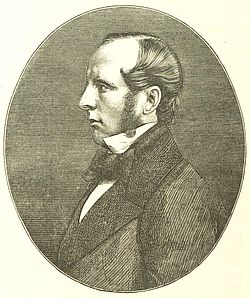
Dr Richard James Mackenzie, M.D., F.R.C.S. From photograph in 1854, in possession of Kenneth Mackenzie, Esq.
After being stationed for a short time at Shorncliffe, and for some months at Canterbury, and having been present at the distribution of the Victoria Cross by Her Majesty in Hyde Park on June 26th 1857, the 79th proceeded to Dublin, where it landed on the 28th. Here, however, it remained but a short time, as on account of the Sepoy revolt in India, it was again ordered to prepare for active service. The regiment was rapidly completed to 1000 rank and file, and set sail in the beginning of August, arriving at Madras Roads early in November, when it received orders to proceed to Calcutta, where it disembarked on the 28th of November and occupied Fort-William. After remaining there for a few days, the 79th, on Dec. 2nd, proceeded by rail to Raneegunge, under the command of Lt.-Colonel John Douglas. Towards the end of the month the regiment left Raneegunge for Allahabad, where it halted till the 5th of Jan. 1858, a day memorable in the history of the 79th for its having marched upwards of 48 miles, and gained its first victory in the East, viz., that of Secundragunge, in which happily it had no casualties.
The regiment left Allahabad for Lucknow on the 18th of Jan., and on the 28th of Feb. it joined the force under Sir Colin Campbell at Camp Bunterah. The regiment was then commanded by Lt.-Colonel Taylor, Lt.-Colonel Douglas having been appointed to the command of the 5th Infantry Brigade. After passing the Goomtee, the 79th joined the force under Sir James Outram, and was brigaded with the 1st battalion of the 23rd Fusiliers and the 1st Bengal Fusiliers, under the command of Brigadier General Douglas. The regiment was present, and performed its part bravely during the siege and capture of Lucknow, from the 2nd to the 16th of March 1858, its loss being 7 non-commissioned officers and privates killed, and 2 officers, Brevet-Major Miller and Ensign Haine, and 21 non-commissioned officers and privates wounded.[535]
After the capture of Lucknow the 79th joined the division under the command of Major-General Walpole, in the advance towards Allahgunge, Shahjehanpoor, and Bareilly. Its next engagement was the action of Boodaoon, where the regiment had only 1 man wounded, who afterwards died of his wounds. On the 22nd of April the 79th was present at the action of Allahgunge, where it had no casualties. On the 27th, Sir Colin Campbell assumed command of the force and marched on Bareilly, the 79th, along with the 42nd and 93rd, forming the Highland brigade. On the 5th of May the 79th was formed in line of battle before Bareilly, when it helped to gain another glorious victory, with a loss of only 2 men killed and 2 wounded. The regiment received the special thanks of Sir Colin Campbell.
The 79th next made a forced march to the relief of Shahjehanpoor, under the command of Brigadier-General John Jones, and on the 21st of May was again under fire at the attack of that place. Thence it went to Mohoomdee, in the attack on which it took part on the 24th and 25th; here it had 2 men wounded, and, according to the Record-Book, upwards of 100 men suffered from sunstroke.
After this last action the regiment once more found itself in quarters at Futtehgurh and Cawnpoor, one wing being detached to Allahabad; this, however, was only for a short time, as on the 21st of October an order was received for the 79th to join the brigade in Oudh, under Brigadier-General Wetherall, C.B. On the 3rd of November the 79th was present at the storm and capture of Rampoor Kosilab, the regiment losing only 2 men killed, and 1 sergeant and 6 privates wounded. For its conduct on this occasion the 79th was complimented in General Orders by His Excellency the Commander-in-Chief.
Brig.-Gen. Wetherall having left the force, was succeeded in command by Sir Hope Grant, K.C.B., who appointed Lt.-Col. Taylor, 79th, to command the brigade, Major Butt succeeding the latter in command of the 79th.
The 79th proceeded by forced marches to Fyzabad to commence the trans-Ghogra operations, and was present at the action of the passage of the Ghogra on the 25th of November, the skirmish at Muchligan on the 6th of Dec., and the skirmish at Bundwa Kotee on the 3rd of Jan. 1859. After the last-mentioned engagement the 79th received orders to proceed to Meean Meer in the Punjab, under the command of Lt.-Col. Taylor.
Thus ended the Indian Mutiny, during which the casualties to the 79th Highlanders amounted to 2 officers wounded, and 158[536] of all ranks killed. For its gallant conduct during the Indian campaign the 79th received the thanks of both Houses of Parliament, and was authorised to bear on its colours the inscription “Capture of Lucknow.” Lt.-Col. Douglas was appointed a K.C.B., and Lt.-Col. Taylor a C.B.
The regiment arrived at Meean Meer on the 8th of April 1859, and on the 15th the command passed into the hands of Lt.-Col. Butt, Colonel Taylor having proceeded to Europe on leave. Lt.-Col. Butt continued in command till the 2nd of April 1860, when he was appointed Chief Inspector of Musketry for Bengal, and was succeeded in command of the regiment by Lt.-Col. Hodgson. On the 16th of March, Lt.-Col. Douglas had retired on half-pay, and Lt.-Col. Taylor did the same on the 10th of May following.
The 79th remained in India till Sept. 1871. On the 5th of Nov. 1860, the right wing, consisting of 287 of all ranks, proceeded to Amritzir under the command of Major M’Barnet. Headquarters left Meean Meer on the 19th of Jan. 1861 for Ferozepoor, where it was joined by the wing from Amritzir in April.
The 79th left Ferozepoor in Feb. 1862 for Nowshera, where it remained till the following November, on the 23rd of which the regiment proceeded to Peshawur, on the frontiers of Afghanistan. In the previous March the regiment lost by death its colonel, General W. A. Sewell, who was succeeded by General the Honourable Hugh Arbuthnott, C.B.
During the stay of the regiment in Peshawur it lost two of its officers. A frontier war having broken out, Lts. Dougal and Jones volunteered their services, and were permitted to proceed with the expedition against the Sitana fanatics, under the command of Brigadier-General Sir M. Chamberlain, K.C.B.; the former was killed when on picquet duty on the 6th of Nov. 1863, and the latter in action on the 18th of the same month.
The 79th remained in Peshawur till Jan. 1864, when it removed to Rawul Pindee, where it remained till 1866. During its stay it furnished a volunteer working party on the Murree and Abbattabad road, and also during 1864 a detachment of 300 of all ranks, under the command of Captain C. Gordon, to the Camp Durrgaw Gully.
In October 1864 the 79th lost by exchange its senior Lt.-Colonel, Colonel Butt having exchanged with Colonel Best of H.M.’s 86th Regiment. By this exchange Lt.-Colonel Hodgson became senior Lt.-Colonel.
For some time after its arrival at Rawul Pindee the regiment continued to suffer from Peshawur fever, a considerable number of men having had to be invalided to England. On the 8th of May 1865 the headquarters and 650 of all ranks proceeded as a working party to the Murree Hills, where the regiment remained till October, much to the benefit of the men’s health, as in a fortnight after its arrival all traces of Peshawur fever had disappeared. A similar working party, but not so large, was sent to the Murree Hills at the same time in the following year.
On the 10th of July of this year (1865) Lt.-Colonel Hodgson received his promotion by brevet to full Colonel in the army.
On the 1st of November 1866, the headquarters and left wing marched from Rawul Pindee for Roorkee, and the right wing under command of Major Maitland for Delhi, the former reaching Roorkee on the 15th and the latter Delhi on Dec. 27th. During the regiment’s stay at these places the two wings exchanged and re-exchanged quarters, both suffering considerably from fever during the spring of 1867. Both wings in the end of March proceeded to Umballah, to take part in the ceremonial attending the meeting between Earl Mayo, Governor-General of India, and Shere Ali Khan, the Ameer of Cabul; the Cameron Highlanders had been appointed part of His Excellency’s personal escort.
On Dec. 7th the headquarters, under the command of Colonel W. C. Hodgson, left Roorkee en route to Kamptee, and on the 15th it was joined by the right wing from Delhi, at Camp Jubbulpoor. Here the regiment remained until the 24th, when it commenced to move by companies towards Kamptee, at which station the headquarters arrived on the 1st of January 1870. Shortly before leaving Roorkee a highly complimentary farewell letter was sent to Colonel Hodgson from Major-General Colin Troup, C.B., commanding the Meerut Division.
During January 1870 the 93d Sutherland Highlanders passed through Kamptee en route for home, when a very pleasing exchange of civilities took place between that distinguished regiment and their old comrades of the 79th. At a mess meeting held at Nagpoor on the 30th by the officers of the 93d, it was proposed and carried unanimously that a letter be written to the officers of the 79th, proposing that, in consideration of the friendship and cordiality which had so long existed between the two regiments, the officers of the two corps be perpetual honorary members of their respective messes. The compliment was, of course, willingly returned by the 79th, and the officers of the 93rd Highlanders were constituted thenceforth perpetual honorary members of the 79th mess.
The regiment remained at Kamptee for nearly two years, furnishing a detachment to the fort at Nagpoor. A very sad event occurred in the regiment during its stay at Kamptee: on Aug. 28th, 1871, Captain Donald Macdonald when at great gun drill at the artillery barracks, dropped down on parade, died instantaneously, and was buried the same evening. Captain Macdonald was by birth and habit a Highlander, and was most warmly attached to his regiment, in which he had served for seventeen years. Great regret was felt by all ranks in the regiment on account of his premature and unexpected death. He was only 34 years of age, and a monument was erected by his brother officers over his grave at Kamptee.
On the 2nd of August 1871 Colonel Best was appointed to the command of the Nagpoor field force, with the rank of brigadier-general.
In the same month the 79th received orders to be in readiness to proceed to England, and the non-commissioned officers and men were permitted to volunteer into regiments remaining in India. About 177 of all ranks availed themselves of this offer, a considerable number of whom were married men. The regiment left Kamptee in two detachments on Sept. 22nd and 23rd, and proceeded by Nagpoor and Deolallee to Bombay, where it embarked on board H.M.’s India troop-ship “Jumna” on the 29th and 30th. The “Jumna” sailed for England on the 1st of October, and after a prosperous voyage by way of the Suez Canal arrived at Spithead on the evening of the 6th of November. Next day the regiment was transferred to three ships, and conveyed to West Cowes, Isle of Wight, where it disembarked the same evening, and marched to the Albany Barracks, Parkhurst.
During the fourteen years that the 79th was stationed in India it was inspected by many distinguished general officers, including Sir Colin Campbell (Lord Clyde), Sir William Mansfield (Lord Sandhurst), Sir Hugh Rose, (Lord Strathnairn), Sir Hope Grant, &c., all of whom expressed themselves highly satisfied with the appearance, conduct, and discipline of the regiment.
During its sojourn in the Isle of Wight the 79th was highly honoured on more than one occasion by the very particular notice of Her Majesty Queen Victoria. In Feb. 1872, Her Majesty being at Osborne, was pleased to express her desire to see the 79th Highlanders in marching order. The regiment accordingly paraded at 10 o’clock on the morning of the 16th, and proceeded towards Osborne. When the 79th was within a short distance of the approach to the house, Her Majesty, with several members of the Royal Family, appeared at an angle of the road, and watched the marching past of the regiment with great interest. The regiment, after making a detour towards East Cowes, was returning to Parkhurst by way of Newport, when Her Majesty re-appeared, paying particular attention to the dress and appearance of the men as they marched past her for the second time.
This was the last occasion on which Colonel Hodgson was destined to command the 79th. On the 1st of March the regiment sustained an irreparable loss in his death, which took place, after a very short illness. Colonel Hodgson was 49 years of age, had served in the 79th for 32 years, and commanded it for 12, and by his invariable kindness and urbanity had endeared himself to all ranks. His sad and unexpected death spread a deep gloom over the whole regiment. Colonel Maitland, in announcing Colonel Hodgson’s death in regimental orders said,—
“The officers have to lament the loss of one who was always to them a kind and considerate commanding officer; and the non-commissioned officers and men have been deprived of a true friend, who was ever zealous in guarding their interests and promoting their welfare.”
Colonel Hodgson was buried in Carisbrooke Cemetery, and over his grave a handsome monument of Aberdeen granite has been erected by his brother officers and friends.
By Colonel Hodgson’s death Colonel Maitland succeeded to the command of the regiment; he, however, retired on half-pay on the 19th of October following, and Lt.-Colonel Miller was selected to succeed him.
On the 17th of Sept, the 79th had the honour of being reviewed by the late ex-Emperor of the French, Napoleon III., and his son, the Prince Imperial, who lunched with the officers. The Emperor made a minute inspection of the men, and watched the various manœuvres with evident interest, expressing at the conclusion his admiration of the splendid appearance and physique of the men, the high state of discipline of the corps, and the magnificent manner in which the drill was performed.
During Her Majesty’s stay at Osborne the 79th always furnished a guard of honour at East Cowes at each of her visits. On the 17th of April 1873 Her Majesty bestowed one of the highest honours in her power on the regiment, when on that day she attended at Parkhurst Barracks to present it with new colours. The presentation took place in the drill-field, and was witnessed by a large number of spectators, who were favoured with a bright sky.
At 11 o’clock A.M. the 79th marched into the field under command of Colonel Miller. The ground was kept by the 102nd Fusiliers, the same regiment also furnishing a guard of honour to Her Majesty. General Viscount Templetown, K.C.B., commanding the district, was present, and also Sir John Douglas, K.C.B., commanding in North Britain, with his A.D.C., Lieutenant Boswell Gordon, of the 79th. The Mayor and Corporation of Newport attended officially, wearing their robes of office. At a quarter to 12 o’clock Her Majesty arrived, attended by their Royal Highnesses Prince Leopold and Princess Beatrice, the Countess of Errol and other ladies, besides the Equerries in Waiting. The royal party having driven along the line, the band and pipers playing, the usual order of presentation was proceeded with.
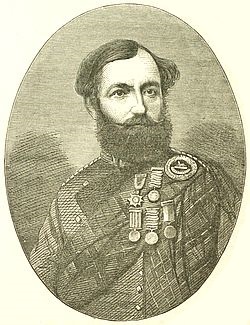
Lieutenant-Colonel W. C. Hodgson.
The old colours were in front of the left of the line, in charge of a colour party and double sentries. The new colours, cased, were in the rear of the centre, in charge of the two senior colour-sergeants, Taylor and Mackie. The old colours having been trooped, these honoured and cherished standards, around which the Cameron Highlanders had so often victoriously rallied, were borne to the rear by Lts. Annesley and Money to the strains of “Auld Lang Syne.” The regiment was then formed into three sides of a square, the drums were piled in the centre, the new colours were brought from the rear, and having been uncased by the Majors, were placed against the pile. After this a most impressive consecration prayer was offered up by the Rev. Charles Morrison, formerly Presbyterian chaplain to the 79th in India, who had come from Aberdeen expressly to perform this duty. When this was concluded, Major Cumming handed the Queen’s colour and Major Percival the regimental colour to Her Majesty, who presented the former to Lt. Campbell and the latter to Lt. Methven, at the same time addressing them thus:—“It gives me great pleasure to present these new colours to you. In thus entrusting you with this honourable charge, I have the fullest confidence that you will, with the true loyalty and well-known devotion of Highlanders, preserve the honour and reputation of your regiment, which have been so brilliantly earned and so nobly maintained by the 79th Cameron Highlanders.”
Colonel Miller then replied as follows:—
“I beg permission, in the name of all ranks of the 79th Cameron Highlanders, to present our loyal and most grateful acknowledgments of the very high honour it has pleased your Majesty this day to confer on the regiment. The incident will ever remain fresh in the memories of all on parade, and of those also who are unable to have the honour of being present on this occasion, and of others who have formerly served with the 79th; and I beg to assure your Majesty that, wherever the course of events may require these colours to be borne, the remembrance that they were received from the hands of our Most Gracious Queen, will render them doubly precious, and that in future years, as at present, the circumstance of this presentation will be regarded as one of the proudest episodes in the records of the Cameron Highlanders.”
After Colonel Miller’s address the regiment re-formed line, and the colours were received with a general salute, after which they were marched to their place in the line in slow time, the band playing “God save the Queen.” The ranks having been closed, the regiment broke into column, and marched past Her Majesty in quick and double time. Line was then re-formed, and Lt.-Gen. Viscount Templetown, K.C.B., called for three cheers for Her Majesty, a request which was responded to by the regiment in true Highland style. The ranks having been opened, the line advanced in review order, and gave a royal salute, after which the royal carriage withdrew.
After the parade was dismissed, the old colours, carried by Lts. Annesley and Money, escorted by all the sergeants, were played round the barracks, and afterwards taken to the officers’ mess. On the 30th of the month the officers gave a splendid ball at the Town-hall, Ryde, at which about 500 guests were present, the new colours being placed in the centre of the ball-room, guarded on each side by a Highlander in full uniform. To mark the occasion also, Colonel Miller remitted all punishments awarded to the men, and the sergeants entertained their friends at a luncheon and a dance in the drill field.
At the unanimous request of the officers, Colonel Miller offered the old colours to Her Majesty, and she having been graciously pleased to accept them, they were taken to Osborne on the 22nd of April. At 12 o’clock noon of that day the regiment paraded in review order and formed a line along the barracks for the colours to pass, each man presenting arms as they passed him, the band playing “Auld Lang Syne.” The colours were then taken by train from Newport to Cowes. At Osborne the East Cowes guard of honour, under command of Captain Allen, with Lts. Bucknell and Smith, was drawn up at each side of the hall door. The old colours, carried by Lts. Annesley and Money, escorted by Quarter-master-Sergeant Knight, Colour-Sergeant Clark, two other sergeants, and four privates, preceded by the pipers, were marched to the door by Colonel Miller, the guard of honour presenting arms. The officers then advanced, and, kneeling, placed the colours at Her Majesty’s feet, when Colonel Miller read a statement, giving a history of the old colours from the time of their presentation at Portsmouth, in the month of April 1854, by Mrs Elliot (the wife of the officer at that time colonel of the regiment), a few days before the regiment embarked for the Crimea.
Colonel Miller then said,—
“It having graciously pleased your Majesty to accept these colours from the Cameron Highlanders, I beg permission to express the gratification which all ranks of the 79th feel in consequence, and to convey most respectfully our highest appreciation of this kind act of condescension on the part of your Majesty.”
The Queen replied,—
“I accept these colours with much pleasure, and shall ever value them in remembrance of the gallant services of the 79th Cameron Highlanders. I will take them to Scotland, and place them in my dear Highland home at Balmoral.”
The guard then presented arms, and the colour party withdrew. Her Majesty afterwards addressed a few words to each of the colour-sergeants.
On the 24th of April, Colonel Miller received orders for the troops of the Parkhurst garrison to march towards Osborne on the following day, for Her Majesty’s inspection, and the troops accordingly paraded at 10 o’clock A.M. in review order. On arriving near Osborne the brigade was drawn up in line on the road, the 79th on the right, and the 102nd on the left. Her Majesty was received with a royal salute, and having driven down the line, the royal carriage took up its position at the crossroads, and the regiments passed in fours; the royal carriage then drove round by a bye-road, and the regiment again passed in fours, after which the troops returned to Parkhurst.
We may state here that on the day on which Her Majesty presented the new colours to the regiment, Colonel Ponsonby, by Her Majesty’s desire, wrote to the Field-Marshal Commanding in Chief that “Her Majesty was extremely pleased with the appearance of the men and with the manner in which they moved,” and hoped that His Royal Highness might think it right to communicate the Queen’s opinion to Lt.-Colonel Miller. The letter was sent to Colonel Miller.
The Queen still further showed her regard for the 79th by presenting to the regiment four copies of her book, “Leaves from our Journal in the Highlands,”—one to Colonel Miller, one for the officers, one for the non-commissioned officers, and one for the privates.
To crown all these signal marks of Her Majesty’s attachment to the Cameron Highlanders, she was graciously pleased to let them bear her own name as part of the style and title of the regiment, as will be seen by the following letter, dated—
“Horseguards, 10th July 1873.
“Sir,—By direction of the Field-Marshal Commanding in Chief, I have the honour to acquaint you that Her Majesty has been pleased to command that the 79th Regiment be in future styled “the 79th Queen’s Own Cameron Highlanders,” that the facings be accordingly changed from green to blue, and that the regiment be also permitted to bear in the centre of the second colour, as a regimental badge, the Thistle ensigned with the Imperial Crown, being the badge of Scotland as sanctioned by Queen Anne in 1707, after the confirmation of the Act of Union of the kingdoms.—I have, &c. &c.
(Signed) “J. W. Armstrong, “Deputy Adjutant-General.
“Lieutenant-Colonel Miller, “Commanding 79th Regiment.”
In acknowledgment of this gracious mark of Her Majesty’s regard, Colonel Miller despatched a letter to Major-General Ponsonby, at Osborne, on the 12th of July, in which he requests that officer
“To convey to the Queen, in the name of all ranks of the 79th, our most respectful and grateful acknowledgments for so distinguished a mark of royal condescension, and I beg that you will assure Her Majesty of the gratification felt throughout the regiment in consequence of the above announcement.”
Finally, on the 13th of August Colonel Miller received a notification that Her Majesty had expressed a wish that the regiment should be drawn up at East Cowes to form a guard of honour on her departure from the island on the following day. The regiment accordingly marched to East Cowes on the following afternoon, and presented arms as Her Majesty embarked on her way to Balmoral.
On 18th of September of the same year the 79th left Parkhurst for Aldershot, where it arrived on the same afternoon, and was quartered in A and B lines, South Camp, being attached to the 1st or Major-General Parkes’ brigade.
The Black Watch has received great and well-merited praise for its conduct during the Ashantee War, in the march from the Gold Coast to Coomassie. It ought, however, to be borne in mind that a fair share of the glory which the 42nd gained on that dangerous coast, under the able command of Major-General Sir Garnet J. Wolseley, really belongs to the Cameron Highlanders. When the 42nd, at the end of December 1873, was ordered to embark for the Gold Coast, 135 volunteers were asked for from the 79th, to make up its strength, when there at once stepped out 170 fine fellows, most of them over ten years’ service, from whom the requisite number was taken. Lieutenants E. C. Annesley and James M’Callum accompanied these volunteers. Although they wore the badge and uniform of the glorious Black Watch, as much credit is due to the 79th on account of their conduct as if they had fought under the name of the famous Cameron Highlanders, in which regiment they received all that training without which personal bravery is of little avail.
Monument in the Dean Cemetery, Edinburgh, erected in 1857. The monument is of sandstone, but the inscription is cut in a block of granite inserted below the shaft.
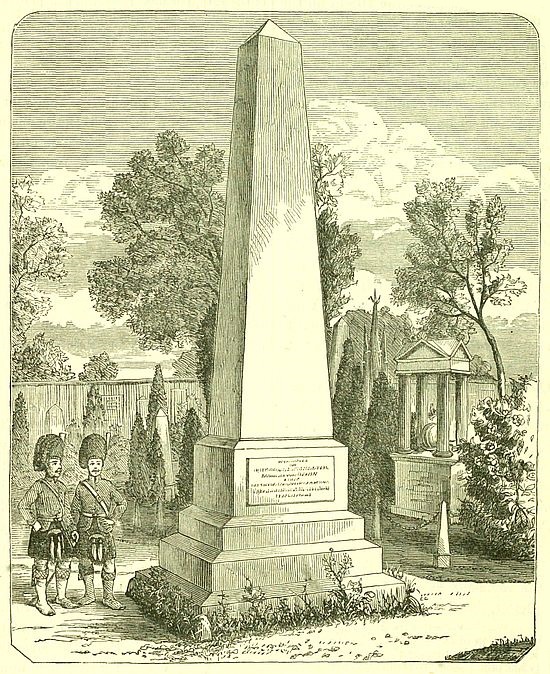
In Memory of Colonel the Honourable Lauderdale Maule; Lieut.-Colonel E. J. Elliot, Lieut.-Colonel James Ferguson; Captain Adam Maitland; Lieutenant F. A. Grant, Lieutenant F. J. Harrison; and Dr R. J. Mackenzie. also 369 Non-Commissioned Officers and Men of the 79th Highlanders, who died in Bulgaria and the Crimea, or fell in action during the Campaign of 1854–55.
Lieut. Colonel Clephane, who for many years was connected with the Cameron Highlanders, has been good enough to furnish us with a number of anecdotes illustrative of the inner life of the regiment and of the characteristics of the men in his time. Some of these we have already given in their chronological place in the text, and we propose to conclude our narrative with one or two others, regretting that space does not permit our making use of all the material Colonel Clephane has been so obliging as to put into our hands.
It may probably be affirmed, as a rule, that there exists in the regiments of the British army an amount of harmony and cordial reciprocation of interest in individual concerns, which cannot be looked for in other professional bodies. From the nature of the circumstances under which soldiers spend the best years of their lives, thrown almost entirely together, sometimes exclusively so, and moving, as fate and the War Office may determine, from one point to another of Her Majesty’s dominions on their country’s concerns, it naturally arises that an amount of familiar knowledge of each other’s characteristics is arrived at which in the world at large is rarely attainable. We should state that the period of the following reminiscences is comprehended between the year 1835 and the suppression of the Indian mutiny.
In the 79th Highlanders the harmony that existed among the officers, and the completeness of the chain of fellow-feeling which bound together all ranks from highest to lowest, was very remarkable. It used to be said among the officers themselves that, no matter how often petty bickerings might arise in the fraternity, anything like a serious quarrel was impossible; and this from the very reason that it was a fraternity, in the best and fullest sense of the word.
And now a temptation arises to notice one or two of those individual members of the regiment whose demeanour and eccentricities of expression furnished a daily supply of amusement:—There was a non-commissioned officer, occupying the position of drill-sergeant about five-and-thirty or forty years ago, whose contributions in this way were much appreciated. “I think I see him now,” writes Colonel Clephane, “sternly surveying with one grey eye, the other being firmly closed for the time being, some unlucky batch of recruits which had unfavourably attracted his attention; his smooth-shaven lip and chin, a brown curl brought forward over each cheek-bone, and the whole surmounted by the high white-banded sergeant’s forage cap of that day set at the regulation military angle over the right ear. He was a Waterloo man, and must have been verging on middle age at the time of which I write, but there was no sign of any falling off in the attributes of youth, if we except the slight rotundity beneath the waistbelt.” No one could be more punctiliously respectful to his superior officers than the sergeant, but when he had young gentlemen newly joined under his charge at recruit drill, he would display an assumption of authority as occasion offered which was sometimes ludicrous enough. On one of these occasions, when a squad of recruits, comprising two newly-fledged ensigns, was at drill in the barrack square, the sound of voices (a heinous offence as we all know) was heard in the ranks. The sergeant stopped opposite the offending squad. There was “silence deep as death”—“Ah—m—m!” said he, clearing his throat after a well-known fashion of his, and tapping the ground with the end of his cane—“Ah—m—m! if I hear any man talkin’ in the ranks, I’ll put him in the guard ’ouse” (here he looked with stern significance at each of the officers in turn)—“I don’t care who he is!” Having thus, as he thought, impressed all present with a due sense of the respect due to his great place, he gave a parting “Ah—m—m!” tapped the ground once or twice more, keeping his eye firmly fixed to the last on the more suspected of the two ensigns, and moved stiffly off to the next batch of recruits. No one ever dreamed of being offended with old “Squid,” as he was called, after his pronunciation of the word squad, and those who had, as he expressed it, “passed through his hands” would never consider themselves as unduly unbending in holding serious or mirthful colloquy with their veteran preceptor. Thus, on another occasion of considerably later date than the above, some slight practical joking had been going on at the officers’ mess, a practice which would have been dangerous but for the real cordiality which existed among its members, and a group of these conversed gleefully on the subject next morning after the dismissal of parade. The peculiar form assumed by their jocularity had been that of placing half a newspaper or so upon the boot of a slumbering comrade, and setting it on fire, as a gentle hint that slumber at the mess-table was objectionable. One officer was inclined to deprecate the practice. “If he had not awoke at once,” said he, “he might have found it no joke.” “Ah—m—m!” uttered the well-known voice close behind the group, where the sergeant, now dépôt sergeant-major, had, unnoticed, been a listener to the colloquy, “I always grease the paper.” This was literally throwing a new light on the subject, and was the worthy man’s method of testifying contempt for all undue squeamishness on occasions of broken etiquette.
One or two subordinates in the same department were not without their own distinguishing characteristics. Colonel Clephane writes—“I remember one of our drill corporals, whose crude ideas of humour were not unamusing when all were in the vein, which we generally were in those days. He was quite a young man, and his sallies came, as it were, in spite of himself, and with a certain grimness of delivery which was meant to obviate any tendency therein to relaxation of discipline. I can relate a slight episode connected with this personage, showing how the memory of small things lingers in the hearts of such men in a way we would little expect from the multifarious nature of their occupations, and the constant change to them of scenes and features. A young officer was being drilled by a lance-corporal after the usual recruit fashion, and being a tall slip of a youth he was placed on the flank of his squad. They were being marched to a flank in what was called Indian or single file, the said officer being in front as right hand man. When the word ‘halt’ was given by the instructor from a great distance off—a favourite plan of his, as testing the power of his word of command—the officer did not hear it, and, while the rest of the squad came to a stand still, he went marching on. He was aroused from a partial reverie by the sound of the well-known broad accent close at his ear, ‘Hae ye far to gang the nicht?’ and, wheeling about in some discomforture, had to rejoin the squad amid the unconcealed mirth of its members. Well, nearly thirty years afterwards, when probably not one of them, officer, corporal, or recruits, continued to wear the uniform of the regiment, the former, in passing through one of the streets of Edinburgh, came upon his old instructor in the uniform of a conducting sergeant (one whose duty it was to accompany recruits from their place of enlistment to the head-quarters of their regiments). There was an immediate cordial recognition, and, after a few inquiries and reminiscences on both sides, the quondam officer said jestingly, ‘You must acknowledge I was the best recruit you had in those days.’ The sergeant hesitated, smiled grimly, and then replied, ‘Yes, you were a good enough recruit; but you were a bad richt hand man!’”
The sequel of the poor sergeant’s career furnishes an apt illustration of the cordiality of feeling wherewith his officer is almost invariably regarded by the fairly dealt with and courteously treated British soldier. A few years subsequent to the period of the above episode, Colonel Clephane received a visit at his house, quite unexpectedly, from his old instructor. The latter had been forced by this time, through failure of health, to retire from the active duties of his profession, and it was, indeed, evident at once, from his haggard lineaments and the irrepressible wearing cough, which from time to time shook his frame, that he had “received the route” for a better world. He had no request to make, craved no assistance, and could with difficulty be persuaded to accept some refreshment. The conversation flowed in the usual channel of reminiscences, in the course of which the officer learned that matters which he had imagined quite private, at least to his own circle, were no secret to the rank and file. The sergeant also adverted to an offer which had been made to him, on his retirement from the 79th, of an appointment in the police force. “A policeman!” said he, describing his interview with the patron who proposed the scheme; “for Godsake, afore ye mak a policeman o’ me, just tie a stane round my neck and fling me into the sea!” After some time, he got up to retire, and was followed to the door by his quondam pupil, who, himself almost a cripple, was much affected by the still more distressing infirmity of his old comrade. The officer, after shaking hands, expressed a hope, by way of saying something cheering at parting, that he should yet see the veteran restored to comparative health. The latter made no reply, but after taking a step on his way, turned round, and said, in a tone which the other has not forgotten, “I’ve seen you once again any way” and so they parted, never to meet again in this world.
These are small matters, but they furnish traits of a class, the free expenditure of whose blood has made Great Britain what she is.
There is in all regiments a class which, very far remote as it is from the possession of the higher, or, at all events, the more dignified range of attributes, yet, as a curious study, is not undeserving of a few notes. It is pretty well known that each officer of a regiment has attached to his special service a man selected from the ranks, and in most cases from the company to which he himself belongs. Now, it is not to be supposed that the captain of a company will sanction the employment in this way of his smartest men, nor, indeed, would the commanding officer be likely to ratify the appointment if he did; still, I have seen smart young fellows occasionally filling the position of officer’s servant, though they rarely continued long in it, but reverted, as a rule, sooner or later, to their places in the ranks, under the influence of a soldier’s proper ambition, which pointed to the acquisition of at least a non-commission officer’s stripes; not to speak of the difference between Her Majesty’s livery and that of any intermediate master, however much in his own person deserving of respect. The young ensign, however, in joining will rarely find himself accommodated with a servant of this class. He will have presented to him, in that capacity, some steady (we had almost said “sober,” but that we should have been compelled forthwith to retract), grave, and experienced old stager, much, probably, the worse of wear from the lapse of time and from subsidiary influences, and serving out his time for a pension (I speak of days when such things were), after such fashion as military regulations and an indulgent captain permitted. This sort of man was generally held available for the newly joined ensign, upon much the same principle as that which places the new dragoon recruit on the back of some stiff-jointed steed of supernatural sagacity and vast experience of a recruit’s weak points in the way of security of seat, which last, however, he only puts to use when he sees a way of doing so with benefit to his position, unaccompanied with danger to his hide; in other words, while regarding with much indifference the feelings of the shaky individual who bestrides him, he has a salutary dread of the observant rough-rider. A soldier servant of the above class will devote himself to making what he can, within the limits of strict integrity, out of a juvenile master; but woe betide the adventurous wight whom he detects poaching on his preserve! On the whole, therefore, the ensign is not badly off, for the veteran is, after all, really honest, and money to almost any amount may be trusted to his supervision; as for tobacco and spirits, he looks upon them, I am afraid, as contraband of war, a fair and legitimate forfeit if left within the scope of his privateering ingenuity.
Many years ago, while the 79th Highlanders formed the garrison of Edinburgh Castle, Her Majesty the Queen, who had very lately ascended the throne of Great Britain, paid a visit to the metropolis of her Scottish dominions, and a guard of honour from the above regiment was despatched down to Holyrood to keep watch and ward over the royal person. It was late in the season, or early, I forget which, Colonel Clephane writes, and when the shades of evening closed round, the officers of the guard were sensible, in their large, gloomy chamber, of a chilly feeling which the regulated allowance of coals failed to counteract. In other words, the fuel ran short, and they were cold, so it was resolved to despatch one of their servants, a type of the class just alluded to, for a fresh supply. Half-a-crown was handed to him for this purpose—a sum which represented the value of more than a couple of hundredweights in those days,—and Donald was instructed to procure a scuttlefull, and bring back the change. Time went on, the few embers in the old grate waxed dimmer and dimmer, and no Donald made his appearance. At last, when the temper of the expectant officers had reached boiling point, increasing in an inverse ratio to their bodily caloric, the door opened, and Donald gravely entered the apartment. The chamber was vast and the light was dim, and the uncertain gait of the approaching domestic was at first unnoticed. Calmly disregarding a howl of indignant remonstrance on the score of his dilatory proceedings, the latter silently approached the end of the room where the two officers were cowering over the dying embers. It was now seen that he carried in one hand a piece of coal, or some substance like it, about the size of a six-pounder shot. “Where have you been, confound you! and why have you not brought the coals?” roared his master. Donald halted, steadied himself, and glanced solemnly, first at the “thing” which he carefully bore in his palm, then at the speaker’s angry lineaments, and in strangely husky accents thus delivered himself:—“Not another—hic—bit of coal in Edinburgh; coalsh—hic—’sh very dear just now, Mr Johnstone!” The delinquent’s master was nearly beside himself with fury when he saw how the matter stood, but he could not for the life of him help, after a moment or two, joining in the merriment which shook the very frame of his comrade. Donald, in the meantime, stood regarding both with an air of tipsy gravity, and was apparently quite bewildered when ordered to retire with a view to being placed in durance vile. This incident naturally ended the connection between him and his aggrieved master. It is but fair to state that the hero of the above little anecdote, though I have called him “Donald,” was a Lowlander.
SUCCESSION LIST OF COLONELS AND LIEUTENANT-COLONELS OF THE 79TH, THE QUEEN’S OWN CAMERON HIGHLANDERS.
COLONELS.
Names.Date of Appointment.Remarks.
Major Alan CameronAugust17,1793Died Lieut.-General, March 9, 1828.
Lieut.-General R. C. Ferguson, G.C.B.March24,1828Died, April 10, 1841.
Major-General the Hon. J. RamsayApril27,1841Died, June 28, 1842.
Lt.-General Sir James Macdonell, K.C.B.July14,1842To 71st Foot, February 8, 1849.
Major-General James Hay, C.B.February8,1849Died, February 25, 1854.
Lieut.-General W. H. Sewell, C.B.March24,1854Died, 1862.
Hugh Arbuthnot, C.B.March14,1862Vice Sewell, deceased.
J. F. Glencairn CampbellJuly12,1868Vice Arbuthnot, deceased.
Henry Cooper, C.B.August21,1870Vice Campbell, deceased.
LIEUTENANT-COLONELS.
Bat.
1. Alan Cameron, Major-ComLt.‑Col. Feb.19,1794Major-General, July 25, 1810.
1. The Hon. A. C. JohnstoneMay2,1794Promoted to colonel of a regiment, Jan. 26, 1797.
1. William AshtonSeptember18,1794Died, September 1796.
1. Patrick MacdowallNovember1,1796Died of wounds, August 1801.
1. William EdenAugust15,1798To 84th Foot, December 11, 1806.
1. Archibald MacleanSeptember3,1801Retired, May 28, 1807.
2. Philip CameronApril19,1804To 1st Battalion, December 11, 1806.
2. John MurrayDecember11,1806To 1st Battalion, May 28, 1807.
1. Philip CameronDecember11,1806From 2nd Battalion. Died of wounds, May 13, 1811.
1. John MurrayMay28,1807To Malta Regiment, February 23, 1808.
2. Robert FultonMay28,1807To 1st Battalion, May 13, 1811.
1. Robert FultonMay13,1811Retired, December 3, 1812.
2. Wm. M. HarveyMay30,1811To 1st Battalion, December 3, 1812.
1. Wm. M. HarveyDecember3,1812Died at sea, June 10, 1813.
2. Neil DouglasDecember3,1812To 1st Battalion, February 20, 1813.
1. Neil DouglasFebruary20,1813To Half-pay, August 16, 1833.
2. Nathaniel CameronJune24,1813Reduced with 2nd Battalion, Dec 25, 1815.
Only one Battalion in Regiment.
1. Duncan MacdougalSeptember6,1833Retired, March 13, 1835.
1. Robert FergusonMarch13,1835Retired, June 8, 1841.
1. Andrew BrownJune8,1841To 1st Battalion Royals, October 29, 1841.
1. John Carter, K.H.October29,1841Retired June 14, 1842.
1. The Hon. Lauderdale MauleJune14,1842To Half-pay unattached, December 24, 1852.
1. Edmund James ElliotDecember24,1852Died, August 12, 1854.
1. John Douglas, K.C.B.August13,1854—
1. R. C. H. Taylor, C.B.December12,1854To Depôt Battalion, October 1, 1856.
1. R. C. H. Taylor, C.B.August1,1857—
1. T. B. ButtApril15,1859Chief Inspector of Musketry, Bengal, 1860. Exchanged to 86th Regiment, Sept. 13, 1864.
1. W. C. HodgsonJuly10,1860Died at Parkhurst, Isle of Wight, March 1, 1872.
1. R. M. BestSeptember13,1864Brigadier-General, India, May 24, 1870. Exchanged from 86th Regiment, Sept. 13, 1864.
1. K. R. MaitlandMarch2,1872To Half-pay, October 19, 1872.
1. G. M. MillerOctober19,1872—
FOOTNOTES:
THE 91ST PRINCESS LOUISE ARGYLLSHIRE HIGHLANDERS.
I. 1794–1848.
Raising of the Regiment—At first the 98th—South Africa—Wynberg—Saldanha Bay—Number changed to 91st—Faithfulness of the Regiment—Returns to England—Germany—Ireland—The Peninsula—Obidos—Vimeiro—Corunna—The detached company—Talavera—Walcheren—Peninsula again—Vittoria—Pamplona—Nivelle—Nive—Bayonne—Orthes—Toulouse—Ireland—Quatre Bras—Waterloo—France—Ireland—91st loses Highland dress—Jamaica—England—Ireland—St Helena—Cape of Good Hope—The Reserve Battalion formed and sails for S. Africa—Wreck of the “Abercrombie Robinson”—Insurrection of Dutch farmers—Frontier service—The Boers again—New colours—The Kaffir War—Amatola Mountains—Attack on Fort Peddie—Buffalo Spruits—1st Battalion goes home.
XCI
NE OBLIVISCARIS.
Roleia. Vimeiro. Corunna. Pyrenees.
Nivelle. Nive. Orthes. Toulouse.
Peninsula.
This regiment was raised, in accordance with a desire expressed by His Majesty George III., by the Duke of Argyll, to whom a letter of service was granted, dated the 10th of February 1794. In March it was decided that the establishment of the regiment should consist of 1112 officers and men, including 2 lieutenant-colonels. Duncan Campbell of Lochnell, who was a captain in the Foot Guards, was appointed Lieutenant-colonel commandant of the regiment, and assumed the command at Stirling on the 15th of April, 1794.
The regiment was inspected for the first time, on the 26th of May, when it had reached a strength of 738 officers and men, by General Lord Adam Gordon, who particularly noticed the attention and good appearance of the men. The regiment remained at Stirling for a month after this inspection, marching about the middle of June to Leith, at which port, on the 17th and 18th of that month, it embarked en route for Netley, where it went into encampment. On the 9th of July the king approved of the list of officers, and the regiment was numbered the 98th.
The 98th, which had meantime removed to Chippenham, marched to Gosport about the end of April, 1795, and on the 5th of May it embarked at Spithead as part of the joint expedition to South Africa, against the Dutch, under Major-General Alured Clark. It arrived in Simon’s Bay on the 3rd, landing at Simon’s Town, on the 9th of September, and encamped at Muysenberg.[537]
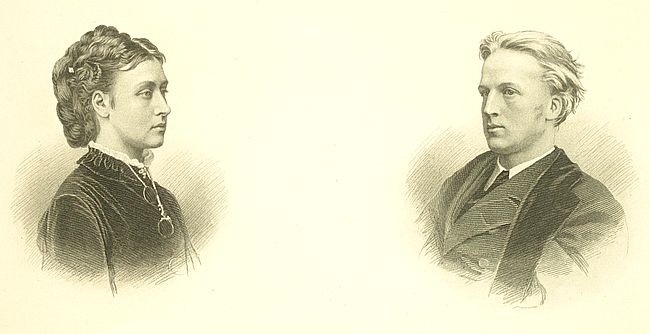
THE PRINCESS LOUISE. FROM PHOTOGRAPH BY HILL & SAUNDERS
THE MARQUIS OF LORNE. FROM PHOTOGRAPH BY ELLIOT & FRY.
After the army under Major-General Clark arrived at the Cape, it advanced on the 14th of September and carried Wynberg, the battalion companies of the regiment, under Colonel Campbell, forming the centre of the line. On this occasion the 98th had 4 privates wounded. On September 16th the regiment entered Cape Town Castle, and relieved the Dutch garrison by capitulation, all the forts and batteries of Cape Town and its dependencies having been given over to the possession of the British. About a year afterwards, however, an expedition was sent from Holland for the purpose of winning back the Cape of Good Hope to that country, and in the action which took place at Saldanha Bay on the 17th of August 1796, and in which the British were completely victorious, the grenadier and light companies of the 98th took part. The regiment remained in South Africa till the year 1802, during which time little occurred to require special notice.
In October 1798, while the regiment was at Cape Town, its number was changed from the 98th to the 91st.
In May 1799 a regimental school was established for the first time for the non-commissioned officers and men.
In the beginning of 1799 a strong attempt was made by a number of the soldiers in the garrison at Cape Town to organise a mutiny, their purpose being to destroy the principal officers, and to establish themselves in the colony. Not only did the 91st not take any part in this diabolical attempt, but the papers containing the names of the mutineers and their plans were discovered and seized by the aid of private Malcolm M’Culloch and other soldiers of the regiment, who had been urged by the mutineers to enter into the conspiracy. Lt.-Col. Crawford in a regimental order specially commended the conduct of M’Culloch, and declared that he considered himself fortunate in being the commander of such a regiment.
In November 1802 the first division of the 91st embarked at Table Bay for England, arriving at Portsmouth in February 1803. On the 28th of the latter month the second division had the honour of delivering over the Cape of Good Hope to the Dutch, to whom it had been secured at the peace of Amiens. After performing this duty the division embarked at Table Bay, arriving at Portsmouth in May, and joining the first division at their quarters in Bexhill during the next month.
During the next few years the Record Book contains nothing but an enumeration of the various places to which the regiment marched for the purpose of encamping or acting as garrison. A slight, and no doubt welcome interruption of this routine was experienced in December 1805, at the end of which month it embarked for Hanover, and was brigaded along with the 26th and 28th regiments, under the command of Major-General Mackenzie Fraser.[538] After the regiment had been about a month in Germany the British army was recalled, and the 91st consequently returned to England in the end of January 1806, taking up its quarters at Faversham.
In August 1804, in accordance with the recent Act of Parliament known as the Defence Act, means were taken to add a second battalion to the 91st, by raising men in the counties of Perth, Argyll, and Bute.
The regiment remained in England until the end of 1806, when it embarked at Dover for Ireland, disembarking at the Cove of Cork on Jan. 7th, 1807, and marching into Fermoy. It remained in Ireland, sending detachments to various places, till the middle of 1808, embarking at Monkstown on the 15th of June, to form part of the Peninsular expedition under Lieutenant-General Sir Arthur Wellesley. The 91st was brigaded with the 40th and 71st regiments under Brigadier General Crawford, the three regiments afterwards forming the 5th Brigade.[539] The 91st was engaged in most of the actions during the Peninsular war, and did its part bravely and satisfactorily.
On August 9th 1808, the 91st advanced with the rest of the army, and, on the 17th, in the affair at Obidos the light company of the regiment, with those of the brigade under the command of Major Douglas of the 91st, were engaged, when the advanced posts of the enemy were driven from their positions. On August 21st, the regiment was present at the battle of Vimeiro, forming part of the reserve under General C. Crawford, which turned the enemy’s right,—a movement which was specially mentioned in the official despatch concerning this important battle.
In the beginning of September, by a new distribution of the army, the 91st was placed in Major-General Beresford’s brigade with the 6th and 45th regiments, and in the 4th division, that of Lieutenant-General Sir Arthur Wellesley. On Sept. 20th, however, it seems to have been attached, with its brigade, to the 3rd division.
On Oct. 19th the regiment advanced into Spain, with the rest of the army under Lt.-Gen. Sir John Moore, proceeding by Abrantes, Covilhão, Belmonte, Morilhão, Ciudad Rodrigo, and Salamanca, arriving at the last-mentioned place on Nov. 18th. On the 28th the regiment was formed into a brigade with the 20th, 28th, 52nd, and 95th regiments, to compose a part of the reserve army under Major-General the Hon. Edward Paget, in which important capacity it served during the whole of Sir John Moore’s memorable retreat to Corunna. On Jan. 11th, 1809, the 91st, along with the rest of the army, took up its position on the heights of Corunna, the reserve brigade on the 16th—the day of battle—being behind the left of the British army. The 91st does not appear to have been actively engaged in this disastrous battle,—disastrous in that it involved the loss of one of England’s greatest generals, the brave Sir John Moore. On the evening of the 16th the 91st embarked, and arrived in Plymouth Sound on the 28th.
The officers, non-commissioned officers, and men who were left sick in Portugal on the advance of the regiment with Sir John Moore, were formed into a company under Captain Walsh, and placed as such in the first battalion of detachments. This battalion was commanded by Lt.-Col. Bunbury, and composed part of the army in Portugal under Lt.-General Sir Arthur Wellesley. This company was actively employed in the affairs of May 10th, 11th, and 12th, which led to the capture of Oporto. It afterwards advanced with the army which drove the enemy into Spain.
The company was engaged on July 27th and 28th in the battle of Talavera, in which, out of a total strength of 93 officers and men, it lost 1 officer, Lieutenant Macdougal, and 9 rank and file killed, 1 sergeant and 30 rank and file wounded, and 1 officer, Captain James Walsh, and 19 men missing; in all, 61 officers and men. Captain Walsh was taken prisoner by the enemy in a charge, and with many other officers was marched, under a strong escort, towards France. He, however, effected his escape at Vittoria on the night of August 20th, and after suffering the greatest privation and hardship, he rejoined the army in Portugal, and reported himself personally to Lord Wellington. Captain Thomas Hunter, of the 91st, who was acting as major of brigade, was also wounded and taken prisoner in this action.
Meantime, the main body of the 91st, after being garrisoned in England for a few months, was brigaded with the 6th and 50th Foot, under Major-General Dyott, and placed in the 2nd division, under Lieut.-General the Marquis of Huntly, preparatory to its embarkation in the expedition to Walcheren, under Lieut.-General the Earl of Chatham. The regiment disembarked at South Beveland on August 9th, and entered Middelburg, in the island of Walcheren, on Sept. 2nd. Here it seems to have remained till Dec. 23rd, when it re-embarked at Flushing, arriving at Deal on the 26th, and marched to Shorncliffe barracks. In this expedition to Walcheren the 91st must have suffered severely from the Walcheren fever, as in the casualty table of the Record Book for the year 1809 we find, for the months of Sept. and Oct. respectively, the unusually high numbers of 37 and 42 deaths.
The 91st remained in England till the month of Sept. 1812, on the 18th and 19th of which it again embarked to take its share in the Peninsular war, arriving at Corunna between the 6th and the 12th of October. On October 14th the regiment set out to join the army under the Duke of Wellington, arriving on Nov. 1st at Villafranca, about 12 miles from Benavente. After taking part in a movement in the direction of Bragança, on the frontiers of Portugal, the 91st, which had been placed in the Highland or General Pack’s brigade, then under the command of Colonel Stirling of the 42nd Regiment, in the 6th division,—finally removed to San Roma, where it remained during the winter.
In April 1813, the 91st left its winter quarters, and on May 14th advanced with the combined army to attack the enemy. At the battle of Vittoria, on June 21st, the 6th division, to which the 91st belonged, was ordered to defile to the right to watch the movements of a division of the enemy during this important action, and on the 22nd it marched through Vittoria, and took charge of the guns and other warlike stores abandoned by the enemy.
On June 27th the 91st, along with the rest of the army, commenced the march towards Pamplona, and on July 6th the 6th division, in conjunction with the 5th, invested that fortress. But the blockade of Pamplona having been left to the 5th division and the Spanish legion, the 6th division advanced to San Estevan on July 15th. On the 26th of the same month, the enemy having made some movements to raise the siege of Pamplona, the 6th division moved from San Estevan on that day, and, in conjunction with the 4th and 7th divisions, on July 28th attacked the head of the French column at the small village of Sorauren, near Pamplona, and completely checked its progress. On the 30th, at daybreak, the action recommenced on the right of the division by an attack from the enemy’s left wing. The action continued hotly until about noon, when the light companies of the Highland brigade, under the direction of Major Macneil of the 91st Regiment, stormed and carried the village of Sorauren, causing the enemy to flee in all directions, pursued by the division.
On the 28th the regiment lost 1 sergeant and 11 rank and file killed, and 6 officers—Captain Robert Lowrie, Lts. Allan Maclean, John Marshall, and S. N. Ormerod, and Ensigns J. A. Ormiston and Peter M’Farlane—and 97 rank and file wounded; on the 30th, 1 private was killed, and Major Macneil and 8 rank and file wounded. At least about 40 of the wounded afterwards died of their wounds.
The 91st continued to take part in the pursuit of the enemy, and on the night of August 1st bivouacked on the heights of Roncesvalles; on August 8th it encamped on the heights of Maya. The regiment remained in this quarter till the 9th of Nov., on the evening of which the army marched forward to attack the whole of the enemy’s positions within their own frontier; and on the next day, the 10th of Nov., the battle of Nivelle was fought, the British attacking and carrying all the French positions, putting the enemy to a total rout. The 91st lost in this action, Captain David M’Intyre and 3 men killed, and 2 sergeants and 4 men wounded.
On November 11th the British continued to pursue the enemy towards Bayonne, but the weather being extremely wet the troops were ordered into cantonments. The British were in motion again, however, in the beginning of Dec., early on the morning of the 9th of which the 6th division crossed the Nive on pontoon bridges, and attacked and drove in the enemy’s outposts. As the 6th division had to retire out of the range of the fire of the 2nd division, it became during the remainder of the day merely an army of observation. The only casualties of the 91st at the battle of the Nive were 5 men wounded.
Marshal Soult, finding himself thus shut up in Bayonne, and thinking that most of the British troops had crossed the Nive, made, on the 10th, a desperate sally on the left of the British army, which for a moment gave way, but soon succeeded in regaining its position, and in driving the enemy within the walls of Bayonne. During the action the 6th division recrossed the Nive, and occupied quarters at Ustaritz.
At Bayonne, on Dec. 13th, Sir Rowland Hill declined the proffered assistance of the 6th division, which therefore lay on its arms in view of the dreadful conflict, that was terminated only by darkness. The enemy were completely driven within the walls of Bayonne.
During December and January the British army was cantoned in the environs of Bayonne, but was again in motion on Feb. 5th, 1814, when, with the exception of the 5th division and a few Spaniards left to besiege Bayonne, it proceeded into France. On Feb. 26th the 6th division arrived on the left bank of the Adour, opposite Orthes; and on the morning of the 27th the 3d, 4th, 6th, and 7th divisions crossed on pontoons and drew up on the plain on the right bank of the river. The French thought themselves secure in their fortified heights in front of the British position. About 9 o’clock in the morning the divisions moved down the main road towards Orthes; each division, as it came abreast of the enemy’s position, broke off the road and attacked and carried the position in its front. About noon the enemy fled, pursued by the British, who were stopped only by the darkness of night. In the battle of Orthes the 91st had Captain William Gunn and Lts. Alexander Campbell, John Marshall, and John Taylor, and 12 rank and file wounded. At the Aire, on March 2nd, the 91st had 1 man killed, and Captain William Douglas, Ensign Colin Macdougal, 1 sergeant, and 14 men wounded.
The 91st continued with its division to advance towards Toulouse, where the great Peninsular struggle was to culminate. On March 26th, the 6th division arrived at the village of Constantine, opposite to and commanding a full view of Toulouse, and on the 8th it moved to the right, and occupied the village of Tournefouille. Early on the morning of April 4th the division moved a few miles down the Garonne, and a little after daybreak crossed.[540] On the morning of April 10th the army left its tents at an early hour, and at daybreak came in sight of the fortified heights in front of Toulouse. The 6th division was ordered to storm these heights, supported by the Spaniards on the right and the 4th division on the left. About ten o’clock the Highland brigade attacked and carried all the fortified redoubts and entrenchments along the heights, close to the walls of Toulouse. Night alone put an end to the contest. We are sorry that we have been unable to obtain any details of the conduct of the 91st; but it may be gathered from what has been said in connection with the 42nd and 79th, as well as from the long list of casualties in the regiment, that it had a full share of the work which did so much honour to the Highland brigade.
At Toulouse the 91st had 1 sergeant and 17 men killed, and 7 officers—viz., Col. Sir William Douglas,[541] who commanded the brigade after Sir Dennis Pack was wounded, Major A. Meade, Captains James Walsh and A. J. Callender, Lts. J. M. Macdougal, James Hood, and Colin Campbell—1 sergeant, and 93 rank and file wounded; a good many of the latter afterwards dying of their wounds.
As is well known, on the day after the battle of Toulouse news of the abdication of Napoleon, and the restoration of the Bourbons, was received, and hostilities were therefore suspended. On April 20th the 6th division marched for Auch, and on the 24th of June the first detachment of the regiment sailed for home, the second following on July 1st, both arriving at Cork towards the end of the latter month.
Lt.-Colonel Macneil was presented with a gold medal, and promoted to the rank of lt.-colonel in the army, for his services in the Peninsula, and especially for his gallant conduct in command of the light companies of the light brigade of the 6th division at Sorauren. Captain Walsh was also promoted to the rank of brevet lt.-colonel.
On March 17th the 91st, accompanied by the 42nd, 71st, and 79th regiments, sailed for Carlingford Bay, in the north of Ireland, and from thence to the Downs, where it was transhipped into small crafts and sailed for Ostend, where it arrived on the night of the 17th of April.
Although at Quatre Bras and Waterloo,[542] the 91st had no opportunity of coming to close quarters with the enemy, yet its service in these days was so efficient as to gain for it all the honours, grants, and privileges which were bestowed on the army for that memorable occasion. The 91st did good service on the morning of the 18th of June by helping to cover the road to Brussels, which was threatened by a column of the French. On the 19th the 91st took part in the pursuit of the flying enemy, and on the 24th it sat down before Cambray, which, having refused to capitulate, was carried by assault. On this occasion the 91st had Lt. Andrew Cathcart and 6 men wounded; and at Autel de Dieu, on June 26th, a private was killed on this post by some of the French picquets. On July 7th the 91st encamped in the Bois de Boulogne, where it remained till Oct. 31st, when it went into cantonments.
The 91st remained in France till Nov. 2nd, 1818, when it embarked at Calais for Dover; sailed again on Dec. 17th from Gosport for Cork, where it disembarked on the 24th; finally, marching in two divisions, on Dec. 27th and 28th, for Dublin, which it reached on the 6th and 7th Jan. 1819.
By this time the 91st had ceased to wear both kilt and tartan, lost its Highland designation, and had gradually become an ordinary regiment of the line. From the statement of John Campbell, who was living at Aberdeen in 1871, and who served in the 91st throughout the Peninsular war, we learn that in 1809, just before embarking for Walcheren, the tartan for the kilts and plaids reached the regiment; but an order shortly came to make it up into trews. Along with the trews, a low flat bonnet with a feather on one side was ordered to be worn. About a year after, in 1810, even the tartan trews were taken from the 91st, a kind of grey trousers being ordered to be worn instead; the feathered bonnet was taken away at the same time, and the black cap then worn by ordinary line regiments was substituted.
The 91st remained in Dublin till July 22nd, 1820, eliciting the marked approbation of the various superior officers appointed to inspect it. On July 22nd it proceeded to Enniskillen, furnishing detachments to the counties of Cavan, Leitrim, and Donegal. Orders having been received in June 1821 that the regiment should prepare to proceed for Jamaica from the Clyde, the 91st embarked on the 18th at Donaghadee for Portpatrick, and marched to Glasgow, where it arrived on the 27th and 28th.
The regiment embarked at Greenock in two divisions in Nov. 1821 and Jan. 1822, arriving at Kingston, Jamaica, in Feb. and March respectively.
The 91st was stationed in the West Indies till the year 1831, during which time nothing notable seems to have occurred. The regiment, which lost an unusually large number of men by death in the West Indies, left Jamaica in three divisions in March and April 1831, arriving at Portsmouth in May and June following. The reserve companies having come south from Scotland, the entire regiment was once more united at Portsmouth in the beginning of August. In October the 91st was sent to the north, detachments being stationed at various towns in Lancashire and Yorkshire till the 10th of July 1832, when the detachments reunited at Liverpool, where the regiment embarked for Ireland, landing at Dublin on the following day. The 91st was immediately sent to Mullingar, where headquarters was stationed, detachments being sent out to various towns. From this time till the end of 1835 the regiment was kept constantly moving about in detachments among various stations in the centre, southern, and western Irish counties, engaged in duties often of the most trying and harassing kind, doing excellent and necessary service, but from which little glory could be gained. One of the most trying duties which the 91st had to perform during its stay in Ireland at this time, was lending assistance to the civil power on the occasion of Parliamentary elections. On such occasions the troops were subjected to treatment trying to their temper in the highest degree; but to the great credit of the officers and men belonging to the 91st, when employed on this duty, they behaved in a manner deserving of all praise.
The 91st having been ordered to proceed to St Helena, embarked in two detachments in November, and sailed from the Cove of Cork on the 1st of Dec. 1835, disembarking at St Helena on the 26th of Feb. 1836. The companies were distributed among the various stations in the lonely island, and during the stay of the regiment there nothing occurred which calls for particular notice. At the various inspections the 91st received nothing but praise for its discipline, appearance, and interior economy.
On the 4th of June 1839, headquarters, grenadiers, No. 2, and the light infantry companies, left St Helena for the Cape of Good Hope, disembarking at Algoa Bay on the 3d of July, and reaching Grahamstown on the 8th.
Nothing of note occurred in connection with the regiment for the first two years of its stay at the Cape. It was regularly employed in detachments in the performance of duty at the various outposts on the Fish river, the Kat river, the Koonap river, Blinkwater, Double Drift, Fort Peddie, and other places, the detachments being relieved at regular intervals.
Government having decided upon the formation of reserve battalions, for the purpose of facilitating the relief of regiments abroad, and shortening their periods of foreign service, early in the month of April 1842, the establishment of the four company dépôts of certain regiments was changed, and formed into battalions of six skeleton companies by volunteers from other corps. The 91st, the dépôt companies of which were then stationed at Naas, was selected in March 1842 as one of the regiments to be thus augmented. When complete the numbers and distribution of the rank and file stood as follows:—1st battalion, 540; reserve battalion, 540; dépôt, 120; total, 1200.
The Lt.-Colonel, whose post was to be with the 1st battalion, had the general charge and superintendence of the whole regiment, assisted by an additional major. The reserved battalion had the usual proportion of officers and non-commissioned officers appointed to it, but had no flank companies. The senior major had the immediate command of the reserve battalion.
The reserve battalion having been reported fit for service, was directed to hold itself in readiness to proceed to the Cape of Good Hope.
The wing under Capt. Bertie Gordon—who had joined the regiment about nine years previously, and who was so long and honourably connected with the 91st—joined the headquarters of the regiment at Naas on May 26th 1842, where the six companies were united under his command, both the lt.-col. and the major being on leave. On the 27th of May the battalion, under Capt. Gordon, proceeded from Naas to Kingstown, and embarked on board the transport “Abercrombie Robinson.” On the 2d of June the transport sailed for the Cape of Good Hope, the strength of the regiment on board being 17 officers and 460 men, Lt.-Col. Lindsay being in command. The ship also contained drafts of the 27th regiment and the Cape Mounted Rifles. The transport having touched at Madeira, arrived in Table Bay on the 25th of August 1842. Here the battalion was warned for service on the north-eastern frontier of the colony, relieving the 1st battalion of the regiment, which was to be stationed at Cape Town. In consequence of this arrangement Lt.-Col. Lindsay and Major Ducat disembarked on the 27th, for the purpose of joining the 1st battalion, to which they belonged. All the other officers, not on duty, obtained permission to go ashore, and all landed except six, the command of the troops on board devolving on Capt. Bertie Gordon.
An event now took place which can only be paralleled by the famous wreck of the “Birkenhead” ten years afterwards, the narrative of which we have recorded in our history of the 74th.
At 11 o’clock P.M., on the night of the 27th, it was blowing a strong gale, and the sea was rolling heavily into the bay. The ship was pitching much and began to feel the ground, but she rode by two anchors, and a considerable length of cable had been served out the night before. Captain Gordon made such arrangements as he could, warning the officers, the sergeant-major, and the orderly non-commissioned officers to be in readiness.
From sunset on the 27th the gale had continued to increase, until at length it blew a tremendous hurricane, and at a little after 3 o’clock on the morning of the 28th the starboard cable snapped in two. The other cable parted a few minutes afterwards, and away went the ship before the storm, her hull striking with heavy crashes against the ground as she drove towards the beach, three miles distant under her lee. About the same time the fury of the gale, which had never lessened, was rendered more terrible by one of the most awful storms of thunder and lightning that had ever been witnessed in Table Bay.
While the force of the wind and sea was driving the ship into shoaler water, she rolled incessantly and heaved over fearfully with the back set of the surf. While in this position the heavy seas broke over her side and poured down the hatchways, the decks were opening in every direction, and the strong framework of the hull seemed compressed together, the beams starting from their places. The ship had been driven with her starboard bow towards the beach, exposing her stern to the sea, which rushed through the stern-posts and tore up the cabin floors of the orlop deck. The thunder and lightning ceased towards morning, and the ship seemed to have worked a bed for herself on the sand; for the rolling had greatly diminished, and there then arose the hope that all on board might get safe ashore.
At daybreak, about 7 o’clock, the troops, who had been kept below, were now allowed to come on deck in small numbers. After vain attempts to send a rope ashore, one of the cutters was carefully lowered on the lee side of the ship, and her crew succeeded in reaching the shore with a hauling line. The large surf-boats were shortly afterwards conveyed in waggons to the place where the ship was stranded, and the following orders were given by Captain Gordon for the disembarkation of the troops:—1. The women and children to disembark first; of these there were above 90. 2. The sick to disembark after the women and children. 3. The disembarkation of the troops to take place by the companies of the 91st Regiment drawing lots; the detachment of the 27th Regiment and the Cape Mounted Rifles to take the precedence. 4. The men to fall in on the upper deck, fully armed and accoutred, carrying their knapsacks and their great-coats. 5. Each officer to be allowed to take a carpet-bag or small portmanteau.
The disembarkation of the women and children and of the sick occupied from half-past 8 until 10 o’clock A.M. The detachments of the 27th Regiment and the Cape Mounted Rifles followed. The disembarkation of the 91st was arranged by, first, the wings drawing lots, and then the companies of each wing.
At half-past 10 one of the surf boats, which had been employed up to this time in taking the people off the wreck, was required to assist in saving the lives of those on board the “Waterloo” convict ship, which was in still more imminent peril about a quarter of a mile from the “Abercrombie Robinson.” There was now but one boat to disembark 450 men, the wind and sea beginning again to rise, and the captain was apprehensive that the ship might go to pieces before sunset.
The disembarkation of the six companies went on regularly but slowly from 11 A.M. until 3.30 P.M., the boat being able to hold only 30 men at a time. At half-past 3 the last boat-load left the ship’s side. It contained those of the officers and crew who had remained to the last, Captain Gordon of the 91st, Lt. Black, R.N., agent of transports, the sergeant-major of the reserve battalion of the 91st, and one or two non-commissioned officers who had requested permission to remain.
Nearly 700 souls thus completed their disembarkation after a night of great peril, and through a raging surf, without the occurrence of a single casualty. Among them were many women and children, and several sick men, two of whom were supposed to be dying. Although it had been deemed prudent to abandon the men’s knapsacks and the officer’s baggage, the reserve battalion of the 91st went down the side of that shattered wreck fully armed and accoutred, and ready for instant service.
It would be difficult to praise sufficiently the steady discipline of that young battalion, thus severely tested during nearly seventeen hours of danger, above eight of which were hours of darkness and imminent peril. That discipline failed not when the apparent hopelessness of the situation might have led to scenes of confusion and crime. The double guard and sentries which had at first been posted over the wine and spirit stores were found unnecessary, and these stores were ultimately left to the protection of the ordinary single sentries. Although the ship was straining in every timber, and the heavy seas were making a fair breach over her, the companies of that young battalion fell in on the weather side of the wreck as their lots were drawn, and waited for their turn to muster at the lee gangway; and so perfect were their confidence, their patience, and their gallantry, that although another vessel was going to pieces within a quarter of a mile of the transport ship, and a crowd of soldiers, sailors, and convicts were perishing before the eyes of those on board, not a murmur arose from their ranks, when Captain Gordon directed that the lot should not be applied to the detachment of the 27th regiment and Cape Mounted Riflemen, but that the 91st should give the precedence in disembarking from the wreck.
The narrative of the wreck was submitted to Field-Marshal the Duke of Wellington, who wrote upon it words of the highest commendation on the conduct of officers and men. “I have never,” the Duke wrote, “read anything so satisfactory as this report. It is highly creditable, not only to Captain Bertie Gordon and the officers and troops concerned, but to the service in which such an instance has occurred, of discretion and of firmness in an officer in command, and of confidence, good order, discipline, and obedience in all under his direction, even to the women and children.” The Duke did not forget the conduct of those concerned in this affair; it was mainly owing to the way in which Sergeant-major Murphy performed his duty on this occasion, that in 1846, through the Duke of Wellington’s influence, he was appointed to a wardership of the Tower.
In consequence of this unfortunate disaster the 91st remained stationed at Cape Town until Feb. 1843. In Oct. 1842 Lt.-Col. Lindsay took command of the 1st battalion at Grahamstown, and Major Ducat assumed command of the reserve.
As the histories of the two battalions of the 91st during their existence are to a great extent separate, and as the 1st battalion did not remain nearly so long at the Cape as the reserve, nor had so much fighting to do, it will, we think, be better to see the 1st battalion safely home before commencing the history of the 2nd.
During the remainder of its stay at the Cape, till 1848, the 1st battalion continued as before to furnish detachments to the numerous outposts which guarded the colony from the ravages and ferocity of the surrounding natives. Such names as Fort Peddie, Fort Armstrong, Trompeter’s Drift, Commity Drift, Eland’s River, Bothas Post, &c., are continually occurring in the Record Book of the regiment.
The three companies that were left at St Helena in June 1839 joined the headquarters of the 1st battalion on Dec. 6th, 1842.
In the beginning of Dec. 1842 a force, consisting of 800 men, of whom 400 belonged to the 1st battalion of the 91st, was ordered to proceed from the eastern frontier to the northern boundary, an insurrection of the Dutch farmers having been expected in that quarter. This force, commanded by Colonel Hare, the Lieutenant-Governor, arrived at Colesberg, a village near the Orange river, about the end of the month. No active operations were, however, found necessary, and the troops were ordered to return to their quarters, after leaving 300 men of the 91st in cantonment at Colesberg. Previous to the force breaking up, Colonel Hare issued a frontier order, dated Feb. 1st, 1843, in which he expressed his admiration of the conduct of officers and men.
In the beginning of June 1843 nearly all the disposable troops on the eastern frontier were ordered on a special service to Kaffirland. The 1st and reserve battalions of the 91st furnished detachments for this service. The object of the expedition was to drive a refractory Kaffir chief, named Tola, from the neutral territory, and to dispossess him of a number of cattle stolen from the colony. The third division, commanded by Lt.-Col. Lindsay of the 91st Regiment, in the performance of this duty encountered some opposition from a body of armed Kaffirs, in a skirmish with whom one man of the battalion was severely wounded. The force returned to the colony in the beginning of the following July, having captured a considerable number of cattle.
The emigrant farmers beyond the Orange river, or N.E. boundary of the colony, having early in the year 1845 committed aggressions on the Griquas or Bastards, by attacking their villages and kraals, and carrying off their cattle, &c., the Griquas claimed the protection of the British Government, the Boers having assembled in large bodies. Accordingly, the detachment of the 91st stationed at Colesberg, consisting of the grenadiers No. 2 and light companies, under the command of Major J. F. G. Campbell, was ordered to the Orange river, about fifteen miles from Colesberg. The detachment, along with a company of the Cape Mounted Riflemen, crossed the river on the night of April 22nd, and marched to Philippolis, a village of the Griquas.