Volume 2 / Part 2 — CHAPTER VIII. (continued 2)
Reading edition
His eldest son, Sir James Colquhoun, the fourth baronet of the new creation, and the eighth of the old patent, succeeded on his father’s death, 3d Feb. 1836; chief of the Colquhouns of Luss; Lord-lieutenant of Dumbartonshire, and M.P. for that county from 1837 to 1841. He married in June 1843, Jane, daughter of Sir Robert Abercromby of Birkenbog. She died 3d May 1844, leaving one son, James, born in 1844.
The family mansion, Rossdhu, is situated on a beautiful peninsula. To the possessions of the family of Colquhoun was added in 1852 the estate of Ardincaple, purchased from the Duchess Dowager of Argyll. According to Mr Fraser, the three baronets of Luss, before Sir James, purchased up no less than fourteen lairdships.
Robert, a younger son of Sir Robert Colquhoun of that ilk, who married the heiress of Luss, was the first of the Colquhouns of Camstrodden, which estate, with the lands of Achirgahan, he obtained by charter, dated 4th July 1395, from his brother Sir Humphry. Sir James Colquhoun, third baronet, purchased in 1826 that estate from the hereditary proprietor, and re-annexed it to the estate of Luss.
The Killermont line, originally of Garscadden, is a scion of the Camstrodden branch.
FORBES.
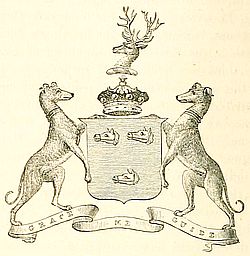
Badge—Broom.
Although there is great doubt as to the Celtic or at least Gaelic origin of the Forbes clan, still, as it was one of the most powerful and influential of the northern clans, it may claim a notice here. “The Forbes Family and following,” says Smibert, “ranked early among the strongest on the north-eastern coast of Scotland; and no one can reasonably doubt but that the ancient Pictish Gael of the region in question constituted a large proportion (if not of the Forbeses, at least) of the followers of the house.”
The traditions regarding the origin of the surname of Forbes are various; and some of them very fanciful. The principal of these, referred to by Sir Samuel Forbes in his “View of the diocese of Aberdeen” (MS. quoted by the Statistical Account of Scotland, art. Tullynessle and Forbes), states that this name was first assumed by one Ochonchar, from Ireland, who having slain a ferocious bear in that district, took the name of Forbear, now spelled and pronounced Forbes, in two syllables; although the English, in pronunciation, make it only one. In consequence of this feat the Forbeses carry in their arms three bears’ heads. A variation of this story says that the actor in this daring exploit was desirous of exhibiting his courage to the young and beautiful heiress of the adjacent castle, whose name being Bess, he, on receiving her hand as his reward, assumed it to commemorate his having killed the bear for “Bess.” Another tradition states that the name of the founder of the family was originally Bois, a follower of an early Scottish king, and that on granting him certain lands for some extraordinary service, his majesty observed that they were “for Boice.” The surname, however, is territorial, and said to be Celtic, from the Gaelic word Ferbash or Ferbasach, a bold man.
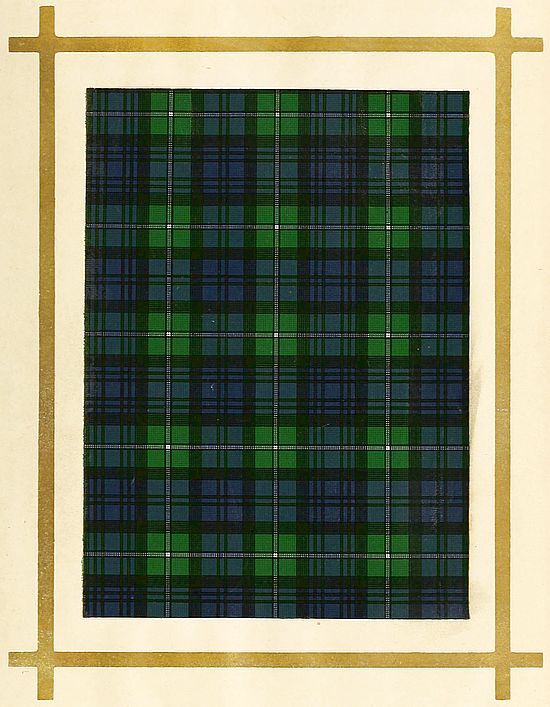
FORBES.
“On the whole,” says Smibert, “the traditions of the family, as well as other authorities, countenance with unusual strength, the belief, that the heads of the Forbeses belonged really to the Irish branch, and were among those strangers of that race whom the Lowland kings planted in the north and north-east of Scotland to overawe the remaining primary population of Gaelic Picts.”
According to Skene, in his treatise De Verborum Significatione, Duncan Forbois got from King Alexander (but which of the three kings of that name is not mentioned) a charter of the lands and heritage of Forbois in Aberdeenshire, whence the surname. In the reign of King William the Lion, John de Forbes possessed the lands of that name. His son, Fergus de Forbes, had a charter of the same from Alexander, Earl of Buchan, about 1236. Next of this race are Duncan de Forbes, his son, 1262, and Alexander de Forbes, grandson, governor of Urquhart Castle in Moray, which he bravely defended for a long time, in 1304, against Edward I. of England; but on its surrender all within the castle were put to the sword, except the wife of the governor, who escaped to Ireland, and was there delivered of a posthumous son. This son, Sir Alexander de Forbes, the only one of his family remaining, came to Scotland in the reign of Robert the Bruce, and his patrimonial inheritance of Forbes having been bestowed upon others, he obtained a grant of other lands instead. He was killed at the battle of Duplin, in 1332, fighting valiantly on the side of King David, the son of Bruce. From his son, Sir John de Forbes, 1373, all the numerous families in Scotland who bear the name and their offshoots, trace their descent.[241]
Sir John’s son, Sir Alexander de Forbes (curiously said to be posthumous like the above Alexander), acquired from Thomas, Earl of Mar, several lands in Aberdeenshire, the grant of which King Robert II. ratified by charter in the third year of his reign. By King Robert III. he was appointed justiciary of Aberdeen, and coroner of that county. He died in 1405. By his wife, a daughter of Kennedy of Dunure, he had four sons, namely—Sir Alexander, his successor, the first Lord Forbes; Sir William, ancestor of the Lords Pitsligo; Sir John, who obtained the thanedom of Formartine (which now gives the title of viscount to the Earl of Aberdeen) and the lands of Tolquhoun, by his marriage with Marjory, daughter and heiress of Sir Henry Preston of Formartine, knight (of the Dingwall family), and was ancestor of the Forbeses of Tolquhoun, Foveran, Watertoun, Culloden, and others of the name; and Alexander, founder of the family of Brux, and others.
Alexander, the elder son, was created a peer of parliament sometime after 1436. The precise date of creation is not known, but in a precept, directed by James II. to the lords of the exchequer, dated 12th July 1442, he is styled Lord Forbes. He died in 1448. By his wife, Lady Elizabeth (sometimes called Lady Mary) Douglas, only daughter of George, Earl of Angus, and grand-daughter of King Robert II, he had two sons and three daughters.
James, the elder son, second Lord Forbes, was knighted by King James III. He died soon after 1460. By his wife, Lady Egidia Keith, second daughter of the first Earl Marischal, he had three sons and a daughter, namely—William, third Lord Forbes; Duncan, of Corsindae, ancestor (by his second son) of the Forbeses of Monymusk; and Patrick, the first of the family of Corse, progenitor of the Forbeses, baronets, of Craigievar, and of the Irish Earls of Granard. The daughter, Egidia, became the wife of Malcolm Forbes of Tolquhoun.
William, third Lord Forbes, married Lady Christian Gordon, third daughter of Alexander, first Earl of Huntly, and had, with a daughter, three sons, Alexander, fourth lord; Arthur, fifth lord; and John, sixth lord.
Alexander, fourth lord, died, while yet young, before 16th May 1491.
Arthur, fifth Lord Forbes, succeeded his brother, and being under age at the time, he was placed as one of the king’s wards, under the guardianship of John, Lord Glammis, whose daughter he had married, but he died soon after his accession to the title, without children.
His next brother, John, became sixth Lord Forbes, before 30th October 1496, at which date he is witness to a charter. The sixth lord died in 1547. He was thrice married, first, to Lady Catherine Stewart, second daughter of John, Earl of Athole, uterine brother of King James II., and by her he had a son John, who died young, and a daughter, Elizabeth, married to John Grant of Grant; secondly, to Christian, daughter of Sir John Lundin of that ilk, by whom he had two sons and four daughters; and, thirdly, to Elizabeth Barlow or Barclay, relict of the first Lord Elphinstone, killed at Flodden in 1513, by whom he had a son, Arthur Forbes of Putachie, and a daughter, Janet, who was also thrice married.
The elder son of the second marriage, John, the Master of Forbes above mentioned, is stated to have been a young man of great courage and good education, but of a bold and turbulent spirit. He was beheaded for treason, on the 17th of July 1537.
After the execution of the Master, the king (James V.) seems to have been anxious to compensate the family for his severity towards them, by admitting his next brother, William, into his favour. He restored to him his brother’s honours and estates, and in 1539, appointed him one of the gentlemen of his bedchamber. This William succeeded his father in 1547, as seventh Lord Forbes, and died in 1593. He had married Elizabeth Keith, daughter and coheiress, with her sister, Margaret, Countess Marischal, of Sir William Keith of Inverugie, and had by her six sons and eight daughters. The sons were, John, eighth Lord Forbes; William, of Foderhouse; James, of Lethendy: Robert, prior of Monymusk; Arthur of Logie, called from his complexion, “Black Arthur;” and Abraham, of Blacktoun.
John, eighth Lord Forbes, was one of the five noblemen appointed by commission from the king, dated 25th July 1594, lieutenants of the northern counties, for the suppression of the rebellion of the popish Earls of Huntly and Errol. His lordship was served heir to his mother 13th November 1604, and died soon afterwards. He had married, while still Master of Forbes, Lady Margaret Gordon, eldest daughter of George, fourth Earl of Huntly, and had, with a daughter named Jean, a son, John, who, being educated in the faith of his mother, entered a religious order on the continent, and died without succession. This lady Lord Forbes repudiated, and in consequence a sanguinary contest took place in 1572, in the parish of Clatt, Aberdeenshire, between the two rival clans of Forbes and Gordon. The latter, under the command of two of the earl’s brothers, attacked the Forbeses, within a rude intrenchment which they had formed on the white hill of Tillyangus, in the south-western extremity of the parish, and after a severe contest the Gordons prevailed, having carried the intrenchment, and slain the Master’s brother, “Black Arthur.” The pursuit of the Forbeses was continued to the very gates of Druminner, the seat of their chief. A number of cairns are still pointed out where those slain on this occasion are said to have been buried. The eighth Lord Forbes took for his second wife, Janet, daughter of James Seton of Touch, and had, besides Arthur, ninth lord, another son, and a daughter.
Arthur, ninth lord, married on 1st February 1600, Jean, second daughter of Alexander, fourth Lord Elphinstone. He was succeeded by his only surviving son, Alexander, tenth Lord Forbes, who fought against the imperialists under the banner of the lion of the north, the renowned Gustavus Adolphus of Sweden, in whose service he attained the rank of lieutenant-general, and won for himself a high military reputation. On his return home, he had a considerable command in the army sent from Scotland to suppress the Irish rebellion in 1643. He afterwards retired to Germany, where he spent the remainder of his days. He was twice married—first, to Anne, eldest daughter of Sir John Forbes of Pitsligo, by whom he had, besides several children, who died young, a son, William, eleventh Lord Forbes; and secondly, to Elizabeth, daughter of Robert Forbes of Rires, in Fife, and by her had a large family.
William, eleventh Lord Forbes, died in 1691. He was thrice married, but had issue only by his first wife, Jean, a daughter of Sir John Campbell of Calder.
His eldest son, William, twelfth Lord Forbes, was a zealous supporter of the revolution. In 1689 he was sworn a privy councillor to King William. He died in July 1716. By his wife, Anne, daughter of James Brodie of Brodie, he had three sons and one daughter.
William, the eldest son, thirteenth Lord Forbes, married, in September 1720, Dorothy, daughter of William Dale, Esq. of Covent Garden, Westminster. He died at Edinburgh 26th June 1730. He had a son, Francis, fourteenth lord, who died in August 1734, in the thirteenth year of his age, and four daughters, one of whom, Jean, was married to James Dundas of Dundas, and another, the youngest, Elizabeth, married John Gregory, M.D., professor of the practice of medicine in the university of Edinburgh, and was the mother of the celebrated Dr James Gregory.
James, second son of the twelfth lord, succeeded his nephew, as fifteenth Lord Forbes, and died at Putachie, 20th February 1761, in the 73d year of his age. He married, first, Mary, daughter of the third Lord Pitsligo, widow of John Forbes of Monymusk, and grandmother of the celebrated Sir William Forbes of Pitsligo, baronet, and had a son, James, sixteenth Lord Forbes, and three daughters; secondly, in July 1741, Elizabeth, daughter of Sir James Gordon of Park, baronet.
James, sixteenth lord, died at Edinburgh 29th July 1804, in the 80th year of his age. By his wife Catherine, only daughter of Sir Robert Innes, baronet, of Orton and Balvenie, he had four sons and two daughters.
James Ochoncar Forbes, seventeenth lord, the eldest son, born 7th March 1765, entered the army in 1781, as ensign in the Coldstream regiment of foot guards, in which he was an officer for twenty-six years, holding important positions, and doing good service for his country. He died 4th May 1843. By his wife, Elizabeth, daughter and heiress of Walter Hunter of Polmood, Peeblesshire, and Crailing, Roxburghshire, he had six sons and four daughters. The estate of Polmood had been the subject of litigation for nearly fifty years in the Court of Session and House of Lords, but it was ultimately decided that an old man named Adam Hunter, who laid claim to it, had not established his pedigree. It consequently came into the possession of Lady Forbes. His lordship’s eldest son, James, a lieutenant-colonel in the Coldstream guards, predeceased his father in 1835.
Walter, the second son, born 29th May 1798, became eighteenth Lord Forbes, on his father’s death in 1843. He was twice married, and had in all eight sons and one daughter. He died in May 1868, and was succeeded by his eldest son, Horace Courtenay, born in 1829.
Lord Forbes is the premier baron of Scotland, being the first on the union roll. He is also a baronet of Nova Scotia, the date of creation being 1628.
The Forbeses of Tolquhoun, ancient cadets of this family, one of whom fell at the battle of Pinkie, 10th September 1547, are descended from Sir John Forbes, third son of Sir John Forbes, justiciary of Aberdeen in the reign of Robert III., are now represented by James Forbes Leith, Esq. of Whitehaugh, in the same county.
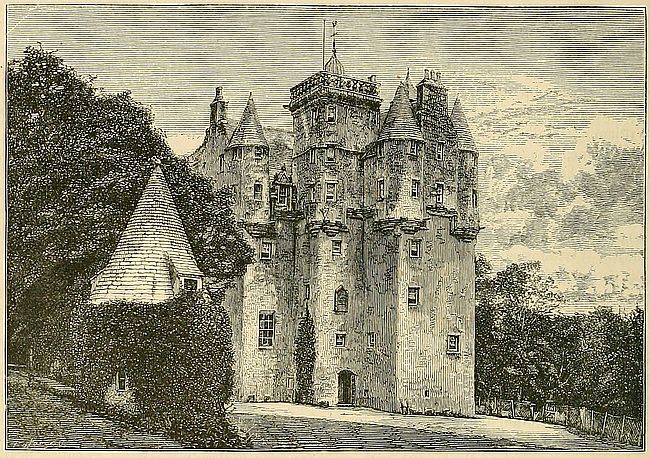
Craigievar Castle.
The Forbeses of Craigievar (also in Aberdeenshire), who possess a baronetcy, descend from the Hon. Patrick Forbes of Corse, armour-bearer to King James III., and third son, as already stated, of James, second Lord Forbes. The lands of Corse, which formed part of the barony of Coul and O’Nele or O’Neil, were in 1476 bestowed on this Patrick, for his services, by that monarch, and on 10th October 1482 he had a charter of confirmation under the great seal, of the barony of O’Neil, namely, the lands of Coule, Kincraigy, and le Corss. In 1510 his son and successor, David, called “Trail the Axe,” had a charter of the lands of O’Nele, Cors, Kincraigy, le Mureton, with the mill and alehouse thereof (the lands of Coul being now disjoined therefrom), and uniting and incorporating them into a haill and free barony, “cum furca, fossa, pitt et gallous,” &c., to be called the barony of O’Neil in all time coming. He married Elizabeth, sister of Panter of Newmanswells, near Montrose, secretary of state to James IV., and had a son, Patrick of O’Neil Corse, infeft in 1554. Patrick’s eldest son, William, infeft in January 1567, by his wife Elizabeth, daughter of Sir Alexander Strachan of Thornton, had six sons and five daughters.
His eldest son, Patrick Forbes of Corse and O’Neil, was bishop of Aberdeen for seventeen years, and died in 1635. The bishop’s male line failing with his grandchildren, the family estates devolved on the descendants of his next brother, William Forbes of Craigievar, the first of that branch.
His eldest son, William, was created a baronet of Nova Scotia, 20th April 1630, with a grant of sixteen thousand acres in New Brunswick, erected into a free barony and regality, to be called New Craigievar.
Sir William’s son, Sir John, second baronet, married Margaret, a daughter of Young of Auldbar, and had six sons and three daughters.
His grandson, Sir Arthur, fourth baronet, represented the county of Aberdeen in parliament from 1727 to 1747. Sir Arthur was the bosom friend of Sir Andrew Mitchell, British ambassador to Frederick the Great of Prussia, who left to Sir Arthur the bulk of his property, including his valuable library, and his estate of Thainston.
His son, Sir William, fifth baronet, born in 1753, by his wife, the Hon. Sarah Sempill, daughter of the twelfth Lord Sempill, had four sons and seven daughters.
His son, Sir Arthur, sixth baronet, was for some time an officer in the 7th hussars. He died unmarried in 1823, and was succeeded by his brother, Sir John, seventh baronet, born in 1785. He was a judge in the Hon. East India company’s service, and married in September 1825, the Hon. Charlotte Elizabeth, daughter of the 17th Lord Forbes, and had two sons and six daughters. He died 16th February 1846.
The elder son, Sir William, born May 20, 1836, succeeded as eighth baronet. In 1858 he married the only daughter of Sir Charles Forbes, Bart., of Newe and Edinglassie. He married, secondly, in November 1862, Frances Emily, youngest daughter of the late Sir George Abercromby, Bart. of Birkenbog, and has issue several sons.
The family of Forbes of Pitsligo and Fettercairn, which possesses a baronetcy, is descended from Hon. Duncan Forbes of Corsindae, second son of the second Lord Forbes.
The family of Forbes of Newe and Edinglassie, which also possesses a baronetcy, is descended from William Forbes of Dauch and Newe, younger son of Sir John Forbes, knight, who obtained a charter of the barony of Pitsligo and Kinnaldie, 10th October 1476, and whose elder son, Sir John Forbes, was the progenitor of Alexander Forbes, created Lord Forbes of Pitsligo, 24th June 1633, a title attainted in the person of Alexander, fourth lord, for his participation in the rebellion of 1745. John Forbes of Bellabeg, the direct descendant of the said William of Dauch, was born at Bellabeg in September 1743. In early life he went to Bombay, and engaging in mercantile pursuits, became one of the most extensive and distinguished merchants in India. Having realised a large fortune he repurchased Newe, the estate of his ancestors, besides other lands in Strathdon, and the whole of his rental was laid out in improvements. He died 20th June 1821, and was succeeded by his nephew, Sir Charles Forbes, eldest son of the Rev. George Forbes of Lochell, by his wife, Katharine, only daughter of Gordon Stewart of Inveraurie. He was created a baronet, 4th November 1823. He sat in parliament for upwards of twenty years. In 1833 he was served nearest male heir in general to Alexander, third Lord Pitsligo, by a jury at Aberdeen, and the same year he obtained the authority of the Lord Lyon to use the Pitsligo arms and supporters. He died 20th November 1849, and was succeeded by his grandson, Sir Charles, second baronet, born 15th July 1832, on whose death, unmarried, 23d May 1852, the title devolved on his uncle, Sir Charles Forbes, third baronet, born at Bombay 21st September 1803, and educated at Harrow school.
The first of the Forbeses of Culloden,[242] Inverness-shire, was Duncan Forbes, great-grandfather of the celebrated Lord President Forbes, descended from the noble family of Forbes through that of Tolquhoun, and by the mother’s side from that of Keith, Earl Marischal. He was M.P. and provost of Inverness, and purchased the estate of Culloden from the laird of Mackintosh in 1626. He died in 1654, aged 82.
Duncan Forbes, the first of Culloden, married Janet, eldest daughter of James Forbes of Corsindae, also descended from the noble family at the head of the clan, and had, with two daughters, three sons, namely, John, his heir, Captain James Forbes of Caithness, and Captain Duncan Forbes of Assynt.
John Forbes of Culloden, the eldest son, was also provost of Inverness. He was the friend and supporter of the Marquis of Argyll, and from his strong support of Presbyterian principles he suffered much in the reign of Charles II. and his brother James. About the year 1670, his landed estate was doubled by the purchase of the barony of Ferintosh and the estate of Bunchrew. As a compensation for the loss which the family had sustained during the revolution, his eldest son and successor, Duncan Forbes, third of Culloden, received from the Scots parliament the privilege of distilling into spirits the grain of the barony of Ferintosh, at a nominal composition of the duty, which remained the same, after the spirits distilled in other parts of the country were subjected to a comparatively heavy excise; hence Ferintosh became renowned for its whisky. The privilege was taken away in 1785. By his wife, Mary, daughter of Sir Robert Innes, of Innes, in Morayshire, baronet, he had two sons, John, and Duncan, Lord President, and several daughters.
John, the fourth laird of Culloden, took an active part on the side of government on the breaking out of the rebellion of 1715, and, with the afterwards celebrated Lord Lovat, narrowly escaped being apprehended at Aberdeen by Lord Saltoun, in command of the Jacobite forces there. Both he and his brother Duncan were engaged in putting down the insurrection in Inverness-shire. In those convivial times he so much excelled most of his friends in the quantity of claret that he could drink, that he was distinguished by the name of Bumper John. Dying without issue in 1734, he was succeeded by his only brother, Duncan,[243] the celebrated Lord President, whose only child, John Forbes, the sixth of Culloden, showed, when young, says Mr Burton, “the convivial spirit of his race, without their energy and perseverance.” He lived retired at Stradishall, in Suffolk, and by economy and judicious management succeeded in some measure in retrieving the losses which his father had sustained in the public service, and which, with the utmost ingratitude, the government, which his exertions and outlay had mainly helped to establish, refused to acknowledge or compensate. John Forbes died 26th September 1772. He was twice married—first to Jane, daughter of Sir Arthur Forbes of Craigievar, baronet, by whom he had two sons, Duncan, who died before him, and Arthur, his successor; and, secondly, Jane, daughter of Captain Forbes of Newe, without issue.
Arthur, seventh laird, died 26th May 1803, and was succeeded by his only son, Duncan George, who died 3d November 1827, when his eldest son, Arthur, born 25th January 1819, became the ninth laird of Culloden.
There are many other families of this name, but want of space forbids us entering into further details.
URQUHART.
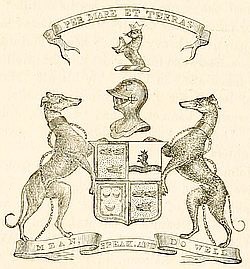
Badge—Wall-flower.
Urquhart, or Urchard, is the name of a minor clan (Urachdun), originally settled in Cromarty (badge, the wallflower), a branch of the clan Forbes. Nisbet says,—“A brother of Ochonchar, who slew the bear, and was predecessor of the Lords Forbes, having in keeping the castle of Urquhart, took his surname from the place.” This castle stood on the south side of Loch Ness, and was in ancient times a place of great strength and importance, as is apparent from its extensive and magnificent ruins. In that fabulous work, “The true pedigree and lineal descent of the most ancient and honourable family of Urquhart, since the creation of the world, by Sir Thomas Urquhart, Knight of Cromartie,” the origin of the family and name is ascribed to Ourqhartus, that is, “fortunate and well-beloved,” the familiar name of Esormon, of whom the eccentric author describes himself as the 128th descendant. He traces his pedigree, in a direct line, even up to Adam and Eve, and somewhat inconsistently makes the word Urquhart have the same meaning as Adam, namely, red earth.
The family of Urquhart is one of great antiquity. In Hailes’ Annals, it is mentioned that Edward I. of England, during the time of the competition for the Scottish crown, ordered a list of the sheriffs in Scotland to be made out. Among them appears the name of William Urquhart of Cromartie, heritable sheriff of the county. He married a daughter of Hugh, Earl of Ross, and his son Adam obtained charters of various lands. A descendant of his, Thomas Urquhart of Cromartie, who lived in the 16th century, is said to have been father of 11 daughters and 25 sons. Seven of the latter fell at the battle of Pinkie in 1547, and from another descended the Urquharts of Newhall, Monteagle, Kinbeachie, and Braelangwell.
The eldest son, Alexander Urquhart of Cromartie, had a charter from James V. of the lands of Inch Rory and others, in the shires of Ross and Inverness, dated March 7, 1532. He had two sons. The younger son, John Urquhart, born in 1547, became tutor to his grand-nephew, Sir Thomas Urquhart, and was well known afterwards by the designation of the “Tutor of Cromartie.” He died November 8, 1631, aged 84.
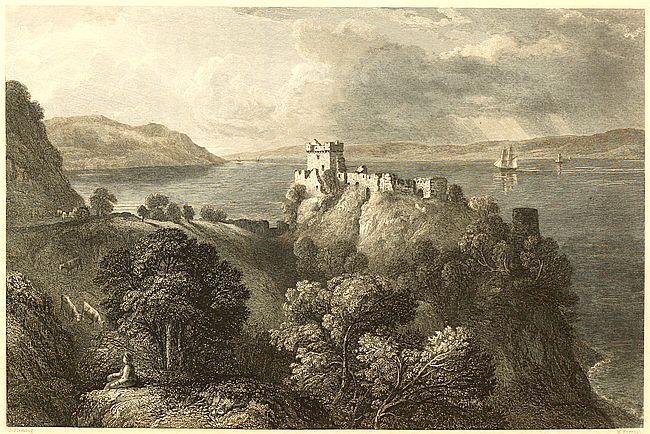
CASTLE URQUHART, (LOCH NESS) GRANTED BY CHARTER 1509 TO THE FAMILY OF GRANT OF GRANT NOW EARLS OF SEAFIELD. A. Fullerton & Co London & Edinburgh.
Sir Thomas, the family genealogist, is chiefly known as the translator of Rabelais. He appears to have at one period travelled much on the continent. He afterwards became a cavalier officer, and was knighted by Charles I. at Whitehall. After that monarch’s decapitation, he accompanied Charles II. in his march into England, and was taken prisoner at the battle of Worcester in 1651, when his estates were forfeited by Cromwell. He wrote several elaborate works, but the most creditable is his translation of Rabelais. Such, notwithstanding, was the universality of his attainments, that he deemed himself capable of enlightening the world on many things never “dreamed of in the philosophy” of ordinary mortals. “Had I not,” he says, “been pluck’d away by the importunity of my creditors, I would have emitted to public view above five hundred several treatises on inventions, never hitherto thought upon by any.” The time and place of his death are unknown. There is a tradition that he died of an inordinate fit of laughter, on hearing of the restoration of Charles II. The male line ended in Colonel James Urquhart, an officer of much distinction, who died in 1741. The representation of the family devolved on the Urquharts of Braelangwell, which was sold (with the exception of a small portion, which is strictly entailed) by Charles Gordon Urquhart, Esq., an officer in the Scots Greys. The Urquharts of Meldrum, Aberdeenshire, obtained that estate through the marriage, in 1610, of their ancestor, John Urquhart of Craigfintry, tutor of Cromarty, with Elizabeth Seton, heiress of Meldrum. The Urquharts of Craigston, and a few more families of the name, still possess estates in the north of Scotland; and persons of this surname are still numerous in the counties of Ross and Cromarty. In Ross-shire, Inverness-shire, and Morayshire, there are parishes of the name of Urquhart.