Volume 2 / Part 3 — PART THIRD. HISTORY OF THE HIGHLAND REGIMENTS. (continued 6)
Reading edition
Fraser, The Hon. Henry Thomas, Lieut.-Colonel.—10th April 1858, Ensign—To Scots Fusilier Guards, 24th June 1859.
Fraser, Hugh Andrew, Major.—25th April 1806, Ensign—Half-pay, 4th May 1832. Died at Maidstone, Kent, 3d May 1855.
Fraser, William Thomas, Lieut.—1st May 1855, Ensign—Lieut. 14th Dec. 1855. Retired 9th April 1861.
Frazer, Daniel, Colonel.—27th Dec. 1827, Captain from H. P. Retired on full-pay, Major and Brevet Lieut.-Colonel. Died Colonel at Feversham Rectory, Newport Pagnel, Bucks, 12th July 1868.
Frazer, Rowland Aynsworth (son of Col. Daniel Frazer). Captain.—14th April 1846, Ensign. Killed before Sebastopol, 17th July 1855.
Furlong, John Sheldon, M.D. Surgeon-Major.—9th Feb. 1855, Surgeon from 39th—To 6th Dragoons, 14th June 1864.
Furse, George Armand, Captain.—29th March 1855, Ensign.—Captain 12th Sept. 1865.
Fyfe, Laurence, Captain.—10th Oct. 1817, Ensign—Exchanged to 17th Foot, 10th Aug. 1838. Retired from Half-pay 22d Nov. 1842.
Gartshore, John Murray,(of Ravelston), Captain—7th Dec. 1826. Retired 30th March 1838.
Gisborne, Henry Francis, Assistant-Surgeon—15th Jan. 1827, Assistant-Surgeon. Resigned 27th Nov. 1828.
Goldie, Mark Wilkes.—27th Aug. 1844, Captain from 22d. Retired 3d Nov. 1846.
Gordon, Lord Cecil, Captain.—10th Aug. 1838, Captain from 17th. Retired 4th Nov. 1841.
Gordon, The Hon. Sir Charles, Lieut.-Colonel.—From H. P. 93d, 25th Nov. 1828. Died at Geneva, when on leave from Corfu. 30th Sept. 1835.
Gordon, George, Lieut.—20 Feb. 1812, Ensign—Half-pay 30th Dec. 1819. Died at Glasgow, 31st March 1861.
Gordon, Hamilton Douglas.—2d May 1851, Captain from 78th. Died at Cairo, on his way to join from India, 9th Sept. 1851.
Gordon, Rowland Hill, Captain from Coldstream Guards, 7th Sept. 1855. Retired 30th June 1869.
Graham, Charles Campbell, (now Graham Stirling, of Craigbarnet), Brevet-Major.—30th Aug. 1841, Ensign. Retired 1st May 1847.
Graham, Thomas, Lieut.-Colonel.—30th April 1827, Lieut.—Half-Pay, Captain, 9th Aug. 1833. Died Lieut.-Colonel 1st Royal Scots at Haslar, Gosport, from the Crimea, 29th Oct. 1855. [365] Granger, John, Captain—Joined the Regiment 21st Dec. 1837.—Promoted from Sergeant-Major to Lieut, in Land Transport Corps, 1st Oct. 1855—Captain, 1st Feb. 1856, Half-pay, 1st April 1857. Retired in 1860.
Grant, Alexander, Lieut.—16th Oct. 1866, Ensign from 15th Foot.—Lieut. 22d Oct. 1870. Retired 24th March 1871.
Grant, Edward Birkett, Captain.—14th Nov. 1826, Ensign—To 92d, 22d March 1827. Retired Captain from 4th Light Dragoons, 13th May 1839. Died at Hill, near Carlisle, 25th Sep. 1852.
Grant, The Hon. George Henry Essex, Captain.—5th Nov. 1841, Ensign. Retired Captain, 6th April 1865. Died at Crieff, 31st May 1873.
Grant, The Hon. James, Lieut.—30th March 1838, Ensign. Retired 26th October 1841.
Grant, John, Lieut.—20th May 1811, Ensign—To Half-pay 24th Aug. 1821. Died 18th June 1827.
Grant, John, (of Glenmoriston), Captain.—8th May 1840, Lieut, from 62d—Exchanged Captain, to 49th 22d May 1846. Retired 23d May 1848. Died at Moy House, Forres, 17th Aug. 1867.
Grant, William Oliver, Lieut.—29th March 1827, Ensign. Retired Lieut. 25th Sept. 1835. Died in 1836.
Green, William, Bt.-Major.—16th Jan. 1855, Ensign—Captain 19th Aug. 1859—Bt.-Major 5th July 1872.
Grogan, Edward George, Lieut.—24th July 1869, Ensign—Lieut. 28th Oct. 1871.
Grove, J. Charles Ross, Captain.—9th Sept. 1851, Ensign—Half-pay Captain, 14th June 1864. Retired 16th Oct. 1866.
Guthrie, John (of Guthrie), Lieut.—16th July 1829, Lieut.—Half-pay 15th June 1832. Retired 19th July 1836.
Guthrie, William, Captain.—21st March 1827, Lieut.—To Half-pay Captain, 10th August 1847.
Haldane, Edward, Orlando.—30th June 1863, Lieut. from H. P. 14th Hussars. Retired 23d Nov. 1865.
Halkett, Sir P. Arthur, of Pitfirrane, Bart., Captain.—20th May 1853, Ensign from 71st, exchanged Captain to 3d Light Dragoons 8th Jan. 1856. Retired 21st May 1858.
Hamilton, Alex. Thomas, Lieut.—18th August 1869, Ensign—Lieut. 28th October 1871. Retired 26th March 1873.
Harrison, James Compson, Lieut.—23d Nov. 1867, Ensign from 73d—Lieut. 28th Oct. 1871. Retired 22d April 1873.
Harvey, John, E. A.—31st Oct. 1871, Lieut. from 51st.
Hay, T. R. Drummond, Lieut.-Colonel.—2d August 1839, Ensign—Exchanged Captain to 78th—To Half-pay 2d Feb. 1864.
Haynes, Jonathan Wynyard, Captain.—25th May 1855, Ensign—Captain 10th July 1866—Exchanged to 2d West India Regiment, 30th July 1869.
Hesketh, Wm. Pemberton, Lieut.—9th March 1855, Ensign—Lieut. 6th Sept. 1855—To 18th Hussars 16th March 1858. Retired 7th Nov. 1862.
Hicks, Edward Percy, Lieut.—24th May 1861—Ensign 12th Sept. 1865.
Hill, Harcourt, Lieut.—10th Feb. 1825, Ensign—Half-pay 28th May 1829. Dead.
Hill, Marcus, Lieut.—7th June 1854, Ensign—Resigned 23d March 1855.
Hogarth, George, Lieut.-Colonel.—4th Nov. 1819, Ensign—Lieut. H. P. 13th Sept. 1821. Died Major and Brevet. Lieut.-Colonel in the 26th Regiment at Quebec, 25th July 1854.
Home, John, Paymaster.—21st March 1800, Paymaster—Half-pay 20th December 1818. Died at Eskbank, near Dalkeith, 14th April 1849.
Hooper, Alfred, Surgeon.—31st July 1857, Assistant Surgeon from Staff—To Staff Corps in India, 1st Sept. 1865—Surgeon 10th July 1866.
Hopetoun, John, Earl of, General.—29th Jan. 1820, Colonel. Died 27th August 1823.
Hulse, Samuel George.—3d March 1865, Ensign. Retired 11th Dec. 1866.
Hunter, James, Captain.—17th Nov. 1837, Ensign—Exchanged to 13th Foot, Lieut., 2d Sept. 1845. Died Staff Officer of Pensioners at Chester, 26th March 1860.
Inglis, Abraham, Lieut.—15th August 1826, Ensign—Retired Lieut. 15th Jan. 1833.
Jackson, Adam Thomas, M.D., Surgeon Major.—15th Feb. 1833, Assistant-Surgeon—To Staff 5th May 1837. Died at Athlone, Surgeon-Major Depot Battalion, 1st May 1860.
James, Thomas Mansfield, Lieut.—11th May 1855, Ensign—Lieut. 22d Nov. 1855. Died at Almorah, India, 26th Sept. 1860.
James, William, Lieut.—30th March 1855, Ensign.—Lieut. 16th April 1858. Retired 19th Dec. 1865.
Jervoise, Henry Clark, Lieut.-Colonel.—8th April 1853 Lieut. from 23d—Exchanged to Coldstream Guards Captain, 7th Sept. 1855.
Johnstone, George, Lieut.-Colonel.—From H. P. Late of the Grenadier Guards—4th May 1832, Major—To Half-pay from Lieut.-Colonel Commanding, 5th Sept. 1843.
Johnstone, Wm. James Hope (Yr. of Annandale), Lieut.—16th March 1838, Ensign. Retired 16th May 1840. Died at Annandale, 17th March 1850.
Kauntze, George, E. F. Major.—8th June 1856 Captain from 3d Light Dragoons—To Half-pay on reduction 7th Nov. 1856—To 7th Dragoon Guards. Retired Major 1867.
Kellet, Robert J. Napier, Captain.—3d Sept. 1829, Captain—To Half-pay 24th Feb. 1837. Retired 19th Oct. 1838. Died at Florence 2d Nov. 1853.
Kerr, Lord Charles Lennox, Captain.—1st Sept. 1837, Lieut.—Half-pay Captain 23d August 1844. Retired 10th Dec. 1848.
Kidston, Alex. Ferrier, Captain—9th Nov. 1858, Ensign—Captain 12th Feb. 1873.
King, Finlay. Joined the Regiment in 1803.—31st Dec. 1818, from Sergeant-Major promoted to Quarter-Master—Half-pay 19th June 1840. Died at Guernsey, 7th November 1842.
King, Robert Henry (son of the Quarter-Master).—18th August 1848, Assistant-Surgeon—To Staff 16th July 1852. Died in Canada 31st July 1853.
Kinloch, Thomas, Captain.—14th Sept. 1832, Ensign—Retired 25th Oct. 1844. Died at Logie, Perthshire, 6th Dec. 1848.
Lawson, William, Captain.—Joined the Regiment 29th Sept. 1837—Promoted to Ensign from Sergeant-Major, 5th Nov. 1854—Captain 10th August 1858. Died from wounds received in action, 19th August 1858.
Leith, T. Augustus Forbes.—18th Nov. 1854. Resigned 23d March 1855.
Leslie, John, Captain.—20th July 1815, Ensign—To Half-pay 9th March 1838. Died at Aberdeen 25th Dec. 1845.
M’Dakin, S. Gordon, Lieut.—23d Oct. 1855, Ensign—Lieut. 24th May 1861—To 19th Foot 5th Nov. 1861—Half-pay 22d Dec. 1863.
Macdonald, Atholl Wentworth, Captain.—9th August 1833, Ensign. Retired Captain 6th Dec. 1844. Died in the Pavilion Floriana Malta, with the Regiment, 27th February 1845.
Macdonald, Charles Kerr, Brevet-Major.—15th May 1823, Ensign—Half-pay Captain, 7th Nov. 1826. Died at Alexandria in Egypt, 17th Oct. 1867.
M’Donald, Donald, Captain.—16th August 1803, Ensign—Half-pay 27th May 1819. Died at Musselburgh 24th Sept. 1865.
Macdonald, Sir John, Lieut.-General.—15th Jan. 1844, Colonel. Died in London 28th March 1850.
M’Donald, Ranald, Ensign.—10th August 1815—Half-pay 8th July 1819. Cashiered from 3d Foot 31st July 1828.
Macdonald, Robert Douglas, Captain.—11th July 1822, Ensign. Exchanged to 94th 15th June 1838. Died Barrack-Master at Dover, 9th Feb. 1860.
Macdougall, James, Lieut.-Colonel.—From H. P. 23d, 30th Dec. 1819, Lieut. Retired from Lieut.-Colonel Commanding the Reserve Battalion, 15th Feb. 1850.
M’Dougall, Kenneth, Lieut.—6th March 1809, Ensign. Retired 9th Nov. 1826. Died in the Island of Skye, 1827.
M’Dougall, William Adair, Paymaster—23d August 1833.—To Half-pay 1st Oct. 1838. Died at Guernsey 27th Jan. 1841.
M’Duff, John, Major-General.—7th April 1825, Ensign—from Half-pay; Lieut. 40th Regiment 26th June 1827—Major-General 23d Oct. 1863. Died at New-miln Stanley, Perthshire, 25th September 1865.
Macfarlane, Victor, Ensign.—2d October 1855.—Superseded for absence without leave, 29th July 1856.
Macfarlane, Wm. Dick (of Donavourd), Captain.—10th Sept. 1825, Ensign—Half-pay Captain 16th Nov. 1832. Retired from 92d 15th Jan. 1836. Died at Perth 3d Feb. 1838.
M’Gregor, Alexander.—Joined the Regiment 13th March 1833.—Promoted to Quarter-Master from Quarter-Master Sergeant 25th May 1855—To a Depot Battalion, 30th August 1859—To Half-pay with rank of Captain, from 98th Regiment 1st August 1868.
M’Gregor, Alex. Edgar, Captain.—18th June 1852 Lieut, from 93d. Died Captain in the 31st at Hong-Kong, 12th August 1860.
M’Gregor, James (of Fonab), Dep. Inspector General.—12th April 1826, Assistant-Surgeon—To Staff Surgeon 1st class 12th March 1852—To Half-pay, 7th Dec. 1858.
M’Gregor, James, M.D.—12th March 1841, Assistant-Surgeon—To Staff 22d Nov. 1842.
M’Intosh, Daniel, Captain.—4th June 1805, Lieut. Retired 24th October 1821. Died at Hamilton 13th March 1830.
M’Intosh, Donald, Quarter-Master.—Joined the Regiment, not known—9th July 1803, Quarter-Master—Half-pay 30th Dec. 1818. Died at Perth 30th July 1829.
M’Intosh, William Henry.—27th Oct. 1846, Assistant-Surgeon.—Resigned 18th August 1848.
M’Iver, George, Captain.—31st March 1814, Ensign—To Half-pay 5th April 1839. Died July 1845.
M’Kay, Donald, Captain.—25th Jan. 1810, Ensign. Died at the Regimental Depot, Stirling, 13th Feb. 1832.
Mackie, Hugh, 7th August 1846, Surgeon.—To Staff 1st April 1850. Died at Halifax, Nova Scotia, 10th April 1858.
M’Kenzie, Donald, Captain.—23d July 1807, Lieut. Retired 13th Sept. 1821. Died in Edinburgh 5th Dec. 1838.
M’Kenzie, Thomas, Captain.—8th Feb. 1856, Ensign. Exchanged to 78th 23d Oct. 1857.
M’Kinnon, Wm. Alex., C.B., Surgeon-Major.—24th March 1854, Assistant-Surgeon from the Staff—To 57th Surgeon 28th Jan. 1862.
Maclachlan, James.—16th April 1842, Ensign. Resigned 24th May 1844.
M’Laine, Murdoch, Brevet-Major.—18th Jan. 1800, Ensign. Died 12th Dec. 1822.
M’Laren, Charles, Lieut.—2d June 1808, Lieut.—Half-pay 25th June 1817. Died in London 13th March 1818.
M’Lean, Alex., Surgeon.—7th Sept. 1854, Assistant-Surgeon—To Royal Artillery 8th Nov. 1861.
Macleod, Arthur Lyttleton, Captain.—12th Dec. 1822, Ensign—Half-pay Lieut, 9th June 1825. Retired from 86th 12th March 1841. Nothing more known of him.
M’Leod, John Chetham, C.B., Colonel.—21st April 1846, Ensign—now (1873) in command of the Regiment.
M’Leod, Murdoch, Captain.—20th Feb. 1855, Ensign—Captain 24th May 1861. Retired 17th August 1869.
Macleod, Swinton, Dep.-Inspec.-General.—25th June 1801, Assistant-Surgeon—Half-pay 5th Nov. 1829. Died in London 27th Dec. 1847.
Macnish, Wm. Lear, Lieut.—28th August 1846, Ensign—Exchanged to 93d, Lieut. 18th June 1852. Drowned at Scutari, Turkey, 19th May 1854.
Macpherson, Andrew Kennedy, Lieut.—19th Dec. 1865, Ensign—To 17th Foot 16th Feb. 1869. Lieut. Bengal Staff Corps 14th Dec. 1869.
Macpherson, Donald, Surgeon.—1st June 1809, Assistant-Surgeon—To half-pay from 62d 24th July 1835. Died at Chatham, 25th June 1839.
Macpherson, Duncan (Younger of Cluny), Major.—25th June 1852, Ensign—Major 5th July 1865.
Macpherson, Ewen (of Cluny), 15th June 1830, Captain.—Half-pay 14th June 1833. Retired 16th July 1841.
Macpherson, John Cameron, Lieut.-Colonel.—10th September 1830, Ensign—To full-pay Major, with rank of Lieut.-Colonel 24th April 1855. Died at Stirling, 23d April 1873.
Macpherson, Mungo, Major.—4th Nov. 1800, Ensign—Half-pay Major 18th May 1826. Died at Hastings 26th Nov. 1844.
Macquarie, George W., Captain.—25th Sept., Ensign—Exchanged to 63d—Captain 21st Jan. 1853. Retired 7th Sept. 1855.
Maginn, Daniel Wedgworth, Assistant-Surgeon 27th Nov. 1828. Exchanged to Staff 15th Feb. 1833. Died at Chatham 20th March 1834.
Maitland, Charles.—12th Nov. 1847, Ensign. Died at Bermuda 21st April 1851.
Maitland, George Thomas, Lieut.—9th April 1861, Ensign—Lieut. 5th July 1865—To Bengal Staff Corps 2d March 1866.
Malcolm, John, Major.—19th Feb. 1807, Ensign. Died at Cork, returning home on sick leave from Gibraltar 14th Nov. 1829.
Malcolm, John, Ensign.—6th Jan. 1814, Ensign—To Half-pay 4th Nov. 1819. Died 8th Sept. 1835.
Menzies, Archd., Major.—25th September 1800, Ensign—Retired Major 25th Dec. 1828. Died at Avondale, near Falkirk, 11th July 1854.
Menzies, Gilbert Innes, Lieut.—18th April 1842, Ensign. Retired 20th May 1853.
Middleton, William, Lieut.-Colonel.—9th July 1803, Ensign. Retired from command of the Regiment 23d August 1839. Died at Woolwich 18th Feb. 1843.
Mitchel, James William.—5th March 1858, Lieut, from St Helena Regiment—To 17th Foot 10th July 1860. Retired 23d July 1861.
Montague, George, Brevet-Major.—5th April 1839.—From H. P. 52d, 3d June 1842.
Montgomery, Thos. Henry (of Hattonburn), Captain.—3d March 1847, Ensign. Retired 22d May 1847.
Moore, George T. Carns, Captain.—12th Dec. 1856, Ensign—Captain 23d Nov. 1872.
Moseley, Herbert Henry, Captain.—3d June 1853, Ensign—Retired 24th March 1863. Died at Calcutta 19th May 1863.
Moubray, William Henry H. C., Lieut.—22d Oct. 1870, Ensign—Lieut. 25th Oct. 1871.
Muir, Sir Wm., K.C.B., M.D. and C.B.—22d Nov. 1842, Assistant-Surgeon—Promoted Surgeon 33d Regiment 24th Feb. 1854—Inspector-General 15th Feb. 1861.
Munro, George Montgomery, Sub-Lieut.—11th Dec. 1872.
Murray, Charles, Lieut.-Colonel.—21st June 1833, Ensign—To Half-pay Major 12th Sept. 1856. Retired 21st Sept. 1860 with rank of Lieut.-Colonel.
Murray, The Hon. David Henry, Brevet-Major.—6th April 1828, Ensign—To Lieut. 7th Fusiliers 9th Nov. 1830. Retired from Scots Fusilier Guards 4th Feb. 1848. Died at Taymount, Perthshire, 5th Sept. 1862.
Murray, Sir George, General.—6th Sept. 1823, Colonel—Removed to the 1st Royal Scots 29th Dec. 1843. Died in London 28th July 1846.
Murray, Henry Dundas.—30th Jan. 1835, Ensign. Retired 17th Nov. 1837.
Murray, James Wolfe (of Cringletie).—25th Jan. 1833, Ensign. Retired 24th June 1833.
Murray, Sir Robert, Bart.—15th Dec. 1837, Ensign. Retired 2d August 1839.
Murray, Sir William Keith, Bart.—Captain 1st Oct. 1825.—Half-pay 15th June 1830. Retired 10th March 1838. Died 16th Oct. 1861.
Nicholson, Brinsley, M.D., Dep.-Inspector-General.—15th Nov. 1829, Surgeon—Staff-Surgeon to the Forces 19th June 1835—Half-pay 30th Dec. 1845. Died at Red Hill, Surrey, 15th March 1857.
Orde, John W. Powlett, Captain (yr. of Kilmory).—6th Dec. 1844, Ensign. Retired 9th Jan. 1857.
Paterson, Augustus, Captain.—10th Jan. 1840, Ensign—To 68th Captain on reduction 24th Sept. 1850. Retired from 41st on the 24th Nov. 1854.
Paterson, James, M.D., Surgeon.—19th June 1835, Surgeon—To Half-pay 26th Feb. 1841. Died in Edinburgh 26th August 1866.
Paterson, James Erskine, Lieut, (now Erskine Erskine of Linlathen).—3d Nov. 1846, Ensign. Retired 12th Oct. 1852.
Paton, Edward, Captain.—Joined the Regiment as Armourer-Serjeant 24th August 1814.—Quarter-Master-Serjeant 15th Nov. 1838—Quarter-Master 19th June 1840—To Half-pay 5th May 1854. Died at Southsea, Portsmouth, 2d May 1863.
Peter, James John, Lieut.—16th April 1861, Ensign from 5th foot—Lieut. 14th June 1864. Died in India, 11th Nov. 1865.
Pitcairn, Andrew, Lieut.-Colonel.—15th May 1840, Ensign—Exchanged Major to 25th, 17th July 1857. To Half-pay Lieut.-Colonel on reduction of a Depot Battalion—1st April 1870. Retired 21st August 1871.
Priestly, Edward Ramsden, Colonel.—17th July 1857, Major from 25th Regiment. Died in command of the Regiment at Stirling, 25th March 1868.
Ramsay, Alexander, Captain.—16th May 1840, Ensign—Exchanged to 68th. Captain 27th Sept. 1853. Retired 20th Jan. 1854.
Ramsay, Robert Williamson, Captain.—15th June 1832, Lieut. from 62d. Retired 16th Nov. 1841.
Raynes, Thomas, Captain.—2d Sept. 1824, Ensign. Retired 30th Jan. 1835.
Robertson, George Duncan (of Struan), Lieut.—14th June, 1833, Ensign. Retired 16th May 1840. Died at Bonchurch, Isle of Wight, 3d April 1864.
Robertson, James, Captain.—1st Dec. 1808, Ensign—to Half-pay Captain 13th Feb. 1827. Died in the 48th Regiment, at Chatham, 20th April 1833.
Robertson, Wm. James (younger of Kinlochmoidart), Captain.—16th June 1848, Ensign—Exchanged Lieut. to 30th Regiment. Retired 4th Dec. 1857. Died at Kinlochmoidart, 26th June 1869.
Rollo, The Hon. Robert, C.B., Major-General.—10th Aug. 1832, Ensign—To Half-pay Lieut.-Colonel 17th July 1855.
Rose, Eustace, Henry.—21st Jan. 1833, Captain from 60th Rifles—Exchanged to 7th Fusiliers 27th May 1853. Retired 3d June 1856.
Ross, Gilian M’Lean, Brevet-Major.—17th Nov. 1841—Lieut. from 57th—To Half-pay as Captain 4th Sept. 1849—To 3d W. I. Regiment—and To Half-pay from it 6th March 1863. Died in London 23d May 1866.
Ross, James Kerr, Lieut.-General.—31st May 1821, Captain—Half-pay 27th Dec. 1827. Died at Edinburgh, 26th April 1872.
St John, George Frederick Berkeley, Major.—25th Nov. 1819, Lieut.—To Half-pay Captain 25th Oct. 1821—To H. P. Major from the 52d, 31st May 1839. Died a Knight of Windsor, 23d July 1866.
Samwell, Frank, Captain.—Paymaster from Half-pay 102d 15th Dec. 1869.
Sandeman, Thos. Fraser, Captain.—24th Dec. 1848, Ensign—Half-pay Lieut. 10th Aug. 1832. Retired from 73d Captain 31st May 1844.
Sandilands, E. Nimmo, Lieut.-Colonel.—21st May 1842, Ensign—Promoted to Lieut. 8th Foot 3d April 1846—Lieut.-Colonel Bengal Staff Corps.
Scobie, Mackay John, Lieut.—12th Jan. 1867, Ensign—Lieut. 28th Oct. 1871.
Scott, Francis Cunningham (younger of Malleny), Major.—24th Nov. 1852, Ensign—Major 26th March 1868.
Scott, James Rattray, Lieut.—4th July 1819, Ensign—To 47th 11th July 1822. Resigned 6th Dec. 1826.
Shuttleworth, Charles, Captain.—23d April 1855, Ensign—To Bengal Staff Corps, Lieut. 27th Oct. 1865—Captain 23d April 1867.
Simpson, John, V.C.—Joined the Regiment 8th June 1843—From Quarter-Master Sergeant promoted to Quarter-Master 7th Oct. 1859.
Sinclair, Robert Bligh, Captain.—27th Sept. 1839, Ensign.—To Half-pay Captain on reduction 15th Nov. 1850. Retired from 66th Captain 3d Nov. 1854—Was Adjutant-General of Militia for Nova Scotia, and went to the Danish Island of Santa Cruz for the benefit of his health, where he died on the 28th of June 1872.
Spens, Colin, Lieut.—2d Dec. 1862, Ensign—Lieut. 2d March 1866. Died in India 22d June 1867.
Spooner, Wm. Henry, Lieut.—9th Oct. 1855, Ensign—To 9th Foot Lieut. 16th April 1861—To 90th 11th April 1862—Half-pay 27th Feb. 1867. Died at Bingen on the Rhine, 29th Nov. 1870.
Stevenson, A. Scott, Lieut.—17th March 1869, Ensign—Lieut. 28th Oct. 1871.
Stevenson, George Milne, Lieut.-Colonel.—10th Sept. 1818, Lieut.—To Half-pay Captain 19th June 1840—To H. P. Lieut.-Colonel from Rifle Brigade 19th June 1840. Retired 7th August 1846. Nothing more known of him.
Stewart, Andrew David Alston, Captain.—26th Sept. 1831, Ensign—Exchanged to 6th Foot Lieut. 1st Sept 1837. Died in India, Captain 61st, 18th May 1848.
Stewart, Charles Edward, Ensign.—8th June 1826, Ensign. Died at Gibraltar, 3d Nov. 1828.
Stewart, The Hon. Randolph Henry, Captain.—2d March 1855, Ensign—Captain 14th June 1864—To Half-pay 23d March 1867.
Stewart, John, Assistant-Surgeon.—4th May 1809.—To Half-pay 25th Dec. 1818. Died at Perth, 2d Jan. 1837.
Stewart, Roger, Captain.—28th June 1810, Ensign—To Half-pay Captain 13th Feb. 1827. Died in the Royal African Corps, on the West Coast, 15th July 1833.
Stirling, James, Captain.—13th August 1805, Ensign. Retired 25th Sept. 1817. Died at Musselburgh 20th Jan. 1818.
Stirling, Thos. Jas. Graham (of Strowan), Lieut.—8th Nov. 1827, Ensign. Retired 15th Dec. 1837.
Strange, Alex., Lieut.—8th Feb. 1809, Ensign. Died 15th May 1823.
Stuart, J. G. Gordon, Lieut.—1st June 1855, Ensign—Lieut. 1st May 1857—Exchanged to St Helena Regiment 5th March 1858. Retired 23d Sept. 1862.
[366]Stuart, John Patrick, Brevet-Major.—Joined the Regiment 18th May 1825—Promoted from Colour-Serjeant to 2d Lieut. in the 21st Fusiliers, 30th Dec. 1838—To Staff-Officer of Pensioners, 1st Jan. 1855, from 43d Light Infantry.
Suther, William King, Lieut.—13th Feb. 1866, Ensign from 99th—Lieut. 18th August 1869.
Thompson, William Kerr, Lieut.—7th April 1825, Ensign from Half-pay, Lieut. 26th Regiment, 26th April 1828. Died on Half-pay 27th May 1833.
Thompson, William Thomas, Captain from 83d, 28th Jan. 1870. Retired 19th Oct. 1872.
Thornhill, T. Allen, M.B.—24th July 1867, Assistant-Surgeon—To 7th Hussars 25th March 1859.
Thorold, George Edward, Colonel.—28th July 1857, Lieut.-Colonel from H. P. 92d. Retired on Full-pay, with rank of Colonel, 16th March 1858.
Tinnie, William Thomas, Captain.—26th June 1827, Ensign—To 86th Lieut. 20th Dec. 1827. Retired Captain from 8th Hussars 15th Nov. 1839. Died 21st March 1848.
Troup, Robert William, M.B.—1st Sept. 1865, Assistant-Surgeon from the Staff.
Tulloch, Thomas, Colonel.—15th June 1838, Captain from 94th—To Half-pay Lieut.-Colonel 9th Oct. 1855. Retired with the rank of Colonel 21st Oct. 1859. Died in London 3d Jan. 1866.
Tulloch, James Tulloch, M.D., Assistant-Surgeon.—2d July 1861, from Rifle Brigade. Died in India 16th July 1867.
Underwood, William, Captain.—5th June 1855, Ensign—Captain 11th Jan. 1867. Retired 12th Feb. 1873.
Wade, Thos. Francis, Colonel.—13th July 1809, Captain from 20th—Half-pay Major 4th May 1826. Died at Haverford West, 3d Dec. 1846.
Wade, Thomas Francis (son of the Colonel), Lieut.—23d August 1839, Ensign—Promoted in 98th, Lieut. 16 Nov. 1841. Retired 22d June 1847. Now British Minister at Pekin.
Walter, William Sanders, Captain.—25th Jan. 1856, Ensign—Captain 23d March 1867. Retired 23d Nov. 1872.
Ward, William Crofton, Captain.—18th August 1848, Ensign—Retired 24th May 1861.
Wardell, Charles, Paymaster.—22d Feb. 1821.—Half-pay 25th Jan. 1828. Died 29th July 1862.
Warner, Chas. W. Pole.—28th Dec. 1860, Ensign from 43d. Resigned 16th April 1861.
Warrand, Arthur Wellesley, Lieut. 24th March 1863, Ensign—Lieut. 10th July 1866. Retired 21st Oct. 1870. Died at Cape of Good Hope 1st June 1871.
Wauchope, Andrew Gilbert, Lieut. and Adjutant.—21st Nov. 1865, Ensign—Lieut. 23d June 1867—Adjutant 5th April 1870.
Webber, W. G. Everard, Captain.—23d Nov. 1852, Ensign. Died in India, 9th July 1866.
Wedderburn, John Walter, Lieut.-Colonel.—26th Oct. 1841, Ensign. Retired Captain 12th May 1854—Major, Royal Perth Rifles, 5th Nov. 1855. Retired with rank of Lieut.-Colonel 10th Dec. 1869.
Wheatley, John, Lieut.-Colonel.—Joined the Regiment 1st May 1817—Ensign and Adjutant from Acting Serjeant-Major 20th July 1832—To a Depot Battalion, 26th Jan. 1855. Retired on Half-pay 27th June 1866.
Whigham, Robert, Major.—6th June 1854, Ensign.—To Half-pay Captain on reduction 1st Jan. 1857—7th Fusiliers 31st Dec. 1857—16th Lancers 9th Oct. 1863.
Whitehead, Edmund, Captain.—22d May 1857, Ensign.—Captain 17th August 1869.
Whitehead, Frederick G. I.—27th May 1853, Captain from 7th Fusiliers. Retired 27th July 1854.
Wilkes, Edwin.—10th July 1860, Assistant-Surgeon from Staff—To Staff Corps in India, 8th Aug. 1862.
Wilkinson, Frederick Green, Colonel.—28th Nov. 1851, Captain from 43d—Lieut.-Colonel, exchanged to a Depot Battalion 27th Sept. 1861.
Wilson, John, Bt.-Major.—Joined the Regiment 22d Oct. 1844—Promoted Ensign from Sergeant-Major 10th August 1854—Captain 16th March 1858—Bt.-Major 5th July 1872.
Wood, John Gillespie, M.D.—12th March 1852, Surgeon—To Staff Surgeon-Major 9th Feb. 1855—To Half-pay Dep.-Inspec.-General, 8th June 1867.
Wood, William, Major—Joined the Regiment 27th July 1843—Promoted to Quarter-Master from Sergeant-Major, 5th May 1854—Adjutant 16th Feb. 1855—To Half-pay Captain 17th March 1863—Major 1st April 1870.
Young, James, Lieut.—22d Oct. 1805, Ensign—Half-pay 25th Nov. 1819. Died in Edinburgh, 15th June 1846.
HIGHLAND PIBROCH:
Composed by one of the MacCrummens in the midst of the Battle of Inverlochy, 1427, wherein Donald Balloch of the Isles was victorious over the Royal Forces.
Arranged for the Bagpipes.
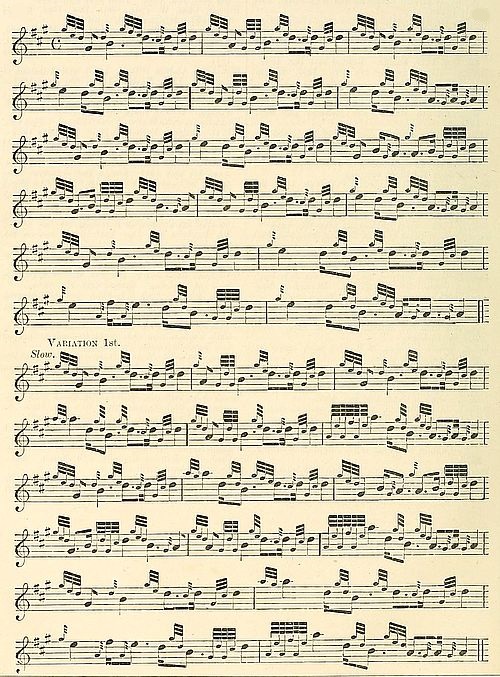
Variation 1st. Slow.
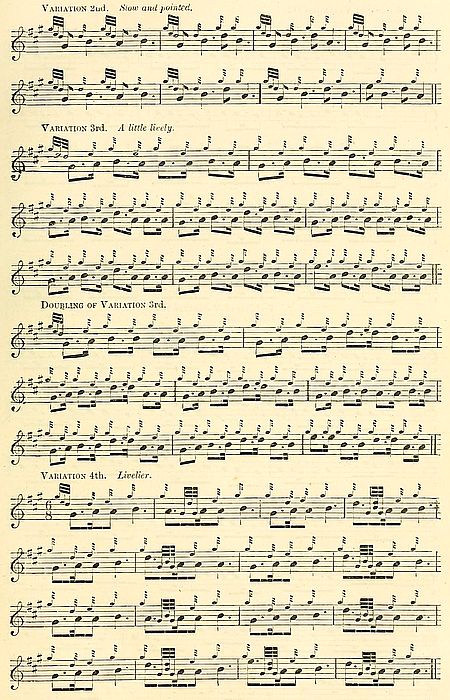
Variation 2nd. Slow and pointed.
Variation 3rd. A little lively.
Doubling of Variation 3rd.
Variation 4th. Livelier.
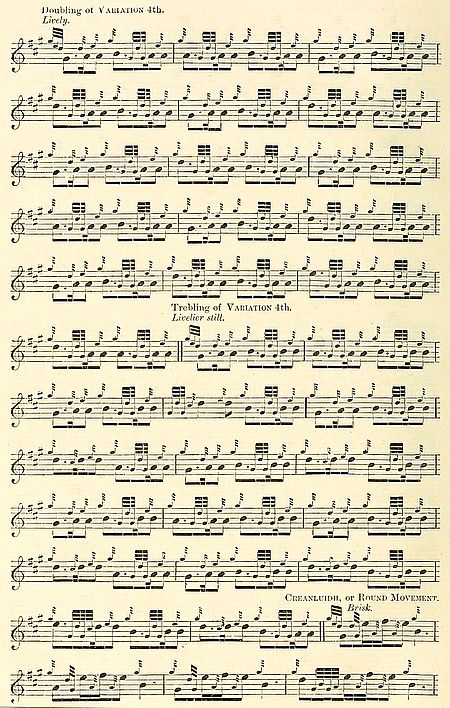
Doubling of Variation 4th. Lively.
Trebling of Variation 4th. Livelier still.
Creanluidh or Round Movement. Brisk.
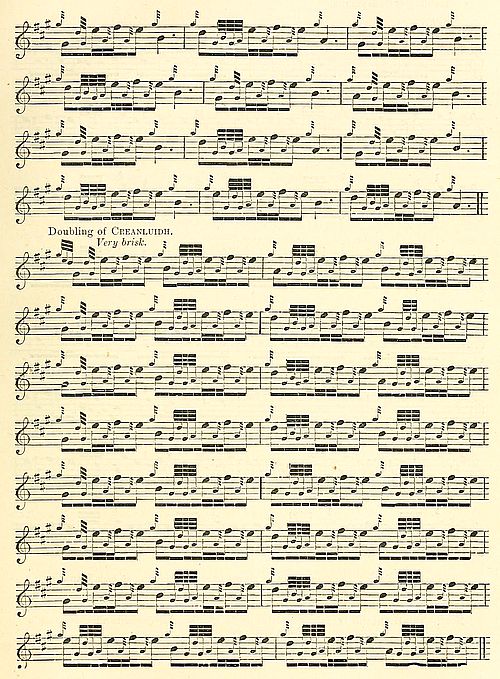
Doubling of Creanluidh. Very brisk.
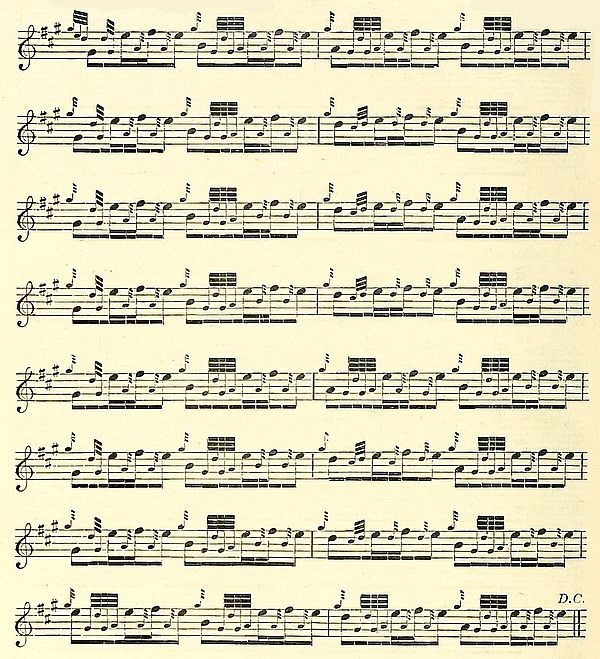
Trebling of Creanluidh. As lively as can be played distinctly.
The ground of this Piobaireachd may be played after the Doubling of each Variation.
[Listen (.mid)] Audio content is not currently supported on your device.
Note.—This Highland Pibroch was played by the 42nd Royal Highlanders while marching to Quatre Bras. See page 394.
FOOTNOTES:
LOUDON’S HIGHLANDERS.
1745–1748.
Raising of Regiment—Rebellion of 1745—Flanders—Bergen-op-Zoom—Reduction of Regiment.
The bravery displayed by Lord John Murray’s Highlanders at Fontenoy opened the eyes of Government to the importance of securing the military services of the clans. It was therefore determined to repair, in part, the loss sustained in that well-fought action, by raising a second regiment in the Highlands, and authority to that effect was granted to the Earl of Loudon. By the influence of the noblemen, chiefs, and gentlemen of the country, whose sons and connexions were to be appointed officers, a body of 1250 men was raised, of whom 750 assembled at Inverness, and the remainder at Perth. The whole were formed into a battalion of twelve companies, under the following officers, their commissions being dated June 8th 1745:—
Colonel.—John Campbell, Earl of Loudon, who died in 1782, a general in the army.
Lieutenant-Colonel.—John Campbell (afterwards Duke of Argyll), who died a field-marshal in 1806.
Captains.
John Murray (afterwards Duke of Athole), son of Lord George Murray.
Alexander Livingstone Campbell, son of Ardkinglass.
John Macleod, younger of Macleod.
Henry Munro, son of Colonel Sir Robert Munro of Fowlis.
Lord Charles Gordon, brother of the Duke of Gordon.
John Stewart, son of the Earl of Moray.
Alexander Mackay, son of Lord Reay.
Ewen Macpherson of Clunie.
John Sutherland of Forse.
Colin Campbell of Ballimore, killed at Culloden.
Archibald Macnab, who died a lieutenant-general in 1791, son of the laird of Macnab.
Lieutenants.
Colin Campbell of Kilberrie.
Alexander Maclean.
John Campbell of Strachur, who died in 1806, a general in the army, and colonel of the 57th regiment.
Duncan Robertson of Drumachuine, afterwards of Strowan.
Patrick Campbell, son of Achallader.
Donald Macdonald.
James Macpherson of Killihuntly.
John Robertson or Reid, of Straloch, who died in 1806, at the age of eighty-five, a general in the army and colonel of the 88th or Connaught Rangers.[367]
Patrick Grant, younger of Rothiemurchus.
John Campbell of Ardsliginish.
Alexander Campbell, brother to Barcaldine.
Donald Macdonell of Lochgarry.
Colin Campbell of Glenure.
Ensigns.
James Stewart of Urrard.
John Martin of Inch.
George Munroe of Novar.
Malcolm Ross, younger of Pitcalnie.
Hugh Mackay.
James Fraser.
David Spalding of Ashintully.
Archibald Campbell.
Donald Macneil.
Alexander Maclagan, son of the minister of Little Dunkeld.
Robert Bisset of Glenelbert, afterwards commissary-general of Great Britain.
John Grant, younger of Dalrachnie.
Before the regiment was disciplined, the rebellion broke out, and so rapid were the movements of the rebels, that the communication between the two divisions, at Perth and Inverness, was cut off. They were therefore obliged to act separately. The formation of the regiment at the time was considered a fortunate circumstance, as many of the men would certainly have joined in the insurrection; and indeed several of the officers and men went over to the rebels. Four companies were employed in the central and southern Highlands, whilst the rest were occupied in the northern Highlands, under Lord Loudon. Three companies under the Hon. Captains Stewart and Mackay, and Captain Munro of Fowlis, were, with all their officers, taken prisoners at the battle of Gladsmuir. Three other companies were also at the battle of Culloden, where Captain Campbell and six men were killed and two soldiers wounded.
On the 30th of May 1747, the regiment embarked at Burntisland for Flanders, but it did not join the Duke of Cumberland’s army till after the battle of Lafeldt, on the 2d of July. Though disappointed of the opportunity which this battle would have given them of distinguishing themselves, another soon offered for the display of their gallantry. Marshal Saxe having determined to attack the strong fortress of Bergen-op-Zoom, with an army of 25,000 men under General Count Lowendahl, all the disposable forces in Brabant, including Loudon’s Highlanders, were sent to defend the lines, which were strongly fortified. To relieve the garrison, consisting of six battalions, and to preserve a communication with the country, eighteen battalions occupied the lines. The fortress, which was considered impregnable, was defended by 250 pieces of cannon. The siege was carried on unremittingly from the 15th of July till the 17th of September, during which time many sorties were made. In the Hague Gazette, an account is given of one of these, which took place on the 25th of July, in which it is stated “that the Highlanders, who were posted in Fort Rouro, which covers the lines of Bergen-op-Zoom, made a sally, sword in hand, in which they were so successful as to destroy the enemy’s grand battery, and to kill so many of their men, that Count Lowendahl beat a parley, in order to bury the dead. To this it was answered, that had he attacked the place agreeably to the rules of war, his demand would certainly have been granted; but as he had begun the siege like an incendiary, by setting fire to the city with red-hot balls, a resolution had been taken neither to ask or grant any suspension of arms.”
Having made breaches in a ravelin and two bastions, the besiegers made an unexpected assault on the night of the 16th of September, and throwing themselves into the fosse, mounted the breaches, forced open a sally port, and, entering the place, ranged themselves along the ramparts, almost before the garrison had assembled. Cronstrun, the old governor, and many of his officers, were asleep, and so sudden and unexpected was the attack, that several of them flew to the ranks in their shirts. Though the possession of the ramparts sealed the fate of the town, the Scottish troops were not disposed to surrender it without a struggle. The French were opposed by two regiments of the Scotch brigade, in the pay of the States-general, who, by their firmness, checked the progress of the enemy, and enabled the governor and garrison to recover from their surprise. The Scotch assembled in the market-place, and attacked the French with such vigour that they drove them from street to street, till, fresh reinforcements pouring in, they were compelled to retreat in their turn,—disputing every inch as they retired, and fighting till two-thirds of their number fell on the spot, killed or severely wounded,—when the remainder brought off the old governor, and joined the troops in the lines.
The troops in the lines, most unaccountably, retreated immediately, and the enemy thus became masters of the whole navigation of the Scheldt. “Two battalions,” says an account of the assault published in the Hague Gazette, “of the Scotch brigade have, as usual, done honour to their country,—which is all we have to comfort us for the loss of such brave men, who, from 1450, are now reduced to 330 men—and those have valiantly brought their colours with them, which the grenadiers twice recovered from the midst of the French at the point of the bayonet. The Swiss have also suffered, while others took a more speedy way to escape danger.” In a history of this memorable siege the brave conduct of the Scotch is also thus noticed: “It appears that more than 300 of the Scotch brigade fought their way through the enemy, and that they have had 19 officers killed and 18 wounded. Lieutenants Francis and Allan Maclean of the brigade were taken prisoners, and carried before General Lowendahl, who thus addressed them: ‘Gentlemen, consider yourselves on parole. If all had conducted themselves as you and your brave corps have done, I should not now be master of Bergen-op-Zoom.’”[368]
The loss of a fortress hitherto deemed impregnable was deeply felt by the allies. The eyes of all Europe had been fixed upon this important siege, and when the place fell strong suspicions were entertained of treachery in the garrison. Every thing had been done by the people of the United Provinces to enable the soldiers to hold out: they were allowed additional provisions of the best quality, and cordials were furnished for the sick and dying. Large sums of money were collected to be presented to the soldiers, if they made a brave defence; and £17,000 were collected in one day in Amsterdam, to be applied in the same way, if the soldiers compelled the enemy to raise the siege. Every soldier who carried away a gabion from the enemy was paid a crown, and such was the activity of the Scotch, that some of them gained ten crowns a-day in this kind of service. Those who ventured to take the burning fuse out of the bombs of the enemy (and there were several who did so), received ten or twelve ducats. In this remarkable siege the French sustained an enormous loss, exceeding 22,000 men; that of the garrison did not exceed 4000.[369]
After the loss of Bergen-op-Zoom, Loudon’s Highlanders joined the Duke of Cumberland’s army, and at the peace of 1748 returned to Scotland, and was reduced at Perth in June of the same year.
FOOTNOTES:
MONTGOMERY’S HIGHLANDERS,
OR
SEVENTY-SEVENTH REGIMENT.
1757–1763.
Lord Chatham and the Highlanders—Raising of the Regiment—America—Fort du Quèsne—Ticonderoga—Cherokees—Dominique—West Indies—Newfoundland—Fort Pitt.
We have already quoted[370] Lord Chatham’s eloquent statement with regard to the Highland Regiments, in his celebrated speech on the differences with America in 1766. The only way by which the Highlanders could be gained over was by adopting a liberal course of policy, the leading features of which should embrace the employment of the chiefs, or their connections, in the military service of the government. It was reserved to the sagacity of Chatham to trace to its source the cause of the disaffection of the Highlanders, and, by suggesting a remedy, to give to their military virtue a safe direction.
Acting upon the liberal plan he had devised, Lord Chatham (then Mr Pitt), in the year 1757 recommended to his Majesty George II. to employ the Highlanders in his service, as the best means of attaching them to his person. The king approved of the plan of the minister, and letters of service were immediately issued for raising several Highland regiments. This call to arms was responded to by the clans, and “battalions on battalions,” to borrow the words of an anonymous author, “were raised in the remotest part of the Highlands, among those who a few years before were devoted to, and too long had followed the fate of the race of Stuarts. Frasers, Macdonalds, Camerons, Macleans, Macphersons, and others of disaffected names and clans, were enrolled; their chiefs or connections obtained commissions; the lower class, always ready to follow, with eagerness endeavoured who should be first listed.”
This regiment was called Montgomerie’s Highlanders, from the name of its colonel, the Hon. Archibald Montgomerie, son of the Earl of Eglinton, to whom, when major, letters of service were issued for recruiting it. Being popular among the Highlanders, Major Montgomerie soon raised the requisite body of men, who were formed into a regiment of thirteen companies of 105 rank and file each; making in all 1460 effective men, including 65 sergeants, and 30 pipers and drummers.
The colonel’s commission was dated the 4th of January 1757. The commissions of the other officers were dated each a day later than his senior in the same rank.
Lieutenant-Colonel Commanding.
The Hon. Archibald Montgomerie, afterwards Earl of Eglinton, died a general in the army, and colonel of the Scots Greys, in 1796.
Majors.
James Grant of Ballindalloch, died a general in the army in 1806.
Alexander Campbell.
Captains.
John Sinclair.
Hugh Mackenzie.
John Gordon.
Alexander Mackenzie, killed at St John’s, 1761.
William Macdonald, killed at Fort du Quèsne, 1759.
George Munro, killed at Fort du Quèsne, 1759.
Robert Mackenzie.
Allan Maclean, from the Dutch brigade, colonel of the 84th Highland Emigrants; died Major-general, 1784.
James Robertson.
Allan Cameron.
Captain-lieutenant Alexander Mackintosh.
Lieutenants.
Charles Farquharson.
Alexander Mackenzie, killed at Fort du Quèsne, 1759.
Nichol Sutherland, died Lieutenant-colonel of the 47th regiment, 1780.
Donald Macdonald.
William Mackenzie, killed at Fort du Quèsne.
Robert Mackenzie, killed at Fort du Quèsne.
Henry Munro.
Archibald Robertson.
Duncan Bayne.
James Duff.
Colin Campbell, killed at Fort du Quèsne, 1759.
James Grant.
Alexander Macdonald.
Joseph Grant.
Robert Grant.
Cosmo Martin.
John Macnab.
Hugh Gordon, killed in Martinique, 1762.
Alexander Macdonald, killed at Fort du Quèsne.
Donald Campbell.
Hugh Montgomerie, late Earl of Eglinton.
James Maclean, killed in the West Indies, 1761.
Alexander Campbell.
John Campbell of Melford.
James Macpherson.
Archibald Macvicar, killed at the Havannah, 1762.
Ensigns.
Alexander Grant.
William Haggart.
Lewis Houston.
Ronald Mackinnon.
George Munro.
Alexander Mackenzie.
John Maclachlane.
William Maclean.
James Grant.
John Macdonald.
Archibald Crawford.
James Bain.
Allan Stewart.
Chaplain.—Henry Munro.
Adjutant.—Donald Stewart.
Quarter-master.—Alex. Montgomerie.
Surgeon.—Allan Stewart.
The regiment embarked at Greenock for Halifax, and on the commencement of hostilities in 1758 was attached to the corps under Brigadier-general Forbes in the expedition against Fort du Quèsne, one of the three great enterprises undertaken that year against the French possessions in North America. Although the point of attack was not so formidable, nor the number of the enemy so great, as in the cases of Ticonderoga and Crown Point; yet the great extent of country which the troops had to traverse covered with woods, morasses, and mountains, made the expedition as difficult as the other two. The army of General Forbes was 6238 men strong.
The brigadier reached Raystown, about 90 miles from the Fort, in September, having apparently stayed some time in Philadelphia.[371] Having sent Colonel Boquet forward to Loyal Henning, 40 miles nearer, with 2000 men, this officer rashly despatched Major Grant of Montgomery’s with 400 Highlanders and 500 provincials to reconnoitre. When near the garrison Major Grant imprudently advanced with pipes playing and drums beating, as if entering a friendly town. The enemy instantly marched out, and a warm contest took place. Major Grant ordered his men to throw off their coats and advance sword in hand. The enemy fled on the first charge, and spread themselves among the woods; but being afterwards joined by a body of Indians, they rallied and surrounded the detachment on all sides. Protected by a thick foliage, they opened a destructive fire upon the British. Major Grant then endeavoured to force his way into the wood, but was taken in the attempt, on seeing which his troops dispersed. Only 150 of the Highlanders returned to Loyal Henning.
In this unfortunate affair 231 soldiers of the regiment were killed and wounded. The names of the officers killed on this occasion have already been mentioned; the following were wounded: viz. Captain Hugh Mackenzie; Lieutenants Alexander Macdonald, junior, Archibald Robertson, Henry Monro; and Ensigns John Macdonald and Alexander Grant. The enemy did not venture to oppose the main body, but retired from Fort du Quèsne on its approach, leaving their ammunition, stores, and provisions untouched. General Forbes took possession of the Fort on the 24th of November, and, in honour of Mr Pitt, gave it the name of Pittsburgh.
VIEW OF THE CITY OF PHILADELPHIA
AS IN 1753 A.D.,
TAKEN FROM THE JERSEY SIDE OF THE DELAWARE.
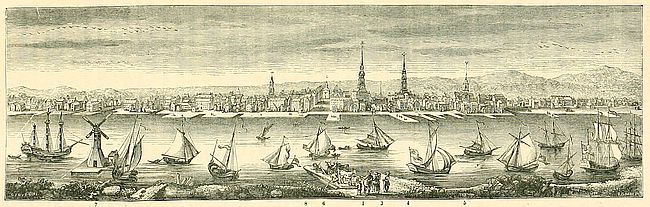
1. Christ Church.3. Academy.5. Dutch Calvinist Church.7. Corn Mill.
2. State House.4. Wesleyan Church.6. The Court House.8. Quaker Meeting House.
From a rare print, the drawing of which was made under the direction of Nicholas Scull, Surveyor-General of Pennsylvania.
The regiment passed the winter of 1758 in Pittsburgh, and in May following they joined part of the army under General Amherst in his proceedings at Ticonderoga, Crown Point, and the Lakes,—a detail of which has been given in the history of the service of the 42d regiment.
In consequence of the renewed cruelties committed by the Cherokees, in the spring of 1760, the commander-in-chief detached Colonel Montgomery with 700 Highlanders of his own regiment, 400 of the Royals, and a body of provincials, to chastise these savages. The colonel arrived in the neighbourhood of the Indian town Little Keowee in the middle of June, having, on his route, detached the light companies of Royals and Highlanders to destroy the place. This service was performed with the loss of a few men killed and two officers of the Royals wounded. Finding, on reaching Estatoe, that the enemy had fled, Colonel Montgomery retired to Fort Prince George. The Cherokees still proving refractory, he paid a second visit to the middle settlement, where he met with some resistance. He had 2 officers and 20 men killed, and 26 officers and 68 men wounded.[372] Of these, the Highlanders had 1 sergeant and 6 privates killed, and Captain Sutherland, Lieutenants Macmaster and Mackinnon, and Assistant-surgeon Monro, and 1 sergeant, 1 piper, and 24 rank and file wounded. The detachment took Fort Loudon,—a small fort on the confines of Virginia,—which was defended by 200 men.
The next service in which Montgomery’s Highlanders were employed was in an expedition against Dominique, consisting of a small land force, which included six companies of Montgomery’s Highlanders and four ships of war, under Colonel Lord Rollo and Commodore Sir James Douglas. The transports from New York were scattered in a gale of wind, when a small transport, with a company of the Highlanders on board, being attacked by a French privateer, was beaten off by the Highlanders, with the loss of Lieutenant Maclean and 6 men killed, and Captain Robertson and 11 men wounded. The expedition arrived off Dominique on the 6th of June 1761. The troops immediately landed, and marched with little opposition to the town of Roseau. Lord Rollo without delay attacked the entrenchments, and, though the enemy kept up a galling fire, they were driven, in succession, from all their works by the grenadiers, light infantry, and Highlanders. This service was executed with such vigour and rapidity that few of the British suffered. The governor and his staff being made prisoners, surrendered the island without further opposition.
In the following year Montgomery’s Highlanders joined the expeditions against Martinique and the Havannah, of which an account will be found in the narrative of the service of the 42d regiment. In the enterprise against Martinique, Lieutenant Hugh Gordon and 4 rank and file were killed, and Captain Alexander Mackenzie, 1 sergeant, and 26 rank and file, were wounded. Montgomery’s Highlanders suffered still less in the conquest of the Havannah, Lieutenant Macvicar and 2 privates only having been killed, and 6 privates wounded. Lieutenants Grant and Macnab and 6 privates died of the fever. After this last enterprise Montgomery’s Highlanders returned to New York, where they landed in the end of October.
Before the return of the six companies to New York, the two companies that had been sent against the Indians in the autumn of 1761, had embarked with a small force, under Colonel Amherst, destined to retake St John’s, Newfoundland, which was occupied by a French force. The British force, which consisted of the flank companies of the Royals, a detachment of the 45th, two companies of Fraser’s and Montgomery’s Highlanders, and a small party of provincials, landed on the 12th of September, seven miles to the northward of St John’s. A mortar battery having been completed on the 17th, and ready to open on the garrison, the French commander surrendered by capitulation to an inferior force. Of Montgomery’s Highlanders, Captain Mackenzie and 4 privates were killed, and 2 privates wounded.
After this service the two companies joined the regiment at New York, where they passed the ensuing winter. In the summer of 1763 a detachment accompanied the expedition sent to the relief of Fort Pitt under Colonel Bouquet, the details of which have been already given in the account of the 42d regiment. In this enterprise 1 drummer and 5 privates of Montgomery’s Highlanders were killed, and Lieutenant Donald Campbell, and Volunteer John Peebles, 3 sergeants, and 7 privates were wounded.
After the termination of hostilities an offer was made to the officers and men either to settle in America or return to their own country. Those who remained obtained a grant of land in proportion to their rank. On the breaking out of the American war a number of these, as well as officers and men of the 78th regiment, joined the royal standard in 1775, and formed a corps along with the Highland Emigrants in the 84th regiment.
FOOTNOTES:
FRASER’S HIGHLANDERS,
OR
OLD SEVENTY-EIGHTH AND SEVENTY-FIRST REGIMENTS.
I. 78th Regiment. 1757–1763.
Raising of the Regiment—Uniform—North America—Louisburg—Quebec—General Wolfe—Newfoundland—Reduction of the Regiment—Its descendants.
Following up the liberal policy which Lord Chatham had resolved to pursue in relation to the Highlanders, he prevailed upon George II. to appoint the Hon. Simon Fraser, son of the unfortunate Lord Lovat, and who had himself, when a youth, been forced into the rebellion by his father, Lieutenant-colonel commandant of a regiment to be raised among his own kinsmen and clan. Though not possessed of an inch of land, yet, such was the influence of clanship, that young Lovat in a few weeks raised a corps of 800 men, to whom were added upwards of 600 more by the gentlemen of the country and those who had obtained commission. The battalion was, in point of the number of companies and men, precisely the same as Montgomery’s Highlanders.
The following is a list of the officers whose commissions were dated the 5th January 1757:—
Lieutenant-Colonel Commandant.
The Hon. Simon Fraser, died a Lieutenant-general in 1782.
Majors.
James Clephane.
John Campbell of Dunoon, afterwards Lieutenant-colonel commandant of the Campbell Highlanders in Germany.
Captains.
John Macpherson, brother of Cluny.
John Campbell of Ballimore.
Simon Fraser of Inverallochy, killed on the heights of Abraham, 1759.
Donald Macdonald, brother to Clanranald, killed at Quebec in 1760.
John Macdonell of Lochgarry, afterwards colonel of the 76th, or Macdonald’s regiment, died in 1789 colonel.
Alexander Cameron of Dungallon.
Thomas Ross of Culrossie, killed on the heights of Abraham, 1759.
Thomas Fraser of Strui.
Alexander Fraser of Culduthel.
Sir Henry Seton of Abercorn and Culbeg.
James Fraser of Belladrum.
Captain-lieutenant—Simon Fraser, died Lieutenant-general in 1812.
Lieutenants.
Alexander Macleod.
Hugh Cameron.
Ronald Macdonell, son of Keppoch.
Charles Macdonell from Glengarry, killed at St John’s.
Roderick Macneil of Barra, killed on the heights of Abraham, 1759.
William Macdonell.
Archibald Campbell, son of Glenlyon.
John Fraser of Balnain.
Hector Macdonald, brother to Boisdale, killed 1759.
Allan Stewart, son of Innernaheil.
John Fraser.
Alexander Macdonald, son of Darisdale, killed on the heights of Abraham, 1759.
Alexander Fraser, killed at Louisburg.
Alexander Campbell of Aross.
John Douglas.
John Nairn.
Arthur Rose of the family of Kilravock.
Alexander Fraser.
John Macdonell of Leeks, died in Berwick, 1818.
Cosmo Gordon, killed at Quebec, 1760.
David Baillie, killed at Louisburg.
Charles Stewart, son of Colonel John Roy Stewart.
Ewen Cameron, of the family of Glennevis.
Allan Cameron.
John Cuthbert, killed at Louisburg.
Simon Fraser.
Archibald Macallister, of the family of Loup.
James Murray, killed at Louisburg.
Alexander Fraser.
Donald Cameron, son of Fassifern, died Lieutenant on half-pay, 1817.
Ensigns.
John Chisolm.
Simon Fraser.
Malcolm Fraser, afterwards captain 84th regiment.
Hugh Fraser, afterwards captain 84th or Highland Emigrants.
Robert Menzies.
John Fraser of Errogie.
James Mackenzie.
Donald Macneil.
Henry Munro.
Alexander Gregorson, Ardtornish.
James Henderson.
John Campbell.
Chaplain.—Robert Macpherson.
Adjutant.—Hugh Fraser.
Quarter-master.—John Fraser.
Surgeon.—John Maclean.
The uniform of the regiment “was the full Highland dress with musket and broadsword, to which many of the soldiers added the dirk at their own expense, and a purse of badger’s or otter’s skin. The bonnet was raised or cocked on one side, with a slight bend inclining down to the right ear, over which were suspended two or more black feathers. Eagle’s or hawk’s feathers were usually worn by the gentlemen, in the Highlands, while the bonnets of the common people were ornamented with a bunch of the distinguishing mark of the clan or district. The ostrich feather in the bonnets of the soldiers was a modern addition of that period, as the present load of plumage on the bonnet is a still more recent introduction, forming, however, in hot climates, an excellent defence against a vertical sun.”[373]
The regiment embarked in company with Montgomery’s Highlanders at Greenock, and landed at Halifax in June 1757. They were intended to be employed in an expedition against Louisburg, which, however, after the necessary preparations, was abandoned. About this time it was proposed to change the uniform of the regiment, as the Highland garb was judged unfit for the severe winters and the hot summers of North America; but the officers and soldiers having set themselves in opposition to the plan, and being warmly supported by Colonel Fraser, who represented to the commander-in-chief the bad consequences that might follow if it were persisted in, the plan was relinquished. “Thanks to our gracious chief,” said a veteran of the regiment, “we were allowed to wear the garb of our fathers, and, in the course of six winters, showed the doctors that they did not understand our constitution; for, in the coldest winters, our men were more healthy than those regiments who wore breeches and warm clothing.”
Amongst other enterprises projected for the campaign of 1758, the design of attacking Louisburg was renewed. Accordingly, on the 28th of May, a formidable armament sailed from Halifax, under the command of Admiral Boscawen and Major-general Amherst, and Brigadier-generals Wolfe, Laurence, Monckton, and Whitmore. This armament, consisting of 25 sail of the line, 18 frigates, and a number of bombs and fire-ships, with 13,000 troops including the 78th Highlanders, anchored, on the 2d of June, in Gabarus Bay, seven miles from Louisburg. In consequence of a heavy surf no boat could approach the shore, and it was not till the 8th of June that a landing could be effected. The garrison of Louisburg consisted of 2500 regulars 600 militia, and 400 Canadians and Indians. For more than seven miles along the beach a chain of posts had been established by the enemy, with entrenchments and batteries; and, to protect the harbour, there were six ships of the line and five frigates placed at its mouth, of which frigates three were sunk.
The disposition being made for landing, a detachment of several sloops, under convoy, passed the mouth of the harbour towards Lorembec, in order to draw the enemy’s attention that way, whilst the landing should really be on the other side of the town. On the 8th of June, the troops being assembled in the boats before day-break in three divisions, several sloops and frigates, that were stationed along shore in the bay of Gabarus, began to scour the beach with their shot. The division on the left, which was destined for the real attack, consisted of the grenadiers and light infantry of the army, and Fraser’s Highlanders, and was commanded by Brigadier-general Wolfe. After the fire from the sloops and frigates had continued about a quarter of an hour, the boats containing this division were rowed towards the shore; and, at the same time, the other two divisions on the right and in the centre, commanded by Brigadiers-general Whitmore and Laurence, made a show of landing, in order to divide and distract the enemy. The landing-place was occupied by 2000 men entrenched behind a battery of eight pieces of cannon and ten swivels. The enemy reserved their fire till the boats were near the beach, when they opened a discharge of cannon and musketry which did considerable execution. A considerable surf aided the enemy’s fire, and numbers of the men were drowned by the upsetting of the boats. Captain Baillie and Lieutenant Cuthbert of the Highlanders, Lieutenant Nicholson of Amherst’s, and 38 men were killed; but, notwithstanding these disadvantages, General Wolfe pursued his point with admirable courage and deliberation: “and nothing could stop our troops, when headed by such a general. Some of the light infantry and Highlanders got first ashore, and drove all before them. The rest followed; and, being encouraged by the example of their heroic commander, soon pursued the enemy to the distance of two miles, where they were checked by a cannonading from the town.”
The town of Louisburg was immediately invested; but the difficulty of landing stores and implements in boisterous weather, and the nature of the ground, which, being marshy, was unfit for the conveyance of heavy cannon, retarded the operations of the siege. The governor of Louisburg, having destroyed the grand battery which was detached from the body of the place, recalled his outposts, and prepared for a vigorous defence. He opened a fire against the besiegers and their work from the town, the island battery, and the ships in the harbour, but without much effect. Meanwhile General Wolfe, with a strong detachment, marched round the north-east part of the harbour to secure a point called the Light-house Battery, from which the guns could play on the ships and on the batteries on the opposite side of the harbour. This service was performed on the 12th by General Wolfe with great ability, who, “with his Highlanders and flankers,” took possession of this and all the other posts in that quarter with very trifling loss. On the 25th the inland battery immediately opposite was silenced from this post. The enemy however, kept up an incessant fire from their other batteries and the shipping in the harbour. On the 9th of July they made a sortie on Brigadier-general Lawrence’s brigade, but were quickly repulsed. In this affair Captain, the Earl of Dundonald, was killed. On the 16th General Wolfe pushed forward some grenadiers and Highlanders, and took possession of the hills in front of the Light Horse battery, where a lodgement was made under a fire from the town and the ships. On the 21st one of the enemy’s line-of-battle ships was set on fire by a bombshell and blew up, and the fire being communicated to two others, they were burned to the water’s edge. The fate of the town was now nearly decided, the enemy’s fire being almost totally silenced and their fortifications shattered to the ground. To reduce the place nothing now remained but to get possession of the harbour, by taking or burning the two ships of the line which remained. For this purpose, in the night between the 25th and 26th, the admiral sent a detachment of 600 men in the boats of the squadron, in two divisions, into the harbour, under the command of Captains Laforey and Balfour. This enterprise was gallantly executed, in the face of a terrible fire of cannon and musketry, the seamen boarding the enemy sword in hand. One of the ships was set on fire and destroyed, and the other towed off. The town surrendered on the 26th, and was taken possession of by Colonel Lord Rollo the following day; the garrison and seamen, amounting together to 5637 men, were made prisoners of war. Besides Captain Baillie and Lieutenant Cuthbert, the Highlanders lost Lieutenants Fraser and Murray, killed; Captain Donald M’Donald, Lieutenants Alexander Campbell (Barcaldine), and John M’Donald, wounded; and 67 rank and file killed and wounded.
In consequence of the treaty of peace between Great Britain and the several nations of Indians between the Apalachian mountains and the Lakes, the British government was enabled to carry into effect those operations which had been projected against the French settlements in Canada. The plan and partial progress of these combined operations have been already detailed in the service of the 42d regiment. The enterprise against Quebec, the most important by far of the three expeditions planned in 1759, falls now to be noticed from the share which Fraser’s Highlanders had in it.
According to the plan fixed upon for the conquest of Canada, Major-general Wolfe, who had given promise of great military talents at Louisburg, was to proceed up the river St Lawrence and attack Quebec, whilst General Amherst, after reducing Ticonderoga and Crown Point, was to descend the St Lawrence and co-operate with General Wolfe in the conquest of Quebec. Though the enterprise against this place was the main undertaking, the force under General Wolfe did not exceed 7000 effective men, whilst that under General Amherst amounted to more than twice that number; but the commander in-chief seems to have calculated upon a junction with General Wolfe in sufficient time for the siege of Quebec.
The forces under General Wolfe comprehended the following regiments,—15th, 28th, 35th, 43d, 47th, 48th, 58th, Fraser’s Highlanders, the Rangers, and the grenadiers of Louisburg. The fleet, under the command of Admirals Saunders and Holmes, with the transports, proceeded up the St Lawrence, and reached the island of Orleans, a little below Quebec, in the end of June, where the troops were disembarked without opposition. The Marquis de Montcalm who commanded the French troops, which were greatly superior in number to the invaders, resolved rather to depend upon the natural strength of his position than his numbers, and took his measures accordingly. The city of Quebec was tolerably well fortified, defended by a numerous garrison, and abundantly supplied with provisions and ammunition. This able, and hitherto fortunate leader had reinforced the troops of the colony with five regular battalions, formed of the best of the inhabitants, and he had, besides, completely disciplined all the Canadians of the neighbourhood capable of bearing arms, and several tribes of Indians. He had posted his army on a piece of ground along the shore of Beaufort, from the river St Charles to the falls of Montmorency,—a position rendered strong by precipices, woods, and rivers, and defended by intrenchments where the ground appeared the weakest. To undertake the siege of Quebec under the disadvantages which presented themselves, seemed a rash enterprise; but, although General Wolfe was completely aware of these difficulties, a thirst for glory, and the workings of a vigorous mind, which set every obstacle at defiance, impelled him to make the hazardous attempt. His maxim was, that “a brave and victorious army finds no difficulties;”[374] and he was anxious to verify the truth of the adage in the present instance.
Having ascertained that, to reduce the place, it was necessary to erect batteries on the north of the St Lawrence, the British general endeavoured, by a series of manœuvres, to draw Montcalm from his position; but the French commander was too prudent to risk a battle. With the view of attacking the enemy’s intrenchments, General Wolfe sent a small armament up the river above the city, and, having personally surveyed the banks on the side of the enemy from one of the ships, he resolved to cross the river Montmorency and make the attack. He therefore ordered six companies of grenadiers and part of the Royal Americans to cross the river and land near the mouth of the Montmorency, and at the same time directed the two brigades commanded by Generals Murray and Townshend to pass a ford higher up. Close to the water’s edge there was a detached redoubt, which the grenadiers were ordered to attack, in the expectation that the enemy would descend from the hill in its defence, and thus bring on a general engagement. At all events the possession of this post was of importance, as from it the British commander could obtain a better view of the enemy’s intrenchments than he had yet been able to accomplish. The grenadiers and Royal Americans were the first who landed. They had received orders to form in four distinct bodies, but not to begin the attack till the first brigade should have passed the ford, and be near enough to support them. No attention, however, was paid to these instructions. Before even the first brigade had crossed, the grenadiers, ere they were regularly formed, rushed forward with impetuosity and considerable confusion to attack the enemy’s intrenchments. They were received with a well-directed fire, which effectually checked them and threw them into disorder. They endeavoured to form under the redoubt, but being unable to rally, they retreated and formed behind the first brigade, which had by this time landed, and was drawn up on the beach in good order. The plan of attack being thus totally disconcerted, General Wolfe repassed the river and returned to the isle of Orleans. In this unfortunate attempt the British lost 543 of all ranks killed, wounded, and missing. Of the Highlanders, up to the 2d of September, the loss was 18 rank and file killed, Colonel Fraser, Captains Macpherson and Simon Fraser, and Lieutenants Cameron of Gleneves, Ewen Macdonald, and H. Macdonald, and 85 rank and file, wounded. In the general orders which were issued the following morning, General Wolfe complained bitterly of the conduct of the grenadiers: “The check which the grenadiers met with yesterday will, it is hoped, be a lesson to them for the time to come. Such impetuous, irregular, and unsoldier-like proceedings, destroy all order, make it impossible for the commanders to form any disposition for attack, and put it out of the general’s power to execute his plan. The grenadiers could not suppose that they alone could beat the French army; and therefore it was necessary that the corps under brigadiers Monckton and Townshend should have time to join, that the attack might be general. The very first fire of the enemy was sufficient to repulse men who had lost all sense of order and military discipline. Amherst’s (15th regiment) and the Highlanders alone, by the soldier-like and cool manner they were formed in, would undoubtedly have beaten back the whole Canadian army if they had ventured to attack them.”
General Wolfe now changed his plan of operations. Leaving his position at Montmorency, he re-embarked his troops and artillery, and landed at Point Levi, whence he passed up the river in transports; but finding no opportunity of annoying the enemy above the town, he resolved to convey his troops farther down, in boats, and land them by night within a league of Cape Diamond, with the view of ascending the heights of Abraham,—which rise abruptly, with steep ascent, from the banks of the river,—and thus gain possession of the ground on the back of the city, where the fortifications were less strong. A plan more replete with dangers and difficulties could scarcely have been devised; but, from the advanced period of the season, it was necessary either to abandon the enterprise altogether, or to make an attempt upon the city, whatever might be the result. The troops, notwithstanding the recent disaster, were in high spirits, and ready to follow their general wherever he might lead them. The commander, on the other hand, though afflicted with a severe dysentery and fever, which had debilitated his frame, resolved to avail himself of the readiness of his men, and to conduct the hazardous enterprise in which they were about to engage in person. In order to deceive the enemy, Admiral Holmes was directed to move farther up the river on the 12th of September, but to sail down in the night time, so as to protect the landing of the forces. These orders were punctually obeyed. About an hour after midnight of the same day four regiments, the light infantry, with the Highlanders and grenadiers, were embarked in flat-bottomed boats, under the command of Brigadiers Monckton and Murray. They were accompanied by General Wolfe, who was among the first that landed. The boats fell down with the tide, keeping close to the north shore in the best order; but, owing to the rapidity of the current, and the darkness of the night, most of the boats landed a little below the intended place of disembarkation.[375] When the troops were landed the boats were sent back for the other division, which was under the command of Brigadier-general Townshend. The ascent to the heights was by a narrow path, that slanted up the precipice from the landing-place; this path the enemy had broken up, and rendered almost impassable, by cross ditches, and they had made an intrenchment at the top of the hill. Notwithstanding these difficulties, Colonel Howe, who was the first to land, ascended the woody precipices, with the light infantry and the Highlanders, and dislodged a captain’s guard which defended the narrow path. They then mounted without further molestation, and General Wolfe, who was among the first to gain the summit of the hill, formed the troops on the heights as they arrived. In the ascent the precipice was found to be so steep and dangerous, that the troops were obliged to climb the rugged projections of the rocks, pulling themselves up by aid of the branches of the trees and shrubs growing on both sides of the path. Though much time was thus necessarily occupied in the ascent, yet such was the perseverance of the troops, that they all gained the summit in time to enable the general to form in order of battle before daybreak. M. de Montcalm had now no means left of saving Quebec but by risking a battle, and he therefore determined to leave his stronghold and meet the British in the open field. Leaving his camp at Montmorency, he crossed the river St Charles, and, forming his line with great skill, advanced forward to attack his opponents. His right was composed of half the provincial troops, two battalions of regulars, and a body of Canadians and Indians; his centre, of a column of two battalions of Europeans, with two field-pieces; and his left of one battalion of regulars, and the remainder of the colonial troops. In his front, among brushwood and corn-fields, 1500 of his best marksmen were posted to gall the British as they approached. The British were drawn up in two lines: the first, consisting of the grenadiers, 15th, 28th, 35th Highlanders, and 58th; the 47th regiment formed the second line, or reserve. The Canadians and the Indians, who were posted among the brushwood, kept up an irregular galling fire, which proved fatal to many officers, who, from their dress, were singled out by these marksmen. The fire of this body was, in some measure, checked by the advanced posts of the British, who returned the fire; and a small gun, which was dragged up by the seamen from the landing-place, was brought forward, and did considerable execution. The French now advanced to the charge with great spirit, firing as they advanced; but, in consequence of orders they received, the British troops reserved their fire till the main body of the enemy had approached within forty yards of their line. When the enemy had come within that distance, the whole British line poured in a general and destructive discharge of musketry. Another discharge followed, which had such an effect upon the enemy, that they stopped short, and after making an ineffectual attempt upon the left of the British line, they began to give way. At this time General Wolfe, who had already received two wounds which he had concealed, was mortally wounded whilst advancing at the head of the grenadiers with fixed bayonets. At this instant every separate corps of the British army exerted itself, as if the contest were for its own peculiar honour. Whilst the right pressed on with their bayonets, Brigadier-general Murray briskly advanced with the troops under his command, and soon broke the centre of the enemy, “when the Highlanders, taking to their broadswords, fell in among them with irresistible impetuosity, and drove them back with great slaughter.”[376] The action on the left of the British was not so warm. A smart contest, however, took place between part of the enemy’s right and some light infantry, who had thrown themselves into houses, which they defended with great courage. During this attack, Colonel Howe, who had taken post with two companies behind a copse, frequently sallied out on the flanks of the enemy, whilst General Townshend advanced in platoons against their front. Observing the left and centre of the French giving way, this officer, on whom the command had just devolved in consequence of General Monckton, the second in command, having been dangerously wounded, hastened to the centre, and finding that the troops had got into disorder in the pursuit, formed them again in line. At this moment, Monsieur de Bougainville, who had marched from Cape Rouge as soon as he heard that the British troops had gained the heights, appeared in their rear at the head of 2000 fresh men. General Townshend immediately ordered two regiments, with two pieces of artillery, to advance against this body; but Bougainville retired on their approach. The wreck of the French army retreated to Quebec and Point Levi.
The loss sustained by the enemy was considerable. About 1000 were made prisoners, including a number of officers, and about 500 died on the field of battle. The death of their brave commander, Montcalm, who was mortally wounded almost at the same instant with General Wolfe, was a serious calamity to the French arms. When informed that his wound was mortal,—“So much the better,” said he, “I shall not live to see the surrender of Quebec.” Before his death he wrote a letter to General Townshend, recommending the prisoners to the generous humanity of the British. The death of the two commanders-in-chief, and the disasters which befell Generals Monckton and Severergues, the two seconds in command, who were carried wounded from the field, are remarkable circumstances in the events of this day. This important victory was not gained without considerable loss on the part of the British, who, besides the commander-in-chief, had 8 officers and 48 men killed; and 43 officers and 435 men wounded. Of these, the Highlanders had Captain Thomas Boss of Culrossie, Lieutenant Roderick Macneil of Barra, Alexander Macdonell, son of Barrisdale, 1 sergeant and 14 rank and file killed; and Captains John Macdonell of Lochgarry, Simon Fraser of Inverallochy; Lieutenants Macdonell, son of Keppoch, Archibald Campbell, Alexander Campbell, son of Barcaldine, John Douglas, Alexander Fraser, senior; and Ensigns James Mackenzie, Malcolm Fraser, and Alexander Gregorson; 7 sergeants and 131 rank and file, wounded. The death of General Wolfe was a national loss. When the fatal ball pierced the breast of the young hero, he found himself unable to stand, and leaned upon the shoulder of a lieutenant who sat down on the ground. This officer, observing the French give way, exclaimed,—“They run! they run!” “Who run?” inquired the gallant Wolfe with great earnestness. When told that it was the French who were flying: “What,” said he, “do the cowards run already? Then I die happy!” and instantly expired.[377]
On the 18th of September the town surrendered, and a great part of the surrounding country being reduced, General Townshend embarked for England, leaving a garrison of 5000 effective men in Quebec, under the Hon. General James Murray. Apprehensive of a visit from a considerable French army stationed in Montreal and the neighbouring country, General Murray repaired the fortifications, and put the town in a proper posture of defence; but his troops suffered so much from the rigours of winter, and the want of vegetables and fresh provisions, that, before the end of April, 1760, the garrison was reduced, by death and disease, to about 3000 effective men. Such was the situation of affairs when the general received intelligence that General de Levi, who succeeded the Marquis de Montcalm, had reached Point au Tremble with a force of 10,000 French and Canadians, and 500 Indians. It was the intention of the French commander to cut off the posts which the British had established; but General Murray defeated this scheme, by ordering the bridges over the river Rouge to be broken down, and the landing-places at Sylleri and Foulon to be secured. Next day, the 27th of April, he marched in person with a strong detachment and two field-pieces, and took possession of an advantageous position, which he retained till the afternoon, when the outposts were withdrawn, after which he returned to Quebec with very little loss, although the enemy pressed closely on his rear.
General Murray was now reduced to the necessity of withstanding a siege, or risking a battle. He chose the latter alternative, a resolution which was deemed by some military men as savouring more of youthful impatience and overstrained courage, than of judgment; but the dangers with which he was beset, in the midst of a hostile population, and the difficulties incident to a protracted siege, seem to afford some justification for that step. In pursuance of his resolution, the general marched out on the 28th of April, at half-past six o’clock in the morning, and formed his little army on the heights of Abraham. The right wing, commanded by Colonel Burton, consisted of the 15th, 48th, 58th, and second battalion of the 60th, or Royal Americans: the left under Colonel Simon Fraser, was formed of the 43d, 23d Welsh fusiliers, and the Highlanders. The 35th, and the third battalion of the 60th, constituted the reserve. The right was covered by Major Dalling’s corps of light infantry; and the left by Captain Huzzen’s company of rangers, and 100 volunteers, under the command of Captain Macdonald of Fraser’s regiment. Observing the enemy in full march in one column, General Murray advanced quickly forward to meet them before they should form their line. His light infantry coming in contact with Levi’s advance, drove them back on their main body; but pursuing too far, they were furiously attacked and repulsed in their turn. They fell back in such disorder on the line, as to impede their fire, and in passing round by the right flank to the rear, they suffered much from the fire of a party who were endeavouring to turn that flank. The enemy having made two desperate attempts to penetrate the right wing, the 35th regiment was called up from the reserve, to its support. Meanwhile the British left was struggling with the enemy, who succeeded so far, from their superior numbers, in their attempt to turn that flank, that they obtained possession of two redoubts, but were driven out from both by the Highlanders, sword in hand. By pushing forward fresh numbers, however, the enemy at last succeeded in forcing the left wing to retire, the right giving way about the same time. The French did not attempt to pursue, but allowed the British to retire quietly within the walls of the city, and to carry away their wounded. The British had 6 officers, and 251 rank and file killed; and 82 officers, and 679 non-commissioned officers and privates, wounded. Among the killed, the Highlanders had Captain Donald Macdonald,[378] Lieutenant Cosmo Gordon and 55 non-commissioned officers, pipers, and privates; their wounded were Colonel Fraser, Captains John Campbell of Dunoon, Alexander Fraser, Alexander Macleod, Charles Macdonell; Lieutenants Archibald Campbell, son of Glenlyon, Charles Stewart,[379] Hector Macdonald, John Macbean, Alexander Fraser, senior, Alexander Campbell, John Nairn, Arthur Rose, Alexander Fraser, junior, Simon Fraser, senior, Archibald M’Alister, Alexander Fraser, John Chisholm, Simon Fraser, junior, Malcolm Fraser, and Donald M’Neil; Ensigns Henry Monro, Robert Menzies, Duncan Cameron (Fassifern), William Robertson, Alexander Gregorson, and Malcolm Fraser,[380] and 129 non-commissioned officers and privates. The enemy lost twice the number of men.
Shortly after the British had retired, General Levi moved forward on Quebec, and having taken up a position close to it, opened a fire at five o’clock. He then proceeded to besiege the city in form, and General Murray made the necessary dispositions to defend the place. The siege was continued till the 10th of May, when it was suddenly raised; the enemy retreating with great precipitation, leaving all their artillery implements and stores behind. This unexpected event was occasioned by the destruction or capture of all the enemy’s ships above Quebec, by an English squadron which had arrived in the river, and the advance of General Amherst on Montreal. General Murray left Quebec in pursuit of the enemy, but was unable to overtake them. The junction of General Murray with General Amherst, in the neighbourhood of Montreal, in the month of September, and the surrender of that last stronghold of the French in Canada, have been already mentioned in the history of the service of the 42d regiment.
Fraser’s Highlanders were not called again into active service till the summer of 1762, when they were, on the expedition under Colonel William Amherst, sent to retake St John’s, Newfoundland, a detailed account of which has been given in the notice of Montgomery’s Highlanders. In this service Captain Macdonell of Fraser’s regiment, was mortally wounded, 3 rank and file killed, and 7 wounded.
At the conclusion of the war, a number of the officers and men having expressed a desire to settle in North America, had their wishes granted, and an allowance of land given them. The rest returned to Scotland, and were discharged. When the war of the American revolution broke out, upwards of 300 of those men who had remained in the country, enlisted in the 84th regiment, in 1775, and formed part of two fine battalions embodied under the name of the Royal Highland Emigrants.
Many of the hundreds of Frasers who now form so important a part of the population of Canada claim descent from these Fraser Highlanders who settled in America. Full details concerning the Canadian branch of the great clan Fraser have already been given at the conclusion of our history of that clan.
The loss of this regiment during four years’ active service was—
KILLED.
In officers,14
Non-commissioned officers and privates,109
——
Total,123
WOUNDED.
In officers,46
Non-commissioned officers and privates,400
——
Total,446
——
Grand Total,569
II. Old Seventy-First Regiment. 1775–1783.
Raising of the Regiment—American Revolutionary War—Honourable place assigned to the regiment—Brooklyn—Various expeditions—Savannah—Boston Creek—Defence of Savannah—Stony Point and Verplanks—Cambden—Catawba River—South Carolina—Guilford Court-house—York River—Reduction of Regiment.
The American revolutionary war requiring extraordinary exertions on the part of the Government, it was resolved in 1775 to revive Fraser’s Highlanders, by raising two battalions, under the auspices of Colonel Fraser, who, for his services, had been rewarded by King George III. with a grant of the family estates of Lovat, which had been forfeited in 1746. In his exertions to raise the battalions, Colonel Fraser was warmly assisted by his officers, of whom no less than six, besides himself, were chiefs of clans, and within a few months after the letters of service were issued, two battalions of 2340 Highlanders were raised, and assembled first at Stirling, and afterwards at Glasgow, in April 1776. The following were the names of the officers:—
FIRST BATTALION.
Colonel.—The Honourable Simon Fraser of Lovat, died in 1782, a lieutenant-general.
Lieutenant-Colonel.—Sir William Erskine of Torry, died in 1795, a lieutenant-general.
Majors.
John Macdonell of Lochgarry, died in 1789, colonel.
Duncan Macpherson of Cluny, retired from the foot-guards in 1791, died in 1820.
Captains.
Simon Fraser, died lieutenant-general in 1812.
Duncan Chisholm of Chisholm.
Colin Mackenzie, died general in 1818.
Francis Skelly, died in India, lieutenant-colonel of the 94th regiment.
Hamilton Maxwell, brother of Monreith, died in India lieutenant-colonel of the 74th regiment, 1794.
John Campbell, son of Lord Stonefield, died lieutenant-colonel of the 2d battalion of 42d regiment at Madras, 1784.
Norman Macleod of Macleod, died lieutenant-general, 1796.
Sir James Baird of Saughtonhall.
Charles Cameron of Lochiel, died 1776.
Lieutenants.
Charles Campbell, son of Ardchattan, killed at Catauba.
John Macdougall.
Colin Mackenzie.
John Nairne, son of Lord Nairne.
William Nairne, afterwards Lord Nairne.
Charles Gordon.
David Kinloch.
Thomas Tause, killed at Savannah.
William Sinclair.
Hugh Fraser.
Alexander Fraser.
Thomas Fraser, son of Leadclune.
Dougald Campbell, son of Craignish.
Robert Macdonald, son of Sanda.
Alexander Fraser.
Roderick Macleod.
John Ross.
Patrick Cumming.
Thomas Hamilton.
Ensigns.
Archibald Campbell.
Henry Macpherson.
John Grant.
Robert Campbell, son of Ederline.
Allan Malcolm.
John Murchison.
Angus Macdonell.
Peter Fraser.
Chaplain.—Hugh Blair, D.D., Professor of Rhetoric in the University of Edinburgh.
Adjutant.—Donald Cameron.
Quarter-master.—David Campbell.
Surgeon.—William Fraser.
SECOND BATTALION.
Colonel.—Simon Fraser.
Lieutenant-Colonel.
Archibald Campbell, died lieutenant-general, 1792.
Majors.
Norman Lamont, son of the Laird of Lamont.
Robert Menzies, killed in Boston harbour, 1776.
Captains.
Angus Mackintosh of Kellachy, formerly Captain in Keith’s Highlanders, died in South Carolina, 1780.
Patrick Campbell, son of Glenure.
Andrew Lawrie.
Æneas Mackintosh of Mackintosh.
Charles Cameron, son of Fassifern, killed at Savannah, 1779.
George Munro, son of Culcairn.
Boyd Porterfield.
Law Robert Campbell.
Lieutenants.
Robert Hutchison.
Alexander Sutherland.
Archibald Campbell.
Hugh Lamont.
Robert Duncanson.
George Stewart.
Charles Barrington Mackenzie.
James Christie.
James Fraser.
Dougald Campbell, son of Achnaba.
Lodovick Colquhoun, son of Luss.
John Mackenzie.
Hugh Campbell, son of Glenure.
John Campbell.
Arthur Forbes.
Patrick Campbell.
Archibald Maclean.
David Ross.
Thomas Fraser.
Archibald Balnevis, son of Edradour.
Robert Grant.
Thomas Fraser.
Ensigns.
William Gordon.
Charles Main.
Archibald Campbell.
Donald Cameron.
Smollett Campbell, son of Craignish.
Gilbert Waugh.
William Bain.
John Grant.
Chaplain.—Malcolm Nicholson.
Adjutant.—Archibald Campbell.
Quarter-master.—J. Ogilvie.
Surgeon.—Colin Chisholm, afterwards physician in Bristol.
At the time when the regiment was mustered in Glasgow, there were nearly 6000 Highlanders in that city, of whom 3000 belonging to the 42d and 71st regiments were raised and brought from the North in ten weeks. A finer and a more healthy and robust body of men could not have been anywhere selected; and their conduct was so laudable and exemplary as to gain the affections of the inhabitants, between whom and the soldiers the greatest cordiality prevailed. So great was the desire of the Highlanders to enlist into this new regiment, that before leaving Glasgow for embarkation, it was found that more men had arrived than were required, and it became necessary, therefore, to leave some of them behind; but unwilling to remain, several of these stole on board the transports, and were not discovered till the fleet was at sea. There were others, however, who did not evince the same ardour to accompany their countrymen. A body of 120 men had been raised on the forfeited estate of Captain Cameron of Lochiel, by the ancient tenants, with the view of securing him a company. Lochiel was at the time in London, and being indisposed, was unable to join the regiment. His men were exceedingly disappointed at not meeting their chief and captain at Glasgow, and when they received orders to embark, they hesitated, as they believed that some misfortune had befallen him; but General Fraser, with a persuasive eloquence, in which he was well skilled, removed their scruples; and as Captain Cameron of Fassifern, a friend and near relation of Lochiel, was appointed to the company, they cheerfully consented to embark.[381] When Lochiel heard of the conduct of his men he hastened to Glasgow, though he had not recovered from the severe illness which had detained him in London; but the fatigue of the journey brought on a return of his complaint, to which he fell a victim in a few weeks. His death was greatly lamented, as he was universally respected.
Some time after the sailing of the fleet, it was scattered in a violent gale, and several of the ships were attacked singly by American privateers. One of these, with eight guns, attacked a transport with two six pounders only, having Captain (afterwards Sir Æneas) Macintosh and his company on board. Having spent all their ammunition, the transport bore down upon the privateer to board her; but the latter sheered off, and the transport proceeded on her voyage.
Another transport, having Colonel Archibald Campbell and Major Menzies on board, was not so fortunate. Ignorant of the evacuation of Boston by General Howe, they sailed into Boston harbour, and were instantly attacked by three privateers full of men. The transport beat off her antagonists, but expended all her ammunition, and getting her rudder disabled by a shot, she grounded under a battery, and was forced to surrender. Major Menzies and seven men were killed, and Colonel Campbell and the rest were made prisoners. The death of Major Menzies was a great loss, as from his great military experience he was particularly well qualified to discipline the corps which had not yet undergone the process of drilling.
The regiment joined the army under General Howe in Staten island, and though totally undisciplined, the 71st was immediately put in front, the general judging well from the experience he had had of Fraser’s Highlanders in the seven years’ war, that their bravery, if engaged before being disciplined, would make up for their want of discipline. The regiment was divided, the grenadiers being placed in the battalion under the Hon. Lieutenant-Colonel Charles Stewart, and the other companies, which were formed into three small battalions, formed a brigade under Sir William Erskine.
The first affair in which they were engaged was the battle of Brooklyn, referred to in the notice of the 42d. In this action they fully justified the expectations of the commander. They displayed, in common with the other troops, great eagerness to push the enemy to extremities, and compel them to abandon the strong position they had taken up; but from a desire to save the lives of his troops, General Howe restrained their ardour by recalling the right wing, in which the grenadiers were, from the attack. The loss sustained on this occasion by the 71st was 3 rank and file killed, and 2 sergeants and 9 rank and file wounded.
The regiment passed the winter at Amboy. The next campaign was spent in skirmishes, in some of which the regiment was engaged. They were also employed in the expeditions against Willsborough and Westfield, at the commencement of the campaign of 1777. They afterwards embarked for the Chesapeake, and part of them were engaged in the battle of Brandywine. They embarked for New York in November, where they received an accession of 200 recruits from Scotland. Along with 100 more from the hospital, they were formed into a corps under Captain Colin (afterwards General) Mackenzie. This small corps acted as light infantry, and formed part of an expedition sent up the New River to make a diversion in favour of General Burgoyne’s movements. This corps led a successful assault on Fort Montgomery on the 6th of October, in which they displayed great courage. In the year 1778 the 71st regiment was employed in the Jerseys, under Lord Cornwallis, in which excursion on occasion occurred for distinguishing themselves.
On the 29th of November 1777, an expedition, of which the 71st formed a part, destined against Savannah, the capital of Georgia, sailed from Sandy Hook, and reached the river of that name about the end of December, under Lieutenant-Colonel Archibald Campbell, who had been exchanged this year. The 1st battalion and the light infantry, having landed a little below the town, Captain Cameron, an “officer of high spirit and great promise,” instantly pushed forward to attack the advanced post of the enemy, when he and three men were killed by a volley. The remainder advancing, charged the enemy and drove them back on the main body drawn up in line in an open plain behind the town. As soon as the disembarkation was finished, Colonel Campbell formed his army in line, and whilst he detached Sir James Baird with the light infantry, to get round the right flank of the enemy by a narrow path, he sent the corps, lately Captain Cameron’s, to get round the left. The attention of the enemy being occupied by the army in front, they neglected to watch the motions of the flanking parties, who, on reaching their ground, made signals to the front to advance. These being instantly answered, the enemy now perceived they were nearly surrounded, and turning their backs fled in great disorder. They suffered severely from the light infantry, who closed in upon their flanks; they had 100 men killed, and 500 wounded or taken prisoners. The British had only 4 soldiers killed and 5 wounded. The town then surrendered, and the British took possession of all the shipping and stores and 45 pieces of cannon.
Colonel Campbell now advanced into the interior, and entered Augusta, a town 150 miles distant from Savannah, where he established himself. Meanwhile General Prevost, having arrived at Savannah from Florida, assumed the command. Judging the ground occupied too extensive, he evacuated Augusta. The Americans, taking courage from this retrograde movement, assembled in considerable numbers, and harassed the rear of the British. The Loyalists in the interior were greatly dispirited, and, being left unprotected, suffered much from the disaffected. The winter was spent in making some inroads into the interior, to keep the Americans in check. About this time Lieutenant-Colonel Maitland succeeded to the command of the regiment, in consequence of the return of Colonel Campbell to England, on leave of absence.
The regiment remained almost inactive till the month of February 1779, when it was employed in an enterprise against Boston Creek, a strong position defended by upwards of 2000 men, besides 1000 occupied in detached stations. The front of this position was protected by a deep swamp, and the only approach in that way was by a narrow causeway; on each flank were thick woods nearly impenetrable, except by the drier parts of the swamps which intersected them; but the position was more open in the rear. To dislodge the enemy from this stronghold, which caused considerable annoyance, Lieutenant-Colonel Duncan Macpherson,[382] with the first battalion of the 71st, was directed to march upon the front of the position; whilst Colonel Prevost, and Lieutenant-Colonels Maitland and Macdonald, with the 2d battalion, the light infantry, and a party of provincials, were ordered to attempt the rear by a circuitous route of many miles. These combined movements were executed with such precision, that, in ten minutes after Colonel Macpherson appeared at the head of the causeway in front, the fire of the body in the rear was heard. Sir James Baird, with the light infantry, rushing through the openings in the swamps on the left flank, the enemy were overpowered after a short resistance. In this affair the Highlanders had 3 soldiers killed, and 1 officer and 12 rank and file wounded.
General Prevost next determined to dislodge a considerable force under General Lincoln, stationed on the South Carolina side of the river. With the troops lately so successful at Brien’s Creek, he crossed the river ten miles below the enemy’s position. Whilst the general advanced on their front, he ordered the 71st to attack their rear by a circuitous march of several miles. Guided by a party of Creek Indians, the Highlanders entered a woody swamp at eleven o’clock at night, in traversing which they were frequently up to the shoulders in the swamp. They cleared the woods at eight o’clock in the morning, with their ammunition destroyed. They were now within half a mile of the enemy’s rear, and although General Prevost had not yet moved from his position, the Highlanders instantly attacked and drove the enemy from their position without sustaining any loss.
Emboldened by this partial success, the general made an attempt upon Charleston; but after summoning the town to surrender, he was induced, by the approach of the American general, Lincoln, with a large force, to desist, and determined to return to his former quarters in Georgia. As the Americans were in arms, and had possessed themselves of the principal pass on the route, he was forced to return by the sea-coast, a course very injurious to the troops, as they had to march through unfrequented woods, and salt water marshes and swamps, where they could not obtain fresh water. In this retreat, the British force was separated in consequence of Lieutenant-Colonel Prevost, the Quarter-master-general, who had gone with a party on a foraging excursion, having removed part of a bridge of boats leading to John’s Island. The enemy, who had 5000 men in the neighbourhood, endeavoured to avail themselves of this circumstance, and pushed forward 2000 men with some artillery, to attack a battalion of the Highlanders and some Hessians under Colonel Maitland, who were placed in a redoubt at Stone Ferry, for the purpose of protecting the foraging party. Hearing of the advance of the enemy, Colonel Maitland sent out Captain Colin Campbell,[383] with 4 officers and 56 men, to reconnoitre. Whilst this small party was standing on an open field, the enemy emerged from a thick wood. Regardless of the inequality of numbers, Captain Campbell attacked the enemy with great vivacity; and a desperate contest took place, in which all the Highlanders and officers, except 7 of the soldiers, fell. When Captain Campbell was struck, he desired such of his men as were able to retire to the redoubt; but they refused to obey, as they considered that if they left their officers behind in the field, they would bring a lasting disgrace on themselves. The enemy, unexpectedly, ceased firing, and the 7 men, availing themselves of the respite, retired, carrying their wounded officers along with them, followed by such of the soldiers as were able to walk. The enemy then advanced on the redoubt, and the Hessians having got into confusion, they forced an entrance; but they were driven out by the Highlanders, at the point of the bayonet. The enemy were preparing for another attack, but the second battalion of the Highlanders having come up, the Americans retired with considerable loss.
After this affair, General Prevost retired with the main body towards Savannah, leaving behind him 700 men under Colonel Maitland, who took up a position in the island of Port Royal. In the month of September 1779, the Count D’Estaing arrived on the coast of Georgia with a large fleet, with troops on board, for the purpose of retaking Savannah, then garrisoned by 1100 effective men, including one battalion of the 71st. The town, situated on a sandy plain, gently declining towards the south, had few natural or artificial means of defence, and as the force about to attack it was said to exceed 12,000 men, the British general had nothing to rely upon but the energy and firmness of his troops. The Count, on landing, made regular approaches, and summoned the town to surrender. In the absence of Colonel Maitland’s detachment in Port Royal, time was of importance, and being demanded, was granted. Colonel Maitland, on hearing of the arrival of the enemy, instantly set out for Savannah; but finding the principal passes and fords in possession of the enemy, he made a wide circuit; and after a most tedious march through marshes and woods hitherto considered impassable, he reached Savannah before General Prevost had returned a definitive answer to D’Estaing’s summons.
Having thus accomplished his object, General Prevost made immediate preparations to defend the place to the last extremity, and being seconded by the zeal and abilities of Captain Moncrieff, the chief engineer, and the exertions of the officers and soldiers, assisted by the Negro population, the town was put in a good state of defence before the enemy had completed their approaches. During these operations, several sorties were made by the garrison. On the morning of the 24th of September, Major Colin Graham sallied out with the light company of the 16th and the Highlanders, and drove the enemy from their outworks, with the loss of 14 officers, and 145 men killed, wounded, and prisoners. In this affair, Lieutenant Henry Macpherson of the 71st and 3 privates were killed, and 15 wounded. In another sortie, Major Macarthur with the piquets of the Highlanders advanced with such caution, that, after a few rounds, the Americans and French, mistaking their object, fired on each other, and killed 50 men, during which encounter he retired without loss.
Having completed his arrangements, D’Estaing made an assault, on the 9th of October, before day-break, with all his forces. Owing to a thick fog, and the darkness of the morning, it was some time before the besieged could ascertain in what direction the principal attack was to be made. As soon as daylight appeared, the French and American forces were seen advancing in three columns, D’Estaing leading the right in person. By taking too large a circuit, the left column got entangled in a swamp, and being exposed to the guns of the garrison, fell into confusion, and was unable to advance. The heads of the right and centre columns suffered greatly, from a well-directed fire from the batteries; but they still persevered in advancing; the men in the rear supplying the place of those who fell in front. When the enemy reached the first redoubt, the contest became furious; many of them entered the ditch, and some of them even ascended and planted the colours on the parapet, where they were killed. The first man who mounted was stabbed by Captain Tawse of the 71st, who commanded the redoubt, and the Captain himself was shot dead by the man who followed. The grenadiers of the 60th came up to the support of Captain Archibald Campbell, who had assumed the command of the redoubt, and the enemy’s column, being attacked on both sides, was broken and driven back with precipitation.
In this enterprise the enemy are supposed to have lost 1500 men killed, wounded, and prisoners. The British had only 3 officers and 36 soldiers killed, and 2 officers and 60 men wounded. The Americans retired to South Carolina, and the French to their ships. The garrison before the siege was sickly, but during active operations, the disease was in a manner suspended, an affect which has been often observed in the army. After the cause of excitement was over, by the raising of the siege, the men relapsed, and one-fourth of them were sent to the hospital.[384]
The grenadiers of the 71st were not employed in Georgia, but were posted at Stony Point and Verplanks, in the state of New York, which places had been recently taken from the enemy. Wishing to make amends for allowing his post to be surprised by Major-General Sir Charles Grey, the American general, Wayne, was sent to retake the posts of Stony Point and Verplanks. Accordingly, with a body of troops, he proceeded at eight o’clock in the evening of the 15th of July 1779, and taking post in a hollow within two miles of the fort, advanced unperceived, about midnight, in two columns. One of these gained the summit, on which the fort stood, without being observed, and the garrison being surprised, surrendered after a short resistance, with the loss of 17 soldiers killed, and 3 officers and 72 privates wounded. The piquet, which was commanded by Lieutenant Cumming of the 71st, resisted one of the columns till almost all the men composing it were killed or wounded. Lieutenant Cumming was among the latter.