Volume 2 / Part 2 — CHAPTER II.
Reading edition
CHAPTER II.
The Gallgael, or Western Clans—Fiongall and Dubhgall—Lords of the Isles—Somerled—Suibne—Gillebride Mac Gille Adomnan—Somerled in the West—Defeat and death—His children—Dugall and his descendants—Ranald’s three sons, Ruari, Donald, Dugall—Roderick—Ranald—The Clan Donald—Origin—Angus Og—His son John—His sons Godfrey and Donald—Donald marries Mary, sister of Earl of Ross—Battle of Harlaw—Policy of James I.—Alexander of the Isles—Donald Balloch—John of the Isles—Angus Og declares himself Lord of the Isles—Seizes Earl and Countess of Athole—Intrigues with England—Battle of Lagebread—Battle of Bloody Bay—Alexander of Lochalsh—Expedition of James IV.—Donald Dubh—Donald Galda—Donald Gorme—Donald Dubh reappears—Somerled’s descendants fail—The various Island Clans—The Chiefship—Lord Macdonald and Macdonald of Clan Ranald—Donald Gorme Mor—Feuds with the Macleans and Macleods—Sir Donald, fourth Baronet—Sir Alexander’s wife befriends Prince Charles—Sir James, eighth Baronet—Sir Alexander, ninth Baronet, created a peer of Ireland—Present Lord Macdonald—Macdonalds of Islay and Kintyre—Alexander of Islay’s rebellions—Angus Macdonald—Feud with Macleans—Sir James imprisoned—His lands pass to the Campbells—Macdonalds of Keppoch, or Clanranald of Lochaber—Disputes with the Mackintoshes—The Macdonalds at Culloden—Clanranald Macdonalds of Garmoran and their offshoots—Battle of Kinloch-lochy or Blar-nan-leine—Macdonalds of Benbecula, Boisdale, Kinlochmoidart, Glenaladale—Marshal Macdonald, Duke of Tarentum—Macdonalds of Glencoe—Macdonnells of Glengarry—Feud between the Glengarry Macdonalds and Mackenzie of Kintail—General Sir James Macdonnell—Colonel Alexander Ranaldson Macdonnell, last specimen of a Highland Chief—Families descended from the Macdonnells of Glengarry—Strength of the Macdonalds—Characteristic in the arms of the Coast-Gael.
The clans that come first in order in Mr Skene’s classification are those whose progenitor is said by the genealogists to have been the fabulous Irish King Conn “of the hundred battles.” They are mostly all located in the Western Islands and Highlands, and are said by Mr Skene to have been descended from the Gallgael, or Gaelic pirates or rovers, who are said to have been so called to distinguish them from the Norwegian and Danish Fingall and Dugall, or white and black strangers or rovers. Mr Skene advocates strongly the unmixed Gaelic descent of these clans, as indeed he does of almost all the other clans. He endeavours to maintain that the whole of these western clans are of purely Pictish descent, not being mixed with even that of the Dalriadic Scots. We are inclined, however, to agree with Mr Smibert in thinking that the founders of these clans were to a large extent of Irish extraction, though clearly distinguishable from the primitive or Dalriadic Scots, and that from the time of the Scottish conquest they formed intimate relationships with the Northern Picts. “From whatever race,” to quote the judicious remarks of Mr Gregory, “whether Pictish or Scottish, the inhabitants of the Isles, in the reign of Kenneth MacAlpin, were derived, it is clear that the settlements and wars of the Scandinavians in the Hebrides, from the time of Harald Harfager to that of Olave the Red, a period of upwards of two centuries, must have produced a very considerable change in the population. As in all cases of conquest, this change must have been most perceptible in the higher ranks, owing to the natural tendency of invaders to secure their new possessions, where practicable, by matrimonial alliances with the natives. That in the Hebrides a mixture of the Celtic and Scandinavian blood was thus effected at an early period seems highly probable, and by no means inconsistent with the ultimate prevalence of the Celtic language in the mixed race, as all history sufficiently demonstrates. These remarks regarding the population of the Isles apply equally to that of the adjacent mainland districts, which, being so accessible by numerous arms of the sea, could hardly be expected to preserve the blood of their inhabitants unmixed. The extent to which this mixture was carried is a more difficult question, and one which must be left in a great measure to conjecture; but, on the whole, the Celtic race appears to have predominated. It is of more importance to know which of the Scandinavian tribes it was that infused the greatest portion of northern blood into the population of the Isles. The Irish annalists divide the piratical bands, which, in the ninth and following centuries infested Ireland, into two great tribes, styled by these writers Fiongall, or white foreigners, and Dubhgall, or black foreigners. These are believed to represent, the former the Norwegians, the latter the Danes; and the distinction in the names given to them is supposed to have arisen from a diversity, either in their clothing or in the sails of their vessels. These tribes had generally separate leaders; but they were occasionally united under one king; and although both bent first on ravaging the Irish shores, and afterwards on seizing portions of the Irish territories, they frequently turned their arms against each other. The Gaelic title of Righ Fhiongall, or King of the Fiongall, so frequently applied to the Lords of the Isles, seems to prove that Olave the Red, from whom they were descended in the female line, was so styled, and that, consequently, his subjects in the Isles, in so far as they were not Celtic, were Fiongall or Norwegians. It has been remarked by one writer, whose opinion is entitled to weight,[136] that the names of places in the exterior Hebrides, or the Long Island, derived from the Scandinavian tongue, resemble the names of places in Orkney, Shetland, and Caithness. On the other hand, the corresponding names in the interior Hebrides are in a different dialect, resembling that of which the traces are to be found in the topography of Sutherland; and appear to have been imposed at a later period than the first mentioned names. The probability is, however, that the difference alluded to is not greater than might be expected in the language of two branches of the same race, after a certain interval; and that the Scandinavian population of the Hebrides was, therefore, derived from two successive Norwegian colonies. This view is further confirmed by the fact that the Hebrides, although long subject to Norway, do not appear to have ever formed part of the possessions of the Danes.”[137]
As by far the most important, and at one time most extensive and powerful, of these western clans, is that of the Macdonalds, and as this, as well as many other clans, according to some authorities, can clearly trace their ancestry back to Somerled, the progenitor of the once powerful Lords of the Isles, it may not be out of place to give here a short summary of the history of these magnates.
The origin of Somerled, the undoubted founder of the noble race of the Island Lords, is, according to Mr Gregory, involved in considerable obscurity. Assuming that the clan governed by Somerled formed part of the great tribe of Gallgael, it follows that the independent kings of the latter must in all probability have been his ancestors, and should therefore be found in the old genealogies of his family. But this scarcely appears to be the case. The last king of the Gallgael was Suibne, the son of Kenneth, who died in the year 1034; and, according to the manuscript of 1450, an ancestor of Somerled, contemporary with this petty monarch, bore the same name, from which it may be presumed that the person referred to in the genealogy and the manuscript is one and the same individual. The latter, however, calls Suibne’s father Nialgusa; and in the genealogy there is no mention whatever of a Kenneth. But from the old Scottish writers we learn that at this time there was a Kenneth, whom they call Thane of the Isles, and that one of the northern mormaors also bore the same name, although it is not very easy to say what precise claim either had to be considered as the father of Suibne. There is also a further discrepancy observable in the earlier part of the Macdonald genealogies, as compared with the manuscript; and besides, the latter, without making any mention of these supposed kings, deviates into the misty region of Irish heroic fable and romance. At this point, indeed, there is a complete divergence, if not contrariety, between the history as contained in the Irish Annals, and the genealogy developed in the manuscript; for, whilst the latter mentions the Gallgael under their leaders as far back as the year 856, the former connect Suibne, by a different genealogy, with the kings of Ireland. The fables of the Highland and Irish Sennachies now became connected with the genuine history. The real descent of the chiefs was obscured or perplexed by the Irish genealogies, and previously to the eleventh century neither these genealogies nor even that of the manuscript of 1450 can be considered as of any authority whatsoever. It seems somewhat rash, however, to conclude, as Mr Skene has done, that the Siol-Cuinn, or descendants of Conn, were of native origin. This exceeds the warrant of the premises, which merely carry the difficulty a few removes backwards into the obscurity of time, and there leave the question in greater darkness than ever.
From the death of Suibne till the accession of Gillebride Mac Gille Adomnan, the father of Somerled, nothing whatever is known of the history of the clan. The latter, having been expelled from his possessions by the Lochlans and the Fingalls, took refuge in Ireland, where he persuaded the descendants of Colla to espouse his quarrel and assist him in an attempt to recover his possessions. Accordingly, four or five hundred persons put themselves under his command, and at their head he returned to Alban, where he effected a landing; but the expedition, it would seem, proved unsuccessful. Somerled, the son of Gillebride, was, however, a man of a very different stamp. At first he lived retired, musing in solitude upon the ruined fortunes of his house. But when the time for action arrived, he boldly put himself at the head of the inhabitants of Morven; attacked the Norwegians, whom, after a considerable struggle, he expelled; made himself master of the whole of Morven, Lochaber, and northern Argyle; and not long afterwards added to his other possessions the southern districts of that country. In the year 1135, when David I. expelled the Norwegians from Man, Arran, and Bute, Somerled appears to have obtained a grant of those Islands from the king. But finding himself still unable to contend with the Norwegians of the Isles, whose power remained unbroken, he resolved to recover by policy what he despaired of acquiring by force of arms; and, with this view, he succeeded in obtaining (about 1140) the hand of Ragnhildis, the daughter of Olaf, surnamed the Red, who was then the Norwegian king of the Isles. This lady brought him three sons, namely, Dugall, Reginald, and Angus; and, by a previous marriage, he had one named Gillecallum.
The prosperous fortunes of Somerled at length inflamed his ambition. He had already attained to great power in the Highlands, and success inspired him with the desire of extending it. His grandsons having formerly claimed the earldom of Moray, their pretensions were now renewed, and this was followed by an attempt to put them in actual possession of their alleged inheritance. The attempt, however, failed. It had brought the regulus of Argyll into open rebellion against the king, and the war appears to have excited great alarm amongst the inhabitants of Scotland; but Somerled, having encountered a more vigorous opposition than he had anticipated, found it necessary to return to the Isles, where the tyrannical conduct of his brother-in-law, Godred, had irritated his vassals and thrown everything into confusion. His presence gave confidence to the party opposed to the tyrant, and Thorfinn, one of the most powerful of the Norwegian nobles, resolved to depose Godred, and place another prince on the throne of the Isles. Somerled readily entered into the views of Thorfinn, and it was arranged that Dugall, the eldest son of the former, should occupy the throne from which his maternal uncle was to be displaced. But the result of the projected deposition did not answer the expectations of either party. Dugall was committed to the care of Thorfinn, who undertook to conduct him through the Isles, and compel the chiefs not only to acknowledge him as their sovereign, but also to give hostages for their fidelity and allegiance. The Lord of Skye, however, refused to comply with this demand, and, having fled to the Isle of Man, apprised Godred of the intended revolution. Somerled followed with eight galleys; and Godred having commanded his ships to be got ready, a bloody but indecisive battle ensued. It was fought on the night of the Epiphany; and as neither party prevailed, the rival chiefs next morning entered into a sort of compromise or convention, by which the sovereignty of the Isles was divided, and two distinct principalities established. By this treaty Somerled acquired all the islands lying to the southward of the promontory of Ardnamurchan, whilst these to the northward remained in the possession of Godred.
But no sooner had he made this acquisition than he became involved in hostilities with the government. Having joined the powerful party in Scotland, which had resolved to depose Malcolm IV., and place the boy of Egremont on the throne, he began to infest various parts of the coast, and for some time carried on a vexatious predatory warfare. The project, however, failed; and Malcolm, convinced that the existence of an independent chief was incompatible with the interests of his government and the maintenance of public tranquillity, required of Somerled to resign his lands into the hands of the sovereign, and to hold them in future as a vassal of the crown. Somerled, however, was little disposed to comply with this demand, although the king was now preparing to enforce it by means of a powerful army. Emboldened by his previous successes, he resolved to anticipate the attack, and having appeared in the Clyde with a considerable force, he landed at Renfrew, where being met by the royal army under the command of the High Steward of Scotland, a battle ensued which ended in his defeat and death (1164). This celebrated chief has been traditionally described as “a well-tempered man, in body shapely, of a fair piercing eye, of middle stature, and of quick discernment.” He appears, indeed, to have been equally brave and sagacious, tempering courage with prudence, and, excepting in the last act of his life, distinguished for the happy talent, rare at any period, of profiting by circumstances, and making the most of success. In the battle of Renfrew his son Gillecallum perished by his side. Tradition says that Gillecallum left a son Somerled, who succeeded to his grandfather’s possessions in the mainland, which he held for upwards of half a century after the latter’s death. The existence of this second Somerled, however, seems very doubtful although Mr Gregory believes that, besides the three sons of his marriage with Olave the Red, Somerled had other sons, who seem to have shared with their brothers, according to the then prevalent custom of gavelkind, the mainland possessions held by the Lord of Argyle; whilst the sons descended of the House of Moray divided amongst them the South Isles ceded by Godred in 1156. Dugall, the eldest of these, got for his share, Mull, Coll, Tiree, and Jura; Reginald, the second son, obtained Isla and Kintyre; and Angus, the third son, Bute. Arran is supposed to have been divided between the two latter. The Chronicle of Man mentions a battle, in 1192, between Reginald and Angus, in which the latter obtained the victory. He was killed, in 1210, with his three sons, by the men of Skye, leaving no male issue. One of his sons, James, left a daughter and heiress, Jane, afterwards married to Alexander, son and heir of Walter, High Steward of Scotland, who, in her right, claimed the isle of Bute.
Dugall, the eldest son of his father by the second marriage, seems to have possessed not only a share of the Isles, but also the district of Lorn, which had been allotted as his share of the territories belonging to his ancestors. On his death, however, the Isles, instead of descending immediately to his children, were acquired by his brother Reginald, who in consequence assumed the title of King of the Isles; but, by the same law of succession, the death of Reginald restored to his nephews the inheritance of their father. Dugall left two sons, Dugall Scrag and Duncan, who appear in the northern Sagas, under the title of the Sudereyan Kings. They appear to have acknowledged, at least nominally, the authority of the Norwegian king of the Hebrides; but actually they maintained an almost entire independence. Haco, the king of Norway, therefore came to the determination of reducing them to obedience and subjection, a design in which he proved completely successful. In a night attack the Norwegians defeated the Sudereyans, and took Dugall prisoner.
Duncan was now the only member of his family who retained any power in the Sudereys; but nothing is known of his subsequent history except that he founded the priory of Ardchattan, in Lorn. He was succeeded by his son Ewen, who appears to have remained more faithful to the Norwegian kings than his predecessors had shown themselves; for, when solicited by Alexander II. to join him in an attempt he meditated to obtain possession of the Western Isles, Ewen resisted all the promises and entreaties of the king, and on this occasion preserved inviolate his allegiance to Haco. Alexander, it is well known, died in Kerreray (1249), when about to commence an attack upon the Isles, and was succeeded by his son Alexander III. When the latter had attained majority, he resolved to renew the attempt which his father had begun, and with this view excited the Earl of Ross, whose possessions extended along the mainland opposite to the Northern Isles, to commence hostilities against them. The earl willingly engaged in the enterprise, and having landed in Skye, ravaged the country, burned churches and villages, and put to death numbers of the inhabitants without distinction of age or sex. Haco soon appeared with a Norwegian force, and was joined by most of the Highland chiefs. But Ewen having altered his views, excused himself from taking any part against the force sent by the Scottish king; and the unfortunate termination of Haco’s expedition justified the prudence of this timely change. In the year 1263 the Norwegians were completely defeated by the Scots at the battle of Largs; and the Isles were, in consequence of this event, finally ceded to the kings of Scotland. This event, however, rather increased than diminished the power of Ewen, who profited by his seasonable defection from the Norwegians, and was favoured by the government to which that defection had been useful. But he died without any male issue to succeed him, leaving only two daughters, one of whom married the Norwegian king of Man, and the other, Alexander of the Isles, a descendant of Reginald.
The conquest and partition of Argyle by Alexander II., and the subsequent annexation of the Western Islands to the kingdom of Scotland, under the reign of his successor, annihilated the power of the race of Conn as an independent tribe; and, from the failure of the male descendants of Dugall in the person of Ewen, had the effect of dividing the clan into three distinct branches, the heads of which held their lands of the crown. These were the clan Ruari or Rory, the clan Donald, and the clan Dugall, so called from three sons of Ranald or Reginald, the son of Somerled by Ragnhildis, daughter of Olave.
Of this Ranald or Reginald, but little comparatively is known. According to the Highland custom of gavel, Somerled’s property was divided amongst all his sons; and in this division the portion which fell to the share of Reginald appears to have consisted of the island of Islay, with Kintyre, and part of Lorn on the mainland. Contemporary with Reginald there was a Norwegian king of Man and the Isles, who, being called by the same name, is liable to be confounded with the head of the Siol Conn. Reginald, after the death of his brother Dugall, was designated as Lord, and sometimes even as King, of the Isles;[138] and he had likewise the title of Lord of Argyle and Kintyre, in which last capacity he granted certain lands to an abbey that had been founded by himself at Saddel in Kintyre. But these titles did not descend to his children. He was succeeded by his eldest son Roderick,[139] who, on the conquest of Argyle, agreed to hold his lands of Rory, or the crown, and afterwards was commonly styled Lord of Kintyre. In this Roderick the blood of the Norwegian rovers seems to have revived in all its pristine purity. Preferring “the good old way, the simple plan” to more peaceful and honest pursuits, he became one of the most noted pirates of his day, and the annals of the period are filled with accounts of his predatory expeditions. But his sons, Dugall and Allan, had the grace not to follow the vocation of their father, for which they do not seem to have evinced any predilection. Dugall having given important aid to Haco in his expedition against the Western Isles, obtained in consequence a considerable increase of territory, and died without descendants. Allan succeeded to the possessions of this branch of the race of Conn, and, upon the annexation of the Isles to the crown of Scotland, transferred his allegiance to Alexander III., along with the other chiefs of the Hebrides.[140]
Allan left one son, Roderick, of whom almost nothing is known, except that he was not considered as legitimate by the feudal law, and in consequence was succeeded in his lordship of Garmoran by his daughter Christina. Yet the custom or law of the Highlands, according to which his legitimacy could ‘moult no feather,’ had still sufficient force amongst the people to induce the daughter to legalise her father’s possession of the lands by a formal resignation and reconveyance; a circumstance which shows how deeply it had taken root in the habits and the opinions of the people. Roderick, however, incurred the penalty of forfeiture during the reign of Robert Bruce, “probably,” as Mr Skene thinks, “from some connection with the Soulis conspiracy of 1320;” but his lands were restored to his son Ranald by David II. Ranald, however, did not long enjoy his extensive possessions. Holding of the Earl of Ross some lands in North Argyle, he unhappily became embroiled with that powerful chief, and a bitter feud, engendered by proximity, arose between them. In that age the spirit of hostility seldom remained long inactive. In 1346, David II. having summoned the barons of Scotland to meet him at Perth, Ranald, like the others, obeyed the call, and having made his appearance, attended by a considerable body of men, took up his quarters at the monastery of Elcho, a few miles distant from the Fair City. To the Earl of Ross, who was also with the army, this seemed a favourable opportunity for revenging himself on his enemy; and accordingly having surprised and entered the monastery in the middle of the night, he slew Ranald and seven of his followers. By the death of Ranald, the male descendants of Roderick became extinct; and John of the Isles, the chief of the Clan Donald, who had married Amy, the only sister of Ranald, now claimed the succession to that principality.
THE MACDONALDS OR CLAN DONALD.
Badge.—Heath.
The Clan Donald derive their origin from a son of Reginald, who appears to have inherited South Kintyre, and the island of Islay; but little is known of their history until the annexation of the Isles to the crown in the year 1266. According to Highland tradition, Donald made a pilgrimage to Rome to do penance, and obtain absolution for the various enormities of his former life; and, on his return, evinced his gratitude and piety by making grants of land to the monastery of Saddel, and other religious houses in Scotland. He was succeeded by his son, Angus Mor, who, on the arrival of Haco with his fleet, immediately joined the Norwegian king, and assisted him during the whole of the expedition; yet, when a treaty of peace was afterwards concluded between the kings of Norway and Scotland, he does not appear to have suffered in consequence of the part which he took in that enterprise. In the year 1284 he appeared at the convention, by which the Maid of Norway was declared heiress of the crown, and obtained as the price of his support on that occasion a grant of Ardnamurchan, a part of the earldom of Garmoran,[141] and the confirmation of his father’s and grandfather’s grants to the monastery of Saddel. Angus left two sons, Alexander and Angus Og (i.e., the younger). Alexander, by a marriage with one of the daughters of Ewen of Ergadia, acquired a considerable addition to his possessions; but having joined the Lord of Lorn in his opposition to the claims of Robert Bruce, he became involved in the ruin of that chief; and being obliged to surrender to the king, he was imprisoned in Dundonald Castle, where he died. His whole possessions were forfeited, and given to his brother, Angus Og, who, having attached himself to the party of Bruce, and remained faithful in the hour of adversity, now received the reward of his fidelity and devotion. Angus assisted in the attack upon Carrick, when the king recovered “his father’s hall;” and he was present at Bannockburn, where, at the head of his clan, he formed the reserve, and did battle “stalwart and stout,” on that never-to-be-forgotten day. Bruce, having at length reaped the reward of all his toils and dangers, and secured the independence of Scotland, was not unmindful of those who had participated in the struggle thus victoriously consummated. Accordingly, he bestowed upon Angus the lordship of Lochaber, which had belonged to the Comyns, together with the lands of Durrour and Glencoe, and the islands of Mull, Tyree, &c., which had formed part of the possessions of the family of Lorn. Prudence might have restrained the royal bounty. The family of the Isles were already too powerful for subjects; but the king, secure of the attachment and fidelity of Angus, contented himself with making the permission to erect a castle or fort at Tarbet in Kintyre, a condition of the grants which he had made. This distinguished chief died early in the fourteenth century, leaving two sons, John his successor, and John Og, the ancestor of the Macdonalds of Glencoe.
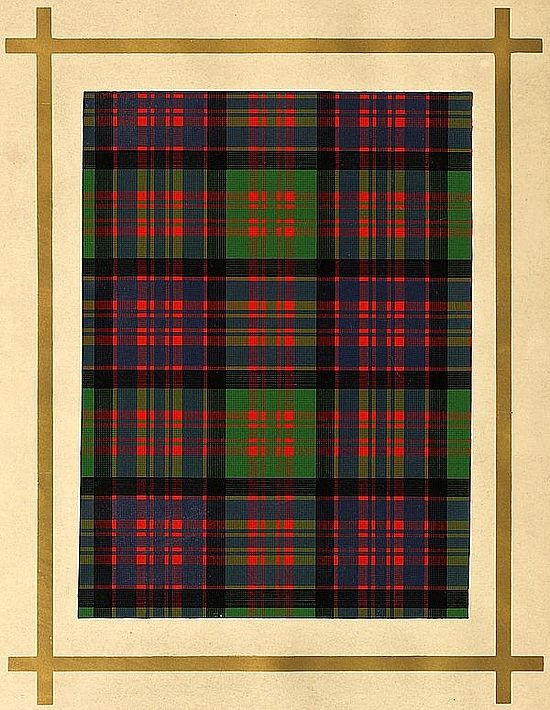
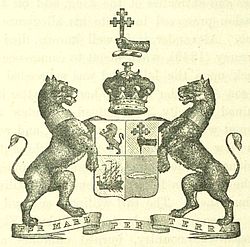
MACDONALD.
Angus, as we have already seen, had all his life been a steady friend to the crown, and had profited by his fidelity. But his son John does not seem to have inherited the loyalty along with the power, dignities, and possessions of his father. Having had some dispute with the Regent concerning certain lands which had been granted by Bruce, he joined the party of Edward Baliol and the English king; and, by a formal treaty concluded on the 12th of December 1335, and confirmed by Edward III. on the 5th October 1336, engaged to support the pretensions of the former, in consideration of a grant of the lands and islands claimed by the Earl of Moray, besides certain other advantages. But all the intrigues of Edward were baffled; Scotland was entirely freed from the dominion of the English; and, in the year 1341, David II. was recalled from France to assume the undisputed sovereignty of his native country. Upon his accession to the throne, David, anxious to attach to his party the most powerful of the Scottish barons, concluded a treaty with John of the Isles, who, in consequence, pledged himself to support his government. But a circumstance soon afterwards occurred which threw him once more into the interest of Baliol and the English party. In 1346, Ranald of the Isles having been slain at Perth by the Earl of Ross, as already mentioned, John, who had married his sister Amy, immediately laid claim to the succession. The government, however, unwilling to aggrandise a chief already too powerful, determined to oppose indirectly his pretensions, and evade the recognition of his claim. It is unnecessary to detail the pretexts employed, or the obstacles which were raised by the government. Their effect was to restore to the party of Baliol one of its most powerful adherents, and to enable John in the meanwhile to concentrate in his own person nearly all the possessions of his ancestor Somerled.
But ere long a most remarkable change took place in the character and position of the different parties or factions, which at that time divided Scotland. The king of Scotland now appeared in the extraordinary and unnatural character of a mere tool or partisan of Edward, and even seconded covertly the endeavours of the English king to overturn the independence of Scotland. Its effect was to throw into active opposition the party which had hitherto supported the throne and the cause of independence; and, on the other hand, to secure to the enemies of both the favour and countenance of the king. But as soon as by this interchange the English party became identified with the royal faction, John of the Isles abandoned it, and formed a connection with that party to which he had for many years been openly opposed. At the head of the national party was the Steward of Scotland, who, being desirous of strengthening himself by alliances with the more powerful barons, hailed the accession of John to his interests as an extraordinary piece of good fortune, and cemented their union by giving to the Lord of the Isles his own daughter in marriage. The real aim of this policy was not for a moment misunderstood; but any open manifestation of force was at first cautiously avoided. At length, in 1366, when the heavy burdens imposed upon the people to raise the ransom of the king had produced general discontent, and David’s jealousy of the Steward had displayed itself by throwing into prison the acknowledged successor to the throne, the northern barons broke out into open rebellion, and refused either to pay the tax imposed, or to obey the king’s summons to attend the parliament.
In this state matters remained for some time, when David applied to the Steward, as the only person capable of restoring peace to the country, and, at the same time, commissioned him to put down the rebellion. The latter, satisfied that his objects would be more effectually forwarded by steady opposition to the court than by avowedly taking part with the insurgents, accepted the commission, and employed every means in his power to reduce the refractory barons to obedience. His efforts, however, were only partially successful. The Earls of Mar and Ross, and other northern barons, whose object was now attained, at once laid down their arms; John of Lorn and Gillespie Campbell likewise gave in their submission; but the Lord of the Isles, secure in the distance and inaccessible nature of his territories, refused to yield, and, in fact, set the royal power at defiance. The course of events, however, soon enabled David to bring this refractory subject to terms. Edward, finding that France required his undivided attention, was not in a condition to prosecute his ambitious projects against Scotland; a peace was accordingly concluded between the rival countries; and David thus found himself at liberty to turn his whole force against the Isles. With this view he commanded the attendance of the Steward and other barons of the realm, and resolved to proceed in person against the rebels. But the Steward, perceiving that the continuance of the rebellion might prove fatal to his party, prevailed with his son-in-law to meet the king at Inverness, where an agreement was entered into, by which the Lord of the Isles not only engaged to submit to the royal authority, and pay his share of all public burdens, but further promised to put down all others who should attempt to resist either; and, besides his own oath, he gave hostages to the king for the fulfilment of this obligation. The accession of Robert Steward or Stewart to the throne of Scotland, which took place in 1371, shortly after this act of submission, brought the Lord of the Isles into close connection with the court; and during the whole of this reign he remained in as perfect tranquillity, and gave as loyal support to the government as his father Angus had done under that of King Robert Bruce.[142] In those barbarous and unsettled times, the government was not always in a condition to reduce its refractory vassals by force; and, from the frequent changes and revolutions to which it was exposed, joined to its general weakness, the penalty of forfeiture was but little dreaded. Its true policy, therefore, was to endeavour to bind to its interests, by the ties of friendship and alliance, those turbulent chiefs whom it was always difficult and often impossible to reduce to obedience by the means commonly employed for that purpose.
The advice which King Robert Bruce had left for the guidance of his successors, in regard to the Lords of the Isles, was certainly dictated by sound political wisdom. He foresaw the danger which would result to the crown were the extensive territories and consequent influence of these insular chiefs ever again to be concentrated in the person of one individual; and he earnestly recommended to those who should come after him never, under any circumstances, to permit or to sanction such aggrandisement. But, in the present instance, the claims of John were too great to be overlooked; and though Robert Stewart could scarcely have been insensible of the eventual danger which might result from disregarding the admonition of Bruce, yet he had not been more than a year on the throne when he granted to his son-in-law a feudal title to all those lands which had formerly belonged to Ranald the son of Roderick, and thus conferred on him a boon which had often been demanded in vain by his predecessors. King Robert, however, since he could not with propriety obstruct the accumulation of so much property in one house, attempted to sow the seeds of future discord by bringing about a division of the property amongst the different branches of the family. With this view he persuaded John, who had been twice married, not only to gavel the lands amongst his offspring, which was the usual practice of his family, but also to render the children of both marriages feudally independent of one another. Accordingly King Robert, in the third year of his reign, confirmed a charter granted by John to Reginald, the second son of the first marriage, by which the lands of Garmoran, forming the dowry of Reginald’s mother, were to be held of John’s heirs; that is, of the descendants of the eldest son of the first marriage, who would, of course, succeed to all his possessions that had not been feudally destined or devised to other parties. Nor was this all. A short time afterwards John resigned into the king’s hands nearly the whole of the western portion of his territories, and received from Robert charters of these lands in favour of himself and the issue of his marriage with the king’s daughter; so that the children of the second marriage were rendered feudally independent of those of the first, and the seeds of future discord and contention effectually sown between them. After this period little is known of the history of John, who is supposed to have died about the year 1380.
During the remainder of this king’s reign, and the greater part of that of his successor, Robert III., no collision seems to have taken place between the insular chiefs and the general government; and hence little or nothing is known of their proceedings. But when the dissensions of the Scottish barons, occasioned by the marriage of the Duke of Rothesay, and the subsequent departure of the Earl of March to the English court, led to a renewal of the wars between the two countries, and the invasion of Scotland by an English army, the insular chiefs appear to have renewed their intercourse with England; being more swayed by considerations of interest or policy, than by the ties of relationship to the royal family of Scotland. At this time the clan was divided into two branches, the heads of which seemed to have possessed co-ordinate rank and authority. Godfrey, the eldest surviving son of the first marriage, ruled on the mainland, as lord of Garmoran and Lochaber; Donald, the eldest son of the second marriage, held a considerable territory of the crown, then known as the feudal lordship of the Isles; whilst the younger brothers, having received the provisions usually allotted by the law of gavel, held these as vassals either of Godfrey or of Donald. This temporary equipoise was, however, soon disturbed by the marriage of Donald with Mary, the sister of Alexander Earl of Ross, in consequence of which alliance he ultimately succeeded in obtaining possession of the earldom. Euphemia, only child of Alexander, Earl of Ross, entered a convent and became a nun, having previously committed the charge of the earldom to her grandfather, Albany. Donald, however, lost no time in preferring his claim to the succession in right of his wife, the consequences of which have already been narrated in detail.[143] Donald, with a considerable force, invaded Ross, and met with little or no resistance from the people till he reached Dingwall, where he was encountered by Angus Dhu Mackay, at the head of a considerable body of men from Sutherland, whom, after a fierce conflict, he completely defeated and made their leader prisoner. Leaving the district of Ross, which now acknowledged his authority, he advanced at the head of his army, through Moray, and penetrated into Aberdeenshire. Here, however, a decisive check awaited him. On the 24th of July, 1411, he was met at the village of Harlaw by the Earl of Mar, at the head of an army inferior in numbers, but composed of better materials; and a battle ensued, upon the event of which seemed to depend the decision of the question, whether the Celtic or the Sassenach part of the population of Scotland were in future to possess the supremacy. The immediate issue of the conflict was doubtful, and, as is usual in such cases, both parties claimed the victory. But the superior numbers and irregular valour of the Highland followers of Donald had received a severe check from the steady discipline and more effective arms of the Lowland gentry; they had been too roughly handled to think of renewing the combat, for which their opponents seem to have been quite prepared; and, as in such circumstances a drawn battle was equivalent to a defeat, Donald was compelled, as the Americans say, “to advance backwards.” The Duke of Albany, having obtained reinforcements, marched in person to Dingwall; but Donald, having no desire to try again the fate of arms, retired with his followers to the Isles, leaving Albany in possession of the whole of Ross, where he remained during the winter. Next summer the war was renewed, and carried on with various success, until at length the insular chief found it necessary to come to terms with the duke, and a treaty was concluded by which Donald agreed to abandon his claim to the earldom of Ross, and to become a vassal of the crown of Scotland.
The vigour of Albany restored peace to the kingdom, and the remainder of his regency was not disturbed by any hostile attempt upon the part of Donald of the Isles. But when the revenge of James I. had consummated the ruin of the family of Albany, Alexander, the son of Donald, succeeded, without any opposition, to the earldom of Ross, and thus realised one grand object of his father’s ambition. At almost any other period the acquisition of such extensive territories would have given a decided and dangerous preponderance to the family of the Isles. The government of Scotland, however, was then in the hands of a man who, by his ability, energy, and courage, proved himself fully competent to control his turbulent nobles, and, if necessary, to destroy their power and influence. Distrustful, however, of his ability to reduce the northern barons to obedience by force of arms, he had recourse to stratagem; and having summoned them to attend a parliament at Inverness, whither he proceeded, attended by his principal nobility and a considerable body of troops, he there caused forty of them to be arrested as soon as they made their appearance. Alexander, Earl of Ross and Lord of the Isles, his mother the Countess of Ross, and Alexander MacGodfrey, of Garmoran, were amongst the number of those arrested on this occasion. Along with several others, MacGodfrey was immediately executed, and his whole possessions forfeited to the crown, and the remainder were detained in captivity. By this bold stroke, James conceived that he had effectually subdued the Highland chiefs; and, under this impression, he soon afterwards liberated Alexander of the Isles. But he seems to have forgotten that “vows made in pain,” or at least in durance, “are violent and void.” The submission of the captive was merely feigned. As soon as he had recovered his liberty, the Lord of the Isles flew to arms, with what disastrous results to himself has already been told.[144] So vigorously did the king’s officers follow up the victory, that the insular chief, finding concealment or escape equally impossible, was compelled to throw himself upon the royal clemency. He went to Edinburgh, and, on the occasion of a solemn festival celebrated in the chapel of Holyrood, on Easter Sunday 1429, the unfortunate chief, whose ancestors had treated with the crown on the footing of independent princes, appeared before the assembled court in his shirt and drawers, and implored on his knees, with a naked sword held by the point in his hand, the forgiveness of his offended monarch. Satisfied with this extraordinary act of humiliation, James granted the suppliant his life, and directed him to be forthwith imprisoned in Tantallon castle.
The spirit of clanship could not brook such a mortal affront. The cry for vengeance was raised; the strength of the clan was mustered; and Alexander had scarcely been two years in captivity when the Isles once more broke out into open insurrection. Under the command of Donald Balloch, the cousin of Alexander and chief of clan Ranald, the Islanders burst into Lochaber, where, having encountered an army which had been stationed in that country for the purpose of overawing the Highlanders, they gained a complete victory. The king’s troops were commanded by the Earls of Mar and Caithness, the latter of whom fell in the action, whilst the former saved with difficulty the remains of the discomfited force. Donald Balloch, however, did not follow up his victory, but having ravaged the adjacent districts, withdrew first to the Isles, and afterwards to Ireland. In this emergency James displayed his usual energy and activity. To repair the reverse sustained by his lieutenants, he proceeded in person to the North; his expedition was attended with complete success; and he soon received the submission of all the chiefs who had been engaged in the rebellion. Not long afterwards he was presented with what was believed to be the head of Donald Balloch; “but,” says Mr Gregory, “as Donald Balloch certainly survived king James many years, it is obvious that the sending of the head to Edinburgh was a stratagem devised by the crafty islander, in order to check further pursuit.” The king, being thus successful, listened to the voice of clemency. He restored to liberty the prisoner of Tantallon, granted him a free pardon for his various acts of rebellion, confirmed to him all his titles and possessions, and further conferred upon him the lordship of Lochaber, which, on its forfeiture, had been given to the Earl of Mar. The wisdom of this proceeding soon became apparent. Alexander could scarcely forget the humiliation he had undergone, and the imprisonment he had endured; and, in point of fact, he appears to have joined the Earls of Crawford and Douglas, who at that time headed the opposition to the court; but during the remainder of his life the peace of the country was not again disturbed by any rebellious proceedings on his part, and thus far the king reaped the reward of his clemency. Alexander died about 1447, leaving three sons, John, Hugh, and Celestine.
The opposition of Crawford, Douglas, and their associates had hitherto been chronic; but, on the death of Alexander, it broke out into active insurrection; and the new Lord of the Isles, as determined an opponent of the royal party as his father had been, seized the royal castles of Inverness, Urquhart, and Ruthven in Badenoch, at the same time declaring himself independent. In thus raising the standard of rebellion, John of the Isles was secretly supported by the Earl of Douglas, and openly by the barons, who were attached to his party. But a series of fatalities soon extinguished this insurrection. Douglas was murdered in Edinburgh Castle; Crawford was entirely defeated by Huntly; and John, by the rebellion of his son Angus, was doomed to experience, in his own territories, the same opposition which he had himself offered to the general government. Submission was, therefore, inevitable. Having for several years maintained a species of independence, he was compelled to resign his lands into the hands of the king, and to consent to hold them as a vassal of the crown. This, however, was but a trifling matter compared with the rebellion of his son, which, fomented probably by the court, proved eventually the ruin of the principality of the Isles, after it had existed so long in a state of partial independence. Various circumstances are stated as having given rise to this extraordinary contest, although in none of these, probably, is the true cause to be found. It appears, however, that Angus Og,[145] having been appointed his father’s lieutenant and representative in all his possessions, took advantage of the station or office which was thus conferred on him, deprived his father of all authority, and got himself declared Lord of the Isles. How this was effected we know not; but scarcely had he attained the object of his ambition, when he resolved to take signal vengeance upon the Earl of Athole, an inveterate enemy of his house, and, at the same time, to declare himself altogether independent of the crown. With this view, having collected a numerous army, he suddenly appeared before the castle of Inverness, and having been admitted by the governor, who had no suspicion whatever of his design, immediately proclaimed himself king of the Isles. He then invaded the district of Athole; stormed and took Blair Castle; and having seized the earl and countess, carried them prisoners to Islay. The reason given by Mr Gregory for Angus’s enmity against the Earl and Countess of Athole is, that the former having crossed over privately to Islay, carried off the infant son of Angus, called Donald Dubh, or the Black, and committed him to the care of Argyle, his maternal grandfather, who placed him in the Castle of Inchconnely, where he was detained for many years. Mr Gregory places this event after the Battle of Bloody Bay. On his return to the Isles with the booty he had obtained, the marauder was overtaken by a violent tempest, in which the greater part of his galleys foundered. Heaven seemed to declare against the spoiler, who had added sacrilege to rapine by plundering and attempting to burn the chapel of St Bridget in Athole. Stricken with remorse for the crime he had committed, he released the earl and countess, and then sought to expiate his guilt by doing penance on the spot where it had been incurred.
As a proof of the sincerity of his repentance, this Angus Og next engaged in treason upon a larger scale. At the instigation of this hopeful son, his father, whom he had already deprived of all authority, now entered into a compact with the king of England and the Earl of Douglas, the object of which was nothing less than the entire subjugation of Scotland, and its partition amongst the contracting parties. By this treaty, which is dated the 18th of February 1462, the Lord of the Isles agreed, on the payment of a stipulated sum, to become the sworn ally of the king of England, and to assist that monarch, with the whole body of his retainers, in the wars in Ireland and elsewhere; and it was further provided, that in the event of the entire subjugation of Scotland, the whole of that kingdom, to the north of the Firth of Forth, should be equally divided between Douglas, the Lord of the Isles, and Donald Balloch of Islay; whilst, on the other hand, Douglas was to be reinstated in possession of those lands between the Forth and the English borders, from which he had, at this time, been excluded. Conquest, partition, and spoliation, were thus the objects contemplated in this extraordinary compact. Yet no proceeding appears to have been taken, in consequence of the treaty, until the year 1473, when we find the Lord of the Isles again in arms against the government. He continued several years in open rebellion; but having received little or no support from the other parties to the league, he was declared a traitor in a parliament held at Edinburgh in 1475, his estates were also confiscated, and the Earls of Crawford and Athole were directed to march against him at the head of a considerable force. The meditated blow was, however, averted by the timely interposition of his father, the Earl of Ross. By a seasonable grant of the lands of Knapdale, he secured the influence of the Earl of Argyll, and through the mediation of that nobleman, received a remission of his past offences, was reinstated in his hereditary possessions, which he had resigned into the hands of the crown, and created a peer of parliament, by the title of the Lord of the Isles. The earldom of Ross, the lands of Knapdale, and the sheriffships of Inverness and Nairn were, however, retained by the crown, apparently as the price of the remission granted to this doubly unfortunate man.
But Angus Og was no party to this arrangement. He continued to defy the power of the government; and when the Earl of Athole was sent to the north to reinstate the Earl of Ross in his remaining possessions, he placed himself at the head of the clan, and prepared to give him battle. Athole was joined by the Mackenzies, Mackays, Frasers, and others; but being met by Angus at a place called Lagebread, he was defeated with great slaughter, and escaped with great difficulty from the field. The Earls of Crawford and Huntly were then sent against this desperate rebel, the one by sea and the other by land; but neither of them prevailed against the victorious insurgent. A third expedition, under the Earls of Argyll and Athole, accompanied by the father of the rebel and several families of the Isles, produced no result; and the two earls, who seem to have had little taste for an encounter with Angus, returned without effecting anything. John the father, however, proceeded onwards through the Sound of Mull, accompanied by the Macleans, Macleods, Macneills, and others, and having encountered Angus in a bay on the south side of the promontory of Ardnamurchan,[146] a desperate combat ensued, in which Angus was again victorious, and his unfortunate parent overthrown. By the battle of the Bloody Bay, as it is called in the traditions of the country, Angus obtained possession of the extensive territories of his clan, and, as “when treason prospers ’tis no longer treason,” was recognised as its head. Angus, some time before 1490, when marching to attack Mackenzie of Kintail, was assassinated by an Irish harper.[147]
The rank of heir to the lordship of the Isles devolved on the nephew of John, Alexander of Lochalsh, son of his brother, Celestine. Placing himself at the head of the vassals of the Isles, he endeavoured, it is said, with John’s consent, to recover possession of the earldom of Ross, and in 1491, at the head of a large body of western Highlanders, he advanced from Lochaber into Badenoch, where he was joined by the clan Chattan. They then marched to Inverness, where, after taking the royal castle, and placing a garrison in it, they proceeded to the north-east, and plundered the lands of Sir Alexander Urquhart, sheriff of Cromarty. They next hastened to Strathconnan, for the purpose of ravaging the lands of the Mackenzies. The latter, however, surprised and routed the invaders, and expelled them from Ross, their leader, Alexander of Lochalsh, being wounded, and as some say, taken prisoner. In consequence of this insurrection, at a meeting of the Estates in Edinburgh in May 1493, the title and possessions of the lord of the Isles were declared to be forfeited to the crown. In January following the aged John appeared in the presence of the king, and made a voluntary surrender of his lordship, after which he appears to have remained for some time in the king’s household, in the receipt of a pension. He finally retired to the monastery of Paisley, where he died about 1498; and was interred, at his own request, in the tomb of his royal ancestor, Robert II.[148]
With the view of reducing the insular chiefs to subjection, and establishing the royal authority in the Islands, James IV., soon after the forfeiture in 1493, proceeded in person to the West Highlands, when Alexander of Lochalsh, the principal cause of the insurrection which had led to it, and John of Isla, grandson and representative of Donald Balloch, were among the first to make their submission. On this occasion they appear to have obtained royal charters of the lands they had previously held under the Lord of the Isles, and were both knighted. In the following year the king visited the Isles twice, and having seized and garrisoned the castle of Dunaverty in South Kintyre, Sir John of Isla, deeply resenting this proceeding, collected his followers, stormed the castle, and hung the governor from the wall, in the sight of the king and his fleet. With four of his sons, he was soon after apprehended at Isla, by MacIan of Ardnamurchan, and being conveyed to Edinburgh, they were there executed for high treason.
In 1495 King James assembled an army at Glasgow, and on the 18th May, he was at the castle of Mingarry in Ardnamurchan, when several of the Highland chiefs made their submission to him. In 1497 Sir Alexander of Lochalsh again rebelled, and invading the more fertile districts of Ross, was by the Mackenzies and Munroes, at a place called Drumchatt, again defeated and driven out of Ross. Proceeding southward among the Isles, he endeavoured to rouse the Islanders to arms in his behalf, but without success. He was surprised in the island of Oransay, by MacIan of Ardnamurchan, and put to death.
In 1501, Donald Dubh, whom the islanders regarded as their rightful lord, and who, from his infancy, had been detained in confinement in the castle of Inchconnell, escaped from prison, and appeared among his clansmen. They had always maintained that he was the lawful son of Angus of the Isles, by his wife the Lady Margaret Campbell, daughter of the first Earl of Argyll, but his legitimacy was denied by the government when the islanders combined to assert by arms his claims as their hereditary chief. His liberation he owed to the gallantry and fidelity of the men of Glencoe. Repairing to the isles of Lewis, he put himself under the protection of its lord, Torquil Macleod, who had married Katherine, another daughter of Argyll, and therefore sister of the lady whom the islanders believed to be his mother. A strong confederacy was formed in his favour, and about Christmas 1503 an irruption of the islanders and western clans, under Donald Dubh, was made into Badenoch, which was plundered and wasted with fire and sword. To put down this formidable rebellion, the array of the whole kingdom north of Forth and Clyde was called out; and the Earls of Argyll, Huntly, Crawford, and Marischal, and Lord Lovat, with other powerful barons, were charged to lead this force against the islanders. But two years elapsed before the insurrection was finally quelled. In 1505 the Isles were again invaded from the south by the king in person, and from the north by Huntly, who took several prisoners, but none of them of any rank. In these various expeditions the fleet under the celebrated Sir Andrew Wood and Robert Barton was employed against the islanders, and at length the insurgents were dispersed. Carniburg, a strong fort on a small isolated rock, near the west coast of Mull, in which they had taken refuge, was reduced; the Macleans and the Macleods submitted to the king, and Donald Dubh, again made a prisoner, was committed to the castle of Edinburgh, where he remained for nearly forty years. After this the great power formerly enjoyed by the Lords of the Isles was transferred to the Earls of Argyll and Huntly, the former having the chief rule in the south isles and adjacent coasts, while the influence of the latter prevailed in the north isles and Highlands.
The children of Sir Alexander of Lochalsh, the nephew of John the fourth and last Lord of the Isles, had fallen into the hands of the king, and as they were all young, they appear to have been brought up in the royal household. Donald, the eldest son, called by the Highlanders, Donald Galda, or the foreigner, from his early residence in the Lowlands, was allowed to inherit his father’s estates, and was frequently permitted to visit the Isles. He was with James IV. at the battle of Flodden, and appears to have been knighted under the royal banner on that disastrous field. Two months after, in November 1513, he raised another insurrection in the Isles, and being joined by the Macleods and Macleans, was proclaimed Lord of the Isles. The numbers of his adherents daily increased. But in the course of 1515, the Earl of Argyll prevailed upon the insurgents to submit to the regent. At this time Sir Donald appeared frequently before the council, relying on a safe-conduct, and his reconciliation to the regent (John, Duke of Albany) was apparently so cordial that on 24th September 1516, a summons was despatched to ‘Monsieur de Ylis,’ to join the royal army, then about to proceed to the borders. Ere long, however, he was again in open rebellion. Early in 1517 he razed the castle of Mingarry to the ground, and ravaged the whole district of Ardnamurchan with fire and sword. His chief leaders now deserted him, and some of them determined on delivering him up to the regent. He, however, effected his escape, but his two brothers were made prisoners by Maclean of Dowart and Macleod of Dunvegan, who hastened to make their submission to the government. In the following year, Sir Donald was enabled to revenge the murder of his father on the MacIans of Ardnamurchan, having defeated and put to death their chief and two of his sons, with a great number of his men. He was about to be forfeited for high treason, when his death, which took place a few weeks after his success against the MacIans, brought the rebellion, which had lasted for upwards of five years, to a sudden close. He was the last male of his family, and died without issue.
In 1539, Donald Gorme of Sleat claimed the lordship of the Isles, as lawful heir male of John, Earl of Ross. With a considerable force he passed over into Ross-shire, where, after ravaging the district of Kinlochewe, he proceeded to Kintail, with the intention of surprising the castle Eilandonan, at that time almost without a garrison. Exposing himself rashly under the wall, he received a wound in the foot from an arrow, which proved fatal.
In 1543, under the regency of the Earl of Arran, Donald Dubh, the grandson of John, last Lord of the Isles, again appeared upon the scene. Escaping from his long imprisonment, he was received with enthusiasm by the insular chiefs, and, with their assistance, he prepared to expel the Earls of Argyll and Huntly from their acquisitions in the Isles. At the head of 1800 men he invaded Argyll’s territories, slew many of his vassals, and carried off a great quantity of cattle, with other plunder. At first he was supported by the Earl of Lennox, then attached to the English interest, and thus remained for a time in the undisputed possession of the Isles. Through the influence of Lennox, the islanders agreed to transfer their alliance from the Scottish to the English crown, and in June 1545 a proclamation was issued by the regent Arran and his privy council against ‘Donald, alleging himself of the Isles, and other Highland men, his partakers.’ On the 28th July of that year, a commission was granted by Donald, ‘Lord of the Isles, and Earl of Ross,’ with the advice and consent of his barons and council of the Isles, of whom seventeen are named, to two commissioners, for treating, under the directions of the Earl of Lennox, with the English king. On the 5th of August, the lord and barons of the Isles were at Knockfergus, in Ireland, with a force of 4000 men and 180 galleys, when they took the oath of allegiance to the king of England, at the command of Lennox, while 4000 men in arms were left to guard and defend the Isles in his absence. Donald’s plenipotentiaries then proceeded to the English court with letters from him both to King Henry and his privy council; by one of which it appears that the Lord of the Isles had already received from the English monarch the sum of one thousand crowns, and the promise of an annual pension of two thousand. Soon after the Lord of the Isles returned with his forces to Scotland, but appears to have returned to Ireland again with Lennox. There he was attacked with fever, and died at Drogheda, on his way to Dublin. With him terminated the direct line of the Lords of the Isles.
All hopes of a descendant of Somerled again governing the Isles were now at an end; and from this period the race of Conn, unable to regain their former united power and consequence, were divided into various branches, the aggregate strength of which was rendered unavailing for the purpose of general aggrandisement, by the jealousy, disunion, and rivalry, which prevailed among themselves.
After the forfeiture of the Lords of the Isles, and the failure of the successive attempts which were made to retrieve their fortunes, different clans occupied the extensive territories which had once acknowledged the sway of those insular princes. Of these some were clans, which, although dependent upon the Macdonalds, were not of the same origin as the race of Conn; and, with the exception of the Macleods, Macleans, and a few others, they strenuously opposed all the attempts which were made to effect the restoration of the family of the Isles, rightly calculating that the success of such opposition would tend to promote their own aggrandisement. Another class, again, were of the same origin as the family of the Isles; but having branched off from the principal stem before the succession of the elder branches reverted to the clan, in the person of John of the Isles, during the reign of David II., they now appeared as separate clans. Amongst these were the Macalisters, the MacIans, and some others. The Macalisters, who are traced to Alister, a son of Angus Mor, inhabited the south of Knapdale and the north of Kintyre. After the forfeiture of the Isles they became independent; but being exposed to the encroachments of the Campbells, their principal possessions were ere long absorbed by different branches of that powerful clan. The MacIans of Ardnamurchan were descended from John, a son of Angus Mor, to whom his father conveyed the property which he had obtained from the crown. The Macdonalds of Glencoe are also MacIans, being descended from John Fraoch, a son of Angus Og, Lord of the Isles; and hence their history is in no degree different from that of the other branches of the Macdonalds. A third class consisted of the descendants of the different Lords of the Isles, who still professed to form one clan, although the subject of the representation of the race soon introduced great dissensions, and all adopted the generic name of Macdonald in preference to secondary or collateral patronymics.
We shall now endeavour to give a short account of the different branches of the Macdonalds, from the time of the annexation of the Lordship of the Isles to the crown in 1540.
Since the extinction of the direct line of the family of the Isles, in the middle of the 16th century, Macdonald of Sleat, now Lord Macdonald, has always been styled in Gaelic Mac Dhonuill nan Eilean, or Macdonald of the Isles.[149]
As the claim of Lord Macdonald, however, to this distinction has been keenly disputed, we shall here lay before the reader, as clearly as possible, the pretensions of the different claimants to the honour of the chiefship of the clan Donald, as these have been very fairly stated by Mr Skene.
That the family of Sleat are the undoubted representatives of John, Earl of Ross, and the last Lord of the Isles, appears to be admitted on all sides; but, on the other hand, if the descendants of Donald, from whom the clan received its name, or even of John of the Isles, who flourished in the reign of David II., are to be held as constituting one clan, then, according to the Highland principles of clanship, the jus sanguinis, or right of blood to the chiefship, rested in the male representative of John, whose own right was undoubted. By Amy, daughter of Roderick of the Isles, John had three sons,—John, Godfrey, and Ranald; but the last of these only left descendants; and it is from him that the Clan Ranald derive their origin. Again, by the daughter of Robert II. John had four sons—Donald, Lord of the Isles, the ancestor of the Macdonalds of Sleat; John Mor, from whom proceeded the Macconnells of Kintyre; Alister, the progenitor of Keppoch; and Angus, who does not appear to have left any descendants. That Amy, the daughter of Roderick, was John’s legitimate wife, is proved, first, by a dispensation which the supreme Pontiff granted to John in the year 1337; and secondly, by a treaty concluded between John and David II. in 1369, when the hostages given to the king were a son of the second marriage, a grandson of the first, and a natural son. Besides, it is certain that the children of the first marriage were considered as John’s feudal heirs; a circumstance which clearly establishes their legitimacy. It is true that Robert II., in pursuance of the policy he had adopted, persuaded John to make the children of these respective marriages feudally independent of each other; and that the effect of this was to divide the possessions of his powerful vassals into two distinct and independent lordships. These were, first, the lordship of Garmoran and Lochaber, which was held by the eldest son of the first marriage,—and secondly, that of the Isles, which passed to the eldest son of the second marriage; and matters appear to have remained in this state until 1427, when, as formerly mentioned, the Lord of Garmoran was beheaded, and his estates were forfeited to the crown. James I., however, reversing the policy which had been pursued by his predecessor, concentrated the possessions of the Macdonalds in the person of the Lord of the Isles, and thus sought to restore to him all the power and consequence which had originally belonged to his house; “but this arbitrary proceeding,” says Mr Skene, “could not deprive the descendants of the first marriage of the feudal representation of the chiefs of the clan Donald, which now, on the failure of the issue of Godfrey in the person of his son Alexander, devolved on the feudal representative of Reginald, the youngest son of that marriage.”
The clan Ranald are believed to have derived their origin from this Reginald or Ranald, who was a son of John of the Isles, by Amy MacRory, and obtained from his father the lordship of Garmoran, which he held as vassal of his brother Godfrey. That this lordship continued in possession of the clan appears evident from the Parliamentary Records, in which, under the date of 1587, mention is made of the clan Ranald of Knoydart, Moydart, and Glengarry. But considerable doubt has arisen, and there has been a good deal of controversy, as to the right of chiefship; whilst of the various families descended from Ranald each has put forward its claim to this distinction. On this knotty and ticklish point we shall content ourselves with stating the conclusions at which Mr Skene arrived ‘after,’ as he informs us, ‘a rigid examination’ of the whole subject in dispute. According to him, the present family of Clanranald have no valid title or pretension whatever, being descended from an illegitimate son of a second son of the old family of Moydart, who, in 1531, assumed the title of Captain of Clanranald; and, consequently, as long as the descendants of the eldest son of that family remain, they can have no claim by right of blood to the chiefship. He then proceeds to examine the question,—Who was the chief previous to this assumption of the captaincy of Clanranald? and, from a genealogical induction of particulars, he concludes that Donald, the progenitor of the family of Glengarry, was the eldest son of the Reginald or Ranald above-mentioned; that from John, the eldest son of Donald, proceeded the senior branch of this family, in which the chiefship was vested; that, in consequence of the grant of Garmoran to the Lord of the Isles, and other adverse circumstances, they became so much reduced that the oldest cadet obtained the actual chiefship, under the ordinary title of captain; and that, on the extinction of this branch in the beginning of the seventeenth century, the family of Glengarry descended from Alister, second son of Donald, became the legal representatives of Ranald, the common ancestor of the clan, and consequently possessed that jus sanguinis of which no usurpation could deprive them. Such are the results of Mr Skene’s researches upon this subject. Latterly, the family of Glengarry have claimed not only the chiefship of clan Ranald, but likewise that of the whole clan Donald, as being the representative of Donald, the common ancestor of the clan; and it can scarcely be denied that the same evidence which makes good the one point must serve equally to establish the other. Nor does this appear to be any new pretension. When the services rendered by this family to the house of Stuart were rewarded by Charles II. with a peerage, the Glengarry of the time indicated his claim by assuming the title of Lord Macdonnell and Aros; and although, upon the failure of heirs male of his body, this title did not descend to his successors, yet his lands formed, in consequence, the barony of Macdonnell.
Donald Gorme, the claimant of the lordship of the Isles mentioned above as having been slain in 1539, left a grandson, a minor, known as Donald Macdonald Gormeson of Sleat. His title to the family estates was disputed by the Macleods of Harris. He ranged himself on the side of Queen Mary when the disputes about her marriage began in 1565. He died in 1585, and was succeeded by Donald Gorme Mor, fifth in descent from Hugh of Sleat. This Donald Gorme proved himself to be a man of superior abilities, and was favoured highly by James VI., to whom he did important service in maintaining the peace of the Isles. “From this period, it may be observed, the family were loyal to the crown, and firm supporters of the national constitution and laws; and it is also worthy of notice that nearly all the clans attached to the old Lords of the Isles, on the failure of the more direct line in the person of John, transferred their warmest affections to those royal Stuarts, whose throne they had before so often and so alarmingly shaken. This circumstance, as all men know, became strikingly apparent when misfortune fell heavily in turn on the Stuarts.”[150]
Donald Gorme Mor, soon after succeeding his father, found himself involved in a deadly feud with the Macleans of Dowart, which raged to such an extent as to lead to the interference of government, and to the passing in 1587 of an act of parliament, commonly called “The general Bond” or Band for maintaining good order both on the borders and in the Highlands and Isles. By this act, it was made imperative on all landlords, bailies, and chiefs of clans, to find sureties for the peaceable behaviour of those under them. The contentions, however, between the Macdonalds and the Macleans continued, and in 1589, with the view of putting an end to them, the king and council adopted the following plan. After remissions under the privy seal had been granted to Donald Gorme of Sleat, his kinsman, Macdonald of Islay, the principal in the feud, and Maclean of Dowart, for all crimes committed by them, they were induced to proceed to Edinburgh, under pretence of consulting with the king and council for the good rule of the country, but immediately on their arrival they were seized and imprisoned in the castle. In the summer of 1591, they were set at liberty, on paying each a fine to the king, that imposed on Sleat being £4,000, under the name of arrears of feu-duties and crown-rents in the Isles, and finding security for their future obedience and the performance of certain prescribed conditions. They also bound themselves to return to their confinement in the castle of Edinburgh, whenever they should be summoned, on twenty days’ warning. In consequence of their not fulfilling the conditions imposed upon them, and their continuing in opposition to the government, their pardons were recalled, and the three island chiefs were cited before the privy council on the 14th July 1593, when, failing to appear, summonses of treason were executed against them and certain of their associates.
In 1601, the chief of Sleat again brought upon himself and his clan the interference of government by a feud with Macleod of Dunvegan, which led to much bloodshed and great misery and distress among their followers and their families. He had married a sister of Macleod; but, from jealousy or some other cause, he put her away, and refused at her brother’s request to take her back. Having procured a divorce, he soon after married a sister of Kenneth Mackenzie of Kintail. Macleod immediately assembled his clan, and carried fire and sword through Macdonald’s district of Trotternish. The latter, in revenge, invaded Harris, and laid waste that island, killing many of the inhabitants, and carrying off their cattle. “These spoliations and incursions were carried on with so much inveteracy, that both clans were brought to the brink of ruin; and many of the natives of the districts thus devastated were forced to sustain themselves by killing and eating their horses, dogs, and cats.” The Macdonalds having invaded Macleod’s lands in Skye, a battle took place on the mountain Benquillin between them and the Macleods, when the latter, under Alexander, the brother of their chief, were defeated with great loss, and their leader, with thirty of their clan, taken captive. A reconciliation was at length effected between them by the mediation of Macdonald of Islay, Maclean of Coll, and other friends; when the prisoners taken at Benquillin were released.[151]
In 1608, we find Donald Gorme of Sleat one of the Island chiefs who attended the court of Lord Ochiltree, the king’s lieutenant, at Aros in Mull, when he was sent there for the settlement of order in the Isles, and who afterwards accepted his invitation to dinner on board the king’s ship, called the Moon. When dinner was ended, Ochiltree told the astonished chiefs that they were his prisoners by the king’s order; and weighing anchor he sailed direct to Ayr, whence he proceeded with his prisoners to Edinburgh and presented them before the privy council, by whose order they were placed in the castles of Dumbarton, Blackness, and Stirling. Petitions were immediately presented by the imprisoned chiefs to the council submitting themselves to the king’s pleasure, and making many offers in order to procure their liberation. In the following year the bishop of the Isles was deputed as sole commissioner to visit and survey the Isles, and all the chiefs in prison were set at liberty, on finding security to a large amount, not only for their return to Edinburgh by a certain fixed day, but for their active concurrence, in the meantime, with the bishop in making the proposed survey. Donald Gorme of Sleat was one of the twelve chiefs and gentlemen of the Isles, who met the bishop at Iona, in July 1609, and submitted themselves to him, as the king’s representative. At a court then held by the bishop, the nine celebrated statutes called the “Statutes of Icolmkill,” for the improvement and order of the Isles, were enacted, with the consent of the assembled chiefs, and their bonds and oaths given for the obedience thereto of their clansmen.[152]
In 1616, after the suppression of the rebellion of the Clanranald in the South Isles, certain very stringent conditions were imposed by the privy council on the different Island chiefs. Among these were, that they were to take home-farms into their own hands, which they were to cultivate, “to the effect that they might be thereby exercised and eschew idleness,” and that they were not to use in their houses more than a certain quantity of wine respectively. Donald Gorme of Sleat, having been prevented by sickness from attending the council with the other chiefs, ratified all their proceedings, and found the required sureties, by a bond dated in the month of August. He named Duntulm, a castle of his family in Trotternish, Skye, as his residence, when six household gentlemen, and an annual consumption of four tun of wine, were allowed to him; and he was once-a-year to exhibit to the council three of his principal kinsmen. He died the same year, without issue, and was succeeded by his nephew, Donald Gorme Macdonald of Sleat.
On July 14th 1625, after having concluded, in an amicable manner, all his disputes with the Macleods of Harris, and another controversy in which he was engaged with the captain of Clanranald, he was created a baronet of Nova Scotia by Charles I., with a special clause of precedency placing him second of that order in Scotland. He adhered to the cause of that monarch, but died in 1643. He had married Janet, commonly called “fair Janet,” second daughter of Kenneth, first Lord Mackenzie of Kintail, by whom he had several children. His eldest son, Sir James Macdonald, second baronet of Sleat, joined the Marquis of Montrose in 1645, and when Charles II. marched into England in 1651, he sent a number of his clan to his assistance. He died 8th December 1678.
Sir James’ eldest son, Sir Donald Macdonald, third baronet of Sleat, died in 1695. His son, also named Sir Donald, fourth baronet, was one of those summoned by the Lord Advocate, on the breaking out of the rebellion of 1715, to appear at Edinburgh, under pain of a year’s imprisonment and other penalties, to give bail for their allegiance to the government. Joining in the insurrection, his two brothers commanded the battalion of his clan, on the Pretender’s side, at Sheriffmuir; and, being sent out with the Earl Marischal’s horse to drive away a reconnoitring party, under the Duke of Argyll, from the heights, may be said to have commenced the battle. Sir Donald himself had joined the Earl of Seaforth at his camp at Alness with 700 Macdonalds. After the suppression of the rebellion, Sir Donald proceeded to the Isle of Skye with about 1000 men; but although he made no resistance, having no assurance of protection from the government in case of a surrender, he retired into one of the Uists, where he remained till he obtained a ship which carried him to France. He was forfeited for his share in the insurrection, but the forfeiture was soon removed. He died in 1718, leaving one son and four daughters.
His son, Sir Alexander Macdonald, seventh baronet, was one of the first persons asked by Prince Charles to join him, on his arrival off the Western Islands, in July 1745, but refused, as he had brought no foreign force with him. After the battle of Preston, the prince sent Mr Alexander Macleod, advocate, to the Isle of Skye, to endeavour to prevail upon Sir Alexander Macdonald and the laird of Macleod to join the insurgents; but instead of doing so, these and other well-affected chiefs enrolled each an independent company for the service of government, out of their respective clans. The Macdonalds of Skye served under Lord Loudon in Ross-shire.
After the battle of Culloden, when Prince Charles, in his wanderings, took refuge in Skye, with Flora Macdonald, they landed near Moydhstat, or Mugstot, the seat of Sir Alexander Macdonald, near the northern extremity of that island. Sir Alexander was at that time with the Duke of Cumberland at Fort Augustus, and as his wife, Lady Margaret Montgomerie, a daughter of the ninth Earl of Eglinton, was known to be a warm friend of the prince. Miss Macdonald proceeded to announce to her his arrival. Through Lady Margaret the prince was consigned to the care of Mr Macdonald of Kingsburgh, Sir Alexander’s factor, at whose house he spent the night, and afterwards departed to the island of Rasay. Sir Alexander died in November 1746, leaving three sons.
His eldest son, Sir James, eighth baronet, styled “The Scottish Marcellus,” was born in 1741. At his own earnest solicitation he was sent to Eton, on leaving which he set out on his travels, and was everywhere received by the learned with the distinction due to his unrivalled talents. At Rome, in particular, the most marked attention was paid to him by several of the cardinals. He died in that city on 26th July 1766, when only 25 years old. In extent of learning, and in genius, he resembled the admirable Crichton. On his death the title devolved on his next brother, Alexander, ninth baronet, who was created a peer of Ireland, July 17, 1776, as Baron Macdonald of Sleat, county Antrim. He married the eldest daughter of Godfrey Bosville, Esq. of Gunthwaite, Yorkshire, and had seven sons and three daughters. Diana, the eldest daughter, married in 1788 the Right Hon. Sir John Sinclair of Ulbster. His lordship died Sept. 12, 1795.
His eldest son, Alexander Wentworth, second Lord Macdonald, died unmarried, June 9, 1824, when his brother, Godfrey, became third Lord Macdonald. He assumed the additional name of Bosville. He married Louise Maria, daughter of Farley Edsir, Esq.; issue, three sons and seven daughters. He died Oct. 13, 1832.
The eldest son, Godfrey William Wentworth, fourth Lord Macdonald, born in 1809, married in 1845, daughter of G. T. Wyndham, Esq. of Cromer Hall, Norfolk; issue, Somerled James Brudenell, born in 1849, two other sons and four daughters.
The Macdonalds of Isla and Kintyre, called the Clan Ian Vor, whose chiefs were usually styled lords of Dunyveg (from their castle in Isla) and the Glens, were descended from John Mor, second son of “the good John of Isla,” and of Lady Margaret Stewart, daughter of King Robert II. From his brother Donald, Lord of the Isles, he received large grants of land in Isla and Kintyre, and by his marriage with Marjory Bisset, heiress of the district of the Glens in Antrim, he acquired possessions in Ulster. He was murdered before 1427 by an individual named James Campbell, who is said to have received a commission from King James I. to apprehend him, but that he exceeded his powers by putting him to death. His eldest son was the famous Donald Balloch. From Ranald Bane, a younger brother of Donald Balloch, sprang the Clanranaldbane of Largie in Kintyre.
Donald Balloch’s grandson, John, surnamed Cathanach, or warlike, was at the head of the clan Ian Vor, when the lordship of the Isles was finally forfeited by James IV. in 1493. In that year he was among the chiefs, formerly vassals of the Lord of the Isles, who made their submission to the king, when he proceeded in person to the West Highlands. On this occasion he and the other chiefs were knighted.
Alexander of Isla was with Sir Donald of Lochalsh when, in 1518, he proceeded against the father-in-law of the former, MacIan of Ardnamurchan, who was defeated and slain, with two of his sons, at a place called Craiganairgid, or the Silver Craig in Morvern. The death of Sir Donald soon after brought the rebellion to a close. In 1529 Alexander of Isla and his followers were again in insurrection, and being joined by the Macleans, they made descents upon Roseneath, Craignish, and other lands of the Campbells, which they ravaged with fire and sword. Alexander of Isla being considered the prime mover of the rebellion, the king resolved in 1531 to proceed against him in person, on which, hastening to Stirling, under a safeguard and protection, he submitted, and received a new grant, during the king’s pleasure, of certain lands in the South Isles and Kintyre, and a remission to himself and his followers for all crimes committed by them during the late rebellion.
In 1543, on the second escape of Donald Dubh, grandson of John, last lord of the Isles, and the regent Arran’s opposing the views of the English faction, James Macdonald of Isla, son and successor to Alexander, was the only insular chief who supported the regent. In the following year his lands of Kintyre were ravaged by the Earl of Lennox, the head of the English party.
After the death of Donald Dubh, the islanders chose for their leader James Macdonald of Isla, who married Lady Agnes Campbell, the Earl of Argyll’s sister, and though the most powerful of the Island chiefs, he relinquished his pretensions to the lordship of the Isles, being the last that assumed that title.
A dispute between the Macleans and the clan Ian Vor, relative to the right of occupancy of certain crown lands in Isla, led to a long and bloody feud between these tribes, in which both suffered severely. In 1562 the matter was brought before the privy council, when it was decided that James Macdonald of Isla was really the crown tenant, and as Maclean refused to become his vassal, in 1565 the rival chiefs were compelled to find sureties, each to the amount of £10,000, that they would abstain from mutual hostilities.
James having been killed while helping to defend his family estates in Ulster, Ireland, his eldest son, Angus Macdonald, succeeded to Isla and Kintyre, and in his time the feud with the Macleans was renewed, details of which will be found in the former part of this work. In 1579, upon information of mutual hostilities committed by their followers, the king and council commanded Lauchlan Maclean of Dowart and Angus Macdonald of Dunyveg or Isla, to subscribe assurances of indemnity to each other, under the pain of treason, and the quarrel was, for the time, patched up by the marriage of Macdonald with Maclean’s sister. In 1585, however, the feud came to a height, and after involving nearly the whole of the island clans on one side or the other, and causing its disastrous consequences to be felt throughout the whole extent of the Hebrides, by the mutual ravages of the contending parties, government interfered, and measures were at last adopted for reducing to obedience the turbulent chiefs, who had caused so much bloodshed and distress in the Isles.
James Macdonald, son of Angus Macdonald of Dunyveg, had remained in Edinburgh for four years as a hostage for his father, and early in 1596 he received a license to visit him, in the hope that he might be prevailed upon to submit to the laws, that the peace of the Isles might be secured. He sent his son, who was soon afterwards knighted, back to court to make known to the privy council, in his father’s name and his own, that they would fulfil whatever conditions should be prescribed to them by his majesty. At this time Angus made over to his son all his estates, reserving only a proper maintenance for himself and his wife during their lives. When Sir William Stewart arrived at Kintyre, and held a court there, the chief of Isla and his followers hastened to make their personal submission to the king’s representative, and early in the following year he went to Edinburgh, when he undertook to find security for the arrears of his crown rents, to remove his clan and dependers from Kintyre and the Rinns of Isla, and to deliver his castle of Dunyveg to any person sent by the king to receive it.
Angus Macdonald having failed to fulfil these conditions, his son, Sir James, was in 1598 sent to him from court, to induce him to comply with them. His resignation of his estates in favour of his son was not recognised by the privy council, as they had already been forfeited to the crown; but Sir James, on his arrival, took possession of them, and even attempted to burn his father and mother in their house of Askomull in Kintyre. Angus Macdonald, after having been taken prisoner, severely scorched, was carried to Smerbie in Kintyre, and confined there in irons for several months. Sir James, now in command of his clan, conducted himself with such violence, that in June 1598 a proclamation for another royal expedition to Kintyre was issued. He, however, contrived to procure from the king a letter approving of his proceedings in Kintyre, and particularly of his apprehension of his father; and the expedition, after being delayed for some time, was finally abandoned.
In August of the following year, with the view of being reconciled to government, Sir James appeared in presence of the king’s comptroller at Falkland, and made certain proposals for establishing the royal authority in Kintyre and Isla; but the influence of Argyll, who took the part of Angus Macdonald, Sir James’s father, and the Campbells, having been used against their being carried into effect, the arrangement came to nothing, and Sir James and his clan were driven into irremediable opposition to the government, which ended in their ruin.
Sir James, finding that it was the object of Argyll to obtain for himself the king’s lands in Kintyre, made an attempt in 1606 to escape from the castle of Edinburgh, where he was imprisoned; but being unsuccessful, was put in irons. In the following year a charter was granted to Argyll of the lands in North and South Kintyre, and in the Isle of Jura, which had been forfeited by Angus Macdonald, and thus did the legal right to the lands of Kintyre pass from a tribe which had held them for many hundred years.[153]
Angus Macdonald and his clan immediately took up arms, and his son, Sir James, after many fruitless applications to the privy council, to be set at liberty, and writing both to the king and the Duke of Lennox, made another attempt to escape from the castle of Edinburgh, but having hurt his ancle by leaping from the wall whilst encumbered with his fetters, he was retaken near the West Port of that city, and consigned to his former dungeon. Details of the subsequent transactions in this rebellion will be found in the former part of this work.[154]
After the fall of Argyll, who had turned Roman Catholic, and had also fled to Spain, where he is said to have entered into some very suspicious dealings with his former antagonist, Sir James Macdonald, who was living there in exile, the latter was, in 1620, with MacRanald of Keppoch, recalled from exile by King James. On their arrival in London, Sir James received a pension of 1000 merks sterling, while Keppoch got one of 200 merks. His majesty also wrote to the Scottish privy council in their favour, and granted them remissions for all their offences. Sir James, however, never again visited Scotland, and died at London in 1626, without issue. The clan Ian Vor from this period may be said to have been totally suppressed. Their lands were taken possession of by the Campbells, and the most valuable portion of the property of the ducal house of Argyll consists of what had formerly belonged to the Macdonalds of Isla and Kintyre.
The Macdonalds of Garragach and Keppoch, called the Clanranald of Lochaber, were descended from Alexander, or Allaster Carrach, third son of John, Lord of the Isles, and Lady Margaret Stewart. He was forfeited for joining the insurrection of the Islanders, under Donald Balloch, in 1431, and the greater part of his lands were bestowed upon Duncan Mackintosh, captain of the clan Chattan, which proved the cause of a fierce and lasting feud between the Mackintoshes and the Macdonalds. It was from Ranald, the fourth in descent from Allaster Carrach, that the tribe received the name of the Clanranald of Lochaber.
In 1498, the then chief of the tribe, Donald, elder brother of Allaster MacAngus, grandson of Allaster Carrach, was killed in a battle with Dougal Stewart, first of Appin. His son John, who succeeded him, having delivered up to Mackintosh, chief of the clan Chattan, as steward of Lochaber, one of the tribe who had committed some crime, and had fled to him for protection, rendered himself unpopular among his clan, and was deposed from the chiefship. His cousin and heir-male presumptive, Donald Glas MacAllaster, was elected chief in his place. During the reign of James IV., says Mr Gregory, this tribe continued to hold their lands in Lochaber, as occupants merely, and without a legal claim to the heritage.[155] In 1546 Ranald Macdonald Glas, who appears to have been the son of Donald Glas MacAllaster, and the captain of the clan Cameron, being present at the slaughter of Lord Lovat and the Frasers at the battle of Kinloch-lochy, and having also supported all the rebellions of the Earl of Lennox, concealed themselves in Lochaber, when the Earl of Huntly entered that district with a considerable force and laid it waste, taking many of the inhabitants prisoners. Having been apprehended by William Mackintosh, captain of the clan Chattan, the two chiefs were delivered over to Huntly, who conveyed them to Perth, where they were detained in prison for some time. They were afterwards tried at Elgin for high treason, and being found guilty, were beheaded in 1547.
Allaster MacRanald of Keppoch and his eldest son assisted Sir James Macdonald in his escape from Edinburgh Castle in 1615, and was with him at the head of his clan during his subsequent rebellion. On its suppression, he fled towards Kintyre, and narrowly escaped being taken with the loss of his vessels and some of his men.